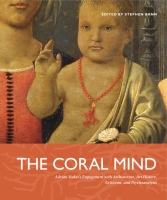




The Coral Mind
Adrian Stokes's Engagement with Architecture, Art History, Criticism, and Psychoanalysis
Edited by Stephen Bann
The Coral Mind
Adrian Stokes's Engagement with Architecture, Art History, Criticism, and Psychoanalysis
Edited by Stephen Bann
“To the outside world, scholarly activity must often seem exceedingly tedious and of questionable purpose. To those who practice scholarly inquiry, even imperfectly, the prospect of a single mind grasping and engaging its subject with focused intellect can be thrilling. That fascination may explain the revived appreciation of Stokes’s writings as records of his intellectual grappling with meaning in art, critical apprehension, and the creative psyche. The Coral Mind is the latest addition to this published appreciation, a collection of 12 intriguing essays on various aspects of Stokes’s critical inquiry. Guided by honest questions about why and how one reads Stokes today, the essay authors approach the reflections put forth by Stokes from differing perspectives that reveal the complexity of his observations. Stokes’s methods of inquiry do not consistently follow the prevailing theoretical approaches of 20th-century art historical scholarship of iconography, social history, or psychoanalysis, but they converge with all these methodologies in his uniquely subjective response to the space, place, and surface of the art object. Readers who enjoy questioning their own intellectual processes in encounters with created forms will appreciate the mind revealed in these essays. Summing Up: Recommended for graduate students and faculty/researchers.”
- Description
- Reviews
- Bio
- Table of Contents
- Sample Chapters
- Subjects
The essays in The Coral Mind make Stokes required reading for anyone with a serious interest in British modernism; psychoanalysis and art; alternatives to Clement Greenberg’s account of modernism; the relevance of architecture, sculpture, and ballet to our understanding of twentieth-century art; “writerly” art criticism; and the concept of “research” in art history.
Contributors include David Carrier, Martin Golding, Michael Ann Holly, David Hulks, Étienne Jollet, Stephen Kite, Peter Leech, Alex Potts, Richard Read, Janet Sayers, Lyndsey Stonebridge, and Paul Tucker.
“To the outside world, scholarly activity must often seem exceedingly tedious and of questionable purpose. To those who practice scholarly inquiry, even imperfectly, the prospect of a single mind grasping and engaging its subject with focused intellect can be thrilling. That fascination may explain the revived appreciation of Stokes’s writings as records of his intellectual grappling with meaning in art, critical apprehension, and the creative psyche. The Coral Mind is the latest addition to this published appreciation, a collection of 12 intriguing essays on various aspects of Stokes’s critical inquiry. Guided by honest questions about why and how one reads Stokes today, the essay authors approach the reflections put forth by Stokes from differing perspectives that reveal the complexity of his observations. Stokes’s methods of inquiry do not consistently follow the prevailing theoretical approaches of 20th-century art historical scholarship of iconography, social history, or psychoanalysis, but they converge with all these methodologies in his uniquely subjective response to the space, place, and surface of the art object. Readers who enjoy questioning their own intellectual processes in encounters with created forms will appreciate the mind revealed in these essays. Summing Up: Recommended for graduate students and faculty/researchers.”
Stephen Bann is Professor of Art History at the University of Bristol and was President of the Comité International d'Histoire de l'Art from 2000 to 2004. His books include Ways Around Modernism (2007), Parallel Lines: Printmakers, Painters, and Photographers in 19th-Century France (2001), Paul Delaroche: History Painted (1997), and The True Vine: On Visual Representation and the Western Tradition (1989).
Contents
List of Illustrations
Bibliographical Note
Introduction
Stephen Bann
1. Stokes and the Architectural Basis of the Sculptural
Alex Potts
2. “A Deep and Necessary Commerce”: Venice and the “Architecture of Colour-Form”
Stephen Kite
3. “The House of the Mind”: On Piero, Perspective, and Psychoanalysis
Peter Leech
4. “We Are Exalted”: Adrian Stokes’s Coming to Terms with Michelangelo’s Massiveness
David Hulks
5. Stokes’s Analysis
Richard Read
6. Portrait of an Analyst: Adrian Stokes and Melanie Klein
Lyndsey Stonebridge
7. Healing Art—Healing Stokes
Janet Sayers
8. “Showing Openly the Inside of Action”: Place, Ballet, Psychoanalysis
Martin Golding
9. The Art Historian as Art Critic: In Praise of Adrian Stokes
David Carrier
10. “Inferential Muscle” and the Work of Criticism: Michael Baxandall on Adrian Stokes and Art-Critical Language
Paul Tucker
11. To Bring the Distant Things Near: Distance in Relation to the Work of Art in Stokes’s Thought
Étienne Jollet
12. Stones of Solace
Michael Ann Holly
Index
Introduction
Stephen Bann
“Ceaseless seas of experience construct the coral mind.”
—Adrian Stokes, Smooth and Rough (1951)
On the inside flaps of the dust jacket of The Quattro Cento (1932), the publisher alerts the prospective reader to the novelty and ambition of the enclosed study while nevertheless promising a work that satisfies current expectations of a survey of Renaissance art. Stokes’s book is presented as “a work on the art of the fifteenth century in Italy” that is “not so much critical as creative, the author exploiting the device of fantasy to uncover the roots of Italian creative power.” The book attempts to isolate “a humanism which is found expressed in art embodying a special attitude to material, particularly to stone.” It acknowledges the labors of art historians in the “last twenty years or so” and in so doing “embod[ies] the fruits of the latest corrective researches.” Indeed, it promises to break new ground for the “English educated public” by bringing to their notice evidence of such recent scholarship on early Renaissance sculpture and architecture, which has up to now been published exclusively by “continental critics.” However, The Quattro Cento’s account will not be primarily historical. “The author writes his book with his eye on the present.” Thus far, only “Part One: Florence and Verona” is being put before the reader. But the prospect of a more ambitious project that contrasts “the final art-values of Southern climate” with those of “East and North” is imminent. “The outcome, then, of the complete work will be the presentation of a new aesthetic gained from analysis of a little known art in a well known period.”
Did Stokes himself maybe pen this unusually perceptive summary of The Quattro Cento? At any rate, over seventy years later, this ephemeral message remains a valid, if paradoxical, starting point for a collection of essays that discusses Stokes’s significance at the present. The year 2002, the centenary of his birth, marked a high tide in the gradual swell of publications testifying to the continued importance of his legacy. Anticipated by his appearance in David Carrier’s anthology, England and Its Aesthetes (1997), and by the reissue of Michelangelo, with a new preface by Richard Wollheim, in 2001, the dividends of the centenary year included the republication, in a facsimile edition, of The Quattro Cento and its successor, Stones of Rimini (1934), and the appearance of Richard Read’s meticulous and challenging biographical study covering the first half of his life, Art and Its Discontents. It also provided the occasion for the group of twelve scholars writing here to make their own assessments of the reasons why Stokes’s work remains important at the present time. These scholars range from stalwart exponents of Stokes who in their studies have already enhanced his reputation to some who have only rarely, or indirectly, discussed his work before. They represent a spectrum of ages, including two scholars who have recently produced doctoral theses on different aspects of his achievement. But whether they endorse the critical, the historical, or indeed the therapeutic value of Stokes’s “new aesthetic” as it touches the task of interpreting art today, all are agreed on the desirability of returning to his insights.
So we still read Stokes today. But how and why do we read him? The puff from the dust jacket of 1932 indicates at least one area in which he can no longer make a strong claim on our attention. The gap between English (or should one say Anglo-American) and Continental scholarship vis-à-vis the early Renaissance no longer exists to the same degree. Insofar as he was an art historian, Stokes offered historical accounts that were liable to revision in the light of the growing pace of professional research. In this respect, he is no different from any other historian. Though it is argued in this volume that his work after the Second World War was informed by his dialogue with the most respected academic historians working in Britain at the time, it is obvious that he would never have claimed (and could not have been made to assume) a place alongside Gombrich and Panofsky. On the other hand, the final paragraph from the 1932 jacket makes a controversial assertion that could certainly be defended today: “No writer since Pater with a serious mind and with a fund of original poetry has found in [the new aesthetic derived from the Renaissance] a subject for his interpretative genius.” On this particular judgment, which ingeniously associates the concepts of “poetry” and “interpretation” while underlining the relevance of Pater’s legacy to Stokes as a serious-minded member of the “younger generation,” we could still find occasion to linger, as we plot Stokes’s location on the map of our contemporary concerns.
Yet such a mention of “poetry” does not mean that we have to restart the long-running debate that revolved for many years around the relationship, and apparent mutual influence, between Stokes and Ezra Pound. It is one of the merits of Read’s biography that he convincingly historicizes the issue of Stokes’s close contact with Pound in the early 1930s and this contact’s major role in the evolution of Stokes’s own reputation during the postwar period. Having prepared the way by publishing the surprising exchange of letters between these two enthusiasts for Sigismondo Malatesta and his Tempio, Read was able to indicate how Donald Davie’s revaluation of Pound incidentally distorted Stokes’s role, all the more so as Davie frankly expressed his distaste for the more overtly psychoanalytic cast of the postwar writings. This issue can now, I hope, be viewed as water under the bridge. All of the contributors to this collection, at least, are united in placing the focus well away from the Pound connection, though the link to Pater and his predecessor/antagonist Ruskin still provides a range of themes for investigation that is far from exhausted.
In fact, one of the main points common to all the essays collected here is that Stokes’s career needs to be seen as a whole, with the later, postwar writings being shown to have an integral connection to those published in the 1930s. This is in no way to depreciate the significance of such books as The Quattro Cento and Stones of Rimini. The introductions provided by David Carrier and Stephen Kite for the new reissue demonstrate how fresh these texts remain and how undiminished is their power to excite new readings. But they are also now seen as part of an overarching development, rather than as peaks of a precocious critical career that later declined. David Hulks in fact explicitly prefigures his view of Stokes’s work in terms of an arc and looks at Michelangelo (1955), in particular, as the point of return where the earlier polarity of “carving” and “modeling” is both displaced from its Quattrocento source and extended to a further stage of synthesis. Other contributors direct their focus onto later publications like Venice (1945), Art and Science (1949), Smooth and Rough (1951), “The Impact of Architecture” (1961), and Reflections on the Nude (1967). Martin Golding devotes the greater part of his discussion to a text that was published in the same year as Stones of Rimini: Tonight the Ballet (1934). But in this particular essay, the relatively unstudied writings on dance are used to characterize the overall cast of Stokes’s thinking about place and the mind. It will also become evident to the reader that several other contributors featured here have profited from the close investigation of little-known writings and so far unpublished texts by Stokes, many of them held in the collection of his papers in the Tate Gallery archive. Material derived from letters, notebooks, and manuscript drafts has contributed substantially to the interpretation of the major published works.
This having been said, the twelve essays published here divide into three main groups, in which central aspects of Stokes’s achievement are singled out for attention. I asked the rhetorical question: how and why do we read Stokes today? One of the first reasons that comes to mind is that his writings invoke the long tradition of comparison between the arts—deriving from the Renaissance genre of paragone—which seems more relevant than ever when revising the still prevalent assumptions of modernist criticism. Alex Potts goes right to the heart of the matter when he explains that, for a critic such as Clement Greenberg, painting is taken to be “representative of art in general.” Yet this bias neglects the fundamental categories of the sculptural and the architectural that need to be taken into account in any survey of the plastic arts over the past century. Stokes had, it is true, an original and in many respects pessimistic view of contemporary architecture. He held that its essential values had migrated to the small-scale, still handcrafted medium of sculpture, with bas-relief possessing special significance as the domain in which “carving” features could be appreciated through their connection with the plane surface. This focus also engendered a renewed emphasis on the quality that, in Stokes’s view, had made the architecture of his “Quattro Cento” so noteworthy. It was an architecture not of space but of walls, more precisely of “surfaces that are pierced by apertures with entry to a womb-like cave.” Potts puts forward the convincing claim that this means of recuperating the architectural dimension not only is of historical interest but helps us to understand the current potency of minimalist work by sculptors like Donald Judd and Richard Serra. Their phenomenological effect can be appreciated and analyzed with reference to Stokes’s “wall aesthetic.”
The three other essays within this initial grouping also investigate the different ways in which Stokes’s emphasis on the theory and practice of Renaissance art and architecture impinges on his critical approach to the manifestations of contemporary art. Stephen Kite selects the midperiod texts Colour and Form (1937) and Venice (1945), drawing our attention to the special role of architecture in creating the color values that Stokes cherished. In the earlier of the two works, Stokes had reviewed the history of color theory, rejecting the “muddled radiance” that he detected as the keynote of modernist theorists like Kandinsky but fully acknowledging the unparalleled “visual imagination” displayed in Goethe’s Farbenlehre. In the moving homage to Venice, completed during the last stages of the Second World War, he then proceeded to consider the entire cityscape as a panorama of light and dark, out of which contrasting color values emerged. Kite is well aware that, in this work, Stokes is still settling his accounts with the flagrant partisanship of Ruskin, who developed the fantasy of a medieval Venice largely composed of brick in order to ward off the vision of a Renaissance city rejoicing in its surfaces of white stone.
Stones of Rimini had originally enabled Stokes to advance his case against Ruskin by singling out the little-known Florentine sculptor Agostino di Duccio as a promoter of “carving,” as opposed to “modeling,” values. Peter Leech and David Hulks examine the ways in which the postwar Stokes strengthened his arguments for the primacy of Renaissance art by turning to two of its most universally celebrated exponents. Hulks makes the valuable point that Stokes’s Michelangelo benefited from the advice of Gombrich and from his scholarly acquaintance with the iconological method of Panofsky. Stokes was thus immersed in a milieu of art-historical discourse that was distinctly richer than that of the early 1930s, and his own writings acknowledged this debt. However, in Hulks’s view, his distinctive contribution lay in the skill with which he indicated a “third way,” equally distinct from the approach of the “extreme Neoplatonists, carried away with the science of iconology,” and that of their opponents, the “iconological skeptics, or extreme formalists.” If this argument helps in showing how Stokes’s critical acumen could be used to defend a subtle art-historical case, it is also illuminating in placing his Michelangelo in a convincing relationship to the work of the early 1930s. For Stokes, Michelangelo as an artist had indeed come to embody a “third way,” in which the modeling approach was no longer inconsistent with a parallel attention to the disciplines of carving.
Peter Leech, by contrast, looks at Stokes’s late treatment of the painter who always impressed him as emblematic of the carving approach: Piero della Francesca. In this case, the focus on an artist infinitely more important than Agostino di Duccio did not present the same order of difficulty that he encountered when adjudicating Michelangelo’s debt to Neoplatonism. The sources that he used for the study of Piero were the much more traditional writings by English-speaking scholars like Bernard Berenson and Kenneth Clark. Yet Leech makes a strong case for regarding Art and Science—the work in which Stokes most fully engages with Piero’s achievement—as having a “central” position in the sequence of his writings. It belongs there because it stands between the major works of the first period (all of them published by Faber & Faber) and the series that appeared with the psychoanalytically specialized Tavistock Press, which began with Michelangelo in 1955. Art and Science is one of a group of three—the overtly autobiographical Inside Out (1947) and the architectural meditation Smooth and Rough (1951) being the others—that Leech credits with achieving a specially “intimate” character. But Art and Science stands out because of its sustained engagement with a major artist and theorist. Having dramatized the theme of the carver’s love for the stone in Stones of Rimini (with reference to an artist of which precious little is known), Stokes here attempts to counter the loose references to Piero’s lack of feeling with a celebration of the painter’s “love of perspective.” This claim may at first appear counterintuitive in the light of so many comments on Piero’s “frozen” forms. Yet in putting it forward, Stokes is anticipating a psychological discovery that will be finally concretized only when he writes, quite explicitly, from a psychoanalytic viewpoint.
That Leech moves directly from Piero’s paintings to the essay “On Resignation” is yet another indication of the fact that psychoanalysis is at the core of Stokes’s critical and humanistic project. If at one time it seemed plausible to make a formal distinction between the earlier “poetic” criticism and the later writings supposedly contaminated by an alien vocabulary, this division can hardly stand up to examination today. In effect, while more and more of the biographical details of Stokes’s life have been placed in the public domain, this has in no way exhausted the interest of his prolonged engagement with psychoanalysis, both as a patient and as an exponent of the method. It should still be acknowledged that he was the first critic outside the profession to nail his colors to the mast with such conviction. His posthumously published book of papers, A Game That Must Be Lost (1973), remains undiminished in its acute reappraisal of the areas of contemporary culture that Freud, in his remarkable inclusiveness, had begun to open up. Richard Read here questions whether anyone has yet “risen to [the book’s] challenge.”
The challenge applies in almost the same degree to those who choose to write about such a difficult subject in connection with Stokes’s personal life. In the four essays that broadly undertake to do so, the very diversity of approaches signals the impossibility of reaching any definitive answers. Admittedly Read, with his unrivaled knowledge of the details of Stokes’s life, perhaps comes close to doing so. He takes a fresh look at the circumstances not only of the analysis with Melanie Klein, which dated from 1929 to 1936, but also of Stokes’s dealings with important contacts such as the American art historian Meyer Schapiro, himself among the first to apply psychoanalytic interpretation to art in a transatlantic context. It is perhaps apt that this fascinating contribution should be framed by psychoanalytically flavored comments touching on the fantasies of Read himself, as biographer, and the personal investment of Lawrence Gowing, who so efficiently brought the majority of the writings on art and architecture to public attention when he edited the Critical Writings of 1978. Lyndsey Stonebridge’s essay then vividly explores the necessarily open-ended process whereby the transference between patient and analyst is repeated, not to say mimicked, in relationships that extend beyond the consulting room. Her extraordinary account of Stokes’s commissioning of a portrait of Melanie Klein from William Coldstream, and its subsequent destruction on the express orders of the sitter, highlights the unfinished nature of the analytic relationship between the two. Incidentally it also suggests how Stokes came to acquire the painting by Coldstream that might well have initiated his late Reflections on the Nude (1967).
Janet Sayers and Martin Golding strike a rather different note in foregrounding the healing role of psychoanalysis. They suggest that the therapeutic claims to which Stokes was sympathetic are indeed embodied in the experience of the arts that he so memorably described. Sayers divides her essay into “pre-Klein” and “post-Klein.” But this is not in order to imply that the analysis marked a watershed in Stokes’s writing, for good or for ill. She maps out the successive phases of Stokes’s career against the broad development of his psychoanalytic concerns—one might almost say their maturation—which was taking place in parallel. Stokes’s own dissatisfaction with Freud’s early attempt retrospectively to psychoanalyze great artists of the past was of course made amply clear in his prefatory remarks to Michelangelo. For Sayers, it is important to notice the growing preoccupation of psychoanalysts known to Stokes, like Marion Milner and W. R. Bion, with the issues of form and formlessness as exemplified in the visual arts.
Golding, on the other hand, tracks the specific theme of interchange between the “outer” and the “inner” through a sequence of quotations that are attached to Stokes’s sensitive response to place. The experience of the Mediterranean world on his first visit to Italy, in 1921, recounted in Inside Out (1947), presents him with “an open and naked world,” with no thought of “fear for the hidden, for what might be hidden inside me.” This perception is then re-created in numerous other ways that involve exaltation of the ordinary, as when “the barrel-organ . . . allows the street to compose itself,” or the ballet betrays its origins in “a heightened and ideal sense of the walk.” By citing such instances of inspired writing, Golding’s essay succeeds in illuminating Stokes’s “internal journey,” which was indeed the journey of psychoanalysis. The Italian city might serve as an emblem “to bring the distant things near.” The quoted phrase itself, however, would at the same time poetically express the subject’s desire to “find a nurturing setting in which it may be integrated without anxiety.”
“To bring the distant things near” also appears as the main motif of Étienne Jollet’s contribution. But in order to appreciate the very different context in which he interprets this phrase, it is important to define the general issue that is addressed in the last group of four essays. I began by asking how and why we read Stokes today. Up to a point, the arguments summarized so far have tended to address the second question rather than the first. The general assessment would be that Stokes’s work is valuable both as criticism that adheres to a long “writerly” tradition and as criticism that questions and revises some of the prevalent emphases of art history. It is also intimately engaged with the therapeutic goals of psychoanalysis, though in that respect it matters that the follower of Stokes should be wary of the perils of transference so that the healing project can be successfully carried out. But the “how” question invites quite another level of consideration. If—to take Sayers’s point—the writing of Stokes is disruptive and difficult in the way that Picasso is, or if—to paraphrase Golding—the narrative of psychoanalysis can be compared with the complexity of a modernist novel, then what special techniques will enable us to understand this “difficulty” or “complexity” as it is instantiated in the writing of Stokes? And what is the institutional frame that we have to place around such writing to account for the fact that, after all, it is not the art of painting or the art of fiction with which we are dealing, but a form of critical discourse about works of art?
These are some of the issues the last four essays address, each in its own way. David Carrier, whose sensitive analysis of the varieties of “artwriting” has already made its mark in a number of publications, begins with the unequivocal assertion that Stokes is important. He is, along with Hazlitt, Ruskin, and Pater, “one of the few transcendentally great art writers.” But (as Carrier recognizes) this judgment begs a number of questions, since we cannot simply categorize him (any more than the trinity of nineteenth-century English art critics) as “creative.” Because reference to works of art is central to his work, we must develop some means of assessing the character and adequacy of that reference. Ranging over a number of quotations taken from different works by Stokes, Carrier creates his own implicit scheme of evaluation through the terms with which he describes the various textual effects. Terms like “astonishing,” “jump cut,” “wild verbal play,” and “imaginative comparisons” indicate a disjunctive strategy, opposed to “clichéd prose” and conventional narrative, that is reminiscent of the process of “making strange” advocated by the Russian formalists. But, as Carrier justly remarks, this does not mean that Stokes’s evocations are interchangeable with a purely fictional commentary on an imaginary work, like Proust’s description of an Elstir seascape. Inevitably, because of their insistent topographical reference, they pose the question of how such a piece of fine writing about art squares up to the less ambitious and often “clichéd” prose of the art historian.
Carrier treats this issue in part as a question of language games. Stokes may appear to rule himself out of the columns of the Burlington Magazine because he writes quite differently from the conventional art historian. But if we make believe that his “poetic” prose was the genuine product of a poet contemporary with Agostino di Duccio, we can appreciate how it might also ultimately have been published in an art-historical magazine under a documentary pretext, figuring as “a fifteenth-century perspective on the sculpture.” In other words, that which disqualifies Stokes’s writing from the Burlington is not precisely its “poetic” character as such but the hierarchization of types of discourse that is the determining protocol of modern historical writing. History does not necessarily reject poetry, but only an already historicized poetry can be finally ground through the historical mill.
Paul Tucker views the language of Stokes’s criticism from a rather different angle. He takes as his point of departure a brief but telling reference to Stokes that occurs in Michael Baxandall’s essay “The Language of Art History.” The assumptions behind Baxandall’s essay indeed prove interesting in the context of the present collection insofar as it asserts the relevance of Stokes’s critical work to art historians. For Baxandall emphasizes the necessity of “art-critical demonstration” as an integral aspect of the art historian’s practice. As Tucker points out, he envisages critical characterization and historical explanation as going “hand in hand.” Moreover, Baxandall selects one of the most exemplary passages in Stokes’s early work to demonstrate this central point. Beginning with the passage from Stones of Rimini where Stokes compares stone reliefs by Donatello and Agostino di Duccio, he proceeds with two parallel distinctions in mind: in the first place, between the status of the artwork as a “physical object” and its status as “something more than a physical object,” that is, with a history of its own making and reception; and in the second place, between informative and ostensive comment. By carefully analyzing the use of language in Stokes’s passage according to these linked criteria, Baxandall claims to demonstrate (in Tucker’s words) “Stokes’s capacity as a critic to evade self-absorption through the precise evocation of the visual quality of individual artworks considered as products of human action.”
Tucker’s view of this analysis is that Baxandall does not pursue it far enough. While he refers to the inferences that the reader is invited to make, he does not direct sufficient attention to the overall “argument” that is being presented. He fails to bring out the point that a very great deal is at stake, for Stokes, in the distinction between “carving” and “modeling” that underlies this comparison between Agostino and Donatello. As Tucker puts it: “Stokes’s aim as a critic here is thus not simply to indicate ‘visual interest’ of the ‘inferential’ kind but to stage an evaluative contest between himself and ‘Donatello’ (the artist as presented in the text).” In order to demonstrate the point, Tucker reunites the short extract analyzed by Baxandall with the much more substantial paragraph to which it belongs. This enables us to see that what is missing from Baxandall’s edited version is “precisely the passage’s primary critical function, that evaluative ‘conviction’ which it expresses and urges on the reader through lexical ingenuity and textual command.”
From diagnosing this limitation in Baxandall’s analysis, Tucker moves on to an ambitious attempt to frame a more adequate model for the linguistic description of art criticism. He broadens the field by involving Sir Joshua Reynolds’s comments on Dutch painting while at the same time pursuing his intensive commentary on Stokes. His adverse judgment on the model of art-critical practice that Baxandall proposes with reference to Stones of Rimini is in no way attenuated as a result. He concludes that this model “significantly omits the critic as such: it fails at least to distinguish the critic from the beholder and therefore also to identify the beholder as the receiver of the critic’s words.” But Tucker fully concedes that this judgment does not apply to Baxandall’s more general account of the functions of criticism, or indeed to his actual practice as an art historian. He adduces Baxandall’s memorable account of Chardin’s Lady Taking Tea as an example of a “complex descriptive scenario” in which the operations of description and evaluation are intricately combined.
Tucker’s essay, supplemented by its illuminating diagrams, directs close attention to the interface between art criticism and art history. Where Carrier makes a plea for the relevance of Stokes to the present practice of criticism, Tucker leaves us in no doubt that historians of the present day ought not to disavow the issues raised by Stokes’s writing. In the last two essays presented here, this challenge to engage with the historical aspect of Stokes’s work is decisively addressed.
Can the same be said for the art historian? Both Étienne Jollet and Michael Ann Holly write as art historians, rather than critics, and thus as writers who are engaged precisely in the temporal gap between Stokes and the works that are appropriated through his discussions. Jollet in fact takes the question of “distance,” in its many possible meanings, as the clue to many of the features of Stokes’s procedure. His treatment of the question is triune: First, there is the basic question of presence—or “distance reduced to nothing”—which is also evoked in the all too familiar early-twentieth-century discussions on the “original” and the copy, like those of Paul Valéry and Walter Benjamin. Second, and by contrast, there is the question of the gaps that remain constitutive in the process of experiencing, and then writing about, works of art. These may be geographical, as in the case of the North/South divide that plays so important a part in Stokes’s work—especially in his publications concerning the Renaissance. But they are also temporal, since the very process of thinking about an artwork that has been seen presupposes a distance, quite apart from the process of making sense of the experience by putting it into words. Third, and most distinctively related to Stokes himself, there is the question of the special devices that Stokes as a writer puts into effect in his attempt “to bring the distant things near.”
By pluralizing the problem of distance in this expansive way, Jollet is able to seize upon many of the special features of Stokes’s writing, and so complement the analyses of Carrier and Tucker. It is significant, for example, that Stokes’s textual devices correspond to a great extent with some of the traditional features of classical rhetoric, such as cataphora (the announcement of what is to come in the text) and hypotyposis (the placement of the thing described under the eyes of the reader). Analogously, Stokes “uses the various distinctive features of the travel guide,” not because Baedeker forms a “literary” influence on him, but because the assumption that author and audience are together in the presence of the work of art serves him as a helpful discursive protocol. It is in this connection that we can appreciate the role of what Stokes describes as our “first visit” to the Tempio. Nevertheless, as Jollet points out, we still know too little about the “role played by Adrian Stokes in the preparation of his books.” His use of photographic illustrations, and his occasional decision to abstain from using them, are both integrally related to such basic issues of distance and propinquity—to the absence and presence of the referent.
If it makes sense to look at all these elements of visual rhetoric as aspects of Stokes’s overall design, this is surely because of the unusual intensity with which he succeeded in concretizing his thinking within the terms of this dialectic of near and far. The title chosen for this collection is one further instance of how he made his thought concrete by the use of metaphor. In the phrase “the coral mind” the age-long accumulation of human knowledge and experience assumes vivid presence in the image of a marine accretion that is also valued as a precious stone. But equally the book that supplies the quote, Smooth and Rough, can be regarded as a material precipitate of experience, as it exists between its coral pink textured covers, with its green and orange dust jacket and its paired photographic illustrations on coated paper (quite different in their visual effect from the collotypes used in Stokes’s prewar editions). In such an example, the book as a physical object also serves metonymically as a displacement of thought and synecdochically as thought’s intensification.
Michael Ann Holly is also chiefly concerned, in her essay, with the issue of the “distance between the work and the apprehending subject.” The contemporary context in which she places Stokes is not so much that of Valéry and Benjamin as that of Warburg, Braudel, and Heidegger. The gap can thus be conceived in metaphysical terms, though certainly not exclusively in terms of replication and the loss of aura, since it is actually the psychological content of the experience of distance that is at stake. Holly considers the difference between Heidegger and Stokes in terms of the philosopher’s concern with the primal “origin” of the artwork, while the art historian and critic suffers from “the pangs of melancholy” precisely because of his being “dedicated to [its] restitution.” But Holly is reluctant to reduce this difference to Freud’s distinction between mourning and melancholia, where the first condition signifies the consciousness (and overcoming) of loss, and the latter merely its repetition in a pathological form. Stokes did indeed believe (as he attests in the letter that comes at the outset of Read’s essay) in the endless process of psychoanalysis. But the talking cure is not by that token ineffectual. Although Holly underlines the paradox that art history “writes about loss without lost objects,” she concedes at the same time that Stokes’s “prose papers over that loss as it works at summoning the felt world of the past.”
This emphasis on the psychological experience of loss, rather than the linguistic function of the texts as such or their reification in the form of books, points inevitably to a further aspect of the play between distance and propinquity. What drives the “coral mind”? What is the process by which experience is encountered, gathered, and ultimately sedimented? For the art historian, this process has come to be called “research.” And Holly herself asks the question: “What is research in art history now?” In answer, she introduces a fascinating analogy with the particular branch of the natural sciences that involves a surprising lesson about the limitations, and accumulated powers, of vision. “We can never forget that an individual work of art and the historical constellation of which it is a part, like light radiating from a distant galaxy, have come from a time and a place that still resonate, and what is past is not necessarily so.” Whether we see him as critic or historian, the master or the victim of loss, Stokes has succeeded in attuning us to such a powerful resonance.
Also of Interest

Mailing List
Subscribe to our mailing list and be notified about new titles, journals and catalogs.