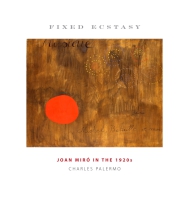




Fixed Ecstasy
Joan Miró in the 1920s
Charles Palermo
“These beautiful and elegantly complex volumes reconsider major figures in the development of 20th-century modernism. . . . While these volumes, like others in the series, may seem geared for the specialist, their value lies in their willingness to question, to use new evidence and new methods of addressing art history, and to forge new connections between disciplines. Patient readers will find these books can enliven and deepen their examination of art.”
- Media
- Description
- Reviews
- Bio
- Table of Contents
- Sample Chapters
- Subjects
Publication of this book has been aided by a grant from the Millard Meiss Publication Fund of the College Art Association
Palermo’s arguments are based on new research into Miró’s relations with the rue Blomet group of writers and artists, as well as on close readings of the techniques and formal structures of Miró’s early drawings and paintings. Chapter by chapter, Palermo unfolds a narrative that makes a cogent argument for freeing Miró from long-standing dependence on Surrealism, with its strong emphasis on dreams and the unconscious. Miró, along with associates such as Georges Bataille, Carl Einstein, and Michel Leiris, pressed representation to its limit at the verge of an ecstatic identification with the world.
“These beautiful and elegantly complex volumes reconsider major figures in the development of 20th-century modernism. . . . While these volumes, like others in the series, may seem geared for the specialist, their value lies in their willingness to question, to use new evidence and new methods of addressing art history, and to forge new connections between disciplines. Patient readers will find these books can enliven and deepen their examination of art.”
“To complete his extremely thorough examination, Palermo regularly compares his conclusions with ideas put forth by other scholars in recent Miró scholarship, often quoting extensively from their writings, and thereby offering a glimpse of the entire spectrum of current views on Miró.”
“Palermo’s study not only breaks new ground by reevaluating Miró’s relationship to Surrealism, but also elucidates the stakes of the artist’s commitment to automatism. . . .
The volume . . . constitutes a major contribution to the field.”
Charles Palermo is Assistant Professor of Art and Art History at the College of William and Mary. He has published articles in such periodicals as October, MLN, and The Art Bulletin.
Contents
Illustrations
Introduction: Silence in Painting
1. Calligraphy: Vine and Sundial
2. Extension: Toys and Rainbows
3. Stroke: Medium and Compass
4. Entering Painting’s Thickness: Translucence and Turning
5. Suicide: Leiris and Siriel
Conclusion: Miró in Silence
Works Cited
Index
Introduction
Silence in Painting
In 1920, Joan Miró paid his first visit to Paris. At the time of that visit, he was painting in his “detailist” mode—painting pictures that (as I will explain further) emphasize small details. Within four years, his “detailism” gave way to what may be called his mature style. By considering what changed and what remained the same in Miró’s painting during that period, I hope to provide some insight into the sensibility that animates the great works he then produced. I believe that understanding that sensibility will, in turn, offer new approaches to the study of Miró’s colleagues—the generation of young artists and writers between cubism and surrealism.
On visits to Paris in the course of those crucial years, Miró worked and (usually) lived at 45, rue Blomet. There he was part of an intense artistic fraternity centered on the studio of his neighbor, the painter André Masson. Michel Leiris, later best known for his autobiographical and ethnographic writings, was a frequent visitor, as were Roland Tual and the writers Armand Salacrou and Georges Limbour. In 1922, the rue Blomet group began to forge various links with the circle of Daniel-Henry Kahnweiler and Juan Gris and then, starting in late 1924, it attached itself to the surrealist movement.
Despite the common belief that the surrealists exerted a formative influence on Miró, the present work does not discuss Miró’s connection with the central surrealist movement for two principal reasons: first, Miró appears never to have been as enthusiastically connected to the surrealist movement as were some of his contemporaries and, second, his transformation from detailist and experimenter in avant-garde styles to author of mature works, such as Catalan Landscape (The Hunter) (1923–24; Museum of Modern Art [fig. 17]), took place during 1923 and much of 1924, before he met Breton and before he had come to know the surrealists except through what he read and through the surrealists’ very limited contacts with the rue Blomet. I think Miró’s later interest in and success among the surrealists should be seen as a result of the pertinence of their emerging concerns to his own prior interests rather than as owing to their formative influence on him. (Much the same appears to be true of Leiris.)
In contrast to the surrealists, the Kahnweiler circle appears to have had a great impact on the rue Blomet early on. Kahnweiler become Masson’s dealer in 1922, and Leiris met Kahnweiler at around the same time. Leiris visited Kahnweiler and his wife Lucie frequently (he became a fixture at the couple’s popular Sunday gatherings) and married Lucie Kahnweiler’s daughter, Louise (known as Zette), in early 1926. In the early years of their marriage, the Leirises lived in the Kahnweilers’s house in Boulogne and the four remained very close throughout their lives.
I argue that Miró’s early mature style at once continued to engage central concerns of his detailist works and began to explore new modes of representation indigenous to the rue Blomet. From about 1918 until the end of the period I consider (around ten years later), Miró repeatedly allegorized his own activity—that is to say, he projected his work as an artist into the fictional space of his paintings. Agents in his pictures carry out aspects of his own work as a painter, transformed into analogous actions in the fictional world of the picture—for example, Miró drawing a line becomes a blade of grass or a cast shadow slowly extending itself. He also found tokens (surrogates or fragments) that could replace his sitters or motifs (a doll for a woman, a tuft of grass for a distant farmyard) and that thereby preserved the sitter’s or motif’s presence while marking its absence. Further, he constructed frontal spaces or motifs in his works (by compressing depth, by selecting frontal motifs, by representing sitters facing directly out of the picture), which he paired with openings onto deep spaces, folding surfaces, or turning figures that oppose the frontality of his works. These recurrent features helped Miró produce pictures that evoke for the beholder a sense of one’s continuity with, as well as separation from, the fictional world of the painting. By painting such pictures, Miró can be seen to have responded to the limitations of the theories of representation articulated for cubism by the cubists’ first dealer, Daniel-Henry Kahnweiler, and by his friend, the critic, art historian, and novelist Carl Einstein.
Michel Leiris is a key resource for understanding Miró’s work. Leiris’s writings, both on art and on other topics, figure prominently in what I have to say. Leiris was not only insightful in addressing Miró’s works, but he also exhibited in his own writing an analogous inclination to represent the experience of the self at work. An examination of Leiris’s early writings helps make clear the role of the representation of time and space in both his and Miró’s work. Leiris’s writings also shed light on the relationship of those new modes of representation to issues elaborated in the contemporaneous critical work of Einstein. The similarity between Miró’s and Leiris’s work suggests something about the sensibility of the group at the rue Blomet and about why Miró found it possible there to break through to his artistic maturity.
Given that essays by both Leiris and Einstein from Documents are so important to my argument, the reader may wonder why the work of Georges Bataille doesn’t figure largely in it as well. As important a figure as Bataille was for Leiris and especially for Masson beginning in the later 1920s, he appears not to have met members of the rue Blomet group until late 1924 and not to have become particularly close to them for some time after that.5 Moreover, other than the appearance of his name in Miró’s 1927 “Musique—Seine—Michel, Bataille et moi” (Kunstsammlung Winterthur [fig. 40]), no evidence I know of indicates that he was ever close to Miró.6 Rosalind Krauss has argued that Miró’s interest in Bataille’s thought was greater than either the archival evidence or the retrospective triumph of Breton’s view of Miró would allow.7 Obviously, I share her belief that at least two core participants in Documents can help us understand Miró’s early maturity. I also join her in insisting that the standard account of Miró’s work is wrongly dominated by Breton’s surrealism. However, Miró certainly did not know Bataille until the end of the period I consider his breakthrough, and if Bataille exerted an influence on Miró later in the 1920s, it does not appear to me to have left any discernable mark on the themes I consider. (I have more to say in my conclusion about Krauss’s argument and about how Bataille’s work treats the issues I’ll be considering in Miró’s and Leiris’s work.)
One further point about my own approach to Miró: I’ve already mentioned that, by displacing the work of the artist into the fictional world of the picture, Miró was “allegorizing” his activity. This is a fundamental aspect of my account of Miró’s work. It is also a fundamental claim of my account of Leiris’s writing that he was doing something analogous. In calling this displacement in Miró’s and Leiris’s work allegory, I do not mean to invoke or rely on a special notion of allegory that has any particular precedent. The word suggested itself to me through my long, formative acquaintance with Michael Fried and his work. (I explain my debt to and my engagement with Fried’s work more fully in my conclusion.) Still, Paul de Man has used the term in ways that my argument has sometimes brought to mind, and I want to address briefly the correspondences between my argument and his.
In the introduction to his Allegories of Reading (“Semiology and Rhetoric”), de Man states what he takes to be a fundamental (if problematic) premise common to both the critical and the literary texts he considers: “By reading we get, as we say, inside a text that was first something alien to us and which we now make our own by an act of understanding. But this understanding becomes at once the representation of an extra-textual meaning.”8 Following from the premise, a question proposes itself: “Does the metaphor of reading really unite outer meaning with inner understanding, action with reflection, into one single totality?” (13) In the texts de Man goes on to discuss, the project of totalizing undoes itself. Instead of uniting outer meaning with inner understanding, the metaphorical language of literature repeatedly stages its own failure to do so.
But, de Man goes on to explain, this debunking of metaphor’s claims is not something he’s done to the text—something he’s proposed against it, so to speak. “The deconstruction is not something we have added to the text but it constituted the text in the first place” (17). We are just catching up with the text, reading the philosophical examination of language within poetic writing. Further, de Man argues: “The narrator who tells us about the impossibility of metaphor is himself, or itself, a metaphor, the metaphor of a grammatical syntagm whose meaning is the denial of metaphor stated, by antiphrasis, as its priority. And this subject-metaphor is, in its turn, open to [a] deconstruction to the second degree” (18–19). And here we arrive at the matter of allegory. Texts make visible in different ways this metaphorical quality of the “I” that speaks. (Even if a text is written in the third person, there is an “I” relative to that third-person narration, and it is that “I” who narrates, not the author.) Whether a text takes up, as a matter for discussion, the relation between the author and the “subject-metaphor” that serves as the “I” of the text (as does the second preface to Rousseau’s Julie, which de Man discusses in Allegories of Reading [“Allegory (Julie)”]) or insists that the subject-metaphor who speaks is the same person as the author (as one might take traditional autobiography to do), de Man’s point still holds: the story of the “I” is the story of a subject narrating.9 De Man calls the story of this “I” allegory (205).
Thus “[t]he innumerable writings that dominate our lives are made intelligible by a preordained agreement as to their referential authority” (204) and the “I” that offers a text to the reader becomes “the metaphor for readability in general” (202)—that is, for the agreement that establishes and underwrites the text’s referential authority. The metaphor that supplies the “I” of a text is also, like the text’s other metaphors (those that “denominate”), open to deconstruction. And because “second-degree” deconstructions, as de Man names them, target readability in general, they show texts to be unreadable: a second-degree deconstruction shows that its text’s “referential authority” is never definitively established and that one therefore never knows with certainty how to take the text—as literal, figural, factual, fictional, ironic, etc. “Allegories are always allegories of metaphor and, as such, they are always allegories of the impossibility of reading” (205).
A step recurs in de Man’s readings, because it is central to his view of language—he makes the separation of the author from the “I” of the text into an allegory, so to speak, of the complete opacity that separates the outer (text, thing, world) from inner understanding. The break between author and text figures the epistemological problem of knowing (in the total, certain, inner way of epistemological rigor): “We write in order to forget our foreknowledge of the total opacity of words and things or, perhaps worse, because we do not know whether things have or do not have to be understood” (203). Whatever similarities may exist between my idea of allegory and de Man’s, we break on this point because I would argue that “total opacity” is the wrong way to characterize our relationship to words and things—or, at least, that “sever[ing] the writer from the intelligibility of his own text” is not “austere analytical rigor” (207) but a skepticism that has not recognized fully its own implications.10 The notion of an inner (understanding) and an outer (meaning)—the inside and outside of a text (or painting or author or painter)—that form the basis of the model de Man discusses separates the understanding self from its object misleadingly. Indeed, the separation between the author or reader and the (“I” of the) text can with rigor at least equal to de Man’s be thought of as reaching all the way into the author (leaving, one might say, no inside) and is, therefore, not properly speaking a separation between the author and the voice. (And of course, what we say here of writers counts equally for painters.) Rather, the separation between the author and the voice of the text can be thought of as an effect, one that Miró and Leiris both deploy and oppose to an effect of continuity between the painter and painting in Miró’s case and between the author and the text in Leiris’s.
Before I outline my argument, I want to review briefly the current state of scholarship on Miró’s work. Although the period and the developments I will discuss are pivotal, they are not adequately investigated in existing studies of Miró. In the past thirty years, only a few have advanced sustained arguments about his paintings of the 1920s. Jacques Dupin’s updated monograph, although it does not single out the paintings of the ’20s, offers a comprehensive and sensitive consideration of Miró’s life and achievement, including his first years in Paris.11 Although Dupin’s interpretations are generally more evocative than scholarly and often appeal to the imagination at least as strongly as to the spirit of academic rigor, I draw on several of his inspired readings of Miró’s work. Krauss’s and Margit Rowell’s essays for the Solomon R. Guggenheim Museum’s 1972 exhibition catalogue, Joan Miró: Magnetic Fields, remain among the best accounts available of Miró’s painting in the 1920s.12 But Krauss’s and Rowell’s essays cannot offer the last word on Miró’s early maturity, if only because they predate the publication of Miró’s notebooks.
In the 1970s, Miró revealed a cache of notebooks from the ’20s that he claimed to have forgotten and rediscovered. In 1976, Gaëton Picon published the find as Catalan Notebooks: Unpublished Drawings and Writings, and a number of subsequent scholarly works discuss the trove of sketches.13 These include, to name only three, Pere Gimferrer’s The Roots of Miró, a part of a chapter in David Lomas’s The Haunted Self: Surrealism, Psychoanalysis, Subjectivity, and Carolyn Lanchner’s “Peinture-Poésie, Its Logic and Logistics” in her catalogue for the Museum of Modern Art’s 1993 exhibition of Miró’s work.14
In order to understand the devastating effect of the notebooks on earlier Miró studies, consider what William Rubin had to say about The Birth of the World (1925; Museum of Modern Art [fig. 1]) in 1973. Rubin begins by citing Miró: “[R]ather than setting out to paint something, I begin painting and as I paint, the picture begins to assert itself, or suggest itself under my brush. The form becomes a sign for a woman or a bird as I work. . . . The first stage is free, unconscious. . . . [But] the second stage is carefully calculated.”15 With more help from Miró, Rubin explains the development of the painting:
After sizing the canvas, Miró rapidly laid down successive veils of transparent bister and black glazes. These were both poured and applied with the brush and, in some black areas, spread with a rag while still wet. Then a layer of ocher glaze was poured from the top, forming rivulets of greater density—hence opacity—here and there. Miró also dipped his brush in ocher and flicked it over the surface to create the “sprays” visible in particular in the lower part of the canvas. “One large patch of black in the upper left seemed to need to become bigger,” Miró recounts. “I enlarged it and went over it with opaque black paint. It became a triangle, to which I added a tail. It might be a bird.” The need for an accent of red to the right led Miró to make the carefully painted red disk with yellow streamer, which he later identified as a shooting star. These motifs and the nature of the ground, in turn, called forth the descending lines of blue on the upper right. The “personage” with a white head, whose right foot almost touches a spiderlike little black star, was the last motif to be introduced. (Miró in the Collection of the Museum of Modern Art, 33)
Although Rubin insists that Miró’s psychic automatism was far from pure and permitted plenty of deliberation, the idea that Miró conceived the composition’s figures while he painted is integral to Rubin’s account:
The marriage of method and metaphor in The Birth of the World is total, for the imagery recapitulates poetically the process of its own creation. Miró the painter begins with an empty canvas—the “void.” This is followed by a “chaos” of stains and spots. As he looks at these they suggest other forms to him; or he sees that they need to “grow” into another shape or color. The act of making the picture is thus literally the implementation of miromonde, with the painter in the place of God as the “intelligence” behind the new universe. (33)
But that is not how the picture came to be. Rather, Miró planned the picture in advance, in a notebook, a discovery that prompts Picon to describe The Birth of the World as “no more than a colored reproduction” (Catalan Notebooks, 71) of a drawing (fig. 2). Despite general agreement that psychic automatism (understood as passivity or spontaneity) has almost never been used in its purest form to produce art, Picon’s dismissive reevaluation of the painting confirms that the picture’s reputation as a milestone in the exploration of psychic automatism required that it be the product of a scene like the one Rubin narrated. Clearly, the textbook case of psychic automatism Rubin described was a fiction (and at least partly Miró’s fiction).
One might rescue the standard argument made about the paintings by arguing that Miró’s automatism “reside[s] not in the paintings themselves but in the drawings that preceded them” (Lomas, The Haunted Self, 18).16 There is reason for believing the drawings to be automatic: they sometimes follow the tracks left in notebook pages by earlier drawings. Miró clearly used such indentations to guide him in making new drawings and, to that extent anyway, apparently let the activity of drawing proceed mechanically and thus “in the absence of any control exercised by reason, and beyond any esthetic or moral preoccupation” (to borrow Breton’s famous words).17
Of course, following an indentation cannot really ensure any degree of spontaneity.18 No method guarantees spontaneity and no set of procedures can place automatic writing or painting beyond doubt. Further, one can trace an impression in paper quite deliberately and with any conceivable aesthetic or moral idea in mind. And yet we cannot abandon our inquiry into the role of automatic mark-making in Miró’s art. He insisted on the importance of automatism to his work and commentators have consistently felt the need, in describing the impact of his paintings, to elaborate a relationship between that automaticness and the look of the pictures. But one could be left comparing what simply looks automatic, so to speak, with what Miró claimed was automatic and with what we know about Miró’s working methods and thereby end up advancing increasingly circumspect guesses about the real place of psychic automatism in his enterprise. The rest of his practice would then become something separate and merely technical, in which the artist would turn the spontaneous drawing into a painting, a process presumably filled with aesthetic preoccupations and taste. What I offer instead is a notion of automatism that does not depend on suppressing conscious control, one that is more grounded in what we know about Miró’s and Leiris’s practices and in the developments in psychology that preceded surrealism than the species of automatism traditionally invoked by scholars writing after surrealism. In doing so, I hope to open up new ways of considering the relationship between what we know about how Miró made his paintings and what they mean—a set of questions only possible now, after the rediscovery of Miró’s notebooks.
Several recent works in Miró studies that bear on my argument deserve special discussion. Robert Lubar’s dissertation, “Miró Before The Farm, 1915-1922,” offers a well-researched and informative investigation of Miró’s cultural background in the years before his breakthrough. His approach (in his early studies of Miró) is very different from mine and articulates a view of Miró’s work that emphasizes its political connotations, discovering in it a series of gambits aimed at carving out a viable niche in a politically charged post–World War I Europe.19 I value (and have profited from) Lubar’s work, and I join Lubar in advancing his most basic claim—that Miró’s Catalan themes remain important in his work, or grow even more important, after he joins the (international) Parisian avant-garde. Yet I expect my argument will also make clear that I believe the task of accurately placing Miró’s achievement in its immediate historical context as well as in the broader context of the history of modern painting will require considering it differently. For example, here is how Lubar describes the significance of Horse, Pipe and Red Flower (1920; Philadelphia Museum of Art [fig. 3]):
By incorporating minutely-detailed objects associated with Catalan folk culture and peasant life in the still-lifes from the summer and autumn of 1920, Miró reinterpreted Cubist spatial constructions, creating a paradoxical and heterogeneous art. But herein lies the significance of his new work. Miró’s still lifes are modern (Cubism being the “pictorial code” for modernity) without suffering from pedantry, and traditional (in the way a descriptive realism and Miró’s use of emblems communicate his identification with Catalonia), without being retrograde. (“Miró Before The Farm, 1915–1922,” 193–94)
By characterizing Miró’s undertaking and success in terms of “codes,” Lubar, right as he may be about the place of those codes in Miró’s milieu and even in Miró’s deliberations, leaves Miró’s work on what I will shortly call (following Maurice Merleau-Ponty) an “empirical” plane.20 And I think it would be wrong to let that “empirical” sense of Miró’s painting obscure the “expressive” (Merleau-Ponty’s term again) one that both Lubar in his most recent work and I consider.
Another great contribution to the study of Miró in the 1920s is Anne Umland’s 1997 dissertation.21 Umland musters a huge store of information to support her account and, with Erika Mosier, catalogues a number of important but little-known works. Throughout this book, I refer often to Umland’s dissertation and related publications—usually in order to agree with her. Roughly, her claim is that, throughout most of the ’20s, Miró used collage-like effects in his work and, further, that he did so as a way to renew painting dialectically—assassinating painting by introducing nonpainting (collage) into it, all in the name of restoring painting to health. Thus Umland argues that collage, the strictest form of which Miró practiced only sporadically before 1928, underlies much of what he painted even before 1928, in the form of a “collage aesthetic.”
Umland defines collage at the outset: “Within the context of this thesis, any finished work (as opposed to preparatory drawings or other materials) produced by Miró in the 1920s with one or more independent elements attached to its primary support has been defined as a ‘collage’” (“Joan Miró and Collage in the 1920s,” 6–7). This definition is clearly an expedient aimed at establishing the scope of the term’s literal sense, not an attempt at defining the material essence of collage. That becomes clear when she goes on to describe painted and drawn works without “true” collage elements as collage on the grounds that Miró engages with the problems and potentials of collage, even when he’s painting or drawing. Umland discusses Miró’s “collage aesthetic” as unbounded by collage as she has defined it for her purposes:
The fact that Miró presents the viewer with multiple “systems” or choices is key to his “collage aesthetic” in 1924. This is evidenced not only in his “true” collages but in a series of drawings on small wood panels and on paper with which the collages are chronologically intertwined. . . . By mixing not only spatial indicators but different types of media and different forms of verbal and visual marks, by including both “handmade” and “ready-made” signs . . . and by confounding perceptions of figure and ground, Miró subverts the unity of the visual field. This suggests that the word “collage,” when applied to his work of late summer-fall 1924, be considered both in terms of Miró’s distinctive syntax or structure and as a practice within which the sensual, tangible particularities of material play a subtle albeit significant role. (26–27)
The distinctive features of Umland’s “collage aesthetic” (apart from the properties of “‘true’ collage”) turn out, then, to be a disunified pictorial space, writing or pictorial elements that imitate printed sources, and an attention to the physical properties of the materials that make up the picture (particularly the properties of the support). Thus Umland’s argument portrays collage as both a possibility within painting and an alternative to painting—or, to put it another way, as a procedure outside painting that Miró used against painting.
So, should that disunity, etc., count as ingredients in a specifically “collage aesthetic”? Or should they count as elements of Miró’s pictorial sensibility—elements he accepted for their own sake rather than for the sake of their places within collage even if they were perhaps suggested by his knowledge of it or synthetic Cubism—which then might be, or might come to be, associated with collage?
To put the question slightly differently, in a loose paraphrase of Louis Aragon: does Miró’s engagement with collage precede or does it follow from his desire for the effects Umland associates with it, such as the “independent, isolated character of [its] elements within the overall composition”?22 If Miró was principally interested in achieving a disunified pictorial space, then it is far from surprising that, aside from a handful of experiments, we have no record of an inclination toward collage before 1928. Nor is it surprising that he ended up, in 1928, turning to collage to help produce such spaces. And if it is the case that his interest in this kind of pictorial space preceded his interest in collage as a medium, what we must ask of a study like Umland’s is that, when it leaves “true” collage to discuss Miró’s practice in general (and especially before 1928), it not treat the features of Miró’s “collage aesthetic” as codes for “not painting” but rather delve deeper in search of an explanation for the effects it identifies.
And Umland’s study does delve deeper. In fact, Umland’s major point is that “Miró’s aim in 1924 was not simply ‘not painting’ (or, rather, to stop making works on canvas) but to somehow change the definition of the word by confounding categorical distinctions” (“Joan Miró and Collage in the 1920s,” 51–52), and she cites Leiris by way of explanation: “Miró’s friend Leiris commented in 1925 on the arbitrary nature of definitions, writing ‘Now, etymology is a perfectly ineffectual science that is not at all informative about the true meaning of a word, that is, the particular, personal signification that each individual ought to assign to it, as his mind pleases. As for usage, it is superfluous to say that that is the lowest criterion to which one could refer’” (52 n. 62, citing Michel Leiris).23 In “dissecting” his favorite words for the glossary he began writing in the mid-1920s, Leiris hoped to “discover their most hidden qualities and the secret ramifications that are propagated through the whole language, channeled by associations of sounds, forms, and ideas” (Brisées, 3–4). From “courage,” for example, Leiris extracts “nuage rouge de coups.”24
Miró may have sought to challenge the boundaries of what went by the name of painting, but if that is indeed what he meant to do in the disunified spaces of his first mature paintings, perhaps he did so (as an analogy with Leiris’s glossary would suggest) to find painting’s “secret ramifications” and to know painting through its “personal signification.” If I take this direction in Umland’s argument correctly, then, she is suggesting that Miró undertook to “assassinate” painting the way Leiris undertook to “dissect” his words.25 And I agree with that conclusion, even if I’ll go about making the point differently.
Maurice Merleau-Ponty, to whom I turn again more than once in what follows, raises an objection to a naive view of language that recalls Leiris’s opposition to the dictionary:
For the speaker no less than for the listener, language is definitely something other than a technique for ciphering or deciphering ready-made significations. Before there can be such ready-made significations, language must first make significations exist as guideposts by establishing them at the intersection of linguistic gestures as that which, by common consent, the gestures reveal. Our analyses of thought give us the impression that before it finds the words which express it, it is already a sort of ideal text that our sentences attempt to translate. But the author himself has no text to which he can compare his writing, and no language prior to language. His speech satisfies him only because it reaches an equilibrium whose conditions his speech itself defines, and attains a state of perfection which has no model.26
Like Leiris, Merleau-Ponty rejects the table-of-correspondences account of language. He then proposes that the meaning of an utterance cannot be separated from the utterance itself. The point should not be especially controversial. We generally recognize the provisionalness or the inadequacy of translations, paraphrases, and interpretations—at least we do for some texts and for certain purposes. There are other contexts in which language works much more like a code and in which a paraphrase is adequate. But, as Merleau-Ponty argues, language in general depends on and is characterized by the more expressive “creative” species and the “silence” that lies implicit in it (“Indirect Language,” especially 44–45).
What Merleau-Ponty calls the “silence” in expressive speech is the tacit presence of thought’s background, which is not spoken but left instead to be inferred or intuited by the listener if he or she is to hear what raises the speech above the level of the paraphrase. Hearing the real meaning of an utterance depends on listening for the contingency from which it has emerged, hearing it as a choice among imaginable alternatives not chosen. This silence opposes itself to the message encrypted in preestablished codes that comprise and exhaust language’s “empirical” use:
Expressive speech gropes around a significative intention which is not guided by any text, and which is precisely in the process of writing the text. If we want to do justice to expressive speech, we must evoke some of the other expressions which might have taken its place and were rejected, and we must feel the way in which they might have touched and shaken the chain of language in another manner and the extent to which this particular expression was really the only possible one if that signification was to come into the world. In short, we must consider speech before it is spoken, the background of silence which does not cease to surround it and without which it would say nothing. (46)
Leiris’s “Glossaire” advances similar premises about the connection between an utterance and the “chain of language,” although it might also seem to parody them. Leiris makes explicit a resonance for each word in his “Glossaire,” as if to transcribe not the word’s definition but its echo in the space of language. He makes a typical gloss reproduce resonance literally, by basing it on the sounds of the word and thus making the words of the gloss seem to coincide with and emerge from (or in) the experience of speaking, as if these words were “touched” or “shaken” loose by the act of pronouncing the word they elucidate. Leiris’s glosses demonstrate—one might, once again, even say they caricature—the way speaking sends vibrations through the whole of language, through words and meanings other than those ultimately spoken.27 That is, each of Leiris’s glosses stages an encounter with what Merleau-Ponty calls the silence in speech.
And Umland is right, I think, when she suggests that Miró’s painting, and perhaps his assassination of painting, aim to do something for his medium akin to that which Leiris’s glossary does for language. The vitality of Miró’s work during the years both Umland and I consider depends on the way he makes painting itself seem to reveal the intentionality that shakes the medium, to show the contingency from which his painting emerges—and precisely not to draw the beholder into the empirical language of codes. To say that Miró’s painting speaks the empirical language of “pictorial codes” can be right but to leave the matter there would be to deny what is most valuable in them. At best, it would be to fail to listen for the silence that animates them and, at worst, to dismiss Miró’s work as painting in an “empirical” mode, conceived on the order of preestablished correspondences and exhausted by them.
If I am not mistaken, there’s something of this accusation in Picon’s dismissal of The Birth of the World. By implying the painting was nothing but a colored-in rendition of a drawing, Picon suggests that he feels its meaning and its value lie wholly in its correspondence to the drawing. The spontaneity with which Miró was previously supposed to have painted—his automatism—served as a defense against this kind of indictment.
Part of what Merleau-Ponty considers typical of the experience of language is a kind of automatism—a state in which we move with the fluency and abandon of native speakers: “At the very moment language fills our mind up to the top without leaving the smallest place for thought not taken into its vibration, and exactly to the extent that we abandon ourselves to it, it passes beyond the ‘signs’ toward their meaning. And nothing separates us from that meaning any more. Language does not presuppose its table of correspondence; it unveils its secrets itself” (“Indirect Language,” 43).
That is to say, one’s ordinary, expressive use of language is automatic—it is outside deliberate control and “beyond any esthetic or moral preoccupation” (to borrow Breton’s phrase again) insofar as one gives oneself over to it in order to receive its secrets and to find in it the utterance toward which one’s intentionality draws one. Working from a sketchbook could seem like establishing a table of correspondences that determines the shape of the painted utterance and thereby forecloses the possibility of abandon. However, although Merleau-Ponty describes the state of mind of the speaker as fully occupied by the utterance, without reserve, he does not claim that spontaneity is the only way to secure the fullness of the engagement—as he puts it, “there is the improvisation of automatic writing and there is that of the Charterhouse of Parma” (“Indirect Language,” 52). One need not speak or write quickly to be so filled with language that one’s mind feels wholly taken into its vibration. If one feels oneself to emerge from inside one’s writing, to have been continuous with it, and thus recognizes it as something outside, as separate from oneself, the writing may then appear, manifest itself, by itself. And that effect—the effect of taking a double stance toward the written or painted object—may convey itself to the reader as well. One might say that automatism is how one obtains such a double relationship to a text or painting (or anything else).28 Perhaps, as I shall argue, painting automatically could likewise mean (for Miró) immersing oneself fully in the act of painting so as to assassinate painting.
Also of Interest
Mailing List
Subscribe to our mailing list and be notified about new titles, journals and catalogs.