


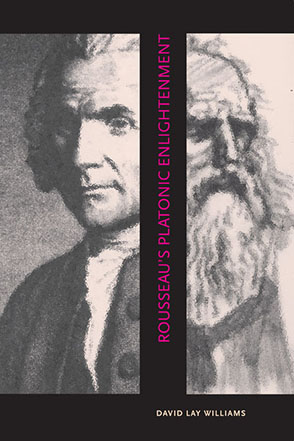
Rousseau's Platonic Enlightenment
David Lay Williams
“Rousseau is too often thought to have waved his hands at what successors like Kant and Freud would really grasp. Williams is to be congratulated for following Rousseau’s own lead to Plato, his greatest predecessor. Surprisingly, his Platonic Rousseau, though rooted in the past, proves a greater original and more important guide to our own time than the Rousseaus who gesture toward the future.”
- Description
- Reviews
- Bio
- Table of Contents
- Sample Chapters
- Subjects
The book is organized into three main parts. The first sketches the background of Platonism and materialist positivism in modern European metaphysics and political philosophy that provided the context for Rousseau’s intellectual development. The second examines Rousseau’s choice of Platonism over positivism and its consequences for his philosophy generally. The third addresses the legacy of Rousseau’s thought and its appropriation by Kant, Marx, and Foucault, suggesting that in an age where materialism and relativism are rife, Rousseau may have much to teach us about how we view our own society and can engage in constructive critique of it.
“Rousseau is too often thought to have waved his hands at what successors like Kant and Freud would really grasp. Williams is to be congratulated for following Rousseau’s own lead to Plato, his greatest predecessor. Surprisingly, his Platonic Rousseau, though rooted in the past, proves a greater original and more important guide to our own time than the Rousseaus who gesture toward the future.”
“David Williams has now brilliantly undertaken the first serious study of Rousseau’s Hellenophilia in seven decades. . . . Williams’s book will immediately become the ‘standard’ one, and will join the company of Shklar, Hendel, Starobinski, and Cassirer as a work that responsible Rousseau students need to know.”
“Williams offers a carefully researched and well-argued case for Rousseau as a latter-day Platonist. Readers who care about Rousseau and his role in the unfolding of modernity will want to read this book.”
“Williams makes an impressive and largely successful attempt to discuss Rousseau beyond the confines of any one discipline, and as a result this book will be of value to literary scholars, historians of ideas, and philosophers as well as political theorists.”
“In this sterling, deeply researched study, Williams (Univ. of Wisconsin, Stevens Point) explores how thinkers ranging from Hobbes to d’Holbach highlight various sets of ideas that Rousseau combated in developing his philosophical teaching. The account of Rousseau’s predecessors who might be called Platonists is especially interesting, as is the account of those who qualify as materialists. Moreover, Williams provides a good overview of Rousseau’s teaching, demonstrates a commendable grasp of the relevant secondary literature, and argues ably for the superiority of his own interpretations. . . . Clearly written and superbly organized, this book contributes much to Rousseau studies. An indispensable book for Rousseau scholars, this volume also will appeal to general readers and students at all levels.”
“David Lay Williams has provided us with a carefully researched and capably argued study of the influence of Platonism on the philosophy of Jean-Jacques Rousseau—the most thorough and systematic study to date. Yet this book is much more than just a study of Rousseau or his relationship to Plato and Platonism ... [its] broad approach allows Williams to demonstrate both Rousseau’s originality and the way in which he drew on previous thinkers and traditions … Rousseau’s Platonic Enlightenment is not only a significant contribution to Rousseau scholarship but also an immensely useful work for scholars and students of eighteenth-century thought and the history of political philosophy more generally.”
“There are many things to like about Rousseau’s Platonic Enlightenment: it is clearly organized, lucidly written, and crisply argued. Williams has read virtually everything Rousseau ever wrote, he knows the secondary literature inside-out, and he also knows a lot about the history of philosophy. The chapters on morality and the general will in Rousseau are both first rate, as is the chapter on Kant.”
“Williams's Platonic reading of Rousseau is refreshing, illuminating, and compelling. . . [His] accomplished book is a highly significant contribution to our understanding of a perennially beguiling political thinker.”
“[Many] readers will appreciate the refreshing boldness with which Williams confronts us with a “choice” . . . between Plato and Hobbes. . . . [This] is a clear and carefully argued book that should be of interest to both Rousseau specialists and eighteenth-century scholars interested in questions of ontology and epistemology.”
“Williams’ work provides a very welcome framework for reflecting upon and discussing a crucially important, yet overlooked and misunderstood aspect of Rousseau’s thought. The author’s own Platonism shines through throughout, in his argument and in his method, engaging the reader readily with Rousseau’s project to surmount the weaknesses of modern philosophy, especially the Hobbesian tradition. As Williams himself points out, his subject of study is particularly cogent in the age of democratic materialism. The fresh perspective he opens on it will hopefully encourage innovative and constructive re-assessments of Rousseau’s sources and legacy, and of his most profound motivations.”
“There are many things to like about Rousseau’s Platonic Enlightenment: it is clearly organized, lucidly written, and crisply argued. Williams has read virtually everything Rousseau ever wrote, he knows the secondary literature inside-out, and he also knows a lot about the history of philosophy. The chapters on morality and the general will in Rousseau are both first rate, as is the chapter on Kant. . . . Williams, [however], presents a one-sided reading of Rousseau. But then, so did Judith Shklar, and so did Jean Starobinski, even more brilliantly. That David Lay Williams does not seem entirely out of place in such exalted company suggests the extent of his accomplishment in this superbly tendentious new study.”
“Rousseau’s Platonic Enlightenment is a model of thoughtful and sustained philosophical argument, and Williams is a sympathetic and careful reader of Rousseau. He has evidently learned much from his engagement with the commentators and from his effort to situate Rousseau’s contributions within a larger intellectual narrative, and his work is rich with insights. Whether or not one is persuaded by its central claim, Rousseau’s Platonic Enlightenment provides the most comprehensive account available of Rousseau’s use of Platonic themes, and it offers a provocative argument bound to stimulate readers interested in Rousseau or the larger tradition of political thought.”
“David Lay Williams has written an important book. Its several virtues include a careful treatment of Rousseau’s primary texts, generous engagement with the secondary literature, and a style characterized by a clarity and precision that renders its arguments accessible not only to specialists but to a wide range of political theorists and historians of ideas. It also develops its argument with conviction and verve, and engagement with this argument will be essential for students of Rousseau.”
David Lay Williams is Associate Professor of Political Science and Philosophy at the University of Wisconsin–Stevens Point.
Contents
Foreword
List of Frequently Cited Works
Preface
Acknowledgments
1. The Context, Part 1: Metaphysics and Politics in Hobbes and Locke
2. The Context, Part 2: Materialism and Platonism in Modern Europe
3. Metaphysics and Morality: The Platonism of the Savoyard Vicar
4. The General Will: On the Meaning and Priority of Justice in Rousseau
5. Of Chains, Caves, and Slaves: Allegory and Illusion in Rousseau
6. Rousseau's System of Checks and Balances: The Negative Function of Justice
7. Kant's Conceptions of the General Will: The Formalist Interpretation
8. The Foucauldian Legacy: Critiques Without Justice?
References
Index
Foreword
The late Judith N. Shklar, doyenne of American Rousseau studies, liked usually to stress Rousseau’s “modernity,” viewing him as a proto-Freudian and pre-Proustian psychologist and group psychologist diagnosing early modern mental illnesses (such as alienation, resentment, and nostalgia). But even she, who saw Rousseau as an eloquent homme revolté railing against misery and inégalité, always insisted too that the “citizen of Geneva” was the “heir of Plato”—not in detailed imitation, but in sheer radical boldness—for if Plato had insisted on sublimated love (philo-sophia) for quasi-mathematical “eternal moral verities” and on the rule of the wise, “golden” few, Rousseau had been no less startlingly innovative in insisting that natural egoists with self-loving “particular wills” must be transformed by “denaturing” education (supplied by Moses or Lycurgus or Numa) into citizens with a civic “general will” like that of the “Spartan mother” in Émile (who asks not whether her sons have survived but whether the city still lives). For Shklar, then, Plato and Rousseau, though separated by whole universes, shared what one wag has called “polis envy.” In fact, she merely pointed to Rousseau’s Platonism, leaving it to others to prove what she only claimed. (Perhaps she thought that Hendel’s magisterial Jean-Jacques Rousseau, Moralist [Oxford, 1934] had done enough to indicate a Platonic provenance for some of Rousseau’s concerns.)
But the point is that, since 1934, we have had no comprehensive, careful “reading” of Rousseau as Plato-shaped. It is, therefore, a matter of the first importance in Rousseau scholarship that David Williams has now brilliantly undertaken the first serious study of Rousseau’s Hellenophilia in seven decades. The wait has been long, but it is now justified by the results: Williams’s book will immediately become the “standard” text and will join the company of Shklar and Hendel and Starobinski and Cassirer as a work that responsible Rousseau students need to know. Moreover, because Rousseau is arguably the greatest and boldest political philosopher of modernity—rivaled only by Hobbes, Kant, and Hegel—a freshly illuminating study of him matters.
As Williams shows very effectively, it is “no accident” that Rousseau revered (among his immediate French intellectual ancestors) especially Malebranche and Fénelon—for the oratorian priest and the archbishop had done most to convey Plato into early modern France. Malebranche’s argument that we know only “ideas,” which are seen “in God,” that we cannot know the reality of a physical world or even of other minds, is obviously a form of hyper-Platonic “idealism” that would appeal to the Rousseau who thought that “materialism” (á la Holbach or Helvétius) was fatal to “morals” and to becoming “what one ought to be.” Hence, it is not surprising that in Rousseau’s early Le Persifleur the spiritual heroes are not just Locke but “Plato and Malebranche.” And Fénelon, even more hyper-Platonic, was of even greater significance to Rousseau: the Archbishop of Cambrai’s reverence for the Greco-Roman polis, for subordinating “self-love” to “disinterested” love of le bien général, led him to write the great didactic novel Telemachus, Son of Ulysses—the story of the denaturing transformation of Ulysses’s son from a thoughtless egoist into a responsible statesman (through the ministrations of Minerva), which Rousseau so loved and admired that he made it the only modern book recommended to Émile (after his own transformative education) when he reaches adulthood at the end of Rousseau’s greatest single work. (And Williams shows, too, that Rousseau’s admiration for Leibniz—in the Lettre à Voltaire sur la providence—is also grounded in modern Platonism, for Leibniz did for German Platonism what Malebranche and Fénelon did for the French version.)
But if Rousseau had only been “influenced” by Malebranche and (especially) Fénelon, making a minor contribution to the great “quarrel between the ancients and the moderns” that dominated French thought from the seventeenth century to the death of Benjamin Constant, he would now be thought of as a secondary embroiderer of French-Platonic themes. In fact, however—as David Williams shows so fully and carefully—Rousseau’s social thought makes “Platonism” central from 1750, from the Discourse on the Arts and Sciences, which made his reputation, in which Rousseau treats Socrates as a civic saint and martyr who willingly sacrificed himself (as a victim of judicial murder) for the general good of the Athenian polis. (Rousseau’s Greek heroes are usually Spartan, and at his hands the self-sacrificing Socrates is more Spartan than Athenian.) Moreover, if Rousseau began his career as political theorist with a Spartanized Socratic Platonism, he later crowned The Social Contract and Government of Poland with yet another encomium of “the general good of the body politic” that owes much to Plato’s notion in book 5 of the Republic that in a body politic, the particular good of any “member” (such as a finger) must lovingly subordinate itself to le bien général—a theme then taken over by St. Paul in I Corinthians 12 and by Pascal in the Pensées before finally reaching Rousseau himself. (Not only does Williams show how much sheer Platonism there is in Rousseau’s published works, but he also—through a first-ever contextual integration of Rousseau’s marginalia to Plato’s texts left behind in Britain when Rousseau gave up his Hume-provided refuge and returned to France—shows that Rousseau was constantly reading and interpreting Plato’s words throughout the 1760s, his most important decade.)
It would have been praiseworthy enough if David Williams had only revealed, often for the first time, the full weight of Platonism in Rousseau: but, meritoriously, Williams reminds us that no less a figure than Immanuel Kant called Rousseau “the Newton of the moral world” who had taught him to “honor mankind,” and that the same Kant had made crucial use of Rousseau’s central idea—“the general will one has as a citizen”—in many of his most important political and moral writings. But while some appreciators of the Rousseau-Kant rapport have pointed out Kant’s use of volonté générale in the 1797 Metaphysik der Sitten, no earlier commentator has shown remotely so fully how Kant used Rousseauean notions in his precritical works before 1781. Indeed, one of the glories of Williams’s new study is a first-ever (once again) full appreciation of Rousseau’s significance for Kant over a thirty-year period. Nothing to match this superb chapter has ever appeared in Kant-Studien, or in the Annales de la société Jean-Jacques Rousseau, or even in Ernst Cassirer’s Kantianizing reading of Rousseau in Rousseau, Kant, and Goethe. For a Plato-Rousseau scholar to throw so much light on Kant on the two-hundredth anniversary of his death (1804) is an unlooked-for bonus that makes an already valuable book absolutely invaluable—the more so because Williams rightly resists the famous claim of Lewis White Beck that Kant’s practical philosophy is “deepened Rousseau.” To have got the Rousseau-Kant rapport exactly right is a welcome added attraction crowning an already splendid effort.
In short, David Williams’s study of Rousseau’s Platonism is the one we have been awaiting since the days of Hendel and Cassirer, and Williams can be rightly glad to find himself in that exalted company.
Patrick Riley
Oakeshott Professor of Political Science and Moral Philosophy
The University of Wisconsin–Madison
December 2004
Also of Interest
Mailing List
Subscribe to our mailing list and be notified about new titles, journals and catalogs.