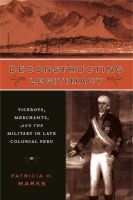




Deconstructing Legitimacy
Viceroys, Merchants, and the Military in Late Colonial Peru
Patricia H. Marks
Deconstructing Legitimacy
Viceroys, Merchants, and the Military in Late Colonial Peru
Patricia H. Marks
“This is an impeccably researched and articulately written inquiry into the collapse of royal authority in Lima at the time of independence. Not only does the book yield a bounty of fresh insights and interpretations into these tumultuous events, but it also identifies actions by the rebels that set an important precedent in Peruvian politics and reverberated in the political culture for years to come.”
- Media
- Description
- Reviews
- Bio
- Table of Contents
- Sample Chapters
- Subjects
Winner of a 2008 Choice Outstanding Academic Title
Although Pezuela's overthrow was organized and carried out by royalists among the merchants and the military, it proved to be an important event in the development of the independence movement as well as a pivotal factor in the failure to establish a stable national state in post-independence Peru. The golpe de estado may thereby be seen as an early manifestation of Latin American praetorianism, in which a sector of the civilian population, unable to prevail politically and unwilling to compromise, pressures army officers to act in order to "save" the state.
“This is an impeccably researched and articulately written inquiry into the collapse of royal authority in Lima at the time of independence. Not only does the book yield a bounty of fresh insights and interpretations into these tumultuous events, but it also identifies actions by the rebels that set an important precedent in Peruvian politics and reverberated in the political culture for years to come.”
“Examining the bitter trade disputes that divided Peru and shaped its conflicts with Spain, Patricia Marks casts new light on Spanish America’s bumpy transition from colony to republic. In delightfully clear prose, she contributes to our understanding of the Wars of Independence and the trans-Atlantic struggles about ‘free trade’ and representation. This is a landmark book that offers many surprising and welcome discoveries.”
“This book, based on decades of meticulous research, is a major contribution to the burgeoning literature on the late colonial period, a period whose intellectual vitality is now being recognized after many decades of neglect.”
“In a thoughtful and perceptive study, independent historian Marks . . . reveals that, rather than acting independently, the military officers who executed the coup also represented a significant group of wholesale merchants in Lima. Based primarily on extensive research in archival materials in Spain and Peru, this clearly written and argued work is the most important English-language study of Peruvian independence to appear in nearly 30 years.”
“In broad terms the arguments and conclusions presented in this stimulating book build upon and extend, rather than contradict, those of previous commentators on Peru’s transition to independence, but they do so with an unprecedented level of detail and incisive analysis, making a major contribution to the historiography of late colonial Peru. This book deserves to be read by all students of the Bourbon reforms and Spanish American independence.”
Patricia H. Marks is an independent scholar who received her doctorate in history from Princeton in 2003.
Contents
Illustrations
Acknowledgments
Abbreviations
Introduction: Mercantile Conflict and Political Culture
1. City of Kings, City of Commerce
2. Bourbon Reformers and the Merchants of Lima
3. Sabotaging Reform
4. Preventing Independence
5. The Free-Trade Dispute
6. Merchants, the Military, and the Disintegration of Pezuela’s Authority
7. The Pronunciamiento and Its Aftermath
Conclusion: Legitimacy and the Salvation of the State
Glossary of Spanish Terms
Bibliography
Index
Introduction
Mercantile Conflict and Political Culture
On 29 January 1821, there was a revolution in Lima, Peru. It was not a revolution for independence, similar to the one that had succeeded in England’s North American colonies a few decades earlier. On the contrary, it was a revolution intended to prevent Peru’s independence from Spain. Nor was it a violent and bloody popular uprising like the French Revolution, which historians have too often taken to be the only model for events defined as revolutionary. The overthrow of Viceroy Joaquín de la Pezuela was nevertheless a revolution in political culture, one that had far-reaching effects on the subsequent history of Peru. It changed the very idea of legitimate governance. Instead of legitimacy being derived from the king’s appointment of a viceroy, a group of army officers and merchants took it upon themselves to decide whether or not Pezuela could legitimately claim the power and authority inherent in his office. Their decision was based not on obedience to the king—the constituted sovereign of Spain—but on their personal understanding of what makes a ruler illegitimate. It violated the two fundamental principles of Spanish monarchical polity, the principles that legitimacy required both continuity of sovereignty and the consent of the governed.
In spite of its importance, very little has been written about Pezuela’s overthrow. Historians have assumed that the golpe de estado was entirely a military uprising planned and carried out by peninsular-born officers of the Army of Lima. According to this view, the military pronunciamiento—the model for many that were to follow in the nineteenth century—was the result of the officers’ ambition for personal advancement and their dissatisfaction with Pezuela’s conduct of the war. In their ultimatum demanding Pezuela’s resignation, the royalist officers blamed the viceroy for the rebels’ success, and since then military matters have dominated discussion of the viceroy’s fall from power. Nevertheless, both the officers’ ultimatum and Pezuela’s Manifiesto, in which he answered the charges against him, indicate that those who engineered the golpe de estado were serving not only their own interests but also those of a powerful group of royalist merchants of the consulado de Lima (the merchants’ guild), who opposed Pezuela’s commercial policies, especially his proposal of 24 July 1818 to open Lima’s port, Callao, to direct trade with the British. One of them, the peninsular-born Gaspar Rico y Angulo, later boasted that he had been the instigator and organizer of the plot against Pezuela. Writing in 1824, he declared:
Since the year 1818 . . . I have not ceased to combat the scandalous lawlessness of the former government. . . . Convinced that we would perish ignominiously if we remained subservient to a man who either did not comprehend the nature of his duty or did not want to do it, I planned, proposed, and pursued his abdication from command, as an honorable Spaniard. This enterprise, the most important and useful thing that I have undertaken in my life, cost me four months of risk, labor, and expense.
Because of his involvement with the controversial periodicals El Peruano (1811–12) and in the 1820s with El Depositario, Gaspar Rico is known to Peruvian history primarily as a publicist, not a merchant. In fact, he was the Peruvian factor for the powerful privileged trading company, the Cinco Gremios Mayores de Madrid, from 1801 to 1811, when the directors of the company finally succeeded in firing him. During his entire residence in Peru, he was the center of highly politicized mercantile quarrels, some of which brought him into direct and bitter conflict with the viceroys and caused one of them to exile him to Spain. After Napoleon’s army invaded Spain in 1808, Rico went so far as to criticize the king himself—in print—and especially the all-powerful royal favorite, Manuel Godoy. Throughout it all, Rico remained an ardent royalist. But his challenges to the authority of the viceroys and his very public participation in the politics of early nineteenth-century Peru played a major role in delegitimizing colonial governance.
In every system of government, a great deal of bargaining among elites and interest groups takes place, however limited or opaque the process may appear to outsiders. Such was the case in the Spanish empire as well. The archives are replete with the records of bargaining groups and individuals, the famous expedientes (case files) that provide historians with so much fascinating information about how the colonial system worked and how the lines of conflict shifted over time. The expedientes and the correspondence of officials and private persons reveal that Gaspar Rico and other elite merchants were adept at promoting the kind of intra-elite conflict that went far toward draining both power and authority from men charged with the governance of Peru. Rico’s quarrels with rival groups of merchants, especially those associated with the Real Compañía de Filipinas, contributed greatly to creating and expanding the cleavages within Peruvian society while diminishing the ability of government to redress grievances and command obedience to its dictates. The stakes were high, not only the wealth and power of individual merchants but also the very survival of a colonial regime heavily dependent on revenue from taxes on trade.
That merchants like Gaspar Rico should challenge the authority of viceroys and even seek to overthrow them comes as no surprise to students of the late colonial history of Spanish America. But Peru has appeared to be exempt from the commercial conflict that provoked political crises in Mexico City and Caracas during the late colonial period. In the case of Lima, evidence of its presence has been ignored, in part because historians have assumed that the consulado of Lima was unified politically, and that all of its members (many of them born in Spain) were determined to maintain a supposed Spanish monopoly over the supply of European manufactures to Peru. But conflict between factions of merchants matriculated in the consulado had long existed, and it escalated dangerously in 1818, provoked by royalist military reverses and a crisis in viceregal finance that led to the viceroy’s willingness to encourage direct trade with foreigners at Callao.
The officers of the Army of Lima who demanded Pezuela’s resignation had a great deal to say about military matters, as would be expected. They would not be expected, however, to take an interest in viceregal commercial policy except as it affected the government’s ability to support the army and the war effort. But in their ultimatum, the officers accused Pezuela of specific crimes against the Spanish laws for the regulation of colonial trade. “The merchants,” they said, “have been injured by the considerable losses occasioned by a scandalous contraband trade and by tolerance of foreigners.” Besides being contrary to law, the officers declared, Pezuela’s tolerance of foreigners wronged those who had been most responsive to viceregal appeals for aid in the battles against the rebels. The merchants had made “great sacrifices” to supply the viceroy with the funds necessary to prosecute the war, but their money had been misused. “No one knows what happened to the immense fortune collected in donations and forced loans,” they wrote; “its misuse has been great and indisputable.”
“I am wronged to the greatest degree by the . . . officers of the Army of Lima who signed the ultimatum,” wrote Pezuela on the day he was overthrown, characterizing the charges against him as “unjust,” “degrading,” and “self-serving.” In his Manifiesto, the viceroy organized his defense according to six “general ideas” and ten “specific charges” that had been used to justify the golpe de estado. The second “general idea” dealt with the allegation that, in spite of Lima’s position as the “very center” of viceregal wealth, Pezuela had failed to amass resources sufficient to prosecute the war successfully. The seventh “specific charge” discussed the accusation that the viceroy had been too tolerant of the contraband trade and of the foreigners whose presence in the ports of Peru had become commonplace.
On both of these issues—financing the war effort and relations with foreigners—two factions of merchants matriculated in the consulado had a great deal to say during the debates leading up to Pezuela’s overthrow. Those debates took place in the context of complex crises in Spain itself during the first decades of the nineteenth century—crises that included foreign wars and the invasion of Spain by Napoleon’s army, multiple changes of government and government policies, royal abdications, and constitutional debates. Between 1808 and 1823, bitter disputes over colonial policy also shook the Spanish government. Michael P. Costeloe has described “an intense struggle . . . between those who favored a policy of moderation toward America, by which most meant the use of limited force tempered with reforms, and those who wanted an all-out military effort with few, if any, concessions. The conflict between these rival groups came to center on the issue of free trade and particularly its use as a bargaining counter in persuading other nations to help in restoring Spanish control of the empire.” That struggle was reflected in events in Peru during the period from 1818 to 1821, and it is here that we can locate the point where the interests of the peninsular army officers who implemented the golpe de estado and those of the faction of merchants led by Gaspar Rico, who claimed to have planned it, coincided.
The Lima pronunciamiento of 29 January 1821, however, was not the result of a mere “four months of risk, labor, and expense,” as Gaspar Rico would have us believe, and was not the work of one man. Nor did it arise solely from conflict between a single viceroy and an ambitious Spanish general. On the contrary, the seeds of the first military revolt in Peru since the sixteenth century were sown by the Spanish Bourbon reformers of the late eighteenth century who sought to reduce the power of a colonial mercantile elite by disrupting its economic foundations. The reforms provoked protests that went beyond the normal patterns of intra-elite bargaining: Their legitimacy was called into question. Merchants soon learned that the reforms would seriously disrupt their accustomed ways of doing business, destroying their semi-autonomous submetropolitan entrepôt. They regarded the losses to be incurred as nothing less than systematic state-sponsored despoliation.
Chapter 1 begins by describing the structure and importance of the intercontinental and interprovincial trades on which Peru’s prosperity and the merchants’ power had been built. But who, exactly, were the merchants who played such a critical role in the politics of late colonial Peru, and what alliances did they form among themselves in order to further their interests? Unlike bureaucrats and military men, they are virtually unknown. Until recently, neither their identities nor the patterns of their trade were the subject of historians’ inquiry. Thus Chapter 1 also describes and analyzes the merchant elite active in Peru from 1779 to 1821, identifying the wealthiest members of the group, describing the principal patterns of their trade, and suggesting where the lines of conflict were likely to lie as the reforms took hold in Peru.
Although competition among groups of merchants had always existed, in 1779, when the first matrícula (register of consulado merchants) considered here was drawn up, there is no evidence of bitter internecine quarrels comparable to those that split the consulado into factions following promulgation of the Reglamento de comercio libre of 1778. The “free trade” of that set of rules for the regulation of colonial commerce was an attempt by the crown to abolish the old system by which only merchants of Cádiz in Spain could trade legally to America, carrying their goods to four ports—Havana, Veracruz, Portobello, or Callao—in all of Spanish America. Instead, merchants resident in thirteen ports in Spain were permitted to trade with six ports in Spanish South America alone.
The Bourbon administrative and commercial reforms attempted to change the structure of Peruvian trade to ensure that the metropolis would reap the lion’s share of the profit to be had from colonial commerce. Chapter 2 describes those changes and the conflicts that arose from them in Peru. The first conflict involved the large numbers of peninsular merchants who sailed for Callao in the 1780s. Like other wealthy merchants, both criollo and peninsular-born, who were already resident in Lima, the new merchants assumed that they had the right to participate in the affairs of the consulado. By their sheer numbers, these newcomers, many of them resident in Spain, threatened to overwhelm the limeño merchants. Questions about who should and should not be admitted to the consulado’s matrícula became crucial contests for power and profit, especially after two large privileged trading houses established offices in Peru. Thus Chapter 2 also discusses the competition for control of the consulado that arose as a result of the Bourbon reforms.
With the growth of the Atlantic trade that followed the reforms, the crown attempted to wrest control over the distribution of both European imports and locally produced goods from the limeño merchants and transfer it instead to merchants domiciled in Spain itself. In the normal course of their comings and goings, the metropolitan merchants would capture a significant portion of the seaborne interprovincial trade in the Pacific, formerly dominated by limeño merchants and shipowners. These issues erupted in battles for economic survival in which the limeños found it increasingly difficult to compete with their metropolitan rivals, who enjoyed state support for their enterprises. Limeño problems were exacerbated by the crown’s well-thought-out program of tax reform, which served to disrupt still further Lima’s position as submetropolitan entrepôt.
The limeños perceived the reforms as having destroyed the economy of Peru, creating poverty where once there had been prosperity. By the end of the eighteenth century, the grievances of the limeño merchants had escalated to the point where political conflict threatened to delegitimize crown authority. Unlike provincial cities such as Arequipa, however, Lima did not erupt in rioting, though viceroys believed that it came close. When their traditional form of bargaining with their colonial masters by means of expediente and correspondence brought no relief, limeños embarked on a campaign to sabotage the reforms or render them irrelevant by noncompliance. Their efforts are discussed in Chapter 3.
With Gaspar Rico’s appointment in 1800 as the Lima factor for the Cinco Gremios Mayores, political conflict derived from commercial competition increased. Unwilling to accept viceregal rulings that curtailed the Cinco Gremios’ commercial power or enhanced the position of the Filipinas Company and its allies, Rico repeatedly challenged the authority of every viceroy who served in Peru between 1801 and 1821. Chapter 3 also discusses attempts by limeños, in league with local agents of the Filipinas Company, to deal with Rico, as well as the international context that made it possible for them to sabotage the reforms that Rico and the metropolitan merchants championed. In the course of these conflicts, personal enmity between Rico and the Filipinas Company’s factor, Pedro de Abadía, erupted into a public scandal, and Viceroy Fernando de Abascal became convinced that Rico was involved with men who sought to reduce his authority or remove him from office. When Abascal exiled Rico to Spain in 1812, however, challenges to viceregal authority did not depart with him. Rico’s periodical, El Peruano, had given limeños a language with which to question the legitimacy of the viceroy and his rulings, especially after the liberal Spanish Constitution of 1812 was promulgated in Peru.
With the return of the absolutist regime in Spain at the end of the Napoleonic war in 1814, liberals like Rico found themselves in a precarious position. Nevertheless, while in Spain, Rico was able to secure the dismissal of Abascal’s charges against him. But by the time Rico disembarked in Callao in 1818, the new viceroy, Joaquín de la Pezuela, was embroiled in a desperate attempt to prevent Peru’s independence. In the struggle against insurgents both within the viceroyalty and on its borders, the absolutist and politically moderate viceroy had to contend with liberal hard-liners, like Rico and General José de La Serna, who believed in a purely military solution to the problem of rebellion, and who questioned Pezuela’s decisions on the conduct of the war and the means he favored to pay for it. Rico quickly assumed a position of power, not as an elected official of the consulado, but as the spokesman for the metropolitan merchants who insisted that Pezuela’s emergency commercial policies were illegal and inadmissable. Chapter 4 discusses the issues raised by royalist efforts to pacify Peru, and Rico’s role in the political debates that ensued.
When Pezuela proposed “free trade” with the English in 1818, Rico’s political power grew steadily, and this process is traced in Chapter 5. By then, “free trade” was no longer defined as the ability of any Spanish merchant residing in designated ports in Spain to trade with Callao and certain other American ports. Instead, it had come to denote direct trade with foreigners whose ships anchored in colonial ports to conduct business without the mediation of merchants resident in Spain or their agents in Peru. As it developed, the free-trade dispute in Lima became the final battleground on which the commercial and political conflicts that began in the 1780s were fought. That dispute played a critical part in destroying the viceroy’s legitimacy.
Gaspar Rico and the coterie of liberal, hard-line metropolitan merchants were convinced that Pezuela’s commercial policy seriously compromised Peru’s security. Rico and his friends were therefore convinced that the viceroy had stepped over a line, had in fact delegitimized himself. They believed themselves justified in seeking redress of their grievances in another quarter: the similarly liberal, hard-line peninsular officers of the Army of Lima. But how were Rico and the metropolitan merchants able to make contact with the peninsular army officers who, for their own reasons, also wished to see Pezuela replaced? Chapter 6 discusses the long-standing links between merchants and the military and, more specifically, Gaspar Rico’s membership in two militia units, both of them milicia disciplinada, that is, units trained by professional army officers. As rebellion increased, military training promoted a common view among merchants and the military of how Peru’s security was to be safeguarded, one that blamed foreigners for much of the accelerating movement toward independence and ignored the rising tide of colonial grievance.
Like the merchants, however, the army was divided in its opinion of Pezuela’s policy of making use of foreigners to secure vital resources for the defense of the viceroyalty. Unfortunately for Pezuela, the officers who supported him were no match for La Serna and his friends, who took advantage of every opportunity to discredit the viceroy militarily, politically, and personally. La Serna’s insubordination played a large part in the campaign to deprive Pezuela of the authority that should have attached to his office, as did the 1820 military pronunciamiento in Spain itself, which restored the liberals to power there. Pezuela was increasingly isolated, and his attempts to negotiate with his adversaries only encouraged them to take advantage of their growing power.
Ultimately, Pezuela and his enemies, both military and civilian, disagreed over concepts of viceregal legitimacy and authority that proved to be irreconcilable. Both the army officers and Rico’s faction of the consulado became convinced that Pezuela was a disastrously incompetent viceroy, and it is this view of the last legitimate viceroy that has prevailed in the historiography. Indeed, little more than that is said about him and the years of his rule. But Pezuela’s enemies went further: they accused him of being in thrall to men, both military and civilian, of questionable loyalty to Spain. They believed, therefore, that his removal from office was both legitimate and essential to the successful pacification of Peru. When La Serna and his allies captured control of the newly formed Army of Lima, Pezuela’s fate was sealed.
Chapter 7 recounts the events of 29 January 1821, showing exactly how La Serna and his allies were able to usurp the remnants of Pezuela’s power and assume the reigns of government. In the aftermath of the pronunciamiento, additional evidence of Gaspar Rico’s complicity in the plot surfaces, suggesting that Pezuela’s overthrow was the precedent for subsequent military takeovers in Republican Peru that also served civilian interests.
The conclusion analyzes the coming of independence from the perspective of the collapse of a colonial regime’s ability to govern, a collapse that owed much to the crown’s failure to understand that allegiance is always conditional, depending upon the willingness of the king’s subjects to obey and a regime’s willingness to hear and redress the grievances of its citizens. Although few governments know at any given moment exactly where the limits of allegiance lie, the Spanish colonial system proved inept in supplying that information to the empire’s rulers, so far away in metropolitan Spain, who in their turn were obstinately deaf. As a result, in Peru a radical change in political culture developed over the course of some forty years, one that went beyond noncompliance and culminated in a retrogressive military revolt. The story of late colonial viceroys and their merchant and military adversaries reveals much about the nature of power and authority in late colonial Peru, and about ideas of legitimacy that continue to be relevant after the passage of almost two centuries of independence.
Also of Interest
Mailing List
Subscribe to our mailing list and be notified about new titles, journals and catalogs.