


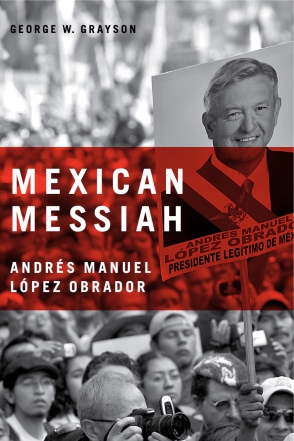
Mexican Messiah
Andrés Manuel López Obrador
George W. Grayson
“No scholar has followed Mexican electoral politics more closely than George Grayson, who capitalizes on that extensive knowledge to provide a readable, provocative, critical, extensively researched biography that sheds light on Mexico’s most controversial politician. Grayson’s challenging interpretations and revelations allow readers to more fully understand López Obrador’s personal and political motivations, his dramatic rise to national prominence, and his place in the recent wave of populist, left-of-center national political figures in Latin America.”
- Media
- Description
- Reviews
- Bio
- Table of Contents
- Sample Chapters
- Subjects
George Grayson, author of Mexican Messiah, has been a guest on CNN's Lou Dobbs Tonight several times. To view the August 21, 2007 CNN interview, click on the link. To read a transcript of the interview that aired on September 17, 2007, click here. Professor Grayson was also interviewed on KCBS in San Francisco on September 1, 2007. Click on the link to listen to that interview. He has written an op-ed piece for the San Diego Union-Tribune that was published on September 2, 2007 as well.
The book follows López Obrador’s life from his early years in the flyspecked state of Tabasco, his university studies, and the years that he lived among the impoverished Chontal Indians. Even as he showed an increasingly messianic élan to uplift the downtrodden, he confronted the muscular Institutional Revolutionary Party in running twice for governor of his home state and helping found the leftist-nationalist Democratic Revolutionary Party (PRD). As the PRD’s national president, he escalated his political and ideological warfare against his former president, Carlos Salinas, and other “conspirators” determined to link Mexico to the global economy at the expense of the poor. His strident advocacy of the “have-nots” lifted López Obrador to the mayorship of Mexico City, which he rechristened the “City of Hope.” Its ubiquitous crime, traffic, pollution, and housing problems have made the capital a tomb for most politicians. Not for López Obrador. Through splashy public works, monthly stipends to senior citizens, huge marches, and a dawn-to-dusk work schedule, he converted the position into a trampoline to the presidency. Although he lost the official count by an eyelash, the hard-charging Tabascan cried fraud, took the oath as the nation’s “legitimate president,” and barnstormed the country, excoriating the “fascist” policies of President Felipe Calderón and preparing to redeem the destitute in the 2012 presidential contest.
Grayson views López Obrador as quite different from populists like Chávez, Morales, and Kirchner and argues that he is a “secular messiah, who lives humbly, honors prophets, gathers apostles, declares himself indestructible, relishes playing the role of victim, and preaches a doctrine of salvation by returning to the values of the 1917 Constitution— fairness for workers, Indians’ rights, fervent nationalism, and anti-imperialism.”
“No scholar has followed Mexican electoral politics more closely than George Grayson, who capitalizes on that extensive knowledge to provide a readable, provocative, critical, extensively researched biography that sheds light on Mexico’s most controversial politician. Grayson’s challenging interpretations and revelations allow readers to more fully understand López Obrador’s personal and political motivations, his dramatic rise to national prominence, and his place in the recent wave of populist, left-of-center national political figures in Latin America.”
“Mexican Messiah examines in copiously researched detail this most important and controversial political figure to emerge in Mexico since Carlos Salinas de Gortari.”
“Drawing on the theoretical work of Oscar Aguilar Ascencio and Enrique Krauss and on exhaustive research (including 140 interviews), the author provides a rich ‘two-fer': an incisive political biography and an astute analysis of contemporary Mexican politics.”
“This book is recommended for anyone who wants a detailed look at Mexican politics, recent Mexican history, or the candidate himself. It also provides insightful information about the nation of Mexico and its people, especially in recent times.”
“[Mexican Messiah] is a must for researchers concentrating on the PRD and will also be of interest to those focusing more generally on Mexican party politics. Given its accessible style and relatively brief theoretical section, it may also be a good read for a more general, non-academic audience.”
George W. Grayson is the Class of 1938 Professor of Government at The College of William and Mary.
Contents
List of Tables
Acknowledgments
List of Acronyms
Introduction
1. A Child Is Born in Tabasco
2. Blessed Are the Poor
3. The Devil and His Ideas
4. López Obrador Takes on the Romans: The 1988 Gubernatorial Campaign
5. López Obrador Fights the Romans a Second Time
6. PRD President: A “Miracle Worker”
7. The New Jerusalem
8. The Mayor of Mexico City
9. “Republican Austerity” and Mañaneras
10. The Loaves and the Fishes
11. “La Ciudad de la Esperanza”
12. Apostles, Disciples, and Magdalenas
13. Challenging the Pharisees, Sadducees, and Scribes
14. Vicente Fox: López Obrador’s Last Neoliberal President
15. The Eleven Commandments
16. Winning the “Promised Land”
17. An Electoral Setback
18. A Second Coming?
Select Bibliography
Index
Introduction
Andrés Manuel López Obrador entered the final stretch of the presidential race as the leading candidate to succeed Vicente Fox Quesada. On the eve of the July 2, 2006, contest, he claimed to have a ten-point lead in a poll that he would not make public. After a partial recount of the nearly 42 million ballots cast in the election, the Federal Electoral Tribunal (TEPJF) found that the former mayor of Mexico City had lost by an eyelash to Felipe Calderón Hinojosa, the nominee of Fox’s National Action Party (PAN). López Obrador blasted the outcome as “fraudulent” and moved to establish a government parallel to Calderón’s.
Nonetheless, el Pejelagarto (or el Peje), as the erstwhile mayor is called, ran an extremely competitive race, despite jarring blows that would have knocked most politicians out of contention and possibly landed them in prison. In early 2004, for example, agents filmed his finance secretary, Gustavo Ponce Meléndez, dropping big bucks at a blackjack table in a posh Las Vegas casino. No sooner had this exposé erupted than the nation’s most popular morning TV show, hosted by Víctor Trujillo—a comedian-turned-television journalist armed with the mordant humor of Saturday Night Live or The Daily Show with Jon Stewart—detonated another bomb. Trujillo aired videos of René Bejarano Martínez, the mayor’s top operative, greedily cramming thousands of dollars into his suitcase and pockets. This money was handed over by a shadowy Argentine entrepreneur with close ties to big shots in López Obrador’s Democratic Revolutionary Party (PRD).
Two months later, the videoescándalos gave way to a concerted drive by Fox to strip López Obrador of his immunity as an elected official so that he could stand trial for having flouted a judge’s order. After months of legal haggling, deputies in the once-dominant Institutional Revolutionary Party (PRI) joined their counterparts in the PAN. Thanks to this alliance, the Chamber of Deputies approved the desafuero—the formal term for divesting the mayor of his legal shield. The outcry at home and abroad against this egregious maneuver forced the chief executive to capitulate and recognize López Obrador’s right to seek the nation’s top office.
Although he had failed to resolve the capital’s crime, pollution, traffic, water, and trash problems, Mexico City’s former chief remained a formidable presidential contender as the nominee of the “For the Good of All” (Por el Bien de Todos) coalition, spearheaded by his leftist-nationalist PRD.
How did López Obrador vault such imposing hurdles to become one of his country’s most popular politicians? Commentators have compared him to such Latin American populists as Venezuela’s Hugo Chávez and Bolivia’s Evo Morales. Indeed, he shares several of their characteristics: he proclaims tidings of change and hope, excoriates the status quo, assails the hegemonic political class, relies on the mass media to disseminate his positions, and decries neoliberal economic policies.
While elements of populism apply to López Obrador, he is in fact a political “messiah,” a term that derives from the Hebrew word for “anointed one.” Unlike a Chávez, for example, he is not just one more option for the masses. Rather, he is a “savior” prepared to rescue the humble from deceitful politicians and their neoliberal schemes that benefit the affluent. While others claim to “represent” the downtrodden, el Peje “incarnates” their struggle.
Central to the concept of a messianic politician is his conviction that he embodies the project of redemption, that he represents a viable mission—based on his moral principles and values—to uplift the “have-nots.” The righteousness of his cause immunizes him from scrutiny and attacks. To question or assail him is to offend the interests of the disadvantaged whom he represents. López Obrador presents an alternative to the neoliberal creed, whose adherents constitute an “evil” so great that he refuses to utter the name of its principal protagonist, President Carlos Salinas de Gortari (1988–94), whom he derides as “the Unmentionable One” (el Innombrable).
Political messiahs explain economic, social, and political “reality” in a way that is credible to the masses. Their success also springs from convincing the faithful that they embrace the interests of the people and possess the strength and fortitude to transform their lives. As mayor, López Obrador continued to exhibit the honesty and austerity that he had demonstrated during a quarter-century of social activism. Upon reaching City Hall, he did not turn his back on the poor but created programs to assist them.
A messiah manifests his powers by performing miracles (Jesus) and in heroic achievements in the face of adversity (López Obrador). The pursuit of social justice—his most outstanding quality—arms him with moral force. The savior has two dimensions: he is both a national and political liberator and the spiritual and religious shepherd of his flock; he is at once a king and a redeemer, a political and spiritual hero. He enhances his credibility by thwarting his enemies’ efforts to expel him from the political scene.
Detractors underestimate such a politician because they fail to appreciate his skill in “connecting” with the people by dint of the potency of his message of liberation. He draws strength from his conviction that he is not alone but basks in the support of the multitudes. He conveys to those struggling to survive the prospect of a better life that is unattainable in the iniquitous and cruel world of the marketplace. He holds out “another realm” infused with justice, equality, and well-being for its inhabitants. The messianic leader relies heavily on the mass media to project his “word,” even as the “neoliberal empire” seeks to block his access to the throne of power. Through speeches, marches, and demonstrations, he warns the elite of the “dangers to democracy” and “stability” if it impedes his crusade of hope.
The term “messianic” is used in a descriptive, not a pejorative, manner. It refers to a person whose political vision and trajectory combine leftist, populist, nationalist, and corporatist elements in a way that separates him from other politicians. El Pejelagarto is a secular messiah who enunciates a doctrine of salvation by returning to the values of the 1917 Constitution—fairness for workers, Indians’ rights, fervent nationalism, and anti-imperialism.
Whether by chance or by design, he employs strategies that are surprisingly similar to those used by Jesus of Nazareth two thousand years ago, when the Romans occupied Palestine. López Obrador makes no pretense of being divine. Yet he has called himself “the little ray of hope” (el rayito de la esperanza) for the dispossessed—a key to his extraordinary success. Once he and his faithful followers had recaptured his nation’s Jerusalem (Mexico City), he immediately fixed his sights on the latter-day Rome (the presidency)—from which recent leaders had propounded despised neoliberal precepts.
Although he was born near the town of Bethlehem in the state of Tabasco, the political messiah’s mother was not a virgin; nor were wise men bearing gold, frankincense, and myrrh guided to his birthplace by a luminous star in the East. Moreover, unlike Christ, about whom we know little before he reached age thirty, we have copious information about el Pejelagarto’s life.
Messianic Qualities
López Obrador shares several traits with the founder of Christianity. First, as Jesus claimed the role of spiritual liberator, the former mayor offers himself as a political redeemer. He is determined to deliver the people from the heinous liberalization that has yielded “monstrous social inequality,” as well as dependence on the United States, the International Monetary Fund (IMF), and other exponents of the “magic of the marketplace.”
Second, like Christ, he lives frugally. A widower during most of his term as mayor, he resided with his three sons and a housekeeper in a small home in an unpretentious neighborhood; he dressed simply, rode in a battered Japanese car, worked sixteen to eighteen hours a day, cut his salary, and promised to do the same if elected president. He also expected members of his entourage to forego creature comforts for the greater good. As was the case with Christ, self-sacrifice included placing a higher priority on one’s mission than on one’s families, and López Obrador demanded this of his employees as well as of himself. During his campaign for the presidency, he often assigned greater importance to his crusade than to his wife, children, parents, and siblings.
Third, at times López Obrador has emulated Jesus’ habit of speaking in parables and coining memorable phrases. When he ran for mayor in 2000, el Peje adopted as his campaign slogan a modern rendering of Jesus’ saying, “Blessed are you who are poor, for yours is the Kingdom of Heaven” (Luke 6:20): “For the Good of All, Above All the Poor” (Por el Bien de Todos, Primero los Pobres), which he abbreviated for his presidential campaign. This emphasized his belief that the poor are the most deserving in society. On another occasion, he expressed his hostility to the elite’s wrongdoing by asserting, “the people are sick and tired of so many petty political deals.”
Fourth, López Obrador is influenced by political icons in much the same way that the Old Testament prophets motivated Jesus. These visionaries include Father José María Morelos y Pavón (1765–1815), a champion of Mexican independence who strove to uplift impoverished Indians; President Benito Juárez (1806–72), an advocate of separating church and state who believed that public servants should live modestly; Francisco I. Madero (1873–1913), an idealistic advocate of “effective suffrage and no re-election” who sparked the overthrow of the encrusted dictatorship of Porfirio Díaz; and Lázaro Cárdenas, a muscular nationalist who organized peasants and workers, even as he accomplished sweeping land reform and nationalized the foreign-controlled petroleum sector. Of these four prophetic figures, el Peje exhibits a special affinity for Juárez and Cárdenas. He told a journalist just before he became mayor, “There are two presidents in Mexican history who continue to lead by their examples, two enduring presences: Juárez and Lázaro Cárdenas.”
Historian Enrique Krauze, who calls López Obrador a “tropical messiah,” argues that Tabasco’s fanatically anticlerical governor, Tómas Garrido Canabal, inspired his “puritanical, dogmatic, authoritarian inclination to hate and . . . redeemer-like” qualities.
Meanwhile, López Obrador has treated PRD founder Cuauhtémoc Cárdenas, son of the late president, as an inept prophet because he failed as the D.F.’s mayor to achieve social justice for the masses. In fact, Cárdenas, who contemplated seeking the presidency a fourth time in 2006, rejected a hallmark of López Obrador’s government—providing monthly stipends to senior citizens—and refused to support el Peje in 2006. Cárdenas even expressed concern that, if elected, López Obrador might seek to extend his tenure more than six years. “A messianic agenda resists limits and needs time: a sexenio is too brief a period,” writes Krauze.
Fifth, López Obrador has confronted the beneficiaries of the neoliberal model that Mexican presidents have trumpeted since the mid-1980s in a manner that parallels Christ’s challenge to the Jewish establishment and their Roman protectors. He employs the idiom of class warfare by focusing his ire on the self-serving, corrupt “political elite” who have abandoned the revolutionary principles inspired by Morelos, Juárez, Madero, and Cárdenas. It is these grandees, who profited from the 1998 Fobaproa bank bailout, whom López Obrador attacks with the self-righteousness of Christ expelling the moneychangers from the temple.
He demonizes Salinas, who promoted the nation’s market-oriented élan and helped forge the North American Free Trade Agreement (NAFTA). For López Obrador, the devil’s sons are Roberto Madrazo Pintado, the wealthy former governor of Tabasco, who ran third in the presidential contest, and Calderón, the winner. El Peje alleged that either Madrazo or Calderón would reprise Salinas’s ruthless policies if elected chief executive.
Sixth, as a “savior,” López Obrador stands above the law just as Christ stood guiltless before Pontius Pilate. He is the conveyor of a message, and his persona cannot be separated from the actions of his government. As a result, he rejected transparency in his administration. If his goals were noble and his intentions pure, why should the press or other outsiders delve into his expenditures on, say, multimillion-dollar public works? Some of his collaborators may have committed “errors,” but their actions did not impugn the integrity of the man who named them to key posts. El Peje has even claimed that his honesty makes him “politically indestructible.”
Christ invariably took the offensive against his detractors, rebuking entrenched religious leaders as serpents: “Ye serpents, ye generation of vipers, how can ye escape the damnation of hell?” (Matt. 23:33). For his part, López Obrador, emphasizing the virtue of his mission, accused his own Pharisees of engaging in a “conspiracy.” When Fox tried to prevent him from seeking the presidency, López Obrador played the martyr’s role, stating, “I do not lust after elective office. I am not obsessed about being president. I struggle for ideas, for an agenda.” He also averred, “I am convoking a movement of analysis, of reflection, of conscience. I might even speak of a spiritual movement. . . . Many people who see me, humble people, tell me that they are praying [for my success].”
Seventh, a messianic politician has a monopoly on truth. Thus his positions are not debated but disseminated, because they hold promise for the political salvation of the destitute. In the same manner that Jesus challenged the emphasis that Jewish clerics placed on form over substance in interpreting the Torah, López Obrador has construed statutes to conform to his goals. He defines law as the “will of the people,” as he construes it. Like Christ, he pays lip service to orthodoxies while continually reinterpreting the law. As mayor, he frequently gave short shrift to bills passed by the city council, known as the Legislative Assembly of the Federal District (ALDF). He treated legislators as latter-day Pharisees, Sadducees, and Scribes with whom Christ clashed as he invested the scriptures with “truer” meaning.
López Obrador borrows Jesus’ strategy of calling simultaneously for conformity and change. Religious, civil, and customary laws were synonymous in Roman-occupied Palestine. Thus Christ was focusing on the central aspect of every life when he said, “Think not that I am come to destroy the law, or the prophets: I am not come to destroy but to fulfill. . . . Whosoever therefore shall break one of these least commandments, and shall teach men so, he shall be called the least in the kingdom of heaven: but whosoever shall do and teach them, the same shall be called great in the kingdom of heaven” (Matt. 5:17, 19). For instance, el Peje gives assurances that he will pursue responsible macroeconomic policies and uphold NAFTA while simultaneously upbraiding the architects of Mexico’s economic opening.
Eighth, unlike most populists, the messianic politician has long worked shoulder to shoulder with the poor and remains in constant contact with them. Even though he won election as Mexico City’s mayor, López Obrador, like Christ, has spent most of his life among peasants. He preaches egalitarianism and forgives prostitutes and other sinners, using this relationship with the dispossessed to energize both himself and his followers. He denies that he is a populist but says he is as “one with the people,” for governments are only legitimate if wedded to the masses.
Ninth, while unable to perform miracles like those attributed to Christ, the Tabascan magically revitalized his PRD, renovated the Historic Center, and provided monthly payments to the needy—his rendition of distributing “loaves and fishes.” In calling Mexico City the “the City of Hope” (la Ciudad de la Esperanza), the mayor has recognized the human need for symbols of transcendence and framed his works in a spiritual context in a country of quiet believers. His revitalization of the capital’s crumbling historic zone—which had been invaded by tawdry bars, pimps, whores, drug dealers, and gangs—is a modern-day wonder that inspires optimism.
Tenth, like other messiahs, López Obrador relies on his own judgment and seldom follows the counsel of others. As his father-in-law said, “He doesn’t hear and he doesn’t listen.” Yet he is surrounded by a small group of confidants, his “apostles,” who include at least one Judas-like betrayer. As was Christ’s practice, López Obrador seldom compliments his subordinates but exhorts them to accomplish even more.
Eleventh, he has also taken a page from Jesus by welcoming into his entourage devoted females. These modern Mary Magdalenes have held prominent positions in his cabinet, worked faithfully and tireless to advance his mission, and helped his campaign in other ways.
Finally, even though an outsider—he broke with the PRI in 1988—López Obrador has risen to power within Mexico’s electoral system. His ascent to the mayorship represented his “political beatification,” just as reaching the National Palace would have constituted his “political canonization.” Oscar Aguilar Ascencio has offered another analogy: “His capturing City Hall was tantamount to Christ’s conquering Jerusalem; now the messianic López Obrador wants to seize Rome, the epicenter of the ‘evil empire.’”
Although he rejects the appellation “messiah,” López Obrador has defined himself as a “mystic.” Writer Carlos Marín has observed that “much of his rhetoric leads to the interpretation that he has found a kind of new political church—that of Saint Andrés Manuel.” The mayor responded: “Messianic? No. There have been such interpretations, but what I have said [is that] when one has principles, when one has ideals, he is less vulnerable and can confront whatever adversary. It annoys my adversaries that I act in this manner. But I am a juarista, and Juárez said that you acquire authority from upright behavior.
Fox, however, referred to el Peje’s qualities when he warned about extravagant campaign promises. Messiahs are already embarked upon campaigns, offering the people “everything imaginable” (el oro y el moro) and confusing them by pretending to have “simple solutions” to complex problems.
The Demonstrations of August 29, 2004, and April 24, 2005
López Obrador’s messianic traits were abundantly clear on August 29, 2004, when hundreds of thousands of his followers cascaded into the streets of the ancient Aztec capital to support their leader as he confronted the desafuero threat. If ousted from city hall, López Obrador would have faced charges of official misconduct, which the Procuraduría General de República (PGR) had leveled against him. The dispute swirled around the allegation that city officials had ignored an injunction against constructing a service road to a new hospital on private property in the city’s Santa Fe area. The matter appeared trivial, yet failure to resolve it by January 2006 would have prevented López Obrador from seeking the presidency, as the Constitution prohibits anyone with legal matters pending against him from becoming a candidate.
This march “for Democracy and Legality” (por la Legalidad y la Democracia)—the largest ever staged by Mexico’s Left—included many senior citizens, some hobbling on canes and walkers. They turned out to display their appreciation for the monthly allowance from the Government of the Federal District (GDF) of 680 pesos, later raised to 720 pesos. A group of elderly women held up a sign that read, “May God Watch over the Little Ray of Hope! (¡Qué Dios te Cuide, Rayito de Esperanza!). Meanwhile, a placard in the central plaza proclaimed, “Musical groups of the blind in the Historic Center are certain that you will be the next president.” The blind, like other disabled residents, also receive the monthly stipend of 720 pesos. Other beneficiaries of government programs include single mothers, scholarship recipients who come from poor neighborhoods, young people from newly established preparatory schools, and students at the Autonomous University of Mexico City (UACM), which López Obrador founded.
These demonstrators rubbed elbows with families that had obtained credits with which to purchase houses and with taxi drivers who had obtained loans with which to buy their own vehicles. Leaders of labor organizations signaled their presence with gaudy pennants. Members of the Mexican Electricians Union (SME) unfurled banners that praised the mayor’s opposition to the nationalization of Mexico’s electricity industry. Their counterparts in the UNAM Workers’ Union (STUNAM) chanted slogans against neoliberalism and on behalf of el Peje.
Neighborhood organizations employed signs, slogans, and songs to express their solidarity with the mayor. These groups included the residents of the Venustiano Carranza neighborhood, whose members shouted, “the voice of the people is the voice of God!” Not only had López Obrador brought leaders of such organizations into his administration, he had also rewarded their loyalty by giving their members preferential access to housing credits, store sites, and areas of sidewalks where they could sell everything from jewelry to videos.
Big shots in his Democratic Revolutionary Party were ubiquitous. The PRD’s yellow-and-black banners and balloons gave the demonstration the appearance of a field of black-eyed Susans. Especially prominent was Deputy Manuel Camacho Solís, an important convert from the PRI and a key strategist for the mayor. While there were no palm leaves, López Obrador occasionally broke his stride to accept flowers, salute well-wishers, or receive embraces from admirers who treated him more as a savior than as a popular run-of-the-mill politician.
Although a smile danced across his face, the mayor seemed to have retreated into his own thoughts, possibly about his plans for nation’s lumpenproletariat. When he arrived three hours late in the Zócalo central square, the crowd opened a path for him. The spontaneous action was reminiscent of the Bible’s account of God’s parting the Red Sea so that Moses and the Israelites could flee their Egyptian foes. A banner proclaimed, “The Voice of AMLO is the Voice of God!”
In his lengthy message, López Obrador elaborated on the theme of his inaugural address. He enunciated a twenty-point program that would constitute a “new social pact” in contrast to the neoliberal approach of President Fox. Un projecto alternativo de nación—his blueprint for change—included reactivating the economy, creating jobs, and improving the lot of Indians, senior citizens, the disabled, poor students, single mothers, and others in need. Upon declaring his presidential candidacy, he expanded his platform from twenty to fifty planks.
He called for honesty and austerity in a government that would guarantee free public education at all levels, respect individual freedoms, and advance social rights. He averred that the best foreign policy is an effective domestic policy and that Mexico must conduct its relations with the United States on the basis of “respect and collaboration.”
Several months passed before he made it official, but the August 2004 march signaled López Obrador’s announcement of his presidential candidacy in a race that promised to be one of the hardest fought in Mexican history. For the first time, traditional contenders would be running against a political messiah.
On April 24, 2005, more than a million loyalists took part in a “March of Silence” to protest the desafuero once again. Many of the same groups participated in this event, using the same slogans. This time, however, there seemed to be one change in the environment. The demonstrators not only manifested allegiance to López Obrador; they put the government on notice that they did not want it to destroy their dream of reaching the Promised Land.
Factors That Give Rise to Messianic Politicians
Analysts have identified a number of factors that explain the appearance of messiahs. These include (1) weak, unrepresentative political institutions, (2) a lack of confidence in traditional politicians, (3) the yearning for a message of hope, (4) the presence of an individual who offers himself as a leader of the masses unrestrained by institutional fetters, (5) adeptness at capturing media attention, and (6) vague proposals complemented by symbolic acts that respond to the needs of the masses.
These factors were present at the time of Jesus, when religious and political ferment roiled Palestine. The Hellenistic influence that had come to dominate the eastern Mediterranean had acutely affected Jewish society, and foreign myths, cults, and philosophies had made notable inroads. The Romans controlled Palestine, and the Jews were a repressed people whose quest for independence would erupt in the war of A.D. 66–73. According to scholar Burton Mack, one important phenomenon of the Greco-Roman age was the appearance of the religious and philosophical entrepreneur, sometimes called the divine man, sometimes the sophist or sage. “The entrepreneur stepped into the void left vacant by the demise of traditional priestly functions at the ancient temple sites and addressed the confusion, concern, and curiosity of people confronted with a complex world that was felt to be at the mercy of the fates.”
The power structure in Palestine was riven. “The geographical division after the death of Herod had left conflict and resentment, the wealthy class and the priests had their differences, the priestly hierarchy was in internal conflict, and the Romans were sufficiently hated to spark a cleavage between the governor and the populace. The establishment could not offer a united front against a bid for power.”
Rather than dominance by Roman Legions, Mexico fell under the seventy-one-year rule of the PRI. In fact, López Obrador tends to praise the “revolutionary party”—to which he belonged until age thirty—before technocrats like Salinas hijacked the party in the 1980s. These infidels, he claims, have forsaken the PRI’s traditional goals. El Peje regards the usurpers as latter-day Romans whose rule is illegitimate and who must be driven out of Jerusalem and defeated in their own citadel. Although Fox belongs to the center-right National Action Party, López Obrador scorns him for embracing the neoliberalism of Salinas and his successor, Ernesto Zedillo Ponce de León (1994–2000). He mocks the PRI and the PAN—he labels them “PRIAN”—as ideological twins.
López Obrador acquired his distaste for neoliberalism in Tabasco. In the mid- to late 1970s, a petroleum boom uprooted tens of thousands of small farmers and fishermen who sought employment with Petróleos Mexicanos (Pemex), the national oil monopoly. The production of black gold—sometimes reviled as the “devil’s excrement”—also contaminated the state’s land, water, and air. Governors Leandro Rovirosa Wade (1976–82) and Enrique González Pedrero (1983–88) succeeded in securing federal government funds to compensate for the pollution and disruptions that afflicted the state. During their terms, Tabasco went from near the bottom to near the top of the nation’s thirty-one states in per capita tax monies disbursed to its government.
In contrast to the achievements of his predecessors, Governor Salvador Neme Castillo (1988–92) ran a hugely corrupt regime, lacked strong allies in Mexico City, and was forced by Salinas to acquiesce in a sharp reduction in federal monies flowing into the state. To make matters worse, at the time of this cutback Pemex began to shift its operations to neighboring Campeche, where it took advantage of the enormous reservoirs of oil located off the state’s coast without provoking the social unrest that occurred in Tabasco. Although the petroleum boom had allowed the construction of roads, bridges, ports, and airports, little had been done to diversify the Tabascan economy, which still relied heavily on the production of livestock and tropical fruits and vegetables.
The state was grossly unprepared for the tumbling of tariff barriers in the 1980s, which brought competition from less expensive items from north of the Río Grande. The resulting economic downturn accentuated the social, economic, and political dislocations sparked by the oil bonanza. As Neme, whom Salinas removed in 1992, fought for his political survival, Tabasco’s poor and dispossessed looked for someone to champion their cause. López Obrador furnished this leadership. He not only excoriated Neme’s and the PRI’s corruption but also mobilized squads of small farmers, fishermen, and Indians to block access to oil wells in order to wrench additional monies from Pemex.
During its protracted hegemony, the PRI resembled both a religious and a political hierarchy that articulated the protean ideology of revolutionary nationalism. Yet by the early twenty-first century, the elites were at each other’s throats. In his quest to succeed Fox, PRI president Madrazo (2002–5) helped scuttle the president’s energy, judicial, labor, and tax reforms. As a result, when Pemex revenues are excluded, the Mexican government collects taxes equal to only 10 to 12 percent of Gross Domestic Product—a figure on par with Haiti. This means there are insufficient funds to augment spending on education, healthcare, housing, employment training, and other crucial items. PRI- and PRD-led opposition to inviting private capital into the energy sector also limits the output of oil, earnings from which generate 36 percent of government resources.
Fox’s ineptitude has weakened the presidency and his party’s candidate; Calderón reached the presidency in large measure because of López Obrador’s mistakes during the campaign. Meanwhile, Madrazo failed to unify a PRI that was profoundly divided over his selection.
The presidential contest took place as globalization continued to erode the PRI-spawned corporatist system, which brought social controls and stability to Mexico for more than half a century. At the same time, many of the economic reforms of the 1980s and 1990s have been implemented haphazardly, resulting in enduring monopolies and oligopolies in both the private and public sectors. These impediments to growth mean that nearly half the population lives in misery, while new technology displaces workers and exporters suffer mounting competition from China, India, and other Asian dynamos. Mexicans also face street violence, corrupt police forces, sticky-fingered bureaucrats, and an unscrupulous judiciary, with the exception of several high federal courts. Just as the Tabasco upheaval in the 1980s gave impetus to López Obrador’s rise at the state level, current national conditions—ubiquitous poverty, high unemployment, debilitated labor unions, weakened peasant leagues, hostility toward the economic liberalism promoted by the United States, and disdain for Congress, politicians, and political parties—enhanced the attractiveness of López Obrador in 2006. Like Christ, he promised salvation from oppressive government programs.
Although he failed to win the presidency, the activities of López Obrador could profoundly affect Mexico’s relations with its northern neighbor. The lack of security along the two-thousand-mile border has led the U.S. State Department to issue six “alerts” to American citizens in recent years and, on July 29, 2005, to close its consulate in violence-plagued Nuevo Laredo, where rival narco-traffickers engaged in a pitched battle. Drug cartels have grown in power and wealth to the degree that they operate as parallel governments in various localities. As a result, thousands of migrants cross into the United States illegally each day, and the nation’s porous, crime-ridden southern flank has become an open door for lawbreakers seeking to use Mexico as an avenue to the United States.
Overview of the Book
Professor Oscar Aguilar Ascencio, a brilliant student of Mexican politics and a superb human being, not only laid out the theoretical design of this Introduction, but his invaluable ideas suffuse virtually every page of this volume. Chapter 1 examines the conditions in López Obrador’s home state of Tabasco and the influence of his family, teachers, and prophets as he grew to maturity. Chapter 2 focuses on López Obrador’s zealous commitment to social causes as revealed in his asceticism and extensive work with the Chontal Indians and the PRI. Chapter 3 concentrates on López Obrador’s antagonism toward the evils of neoliberalism and its devilish advocate, Carlos Salinas. Also included is an overview of the PRI’s hegemony.
Chapter 4 describes the corrupt political system against which López Obrador fought as the crusading gubernatorial candidate for the National Democratic Front in 1988. Chapter 5 analyzes how López Obrador took advantage of his presidency of the state PRD to launch an “exodus for democracy” against voting fraud in 1991, to create a party in Tabasco that emulated the practices of the traditional PRI, and to launch his gubernatorial bid against Roberto Madrazo.
Chapter 6 examines López Obrador’s “miraculous” achievements in advancing the PRD’s fortunes as its national president. It also discusses his animus toward the Fobaproa banking reform. Chapter 7 presents an overview of the political culture of Mexico City that fostered López Obrador’s emergence as a political messiah.
Chapter 8 reviews his successful campaign for the second-most important post in the nation on the platform of “Por el Bien de Todos, Primero los Pobres.” Chapter 9 illuminates how López Obrador employed crack-of-dawn news conferences—the mañaneras—both to gain legitimacy for his regime and to spread his gospel. Chapter 10 explores the programs that the jefe de gobierno launched as the savior of the capital’s dispossessed, as well as the constituencies that he molded in the process. Chapter 11 discusses the mayor’s various public works projects and the compromises he made with key power brokers to burnish his credentials for national office.
Chapter 12 identifies el Peje’s closest male and female followers and sets forth the functions they perform, and describes the Judas who allegedly betrayed him. Chapter 13 recounts López Obrador’s belief that law is the “people’s will” as he interprets it, as well as his selective support for lawmakers, the courts, electoral institutes, and the concept of transparency. Chapter 14 looks at López Obrador’s clashes with Vicente Fox, who, through the desafuero process, sought to prevent his running for president. Chapter 15 evaluates his fifty-point presidential platform, which, if enacted, would create his version of the Promise Land. Chapter 16 sets forth his strategy for expanding the ranks of his disciples so that he can succeed Fox, whom he believes will be the last neoliberal president, and explains the mayor’s efforts to allay fears abroad about his “leftist,” “populist,” and messianic orientation.
Chapter 17 assesses whether López Obrador’s parallel government, which sprang to life at the “Democratic national convention” of September 16, 2006, can thwart Calderón’s reformist agenda and pave the way for the political messiah’s election in 2012. Will “the little ray of hope” block proposed reforms, in a move that would exacerbate economic conditions and thus spur turmoil and bilateral tensions? Chapter 18, the concluding chapter of this book, addresses this question.
Mailing List
Subscribe to our mailing list and be notified about new titles, journals and catalogs.