


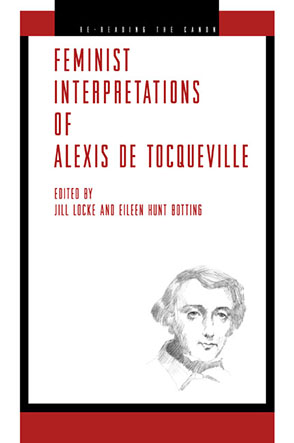
Feminist Interpretations of Alexis de Tocqueville
Edited by Jill Locke, and Eileen Hunt Botting
This book moves beyond traditional readings of Alexis de Tocqueville (1805–59) and his relevance to contemporary democracy by emphasizing the relationship of his life and work to modern feminist thought. Within the resurgence of political interest in Tocqueville during the past two decades, especially in the United States, there has been significant scholarly attention to the place of gender, race, and colonialism in his work. This is the first edited volume to gather together a range of this creative scholarship. It reveals a tidal shift in the reception history of Tocqueville as a result of his serious engagement by feminist, gender, postcolonial, and critical race theorists.
- Description
- Bio
- Table of Contents
- Sample Chapters
- Subjects
The volume highlights the expressly normative nature of Tocqueville’s project, thus providing an overdue counterweight to the conventional understanding of Tocquevillean America as an actual place in time and history. By reading Tocqueville alongside the writings of early women’s rights activists, ethnologists, critical race theorists, contemporary feminists, neoconservatives, and his French contemporaries, among others, this book produces a variety of Tocquevilles that unsettles the hegemonic view of his work.
Seen as a philosophical source and a political authority for modern democracies since the publication of the twin volumes of Democracy in America (1835/1840), Tocqueville emerges from this collection as a vital interlocutor for democratic theorists confronting the power relations generated by intersections of gender, sexual, racial, class, ethnic, national, and colonial identities.
In addition to the editors, the contributors are Jocelyn Boryczka, Richard Boyd, Christine Carey, Barbara Cruikshank, Laura Janara, Matthew Holbreich, Kathleen S. Sullivan, Alvin B. Tillery Jr., Lisa Pace Vetter, Dana Villa, Cheryl B. Welch, and Delba Winthrop.
Jill Locke is Associate Professor of Political Science and Chair of the Department at Gustavus Adolphus College.
Eileen Hunt Botting is Rolfs Associate Professor of Political Science and Director of the Gender Studies Program at the University of Notre Dame.
Contents
Preface
Acknowledgments
Introduction: To Tocqueville and Beyond
Jill Locke and Eileen Hunt Botting
1. Beyond the Bon Ménage: Tocqueville and the Paradox of Liberal Citoyennes
Cheryl B. Welch
2. Democracy’s Family Values
Laura Janara
3. Tocqueville and the Feminization of the Bourgeoisie
Dana Villa
4. A Family Resemblance: Tocqueville and Wollstonecraftian Protofeminism
Eileen Hunt Botting
5. Aristocratic Mourning: Tocqueville, John Quincy Adams, and the Affairs of Andrew Jackson
Jill Locke
6. Sympathy, Equality, and Consent: Tocqueville and Harriet Martineau on Women and Democracy in America
Lisa Pace Vetter
7. Tocqueville’s American Woman and “The True Conception of Democratic Progress.”
Delba Winthrop
8. Toward a Generative Theory of Equality
Kathleen S. Sullivan
9. Imperial Fathers and Favorite Sons: J. S. Mill, Alexis de Tocqueville, and Nineteenth-Century Visions of Empire
Richard Boyd
10. Tocqueville, Black Writers, and American Ethnology: Rethinking the Foundations of Whiteness Studies
Alvin B. Tillery Jr.
11. The Separate Spheres Paradox: Habitual Inattention and Democratic Citizenship
Jocelyn M. Boryczka
12. Tocqueville’s Authority: Feminism and Reform “Between Government and Civil Society”
Barbara Cruikshank
Annotated Bibliography on Alexis de Tocqueville and Gender, Feminism, and Race
Christine Carey
Contributors
Index
Preface
Nancy Tuana
Take into your hands any history of philosophy text. You will find compiled therein the “classics” of modern philosophy. Since these texts are often designed for use in undergraduate classes, the editor is likely to offer an introduction in which the reader is informed that these selections represent the perennial questions of philosophy. The student is to assume that she or he is about to explore the timeless wisdom of the greatest minds of Western philosophy. No one calls attention to the fact that the philosophers are all men.
Though women are omitted from the canons of philosophy, these texts inscribe the nature of woman. Sometimes the philosopher speaks directly about woman, delineating her proper role, her abilities and inabilities, her desires. Other times the message is indirect—a passing remark hinting at women’s emotionality, irrationality, unreliability.
This process of definition occurs in far more subtle ways when the central concepts of philosophy—reason and justice, those characteristics that are taken to define us as human—are associated with traits historically identified with masculinity. If the “man” of reason must learn to control or overcome traits identified as feminine—the body, the emotions, the passions—then the realm of rationality will be one reserved primarily for men, with grudging entrance to those few women who are capable of transcending their femininity.
Feminist philosophers have begun to look critically at the canonized texts of philosophy and have concluded that the discourses of philosophy are not gender-neutral. Philosophical narratives do not offer a universal perspective, but rather privilege some experiences and beliefs over others. These experiences and beliefs permeate all philosophical theories whether they be aesthetic or epistemological, moral or metaphysical. Yet this fact has often been neglected by those studying the traditions of philosophy. Given the history of canon formation in Western philosophy, the perspective most likely to be privileged is that of upper-class white males. Thus, to be fully aware of the impact of gender biases, it is imperative that we re-read the canon with attention to the ways in which philosophers’ assumptions concerning gender are embedded within their theories.
This new series, Re-Reading the Canon, is designed to foster this process of reevaluation. Each volume will offer feminist analyses of the theories of a selected philosopher. Since feminist philosophy is not monolithic in method or content, the essays are also selected to illustrate the variety of perspectives within feminist criticism and highlight some of the controversies within feminist scholarship.
In this series, feminist lenses will be focused on the canonical texts of Western philosophy, both those authors who have been part of the traditional canon, and those philosophers whose writings have more recently gained attention within the philosophical community. A glance at the list of volumes in the series will reveal an immediate gender bias of the canon: Arendt, Aristotle, Beauvoir, Derrida, Descartes, Foucault, Hegel, Hume, Kant, Locke, Marx, Mill, Nietzsche, Plato, Rousseau, Wittgenstein, Wollstonecraft. There are all too few women included, and those few who do appear have been added only recently. In creating this series, it is not my intention to rectify the current canon of philosophical thought. What is and is not included within the canon during a particular historical period is a result of many factors. Although no canonization of texts will include all philosophers, no canonization of texts that excludes all but a few women can offer an accurate representation of the history of the discipline, as women have been philosophers since the ancient period.
I share with many feminist philosophers and other philosophers writing from the margins of philosophy the concern that the current canonization of philosophy be transformed. Although I do not accept the position that the current canon has been formed exclusively by power relations, I do believe that this canon represents only a selective history of the tradition. I share the view of Michael Bérubé that “canons are at once the location, the index, and the record of the struggle for cultural representation; like any other hegemonic formation, they must be continually reproduced anew and are continually contested.”
The process of canon transformation will require the recovery of “lost” texts and a careful examination of the reasons such voices have been silenced. Along with the process of uncovering women’s philosophical history, we must also begin to analyze the impact of gender ideologies upon the process of canonization. This process of recovery and examination must occur in conjunction with careful attention to the concept of a canon of authorized texts. Are we to dispense with the notion of a tradition of excellence embodied in a canon of authorized texts? Or, rather than abandon the whole idea of a canon, do we instead encourage a reconstruction of a canon of those texts that inform a common culture?
This series is designed to contribute to this process of canon transformation by offering a re-reading of the current philosophical canon. Such a re-reading shifts our attention to the ways in which woman and the role of the feminine are constructed within the texts of philosophy. A question we must keep in front of us during this process of re-reading is whether a philosopher’s socially inherited prejudices concerning woman’s nature and role are independent of her or his larger philosophical framework. In asking this question attention must be paid to the ways in which the definitions of central philosophical concepts implicitly include or exclude gendered traits.
This type of reading strategy is not limited to the canon, but can be applied to all texts. It is my desire that this series reveal the importance of this type of critical reading. Paying attention to the workings of gender within the texts of philosophy will make visible the complexities of the inscription of gender ideologies.
Mailing List
Subscribe to our mailing list and be notified about new titles, journals and catalogs.