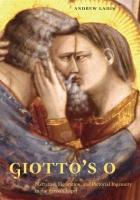




Giotto's O
Narrative, Figuration, and Pictorial Ingenuity in the Arena Chapel
Andrew Ladis
“Andrew Ladis’s inspired and beautifully wrought meditation on Giotto’s Scrovegni Chapel frescoes, a distillation of over thirty years of study, is a book of rare literary distinction, critical acumen, and scholarly depth—a work that illuminates with stunning insight the spirituality, humanity, and artistic genius of one of the truly great artists in the Western tradition.”
- Media
- Description
- Reviews
- Bio
- Table of Contents
- Sample Chapters
- Subjects
Winner, 2009 Choice Outstanding Academic Title
“Andrew Ladis’s inspired and beautifully wrought meditation on Giotto’s Scrovegni Chapel frescoes, a distillation of over thirty years of study, is a book of rare literary distinction, critical acumen, and scholarly depth—a work that illuminates with stunning insight the spirituality, humanity, and artistic genius of one of the truly great artists in the Western tradition.”
“A marvelous work, beautifully written, full of fresh observations about the Arena Chapel.”
“This splendid book represents a culmination of Ladis’s long study of late medieval Italian art, particularly the work of Giotto. Completed just before Ladis’s untimely death, it is a sustained analysis of the interrelated subjects, themes, and theological ideas manifested in the Arena Chapel frescoes. Above all, it represents a remarkable act of seeing, complementing Giotto’s own unique vision. This book, with its emphasis on the poetics of form, serves as the perfect complement to Anne Derbes and Mark Sandona’s equally superb The Usurer’s Heart (2008), which provides a more text-based analysis of the chapel, its donors, and its meaning. Both books will be considered crucial reading for years to come about one of the supreme works of European painting.”
“For the reader of these extraordinarily perceptive essays, [Ladis’s] book is a prose poem in ekphrasis. Again and again, he inspires the reader to be a ‘thoughtful viewer-pilgrim’; we pilgrims are fortunate to have such a meticulous and sophisticated guide in Andrew Ladis.”
Andrew Ladis was Professor of Art History at the University of Georgia. He is the author of Studies in Italian Art (2001), Giotto and the World of Early Italian Art, 4 vols. (1998), The Brancacci Chapel, Florence (1993), Italian Renaissance Maiolica from Southern Collections (1989), and Taddeo Gaddi: Critical Reappraisal and Catalogue Raisonné (1982).
Contents
List of Illustrations
Preface and Acknowledgments
Introduction: Giotto’s O
1. The Highest Thing
2. That Obscure Object of Desire
3. Phantom Presences
4. The Rhetoric of Wonder
5. Things and Time
Conclusion: Full Circle
Notes
Bibliography
Index
Introduction
Giotto’s O
In both the 1550 and 1568 editions of his Lives, Giorgio Vasari tells us that Pope Benedict IX, hearing of Giotto’s fame,
sent one of his courtiers into Tuscany to see what sort of man was Giotto, and of what kind his works, having designed to have some pictures made in S. Pietro. This courtier, coming in order to see Giotto and to hear what other masters there were in Florence excellent in painting and in mosaic, talked to many masters in Siena. Then, having received drawings from them, he came to Florence, and having gone into the shop of Giotto, who was working, declared to him the mind of the Pope and in what way it was proposed to make use of his labour, and at last asked him for some little drawing, to the end that he might send it to His Holiness. Giotto, who was most courteous, took a paper, and on that, with a brush dipped in red, holding his arm fast against his side in order to make a compass, with a turn of the hand made a circle, so true in proportion and circumference that to behold it was a marvel. This done, he smiled and said to the courtier: “Here is your drawing.” He, thinking he was being derided, said: “Am I to have no other drawing but this?” “’Tis enough and to spare,” answered Giotto. “Send it, together with the others, and you will see if it will be recognized.” The envoy, seeing that he could get nothing else, left him, very ill-satisfied and doubting that he had been fooled. All the same, sending to the Pope the other drawings and the names of those who had made them, he also sent that of Giotto, relating the method that he had followed in making his circle without moving his arm and without compasses. Wherefore the Pope and many courtiers that were versed in the arts recognized by this how much Giotto surpassed in excellence all the other painters of his time. This matter having afterwards spread abroad, there was born from it the proverb that is still wont to be said to men of gross wits: “Tu sei più tondo che l’O di Giotto!” (“Thou are rounder than Giotto’s circle”). This proverb can be called beautiful not only from the occasion that gave it birth, but also for its significance, which consists in the double meaning; tondo being used, in Tuscany, both for the perfect shape of a circle and for slowness and grossness of understanding.
The tale of Giotto’s O is a story of magical technical mastery and the most unassuming interpretive intelligence, an extraordinary combination of hand and mind. The painter transforms himself into a human compass, but in addition to mechanical precision there is a diagnostic dimension behind the mark that is equally astonishing, an idea that informs and elevates the painter’s manual dexterity. A tondo is nothing, a simple, unlabored, unostentatious sign, accomplished with near-invisible speed, a zero, but in the case of the pope’s courtier it is also a characterization of the fool who ran the errand, a nothing that says it all. It is significant form. Like the O, the cycle of murals in the Arena Chapel has a depth that underpins the whole, an unpretentious profundity manifested in a formal order, and as in the case of the O, one must have the wherewithal to discern Giotto’s achievement beyond the directness and emotional power of the narrative.
The murals by Giotto in the Arena Chapel (figs. 2, 12) constitute the greatest pictorial cycle of fourteenth-century Europe. Above all, what elevates them to the realm of the universal and timeless is their profound humanity. In a series of images whose subtlety, truthfulness, and dramatic range anticipate Caravaggio and Rembrandt, Giotto explored the world of the human heart and mind in such a way that, as the nineteenth-century English critic John Ruskin put it, he “defines, explains, and exalts every sweet incident of human nature; and makes dear to daily life every mystic imagination of natures greater than our own. He reconciles, while he intensifies, every virtue of domestic and monastic thought. He makes the simplest household duties sacred, and the highest religious passions serviceable and just.” Indeed, Giotto’s cycle in Padua is a monument of sublime storytelling. The narratives on the walls of the Arena Chapel have a dramatic power, an intellectual subtlety, and a pictorial economy undimmed by circumstances of condition or distance. In them the Christian saga of man’s salvation comes to life and takes hold of the imagination by means of an exceptional directness and authenticity. Giotto’s images capture, as writers since the painter’s own day have often said, the abiding and universal verities of the human condition, and such is their effectiveness that they embed themselves in the mind with a pellucid clarity true of only the greatest works of art.
That contemporaries recognized Giotto’s murals as something extraordinary is indicated by early sources. The painted chapel is recorded as an event of note in Riccobaldo’s universal chronicle of 1312–13. Virtually at the same moment—and quite exceptionally for a trecento writer—Francesco da Barberino, in the Documenti d’amore (1313), goes so far as to note the specific personification of Envy in Giotto’s cycle, though he remembers the figure as “Animosity.” But in the years that followed, as Giotto became an artist with international standing and as his name became synonymous with the highest artistic accomplishment, the Arena Chapel somehow began to recede from view. The coup de grace came, perhaps, in the sixteenth century, when the chapel merited no more than a mention in Vasari’s famously influential Lives as una gloria mondana, or “a wonder of the world.” As a consequence, despite its now-universal status as Giotto’s greatest achievement and as a harbinger of the Renaissance, Giotto’s paintings in the Arena Chapel remained relatively obscure until the nineteenth century, when Lord Lindsay and Ruskin recognized them as having a central place in the critical understanding of Giotto’s art. This was at about the time of the rediscovery of Giotto’s murals in Santa Croce, Florence, and the rise of interest in painting before Raphael. If Giotto has been defined by Vasari, then the Arena Chapel has been defined by nineteenth-century values.
The nineteenth-century writers whose praise resurrected Giotto’s murals from their quiet isolation constructed a view of them and of Giotto that would prove decisive for modern scholarship. Above all, Victorian writers such as Mrs. Maria Callcott, Lord Lindsay, Giovanni Battista Cavalcaselle, and Ruskin understood the murals as stories, that is, as unaffected visual prose, uncomplicated in its directness, almost childlike in its simplicity, and unequivocal in its sincerity. Seeing Giotto’s cycle as a story told in a specific chronological sequence encouraged readers and visitors to see it in an additive and progressive way, that is, scene by scene, but to privilege narration is to risk ignoring another part of Giotto’s cycle, namely, that vast body of meaning that lies beneath the surface of the imagery and that enriches the drama’s emotional strength. The narrative, where Giotto’s humanity triumphs, is the most visible and the most communicative part of the program, but it is only the surface. It is a powerfully attractive and engaging lure. Yet to understand the Arena Chapel and Giotto’s accomplishment there, one has to see it whole. To do so hardly changes our understanding of the cycle as a visual treatise on salvation. It does reveal additional layers of meaning, however, so that in the end the subtlety and symmetry of the pictorial cycle itself becomes a visual parallel to the perfection of the divine plan. In addition to a narrative of matchless emotional depth, Giotto’s cycle is an all-embracing figural structure apprehended by abandoning the horizontal thrust of the narrative through time and by following visual cues that encourage readings that transcend narrative time.
It is the premise of this book that the pictorial decoration of the Arena Chapel in Padua is a carefully conceived, ingeniously accomplished, and perfectly unified scheme in which the design, placement, and function of virtually every element, very often even the most seemingly trivial or marginal, stems from a plan that embraces the entire pictorial program. Such comprehensiveness and precision presuppose that the program depicted on the walls of the chapel was begun with an envisioned scheme in mind and in hand, a design that must have included working drawings of specific scenes as well as plans for each narrative sequence and each wall. Form and content work together so carefully as to take in the whole interior and produce a feeling for the whole that is indissoluble from the parts. The painter reveals a consistent tendency to perfect, to balance, to rhyme, to render logical; in this, he recalls the poetry of Dante, the treatises of the Scholastics, and the geometry of his own architecture. Everywhere the pictorial program shows evidence of structure, of order. Indeed, the subtlety and the profundity of the various events depicted on its walls are more fully apprehensible when the parts are understood in relation to each other and to the whole. Like a musical composition that is mathematically perfect, like a poem that is metrically precise, or like a geometric form—say, a circle—Giotto’s cycle must be seen as an entity in which the various parts are subjected to a circumscribed structure and directed toward a common end. It is the simple, and hardly original, basis of this book that keeping the whole of the chapel in mind opens up the possibility of readings that immeasurably enlarge and enrich the narrative without threatening its dramatic effect.
The various particulars of the narrative, no matter how marginal, are connected to the whole in an organic and meaningful way; moreover, the integration that the painter-designer achieves is not merely formal but thematic and structural as well. Building on the observations of many but ultimately of Mikhail Alpatov, this volume seeks to pursue the implications of the latter’s observation that certain scenes within the chapel are so positioned as to create internal parallels within the narrative. It builds on the suggestion, put forward in an inchoate, instinctive way by early scholars, of an internal structure to the narrative manifested in such formal qualities as balance, symmetry, mirroring, and inversion. (In this its geometry recalls the measure, rhythm, and rhyme of poetry. Dante’s Commedia, completed ca. 1310, is effectively contemporary.) Geometry in the sense that I use it applies not only to the disposition of scenes on the walls of the chapel and to Giotto’s design of every scene, but also to the internal order that Giotto imposes on the narrative itself, an order largely concerned with both form and meaning. The importance of geometry for Giotto’s sense of design is a commonplace in the literature, but the implications of Giotto’s geometry for the content of his cycle has been the focus of writings by Max Imdahl and Sven Mieth. Moreover, these observations correspond to Marvin Trachtenberg’s arguments for contemporary urbanism in Florence.
But Giotto’s cycle is also a figural edifice. Alpatov’s insight about the iconographic parallels between the scenes of the Passion and those above should be understood as a starting point. Over the course of the twentieth century, other writers have appreciated the potential of vertical readings of the cycle, and of particular importance are the works of Giuseppe Basile, Janetta Rebold Benton, Bruce Cole, Anne Derbes and Mark Sandona, Laura Jacobus, and Mieth. The present study aims to show how parallelism is something that governs every aspect of the chapel, including the way in which Giotto conceived and painted his cycle. Indeed, symmetry, along with antithesis, may be understood as a guiding ideal in every sense: symmetry as an aesthetic imperative, as an iconographic possibility, as the essence of dramatic action.
The Arena is unique in Giotto’s oeuvre, and there are few, if any, comparable pictorial projects from the Italian trecento. It is often remarked in the literature that the chapel interior was perfectly suited to mural decoration, but it is sometimes easy to forget the attendant difficulties such an undertaking posed some seven hundred years ago. The interior, though far from the scale of the great mendicant churches of the time or of the Sistine Chapel of a later day, is by no means small: 20.82 meters in length, 8.42 meters in width, and 12.80 meters in height. Moreover, the pictorial program is one of the most comprehensive to have been realized by a single painter in the trecento. To be sure, among extant trecento cycles by a single painter, few, if any, can have been so demanding of the artist’s labor, skill, and intellect, and it is hard to think that in its day the commission could have been regarded as anything but notable in terms of its scale and its complexity. Among Giotto’s contemporaries one thinks of Duccio’s Maestà, but in the field of mural painting nothing else from the first half of the century can approach the Arena Chapel in terms of narrative intricacy. Moreover, the commission is extraordinary in another sense as well: it involved decorating an entire interior and not just a part. Few are the surviving cycles by a single artist painting every paintable surface above the floor. The task of decorating such an interior—as opposed to a chapel in a transept or a tier of a wall, such as the Franciscan legend in the nave of the upper church of San Francesco at Assisi—meant that there were no preexisting images to act as impediments to the painter’s scheme but also none to serve as guides. The problem of the Arena Chapel required Giotto to think of the space as a whole, with all of the obstacles as well as the advantages of that contingency, and his genius lay in exploiting the challenge. For all his fabled success, Giotto is unlikely to have gotten another commission of this kind, and he was one of the few painters of his day to have had such an opportunity at all.
The scale and complexity of the project reflect the motivations, hopes, and ambitions of the patron, Enrico Scrovegni. The latter acquired the land, which was the site of an ancient Roman arena at the southern end of Padua, in 1300. The dedication ceremony of 25 March 1303, the Feast of the Annunciation, implies that construction of the chapel, attached to the Scrovegni palace, was finished; a second dedication on 25 March 1305 implies that the interior decoration was probably complete. In 1304, papal indulgences were granted to those who visited the chapel, again indicating the chapel’s readiness as well as its prominence and its role as a private chapel with a strategic purpose. Enrico’s personal and political hopes are evident in the dedication of his chapel to Santa Maria della Carità. The dedication of the chapel to the Virgin of Charity gets at Enrico’s hope to absolve himself and his family from the sins of his father, whom Dante condemned to the rain of fire and burning sands of the seventh circle of the Inferno (XVII.35–65), where he joined other usurers forever burdened with sacks of money suspended from their necks. While it is true, as Cole has argued, that there is no certain evidence that usury was the motivating imperative, the content of the cycle does emphasize charity and envy no less than justice, as stressed by Jonathan Riess, Ursula Schlegel, and Derbes and Sandona. It therefore allows and even encourages one to read the whole as guided by ideas consistent with reconciling the sin of usury with God’s judgment. At the same time, while the unwelcome spiritual burden of usury must have played a motivating role in both the building and its pictorial program, Scrovegni did not neglect his earthly social and political ambitions in Padua, because the chapel proclaims in a shrewd way Enrico’s presence and standing—never mind that in the years between the completion of Giotto’s cycle and Enrico’s death in 1336, the patron was to spend more time in exile than in his native city. The chapel attached to the Scrovegni palace and the cycle created by the painter to the pope amount to more than a case of simple restitution for spiritual credit: the Arena Chapel constitutes an unhushed declaration of legitimacy, a bold statement of the patron’s aspirations, and a visible warning to Enrico’s enemies. Asserting the cleansing power of charity, that is, love, as well as the reclaimed legitimacy of the Scrovegni name, the chapel dwells on the themes of family and love, specifically, the divine father’s love. The chapel is, in fact, a burial chapel and stands as an act of penitence that aims to rescue the family name and to ameliorate its spiritual and earthly fate.
Enrico’s ambitions are evident, too, in the prominent artists whom he employed, notably Giovanni Pisano and Giotto. The latter, at the time of the project, was fresh from a triumphant sojourn in Rome. Described in 1303 as satis juvenis, Giotto’s career was on an upward trajectory, for in Rome he had scored one of his greatest successes—his mosaic of the Navicella for Old Saint Peter’s, which was to remain his most famous work throughout the Renaissance. He is, in fact, depicted as fashioning a mosaic in Rossellino’s fifteenth-century cenotaph in the Florentine cathedral. Perhaps Giotto’s experience of Rome accounts for the ambitiousness of the Arena; the latter comes after the artist saw and, in a sense, created for Rome, and in some way the Arena Chapel may be understood as an attempt to rival Rome. This view supposes that Giotto was deeply impressed with the grandeur of Rome, both ancient and Christian, so that in a sense the Arena may be regarded as Giotto’s greatest surviving “Roman” work (figs. 1, 2).
The complexity of the Paduan cycle, the subtlety of its content, the scale of the undertaking, and the speed of execution allowed little time for planning between the dates of the two dedications, and the many pictorial relationships in the design make it unlikely that the painted program was devised ad hoc, although Giotto certainly made refinements, corrections, discoveries, and alterations during the course of painting. If the chapel itself was not erected until 1303, then one ought to allow for the possibility that Giotto actually began planning the cycle while in Rome. The elaborate structure of the program is such that it is inconceivable without a plan. In Rome he would have had firsthand experience with extensive, theologically complex, multilayered cycles, such as those in Santa Maria Maggiore and Old Saint Peter’s, and in Rome he would have had occasion to encounter theological minds aplenty. In any case, planning could have commenced only after Enrico had acquired the land from the Dalesmanini family on 6 February 1300 and probably after 31 March 1302, when Scrovegni received permission from the bishop of Padua, Ottobono da Piacenza, to build a family oratory on the site. Despite Scrovegni’s stated private aims, the patron revealed his guarded public ambitions when, on 1 March 1304, his friend Pope Benedict XI granted indulgences to those visiting the chapel. The decoration of the interior could have been accomplished between the first dedication on 25 March 1303 and a consecration ceremony on 25 March 1305, but there are no documents for Giotto’s work in the chapel; the dating of his murals thus remains, strictly speaking, conjectural. The complaint of the neighboring Eremitani monks on 9 January 1305 about the scale of the building, the unreasonable human traffic it had generated, and above all the excessive splendor of what was to be a private oratory hints that the interior decoration was already under way or complete. How else does one account for the monks’ otherwise intemperate charge that Scrovegni’s structure was built “more for pomp, vainglory, and wealth than for praise, glory and honor of God”?
It is clear from the internal evidence, not to mention our understanding of trecento procedure, that Giotto did not do all of the painting himself. Apart from help with such things as the scaffolding and plastering, assistance even extended beyond the more or less mechanical undertakings as the painting of borders. Assistants were essential and probably, though not necessarily always, they are responsible for the less successfully painted passages, for there are clear variations in quality: the architecture in the Annunciation to Anna, figures in the Meeting at the Golden Gate, many of the infants in the Massacre of the Innocents, certain figures, including angels and souls, in the Last Judgment, as well as some of the apostles in the Ascension, which shows that Giotto allowed the workshop to participate even in the Passion—namely, that portion of the narrative closest to the viewer, the climax of the cycle, and the most likely to be autograph.
The careful organization of the whole and the calculated manipulation of objects, figures, scenes, and systems of illusion are manifestations of an authorial presence. Whether that author is Giotto alone, or (more likely) Giotto and one or more advisors, the role of the artist in articulating the imagery is paramount. So much of what we see can only have been invented by the painter—albeit a thoughtful painter who may have taken advice as a starting point, one who had the advantage of a pictorial tradition going back to early Christian Italy and was cognizant of a long and vivid exegetical tradition. Who advised Giotto is a more difficult, and perhaps impossible, question to answer. Emma Simi Varanelli sees the whole as deeply influenced by Thomistic theology and suggests an advisor from the local Dominican community. Claudio Bellinati advances the name of Altegrado de’ Cattanei. Others have suggested an unnamed Augustinian. In any event, one must keep in mind that no matter who advised Giotto or how much help he actually got, one is dealing with a painter of exceptional ability and range who made formal and iconographic decisions of his own. Certain solutions are essentially pictorial and unlikely to have come from an advisor whose province was words.
Moreover, the perfection of the design suggests that the whole is as Giotto designed it. Giotto must have had in mind a privileged viewer who could walk freely in the space of the chapel and could see it all (fig. 3). Originally, the chapel was divided into two precincts, public and private, and outfitted with three altars, two of which were situated near the middle of the space, where a rood-beam once supported the painted cross now in the Museo Civico. Yet despite the intrusion of altars and objects, the space of the chapel was open to the free passage of the spectator’s person and eye. As Benton argued, there is an implicit acknowledgment of the spectator’s presence. The design takes into account the physical experience of viewing the interior, the way in which a spectator would slowly and gradually pursue degrees of meaning in the cycle. In fact, one cannot imagine that the many subtleties of the program or of Giotto’s pictorial solutions are apprehensible in a single summary viewing. Rather, one presupposes a viewing of longue durée, or multiple viewings that, added together, make up a cumulative experience. One requires time to meditate upon the images, to unlock their contents. Viewers and worshippers—namely, Scrovegni and his house as well as certain of the “public”—would have brought with them varying degrees of experience, sympathy, acumen, and insight, and the program is conceived, accomplished, and perceived in a way that permits gradual penetration beyond the surface of the narrative, should one have the freedom, capacity, and time to do so. Giotto, and whoever else may have been involved in devising the scheme, fashioned a prodigious biblical compendium whose aim, as with other works of profound spirituality, was to instruct and to encourage discovery. One is invited to go beyond the surface that is the narrative and to enter a different kind of reality in pursuit of what is beyond mere illustration and description. Ultimately, the cycle is not simple storytelling, however memorable, but something more complex. There is a figural system at play, a system that encourages the viewer to look past the narrative’s surface—no matter how compelling, no matter how moving—toward a deeper spiritual truth. That figural order is intellectually weightier: a narrative that aspires to the condition of memory. Nevertheless, if the profundity of Giotto’s cycle lies in its figural content, then its effectiveness depends upon the painter’s humanity and dramatic power, his ability to seize and move the spectator, both in an emotional and in a physical sense.
As Trachtenberg has pointed out, the degree to which Giotto created a complex structure of fictive architecture and material is remarkable. The fictive dentil course, marble dado, and base at the viewer’s level, no less than the framing of the scenes, signals the idea of different levels of reality (fig. 4). The various classes of images, the fictive architecture, and the fictive materials are manifestations of multiple levels of illusion, and thus of meaning, indicated to the spectator from the very beginning, on the lowest level of the space. Robin Simon notes that the fictive marble paneling originally extended to the floor, thereby enhancing the impression of the Virtues and Vices as sculptures set into the wall, while both supporting and detaching the horizontally flowing narrative that plays out just above eye level above the floor (3.02 meters). This fact begs the question of Giotto’s role as architect, proposed long ago by Pietro Selvatico. The interior is free of “real” architectural features, and those who support the theory that Giotto designed the building usually assume that Giotto would have preferred an architecturally “blank” interior. That Giotto struggled to “rectify” the space, that he sought symmetry where the architecture worked against it, may be deduced from the way that the uppermost scenes of the narrative extend into the vault; the latter is a curious and exceptional departure from trecento practice and has the smell of compromise about it.
There is, however, no compromise in Giotto’s ingenious treatment of the action and his profound understanding of the narrative, of the details of composition, much less of human emotion and psychology. So direct, so clear, so human are Giotto’s inventions in the Arena Chapel that his images become embedded in the memory with a sureness granted to few artistic creations. The painter’s insightfulness is as artless and as transparent as a simple mark, bearing the intelligence of geometry and the economy of metaphor. His is a seeming simplicity that contains untold depth, a thing of nature and poetry but also geometry, rhetoric, and theology. In the end, as in the beginning, the scienza underlying the painter’s art is effortless: as unassuming, as pure, and as profound as a circle.
Mailing List
Subscribe to our mailing list and be notified about new titles, journals and catalogs.