



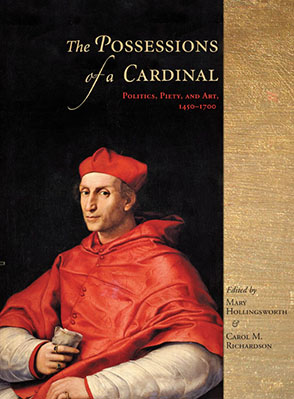
The Possessions of a Cardinal
Politics, Piety, and Art, 1450–1700
Edited by Mary Hollingsworth, and Carol M. Richardson
The Possessions of a Cardinal
Politics, Piety, and Art, 1450–1700
Edited by Mary Hollingsworth, and Carol M. Richardson
“Both informative and engaging.”
- Description
- Reviews
- Bio
- Table of Contents
- Sample Chapters
- Subjects
Cardinals crossed the ambiguous boundaries then existing between religious and secular power. Granted unparalleled access to Church and private property, they spent considerable time, money, and effort on making the best collections of art and antiquities. Some commissioned artworks in churches that advertised their monastic or national connections, while others took Rome and the papacy abroad to enrich their own cities and countries. But theirs was a precarious dignity: while cardinals could thrive during one papacy, they could suddenly fall from power during the next. The new research represented by the sixteen case studies in The Possessions of a Cardinal reveals how cardinals used their vulnerable position and spent their often substantial wealth on personal and religious interests. As a result, the tensions inherent in their position between the spiritual and the worldly are underscored.
“Both informative and engaging.”
“The editors should be congratulated for bringing together such a lively and thought-provoking volume.”
“In this beautifully produced and generously illustrated book, art historians Mary Hollingsworth and Carol Richardson offer case studies on the activities of cardinals as patrons of art and architecture from 1450 to 1700.”
“[This] volume is impressive in its chronological range, allowing for a sense of historical continuity that transcends the labels of Renaissance and Baroque.”
“The Possessions of a Cardinal brings together a variety of analytic techniques. . . . The collection is also distinguished by innovative methods and richness of content. [It] will be of great interest to historians of Italian art, to art literature scholars, and to specialists in the history of Church ecclesiastics. The book is interesting, informative, and fair, and offers something to the specialist as well as to the more general reader.”
“[Mary Hollingsworth and Carol Richardson] have succeeded in producing a collection that is both attractive and compelling. Visually this is a seductive book, full of cardinal red. . . . This volume presents countless gems for the close reader. Not only is this book a treasure trove of detail concerning early modern Rome, its cardinals, and their families, but it also provides a map of manuscript citations and early printed works. . . . This volume is welcome both for its content and its enthusiasm for a field that has experienced past prejudice.”
Mary Hollingsworth is an independent scholar and author of several books, including The Cardinal’s Hat: Money, Ambition, and Everyday Life in the Court of a Borgia Prince (2005).
Carol M. Richardson is Lecturer in Art History at the Open University and Associate Dean (Curriculum and Awards) for the University’s Faculty of Arts. She is the author of Reclaiming Rome: Cardinals in the Early Renaissance (1400–1480) (2007).
Contents
List of Illustrations
Preface and Acknowledgments
Notes on Currencies, Weights, and Measures
List of Abbreviations
Introduction
Mary Hollingsworth and Carol M. Richardson
1. The Renaissance Cardinalate: From Paolo Cortesi’s De cardinalatu to the Present
David S. Chambers
2. Guillaume d’Estouteville’s Italian Journey
Meredith J. Gill
3. Francesco Todeschini Piccolomini (1439–1503), Sant’Eustachio, and the Consorteria Piccolomini
Carol M. Richardson
4. Gabriele Rangone (†1486): The First Observant Franciscan Cardinal and His Chapel in Santa Maria in Aracoeli, Rome
Roberto Cobianchi
5. Cardinal of Naples and Cardinal in Rome: The Patronage of Oliviero Carafa
Diana Norman
6. Cardinal Bernardo Dovizi da Bibbiena (1470–1520): A Palatine Cardinal
Angelica Pediconi
7. “Per havere tutte le opere . . . da monsignor reverendissimo”: Artists Seeking the Favor of Cardinal Giulio de’ Medici
Sheryl Reiss
8. A Taste for Conspicuous Consumption: Cardinal Ippolito d’Este and His Wardrobe, 1555–1566
Mary Hollingsworth
9. Lost in Antiquities: Cardinal Giovanni de’ Medici (1543–1562)
Andrea Gáldy
10. The Court of Humility: Carlo Borromeo and the Ritual of Reform
Pamela M. Jones
11. Contrasting Priorities: Ferdinando I de’ Medici, Cardinal and Grand Duke
Suzanne B. Butters
12. Cardinal Virtues: Odoardo Farnese in His Camerino
Opher Mansour
13. Representing an Alternative Empire at the Court of Cardinal Federico Borromeo in Habsburg Milan
Lucy C. Cutler
14. Cardinal Antonio Barberini (1608–1671) and the Politics of Art in Baroque Rome
Karin Wolfe
15. John Casimir Wasa (1609–1672), Cardinal and Prince of Poland: Problems of Precedence and Primogeniture for Innocent X
Susan Russell
16. “É cortesi, erudito, e disinvolto al pari di qualunque altro buon corteggiano”: Cardinal Camillo Massimo (1620–1677) at the Court of Pope Clement X
Lisa Beaven
17. A Cardinal and His Family: The Case of Cardinal Patrizi
David R. Marshall
Appendixes
Bibliography
List of Contributors
Index
Introduction
Cardinals occupied a unique place in the world of early modern Europe. Appointed for life by popes determined to assert their spiritual supremacy over the authority of temporal rulers, these princes of the Church fulfilled a role that amply illustrates the ambiguous boundaries that then existed between religious and secular power. One popular metaphor of the period defined cardinals as the heirs of the apostles, co-workers of St. Peter, the first pope, who had been entrusted by Christ himself with the care of his flock. The fifteenth-century antiquarian Flavio Biondo, however, preferred to stress their importance in the secular world when he defined the pope and cardinals as the heirs of the emperor and Senate of ancient Rome. This latter definition was perhaps closer to the truth: the college of cardinals was essentially an advisory committee, its influence subordinate to papal authority, though it did acquire real power during the sede vacante (the short period when there was no pope, between the death of one and the election of the next) when the college took charge of running the Church after the death of a pope. This book, which is unique for its chronological span, is particularly concerned with the ways in which the visual arts were used to negotiate some of the conflicting ties of loyalty and identity inherent to the position of a cardinal in the Renaissance and baroque periods.
As the pope’s men, the cardinals played a key role in the dramatic events of a period that was to challenge both the power and authority of the papacy: the conciliar movement of the fifteenth century, the sack of Rome in 1527, and the violent upheavals of the Habsburg-Valois wars; the Protestant Reformation and the religious conflicts that divided Europe during the sixteenth century; the Church’s retaliation and the Counter-Reformation; the political ramifications of the rivalry between France and Spain that continued to divide Europe during the seventeenth century. The prestige of a cardinal’s hat, once acquired, was rarely renounced. Only four cardinals resigned between 1450 and 1605: Odet de Châtillon was deprived of his title in 1563 after converting to Protestantism, while Cesare Borgia, Ferdinando de’ Medici (see Chapter 11, by Suzanne B. Butters) and Albert von Habsburg all opted for secular titles, as did John Casimir Vasa (see Chapter 15, by Susan Russell) in the seventeenth century.
Cardinals were marked out by their distinctive red hats, the visible signs not only of impressive careers, which had brought them to the highest rank the head of the Church could bestow, but also of high social status and of political influence on an international scale. As one new holder of this coveted title was warned in 1503, his activities and behavior would now be scrutinized by kings and princes, towns and nations. These hats, after all, marked the members of the elite from whom the next pope would be chosen. As papal appointees, they took precedence over more senior churchmen in their native countries, a prominence even more significant in the context of the fact that surprisingly few were ordained as priests. As heirs-in-waiting to the papal throne, their rank was equal to that of the princes and dukes in the retinues of Europe’s secular rulers. Unlike these aristocrats, however, cardinals were not necessarily nobly born—among sixteenth-century popes, negotiating as equals with kings and emperors, were the sons of bankers, lawyers, merchants, and even peasants. Nor were they courtiers in the conventional sense—while they owed their spiritual obedience to the pope, their secular loyalties did not necessarily lie in the same direction. They maintained their own courts in Rome, independent of the papal court itself, and operated their own international networks of political patronage, strengthening the city’s position as one of the chief centers of the European political system—just how influential they were is amply demonstrated by the lengths to which secular rulers would go to ensure they had their own man in the college.
One of the most striking aspects of the college of cardinals was its diversity. Most European countries were represented there—indeed, it was the presence in Rome of natives from the many Italian states, as well as those from the large centralized monarchies beyond the Alps, that gave the city its cosmopolitan character. There were also wide differences in wealth and social background, even in hobbies and ages—the youngest cardinal in the 1565 conclave was Ferdinando de’ Medici (see Chapter 11, by Suzanne B. Butters), aged just sixteen; the oldest was the seventy-one-year-old Venetian, Francesco Pisani.
Cardinals belonged to one of Europe’s oldest elites—the term “cardinal” had its roots in early Christian Rome. When Emperor Constantine moved his capital to Constantinople in 330 C.E., the pope was given charge of the administration of Rome, and he brought in clergy to act as his aides, attaching them to churches and other institutions in the city. By the second half of the eighth century these advisers were described as “incardinated,” a canonical term derived from cardo (a hinge or tenon), because they had been removed from their original benefices and attached to new ones in Rome. Thus the term “cardinal” developed to describe the unique status of a special group of clergy closely linked with the pope, the bishop of Rome. Each received one of three different types of title—in order of precedence, bishop, priest, and deacon. Cardinal-bishops were in charge of the sees near Rome. Cardinal-priests were attached to the city’s ancient parish churches, the tituli, many of which had been founded by Roman patricians as early as the third or fourth century. Cardinal-deacons, by contrast, were not attached to churches but to the welfare centers (diaconae) set up in each district of the city, though many had chapels attached. By the end of the twelfth century the number of titles had been fixed at fifty-two—six bishops, twenty-eight priests (divided into groups of seven attached to each of Rome’s four principal churches) and eighteen deacons.
The maximum of twenty-four cardinals, decreed by the Council of Constance (1414–18) and confirmed at Basle (1431–37), was largely ignored by fifteenth-century popes. The number had already reached thirty under Martin V in 1426, and continued to creep upward, to thirty-three under Eugenius IV in 1440 and thirty-six under Sixtus IV in 1477 (see table 2). Traditionally the pope published his lists of new cardinals during the penitential seasons of Advent and Lent. It was a significant act on his part—Pius II called it the consummation of his papacy—and a prime indicator of the direction of his policy. The dramatic increase in the size of the college under Alexander VI, which reached forty-seven in September 1500, reflected his need to acquire financial and political support for his plan to create a duchy for his son, Cesare. The unprecedented appointment of thirty-three new cardinals by Leo X in 1517 was designed to stifle the widespread opposition to the pope’s intention to install his nephew as Duke of Urbino, and evict the rightful duke by force. This massive creation, which brought the total number of cardinals to sixty-three, required the addition of new titular churches to the traditional list, including several with no early Christian provenance.
Leo X’s successors continued the enlargement, though with less drama. The college did not reach sixty-three again until 1544, under Paul III, and rose to sixty-six under Paul IV, when he created eleven new cardinals at Christmas 1557. Paul IV’s priorities were very different from the dynastic ambitions of Alexander VI and Leo X—his cardinals were mainly pious churchmen, committed to rigorous reform of the abuses within the Church. Pius V, who had been one of these hard-line reformers (the Dominican inquisitor-general, Michele Ghislieri), continued to fill the college with like-minded members and increased the number to seventy-two in 1570 with the creation of sixteen new cardinals; he was also obliged to create several new titular churches. With the radical reforms instituted by Sixtus V (one of the cardinals created by Pius V), the size of the college was fixed at seventy, in imitation of the seventy elders who were appointed by Moses—the pope justified the large number on the grounds that the college had to represent all nations and that the elderly and infirm would be unable to fulfill their duties. Sixtus V’s successors largely observed this limit, though it has recently been radically increased.
What kinds of men were made cardinals? Although the college was an international body, the majority were Italian. The chapters in this volume illustrate the variety of backgrounds the college contained: a relative of the king of France (see Chapter 2, by Meredith J. Gill), the son of the king of Poland (see Chapter 15, by Susan Russell), princes of Italy’s ruling houses (see Chapter 8, by Mary Hollingsworth; Chapter 9, by Andrea Gáldy; Chapter 11, by Suzanne B. Butters; and Chapter 12, by Opher Mansour), nobles from Naples (see Chapter 5, by Diana Norman), Milan (see Chapter 10, by Pamela Jones; see Chapter 13, by Lucy C. Cutler) and Rome (see Chapter 16, by Lisa Beaven; see Chapter 17, by David R. Marshall), sons of merchants and bankers (see Chapter 3, by Carol M. Richardson; see Chapter 7, by Sheryl Reiss; see Chapter 14, by Karin Wolfe), and even men from the lower ranks of society (see Chapter 4, by Roberto Cobianchi; see Chapter 6, by Angelica Pediconi).
The Church was the traditional route to wealth and influence for younger sons of the European aristocracy; a cardinal’s hat enabled them to establish their own power base, an option invariably denied to them at home (see Chapters 1, 2, 5, and 8). For men from more modest backgrounds, the hat provided one of the few opportunities available in this class-conscious society for commoners to climb into the ranks of the nobility. The banker Lorenzo de’ Medici, who had used his financial assets to secure a red hat for his fourteen-year-old son, wrote jubilantly to the boy, the future Leo X: “You, and all of us who are interested in your welfare, ought to esteem ourselves highly favored by providence, not only for the many honors and benefits bestowed upon our house, but more particularly for having conferred upon us, in your person, the greatest dignity we have ever enjoyed.” Lorenzo’s deal with Innocent VIII also involved a marriage between the banker’s daughter and the pope’s illegitimate son. Few had the assets of a family bank to finance their ambitions and relied instead on their abilities as theologians, lawyers, diplomats, secretaries, or bureaucrats. They also needed shrewd political skills, a certain amount of luck, and the support of a powerful patron.
Overwhelmingly cardinals were appointed as political favors to the secular rulers of Europe. While they did not have a formal right to name their own cardinals, the constant pressure they exerted on the papacy ensured, more often than not, that they had their way. An ally at the heart of the papal administration was a prize worth pursuing. Privy to the discussions in secret consistories, a cardinal could provide far more reliable information regarding the direction of papal policy than an ambassador, and moreover, he would have a voice in future conclaves, even the chance, if he were Italian, of election himself. The appointment, of course, worked both ways—popes stood to benefit from cardinals who could facilitate delicate negotiations through their close relationships with Europe’s heads of state. The political nature of these appointments also ensured, inevitably, that the college split along the same fault lines of interest and nationality that fractured the wider European arena.
Very few cardinals were appointed solely for their piety. Of the relatively small number who belonged to one of the religious orders, most owed their position to the favor of foreign rulers—the Benedictine Guillaume d’Estouteville for the king of France (see Chapter 2); Francesco della Rovere, minister general of the Franciscans and later Sixtus IV, for the Duke of Milan; Gabriel Rangone, a prominent Observant Franciscan, for the king of Hungary (see Chapter 4); another Observant Franciscan, Ximines de Cisneros, for the king of Spain. It is a significant comment on the secular prestige of the cardinalate during the fifteenth and sixteenth centuries that it did not appeal to those seriously committed to the religious life. The Jesuits, in particular, were initially discouraged from accepting the dignity—St. Francis Borgia, one of the early leaders of the order, is thought to have refused the offer, and Robert Bellarmine accepted his hat from Clement VIII only when the pope threatened to excommunicate him if he refused.
Other cardinals owed their promotion directly to the pope—in particular, his relatives (see Chapters 3, 7, 10, and 14) and his loyal servants (see Chapter 6), a group that accounted for some 10 percent of the total. Alexander VI appointed eight, including his son, Cesare; he also gave a red hat to his beautiful mistress’s brother, the future Paul III. Leo X appointed four nephews and his cousin, who was his right-hand man (see Chapter 7). Paul III gave hats to three of his grandsons (indeed, the Italian term nipote can be translated as either nephew or grandson). In 1550 Julius III caused an uproar when he gave a red hat to the seventeen-year-old Innocenzo del Monte, a boy he had picked up on the streets of Parma several years before and persuaded his brother to adopt: “a vicious man with no religious or virtuous inclinations.”
The practice of nepotism, firmly entrenched by 1450, reflected the very real need of popes to appoint men they could trust to the key positions in the Church’s administration, in particular, those concerned with state security. It was also a central feature of a policy pursued by most early modern popes, lubricated by access to unlimited funds, to establish his family so that the dynasty could withstand the death of its creator and the inevitable attempts of the next pope to dismantle his predecessor’s powerbase (see Chapters 3 and 14). Their attempts met with varying degrees of success—the Borgia ambitions failed spectacularly, the Piccolomini were modestly successful (see Chapter 3), while the Farnese and the Medici (see Chapters 7, 9, and 11) managed spectacularly to install themselves in Europe’s ruling elite. Conversely, having a cardinal in the family had a knock-on and often disruptive effect on the internal hierarchy within the family itself. David R. Marshall’s conclusions in Chapter 17 about the relationship between family and cardinalatial status are particularly interesting in this regard.
Nepotism, however, was not all bad. It is difficult to imagine a greater contrast between Innocenzo del Monte and Carlo Borromeo (see Chapter 10), the pious nephew of Pius IV who was created a cardinal in 1561 and would later be canonized for his services to the Counter-Reformation. With the growing appetite for Church reform during the second half of the sixteenth century, cardinal-nephews increasingly took over the secular aspects of papal authority, acting as a “prime-minister,” directing foreign policy and hosting the grandiose entertainments expected of a powerful ruler, as well as accumulating prestigious collections of art and building superb villas and palaces (see Chapter 14)—leaving the pope to concentrate on his role as spiritual leader of the Catholic world.
The publication of one’s name in the lists of new cardinals was only the first step toward acquiring the coveted red hat. On occasion, the names of some were not made public, usually for political reasons, but kept secret, in pectore (literally, in the breast), to be published when the time was right. All cardinals were expected to travel to Rome for the ceremonies that would officially install them as members of the college, though exceptions were made in special circumstances for legates abroad on important missions, for example, or for churchmen whose political position at home would be compromised by the long absence required for their journey to Rome—two English cardinals, Kemp and Wolsey, both received their hats from papal legates sent to England for the purpose.
The rituals that marked a cardinal’s official inauguration involved several separate events, spread over a period of days, even weeks. In 1505, according to the diary kept by the master of ceremonies, the schedule started on 12 December with Julius II’s public announcement of the creation of nine cardinals. Five days later he distributed hats to eight of them in Rome; for the next four days (18–21 December) the cardinals were occupied with the first visitation, when the new cardinals paid visits to each of the “old” cardinals resident in Rome; on 19 December Julius II held the closing of the mouth ceremony (clausura oris); on 22 December he held the opening of the mouth ceremony (aperitio oris), and distributed rings and titles; finally, on 2–3 January, the second visitation took place, when the “old” cardinals now visited each of their new colleagues. In Ippolito d’Este’s account of his experience of this arcane rite of passage, reported in a letter to his brother, the Duke of Ferrara, he explained that he had arrived in Rome on Sunday, 26 October 1539 and the following morning “the Pope [Paul III] gave me my hat and the usual ceremonies were carried out”; on the Thursday “there was a private consistory which I attended and went through the customary ceremony of closing the mouth, as it is called, which will be opened at my first consistory”; he added, with a certain lack of respect, that both visits and ceremonies were long and tedious. The rituals were finally completed on 10 November: “This morning there was a consistory in which the Pope performed for me those ceremonies which are customary for all new cardinals, opening, as they say, my mouth and giving me the title which was Santa Maria in Aquiro [. . .], the ring and the usual dignities.”
The gap between the papal announcement of a promotion and the ceremonies that formalized it could be long. Ippolito d’Este’s appointment, for example, was announced in pectore on 20 December 1538 and not published until 5 March 1539 (Paul III’s refusal to name Ippolito in December was a ruse, designed to coerce Ippolito’s brother into settling a dispute with the pope); he received his hat on 27 October 1539 but only become cardinal of Santa Maria in Aquiro on November 10. For others, the gap could be considerably longer. In March 1565 Pius IV created twenty-three new cardinals, nine of whom were still without titles when he died in December 1565. The lack of a title did not prevent five of them from attending the conclave, and all nine were subsequently given titular churches by Pius IV’s successor—the last, Francesco Commendone, who had been nuncio in Poland at the time of his creation, finally received his title, San Ciriaco, on 15 November 1566.
In the first of the official ceremonies a new cardinal received his hat from the pope. This was the galero, the large red hat with its distinctive hanging tassels, which was held symbolically over his head by the pope during the ceremony and then proudly carried on his formal visits to the “old” cardinals, subsequently to be worn on entry to the city where he had been appointed legate. The galero finally reappeared after the cardinal’s death, displayed at his feet and in some places hung over the funerary monument, its gradual disintegration symbolic of the inevitability of death. This was his official badge of office, still visible today in hundreds of coats of arms across Rome, but, confusingly, it was not the hat he wore on a daily basis. This was the biretta, the close-fitting scarlet beret, familiar to us from cardinals’ portraits and, as is evident from surviving inventories, had become the standard wear for cardinals by the middle of the fifteenth century. In addition to the hat, cardinals were invested with a ring after the closing of the mouth. These rings were adorned with jewels, usually a sapphire, the gem reserved for them (though modern rings are mostly plain gold). According to the liturgies of Agostino Patrizi-Piccolomini, which date from the 1480s, this ring symbolized the marriage of the cardinal with his titular church, which was assigned at the same time, and it superseded his episcopal ring if he were the bishop of a diocese.
Red was the hallmark of a cardinal, the color that embodied his closeness to, and dependence on, the pope, who traditionally wore scarlet and white—Pius V established white as the main papal color, although the pope today still wears the scarlet cape and other red accessories (notoriously, Benedict XVI’s elegant Prada shoes). According to the inventory of Francesco Soderini’s possessions, his clothes, hangings, and furniture, even his cushions, were almost exclusively red, in a variety of shades from pale to dark. Soderini, like other wealthy cardinals (see Chapter 8), could afford the best quality red cloth made with kermes (cremesino or cherimisi, from the Arabic qirmiz), a dye made from insect bodies and imported to Italy from the Middle East; cheaper reds could be obtained with locally produced grana (grain). As Paul II decreed in 1464, kermes was “the cardinal’s purple, even though it was red.” The phrase “raised to the purple,” frequently used in reference to acquiring a red hat, derives from the ancient Roman habit of investing senators with a purple toga. In the 1480s Agostino Patrizi-Piccolomini explained that cardinals entered the conclave wearing the purple to represent their power during the sede vacante as equivalent to the senators of ancient Rome. The members of Cardinal Antonio Barberini’s literary academy, rather more wittily, were known as the Purple Swans (see Chapter 14).
On certain occasions, cardinals also wore vestments of purple, or rather, a dark purple-red, a color recorded in the documents as pavonazzo or violet (violaceus, violetto), which could be made from either kermes or grana. This was also the color used to identify the conclave cells of the cardinals created by the deceased pope. The various shades of purple may not have been identical but they were, liturgically speaking, the same. It was only with the Council of Trent that the rules of a cardinal’s dress were formally defined, obliging cardinals to wear purple on liturgical days of penitence. Even before Trent, purple was used by cardinals to mark penitential seasons: in 1505 the papal master of ceremonies advised the new intake that they should not dress like some “old” cardinals who wore varying shades of red, “sed omnino violaceum colorem [but entirely in the color purple],” because it was Advent, and he extended the ruling to include the trappings of their mules. However, in the 1450s Domenico Domenichini had criticized cardinals who allowed their retinues to wear anything but purple, which certainly implies that usage varied before, though this is an area where a lot more research is needed.
The final event in the cardinalatial ceremonies was the assignment of titular churches, more often than not a matter of what happened to be vacant at the time (see Chapter 1). Some titles were more attractive than others, particularly those with residences attached. When Filippo Calandrini was made a cardinal in 1448 by his half-brother, Nicholas V, he was given the pope’s old title, Santa Susanna, together with its neglected house; three years later he persuaded Nicholas V to move him to San Lorenzo in Lucina, which came with a much grander palace. Other churches did not have separate lodgings, though some monastic establishments, such as San Clemente, seem to have included rooms reserved for the cardinal’s use. Dominicans were regularly assigned to Santa Maria sopra Minerva after it became a titular church in 1557, and Franciscans to Santa Maria in Aracoeli, while the Venetians monopolized San Marco from 1450 on. There are also several instances of familial assignment—the Medici at Santa Maria in Domica, for example, or the Della Rovere at San Pietro in Vincoli—but it is important not to confuse this with the practice whereby, soon after his election, a new pope distributed his old benefices to those who had supported him in the conclave and assigned his cardinal-nephew, usually the first cardinal to be appointed, to his old titular church.
Modern authors often express surprise over the fact that so few cardinals were ordained as bishops or even priests, but this is a relatively modern requirement. Moreover, this apparent anomaly was actually provided for by the ancient practice of assigning bishops and priests to churches but deacons to the welfare centers of Rome. During the early modern period, and particularly after the Counter-Reformation, young cardinals and those who had not been ordained were usually allocated a deacon’s title—these were also an attractive option for those from ruling dynasties who deliberately avoided ordination in case they were needed as heirs, as was the case with both Giovanni and Ferdinando de’ Medici (see Chapters 9 and 11) and with John Casimir Vasa (see Chapter 15). Generally it was only those who had been ordained who were appointed as cardinal-priests (new cardinals were never allocated to the bishoprics, which were used to reward papal favorites). There were exceptions, of course, especially for papal relatives: in 1534 Paul III gave a hat to his fourteen-year-old grandson, Alessandro Farnese, and the deacon’s title of Sant’Angelo in Pescheria, but the following year, when he appointed Alessandro as vice-chancellor of the Church, he also promoted him to cardinal-priest of San Lorenzo in Damaso, the title traditionally attached to his new position—Alessandro was only ordained in 1564, as part of the reforms instituted by the Council of Trent.
Once the new cardinal had attended the opening of the mouth ceremony and received his titular church, he was able to take up his duties as a member of the college. Not all were resident in Rome—some, mainly non-Italians, chose to live at home, others traveled abroad on official diplomatic missions, and some were exiled from the city for misdemeanors (see Chapter 8). Absence could be a problem for the pope, who relied on resident cardinals for the efficiency of his administration: as Pius II put it, “The harvest is great but the workers are few.” Out of a total of seventy-one members of the college in December 1565, less than half were in Rome when Pius IV died, though forty-eight cardinals entered the conclave ten days later (only eighteen failed to make it). Resident cardinals were central to the social and political life of the city, not to mention its economic prosperity.
A cardinal’s duties have been defined by Lowe as conciliar, ceremonial, and social. At a conciliar level, he was expected to attend consistories and, occasionally, other private meetings with the pope at the Vatican. For those in the inner circle—notably cardinal-nephews and relatives, as well as loyal servants—there would also be regular private discussions regarding papal policy, their access to the pope facilitated by their appointment as palatine cardinals with their own apartments in the Vatican (see Chapter 6). During the course of the sixteenth century, this inner circle of cardinals increasingly took over the advisory function of the college—consistories, which had taken place several times a week in the early 1500s, were held only twice monthly a century later. Its decline became terminal with the reforms instituted by Sixtus V, who, significantly, made a point of defining the cardinals as the heirs of the apostles, not the senators of ancient, pagan, Rome. His most drastic innovation was, in 1588, to devolve much of the college’s power to separate committees of cardinals, the congregations, six covering the administration of the papal states and nine to take charge of spiritual matters. Cardinals remained, however, key figures in the complex networks of political patronage that operated throughout Renaissance Europe. For Romans and foreigners alike, they had siblings, cousins, nephews, and often children of their own, whose advancement they could and did facilitate. Their households usually contained churchmen who rose up the hierarchy thanks to the intervention of their patron. They had fellow compatriots, who would pay for favors. Endemic corruption allowed them to profit on a huge scale financially. Not all cardinals were corrupt, but many were rich.
A cardinal’s income came from several sources: his titular church, his attendance in consistory, any official position he might hold in the curia, the official tip (propina) he could earn from enabling favors in consistories, and above all, from his benefices. For most, and certainly for the rich, their income came largely from the secular world. From humble convent to grand metropolitan see, they owned agricultural land and real estate, charging rents to craftsmen and shopkeepers; selling their grain, wood, and animals to merchants; and levying tithes from the peasants working their fields. The list recording the tax levied by Pius V in 1571 on the benefice income of all Italian cardinals to finance a war against the Turks, shows just how great the discrepancy was between rich and poor. At the top of the list came Alessandro Farnese and Ippolito d’Este (see Chapter 8) with incomes of over 70,000 scudi a year, while ten out of the twenty cardinals, whose total benefice income was listed, earned below 10,000 scudi—three of them registered incomes below 2,500 scudi, what Ippolito d’Este had earned from his attendance in consistory in 1560. It should be noted that, even on these incomes, cardinals were rich by the standards of the day—a painter earned just 100 scudi a year in mid-sixteenth-century Rome (see Chapter 8).
Cardinals, however, unlike painters, were burdened with the financial obligation of displaying their wealth (see Chapter 1). The simple life of a Franciscan friar, as practiced by Cardinal Ximines de Cisneros, did not impress Julius II, who criticized this cardinal’s modest habits as inappropriate to the dignity of his office. Wealthy and extravagant prince, or humble follower of Christ’s apostles? Ever since Emperor Constantine adopted Christianity as the religion of the Roman Empire and replaced the simplicity of the vita apostolica (the modest way of life followed by Christ’s apostles) with all the ceremonial trappings of imperial power, the debate over the nature of the true Christian lifestyle had divided the Church—what Chambers pithily refers to as the “splendid paradox” of wealth combined with professions of poverty. The problem was not simply one of wealth per se, but also expenditure on the grand scale to avoid the sin of avarice (see Chapter 2).
The great cardinals of the early modern period lived in style in their splendid Roman palaces and suburban villas, surrounded by large, sometimes huge, households. In each period much was made of the unparalleled glories of the cardinals’ residences (see Chapters 12 and 16), but the case studies presented here demonstrate that this was as much a concern for fifteenth-century cardinals (see Chapters 2 and 5). The cardinals’ busy social lives reflected the duality of their role as princes of the Church as they attended the papal masses held to celebrate Easter and the other major events of the Christian calendar, enjoyed the entertainments staged for Carnival or visits of foreign dignitaries, and above all, the endless rounds of visits, dinner parties, and banquets. Some took an active part in secular politics, some occupied their spare time with intellectual discussion (see Chapters 12 and 13); others preferred gambling. Several cardinals collected antiquities (see Chapters 6, 9 and 16); others enjoyed riding and hunting, both recommended by Cortesi as suitable pursuits—he even went so far as to suggest the types of horses he should use, even the riding style he should adopt. While cardinals were technically expected to be celibate, few would have been unaware of the chapel in St. Peter’s, under the protection of the kings of France, which was dedicated to St. Petronilla, reputed to be the daughter of the first pope. Many cardinals had children: d’Estouteville (see Chapter 2), Giuliano della Rovere, Ippolito d’Este (see Chapter 8), Alessandro Farnese, whose lovely daughter was the mistress of Ferdinando de’ Medici (see Chapter 11), Ugo Boncompagni (later Gregory XIII), even the modest Franciscan, Gabriel Rangone (see Chapter 4).
The quantity of letters and treatises from the early modern period, outlining the role of a cardinal, his behavior, and the qualities expected of him, provide us with compelling evidence that these issues were far from settled (see Chapter 12). Sixtus V’s reforms had a significant impact on the secular character of the sixteenth-century college: cardinals should be ordained, and at least thirty years old (though deacons could be as young as twenty-two); they should be chosen for their “blameless purity of faith”; and the college should include at least four theologians, while illegitimate men and those with children were excluded absolutely. There would be no place in the reformed college for figures such as Innocenzo del Monte—Pius IV banished him to the monastery of Monte Cassino, in the company of two Jesuits, to improve his morals. By the end of the sixteenth century, the college had begun to acquire the trappings of spirituality—Ludwig von Pastor, a harsh judge, was able to claim that the cardinals appointed by Clement VIII were “almost without exception deserving of praise.” There were even attempts in the seventeenth century to abolish the practice of nepotism, though a single papal relative could still be made a cardinal.
Above all, the early modern era saw the dramatic transformation of the visual fabric of the city of Rome. Although the impetus for this renewal came from the papal throne, the cardinals also played a significant role. In 1400 the city was shabby and dilapidated, with a population of 17,000 clustered around the banks of the Tiber. The huge area once enclosed by the ancient walls was largely empty, providing land for orchards and vineyards, pasture for cows and sheep, orchards, fields for crops, and hideouts for bandits. By 1650 Rome had become a thriving metropolis, with a population of over 100,000, a city of grand roads and piazzas, magnificent churches, and superb palaces and villas, a visual statement of a triumphant Catholic Church.
How did cardinals deal with the “splendid paradox” of being leaders of a Church whose origins were based on the poverty and simplicity of the lives of Christ and his apostles, and also powerful men in an age when conspicuous expenditure was the prime vehicle for the display of prestige? How did membership of this privileged elite affect a cardinal’s lifestyle, his possessions and his patronage of the arts? How far did they go in order to reconcile the demands of God and man? To what extent did their expenditure on art and architecture, possessions and institutions—in Rome, their benefices or their home towns—give visual expression to their religious beliefs, their social status, their personal ambitions, or their dynastic aspirations? And how did these patterns change during the years 1450 to 1700, an era of such fundamental change in the political landscape of Europe and in the Church? As this book demonstrates, the answers to these questions are far from uniform. The images created by this privileged and powerful elite reflected not only the extraordinary degree of contrasts within the college, but also its turbulent history from its unique origins in the era of the early Christian Church.
Mary Hollingsworth and Carol M. Richardson
Mailing List
Subscribe to our mailing list and be notified about new titles, journals and catalogs.