




Canon Fodder
Historical Women Political Thinkers
Penny A. Weiss
“Recognizing that women political theorists exist in gratifying abundance beginning as far back as 2300 B.C.E., Penny Weiss saves these women writers from their destiny as ‘canon fodder.’ With great zest, creativity, and imagination, Weiss reintroduces us to fascinating female thinkers who have contributed to key concepts in the history of political thought. In a lively writing style that often mimics the rhetoric of each thinker, Weiss engages both students and scholars in a discussion of the compelling—but often invisible—arguments that feminist thinkers have contributed to political theory debates.”
- Description
- Reviews
- Bio
- Table of Contents
- Sample Chapters
- Subjects
Restoring female thinkers to the conversation of political philosophy is the primary goal of this book. Part I deploys a range of these thinkers to discuss the nature of political inquiry itself. Part II focuses on alternative approaches to and visions of core political ideas: equality, power, revolution, childhood, and community. While mainly an intellectual act of revival, this book also affects practical political life, because “remote and academic as they sometimes appear, debates about what to include in the canon ultimately touch almost everyone: students handed texts from lists of ‘great books’ to guide them . . . and citizens whose governments justify their actions with ideas from political texts deemed classic."
“Recognizing that women political theorists exist in gratifying abundance beginning as far back as 2300 B.C.E., Penny Weiss saves these women writers from their destiny as ‘canon fodder.’ With great zest, creativity, and imagination, Weiss reintroduces us to fascinating female thinkers who have contributed to key concepts in the history of political thought. In a lively writing style that often mimics the rhetoric of each thinker, Weiss engages both students and scholars in a discussion of the compelling—but often invisible—arguments that feminist thinkers have contributed to political theory debates.”
“It is a provocative work that will lead to broad-based discussions in political science, philosophy, and women’s studies. The work’s greatest contribution is its claims for the importance of women’s political and feminist theory from the past, and what it has to teach us today.”
“This book should have been written long ago, and Weiss superbly delivers her subject. This engaging work should be read and discussed widely by scholars and students of political science, philosophy, and women’s studies.”
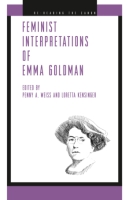
Penny A. Weiss is Director of Women’s Studies and Professor of Political Science at St. Louis University. She is also co-editor of Feminist Interpretations of Emma Goldman (Penn State, 2007).
Contents
Introduction: Search and Recover
Part 1: Rethinking Political Theory
1. The Politics of the Canon: Gatekeepers and Gate-Crashers
2. The Politics of Ignorance: Christine de Pizan
3. The Politics of Form: Sei Shōnagon
Part 2: Doing Political Theory
4. Community: Mary Wollstonecraft and Anna Julia Cooper
5. Revolution: Declaration of Sentiments at Seneca Falls
6. Childhood: Emma Goldman
7. Power: Mary Astell
8. Equality: Quilted Voices
References
Index
Introduction
I was once shocked to discover that feminist theorists actually existed as far back as we have records of political writings. As traditionally trained as possible, with a Ph.D. from Notre Dame (the fighting Yiddish?), I was introduced as a student to only those exalted male figures who to this day continue with astonishing perseverance to dominate every textbook, syllabus, journal, and conference in political theory. It was simply understood that there were no women political philosophers (a few of my peers and teachers thought that unfortunate). Well, not only is that familiar understanding completely without merit, it is not even true that there is a “relative absence of texts in the history of political thought . . . by women,” or that “female (let alone feminist) texts in political thought [a]re an anomaly” (Springborg 1995, 621; emphasis added). What we are faced with is not the absence of writings—they exist in gratifying abundance. The seemingly intractable problems include, instead, failure to keep works by women theorists in print, paucity of academic commentary on the texts, an unmistakable pattern of underestimation and careless analysis in the few judgments on those texts that scholars have rendered (Carroll 1990), and omission of women philosophers in standard college courses.
After the shock of discovery wore off came anger. Thinking back, I was mildly infuriated, for example, that I had to sit through a “Medieval Political Thought” class studying what for me were the nearly unbearable texts of Augustine and Aquinas, when I could have at least also been reading, to name just a few from those same centuries, Hildegard of Bingen; or Saint Catherine of Siena; or Theresa of Avila; or Christine de Pizan; or even, taking a more global approach, Sei Shōnagon or Murasaki Shikibu. I was incensed that liberalism was taught without reference to women such as Mary Wollstonecraft or Harriet Taylor, that anarchism was written about without mention of women like Emma Goldman or Voltairine de Cleyre, that one could read collections on “the Enlightenment” or “democratic theory” and never learn about a single woman who contributed masterfully to such eras or bodies of thought. In fact, whether the approach of teachers and texts was based on concepts or periods of time or schools of thought, women vanished from reading lists in a remarkable political process of erasure. To this day hefty tomes with unabashedly bold and sweeping titles such as Readings in Classical Political Thought (Steinberger 2000) and Classics of Moral and Political Theory (M. Morgan 2006) include not a single female thinker. Even today, in what is supposed to be “postfeminism,” publishers persist in regularly reissuing nearly identical selections from the all-male roster of noteworthy thinkers, and it remains ridiculously rare to find more than token inclusion of women thinkers—at the tail end of the book, speaking only on the subject of feminism. A few female figures are beginning to make repeated appearances—most notably Wollstonecraft, Hannah Arendt, and Simone de Beauvoir—often because editors can link them easily, though not always correctly, to canonized male writers or established schools of thought. But we have barely begun to tap the lengthy list of women thinkers that some date back to Enheduanna (around 2300 B.C.E.), to read them on the wide range of topics they addressed, to understand the diverse theoretical frameworks they used in their work, and to reflect on the contributions they can make to our thinking about and living in various political communities.
As more and more women thinkers throughout the history of political thought are brought to light, I am no longer surprised, though I am occasionally still frustrated by those who both continue to act as if these thinkers did not exist and nonetheless exert much influence in the field. Ultimately, though, I find myself absolutely delighted by the amount of material they produced and the depths and integrity of its intellectual challenges. My goal in this book is to urge inclusion of a broad array of female theorists in the conversations that constitute the history of political ideas (Weiss 1998, 1). To accomplish this I show a favored set of them both working with and contesting traditional categories and concepts of political thought and offer comparisons of them with more familiar political thinkers. Throughout, I also use the ideas and examples of a larger troupe of theorists to give a small sense of the still-growing roster from which we can all draw. I hope I convey some of the reasons for my own intellectual and political enthusiasm for their writings.
Individuals might choose to be involved in a particular war, but no one wants to be cannon fodder, with all it implies about being exposed to attacks from all sides (and protected by none), finding oneself in the thick of every fight, and being treated as expendable. In my referring to historical women philosophers as “canon fodder,” the primary image I have in mind is of women thinkers as needless and unjustifiable casualties of various culture wars, those enduring arguments about what art and literature and philosophy should be studied for its quality and influence.
The “Western canon” is a body of literature and art said to define either Western civilization or the educated person within it. The same widespread consensus that supposedly determines who shall live forever, in books enshrined on the shelves of every respectable library and educated person (who can afford them), also decides what losses are acceptable and who shall be sacrificial lambs to what cultural gods. Remote and academic as they sometimes appear, debates about what to include in the canon ultimately touch almost everyone: students handed texts from lists of “great books” to guide them, for example; members of groups whose history and literature is more or less available or widely known; and citizens whose governments justify their actions with ideas from political texts deemed classic.
While there is an element of joyful wordplay involved in the title, ultimately analogies are useful in life, law, and literature because of their power to help us see something from a new angle. Cannon fodder is a political expression. It reveals and criticizes how some group is being treated, usually by the government or the military, and details the losses that mistreatment entails. The implication is that avoidable injuries and deaths are not being avoided, or are even being purposely inflicted, to serve some other end or supposedly greater good.
In calling historical women political theorists canon fodder, I am also using the phrase as part of a political critique. The works of these thinkers have been deemed by the gatekeepers of the canon as dispensable, relatively worthless, despite the fact that the texts have often not even been read by them, much less seriously studied, and that the standards used to mark them as inferior are, as I show in the following chapter, both questionable and inconsistently applied. All sides seem to come together in this: antifeminism provides rare common ground between socialist, liberal, and conservative political theorists, between individualists and communitarians, statists and anarchists. Women in general and women political thinkers in particular are, variously, ignored, underestimated, plagiarized, and ridiculed. They are canon fodder: attacked from all sides, their ideas are silenced, their protest punished, and their visions erased or mocked, for the sake of maintaining the beauty and purity of a canon that has no interest in the pleasure of their company. Their often nontraditional personal lives get the attention their ideas deserve, and are unimaginatively and disingenuously used against them, while every flaw in their work is considered potentially fatal, giving them responsibility for their own demise.
The realms of action and thought depend upon each other; they are neither always easily distinguishable nor independent. I take women’s erasure from the history of ideas to be part of what many refer to as a broader “war against women”; thus, rediscovering and reconsidering them is, potentially, literally vitally important. The significance of parallels and connections between cannon fodder and canon fodder outweighs my reservations about using military terms, especially during the current “war on terror” when their renewed popularity seems evidence that they effectively function to normalize and justify violence.
<1> Framework for This Book
My work on historical women political thinkers can be placed in the larger context of feminist and political theory in a number of different ways. First, it contributes most obviously to the study of individual figures such as Anna Julia Cooper, Christine de Pizan, Mary Wollstonecraft, Sei Shōnagon, Emma Goldman, Mary Astell, and Elizabeth Cady Stanton. Second, it adds to the study of important concepts in political thought, such as revolution and community, knowledge and power, childhood and equality. Third, though to a lesser extent, it speaks to contemporary debates about different feminist theories, especially the liberal-radical divide. Finally, this work contributes to the history of political thought generally, introducing neglected figures or incorporating them back into the world of ideas in which they played or could play such important parts, perhaps even inviting reconsideration of political theory’s main actors and philosophical divides.
In Part 1, I use a range of thinkers from the history of feminist theory to discuss political inquiry itself. Here political theory and epistemology overlap. In chapter 1, “The Politics of the Canon: Gatekeepers and Gate-Crashers,” I confront a number of arguments used to explain or defend women’s absence from the canon. To make the conversation as grounded as possible, I look in political theory and philosophy textbooks for editors’ justifications for including and excluding specific philosophers and use the irrefutably impressive accomplishments of historical women political thinkers to challenge the editors. While these textbooks use criteria that are not wholly irrational, as judges like to say, neither are they truly receptive to consideration of many great works or consistently applied. Even a criterion that sounds simple, uncontroversial, and innocuous, such as being “influential,” is tough to measure: influence how, on whom, and as evidenced by what, for example? What about unacknowledged indebtedness? Indirect influence? Influence measured by pains taken to discount someone’s work? Potential influence? Finally, I examine the grounds for inclusion offered by editors of feminist theory collections and consider what consequences they are likely to have on whom and what we read.
In chapter 2, “The Politics of Ignorance: Christine de Pizan,” I shift the focus from women’s exclusion from the canon in general to forms of exclusion that persist even in contemporary feminist theory. While I conclude that there are differences in feminist and antifeminist practices, both result in perpetuating an all-male history of political theory. I look to Christine de Pizan to provide both the theoretical framework for this examination (the politics of ignorance), and the style of argument (confrontational conversation). Again I use numerous historical women political thinkers to support my claims and to argue for their importance. Patterns of ignorance can be political phenomena that, Pizan argues, need urgently to be remedied.
Next, chapter 3, “The Politics of Form: Sei Shōnagon,” is also about what we read and confronts the argument that women have written in forms that do not constitute or are incompatible with political thinking. I use Sei Shōnagon as a fascinating case study—an author who used forms of writing that were associated with both the feminine and the nonphilosophical. Focusing on her use of lists, in particular, I question in what forms and genres political theory might be found. I even use some of her style from The Pillow Book to make the argument.
The use of historical women figures themselves in Part 1 to make the arguments about the history of political theory is perhaps the most unique feature of this text. I am true to the spirit of my own work by not only studying the ideas of these thinkers, but also using them. Each chapter becomes a demonstration of the power of their thought, and their work itself becomes part of a larger argument, genuine applications that add to the explication of them. After all, for example, Sei Shōnagon’s style of writing in the tenth century can itself be used to argue for openness to variety of form in political thought. Not only can Pizan’s fifteenth-century argument about the literary misrepresentation of women help us to understand feminist misrepresentation of our feminist foremothers such as Pizan herself, her style can be imitated as a useful form of friendly political confrontation.
In Part 2, I examine political thought in a more traditional manner, through explication of texts, though they treat neglected subjects, works, and theorists. Chapter 4, “Community: Mary Wollstonecraft and Anna Julia Cooper,” focuses on the two figures of Wollstonecraft and Cooper. In it I challenge some annoyingly persistent interpretations of Wollstonecraft that do not do justice to her politics, and I introduce a very beloved Anna Julia Cooper into my work, and into political theory, where she has rarely been studied at all and never on this particular subject. Together, I argue, they suggest a politics of community distinct from that usually associated with communitarian political thought.
Chapter 5, “Revolution: Declaration of Sentiments at Seneca Falls” is the first serious study of the politics expressed in the Declaration of Sentiments, the neglect of which sits oddly next to assertions of the 1848 document’s groundbreaking importance. My argument is that Sentiments simply cannot be understood as the Declaration of Independence extended to women; it contains a broader, more radical understanding of oppression and of revolution.
I take a thematic approach to the work of Goldman (chapter 6) and Astell (chapter 7), as well, tracing one theme in each (childhood and power, respectively). In the chapter on Goldman I consider connections between childhood and politics. Goldman is, I argue, useful as one model of how to include children’s lives more fully in political theorizing and why it is important to do so. In the chapter on power I ask what social relationships political theory studies through the lens of power dynamics and contrast the answers of Astell and Thomas Hobbes. Finally, chapter 8, “Equality: Quilted Voices,” is a sort of experiment in which I collect feminist ideas on equality and put them next to one another for the first time to see what kinds of patterns and emphases we get.
Overall, I show feminist thinkers throughout history wrestling with what the canon has recognized as core topics but has treated narrowly (power, equality, revolution), as well as those it has dismissed (childhood) or minimized (community) without sufficient cause and with undesirable consequences. I demonstrate what it means to search the works of a foremother for insight into a single concept (Goldman on childhood) and to join their analyses of core ideas to one another and to contemporary discussions (Cooper and Wollstonecraft on community). Throughout, I argue for more attention to documents, essays, books, and theorists that could enrich the field of political thought, and maybe make us all a bit smarter.
The women I chose as the main figures in this volume cover different time periods and political perspectives. They were selected after many rewarding years of teaching their work. Included are some (not all) of the figures that had a great impact on me and my students; those I found myself enthusiastically coming back to, to teach and study again and again; those who intrigued me; those from whom I learned important things; those I wanted to talk about with colleagues: women whom political theorists should know. While I focus on but a handful, I make repeated references to a wide range of others in order to offer readers a fuller sense of the number and variety that exist, opinions to the contrary notwithstanding.
Also of Interest

Mailing List
Subscribe to our mailing list and be notified about new titles, journals and catalogs.