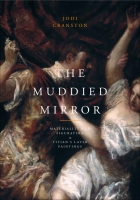




The Muddied Mirror
Materiality and Figuration in Titian's Later Paintings
Jodi Cranston
“Cranston has enormous insight into not only the artist’s brush and its application onto the surface—perhaps no other Renaissance artist was as tactile as Titian—but also the underlying meaning of themes chosen by artist and patron.”
- Description
- Reviews
- Bio
- Table of Contents
- Sample Chapters
- Subjects
“Cranston has enormous insight into not only the artist’s brush and its application onto the surface—perhaps no other Renaissance artist was as tactile as Titian—but also the underlying meaning of themes chosen by artist and patron.”
“[Jodi Cranston’s] sensitive reading of the images and of relevant literary and critical texts for the period provide more than ample reward for the reader interested in Venetian painting of the sixteenth century.”
“Cranston provides one of the most provocative critical examinations currently available of the rhetoric and reception of style in Renaissance art. . . . Cranston's text is logically argued and, like the paintings discussed, beautifully and effectively crafted. Its greatest value lies in mapping out new approaches to analyzing style in sixteenth-century visual culture. . . . The newness of the author's approach has indeed introduced analytical tactics not often seen in scholarship on Renaissance art.”
Jodi Cranston is Associate Professor of Art History at Boston University. She is the author of The Poetics of Portraiture in the Italian Renaissance (1999).
List of Illustrations
Acknowledgments
Introduction: The Substance of Renaissance
1. “Speculum cum macula”: Materiality and Desire
2. Myths of (Un)Making
3. Violence and Retrospection
Notes
Bibliography
Index
Introduction
The Substance of Renaissance Painting
Painting in the Renaissance was described and practiced as an art that ideally offered notional relief while minimizing the actual depth and thickness on the painted surface. Vasari provides such a definition in his prefatory discussion of the art in his Lives: “[Painting] is a plane [‘piano’] covered with patches [‘campi’] of color on the surface of wood, wall, or canvas, filling up the outlines . . . which, by virtue of good design of the encompassing lines surround the figure.” Although Vasari’s emphasis on the relief accomplished by good disegno reflects the specific ambitions of the Tuscan tradition beginning with Giotto, his definition succinctly articulates the fundamental paradox that structured illusionism in Renaissance painting in general and that cultivated the elevation of painting as a liberal art: painting should suppress surface materiality—the physical materials and the indications of making—in order to affirm the three-dimensionality of the represented object.
In upholding this definition of the art, Renaissance painters and painting theorists believed that they were sustaining and developing a central facet of ancient painting. Without any surviving visual examples, they relied on written descriptions, especially those given by Pliny the Elder in his Natural History, that heralded ancient artists for the pleasures and deceits of illusionism in painting. From these ancient accounts of legendary paintings and their frequent Renaissance iterations, early modern readers learned of, among others, Zeuxis’s painting of grapes that fooled birds and Parrhasius’s painting of a curtain that deceived his fellow painter Zeuxis into trying to lift it. Although never attempting to replicate exactly these inventions, Renaissance painters most certainly emulated this apparent defiance of the physical limitations of painting when developing recessional and spatial devices such as perspective, foreshortening, and rilievo, and when celebrating invention over the technical exigencies of the art.
By the mid-sixteenth century, the circumstances of and developments in painting explored and disrupted the tensions and contradictions on which illusionism depended. The ca. 1500 introduction of easel painting created and depended on an intimate viewing situation in which the actual physical limits of the picture were in the viewer’s field of vision. The artifice of painting, more than simply entering into the beholder’s consciousness, became the rightful subject of the painting. Altering the synonymous relationship between painting and the world, cinquecento pictures indicated poetic interests and ambitions with the appropriation of poetic figures and the representation of things and conditions as they should or could be and not necessarily as they are found through direct experience. The frequent Renaissance utterance that painting makes “that which is not seem to be” (“quello che non è, sia”) not only describes the suggestion of three-dimensional relief in painting, but also acknowledges a suggestiveness in painting that oftentimes worked against this fundamental assertion of relief and the imitation of nature. Painters began to draw attention to the precarious and largely undetermined relationship between art and nature through self-conscious manipulations of artistic style, or maniera, and artistic license. At the same time, religious reformers interrogated the very nature and function of images, and particularly the often-conflicting relationship between the expectation of mimesis and the affirmation of painting as an object, a material thing incapable of inherence despite convincing illusionism. Perhaps in response to this climate of reform, some painting theorists positively acknowledged the physical work of painting.
Also in the mid-sixteenth century, the later paintings of Titian, with their roughly worked surfaces and evident signs of making, posed a challenge to the predominant Renaissance paradigm of illusionistic painting. Noting the change from Titian’s earlier work and the necessary viewing adjustments, Vasari, in his second edition of his Lives (1568), writes:
But it is quite true that his method in these later works is rather different from that of his youth; his early paintings are executed with a certain fineness and incredible diligence and can be viewed both from close up and from afar; these recent works, on the other hand, are dashed off in bold strokes, broadly applied in great patches in such a manner that they cannot be looked at closely but from a distance appear perfect. And this method has been the reason that many, wishing to imitate Titian and so demonstrate their own ability, have only produced clumsy pictures. This happens because they think that such paintings are done without effort, but such is not the case and they delude themselves; for Titian’s pictures are often repainted, gone over and retouched repeatedly, so that the work involved is evident. Carried out in this way, the method is judicious, beautiful, and magnificent, because the pictures seem to come alive and are executed with great skill, hiding the effort that went into them.
Despite Vasari’s clear appreciation of these pictures, he stubbornly remains the Tuscan and, following the Horatian trope from poetry, advises adjusting the physical conditions of viewing by standing back in order to view these paintings according to normative expectations of illusionism. At a distance, the surface of painting—or rather, the physical stuff of painting—ceases to be visible and the materials remain subordinated to the mimetic conception. Blobs of paint and exposed canvas cannot be seen and, as Vasari’s comments imply, should not be seen. Patrons who received Titian’s work after the mid-cinquecento launched similar criticisms of a lack of resemblance and complained that the paintings seemed inferior to their expectations. Pietro Aretino, responding to the rough brushwork and muted palette of his Florentine portrait, joked that the lack of finish and, correspondingly, of flattery might have been resolved with a higher payment. Similar technical observations in his other paintings raised suspicions that the master relied too heavily on studio assistance or showed signs of declining ability and dexterity in old age.
In failing to conform and respond to a well-established mode of painting and viewing, Titian’s later paintings raise questions central to the interrelationship between resemblance, illusion, and materiality established since antiquity, but approach these questions in a way that contemporary structures of response and critical discourse could not accommodate or were only beginning to address. One of the central gaps raised by Titian’s later paintings was the unresolved and, in the mid-cinquecento, uneasy relationship between the imitation of nature and the artist’s personal style. Renaissance theorists acknowledged the variations in maniera, but thought of nature in absolute, ideal, and, therefore, vague terms. Understandably, the deviation of Titian’s later work from that of contemporary painters and, according to his peers, his own earlier work compromised his apparent commitment to the Renaissance project of painting. Because he did not transform the materials of art into a flawless illusion of relief, Titian’s later work could be marshaled to affirm the indirect relationship assumed since antiquity between illusion and materiality. But, as this book suggests, Titian’s later work also suggests that painting advances resemblance through other means; through, for example, equivalence in appearance and substance without precise morphological imitation. The physicality of the medium also complicates the longstanding assumption in representational painting that the subject matter dictates and predominates over the means of representation rather than that they affect and change one another. The adjustment of viewing distance allowed these questions to recede and the illusionistic mode of reading Renaissance pictures to persist. In seeking to posit an alternative, historicized approach to Titian’s later paintings, this book relies on related critical efforts in modern and contemporary art history to articulate the interplay of facture and representation. The methodologies explored in these later texts have been invaluable in directing my attention to how many early modern writers thought in very similar ways, despite their differences in terminology and expectations of illusionism.
The written suggestion that evidently worked paintings might be approached positively and not merely in terms of their aberrance arises in the seicento texts of Marco Boschini, who celebrated and defended the diverse accomplishments of cinquecento Venetian painters in La carta del navegar pitoresco (1660) and Breve instruzione (1673). Without any investment in the Tuscan tradition of disegno and rilievo, Boschini appreciated Venetian paintings for their use of color and the manifold ways in which the materials of the art could both represent form and deform those very same forms. His approach to these evidently worked paintings finds its clearest articulation in his descriptions of the experience of viewing a painting not by Titian, the Adoration of the Shepherds executed by Titian’s contemporary Jacopo da Bassano for the Venetian church of San Giorgio Maggiore (fig. 1). Although awestruck by the entire composition, Boschini focuses his attention in both works on the brilliantly luminous representation of the infant Christ at night and the significance of the loose brushwork in this area of the altarpiece. When closely approaching the depiction of Christ, the viewer finds him “dazzling and incomprehensible, no longer discerning the form or substance, in such a way that, fearful of having inadvertently approached too closely the represented Divinity . . . [the viewer] returns to behold the perfection seen earlier.” In the verse account of La carta, Boschini concludes from this situation that we cannot touch God with our hands. Boschini finds devotional significance in the looser handling of paint and the absence of contour, relief, and shadow—the form or substance mentioned above—when in close proximity to the painting, playfully manipulating Vasari’s resolution of illusion through distance to be indicative of the viewer’s relationship with God, of the incomprehensibility of the divine. As much as the visible strokes of paint dissolve the infant body into a radiant patch of light, the stains and splotches, to which Boschini repeatedly refers throughout his rhyming La carta, also indicate the physicality that mediates our devotional experience, especially before an altarpiece. Boschini interweaves metaphors of facture and divinity as if to make simultaneous, if not identical, the physical body revealed by light and the materiality of representation, almost dispensing with Vasari’s recommended position shifts at the same time that he finds exegetical possibilities in them. Drawing upon the eucharistic function of any representation of Christ’s body, Boschini explores how the handling and the substance of paint manifest the liturgical significance and function of the altarpiece.
Boschini’s approach to materiality in this one area of the painting demonstrates a formalism extended to technique that informs our approach to Titian’s later paintings more generally. Meaning inheres in the form of the infant body, but, as Boschini notes, also in the dissolution or disfiguration of that very form. The brushstrokes—while not exactly treated as an index of the painter’s presence, as later viewers have treated the roughly worked paintings of the abstract expressionists—signify more generally as signs of presence through substance; at various moments they imply similar ontological and existential structures of the material trace, such as those of contact, embodiment, temporality, and decay. Boschini suggests this not only in his description of the body of Christ but also in the close connection in his discussion elsewhere of Titian’s paintings between brushstrokes and bodily fluids, such as blood and milk, and between his working method and medical procedures. Consequently, in this interpretive paradigm, the operation of the sign is not entirely subsumed by referentiality, which, as exemplified by the incomprehensible and overwhelming presence of the divine in Bassano’s painting, affects the presumed transparency and unity of Renaissance figurative painting and its responsiveness to a hermeneutic reading.
In many ways, then, Boschini developed an interpretive approach around the properties and conditions of oil painting that Vasari discussed critically in his Lives of Giorgione and Titian and in his and other theorists’ descriptions of the technique. The medium of oil paint on canvas introduced physicality to painting, from the varieties of canvas weave employed to the building up of layers of impasto and glazes. Composition involved depth and thickness, even though the earliest experiments in oil paint explored and thematized the refractory properties of such layering in the service of illusion. Oil paint, whether on panel or canvas, allowed the painter to make changes in the process of painting and work directly on the surface. For those more familiar with fresco painting, which required a preparatory drawing and restricted revisions with its quick-drying plaster, the oil medium compromised the standard of planned invention expected for good painting and the fantasy of the original, identifiable intention. Working in oil lengthened the time of painting: the paint, in all of its stages and states, whether fully or partially dry or entirely fluid, could be worked into and onto the canvas, which, when finished, retained the indications of these interactions. Chance and accident played a significant role in how paintings were made, sometimes serving as a spur to further invention and sometimes remaining as the inadvertent creation similar to those described in early modern anecdotes of the image made by chance (plate 13). The proper application of color depended on casualness, or sprezzatura, an approach that responded to the amorphousness of color, to how coloring does not always follow the logic of illusionism in application and result. Oil painting, according to Vasari, involved love and diligence, which, despite the slightly pejorative implications, could be taken to recognize its inexactitude of method, resistance to prescriptive discourse, and the potential sweetness and softness of modeling.
Titian’s later paintings explore this phenomenology of oil painting by evidently demonstrating the substance of oil medium and the different stages, even those usually concealed, in figurative painting. The weave of the canvas shows through in some sections of paintings, appearing to reverse the additive process of composition (plate 1); thick impasto gives textural elevations to areas of the canvases (plate 2); glazes appear in areas not expected to have those colors; brushstrokes minimize the sense of notional relief and oftentimes, in their seeming randomness, appear to violate the integrity of the figure and the logic of illusionism (plate 3); the background threatens the self-sufficiency of the figure and, by extension, the Albertian ideal of compositional unity (plates 4 and 5). These paintings appear quite literally to disfigure the Renaissance tradition of figurative painting, as Renaissance and modern critics have suggested through their critical readings of these paintings as unfinished. And this, following Boschini’s interpretation above, is precisely wherein the significance of these paintings lies. In drawing our attention to the materials of painting in figurative painting, these later works explore the materiality of existence through the physical stuff of painting, and vice versa. Rather than offer the reflected appearance of the visible world, these paintings demonstrate through the technical process the corporeality—the mass, the weight, the density, the thickness, the interior—of the depicted subject. And because the subjects of these later paintings involve the materiality of the body through stories of violence, metamorphosis, and desire, the subject matter also affects our reading of the technical process. The changes undergone by both are read against the background of illusionistic figuration, whether as a generalized ideal or in the specific illusionistic passages in these later paintings.
The interaction between subject matter and technique—and the corresponding connection between subjectivity and disfiguration—reflects and expands mid-cinquecento conceptions of the subjectivity of the artist. The sixteenth-century idea of the irrational artist replaced the controlled, measured creator of the quattrocento imagination and, consequently, the creative process as well as the result were positively received. Contemporaries collected and valued preparatory sketches and drawings precisely because they demonstrated through their marks and strokes the creative fury at the moment of invention. The traces of the artist’s gesture exemplified the frenzy of divine inspiration, even if those creative energies usually found technical and conceptual resolution in the final painted composition. Other indications of this changing subjectivity include a shift away from earlier, largely metapictorial, motifs of presence: after 1550, painters turned away from thematizing their largely intellectual relationship to their work through the motif of the mirror, through cartellini appended to the fictional surface of the painting, or through self-referential gestures in depictions of themselves—all of which suggested the idea, rather than the physical evidence, of their presence (fig. 2). Venetian paintings, in which these devices had appeared most frequently before midcentury and for which drawing remained a relatively minor creative element, demonstrate through their evident brushwork an analogous subjectivity found in those preliminary graphic inventions. Facture in these paintings—as in drawings—posits the artist as a continuing, lingering presence in the artwork; however, perhaps because of the greater finality ascribed to a painting than a drawing, a more nuanced differentiation of subjectivity in these painted Venetian works arose that depended on both the variations in technique and the subject matter. Tintoretto’s quick and often thin brushstrokes might have compromised Renaissance notions of thoughtful creative effort, for example, but the material indications of quick engagement in his work—which was predominantly religious—signify the spiritual through the (im)material, at times suggesting the limited human agency in the miraculous or the physical energy of the spiritual world.
Boschini attempts to interpret the varied subjectivities of approach, finding meaning whether in Tintoretto’s kinetic speed or Titian’s disfiguration over a long period of time. Consider, for example, his well-known recounting of Palma Giovane’s experience of Titian’s experience of painting in the final years of the latter painter’s career:
Titian blocked in his pictures with a mass of colors, which served as a bed or foundation for what he wished to express, and upon which he would then build. I myself have seen such underpainting, vigorously applied with a loaded brush of pure red ochre, which would serve as the middle ground; then with a stroke of white lead, with the same brush then dipped in red, black, or yellow, he created the light and dark areas of the relief effect. And in this way with four strokes of the brush he was able to suggest a magnificent figure. . . . After having thus established this crucial foundation, he turned the pictures to the wall and left them there, without looking at them, sometimes for several months. When he later returned to them, he scrutinized them as though they were his mortal enemies, in order to discover any faults; and if he did find anything that did not accord with his intentions, like a surgeon treating a patient, he would remove some swelling or excess flesh, set an arm if the bone were out of joint, or adjust a foot if it were misshapen, without the slightest pity for the victim. By thus operating on and re-forming these figures, he brought them to the highest degree of perfection . . . and then, while that picture was drying, he turned to another. And he gradually covered with living flesh those bare bones, going over them repeatedly until all they lacked was breath itself. . . . For the final touches he would blend the transitions from highlights to halftones with his fingers, blending one tint with another, or with a smear of his finger he would apply a dark accent in some corner to strengthen it, or with a dab of red, like a drop of blood, he would enliven some surface—in this way bringing his animated figures to completion. . . . In the final stages he painted more with his fingers than with the brush.
We read about the painter who antagonistically combats his paintings as if his enemies and who threatens to destroy and save his creations through the creative process; the elision of surface and subject in the smear of red paint, which almost instantaneously becomes a drop of blood as an indication of violence and creation; the metaphoric potential of brushstrokes to be stains, to be traces of combat between painter and painting, and to be painfully dislocating and healing; the inquiry into the inherence of meaning in form and into the relationship between abstraction and mimesis in Boschini’s earlier description of Titian’s preliminary work as “the promise of the figure made in four strokes [by Titian’s hand].”
The passage is striking for its proleptic engagement of modernist tropes, but especially for the connection between gestural mode of painting and heroic masculinity. Perhaps reflective of Boschini’s defensive posturing of Venetian painting, his use of this trope participates in the Renaissance discourse of the mastery of artist over materials—as an extension of the superintendency of form over matter—but also interjects into the discourse the disfiguration and physical interaction between artist and materials, and not just dominance, which the paintings themselves confirm. The thick blobs of paint and the sections of exposed canvas in Titian’s later paintings suggest a radically different conception of medium in which not only the materials, but also the artist himself, function as the medium through the performance of painting. He not only shapes the materials but is shaped by them, in the same way that the canvas support also takes on an unexpected and unprecedented role in shaping paint. In suggesting an active, even violent, interaction between painter, paint, and canvas support, these later paintings present a dynamic of creation and destruction that both reinforces and challenges the Renaissance creation myth of divine mastery with the artist as the authoritative protagonist. His self-portraits reflect as much by depicting himself as the reticent painter who is both the subject of and subject to his own making, whether through the instrument of his quite literally self-directed brush or through the depicted hands made and effaced by his own hands (figs. 3 and 4). In his self-portraits and other later paintings, we find our experience of the artist’s subjectivity shifting somewhere in between a transcendent, controlling “I” and a retreating, almost selfless “I” of the accidental mark. This dynamic, which varies from one painting to another and even within a single painting, undermines the predominant interpretive expectation that the medium, artist, and subject matter positively reinforce one another in Renaissance painting, when, as we will see in our consideration of Titian’s paintings, they transform and even deform one another.
By involving the circumstances and materials of making in an interpretation of Titian’s paintings, this study joins the growing interest among art historians in various aspects of materials and the material objects of Renaissance art. For several decades, technical analyses conducted by conservators have assisted scholars in their knowledge of the rudiments of pictorial composition, of knowing which pigments were used and where, and of how painters applied paint. Recently, more focused histories have emerged that consider the origin, properties, and use of specific pigments in painting and of woods, stones, and metals in sculpture. The consideration of why an artist used certain materials has led in many situations to questions of how these materials were used and, in turn, how the made object was used. Other studies have focused on how the process of making oftentimes finds expression through the represented subject or, similarly, how the work of art elicits an allegorical reading that involves the process of making. Many of these latter narratives explore contemporary tropes of artistic genius in which the artist self-reflexively controls and shapes the materials or, alternatively, how the process of making shapes the artist.
This study considers how paintings that respond to and facilitate a self-reflexive allegorical reading through technique also employ an iconography that undermines the authority of these tropes and that questions the intellectual and self-celebratory model of making. Many of these later images by Titian resist hermeneutical reading altogether and instead explore materiality—of the painting and as a subject—through the dissolution of the primacy of figure over ground. The unprecedented role given to the depicted ground, the actual canvas ground, and the compromised figure contributes to and challenges the self-sufficient status of the figure and artist and significantly complicates the role of interpretive approaches dependent on and grounded in ideas of figuration, such as rhetorical theory and iconography. Materiality in all of these later paintings lodges us in the very physical stuff of the world, in the pleasures and dangers of embodiment, and in the situations and conditions that, in their immediate physicality, appear to resist thought and discourse and appear to conflict with the Renaissance ideals that dominate our inherited notion and interpretation of the period.
Not sustaining the idealized beauty and heroic ideal of earlier cinquecento paintings, these later paintings explore violent subject matter and the previously unexplored violent and corporeal dimension of subjects and image types popular in the first decades of the sixteenth century. Coincident with the beginning of Titian’s career, these years saw the execution of half-length images of diverse subjects ranging from sensuous women to abstracted scenes from the Passion of Christ that appealed to the viewer through a direct visual dialogue. Desire and devotion depended on the presence and imaginative participation of beholders to meditate and extend the exchange in their minds. Corporeality and violence, evoked and yet sublimated in these paintings, emerged inconsistently as explicit subjects until the mid-cinquecento, when Titian abandoned the largely rhetorical enactment of cruelty and suffering inherited from antiquity (fig. 5) and directly explored the physicality of horror on and through the surface of the picture (plate 3). Subjects that earlier had offered the opportunity to depict the delights of love in a golden age are transformed into tragic scenes of violence and ominous loss. Compare, for example, his Three Ages of Man (fig. 6) with his later Nymph and Shepherd (plate 6). Titian might have limited his reliance on Pathosformel—those fixed formulae that convey emotions, as termed by Aby Warburg—but he fully developed the irrational, Dionysiac side of the Renaissance embodied by them.
In exploring existential and ontological conditions relating to materiality—and especially the negative implications of corporeality, such as the pure physicality of violence and trauma—these later paintings indicate a largely overlooked dimension of Renaissance culture that shows an interest in the transparency of and deviations from the ideal. Cinquecento painters and sculptors, in pushing the ideal to the extreme of affectation as the century progressed, avoided representations of the materiality of existence, unlike their northern counterparts, who depicted festering flesh. But apparently there was a demand: the rough and low—in subject matter, social class, etc.—found expression in widely disseminated prints. Cinquecento writers, including those close to Titian, satirized the ideals and rules for courtly behavior, mocked learned eloquence through bawdy stories, and emphasized the physicality of human experience through sensuous metaphors and a revival of tragedy. As the less dominant discourse in Italian Renaissance culture, the underside of the ideal received some recognition by those first modern historians of the period, who nonetheless wove a narrative of revival and heroic self-confidence. More recently, historians and interpreters of Italian Renaissance culture have described a more complex and contradictory situation by articulating the anxieties and doubts that coexisted with and even necessitated the polished ideal. This study extends both the conclusions and approaches of these literary, social, and historical studies to thinking about Titian’s later paintings and their reception in the cinquecento.
Although this different sensibility in these accounts establishes a critical, dialectical relationship to the Renaissance ideal, its visual expression extends the structures of viewer involvement theorized and developed for the ideal Renaissance painting and depiction of the ideal. Linear perspective, oriented around the fixed eye of the viewer, was among the earliest Renaissance devices that acknowledged the presence of a beholder outside the frame. Painters also included less analytical motifs, such as a direct address to the viewer through gaze and/or gesture, that immediately involved the beholder in an empathic relationship with the depicted. These inventions aimed to dissolve the idea of the boundary between the worlds of painting and of the viewer at the same time that they reinforced their limits. Many of Titian’s earlier paintings employ these empathic motifs to establish precisely this idea of connection. His later paintings extend this intellectual sensibility in viewing to an embodied experience in which beholders feel a physical connection—however ideated or imagined—to the painting through its materiality. We find an indication of Titian’s movement along this continuum in his Venus of Urbino (1538), in which the sensuous recumbent nude appears to tip toward us due to the unexpected juxtaposition of the flattening curtain and the recessive perspective grid (fig. 7). Our physical access to her remains blocked by the delimiting bed, but the incorporation of the paint into the canvas weave and interplay between the caressed illusionistic roses and the materiality of the printed flowers on the fabric resonate for the interests and direction of Titian’s later work. In these paintings, the more obvious layering of paint, the exposure of the canvas support, and the traces of the brushstroke establish a spatial and temporal (kinesthetic) relationship with the beholder that involves the body. Renaissance and modern responses reflect this experience by declaring, as Aretino did, that Titian “has the essence of things in his brush,” that he gives us the thing itself, or by suggesting that the viewer feels the depicted body from the inside. Several of the depicted figures in these later paintings visualize precisely this shift away from the fantasy of pure visuality by looking too closely at other figures, as if seeing beyond the visible (plates 3, 6, 11, and 13). The figures themselves—compelled and involved beyond perceptual and communicative necessity—demonstrate how to “look” at these paintings.
Early modern viewers acknowledged the potentially phenomenological dimension of painting and sculpture, even if limited to myth, metaphors, and folklore. Beginning with Petrarch, lyric poets developed ancient tropes of the speaking portrait, that image so vivid that it deceptively incites the lover to act as though the beloved is actually present. Equally familiar to Renaissance writers were ancient myths and stories of young men who physically interacted with and reacted to lifelike sculpture. We think, for example, of the Ovidian myth of Pygmalion and Galatea and the story of the unnamed youth who, in his desire, stained the Cnidian Venus by Praxiteles. These stories certainly inform more prosaic experiences of artworks, including Leonardo’s observation that viewers will assume the depicted poses and motions of the represented bodies. Embodied responses such as these testify to the verisimilitude of the works of art. But they also serve as a foundation for the association of the senses of vision and touch with painting and sculpture, respectively, and for the later cinquecento appreciation of senses other than vision in experiencing the visual arts. Whereas Leonardo in the early cinquecento criticized sculpture as an art that appealed to the tactile sense, Varchi, as an advocate for sculpture, praised the plastic media for precisely this quality; and Marco Boschini later celebrated Titian’s paintings and those by contemporary Venetian painters because they appealed to the senses of touch, smell, and taste.
Color, as Boschini and other theorists realized, functions as a sublingual property of painting that arouses the senses more than any other aspect of art. Hardness, softness, heat, cold: all of these conditions and properties found expression through the handling of pigment. In the mid-cinquecento, art theorists and especially religious reformers were keenly aware of the broad appeal of color to the uneducated and of the dangerous effects of the corporeality of vivid hues. Essentially repeating through their criticisms the deeply ingrained division between disegno and colore, intellect and matter, these writers nonetheless acknowledged through their admonishments the possibility for an embodied experience of painting. Some reformers, perhaps influenced by the positive appraisals of color in Venetian painting, even framed their religious devotion through the corporeality of color.
In spite of the rhetoric of visuality, the early modern body was recognized as a complex, material entity that affected, determined, and effected one’s experience of the world. Natural philosophers theorized the operations of the mind in close relationship to those of the body. Humoral fluids in the body, which could vary according to diet, determined personality and disposition. The faculties of common sense and judgment, although located in the brain, were thought to collect information from all of the bodily senses. Discoveries in medicine also affected the conceived relationship between the body, the passions, and perception.
This book considers these issues through a selected group of Titian’s later paintings that addresses and thematizes embodiment through pictorial structures, subjects, and genres that, paradoxically, earlier had exemplified, and sometimes allegorized, the intellectual and visual ideals of quattrocento and early cinquecento painting. It focuses on a few paintings, the Venus with a Mirror (plate 8), the Flaying of Marsyas (plate 3), and a group of later half-length images (plates 1, 9, 14, 15, 18; and fig. 8), which themselves appear to reflect on the intersection of the art of painting and materiality. Not only do the subjects of these images relate to the conflicting conditions of embodiment and of disembodied vision through their depiction of specular desire, of competition between two modes of creation, and of physical sacrifice and spiritual redemption, respectively, but they raise these concerns in somewhat archaic image types that emphasize these very tensions. Titian’s reinterpretation of these earlier compositions indicates that, even if these returns exemplify the large workshop practice of making replicas, the painter found creative possibilities in the past—not unlike his fellow Venetian Tintoretto. Titian’s sustained interest in the recumbent nude—although without the historical break considered here between the later compositions and their earlier sources—speaks to his inventive engagement with the history of art and to the lessening importance of the imitation of nature as the sole aim of art. The supportive network formed by Titian’s other later paintings in the argument of this book suggests that the pictures considered here in detail are not so exceptional as to be without interpretative implications for many of the paintings produced from the early 1550s to Titian’s death in 1576.
The book begins with a discussion of one of the paintings, the Venus with a Mirror (plate 8), which remained in Titian’s studio at the time of his death. As a mythological variant on the “woman at her toilette” type popular in the early sixteenth century, the picture similarly appears to explore themes of desire and possession through vision and specularity. However, the materiality of the mirror reflection—and of the entire painting—deviates from the reflective standard underpinning the image-type, suggesting to some viewers that Titian left the picture unfinished. This first chapter approaches the deviation from a different perspective by asking how this materiality changes the significance of the image-type and, more generally, indicates the role of materiality in early modern framings of desire. Metaphors for love and desire began at midcentury to extend from the illusionistic mirror to include metaphors evoking the physicality of these amorous situations. Vision loses its predominance in later Renaissance dialogues on love, and the less mimetic—or formless—situations of macchie in painting theory and of blurriness, clouds, and wind in lyric poetry are suggestive for considering Love’s embodiment in this painting.
Chapter 2 considers Titian’s Flaying of Marsyas (plate 3), a painting that explores the negative aspects of materiality, but through a subject with similar metapictorial relevance. Instead of the pleasures of love, we confront in this later painting the horror of violence done to the body; instead of a subject with a rich heritage of allegorizing mimesis, we find the mythical creative confrontation between Dionysian materiality and Apollonian rationality. The subject bears an obvious relevance to contemporary discussions of the heroic act and art of Renaissance painting as intellectually inspired. But Titian’s depiction undermines these assumptions by manipulating a well-established iconography of devotional imagery and of creativity. In asserting the interdependence between making and unmaking, production and destruction, the Flaying asserts a changing subjectivity of the artist that conflicts with the predominant Renaissance (and modern) narratives of making as constructive and intentional.
The striking return of both the Mellon Venus and the Flaying to earlier compositional types might indicate a retrospective turn expected for an older painter. However, as chapter 3 asserts, this archaism emphasizes a broader waning of the humanistic ideal and of the imitation of nature in the history of art, and also challenges the intertwined teleological accounts of biography and stylistic development in art history that lead to the largely pejorative concepts of old-age and “late” style. Rather than focus on a single painting, this chapter considers Titian’s return to half-length compositions—including devotional narrative images and some portraits—which, in turn, remind us so clearly of the earlier Renaissance visual traditions from which they deviate (plates 1, 9, 14, 15, and 18; fig. 8). These paintings suggest that painting is no longer conceived or experienced as a kind of friendship or as a self-sufficient totality, as earlier theorists—primarily Alberti—who structured painting according to a rhetorical model claimed; instead, these works advance a more confrontational relationship with the viewer. This dynamic of violence found in Titian’s paintings relates to the intersection of violence and materiality in the sister medium of sculpture, specifically in some of the sculpted works of Donatello and Michelangelo—which, not so coincidentally, have elicited similar allegations, in the artists’ lifetimes until the present day, of old-age style and the nonfinito. Although representative of different visual modes—Florentine sculpture rather than Venetian painting—all of these artworks require viewer involvement that, in its physical immediacy, challenges the concept of the image as appealing primarily to the intellect and draws upon the earlier cultic and mystical associations with bodily presence embedded in these image-types and their sources. Both the return to the earlier history of art and the violent corporeality reflect many of the reformatory prescriptions for the visual arts. Although their specific impact on Titian’s work is difficult to discern, many of these religious discussions contribute to a late Renaissance culture of materiality by questioning, and sometimes even asserting, the possibility of inherence in images, reliquaries, and the Eucharist, and by recommending a greater visceral display in painting. This later interest in the vulnerabilities of humanity, found also in contemporary performances of tragedy and publications of martyrologies, offers a significant counterpoint to the recovered, restored, and idealized body so central to discussions of Renaissance art.
Also of Interest
Mailing List
Subscribe to our mailing list and be notified about new titles, journals and catalogs.