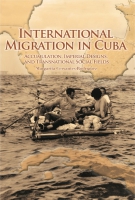




International Migration in Cuba
Accumulation, Imperial Designs, and Transnational Social Fields
Margarita Cervantes-Rodríguez, Foreword by Alejandro Portes
International Migration in Cuba
Accumulation, Imperial Designs, and Transnational Social Fields
Margarita Cervantes-Rodríguez, Foreword by Alejandro Portes
“International Migration in Cuba uses Cuban history as an analytical base and Fernand Braudel’s concept of longue durée as an analytical framework to demonstrate that migration is more often than not the product of the designs and actions of the worldwide system of dependency spawned by global capitalism as it promotes and sustains deep-rooted social pathologies and human despair on a global scale. It is a welcome addition to research on colonialism, imperialism, globalization, and transnational migration. A must-read for all who are interested in the field of global studies.”
- Description
- Reviews
- Bio
- Table of Contents
- Sample Chapters
- Subjects
In this book, the most comprehensive study of international migration in Cuba ever undertaken, Margarita Cervantes-Rodríguez aims to elucidate the forces that have shaped international migration and the involvement of the migrants in transnational social fields since the beginning of the colonial period. Drawing on Fernand Braudel’s concept of longue durée, transnational studies, perspectives on power, and other theoretical frameworks, the author places her analysis in a much wider historical and theoretical perspective than has previously been applied to the study of international migration in Cuba, making this a work of substantial interest to social scientists as well as historians.
“International Migration in Cuba uses Cuban history as an analytical base and Fernand Braudel’s concept of longue durée as an analytical framework to demonstrate that migration is more often than not the product of the designs and actions of the worldwide system of dependency spawned by global capitalism as it promotes and sustains deep-rooted social pathologies and human despair on a global scale. It is a welcome addition to research on colonialism, imperialism, globalization, and transnational migration. A must-read for all who are interested in the field of global studies.”
“A pathbreaking work that will become foundational for migration studies as well as Cuban and American studies, International Migration in Cuba brings to bear the knowledge of Caribbeanists that local history is global and that migration is central to this dynamic. The book stands apart from and above most of the scholarship on Cuban migration. In a narrative that is sweeping yet precise, Margarita Cervantes-Rodríguez places Cuba within the historical forces that shaped Spain, the United States, and the Cuban diaspora. By applying and developing the concept of transnational social fields, Cervantes-Rodríguez highlights how people on the move have shaped, and been shaped by, capital accumulation, class differentiation, racialization, social movements, and ideological struggle.”
“Margarita Cervantes-Rodríguez’s work represents an ambitious intellectual project: to draw together, in a single volume, the various periods, groups, and locations of immigrants in Cuba and its emigrants to the United States, Spain, and other countries. Its main contribution is to integrate a widely disparate literature in several languages and on a broad range of topics. Cervantes-Rodríguez substantially advances current debates about the multiple links among migration, transnationalism, capitalism, and globalization.”
“Cervantes-Rodríguez recounts this compelling human drama with the passion and sweep of neo-Marxian world-historical analysis and her own memories as the granddaughter of Spanish immigrants to Cuba who fled the country because of Fidel Castro’s repression of immigrant entrepreneurship.”
“[Margarita Cervantes-Rodríguez] makes a compelling argument that the 1959 Cuban revolution has obscured the importance of global capitalism's role in shaping migration to and from Cuba before and after the revolution.”
Margarita Cervantes-Rodríguez is Visiting Research Fellow at the Center for Migration and Development, Princeton University.
Contents
List of Figures and Tables
Foreword by Alejandro Portes
Preface
Acknowledgments
Introduction
1. The Theoretical Framework
2. Accumulation, Colonialism, Modernity, and Imperial Rivalry
3. Migration and Other Transnational Processes in the Colonial-Postcolonial Transition
4. Migration Within the U.S. Sphere of Influence
5. Cuba’s Cold War Revolution and Migration
6. Transnational Social Fields Between Cuba and the United States at the Beginning of the Twenty-First Century
Conclusion
Appendix A Sample of Enterprises with Strong Links to Spanish Migrants in the Americas
Appendix B Chronology of Major Events, Agreements, Laws, and Regulations Affecting Cuban Migration to the United States, 1959–2009
References
Index
Introduction
Objectives
Historical analyses of international migration in Cuba have tended to focus on either specific groups of migrants or major aspects of the process associated with specific periods. Notwithstanding their significant contributions, the literature lacks comprehensive appraisals of the dynamics shaping international migration, the inner workings of the process, and its major implications from the colonial period to date. This book tackles these issues by pursuing several interwoven goals. One of the goals is to explore the dynamics of the process of international migration in Cuba associated with major structural transformations—globally, regionally, and in Cuban society—and during periods characterized by important, albeit less sweeping, changes that nevertheless affected the demand for labor or the social and political aspects of the migration process. Another goal is to explore the role played by specific social actors (such as the state, the migrant family and their enterprises, transnational corporations and workers, labor unions, and other politically influential groups) in shaping the migration process. A third, related goal is to explore the role of the migrants in articulating Cuba with the global structures of capitalism. These goals are pursued under some premises that are grounded in historical-structural and transnational perspectives on migration: capitalism is a global system that operates in the longue durèe through pervasive (but not immutable) social structures and fluid social relationships that overflow specific societies; “the migrants” constitute a highly diverse group of people that occupy different “social locations” and include subjugated groups as well as dominant ones; although more frequently than not they have been forced to move across societies, they have not been passive actors in the global scenario; they have played an important role in shaping societies, transnational relations, and the social history of capital. This book also seeks to shed light on the particularities of the Cuban case with respect to other societies of similar socioeconomic and geopolitical locations in the international system at different historical junctures.
Thus, in the present inquiry, I explore how international migration in Cuba has been molded by the interplay of structural and behavioral dynamics that operate at different temporal and spatial scales. These include cycles of accumulation, imperial designs, colonial projects and anticolonial struggles, regime change, nation-building projects, labor-capital relations, immigration policies, strategies of accumulation, and the pursuing of livelihoods, among others. Central to this inquiry is the exploration of the synergies between the structural processes shaping international migration in Cuba during the most critical periods of the process and the expectations, values, identities, and ideologies of specific social actors who were involved either directly or indirectly in the migration process. Thus, the issues examined throughout this work cannot be grasped under a single theoretical paradigm even when a particular conceptualization of history guides the inquiry.
I formulate the terms of investigation according to an analytical schema that allows us to see the continuum between the internal dynamics of Cuban society, those of other societies, and larger social structures. It provides the basis for a systematic inquiry into the continuities and discontinuities of the migration process. I specifically forge conceptual and methodological connections to bridge the gap between Fernand Braudel’s longue durèe conceptualization of history and what I call a comprehensive perspective on transnationalism. Other conceptual frameworks are employed wherever necessary to refine the inquiry.
Historical Antecedents
Several factors related to Cuba’s multiple functions within the Spanish colonial system contributed to an increase in immigration to the island from the onset of the colonial period to the mid-eighteenth century. However, the process intensified in the last decade of the eighteenth century and throughout the first decades of the nineteenth century, primarily as a result of the arrival of massive numbers of people escaping turmoil and as Cuba emerged as a major producer of sugar for the world market. Between 1791 and 1810, an interval the historian Julio Le Riverend called “the French period in immigration to Cuba,” thousands of migrants, many of them French nationals, sought refuge in Cuba from the revolution in Saint-Domingue (currently Haiti) and the subsequent waves of violence that reached other areas of Hispaniola, and when Louisiana was transferred to the United States, among other geopolitical scenarios. By then, the introduction of African slaves began to escalate, and Cuba eventually became one of the epicenters of the slave traffic in the Americas. Between 1847 and 1874, it was the main recipient of Chinese indentured laborers in Latin America and the Caribbean. It was also the main recipient of immigrants from Spain in the nineteenth century. Jordi Maluquer de Motes summarizes the role of Cuba as a magnet of immigration to Latin America in the nineteenth and early twentieth centuries in the following terms: “Once we take into consideration the dimensions of this phenomenon and its numerical relevance with respect to the total population, Cuba surfaces as the only Latin American society that receives a massive number of immigrants throughout the nineteenth century and into the first third of the twentieth century.” Major aspects of the migration process during the second half of the nineteenth century were strongly linked to the expansion of trade, investment, labor, and monetary flows across the Atlantic and between Cuba and the United States—and, to some extent, other areas of the Americas—and the intensification of the political struggle against Spanish colonialism.
The first decades after the Spanish-American War were characterized by the development of a strong immigration regime associated primarily with the expansion of the sugar industry. Spanish immigrants were either returning from societies where they had settled during the independence war or arrived for the first time, often through aggressive recruitment by employers. Immigration to Cuba was linked once again in the Spanish popular imaginary with prospects of social mobility and quick accumulation, which in conjunction with family reunification and an overall positive reception toward members of the group also strengthened the migration ties between Spain and its former colony. Caribbean laborers, the second-largest group arriving on the island at that time, also were massively incorporated into the labor circuits generated by the expansion of the sugar industry through various modalities of labor recruitment. Chinese workers and entrepreneurs once again gravitated toward Cuba, while migrants from other areas of the world also arrived, prompted by the dramatic transformations that were taking place in the island and elsewhere.
International migration in Cuba from the last decades of the colonial period to the first three decades of the twentieth century reflected the juxtaposition of patterns of capitalist expansion on a global scale that heavily relied on migration. One of these patterns pointed to large-scale migrations from Europe to colonial and former colonial areas, which redistributed European workers and entrepreneurs across different areas of the capitalist world economy, with the United States as the major recipient society in the Americas. The other pointed to the growing use by the United States of a non-European workforce through migration processes by importing labor from societies beyond Europe, while the United States also started to rely more heavily on the redistribution of the workforce within the periphery for accumulation purposes. These dynamics directly affected Cuba at that time. The import of labor and entrepreneurship from Cuba as a result of the expansion of accumulation in the United States was first intertwined with the exodus of people from the island related to the anti-colonial struggle there, while during the first decades of the twentieth century, accumulation in the United States benefited primarily from Cuba’s transformation into a regional magnet of labor from the Caribbean along with its continuing role as a magnet of workers and entrepreneurs from Spain, and, once again, the arrival of a large number of Chinese workers. The national and transnational involvement of migrants of different backgrounds played a key role in the expansion of Cuba’s economy and in securing the transfer of value, understood in economic terms, but also facilitated the flow of social values, norms, and ideologies upon which the new imperial designs and further capitalist penetration, and the rise of counterhegemonic projects in labor-capital relations and beyond, were built.
When the notion of migrants as subjugated subjects under capitalism is complemented by a more nuanced approach to this complex social group, and the state-centric way of explaining U.S. hegemony in Cuba is reexamined in light of an inquiry into the social history of capital, we are in a better position to shed light on the role of specific actors and social forces that go beyond state-to-state and labor-capital relations in shaping Cuba’s articulation with the world through migration. The approaches to power and transnationalism used in this work allow for the incorporation of insights about the different strategies and projects, some of which were carried out throughout generations, through which the migrants have historically articulated Cuba with other societies and global structures. The study of the migrants as social subjects of different social locations (e.g., those related to class, gender, politics, and culture) also sheds light on the complex impact that migration had on Cuban society in different periods. While migration and transnationalism exacerbated labor exploitation, labor-capital tensions, and social inequalities and facilitated economic dependency, migration and transnationalism were also instrumental in the unfolding of complex political currents, strategies to resist oppression, the advancing of progressive social programs, and the achievement of certain levels of socioeconomic progress. There are periods in Cuban history where immigration surpassed emigration in impressive ways and others in which the opposite happened. Although this work addresses these general trends, their causes, and their major consequences, it also calls attention to the fact that in most such periods the participation of migrants in transnational social fields remained fluid and scrutinizes the rationales under which such involvement took place.
Immigration to Cuba experienced a sharp decline after the late 1920s as a result of global, regional, and local transformations. Some of these transformations were on their way and had impacted migration and the debates on immigration even earlier than that. Although the island continued to receive immigrants from different areas of the world until the thresholds of the revolution of 1959, it never regained the high levels of immigration it exhibited in the nineteenth and early twentieth centuries. The growth of emigration to and temporary relocations in the United States (and to some extent other societies), as a result of strategies of labor market participation and accumulation, overlapped with the declining trends in immigration. From the 1930s to the late 1950s, Cuban migration to the United States and the transnational processes associated with it became more relevant than immigration to the island from other areas as mechanisms of support of the accumulation process in the United States. In addition, the practices associated with transnational political involvement, which had been an important aspect of the migration experience toward the end of the colonial period and surfaced sporadically in times of turmoil in Cuba, continued to be relevant during this period.
The synergy between geopolitical processes associated with the Cold War and major politico-economic and social transformations brought about by the revolution of 1959 had a dramatic impact on migration. The fact that emigration reached unprecedented levels was just the tip of the iceberg. Certainly, the migration process acquired new quantitative and qualitative dimensions with respect not only to regime change but also to structural transformations involving the disarticulation of the private sector, and the revamping of the class structure of the society upon a radical change of values, norms, laws, and policies that redefined property rights, labor rights, social and citizenship rights, developmental strategies, and the emergence of new identities and recycling of others. At the core of these transformations was the realignment of Cuba in world politics, and the whole restructuring of the relationship with the United States became central to the migration process once again.
In a matter of a century, Cuba transitioned from being a major labor-importing society to being a major refugee-generating and labor-exporting society in the Americas. Some of the dynamics of the migration processes since 1959 point to important discontinuities with respect to both previous time periods in the island and other societies with similar locations in the world economy. Others, however, point to important continuities in relation to the underlying processes shaping migration globally. Exploration of how the general manifests through the particularities of this case is an important aspect of the study, which explores major continuities and changes in the process of international migration in Cuba since the colonial period, from the arrival of the Spaniards and with them the bozales, to the current period, marked by the ongoing departure of the balseros.
Bozales and balseros
Imported from the Iberian Peninsula, where it was widely used to refer to the slaves recently brought from Africa, the term bozales could often be heard in the entry ports of Cuba as early as the sixteenth century. In El engaño de las razas, Fernando Ortiz (1975, 53) explains that bozal referred to African slaves recently taken from their homeland, as well as to domesticated animals, mainly livestock, and to the muzzle employed to prevent domesticated animals from biting. Ortiz further specifies that “Bozal also meant stubbornness, lack of intelligence or being idiotic” [Bozal quiso tambièn significar necio, bruto o idiota]. Works in linguistics tend to use bozal to refer to the particular way African slaves spoke Spanish—when establishing differences between “Black Spanish” and “White Spanish.” Fernando Ortiz adds that the term bozalón was employed to refer to a black person with a low level of Spanish proficiency: “Bozalón se dijo en Cuba al negro que comenzaba a darse a entender algo, chapurreando el castellano.” In a work on African slavery in the Americas published in 1879, Josè Antonio Saco noted that as early as 1510, there was a preference to use the term bozales instead of Ladinos (“Spanish-speaking Christianized Negroes from Spain”) to emphasize precisely their lack of familiarity with and vulnerability to the culture within which they were forced to live.
By the end of the twentieth century, and under different circumstances, common Cuban parlance introduces another term, balseros (“rafters,” or those who leave the island on rafts), to refer to a particular type of migrant who uses precarious means and risks his or her life to escape from the homeland. The symbolic violence that dwells in the term bozales is not found in the term balsero, insofar as the social conditions that led to forced migrations under the institution of slavery differ greatly from the present conditions that induce the balseros to leave their homeland. Unlike the bozales, the balseros are not slaves, nor do they arrive in the ports of Cuba, but rather depart from them. However, the two terms evoke some similarities in terms of human experience and some historical continuities that are worth bearing in mind. Both the balseros and the bozales travel under perilous conditions, with important levels of violence associated with their journeys. Like the bozales, many balseros never make it to the shore. Ultimately, the two traumatic journeys point to a common thread; from the arrival of the Spaniards and the bozales to the departures of the balseros, the process of international migration in Cuba has been molded by labor processes, power relations, and systems of hegemony associated with competition and domination, and has involved significant human degradation and despair.
Structure of the Book
Although the issues of agency and structure, determinacy and contingency, the general and the particular, and continuity and discontinuity are equally relevant throughout this inquiry, the issue of continuity and discontinuity takes precedence for the organization of the book given the period of time covered. The process of international migration in Cuba has evolved since the sixteenth century through phases that reflect major shifts in Cuba’s articulation with the world economy, including its corresponding interstate system, hence the importance of organizing this inquiry along chapters that capture these general dynamics.
Chapter 1, “The Theoretical Framework,” presents the analytical schema employed. This schema relies on the assumption that a historical approach to the role and place of international migration in Cuba’s articulation with the global structures of the capitalist system presupposes a global perspective and a comprehensive transnational perspective. These three perspectives—the historical, the global, and the transnational—are constructed as a unit in this work. The transnational perspective in migration studies invites us to examine how migrants participate in the development of transnational social networks and social fields in relation to their involvement in two or more societies. Notwithstanding its relevance, this perspective is still limited in terms of grasping the manifold dimensions of migration in relation to transnational processes. Acknowledging this limitation, I build on several approaches to transnationalism. I emphasize how the interaction of migrants and nonmigrants and the coalescing of migration strategies and policies with others not directly linked to migration enable the formation and sustainability of the transnational social fields in which the migrants operate. A comprehensive perspective on transnationalism allows us to account for the multiple (and sometimes overlapping) roles played by the migrants (as laborers, merchants, bankers, owners of enterprises, heads of households, members of clubs and associations, and so on) in their interactions with other migrants and nonmigrants as important aspects of their transnational involvement.
The historical perspective on migration, as presented in this work, engages a particular conceptualization of history, one that is rooted in Fernand Braudel’s conceptualization of the longue durèe, which involves a series of interrelated notions and concepts. Frequently, the longue durèe is used to emphasize how the pervasive global structures of capitalism and related geopolitical forces shape events and processes occurring in specific social formations in specific periods of time. Although this interpretation underlies my use of the concept, I also emphasize the centrality of “the plurality of social time” to Braudel’s conceptualization of history. The idea of “breaking history into successive levels” to account for “the multiplicity of times” that every social process involves—a key aspect of Braudel’s historical conceptualization— has particular importance for the study of migration, a process that is molded by the intertwining of social structures and forces that have different durations and operate on different spatial/temporal scales. As Braudel notices, while “the long time span” has “exceptional value” for the historian, it is the complementary notions of “multiplicity of time” and the understanding of history as the “history of a hundred aspects” that engage the attention of the social sciences. Hence, his notion of the “plurality of social times” offers a theoretical tool to incorporate the various perspectives on migration and transnationalism employed in this work, which stem from the social sciences and a coherent historical narrative.
Chapter 2, “Accumulation, Colonialism, Modernity, and Imperial Rivalry,” grounds what follows by examining major causal links, characteristics, and implications of the process of international migration in Cuba under Spanish colonialism. The chapter shows how the gradual increase in the arrival of transients and migrants was related to Cuba’s strategic importance to Spain, the expansion of Cuba’s port economy, and an overall expansion of the division of labor related to these and other activities. It documents the importance of imperial wars and territorial seizures, enslavement, anticolonial struggles, and other violent processes in the Caribbean, Latin America, Europe, the southern United States, and other areas of the world in shaping migration in Cuba throughout the colonial period. Chapter 2 also addresses the synergy between migration and the production of tobacco, coffee, and sugar in relation to large-scale accumulation schema and individual strategies. It discusses how migration impacted the transformation of the urban space in Havana, its articulation with other major cities, and the beginning of patterns of spatial inequalities that still exist.
It examines the entanglements of the debates on migration in the nineteenth century and other debates, such as those pertaining to the sustainability of the slavery system, the technological transformation of the sugar industry, the political status of the island, and the desired racial makeup of the population, as defined by the Spanish authorities and influential members of the Creole elite. It also discusses specific immigration rules and incentives designed to attract Spanish immigrants, their impact on the growth of immigration from Spain, and how these approaches were guided by the interplay of geopolitical, racist, and economic rationales. The growth of the migration links with the United States by the end of the Spanish colonial rule in the island is examined as well.
Chapter 3, “Migration and Other Transnational Processes in the Colonial-Postcolonial Transition,” focuses on the role and place of migration in the expansion of the transnational social fields that linked the island with other societies in the second half of the nineteenth century and throughout the unfolding of Cuba’s postcolonial society. Emphasis is placed on types of transnationalism related to immigration from different regions of Spain and U.S.-bound migration.
The chapter documents the role and place of the migrants in the development of transnational social fields, across the Atlantic and regionally. It calls attention to the centrality of migration in the transnationalization of the Spanish-origin capitalist class, the evolution of family enterprises, and the role of marriage, investment, and other strategies in their survival and even expansion across generations. The chapter also examines the links between migration and the transnationalization of labor-capital relations and the expansion of commercial activities, the banking industry, and social and political projects, including those sustaining “long-distance nationalism.” The analysis of these issues involves exploring both material exchanges and particular interests and their links to the construction of identities and loyalties related to ethnicity, class, gender, and political affiliations, which were forged across the Atlantic and regionally by the migrants.
Chapter 4, “Migration Within the U.S. Sphere of Influence,” examines the interplay between international migration and Cuba’s economic and political repositioning globally and regionally from the early twentieth century to 1958. Cuba’s unfolding as a postcolonial society under the shadow of U.S. hegemony occurred within the global transition from the British-led systemic cycle of accumulation to the one led by the United States. The global transition was marked by the intensification of competition between Britain and the United States for global economic spaces in the early twentieth century, the Great Depression and “final collapse of the nineteenth century world order in the 1930s,” and the subsequent rise of the United States as the global hegemon after World War II. The chapter examines major structural changes and social forces through which these developments impacted migration in Cuba. As in the other chapters, the issue of migrants’ incorporation is discussed in relation to labor market incorporation, transnational livelihoods and accumulation strategies, and political involvement. Chapter 4 also includes an analysis of the evolution of the foreign-born population from the beginning of the twentieth century to the threshold of the revolution of 1959.
Chapter 5, “Cuba’s Cold War Revolution and Migration,” sheds light on how the migration process was affected by the geopolitics of the Cold War, political processes in Cuba, and the political economy of the Cuban revolution since 1959. The role played by the bilateral relationship with the United States in shaping migration is a relevant aspect discussed in this work. However, attention is also called to the political economy of the transformations undergone by Cuban society within the sphere of influence of the Soviet Union and during the post-Soviet era, as well as Cuba’s gradual rearticulation with the structures of capitalism since. It is shown how migration associated with labor processes and the temporary participation of Cubans in labor markets outside the island have been fundamental aspects of such rearticulation. The chapter discusses various characteristics of the migration process and its demographic and socioeconomic implications in Cuba and the United States, particularly South Florida. It also discusses the reversal of the historical pattern of migration from Spain and contrasts some of the characteristics of the migration process and the incorporation of the migrants in Spain with respect to the United States.
Chapter 6, “Transnational Social Fields in the Twenty-First Century,” focuses on how the collapse of the Soviet Union impacted the expansion of transnational social fields between Cuba and the United States and the central role played by migration in this development. It shows that transnational processes operate in truncated ways in this context because of the nature of the bilateral relationship and major characteristics of the migration policy and policy toward the emigrants in Cuba, and other dynamics related to the Cuban political system. However, the chapter also shows that since the 1990s, there has been a growing involvement of Cubans and non-Cubans in transnational relations between the two societies. It documents how transnational practices by migrants and nonmigrants since then have both supported and challenged forms of control and hegemonic designs stemming from the two governments involved. The chapter discusses the particularities of the transnational involvement of Cubans in light of other experiences involving the United States and labor-exporting societies of the region and beyond. It also discusses how certain ideological positions, identities, interests, and strategies currently shape transnational involvement and its implications.
The Conclusion emphasizes that in Cuba’s most crucial transitional periods, the process of international migration has not been weightless for Cubans, Cuba, and the global powers directly involved there in one capacity or another. It further argues that Cuba is currently going through one such moment. It engages a discussion about the tensions between current policy approaches to migration and the global structures and forces shaping the process.
Research Methods and Strategies
This work incorporates evidence from an array of secondary sources spanning several countries and languages, and various emphases and perspectives, over two centuries. Such wealth in the sources attests to the centrality of the process of international migration in Cuba’s society since the colonial period and its key importance in articulating Cuba with the world. Such dispersion, however, called for a synthesis under complementary theoretical perspectives in order to reveal some of the enduring features and major transformations of the migration process in Cuba, its particularities as they have been shaped by global trends, and the historical interface between social structures and social agency under changing conditions.
I consulted a wealth of journals, books, government documents, nonacademic periodicals, reprints of historical documents, and occasionally original documents. Access to documents and studies available in the Cuban Heritage Collection at the University of Miami; the manuscripts section of Guildhall Library, London; the Rare Books Collection of the New York Public Library; the Immigration Archives at the Ministerio de Trabajo y Asuntos Sociales in Madrid; the London School of Economics; and the Biblioteca Nacional de España was very helpful. I also discuss evidence from informal conversations and everyday observations related to my own experiences among Cubans in South Florida and New York, formal interviews with Cubans in Barcelona, and observations and informal conversations with Cuban migrants in other areas of Spain and in France, Mexico, the Dominican Republic, Puerto Rico, and Canada.
In Spain, I conducted a formal preliminary exploration of the migration strategies and aspects of the incorporation process of Cubans through eleven interviews in the summer of 2005 with Cubans living in Barcelona, ten of whom were enterprise owners or operators; a formal interview with a Spanish immigration attorney in Barcelona whose firm has a large Cuban clientele; and participation in a focus group organized by the community organization Debat a Bat in the Esglèsia de Sant Agustí in Barcelona, a church known for having provided sanctuary to undocumented immigrants. I interviewed the attorney and participated in the focus group in order to gain a clearer perspective on the migration context in Barcelona. In addition, I talked to several Cubans whom I met in social events and gathering places, such as Cuban restaurants, in Madrid and Barcelona. Although one cannot claim that the evidence gathered from these interviews and my informal conversations is representative of the entire group, it has helped me understand and compare some aspects of the migration experience of Cubans in Spain with that of Cubans in the United States, including their migration strategies, the ways in which they carry their transnational practices, and their sense of social distance from and proximity to the homeland. These interviews and my observations, combined with information from alternative sources, allowed me to take a glance at one of the most pressing, albeit less studied, issues pertaining to current international migration in Cuba: how gender, class, and racialization interface in Cubans’ migration and adaptation strategies, and, in general, their incorporation into other societies. This book calls attention to the relevance of this issue and the need to study it more systematically in future inquiries. My visits to Spanish cities in recent years and my living experiences in the United States also gave me firsthand knowledge about the experiences of other Latin American and Caribbean groups in these societies and how migration from Cuba is part of general historical processes that include them all.
The least conventional methods of inquiry, such as informal conversations with Cubans residing in other societies and discussions with colleagues and other people from those societies about societal perceptions about Cubans, were instrumental in grounding my understanding about their migration experiences in recent decades, the challenges they face, the continuities and discontinuities in Cuba’s government strategies concerning the insertion of Cubans into labor markets abroad, and the differences in terms of the perceptions of the migrants about their migration experience based on the years in which they departed from the island and the countries in which they live. They also allowed me to improve my understanding of the complex social structures of the Cubans who reside abroad and the different ways in which they are linked to their homeland.
A recent visit to Cuba has also informed this work, particularly the chapters dealing with the current conditions in Cuba and the involvement of Cubans in transnational livelihood to cope with them, how remittances are used, and the specific forces shaping emigration today. Extensive conversations with friends and my systematic communication with my relatives in Cuba have kept me abreast of the human implications of policies that have been frequently designed based on political calculations, entrenched interests, ideologies, and fears rather than by taking into consideration the pressing needs and legitimate aspirations of Cubans on the island and abroad for a better future for their families and their homeland—and the potential for realizing such aspirations.
© 2010 Penn State University
Also of Interest

Mailing List
Subscribe to our mailing list and be notified about new titles, journals and catalogs.