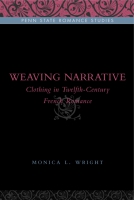




Weaving Narrative
Clothing in Twelfth-Century French Romance
Monica L. Wright
“In remarkably fluid prose, Wright brilliantly demonstrates that vestimentary depictions in twelfth-century French romance functioned as signifiers with multiple levels of meaning. This book weaves a solid connection between material culture and literary expression during a crucial period in the development of vernacular literature in the Middle Ages.”
- Unlocked
- Description
- Reviews
- Bio
- Sample Chapters
- Subjects

An Open Access edition of Weaving Narrative is available through PSU Press Unlocked. To access this free electronic edition click here. Print editions are also available.
“In remarkably fluid prose, Wright brilliantly demonstrates that vestimentary depictions in twelfth-century French romance functioned as signifiers with multiple levels of meaning. This book weaves a solid connection between material culture and literary expression during a crucial period in the development of vernacular literature in the Middle Ages.”
“Wright’s remarkable analysis of clothing and vestimentary acts in twelfth-century French romance yields stunning new insights into works we thought we knew by heart. Relating the history of costume and material culture to the process of writing, Wright skillfully reveals how clothing is worked into the very weave of the text, which it both structures and embellishes.”
“[Weaving Narrative] provides a fascinating lens through which to look at twelfth-century literary creation.”
Monica L. Wright is the Joseph P. Montiel Assistant Professor of French at the University of Louisiana at Lafayette.
Introduction
Enide’s tattered dress and Erec’s fabulous coronation robe; Yvain’s nudity in the forest that prevents maidens who know him well clothed from identifying him; Perceval proudly sporting his rustic Welsh costume, eschewing proper courtly attire to the derision of the court; Tristan disguised as a leper, begging from his peers; the utter abjection and degradation of the three hundred tisseuses toiling in rags while making fine, golden silk; Lanval’s fairy-lady parading about in the Arthurian court scantily dressed for all to observe: just why is clothing so important in twelfth-century French romance? These images dazzle us with their splendor, confuse us with conflicting messages about courtliness, or unsettle us with frightening portraits of an unsavory material reality threatening to manifest. Moreover, these representations are not mere embellishments to the text; they and many other vestimentary depictions help actually to form the textual weave of the romances in which they appear. This book is about how these descriptions are constructed and what they mean, but it is also about how clothing becomes an active part of romance composition: the ways in which writers use it to develop and elaborate character; to advance, or, conversely, stall, the plot; and to structure the narrative generally.
This study seeks to understand the ways in which the writers of twelfth-century French romance used clothing as a signifier with multiple meanings in a variety of ways and for many narrative purposes. An exploration of the relationship between material culture and literary expression will help to elucidate how societal changes influenced and were influenced by the literary use of clothing. Essentially, this relationship is one of expansion: the possible meanings for clothing items were increasing and broadening in the society as new wealth was being created by and for the traders of luxury clothing items. In other words, the preexisting symbolic, unequivocal social meaning of clothing (for example, that if one dressed like a noble, one must be a noble) was being called into question by the merchant class and its members’ ability to profit from providing the nobles with extravagant and exotic clothing. However, the literature pushed the boundaries of this ambiguity even further, creating meanings for clothing that seem improbable for the reality. For instance, in Chrétien de Troyes’s Erec et Enide, the noble but poor heroine wears her tattered dress into Arthur’s magnificent court, only to be met with unanimous admiration for her inherent nobility, which shines brightly despite her impoverished exterior. One has only to consider this first image of Enide to understand how useful vestimentary ambivalence could be to a writer proposing a less rigid conception of nobility to the very nobility that stood to lose something with the change. Moreover, through the use of clothing, the writers inscribed into their texts not only this kind of class ambivalence, but also gender ambivalence (as in the case of Camille, the warrior-queen in the twelfth-century version of Enéas), identity ambivalence (through the extensive use of disguise), and sexual ambivalence (for instance, when a character’s attire communicates a complex and sexualized image). What is fascinating about this process is that, although romance was the courtly literature par excellence, it also presented the nobility with images of itself that must have been shocking, if not outright threatening, since romance writers questioned the social order of the nobility in so many ways. The writers seem to have been conscious of this threat: they tended to reinscribe order into their romances, taking their audience on an exciting voyage in which idealized members of the nobility faced and overcame challenges to their social order. This order, however, was changed in the process, just as the real social order of twelfth-century nobles was changing around them. Clothing is at the very heart both of the actual changes taking place and of the idealized, literary representation of those changes.
The present work instead attempts to generalize across works regarding the use of clothing in the context of a complex and dynamic signifying system in order to view the phenomenon of clothing globally in the corpus of romance of the period. Beyond the more comprehensive nature of this study, the aim is also to contribute to our understanding of the genre of romance and its conventions by relating the history of costume and material culture to the process of writing. I am concerned, moreover, not simply with the historical implications of literary clothing depiction from a remote period; my greatest interest lies, rather, in a shift in the representational system at large and how this shift becomes important to all of the narrative elements of twelfth-century romance.
The methodology employed involves the close reading of a number of texts in the corpus of twelfth-century verse romance and the cross analysis of the clothing references within these texts. I have interpreted each clothing instance in three different contexts: their specific narrative context, the sociohistorical context, and the context of the process of signification. From the set of analyses, I have extrapolated the broad tendencies of the writers of romance as they use the vestimentary code and have charted another tendency of transforming the code into a signifying system capable of creating new meanings. I intend to elucidate of the process of signification valued by the writers and audience of the period as well as its mechanics in order to understand better the principles of representation of the twelfth century.
I am examining clothing as a signifier in the context of a developing signifying system, which allows me to see how the textual structure of romance is related to textile—in other words, how the process of romance composition is a technique of weaving. By this, I do not mean that the relationship between text and textile is simply metaphoric: it actually describes the relationship between the thematic and the formal and between the actions of characters and the process of composition. Eugene Vinaver first noticed this structure when he called romance a tapestry because of the way it creates meaning from patterns; that is, formally similar episodes, tropes, or motifs must be viewed in combination in order to be understood fully, and this is the major organizing principle of romance (Form 12). Romaine Wolf-Bonvin has more recently reminded us of the etymological reasons: “Le texte est avant tout tissage, texture” (Textus 11).
In Chapter 1, I focus upon the extratextual factors that to some extent determine the parameters of the use of clothing in the literature of the period. Included in this discussion are the contexts in which literary expression occurred: the context of the literary project as it was conceived by the writers of the period; the context of the representational mentality and its shift from a symbol-dominated system to one more closely related to the sign; the historical context, in which major changes were occurring that are eventually inscribed in the literature; and the context involving the process by which clothing has meaning within societies.
In Chapter 2, I describe the reality of clothing in the period, to the extent that we can make such determinations. The historiography of clothing for the twelfth century is problematic for two reasons: first, there are no extant garments, certainly not of the kind described in courtly romance, and second, the art historical record is scanty, with few manuscript illuminations dating from the twelfth century depicting lay clothing of the period. There are many dating from the thirteenth and fourteenth centuries, but these tend to depict contemporaneous clothing styles rather than twelfth-century modes. Moreover, for what visual evidence that does remain, mostly in the form of statuary, there is no way to match terms to forms. I extend my discussion of clothing items into the materials used to produce those garments, their origins and the economics involved in obtaining them, finishing the chapter with an overview of how clothing has meaning within human societies.
In Chapter 3, I discuss the function of description in romance and how clothing helps to elaborate characters’ identities, paying particular attention to the dynamism of the emerging clothing system and the way it inscribes flexibility into the descriptions. For example, in Chrétien’s Chevalier de la charrette, or Lancelot, right as Guenevere meets Lancelot for their tryst, she appears to her lover in a window. She is described as wearing a chemise covered with only a mantle. This image, as I analyze more thoroughly in my article “What Was Arthur Wearing? Dress Discrepancies in Dress Descriptions in Twelfth-Century French Romance,” is interesting because it combines two incongruous articles of clothing: the very public, ceremonial garment of the mantle—in fact, the only garment to be exclusively noble during the period—and the most private of garments, the chemise, a garment usually equated with nudity, thus shameful in public. This could be seen as the twelfth-century equivalent of wearing a mink stole with nothing but lingerie underneath. The juxtaposition of these two garments creates a clothing image of the queen that underlines and enhances a crucial duality in her character in this romance: she is both queen and Lancelot’s lover. She is of the highest nobility (the queen of the noblest king) and an adulteress. This image is both public and private, both noble and base, and completely sexualized. This clothing description is extremely dynamic because it incorporates into itself the duality that defines Guenevere’s character. My discussion leads me to an examination of code manipulation by which the writers altered the process of signification by code duplication but with different conventions, changes in community that result in multiple meanings for clothing instances, and subversion of the code until it effaces.
I continue my analysis of code manipulation in Chapter 4 but focus upon clothing acts rather than description and upon code manipulation with regard to context. I examine acts such as gifts, which are largely normative acts that provide evidence that although a clothing signifying system is emerging, the vestimentary code persists in its usage and in acts of dressing and undressing, for which meaning is mediated through changes in context and that must be interpreted in light of context. For example, clothing acts may have different meanings when viewed from different perspectives. My assertion that, in fact, the signifying system does not replace the code but subsumes it is reinforced by my discovery that romance writers model the very process of fashioning new meanings from old material and in which they themselves are engaged when they show characters making cloth or clothing.
Chapter 5 is an investigation of how the clothing signifying system interacts with different levels of the text: structural, thematic, and narrative. Clothing provides structure as instances open and close narrative threads and as they create links among episodes through both formal and thematic analogy. The clothing system also helps elaborate and illustrate the major themes of a given romance, providing thematic cohesion to the work as a whole, which is a form of structuring device. In Chrétien’s Chevalier au lion, or Yvain, the hero fails to fulfill a promise he has made to his lady that he will return from his exploits after one year’s absence. She sends one of her ladies to reclaim the ring that she had given him as a token of her love, and when the lady comes into court, she removes her mantle. She does this to honor the court, but it also prefigures and precipitates two other acts: Yvain’s removal of the ring but also of all his clothes as he slips into madness and becomes a social outcast. This major undressing act makes his madness and outcast status material in the text but is later reversed as Yvain regains his sanity, and of course, his clothes, and as he slowly regains his social status through the repeated fulfillment of obligations. This clothing cycle is emblematic of the major theme of the work: failure to fulfill an obligation, then compensation for the mistake through gradual fulfillment of the obligation. And just as this theme structures the romance, so do clothing instances, since Yvain’s undressing/dressing cycle is reflected in a number of thematically similar episodes. This kind of structuration—analogical—is characteristic of the romance genre, and clothing plays an extremely important role in this weaving of romance. Finally, Chapter 5 concludes with the close reading of two works of courtly literature, Guillaume d’Angleterre, signed by a “Crestïens” whose identity scholars still debate, and Marie’s Guigemar, for which it is possible to read the narrative through the clothing, and my conclusion emphasizes and confirms the contribution that clothing makes to a narrative as a whole.
In virtually every way, in twelfth-century France, clothing reached a new level of significance. Because it was so important, it is not surprising that it would enter so dramatically into the literature. My assertion is that clothing holds a privileged place in romance for two reasons: first, the structural similarity between the weave of cloth and the romance narrative, and second, the importance of clothing in the society at large. The nobility was having to prove itself more and more in ways other than its prowess in war, the twelfth century being a period of relative peace, so nobles had to seek out alternative means to assert their power. The major way they sought to do so was through the ostentatious display of wealth, and there is no better way to display one’s personal wealth than by wearing it. Yet, ironically, the acquisition of luxury clothing items required the nobility to fuel the mercantile economy, which in turn enriched the merchant class, thereby threatening the situation of nobles still further. Feeling this pressure, nobles would also seek out new forms of self-representation, this impulse undoubtedly contributing directly to the rise of courtly romance.
Romance, in which the behavior of the knight at court was just as valued and scrutinized as his behavior on the battlefield perhaps more closely reflected the image that male nobles, who had increasingly fewer opportunities to prove their prowess, wished to project of themselves: as finely and expensively dressed, well-behaved gentlemen. Moreover, the shift in setting from the battlefield to the court allowed for more depictions of ladies and their magnificent attire. Clothing and textiles, along with all of their possible mutations, quickly became part of the romance writers’ repertoire of narrative tools, permitting them to weave the social concerns and material reality into a new literary genre.
Mailing List
Subscribe to our mailing list and be notified about new titles, journals and catalogs.