


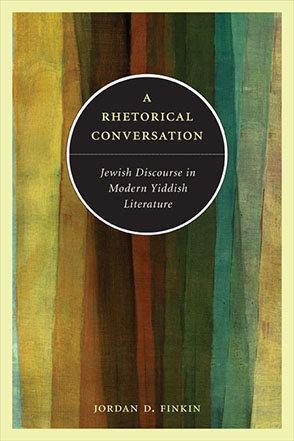
A Rhetorical Conversation
Jewish Discourse in Modern Yiddish Literature
Jordan D. Finkin
“In this brilliant new book, Jordan Finkin illuminates with great flair and precision the many ways in which Talmudic discourse has shaped Yiddish language and literature, from the smallest peculiarities of Yiddish syntax to its largest cultural and discursive formations—the orchestrated associative digressions, the argumentative style, the entire cultural world known as ‘derekh hashas,’ the way of the Talmud.”
- Description
- Reviews
- Bio
- Table of Contents
- Sample Chapters
- Subjects
“In this brilliant new book, Jordan Finkin illuminates with great flair and precision the many ways in which Talmudic discourse has shaped Yiddish language and literature, from the smallest peculiarities of Yiddish syntax to its largest cultural and discursive formations—the orchestrated associative digressions, the argumentative style, the entire cultural world known as ‘derekh hashas,’ the way of the Talmud.”
“A fascinating and engaging study that combines rigorous linguistic analysis with deft literary interpretation. By excavating the layers of Talmudic, biblical, and vernacular discourse within modern Yiddish literature, Jordan Finkin offers a compelling way of understanding the unique expressive qualities of this body of work. Through a series of persuasive readings of key figures such as Sholem Aleykhem, I. L. Perets, and Moyshe-Leyb Halpern, the book demonstrates the embeddedness of Yiddish writing in the textual origins of rabbinic Judaism without minimizing the originality, playfulness, and ironic force of these modern writers.”
“A learned, sophisticated, and smart book. Its exploration of the complex interrelationship between elite conversational discourse and its transition and transformation in the mouths, minds, and words of others is vital for a more nuanced understanding of Yiddish, its speakers, and its writers.”
Jordan D. Finkin is Cowley Lecturer in Post-Biblical Hebrew at the University of Oxford.
Contents
Acknowledgments
Introduction
1. The Case of the Tautological Infinitive
2. The Language of Jewish Discourse
3. Jewish Discourse and Modern Yiddish Poetry
4. Conversational Orchestration in the Tsenerene and Sholem Aleykhem
5. Y. L. Perets’s Conversational Art in Yiddish and Hebrew
Coda
Notes
Bibliography
Index
Introduction
For someone who has seen the film The Producers, it is impossible to forget Zero Mostel’s inimitable delivery of the line “Shut up! I’m having a rhetorical conversation!” This statement operates on more than a single comic level. Of course, it plays on our understanding of the “rhetorical question” as not a question meant to elicit a response, but rather an indirect speech act: in this case, a question that makes a statement. But for these two New York Jews, Max Bialystock and Leo Bloom, a “rhetorical conversation,” a conversation that makes a statement, is rooted in the context and nature—the pragmatics—of this cultural interaction. What is most telling and most funny is not the neologistic compound “rhetorical conversation” but the “Shut up!” that precedes it. Max’s tirade is anything but a soliloquy; it makes absolutely no sense without Leo’s interruption that prompted it.
The idea of a Jewish contextual understanding of conversation is one of the roots of this project. This conversational kernel is key to the observation that, in the linguistic development of Yiddish, not only do certain tendencies of Yiddish discourse bear a distinct resemblance to features found in Talmudic and rabbinic texts, but they owe their development to the complicated contact situation between these texts and Yiddish-speakers. These are elements of a system where the patterns and logic of conversation are the dominant organizing principle.
This cultural-historical context has been described as “the way of SHaS” (derekh hashas). Traditional community life in Yiddish-speaking Eastern Europe was organized around the centrality of rabbinic law and lore, codified in the six so-called Orders (shas, an acronym for shishah sedarim) of the Mishnah, which form the core of the Talmud (also referred to as shas). “The way of SHaS” is a shorthand summary of the cultural nexus that those texts occupy. This nexus—the image of a cultural switchboard—usefully emphasizes its function as both juncture and point of departure; the sacred literature is both an end in itself and a powerful source of fresh cultural creativity. Naturally, language was an area of cultural life where these texts had a deep impact. The literary scholar Benjamin Harshav pithily distills the character of that impact in asserting that when the patterns of Talmudic and sermonic Hebrew (and Aramaic) “discourse were absorbed by the language of conversation, Yiddish, . . . a mode of talkative behavior emerged in which association reigned supreme, analogy was paramount, and anything could be symbolic of anything else.” He goes on to maintain that
typically, such religious and moral discourse—and Yiddish conversation deriving from it—advances not in a straight line, through affirmative statements or the logic of a problem presented in a hierarchical argument, but through many kinds of indirect or “translogical language.” . . . All these modes of translogical discourse common in Yiddish communication have three major principles in common: (1) associative digression; (2) resorting to a canonical textual store; and (3) assuming that all frames of reference in the universe of discourse may be analogous to each other.
This is one broad and general characterization. I hasten to add that it applies, however, only to the complicated aftereffects on Yiddish itself and the self-perception of its speakers, not on how Talmudic language and argumentation themselves actually work. In many ways, the two are apples and oranges. Yet when it comes to precisely those perceptions about language, the rhetorical conversation begins to look less alien.
For this conversational model to be effective, there needs to be a way of linking these texts to a social environment that allows for their diffusion, especially beyond their legal and didactic functions. Though the broad assertion of “absorption” is doubtless accurate, it calls for some elaboration. The primary linkage is through the idea of language contact. Briefly put, language contact involves the often complicated effects of languages on one another in the speech of multilingual individuals or groups of individuals. I say “complicated” because though certain effects are partially predictable, a great many variables influence the direction, degree, and areas of impact, including the social prestige of the languages in question, the amount of time they were in contact, the purposes to which they were put in the multilingual environment, and so forth.
Two additional factors make the situation I am outlining for Yiddish more difficult. First, because of the long-standing stigma of Yiddish (as well as Yiddish speakers’ inferiority complex with regard to their language) as merely a bastardized or workaday language, direct data concerning the nature of spoken Yiddish are rare until relatively late. Second, I am undertaking a kind of hybrid analysis straddling the divide between spoken and written language. The standard accounts of language contact focus primarily on spoken languages. I am, however, describing the literary effects of a contact situation between a spoken language and a textual or literary language. Although there has been little work on this kind of contact, it is essential for understanding the development of a modern Yiddish literary language.
In this contact environment, the multilingual individuals I am referring to at this stage are Yiddish-speakers who can read and intellectually manipulate the rabbinic texts. These are the so-called textual bilinguals. In the Ashkenazi culture of Yiddish-speaking Central and Eastern Europe, the set of truly bilingual individuals was small; it was made up of the scholars, who generally stood on the highest tier of social prestige. These men—and they were exclusively men—were by and large the only ones with true access to the holy texts in which they were fluent. In the study house, however, those Hebrew and Aramaic texts were studied and debated in Yiddish. This complicated linguistic situation, the prolonged and continual discussion in one language of texts written in another, involved important “extra-linguistic factors.” The statement that these men were fluent in the sacred texts needs some clarification. They were native speakers of Yiddish, but their proficiency in the textual language is less clear. Doubtless they were able interpreters of those texts, but it is not at all likely that they would have used those languages in many contexts other than debate about the texts they were written in. This specialized use of the textual language meant that only certain aspects of those languages were ever likely to have an effect on, or be absorbed by, the spoken language. The fact that that spoken language permitted itself to deploy those aspects ubiquitously accounts for some of Yiddish’s notable vitality.
The way that those textual languages were learned, too, had an impact on how they were assimilated. Jewish primary school education took place in the local classroom school, known as the kheyder, which was almost exclusively available only to boys. Lessons primarily involved rote memorization of biblical texts with word-for-word translations into Yiddish. This was the educational terminus for most Jewish males. Those who went on to the yeshivah, the academies for training of scholars in the Talmud, would learn the textual languages through learning the texts. This added to the degree of specialization mentioned above.
Finally, the social attitude toward the status of the languages involved had a direct influence on the course of their linguistic impact. The attitude toward the textual languages, Hebrew and Aramaic, was reverential; they were referred to collectively as loshn-koydesh (the holy tongue). It is more difficult to gauge attitudes toward Yiddish. However, as mame-loshn (the mother tongue), as the language first learned and the one used for almost every other aspect of daily life, it inspired some feeling of intimacy. Encomia to Yiddish, for example, would become a staple genre of Yiddish poetry from the late nineteenth century onwards. As we will see, Yiddish became a crucible of intense cultural expression and creativity, especially among those who were not given access to the status-giving texts.
In the social context of Jewish communities in Eastern and Central Europe, the scholar’s idiom that developed, rife with Hebrew and Aramaic calques and borrowings (in a broad sense) from the Jewish canon, became a prestige idiom, and its influence on the common language was consequently strong. Strong, too, was the cultural weight placed on individual study and textual intimacy. As mentioned earlier, I am primarily dealing with a model of language development applicable to complicated situations of specifically literary language contact: here, Yiddish speakers in extended, continual contact and intercourse with Hebrew and Aramaic texts as mediated through the prestige scholarly idiom.
These are, however, the preexisting conditions of the bilingual individuals. How the textual languages and Yiddish “interfere” with one another, how they are either subtly or starkly altered in this contact, would be the subject of a very interesting but very different study. I am interested, rather, in what has happened postinterference. The period of bilingual contact extends far back into times from which there are few or no data for descriptive analysis. Therefore, from the point of view of a purely descriptive linguistic analysis, there is little we can know about the specific linguistic interference with the speech of bilinguals; we only know the “extra-linguistic factors.” My concern is twofold: first, with what happens as a result of these bilinguals’ coming into contact with unilingual Yiddish speakers (that is, unilingual with respect to the textual languages, since Yiddish-speakers would have been conversant in at least one of the coterritorial spoken languages, such as Russian or Polish); and second, with what ultimately happens when the inheritors of that cultural dynamic write in Yiddish. In this respect, the bilinguals were vehicles for the acculturation of various features of Hebrew and Aramaic discourse, already mediated in the study-house activities. Once unilingual speakers begin to use these features, they are subject to what I call “nativization” into Yiddish.
The observations of Max Weinreich and Benjamin Harshav cited earlier both note and describe the outcome of this linguistic situation, but in general they do not examine how it functions nor the mechanisms involved in it. Therefore, I am accepting the premise of constant, prolonged, and intimate contact between Yiddish-speaking culture and the study of these texts as a linguistically significant historical feature of Yiddish. In the process of this investigation, I will touch on which features were transferred and internalized, from the more discrete lexical and grammatical elements to the more nebulous styles of thought, logic, and argumentation; what were the primary mechanisms for any assumption of such patterns of discourse into Yiddish; and what filters they may have passed through. Of particular concern are those features influenced by Talmudic discourse and more importantly the scholar’s language that developed from it. In other words, how did this “nativization” take place? I am not saying that Talmudic discourse was not “native” to Yiddish-speaking Jewish communities; it was part of a fundamental constitutive element of Jewish life. Rather, in relation to the development of Yiddish language, that discourse had to be assimilated to become what I am calling Jewish discourse.
Much more important, though, is the recognition of that assimilation, particularly by the authors of much of modern Yiddish literature. This project is more than an attempt to see whether there is a way of formulating how such conversational logic gets normalized in Yiddish. It is a demonstration that that normalization takes place precisely in Yiddish literature. The development of a distinctly modern Yiddish literary language builds upon the recognition and manipulation of these patterns and norms.
As the analysis enters the modern period, one further complication presents itself. The emergence of a modern Yiddish language consciousness entailed the recognition of Yiddish as a language in its own right, one that was not, despite its “poverty” in certain areas, a corruption or bastardization of some other more “legitimate” language or (in a more benign formulation) a mere dialect. This recognition, which today might be called language pride, was part of a larger and more complicated discourse on the role of language in the construction of the idea of the modern nation. Part of what it meant to be a nation was to have a particular language. This ideological development went hand in hand with the early twentieth-century proliferation of scholarly investigations into both the history of Yiddish language and its contemporary reality. In addition to interest in the languages of other peoples that Jews also spoke and used in other ways, much energy was focused on internal multilingualism. This is to say that no matter what the Jews’ mother tongue might be in a given society, “Hebrew” (loshn-koydesh) would always be present, occupying prescribed social, communal, and especially religious spaces. Despite the notable heterogeneity of what is referred to as “Hebrew,” this condition is very often referred to as “bilingualism.” Thus the programmatic title of the literary critic Shmuel Niger’s (pseudonym of Daniel Tsharni, 1888–1959) important study The Bilingualism of Our Literature. The broad divergence of socialist Yiddishism from Zionist Hebraism imposed an either/or dichotomy on what had been in many ways an organic symbiosis. The post-Haskalah success in both renovating Hebrew and cultivating Yiddish into versatile media for modern “European” literary production dug new belletristic trenches for these ideological conflicts.
This is not to say, however, that within the contentious world of Jewish national literary theory there were not those who focused on the symbiotic perspective. A representative exponent was the literary critic Bal Makhshoves (pseudonym of Izidor Elyashev, 1873–1924). In his famous essay “Two Languages—One Literature,” he describes how ultimately, despite the different linguistic media, in pre–World War I Europe they were the same authors writing in effect the same works, some in Yiddish and some in Hebrew. This is an essential characteristic of Jewish literature in the diaspora: “[Jewish literature] is one and its name is one. But it comes to the reader in two forms, and like the scales of a balance they sway, one opposite the other . . . so the Jewish writer must know at least two languages with which he may create freely” (italics in original). Although multilingualism as an inherent feature of Jewish writing was later ideologically suppressed, it is certainly not controversial to assert it as a nearly universal property of Yiddish-speaking communities prior to the second World War. Despite Hebrew and Aramaic being largely the preserve of religious and other circumscribed portions of communal life, the perception that “at least two languages” made their home in the language consciousness corroborates the assertion of Yiddish’s openness to all of the languages with which it was in contact. In fact, there is a Yiddish term komponentn-visikayt (component consciousness), which indicates the consciousness among Yiddish speakers of what source language the words they use come from. The presence of such a concept lends support to the importance of both internal and external multilingualism.
For Bal Makhshoves the only qualitative difference between the Hebrew and Yiddish literary realities was in what he refers to as the “spirit” of the languages. This nebulous characteristic of language is a function of place (that is, where a work is written) and time (the language’s historical baggage). Hebrew, according to Bal Makhshoves, has both a past and a present. Yiddish, on the other hand, “only has a present. Making a synthesis of ‘Tsenerene,’ Ayzik Meyer Dik, Aksenfeld, Etinger, Shomer, Yiddish folk songs, Elyakum Zunser, the Zionist and Bundist brochures, and the American literature will probably occur to no one.” This is the gauntlet I am picking up. First of all, though Yiddish is clearly not as ancient as Hebrew, it is obvious to us now that it has more than a “present,” as it did even at the time when Bal Makhshoves composed his essay. His point was ideological rather than chronological. Second, and more importantly, it is the notion of Jewish discourse that offers one possible analytic vantage point from which to conceive just such a synthesis. Bal Makhshoves himself points in this direction when he mentions one of the ideal “inheritors” of Jewish bilingualism, namely the yeshivah student, continuously and simultaneously absorbed not only in multiple texts in multiple languages but also in single polyglot texts. This creative youth will feel “first of all as though it is necessarily natural that the Jew had to speak two languages all along.” The self-perceived “naturalness” of this internal linguistic synthesis is mirrored back onto Yiddish. That is the foundational perception of this book as a whole.
Niger offers a useful simile to understand this synthetic perspective. After maintaining the essential link between the loshn-koydesh corpus and the spirit of Yiddish literature, he goes on to characterize the subsequent literature itself:
We learn that the role of Yiddish literature was, as I have written, in fact similar to the role of the zogerke [the prayer-leader in the synagogue women’s section]. What was her role? To assist unlearned Jewish women in reciting their prayers, their tkhines, their Yiddish Bible. The literature in ivri-taytsh [the archaizing Yiddish used for translating sacred texts] did something similar: it came to help those who were not able to study, just as the old zogerke helped those who were not able to pray. She was a literature—a zogerke. In any event, so she seemed. In truth she said her own words and introduced a good many things. She was, nevertheless, quite attached to the old, Hebrew-Aramaic literature. She stuck to it even when it differed from her. And one really could think that she wanted nothing more with her ivri-taytsh than to recite aloud, to translate, and to interpret—according to the tastes of the Jewish woman—everything, or nearly everything, she might find in the holy (and in the not-quite-so-holy) books in loshn koydesh and in Aramaic.
That Niger would have chosen a woman in a traditional woman’s sphere as the metaphorical mediating force is no accident. Both the oral and the gendered dimension of the diffusion of Jewish discursive patterns cannot be overestimated (as we will see later in the discussion of the Tsenerene). Neither can the importance of such contact zones between sacred and everyday cultural life. Many things need to happen between such putative sites of discursive mediation and the development of modern literature. This is a story that will eventually need to be told. It is, however, a story that seems doubtless to be true.
There is arguably a general concern over the validity for a language of claims based on predominantly literary evidence. In one sense the problem does not have a solution. However, the argument that I am making is ultimately about Yiddish as a literary language, or better, the varieties of literary language in Yiddish, and how that literary language developed. One of the important features of that literary language, particularly in the Eastern European context, is that it was in constant contact with the spoken language. Not only that, but the distinctly oral context in which the literary language contact with the traditional texts took place brought to bear an additional layer of “spoken”-language contact. I am not saying that all varieties of literary Yiddish were at all times modeled on the spoken language. What I am saying, however, is that, particularly after the seventeenth century, they all reacted to it in some way. These constantly intersecting contact situations over time make any attempt at isolating direct lines of descent futile. In fact, a model in which the notion of direct lines of “descent” would seem preferable to indirect and complicated ones is a particularly inadequate one for the description of the contact situation outlined above. One has to begin with the textual evidence and work out from there. What is so fascinating, and one of the reasons why this project was so attractive to me, are the points of contact between the language constructed as literary and what that language itself focuses on as “spoken.” The conversational nexus again rears its head.
I need to emphasize that my approach here draws on an interdisciplinary outlook. This approach, though, was suggested by Uriel Weinreich. In his words: “It is thus in a broad psychological and socio-cultural setting that language contact can best be understood. . . . This involves reference to data not available from ordinary linguistic descriptions and requires the utilization of extra-linguistic techniques. On an interdisciplinary basis research into language contact achieves increased depth and validity.” Weinreich lists the important contributions of such extralinguistic analysis, including geography and ethnography, sociology, jurisprudence, education, and psychology. To this I add literary analysis as no less important to understanding the development of Yiddish language.
The scope of the field in which this project is situated is immense and complicated, far broader than a single study could hope to encompass. Rather, I have conceived of this work as several rays from a prism. It is a multifaceted exposition based on closely defined points of access to that larger field. However, based on the paucity of sources and the kinds of data that are simply unavailable, this approach is the best one suited to deal with the information we do have.
Those are the concerns that led to the interdisciplinary orientation to the material, and from there the structure suggested itself. In broad relief, the first chapters are more linguistically oriented, while the final chapters deal to a greater extent with literary topics. But just as these two categories are intimately connected within Yiddish, none of the chapters wholly excludes either side. I hope that, taken in sum, they will offer a synthetic perspective on the relationship between the two, particularly since, especially on the literary side, Yiddish literary studies often fail to pay heed to the important researches of Yiddish linguistics.
Despite the relatively brief flowering of modern Yiddish literature—roughly from the mid- to late nineteenth through the mid-twentieth centuries—a remarkably large and varied body of works was produced. The few works—a paucity belying plenty—that I have chosen to focus on do not offer any kind of a survey of that literature. Pursuing the didactic literature of the Haskalah, or Jewish Enlightenment, for example, would have been far less fruitful because the conscious literary patterning of that literature on a much different set of models included an expurgation of precisely those discursive features, which were then perceived as oral, conversational, and lowbrow. Though some features may have escaped the cleansing submerged, they are more clearly represented by a different set of texts on which I will focus. As was said, the present study has a set of defined points of access to a much larger topic; though a systematic literary survey is generally desirable, it would be distracting to the express goals of the project. Instead, the texts to be discussed were selected to be as relevant and interesting as possible to the subject. Not only do they very well exemplify individual discursive features, but they also demonstrate a consciousness of that discourse (one might call them metadiscursive). In this way the final chapter may seem particularly narrow or circumscribed. However, the central text of that discussion is a perfect example of how almost all of the features discussed throughout this book work together organically and reinforce one another.
Beginning with the linguistic approach, the central issue is to try to understand the peculiar relationship between the literary language and the spoken language. The linguist James Matisoff has claimed that “everybody knows (but linguists have usually forgotten) that the real communication that goes on during interpersonal exchanges often has very little to do with the actual words that are spoken.” In literary language the situation gets turned around: all of the cues beyond the “actual words that are spoken” are absent. As a result, the Yiddish literary language developed a way of graphically coding that “psychosemantics.” It made particular use of those elements that could be gotten down graphically, as opposed to those elements, such as intonation, that, though very important in Yiddish speech, were far more difficult to convey in the written language. This is one of the reasons why it is important to look at the vocabulary used specifically for Talmudic and rabbinic debate that entered Yiddish. As those debates were themselves debated, intonational patterns and resonances, as well as even gestures, gradually became associated with them. For creative authors, a sonic world could then be instantly evoked by relatively brief and simple references.
Not only that, but this situation influenced the development and diffusion of features latent in the language itself. This is the subject of the first chapter, which explores an exemplary case of the effect of literary language contact, the “tautological infinitive,” an infinitive put at the beginning of a clause, based on the conjugated verb in that clause. For example: shraybn shraybt er, ober nisht azoy gut ([with regard to] writing he writes, but not well). This feature is a grammatical potential in the Germanic stratum of Yiddish, but is seldom encountered in German, whereas in Yiddish it is quite common. I argue that its Yiddish use is promoted and bolstered by the existence of a similar feature in rabbinic texts as well as by the presence of a comparable construction in the coterritorial Slavic languages. This is a process I have dubbed “similative buttressing.” Rather than a uniform notion of linguistic “genetics,” the complex system of contacts taking part in the development of Yiddish argues in favor of a heterogeneous conception of language change. In the case of Yiddish, this involves a set of texts and a way of thinking that elegantly account for the proliferation of this particular grammatical feature.
Once this proliferation has taken place, such a feature becomes ripe for the kinds of literary stylization mentioned above. The authors who fashioned the modern literary idiom, including the so-called classical trio of Sholem Yankev Abramovitsh (also known as Mendele Moykher Sforim, 1836–1917), Sholem Rabinovitsh (also known as Sholem Aleykhem, 1859–1916), and Yitskhok Leybush Perets (1852–1915), were sensitive to the spoken resonance of the tautological infinitive and often used it as a notational representative for authentic folk speech.
It stands to reason that if a grammatical feature such as the tautological infinitive is borrowed, then the more likely borrowing of lexical material from the same source took place as well. Dictionaries have been compiled of just the Hebrew-Aramaic (loshn-koydesh) elements of Yiddish, and numerous scholarly articles, conferences, and much thought have been devoted to the meaning and significance in general of this stratum to Yiddish as a so-called Jewish language. (In fact, one definition of what makes a Jewish language insists on the presence of an Hebraic component.) Because of the importance of lexical borrowing to the analysis of contact situations, I have focused my attention on one particular subset of that stratum, namely Talmudic discourse connectives found in Yiddish. This semantic subfield is significant not only because of its profusion, which on its own would have been good evidence for considerable literary language contact with the rabbinic corpus, but also because its size and diffusion give some indication of the internalization of the logical and discursive system of which it is a visible and representative part. Looking at the historical semantics of many of these words and phrases reveals how deeply integrated they have become in Yiddish, to the extent that some are by and large the most common and unmarked way of saying certain ordinary things. For example, the common adverb “probably” is in Yiddish mistome, which is an Aramaic term found in the Talmud ,where it is used to indicate something “of a general nature” and without reference to a specific authority. From the sense of likelihood surrounding the truth of such situations, one can see where the association of probability arises.
The next two chapters aim to integrate aspects of this lexical analysis into a larger discussion of the development of a modern literary idiom. Yiddish writers were keenly aware not only of the component stratification of Yiddish, but also of this particular subfield, and so one can and does find them self-consciously thematizing the “nativization” of Jewish discourse. In the second chapter I outline a linguistic framework for understanding that process of nativization in general. Briefly put, when the dialogical structure of the texts is mapped onto the dialogical nature of the study of those texts, it is conversational logic that becomes the fundamental organizing principle of Jewish discourse. The intuitive understanding of this structure, particularly among the modernist authors, is stylized in striking ways. This is the subject of the third chapter. Reading closely certain works that foreground these intuitions—including some of the poems that Moyshe-Leyb Halpern (1886–1932) wrote making use of the fictional character Zarkhi in his collection Di goldene pave (The Golden Peacock) as well as poems by Yankev Glatshteyn (1896–1971)—allows for a close examination of how these authors are able to play off of the resonances of this style of thought as thoroughly internalized elements of Yiddish language.
This conversational principle is the core of the fourth chapter. I begin with a discussion of the Tsenerene, including an analysis of an exemplary excerpt. First published in the early seventeenth century and perhaps the most popular and widely read book in traditional Yiddish-speaking Eastern Europe, the Tsenerene was a loose Yiddish Bible translation and commentary. Its author, the scholar Yankev ben Yitskhok Ashkenazi, weaves together various traditions, commentaries, folktales, and similar literature into the Yiddish translation of the biblical text, forming a new encyclopedic and digressive narrative. He was writing for those who had no access to the Hebrew sources, and more accurately, those who were denied access to those sources due to gender or social status, or both. And since he meant it to be understood by those groups, he wrote it in a style that self-consciously accommodated that intention.
Of particular concern for an analysis of the development of the modern literary language is the structure of how those various commentary and narrative elements fit together. The organizational patterns of the Tsenerene’s discourse and topical development capitalize on the perceived conversational norms of rabbinic texts. That is, the movement from topic to topic follows certain principles that can also be observed in spoken conversation.
This observation is picked up to powerful effect by modern authors as a touchstone for their narrative rhetoric. Sholem Rabinovitsh’s (Sholem Aleykhem’s) famous story “Dos tepl” (The Pot) is a paradigmatic example. The story certainly demonstrates the strong affinities of these two texts’ norms of “speech.” More importantly, though, the unmistakable resemblance between how its protagonist, a typical small-town Jewish wife who goes to her rabbi ostensibly for advice on a matter of ritual law, talks through a series of topics, and how the Tsenerene makes its associative connections between various issues is immediately striking. Sholem Aleykhem’s decidedly humorous account is dependent on exactly that similarity; it is the hook on which the humor hangs. After all, the one text this woman would certainly have read was the Tsenerene.
The central observation here is that developing norms of a modern literary idiom for Yiddish involved not only the imitation of Yiddish speech, but a distinct stylization of it. The final chapter takes up this idea and applies it to the work of Yitskhok Leybush Perets, an author who was intimately concerned with Jewish folk culture, which he both lauded and lampooned. What makes Perets so appealing when we look at his process of stylization is that he wrote many of his stories in Yiddish and then translated them into Hebrew. In that transformation one can see two distinct and different sets of concerns being played out, one having to do with Yiddish and the other with Hebrew literary norms.
One aspect of Jewish Eastern European folk culture in which Perets was particularly interested, and with which he is now most often associated, was Hasidism. Over a number of years he produced a series of stories revolving around Hasidim and Hasidic themes. Within the narrative framework of a single story, Perets creates a spoken literary medium based on the discursive linguistic stratum of Yiddish, that is, the language and structure of rabbinic debate. By contrast, his Hebrew translation is an attempt at a more unified style in tone and language, which at the same time allows for subtle irony and critique, far from the unequivocal valorization of Hasidism usually associated with these stories.
The story in question—“A Conversation” (“A shmues” in Yiddish) or “A Conversation of Hasidim” (“Sichat chasidim” in Hebrew)—presents a minimally mediated account of a conversation between two old Hasidim. The Yiddish version imitates and stylizes the Talmudic, study-house language and talkative behaviors of these Hasidim in order to create a specifically literary conversational style. This is an analogue to what Abramovitsh tried to devise in Hebrew with what came to be known as the nusach. Hebrew literature in the mid-nineteenth century, being driven by a need to imitate European literary trends, was constantly confronted by the problem that it had no living spoken idiom upon which to base such things as literary dialogue. nusach—a term based on the Hebrew poet Hayim Nahman Bialik’s (1873–1934) description of Abramovitsh’s literary innovations as nusach mendele, or “Mendele’s style”—refers to the development for Hebrew of a flexible literary “style,” consisting of a plaiting together of the various historical strata of Hebrew, which was therefore better able to depict a more modern literary reality. In an analogous way, Perets’s Yiddish parallels the diction of the nusach, employing a stylized “imitation” of the norms of Yiddish speech in what I refer to as a “Yiddish conversational nusach.”
By contrast, Abramovitsh’s nusach offers a counterpoint with regard to Perets’s own Hebrew version of the story. In that version, Perets has not exactly achieved an anti-nusach style. (“Anti-nusach” refers to the various other attempts at creating a Hebrew literary language—particularly in response to, and divergent from, Abramovitsh’s nusach, which had become dominant in Hebrew letters. This usually involved attempts at a less consciously stratified and more unified, or naturalistic, language. Anti-nusach writers were often more modernist in their approach to depicting an individual’s perceptions of reality.) The antiharmonic, anticlassicist attempts at capturing a more “realistic” psychological portrayal that characterized those Hebrew authors usually associated with the anti-nusach were not the central features of Perets the incipient modernist. Rather, his was a more naturalistic style, a kind of integrational nusach, organized around the rabbinic stratum as the unmarked foundation of the language, and using allusions to the canonical literature in freighted and often subversive ways. Unifying the language around a rabbinic center of gravity is a modern and modernizing move, and ought to be considered in truth proto-anti-nusach in the history of Hebrew literature.
I will conclude this introduction by returning to the notion of conversation at the heart of this investigation. In the philosopher Ted Cohen’s book Jokes: Philosophical Thoughts on Joking Matters, he cites the following exchange as emblematic of Jewish study:
“Why should ‘eretz’ be spelled with a gimmel?”
“A gimmel? It isn’t.”
“Why shouldn’t ‘eretz’ be spelled with a gimmel?”
“Why should ‘eretz’ be spelled with a gimmel?”
“That’s what I’m asking you—Why should ‘eretz’ be spelled with a gimmel?”
The pivotal notion of cooperative exchange—the assumption that both sides of a conversation are trying to be as helpful as possible with regard to being understood, maximally meaningful and minimally confusing—is central to learning both as an experience and as a way of understanding the world. Every single contribution to the exchange just quoted contains a question. The patterns of Yiddish linguistic expression—in which, for example, we see the coding of questions as statements and statements as questions—developed out of a worldview in which that exchange is both amusing and uncontroversial. In what follows, I look at why that is the case.
Also of Interest
Mailing List
Subscribe to our mailing list and be notified about new titles, journals and catalogs.