


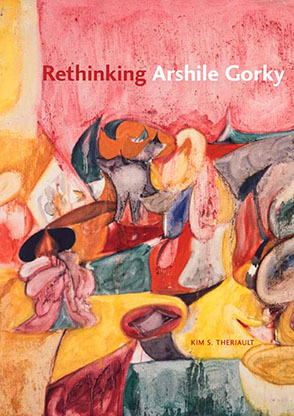
Rethinking Arshile Gorky
Kim S. Theriault
“Kim Theriault’s remarkable scholarly reassessment of Gorky comes as a breath of fresh air and will be considered in years to come as a landmark publication in the field of modern art and criticism. Theriault’s critical study represents the first attempt to link the horrific and traumatic circumstances of Gorky’s early life with his abstract paintings of the 1940s, which she persuasively argues to be a visual manifestation of displacement and trauma rather than simply the assimilation of modernist painting practices.”
- Description
- Reviews
- Bio
- Table of Contents
- Sample Chapters
- Subjects
Rethinking Arshile Gorky is an examination of the artist and his work based on themes of displacement, self-fashioning, trauma, and memory. By applying a multitude of techniques, including psychoanalytic, semiotic, and constructivist analyses, to explain and demythologize the artist, Kim Theriault offers a contemporary critique of both the way we construct the idea of the “artist” in modern society and the manner in which Arshile Gorky and his art have historically been addressed.
“Kim Theriault’s remarkable scholarly reassessment of Gorky comes as a breath of fresh air and will be considered in years to come as a landmark publication in the field of modern art and criticism. Theriault’s critical study represents the first attempt to link the horrific and traumatic circumstances of Gorky’s early life with his abstract paintings of the 1940s, which she persuasively argues to be a visual manifestation of displacement and trauma rather than simply the assimilation of modernist painting practices.”
“Rethinking [Arshile] Gorky is truly a breakthrough publication. It firmly places Gorky as both an artist of note and a sage who tells us, in vivid images, about the brutal impact of genocide on the survivor. Theriault’s book offers scholars of art history and genocide studies a foundation for understanding both Gorky and his art in the right context—as a survivor of the Armenian Genocide. Theriault has unveiled his abstract images and rebuilt his memory, constructing a new view of one of the greatest artists of the twentieth century.”
Kim S. Theriault is Assistant Professor of Art History, Theory, and Criticism at Dominican University.
Contents
List of Illustrations
Acknowledgments
Introduction
1. Genocide, Displacement, and Identity
2. Constructions of Gender, Self, and Other
3. Language, Translation, and Diaspora
4. Exile, Abstraction, and Nonobjectivity
5. Difference, Likeness, and Synthesis
6. Conflation, Re-membering, and Indeterminacy
7. Primitivism, the Feminine, and Orientalization
8. Enigma, Erasure, and Arshile Gorky’s Afterlife
Conclusion
Notes
Selected Bibliography
Index
Introduction
A displaced, poor, and traumatized Armenian in a provincial New York, he could think of no more tractable project for himself than to join the seraphic ranks of the masters. Did he make it? We’re not the ones to say, because our view of what constitutes greatness in art or anything else is so vexed, complicated, and ironic. The whole idea seems old-fashioned, even embarrassing. But Gorky’s best art shows us the miracles that belief in it can work. And we are just the ones to appreciate his self-inventing, reckless grace. The attainment of individuality against ridiculous odds is right up our alley.
—Peter Schjeldahl, “The Great Gorky”
Throughout the criticism, art-historical studies, and biographies of Arshile Gorky (ca. 1900–1948), the artist has remained an intriguing if not enigmatic figure. This book addresses Gorky’s fascinating complexities by exploring the relationship of his artwork to his displacement as an immigrant in the United States, the characteristics and techniques of his style that contributed to the development of abstraction in America during the 1930s and 1940s, and the manner in which he is situated, evaluated, and read within the context of High Modernist art.
Long touted as a transitional figure, Arshile Gorky (fig. 1) appears as an interstice within art history’s linear progression. Often referred to as the last Surrealist and first Abstract Expressionist, Gorky, it has been claimed, embraced dream imagery in the tradition of the Surrealists, used all-over patterning before Jackson Pollock, promoted disembodied color before Mark Rothko, exploited the physicality of paint before Willem de Kooning, and anticipated stain painting. Since the late 1990s, three biographies of the artist have been published, varying somewhat in content and approach but each trying to assert an accurate narrative of the artist’s life. To date, there have been almost as many biographies published as there have been serious art-historical books, even though Gorky himself always preferred not to give too much specific information about his background, believing that after one is gone, it is predominantly the paintings that count. Partially because of the Armenian Genocide and despite attempts by his biographers, much of Gorky’s life story as we know it is inaccurate, unknown, or constructed by the artist, and “Arshile Gorky” is partially a performance based on an invented name and fictionalized background. Similarly, his artwork is a combination of observed and imagined space that has continually eluded description and definition.
Gorky was a survivor of the 1915 Armenian Genocide, a “starving artist” during the Depression, and a fixture in the developing New York City art scene during the second quarter of the twentieth century, and his own tales about his background are a significant backstory to his artistic pursuits. “He was fond of telling his friends,” said fellow painter and sometime art writer Elaine de Kooning, “that he didn’t speak until he was six years old. Before then he spoke only with the birds, he said. And unabashed by the most skeptical reactions (or, more likely, unaware of them), Gorky went on unfolding tale after tale of his childhood, of extraordinary peasants, customs, events and conversations.” Based in actual experience and founded in truth, tales of Gorky’s dramatic persona and fantastic stories are ever-present in recountings of the artist’s life and art, and Gorky himself loved a spectacle. Therefore, the idea of “Arshile Gorky” as a figment of Modernism is often raised to mythic levels because it is complicated by our own stereotype of artists as brooding, mysterious, and often troubled geniuses—a classification into which Gorky’s suicide in 1948 makes him fit all too well. Additionally, available art-historical literature about the artist can be problematic because it founds many of its theories on a cache of letters that Gorky’s nephew and first biographer claims that Gorky authored, but have recently been called into question.
Together, these components of Gorky’s life and afterlife have drawn attention to the individual, while at the same time somewhat obfuscating the historic momentousness of his art. The irony seems to be that, contrary to what we understand of Gorky’s practice and theories, the more he has been explained, the more his art has been disengaged from the viewer’s direct experience. The larger art-historical challenge of this book, therefore, has been to decide what to include of biography and past analyses and when, how often, and to what extent to provoke new interpretations. Yet the necessity of this reexamination is evident: theoretically based endeavors like this study are almost nonexistent, and there have been no single-author book-length scholarly investigations of the artist’s work for almost thirty years.
As a practitioner of modern art in America before it became widespread, Gorky appears as a one-man wrinkle in time, reflecting the social and cultural conditions of his era in addition to revealing art practices. Just as the molded separations that flank cement sidewalk sections both sever and preserve its continuity by allowing adaptation to changeable atmospheric conditions, Gorky’s disjuncture is key to understanding his art. This book rethinks Arshile Gorky’s locus in art history by allowing, like the sidewalk fissures, expansion and contraction of extant knowledge and enlisting it as a solid foundation upon which to step forward and forge new interpretations of Gorky’s place within the art-historical continuum. Ultimately, the multivalent possibilities posed for the artist’s compositions reflect the indeterminate nature of American Modernism itself. For Gorky, art history is not entirely linear, and his artmaking does not necessarily follow a sequential trajectory. Indeed, it can be difficult to determine how some artworks fit into Gorky’s career, because he was known to redate paintings, reuse earlier canvases, and repaint works while they inhabited his studio.
The text and context of Gorky’s art, therefore, cannot be separated. The conditions in which his art was produced, whether historical, biographical, sociological, or political, may have played a role in its development and manifestation, although not always in the way one might expect and usually in a covert manner, even when the obfuscation is not intentional. For instance, knowledge of the Armenian Genocide contextualizes Gorky’s art, but the Genocide is not necessarily present in the works themselves through representative depiction or hyperbole. Rather, emotion is exposed through liminality, as we sense something ominous that is deep-seated and just under the painting’s conceptual surface and arrangement of forms. Although the Armenian Genocide traumatized its victims, its residual effects on survivors were not always obvious, and triggered remembrances tend to be haphazard and rarely linear. In Gorky’s case, the artist’s deidentification with trauma—his refusal to discuss the Genocide—reverberates in his art and life through nuanced behaviors or bold attempts to achieve celebrity under an assumed name that denies his circumstances. Gorky’s personality—he would execute energetic ethnic dances and chants at parties, grandly proclaim his debt to better-known artists, and diligently pursue his painting to the extent that he would often purchase art supplies with his limited funds instead of feeding himself—supports the claim that “even his least susceptible friends had to admit there was something fabulous about the man.”
Simultaneously interdisciplinary and dedisciplinary, this study explores expansive themes and multifaceted relationships between art, history, and society and reveals a continuous interplay between past and present, aesthetic heritage and Modernism, figural and abstract, and considers how individuals, beliefs, and movements may have influenced Gorky’s placement within High Modernist art in America during the twentieth century. It seeks to complement extant critical evaluations of Gorky as a significant exponent of early twentieth-century painting and define him as an eminent Modernist innovator. By engaging sociopolitical, stylistic, and theoretical themes, it allows Gorky’s unique relevance to the course of American artistic advances and his contributions to the art of the last century to become evident.
Locating Gorky within a conceptual framework of plurality to which he himself seems to have subscribed, this study builds upon useful arguments, analyses, and components of earlier examinations of the artist. Inserting a certain amount of academic rigor to attain a better understanding of the artist and his art while avoiding definitive claims that might limit future explanations, this project refuses strict parameters of theory, interpretation, and discipline and embraces the existentiality inherent within the space of art and life. Like Gorky himself, who drew upon multiple influences from a variety of art-historical eras, the study embraces, enlists, and entwines a diverse array of theorists and critics, few of which singly avert the characteristic pitfalls of Gorky’s story that mythologize him as a tragic victim. Constructivist, Postcolonial, and Postmodern critiques coexist here with New Historicism, and theories of time, space, and memory offer new ways of envisioning Gorky’s art. The relativity of this endeavor is in itself challenging because, as Hayden White has pointed out, writing history on some level is also inevitably plot-making. The alternative emplotments introduced here might be more feasible than those structured in the past only when combined with the ultimate conclusion that Gorky and his art are imbued with a Modernist condition of indeterminacy. Additionally, regardless of any past, present, or future theories applied to his art and life, this study acknowledges that Gorky is anchored in making; that is, the process of making art and all of the actions, personal and professional, that manifest it.
Gorky lived during an exciting time in New York City. He understood the energy surrounding him, exclaiming, “The twentieth century—what intensity, what activity, what restless, nervous energy.” With the advent of so many private galleries and new museums, modern art was becoming established in the city’s culture. In 1927, the A. E. Gallatin collection of contemporary European art was installed at the New York University Washington Square campus, within easy access of Gorky’s studio. The Museum of Modern Art was founded in 1929 and expanded three times in the subsequent ten years. Throughout the 1930s, many artists like Gorky were employed through the government support program, the Works Progress Administration Federal Art Project, and among the burgeoning art schools was Hans Hofmann’s, which, relocated from Munich, introduced a new generation of artists to Modernist practice. In 1936, the Museum of Modern Art highlighted the works of De Chirico, Miró, and Dalí, who had been fixtures in private galleries up to that point, in the exhibition Fantastic Art, Dada, Surrealism. A year later, the Museum of Non-Objective Painting (later to become the Solomon R. Guggenheim Museum) installed a permanent collection of European abstract art and the Museum of Modern Art placed Pablo Picasso’s Guernica on display.
Throughout World War II, artists from Europe, including many Surrealists, such as the painter Max Ernst and the writer André Breton, sought refuge in the United States, complementing the pool of modern artists who had already relocated to America, such as André Masson, Piet Mondrian, Fernand Léger, and Amédée Ozenfant. Despite the constant influx of European art and artists, both the American-born and immigrant artists who made up the nucleus of the emerging New York School became increasingly interested in envisioning an American modern art. Summing up their objectives in the 1946 catalogue for the Museum of Modern Art exhibition Fourteen Americans, in which Gorky was included, curator Dorothy Miller proclaimed that “these artists are concerned with communication even more than esthetics.” Gorky’s work, as we shall see, is concerned with viewers’ interpretations while insisting on exploring the formal elements of painting, a practice that later became the hallmark of the new modern American painting.
Rethinking Arshile Gorky begins by articulating Gorky’s relationship to a prism of immigration in which the sociohistorical might be inscribed into his artmaking. Reflecting a Modernist tendency to link art and life, in his seminal essay “The American Action Painters,” the critic and art writer Harold Rosenberg championed the idea that painting is an act, a kind of lived biography, making art and biography inseparable. Chapter 1 posits that Gorky’s background influenced his development as an artist while asserting that it did not define him. Gorky’s practice was to some degree founded on his condition as a newcomer from outside the society in which he came to live, a refugee who had fled the Armenian Genocide and arrived in a xenophobic America in 1920. Gorky’s status as a refugee may have enhanced his awareness of place, both literally, as a displaced person who physically relocated, and figuratively, as a person who as an immigrant was situated within a particular social schema.
When the young immigrant changed his name and moved to New York City in 1925 to become an artist, he began to make up stories about his artistic training. The artist’s transformation from the ethnic Vosdanig Manoug Adoian to “Arshile Gorky” redressed his foreignness. While Gorky’s self-fashioning may have functioned as an immigrant’s attempt to legitimize himself within a largely unwelcoming early twentieth-century American society, it parallels the formation of his oeuvre and his development of a new aesthetic at a crucial point in American art history. Reading Gorky’s self-fashioning within this context elucidates identity as a prevalent theme in Modernist art, particularly for artists residing in the United States prior to and during World War II. Identity construction was important to artists throughout the twentieth century; it is about the process of becoming and both Gorky and American art were transforming at a similar rate.
Chapter 2 continues upon the identity construction theme by examining Gorky’s depictions of himself and his attempts to reconfigure human subjectivity. The chapter highlights how Gorky’s self-portraits and images of women exemplify the dilemmas engendered by exile, the search for his own identity, and the development of his own visual language. Gorky’s artistic vision was initially defined through modifications of his appearance in self-portraits to resemble other artists and in his reconfigurations of the women who were significant in his life. Through a refashioning process, applied both to himself and to his mother, sisters, and wife, he envisioned iconic representations of modern individuals through the use of a budding Modernist visual vocabulary. Gorky’s portraiture presented a visual experience that is emotive in nature and that advanced the Modernist tenet that a picture need not be an accurate representation of or window to the world, but rather is so multidimensional that it transcends accurate identifications and temporal confinements.
An investigation into Gorky’s refashioning is further substantiated in chapter 3, which considers more fully his reinterpretations of works of art that had been made by other artists. Often accused of parroting styles, Gorky migrated through techniques. By acquiring and adapting forms, he loosened their autonomy as if they were the vocabulary of a new language that he eventually recombined into his own sentences. This lexicon exposed broader themes prevalent in American Modernism, particularly those, such as originality, emphasized later in Abstract Expressionism. The art historian Meyer Schapiro claimed that because Gorky approached the art that he studied from completely outside of its tradition, he was “aware of Western Art in a way unlike other artists.” Gorky identified art that was useful, whether it hung in a museum or at an outdoor art fair. His process of displacing forms resembles his own physical relocation and identity fashioning, ushering in a moment of modern art that is tied to physical and emotional execution and setting the stage for the Abstract Expressionist movement, in which art became imbued with the struggle of its own making. The French phenomenological philosopher Maurice Merleau-Ponty once wrote that the Postimpressionist painter Paul Cézanne sought depth, modes of space, and being, mediated by an interest in how one perceives rather than what one perceives. Gorky, through his devotion to the elder artist, similarly endeavored to create a sense of place through the arrangement of compositional elements and belief in the superiority of the artist’s conception of the world over the manner in which it actually existed.
Ultimately for Gorky, art could be the solution to the vexed problem of identity development in America and his desire to be recognized within the annals of art history as a serious and significant artist because of his unique perspective on the world. As the art critic Peter Schjeldahl alleges in the epigraph to this introduction, “the attainment of individuality against ridiculous odds is right up our alley.” The liberties that Gorky took with appearances, distorting them for the sake of pictorial, expressive, and emotive values, anticipated his abstract work, in which forms were subject to internal refinements. Chapter 4 explores Gorky’s philosophy and process of abstraction, particularly through his mural works and in relation to his interpretations of other artists such as Léger, Mondrian, Matisse, Kandinsky, and the Surrealists. In his own art, Gorky created likenesses that were transmutations of the observed and the remembered, continuously shifting between the two, enabling a dialectic for representation and abstraction that forged a diacritical language of displacement and Modernism.
As the study progresses, the interplay between identity, originality, and likeness folds itself into hybridity. Chapter 5 discusses how Gorky’s mature career art used objects, people, or scenes, such as the American landscape, as a point of departure, and united them with other places, spaces, or times, such as the western Armenia of his childhood memories. Gorky often referred to “my country,” but in abstract terms so one could never be exactly sure of what country he was speaking. He was, in fact, referring to his Armenian homeland, which was under Turkish rule, thereby making the term a double dislocation. Gorky’s late-career work of the 1940s, which reflected an abstract-surreal synthetic Modernism based in dislocation, was embraced for its phantasmagorical qualities. The Surrealist sovereign André Breton exclaimed that “those who love easy solutions will find slim pickings here . . . simply because they do not have the courage to recognize the fact that all human emotions tend to be precipitated in hybrid forms.” Breton’s statement recognized that Gorky’s art included emotional transfigurations of observed and remembered worlds.
Like great literature and poetry, whose meanings are often found between the lines, these codetermined hybrid forms of neither subject nor object operate so expansively that they also form a basis for social, cultural, psychological, ethnic, and contextual elaborations of the work. The term “hybrid,” therefore, can be expanded to describe the many elements that operate simultaneously within each of Gorky’s works. Combining both internal combinations and responses to outside influences and structures, Gorky created what might be better termed “displaced landscapes.” If we enlist a definition of place established in the early discussion, these displaced landscapes can be viewed not as complete records of places that exist or had existed but as of both place and displacement, functioning analogically. In this reinterpretation, objects and space are removed from their identity and made to function in a new manner. Gorky’s own life was fractured: he came from a fractured place, spent his life displaced, and conjured places in a similarly fractured, displaced, figural-abstract manner. More simply, Gorky’s work was derived from various sources, both observed and imagined, that were abstracted, rearticulated, and combined.
The discussion of Gorky’s oeuvre continues in chapter 6, which re-places Gorky within twentieth-century Modernism by reinterpreting his attempts to create an identity in America as an artist through manifestations of memory in his art. The chapter introduces Gorky’s practice of “re-membering,” that is, recombining or putting together elements of images that Gorky observed at one point in time with those recalled through the memory that such scenes evoked, by which his art can be understood as synthesized compositions that surpass the basic belief that they are merely nostalgic recuperations. Memory itself is a collection of images that we have maintained from the past. Selective memory edits the past to escape or accentuate it. This embedding operates through abstraction, allowing for an interpretive resolution, which in Gorky’s case navigated national identifications and temporal restrictions to construct what he seems to have hoped to be a simultaneously personal and expansive art, one described as driven and tragic, with “statements of sorrow, joy, passion and agony and, like an undertone to all but the most lyric canvases and nature drawings, a profound Angst.” The ramifications of Gorky’s endeavor likely led to an abstract art that was a product of both physical and psychological displacement. In essence, Gorky composed according to a personal morphology that was haunted by his own individual history, interpretations of it, and imposed identities, but that might also evoke emotions and tones that are universally understood human conditions. His work was part of a shift in thinking that became central to Abstract Expressionism, and this chapter addresses Gorky’s relationship to the burgeoning movement both during and after his death, situating him as instigator for it.
Acknowledging the cultural implications of Gorky’s exilic status and the broader indeterminate nature of Modernist art, which denies labeling or rigid placement, we can recognize Gorky’s mature abstract works as a resolution to the conflicts generated by displacement, while constituting one of the high moments of twentieth-century art. Gorky’s background, it seems, situated him in a peculiar manner to a concept of “other.” While he remade others, himself, and extant art compositions, he simultaneously removed and reinscribed his own Orientalization in the pursuit of being modern. In addition, Gorky was doubly inscribed because he and his art are also feminized. Chapter 7 investigates the reviews of Gorky’s work and physical descriptions of him that feminized or primitivized him and treated him as an exotic. Such a tendency is also, on some level, part of the larger issue of the feminization of artists in general and ties into the Modernist embrace of the “primitive.”
Finally, chapter 8 examines how the artist’s image has developed after his death, particularly the way that Gorky’s myth has evolved in his biographies because of confusion about his displacement, identity, and art. Initially, very little was known about the artist’s background and life, but now there is some question as to whether his biography has come to overshadow his art. This chapter elaborates upon viewpoints inherent in various versions of Gorky’s life story through books and his representation in a feature film, versions that seem to manifest the conditions of their authors, rather than the artist who is the subject of their inquiry. Because of these popular culture representations, interest in Gorky is both useful, introducing people to his art, and problematic, enforcing a preeminence for biography and the myth of the tragic artist over individual responses to the art. Such an interpretation of the artist is reflective of our own “wound culture,” which, coupled with continued denial of the Armenian Genocide, subjects Gorky’s art to the risk of becoming unintelligible without the backstory of his life. The existential struggle of the artist that forever links his art and life is in itself an inherently Modernist process. Yet coupling the artist with tragedy was the antithesis of Gorky’s direction and belief.
Because Gorky’s identity was in flux, the incorporation of artistic technique became part of his struggle for an identity as an artist. And because of his displacement—his being from one place yet existing in another—Gorky’s art was also in flux, and such indeterminacy encouraged an aesthetic that disengaged fixed forms and facilitated abstraction. Such fragmentation and restorying of loss in some ways propelled Gorky into Modernism and prompted him to create an aesthetic that is ultimately American because it consists of interwoven worlds, multidimensional space that blends and clashes, and fabrics of identity that reveal multivalent connotations. “Such art does not merely recall the past,” says Postcolonial theorist Homi Bhabha, but rather refigures it “as a contingent ‘in-between’ space, that innovates and interrupts the performance of the present. The ‘past–present’ becomes part of the necessity, not the nostalgia, of living.” The in-between “past-present” is an important concept in understanding both Gorky’s motivations and his art because, as we shall see, his art is a manifestation of this condition that is not always visible.
Interpreting the multiple layers present in both Gorky’s art and life is complicated by what the artist did not speak of, left out of, or abstracted to the point of unrecognizability in his work, rather than what is present in it. Despite the ethereal qualities of his art, which mimic the spirit of the artist himself, Gorky’s endeavors were clearly tied to questions about what it meant to be an artist in America during the mid-twentieth century, just at the moment when the focus of the art world, bound up with abstraction, was about to shift to the United States. Themes of historicity as justification for abstraction prompt this interdisciplinary and eclectic examination of Gorky’s working method, tangential connection to other artists and movements, and use of abstraction.
Perhaps the best way to understand Gorky would be to view him as a punctum existing within a set of circumstances at a particular point and time, but influencing his art-related surroundings in a spherical rather than linear manner. The French literary and social theorist Roland Barthes’ mechanism of the punctum provides a useful way to address both the artist and his art. Although Barthes applies it as an explanation for a photograph that pricks or grabs the viewer’s attention as a reference to the past, the relationship of the term “punctum” to the idea of punctuation applies to Gorky in many ways. A photograph punctuates the present with a reference to the past, but it also suggests that the past consisted of more than what is evident within the photographic frame. Gorky punctuates a transitional moment in art history: his work and his existence reference the past but also, through their abstracted composition, project onto the future because of the need for a viewer’s interpretation or response to it. The most remarkable aspect of the device of the punctum, as it is applied to Gorky, is its power of expansion, in that it promotes the possibility that the artist’s work can be understood in multiple contexts simultaneously.
Recognizing Gorky’s art as a punctum also expands our comprehension of oeuvre. Within the entity of the punctum, what we know of Gorky and his art points toward many other outward elements. This is particularly true of Gorky’s relationship to the Armenian Genocide, which is not something he addressed directly but is evident in his work partially through the personal and stylistic choices he made. A punctum is often evident only after the fact, and only now in retrospect, when we try to grapple with Gorky’s meaning within art history and are left with the hole between two art movements that scholars have been trying to address for decades, can we determine Gorky’s primacy to the era. The “blind field” that results from the themes of this study increases vision, enhancing our understanding of the elements of a painting that relate to the life outside of it. Gorky’s biography and self-fashioning in the past inform our interpretations of him in the present, and this in turn informs our interpretations of the art—both what the artist meant and our interpretation of it, and readings based upon our own experience with art and life.
Gorky’s work itself is very much a punctum, containing both an absence because of what is unrecognizable, and something that grabs the viewer because of its familiarity. Often, amidst the unrecognizable and abstract shapes, we are enticed by an element that looks familiar—a bird, flower form, or partial body-like image—that has a synecdochic quality because it signifies both itself and the outside world. A work by Gorky is a punctum in its relating to its own internal composition, back to the work of the other artists, and to the landscapes or the sources upon which the composition was based. We can only fathom elements from the observed or remembered that exist in the works in retrospect, as they are an afterimage of sorts. Because Gorky’s work is abstract and often undefined for the viewer, it exists also in a “blind field” in which the viewer completes it. Barthes says, “The punctum, then, is a kind of subtle beyond—as if the image launched desire beyond what it permits us to see: not only toward ‘the rest’ of the nakedness, not only toward the fantasy of a praxis, but toward the absolute excellence of a being, body and soul together.” Gorky’s work, then, and even his biography, which is still being discussed, extend outwardly, forcing the viewer to adjudicate its meaning.
In the end, Gorky’s is not the classic American tale of the triumphant outsider. Complicated and circuitous, his story, and the way it plays out and is interpreted in his art, is, as Schjeldahl says, right up our alley. Although one might muse about the direction of Gorky’s art or what he might have produced or become, this book is about the fungible qualities inherent in Gorky’s oeuvre—how, as a modern maker, he has reached mythic proportions, but also how this endeavor contributes to an understanding of his art that reflects contemporary concerns of self, difference, place, and space. By enlisting a combination of stylistic, historical, and theoretical knowledge and incorporating semiotic, psychoanalytical, philosophical, or sociological readings, we can synthesize the diverse attributes and meanings of Gorky’s art. Explaining his art in terms of an ethnographic Modernism that reflects a teleological experience of twentieth-century America, while at the same time acknowledging that such endeavors expand beyond the examination of a singular artist at a particular juncture, induces plurality and multiple readings.
Neither Gorky nor his art is so provincial as to be concerned solely with hardships. “Tireless, fastidious and intolerant,” as Elaine de Kooning described him, “Gorky reduced tragedy—his own or anyone else’s—to the level of discomfort or irrelevancy, and in the light of his lack of sympathy, any misfortune lost its magnitude.” Never the victim, Gorky industriously learned techniques of art and being an artist. The struggle against displacement, to have an identity, and to produce abstraction is inherently about the need to produce art. Although Gorky’s art offers no easy solutions, it is a tractable project to pursue its significance through the lens of these chapters, which, in turn, can assist each of us in attaining an individual understanding of it. This study, true to Gorky the entity and the manner in which his art functions, is a kind of sheaf, an assemblage with a complex structure that interlaces different threads and lines of meaning that go off in different directions just as they are about to be tied up. The reader is left to determine what he or she wishes to rethink about Gorky and his art because its mutable meanings and indeterminate nature ultimately reflect Gorky’s condition.
Also of Interest
Mailing List
Subscribe to our mailing list and be notified about new titles, journals and catalogs.