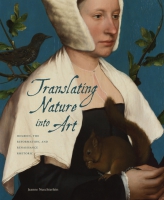




Translating Nature into Art
Holbein, the Reformation, and Renaissance Rhetoric
Jeanne Nuechterlein
Translating Nature into Art
Holbein, the Reformation, and Renaissance Rhetoric
Jeanne Nuechterlein
“Translating Nature into Art is a fascinating case study of the long-standing debate about the relationship between naturalism and meaning, between appearance and essence, in art. It is not casual reading, but diligence will be rewarded with a better understanding not just of Hans Holbein but of all art.”
- Description
- Reviews
- Bio
- Table of Contents
- Sample Chapters
- Subjects
“Translating Nature into Art is a fascinating case study of the long-standing debate about the relationship between naturalism and meaning, between appearance and essence, in art. It is not casual reading, but diligence will be rewarded with a better understanding not just of Hans Holbein but of all art.”
“Nuechterlein rewards her readers with wonderfully sensitive observations about Holbein's art and his possible intentions. Translating Nature into Art is richly rewarding. Nuechterlein proposes a method for understanding Holbein's stylistic decisions and their theoretical underpinnings. . . . Nuechterlein's exercise in careful study of a limited number of works yields stimulating new insights. For this reader, the book makes Holbein the artist both more human and more interesting.”
“In this subtle, original and admirably clearly written book Nuechterlein explores both the nuances of Holbein’s visual language and the German and Latin constructions used in the writings of his contemporaries, at the same time placing the artist’s work at the heart of contemporary debates on the use of images.”
“[Nuechterlein’s] arguments throughout are fresh, insightful, thoroughly researched, and persuasively and eloquently set forth. Sixteenth-century scholars, both in the field of art history and beyond, will find rich stimulation in this welcome new work.”
Jeanne Nuechterlein is Senior Lecturer of History of Art at the University of York.
Contents
List of Illustrations
Acknowledgments
Statement About Orthography
Introduction: Holbein’s Reformation of Art
1 Holbein and the Basel Reformation
2 Choosing Styles
3 Seeing Christ
4 Judging Appearances
5 Translating Nature into Art
Conclusion: Noli me tangere
Notes
Bibliography
Index
Introduction: Holbein’s Reformation of Art
The portraits by Hans Holbein the Younger are astonishing, even in the face of their ordinariness. Take the Vienna Portrait of a Young Man. It allows us, invites us, to linger over details that in everyday life we might overlook, or at least not feel free to stare at: the precisely defined shapes of the man’s features, the subtle shading under his high cheekbones, the delicate black lacing at his collar and cuffs, the gleam of his satin sleeves, the softness of the fur, the dots of stubble. How remarkable Holbein’s capacity to capture detail with such accuracy, and to turn everyday sights into such sublime representation. As we stare like voyeurs, the young man gazes back imperturbably, with a hint of a smile—or is there a touch of sadness around his eyes? Do we sense arrogance perhaps, or wistfulness? Hard to decide, but that only adds to his appeal. We seem to encounter not a painting but a young man at a moment in time; we gaze across the years to discover just what he looked like several centuries ago when Holbein watched him look up from his book and turn to his audience.
Of course, that is something of a fiction, and the painting itself hints at its own artifice. While the man, the book, and the inkwell all project volumetric presence, the cast shadows on the table are too sharp and dark to match the rest of the representation, the table itself stands at an implausible angle to the paneling, and the bluish tones behind the man’s head only half function as a wall. A delicate gold inscription in elegant Roman lettering floats on this ambiguous ground, announcing that the year is 1541 and the man is in his twenty-eighth year. The artifice, however, does not interfere with the man’s illusionism; rather, it makes the illusion all the more remarkable. While we recognize his image as an artistic creation, we are willingly persuaded of its faithfulness. But faithfulness to what, exactly? To one single moment back in 1541? Not exactly: the young man has been represented at a certain time in his life, which is not the same thing as a specific moment—not how he looked on, say, October 27 at 10 A.M., but a kind of weighted average of how he looked when he was twenty-eight years of age. He may have a five-o’clock shadow, but somehow you feel that he always did.
By focusing so intently on tiny descriptive details yet simultaneously generalizing the sense of time and place, Holbein achieves something equivalent to a perfectly framed photograph. The closely examined facts of the man’s outer appearance are not just happenstances of a moment but the truth of who he was when Holbein saw him, or so the painting leads us to believe. This book argues that the attraction of Holbein’s portraits arises from this conflation between momentary appearance and captured essence, and that Holbein’s decision to render human beings in this way was by no means a given but evolved in the context of heated debates in the early Reformation and Renaissance period about the nature of the world and how best to communicate meaning. His portraits’ coolly observed facts about appearance embody—not just accompany—an impression of the subject’s internal or spiritual being.
Although on first thought this may not seem like an unusual thing for an artist to do, I argue to the contrary that it marks Holbein out not only from his contemporaries but from the majority of artists throughout Western art history, with certain exceptions, like Jan van Eyck and Johannes Vermeer. What Holbein shares with Van Eyck and Vermeer is that all of them appear to reproduce more or less holistically plausible scenes, as if they could have been observed rather than invented, and they largely dispense with a range of typical significatory techniques such as overt stylization, expressive brushwork, facial expression, dramatic gesture, and obvious symbolism; yet we still feel upon looking at these pictures that they contain some deeper meaning and are not merely pleasant genre scenes. This impression is connected (though not quite identical) to the so-called disguised symbolism of Van Eyck’s painting, as first formulated by Erwin Panofsky and subsequently debated by virtually all historians of early Netherlandish art. Although I would disagree with many details of Panofsky’s interpretations of Van Eyck’s (and other early Netherlandish) works, I believe that he was essentially right when he said of the Arnolfini Portrait, “The symbolical significance is neither abolished nor does it contradict the naturalistic tendencies; it is so completely absorbed by reality, that reality itself gives rise to a flow of preternatural associations.”
A similar process, I am arguing, occurs in Holbein’s portraits, as well as in Vermeer’s works, though I believe that such meaning operates on a deeper level than the specific symbols that Panofsky perceived in works like the Arnolfini Portrait, or the type of emblematic symbolism that some art historians have perceived in much of seventeenth-century Dutch painting. These critics tend to interpret the paintings as a kind of visual code, matching details to specific symbolic intentions, but I would see the essential meaning in the images of Van Eyck, Vermeer, and Holbein as more profoundly embedded in, or even synonymous with, the representation itself. (In fact, this was also at the heart of Panofsky’s interpretation of Van Eyck, at the “iconological,” rather than the merely “iconographical,” level.) Representing what the world looks like becomes the means of conveying its underlying spiritual essence.
Perhaps paradoxically, this is not how most art conveys meaning. Representational artworks more often imply their own interpretation through other visual means such as symbolism or expressionism, and they usually reinterpret their subjects visually in a more overt manner. That is, while they may contain naturalistic details, their appearance has clearly been filtered through the artist’s visual style or combined within an overall composition that is incontrovertibly an artistic invention rather than an observation. And in fact, when we look at most of Holbein’s works other than his portraits—his religious, historical, allegorical images—we find that alternative type of representation. Take, for instance, his Triumph of Wealth, one of two large-scale paintings in distemper made for the German Steelyard merchants in London. The original was destroyed by fire, but later copies of the painting confirm that the surviving preliminary drawing closely reflects the work’s final appearance. The subject is overtly a figment of artistic imagination, consisting of a group of classical figures (mythological as well as historical) together with personified virtues and vices processing in the manner of Petrarch’s Trionfi. To match the allegorical subject, the style itself is highly fictionalized: the elegant drapery, unnaturally proportioned bodies, expressive poses and gestures, and stark contrasts of light and shade are clearly Holbein’s invention rather than anything he could have observed in the real world. The brunaille coloring and relief-like composition, imitating Andrea Mantegna’s imitations of classical relief sculpture , reinforce the scene’s patent nonreality. The image creates and conveys meaning via an inventive arrangement of idealized figures, not by trying to look like something in the material world.
On first glance the stylistic distinction between Holbein’s portraits and his works with other subject matter seems entirely unsurprising. After all, to paint a portrait, Holbein worked from a real person in the real world, whereas to paint a mythological or religious scene, he necessarily had to work from imagination, combined with the precedents of other artists. But few artists of Holbein’s era differentiated their portraits so starkly from their other kinds of works or tried to make them appear so thoroughly objective. Consider, for example, Albrecht Dürer’s portrait of Hieronymus Holzschuher (fig. 5) in comparison with Holbein’s Vienna portrait. Each panel represents its sitter’s face and upper body with minutely controlled detail, but we sense that Holzschuher in real life must have looked somewhat different from his depiction in the painting—an analogy to his portrait—whereas Holbein’s painting encourages us to think that the real sitter looked identical to his representation. Dürer’s portraits tend to have a distinctive visual style, and Holzschuher, like most of Dürer’s late portraits, has a certain bumpiness to the folds and bulges of his skin, which we perceive at least in part as an imposition by the artist (compare, for example, Dürer’s engraved portrait of Philipp Melanchthon, fig. 97). Dürer renders his sitter not with a neutral expression but with a powerfully furrowed brow, suggesting a forceful character. Moreover, the detailed lines of his hair and beard appear simultaneously as pure line and as individual hairs, both the thing they represent and the means by which they are represented. Most of Dürer’s finished works operate in a similar way; his famous 1500 self-portrait in Munich is exceptional in aiming to downplay or mask the role of his personal hand in creating the image.
Even more “artificial” looking are most of the portraits by another of Holbein’s older contemporaries, Lucas Cranach the Elder. His preliminary drawings and watercolors prove that he was capable of powerful naturalism, but his finished paintings (whether of religious subjects, mythological scenes, or portraiture) have an artfully stylized appearance that clearly appealed to many buyers. Cranach is perhaps an extreme case, but virtually all German and Swiss painters of Holbein’s era put some sense of themselves as creative intermediaries into their portraits as well as into their other types of subjects. So too did contemporary Italian artists—we can hardly imagine a real woman looking identical to Leonardo da Vinci’s Mona Lisa. With Holbein, on the other hand, we perceive his portraits as much more impartial and factual, accurate translations of true appearance into paint. In reality, he surely imposed something of his own vision on his subjects, as Dürer and Cranach did, but we can easily imagine that he merely reproduced what he saw, that what he saw had meaning in and of itself, and that he took no active role in shaping appearance to create meaning.
By the time Holbein first visited England, in 1526, he generally painted his portraits using this objective, or descriptive, mode, whereas for his other works he used a much more inventive and artful manner. Or to be more precise, if we think of Holbein’s styles as ranging along an inventive–objective spectrum, his portraits generally fell toward the objective end, while his other subjects ranged closer to the inventive. A few works might be sited in the middle: Laïs Corinthiaca is an idealized historical figure made to look like a portrait; the Dance of Death woodcuts (e.g., fig. 7) are descriptive in the settings and most of the figural constructions but more inventive in gestures and postures (and of course in the inclusion of the death figure); and most of Holbein’s portraits of royalty combine a degree of description with elements of abstraction, or typing—in the case of Prince Edward (fig. 83), his genuinely babyish features are made perfectly rounded and symmetrical, combined with an implausibly mature gesture to transform him into an appropriately regal infant. For the most part, however, either Holbein’s images are strikingly objective and descriptive in tone, or they are overtly more imaginative. And a crucial point is that this distinction does not simply reflect subject matter or genre: some of his portraits are more inventive, and in the 1520s, toward the beginning of his career and just when the Reformation crisis was erupting, Holbein tried out the objective mode in a few religious paintings, most importantly the Dead Christ in the Tomb of 1521–22 (fig. 47) and the Solothurn Madonna of 1522 (fig. 58), and also to some degree the Darmstadt Madonna of ca. 1526–28 (fig. 98). For Holbein, then, it was not necessary for portraits (and portraits alone) always to look more “real” than other subjects; it was simply that, in the Reformation era, portraits of ordinary people quickly became the most suitable genre for his objective mode of representation.
The contrast between the two modes heightens our perception of each. Holbein’s descriptive manner seems all the more “realistic” in comparison with the distinctly nondescriptive approach in his other works, and vice versa. That distinction, made by the artist himself, is crucial to interpretation. Eyes with different cultural attunements may perceive the same image very differently; medieval icons may look to us flat and stylized, whereas their contemporary audiences generally perceived them as very “real,” as direct embodiments of the subjects they represented. They only look abstract and unnatural when set against Renaissance representations with holistic settings, three-dimensionality, and the descriptive trappings of shadows and textures. But because Holbein himself differentiated between alternative modes that he applied to different works, we can only conclude that he was aware of the difference and that the difference held specific meaning for him (and for at least some of his viewers).
I believe the meaning was this: when Holbein used his stylized manner, he acknowledged that he was the inventor of the image, that he had created it according to his own conception and brought out its significance by shaping its appearance. Visual analogy with the three-dimensional material world was a comparatively minor factor in communicating its meaning. But when Holbein painted a portrait or a religious work in the objective manner, he implied instead that he was observing something in front of him and reproducing what he saw. He may have suggested the pose and chosen the point of view, and he may have made slight adjustments to optimize the visual impact, but the portrayed human being constituted a physical truth that Holbein could not alter at will (or so the painting seems to state), and this physical truth carried within it an internal or spiritual truth, the person’s essential being.
To reiterate, this was not the typical approach to representation in the Renaissance era. Albrecht Dürer and Leonardo da Vinci constructed most of their humans in a highly conceptualized way, with idealized or typed faces, precisely calculated body proportions, vivid expressions and postures. By doing so they sought to reveal deeper truths underlying the visible world: the beauty of that which is most perfect, or the perfect representative of a type. Even Dürer’s most descriptive-looking painting, his 1500 self-portrait, arranged his features according to precise geometric proportions derived from images of the Holy Face of Christ, while Leonardo studied human beings and the natural world in order to understand how they worked, so that his images could show those workings more directly and clearly. Thus Dürer and Leonardo conceived of their images as optimized expressions of truth that could easily be “read” by their viewers: they show nature perfected by art (or art perfected by nature, two sides of the same coin). Holbein, on the other hand, conceived of idealization or stylization not as the highest expression of truth but as a mode of artistic expression qualitatively neither higher nor lower than any other, an option that he might use in some cases but discard in others. By drawing such clear distinctions between his imaginative figures and his described ones—and also by constructing his imaginative figures in different ways, not according to a consistent set of ideals or types—Holbein developed alternative ways of conveying meaning; some images were more the product of invention, others of observation. Holbein’s imaginative works thus emphasized his adjustment of natural appearances to create and shape meaning via his own style; in them, as one might say, art paraphrases nature. (This concept could apply to most Renaissance art, indeed most representational artwork of any time or place.) In Holbein’s descriptive images, on the other hand, he aimed to capture and transmit a meaning that (ostensibly) already existed in the visible world: to translate nature into art.
The latter is the truly surprising choice, and few artists could have made it in the centuries before the Renaissance. Medieval artists may have conceived of their art as communicating, rather than inventing or shaping, truth, but they and their viewers did not generally expect that truth to be equivalent to real-world visual experience. One of the great changes of the Renaissance period was the expectation that images bear greater visual analogy to everyday perception than they had in the recent past (though different artists in different parts of Europe conceived of that analogy differently, and art was still generally expected to interpret the world rather than simply reproduce it). Another change was artists’ increasing self-consciousness about their subjective role in the creative process. Such awareness became a crisis during the controversies of the Reformation, when images (and by extension their makers) were accused of inciting idolatry, the worship of made objects. This book argues that Holbein’s eventual decision to distinguish between alternative modes of representation—and their alternative ways of conveying meaning—emerged through his close engagement with two contemporary sets of concerns: first, Renaissance debates about how stylistic expression shapes meaning; second, the Reformation’s questions about whether material things like images can convey any kind of spiritual truth. Living in an era when images were expected to look so much like the visible world—and with a singular personal talent for creating stunningly realistic-looking images—Holbein explored how much art should look like the visible world, and in the process found alternative ways of making representation meaningful.
Holbein grew up in early sixteenth-century Augsburg in an artistic community acutely aware of stylistic alternatives, not least because of the relatively new Northern European interest in Italy as a cultural model. In Holbein’s earliest extant work, dating from his journeyman period in Basel and Lucerne, he actively explored a wide range of Gothic and classical styles inspired by various models from Italy, Germany, and the Netherlands. This early eclecticism reflects the contemporary German artistic training system whereby aspiring artists traveled around to assist in different workshops before they could become independent masters. It also parallels the latest humanist method of teaching boys to write; proficiency in written expression was developed through the practice of variety, and I believe that Holbein’s early acquaintance with Erasmus in Basel encouraged him to think about artistic expression in a similar way, as I explain further in chapter 2. After the early variety in Holbein’s work, however, his “inventive” images gradually became more consistent, and he seemed more concerned with finding the most appropriate visual mode to express his desired meaning. This parallels the central concern of Renaissance rhetoricians, which was not with style per se but with what manner would best convey a particular subject to a particular audience. An elaborately ornamental style applied to inventive subject matter (like that of the Triumph of Wealth) might be taken by some as the height of persuasive eloquence, but others might see such an image as deceptively artificial—for them a straightforward rendition of a simple subject would be far more appealing. Holbein’s descriptive mode goes even further, however, since in a way it claims not to be shaped by rhetoric in the first place: its “style” is supposedly not Holbein’s choice, because it simply reproduces the subject’s actual appearance.
The emerging crisis of the Reformation made such stylistic decisions acute. Was “style” an artificial intermediary standing between truth and human understanding, or was the right style that which best showed how things really were? Correspondingly, did the things visible in the world reveal the truth of themselves at their core, or was an intervening medium needed to bring out their true essence? During the years Holbein prepared for and then became an independent master, Martin Luther and other reformers raised profound doubts about the relationship between spiritual truth and the visible world. Theologians increasingly debated how objects like religious images and relics bring human beings into contact with God—how (and indeed whether) physical matter can convey divine spirit, particularly when that matter has been created by an artist. In a similar way, portraitists wrestled with how external appearance communicates identity: should a portrait simply reproduce appearance, warts and all, or should it reshape appearance to better convey the subject’s character or to present him or her in the best possible light? While scholars, physicians, and art theorists debated the physiognomic connection between the body’s appearance and the soul’s moral virtue, religious reformers conducted a parallel debate regarding the connection between the visible bread and wine of the Eucharist and Christ’s invisible bodily and spiritual presence. When we see the bread and wine on the altar, can we really “see” God, or do we only perceive his presence through the eyes of faith?
It was in this climate that Holbein explored and then consolidated as two alternatives his two modes of representation. In his imaginative images, he held responsibility for shaping the message, the “truth” of his subject, and he did so by altering appearances to optimize communication. But in his objective mode he appeared to reproduce the subject without intervening interpretation, thereby making meaning seem embedded within the subject itself. In a world becoming increasingly polarized between Protestant and Catholic worldviews, Holbein’s descriptive images sought a middle ground. In those works representation could be entirely of this world yet simultaneously a pointer to things beyond, just as Christ had been both fully human and fully divine.
The Nature of the World: A Clash of Perspectives
The relationship between Holbein’s stylistic choices and Reformation doubt about the nature of the visible world merits further explanation. Toward that end I will describe two recent examples of religious response to Christ’s burial site in Jerusalem, as an illustration of the divergence of Protestant and Catholic ideas about the presence of God in the world. Though set in the modern era, this analogy illuminates the dilemmas Holbein faced in trying to find new ways of using material forms to convey spiritual truths. When visiting Jerusalem some years ago, I saw clearly that devout Catholics responded to its holy sites differently than Protestants did; in the early decades of the sixteenth century, when Holbein was coming into maturity, such differences were turning into a profoundly divisive force in European society.
Consider first the Catholic response to the Holy Sepulchre in Jerusalem, which has been identified as the location of Christ’s crucifixion and burial since at least the early fourth century, when the Christian emperor Constantine built a church on the excavated site of Golgotha, the “place of the skull,” where the Gospel texts proclaim that Christ died. The church, largely rebuilt after the European recovery of the Holy Land in the First Crusade, encompasses both the stone in which Christ’s cross was implanted and the slab upon which Christ’s body was laid, the latter located inside a circular aedicule under the church’s dome. Constantine went to a great deal of trouble to build his church on the presumed site of Christ’s death and burial because he knew that pilgrims would be attracted to the sacred power of the places Christ had touched during his earthly existence; indeed, it became one of the most important of all Christian pilgrimage sites, despite the difficulty of getting there. Its authenticity helped visitors to identify with Christ’s Passion, an experience that thirteenth-century Franciscans developed into the Via Dolorosa, or Way of Sorrows, a series of intense devotional meditations on each event in the Passion, designed to mentally reenact the last day of Christ’s life. In western Europe, Catholics follow the Way of Sorrows by a series of images circling their churches, but in Jerusalem they can retrace the actual route that Jesus supposedly took on his final walk to Golgotha, beginning at what is now Stephen’s Gate, in the Muslim quarter, and ending inside the Holy Sepulchre, in the Christian quarter (Franciscan brothers still follow Jerusalem’s Via Dolorosa every Friday afternoon). Inside the church, crowds gather at the station of the Crucifixion, where devout visitors gaze reverently at icons of Christ on the Cross flanked by Mary and John; some kneel before it and kiss another silver icon underneath an Orthodox altar. Even more crowded is the final station of Christ’s burial, inside the aedicule. Some who wait in line to get in are just curious tourists, but others experience their eventual entry into the sepulchre as a profound culmination of their pilgrimage to the Holy City, even a high point of their spiritual life. Despite the occasional doubts that have been expressed over the centuries about its authenticity, for Catholic (and Orthodox) Christians the church powerfully draws the faithful to pilgrimage by marking the precise site where Christ was crucified and buried.
Then there are the Protestants. A few hundred yards north of the Holy Sepulchre is the Garden Tomb, a small, quiet haven from the noise of the modern city, its paths leading between trees and flower beds to viewpoints toward a hill and a burial cave. The site was “discovered” in 1883 by the British general Charles Gordon, who noted that the hill looked strikingly like a skull because of the configuration of hollows in its side. Archaeologists have studied numerous burial caves in the area, but one not far from the skull-like hill has attracted particular attention. Inside the entrance, which originally was only about waist high but has since been enlarged to standing height, is a small mourning chamber. To its right is a separate space with two carved niches in the floor, one of which, the one nearest to the door, is unfinished. Many Protestant groups in the United States and England came to believe that this must be the true Golgotha and burial place, and the site is now owned by an evangelical organization. The tour guide suggests that this, rather than the slab in the Church of the Holy Sepulchre, could well be the actual site of Christ’s burial, and his arguments are heavily based on Scripture—its original closure by a rolling stone, one partially unfinished tomb, the once-low entry, all matched to passages from the Gospels. But the Garden Tomb is not a pilgrimage site in the same way that the Church of the Holy Sepulchre is. That is not at all surprising given the weight of tradition and history in favor of the ancient church; moreover, it seems highly likely that the Garden Tomb in fact dates from much earlier than the first century A.D. and so cannot be the tomb of Nicodemus. What is more interesting, though, is that evangelicals themselves are not that much moved by the idea that this is the true site of Christ’s crucifixion and burial. A guide leading a group of Protestants through the garden presents the arguments for its being the real thing, but then his talk takes a different turn:
It’s up to you now to decide if you think this is Jesus’ tomb or not. But don’t spend too much time thinking about the location. Because what’s really important is that Jesus is not here—the tomb is empty—he is risen! He was crucified and resurrected to redeem us from our sins; where it happened doesn’t matter so much as that it did happen. When you go back home and tell your friends and relatives about your trip, you might tell them you’ve been to the place where Christ was crucified and buried, but don’t just talk about a hill and a cave, talk about what it means.
His audience nods in agreement, several adding an “Amen” to his words.
These two locations in the city of Jerusalem embody very different attitudes toward the sacrality of objects and places. In the outlook embodied by the Church of the Holy Sepulchre, the location at which sacred events occurred takes on an aura of sacrality itself, and its authenticity creates an environment particularly conducive to religious meditation. The divinity of past events still adheres to the place and to the preserved stone, making them numinous in their own right. To the other group, the evangelicals at the Garden Tomb, there is no such thing as sacred space or sacred objects. Identifying and visiting the sites of the Passion is inspiring and helps to remind viewers of the central truths of the Christian message, but that message is ultimately all that matters, and it is fundamentally detached from the places where it was first manifested.
Between these two groups the Christian message itself is not much different, but they employ very divergent modes of experiencing and believing it. Although these modern-day Catholics and Protestants are not identical to those of five hundred years ago, a similar divergence lies at the heart of the insurmountable differences that arose between them in sixteenth-century Europe and led artists like Holbein to rethink how representations of material form might convey invisible meaning. Following the emergence of Martin Luther as a symbol of opposition to the papacy, a substantial contingent of the European population came to insist, in contradiction to established authority, that there are no such things as sacred objects and that devotion to God occurs equally well anywhere, at any time, and by anyone who has the right attitude. Protestants rejected the church hierarchy’s authority to establish sacramental truth and to stand as mediator between the individual and God. Their attitude called into question a wide range of traditional religious practices, including the use of sacred objects such as relics and religious images, which previously had often been seen as embodiments of, and direct conduits to, the saints they represented. Such skepticism by no means originated in the sixteenth century—controversy about sacramental authority and sacred objects has existed within Christianity since its inception—but over the centuries the church had usually accepted the role of objects and images within religious practice, and any opposition to them was either expressed within the church in a moderate form, or in extreme forms condemned as heresy. By the time of the Reformation, religious images of all kinds had become ubiquitous in churches and chapels as well as in domestic lay practice, but even as they became ever more widespread, complaints about them—as overly lavish, even “whorish” distractions from the real truth of the Gospel—became more vociferous, as will be discussed further in chapters 1 and 3. Many people in the early sixteenth century came to reject religious images entirely, along with all the other practices that sought sacred truth by means of visible things. Since the divine realm had nothing to do with the physical world (in their view), any attempt to access it by material means inevitably resulted in superstition and idolatry.
This is the type of argument that Holbein attempted to address in his objective-mode religious paintings, a highly idiosyncratic (and as it turned out short-lived) contribution to the debate. Holbein’s relationship to the Reformation has been studied before, but such studies have generally investigated whether he himself can be identified as Protestant or Catholic, or the extent to which confessional associations seem to emerge in his subject matter. This is in itself a complex and interesting question: given that he worked for both Catholic and Protestant patrons and adapted his output accordingly, as did many other artists in this period (including Lucas Cranach), it is difficult to determine how far Holbein’s images reflect his personal beliefs or were designed to suit their buyers—contrast, for instance, his very traditional organ wings (fig. 43) with the Protestant Allegory of Law and Grace made in roughly the same period. This book, however, explores Holbein and the Reformation at a more fundamental level, by assessing how his art addresses two themes at the heart of the Reformation era, the nature of the visible world and the artist’s role in communicating meaning. Holbein’s engagement with these issues is not limited to choice of subject matter but runs on a deeper level to how he portrayed visible things. In his Dead Christ (fig. 47) and Solothurn Madonna the artist took the highly unusual approach of representing traditional religious subject matter in a thoroughly naturalized style: thus, in these works, he rejected the arguments of the radical reformers by showing that things of and in the world can indeed reveal things of the spirit, while at the same time, by appearing so thoroughly humanized, they deflected the idolatry Protestants feared. However, as the religious divisions became increasingly polarized and the market for religious artworks contracted, Holbein evidently created no further such works; instead, he brought the objective mode into his portraiture, while his other imagery remained more inventive in style, overt creations of his imagination.
The controversy over material objects and practices does not of course completely explain who Protestants and Catholics were, all that they disagreed about, and why they could not reach a compromise; many other factors, such as desire for local control over religious institutions, or abhorrence of division within the church, led some individuals to identify themselves as Protestant while others adhered to the traditional faith. Nevertheless, the critique of images was by no means an abstract question affecting only a few: it became one of the major bones of contention between the old and the new faiths, and implementations of the Reformation resulted in dramatic transformations in worship and the appearance of churches. At the same time, Protestants and Catholics, especially in the early Reformation, were not always easily identifiable categories. Although I have so far been discussing a “Protestant” worldview opposed to its “Catholic” counterpart, in reality such a dichotomy can only be a useful, if overgeneralizing, tool in helping to identify major strands of thought. Each faith harbored a spectrum of opinions on such matters, and categorization is particularly difficult for the 1520s, when reformers were still developing and disseminating their ideas and the church had not yet irrevocably divided. Especially before the Augsburg Confession of 1530, which codified the central tenets of Lutheranism, the specifics of the various Protestant theologies often shifted; individual reformers did not always hold consistent views over time and across different issues, and even their most ardent supporters likewise did not all believe the same things for the same reasons. Some people changed their position quite dramatically within a short time, suddenly becoming religious radicals after years of moderation or conservatism. The nebulous relationship between radical reform ideas and Christian humanism compounds the confusion, as we will see in chapter 1. Thus it can be difficult to pinpoint what made a potential Protestant and what a faithful Catholic in the early 1520s, or to interpret particular points of view as necessarily one or the other. Some people already held resolutely to either reform or defense, but for most it was not until some years later that making such a choice became necessary.
These uncertainties of religious identity are crucial to understanding why and how Holbein spent so much of his early career reflecting on the meaning of external appearances. The religious controversies erupted precisely during the time that he was establishing himself in Basel, and they were a crucial aspect of life in the city and among his patrons. In 1520 Holbein was about twenty-two years old and securing patronage among the city’s book printers, humanist scholars, and the businessmen who ran the guilds and city council. During the following decade, some of these patrons came to identify themselves as Protestants, some as Catholics, while others avoided making a choice as long as possible (as seems to have been Holbein’s own response). In 1520 Basel was already becoming one of the major centers of reform publication in Europe, and its printers hired Holbein to design numerous book decorations. While a large faction of Basel’s population pushed for religious reform over the course of the 1520s, the more conservative civic leaders (several of them Holbein’s patrons) tried to delay any decisive actions, until an iconoclastic riot in early 1529 forced through a full Zwinglian Reformation. The one extant piece of documentary evidence concerning Holbein’s own religious beliefs suggests that while he converted to Protestantism, he did so only hesitantly. When the Basel city council investigated church attendance among guild members in June 1530, a year after the implementation of the reform ordinance, Holbein was among those who had not been going, and the reason he gave is striking—he wanted the new Eucharist better explained to him before he would attend (“Meyster Hans Holbein, der maller, spricht, man musz im den tisch basz uslegen, ob er gang”). Shortly thereafter he evidently became willing to conform—or at least his name was crossed off the list of nonattendees—though it is unclear whether his acquiescence followed from genuine acceptance of whatever explanation he got or from a simple desire to preserve the favor of the council. I suggest in chapter 3 that to paint the Dead Christ Holbein must have known the Eucharist debates at the beginning of the 1520s, and given the attempt in his objective-mode works to unify material description with meaning, he could well have found hard to stomach the extreme Zwinglian position that the Eucharist is merely a human and worldly act of commemoration, lacking Christ’s true bodily or even spiritual presence. By then he had already spent time in France and England, and in 1532 he finally left Basel for good, settling permanently in London for the last decade of his life. There his artistic options were more limited, and he spent his last years focused on portraiture and the design of courtly paraphernalia, but the legacy of his early experiences still shaped the contrast between his sober objective portraits and his more stylized decorative imagery.
In the following chapter, which sets the context for the rest of the book, I closely examine the trajectory of Holbein’s early patronage together with the path of the Reformation in 1520s Basel. Chapter 2 traces the artistic development of Holbein’s early work, his transition from highly varied to more consolidated styles, in the context of contemporary concerns about rhetoric, in order to establish how and why he came to develop different modes for different works. Chapters 3 and 4 focus respectively on Holbein’s first explorations of the objective style within the Dead Christ and the Solothurn Madonna, two religious paintings dating from the beginning of the 1520s. The early Reformation debates about images, transubstantiation, and care for the poor—each of which concerned the relationship between outer form and internal essence—help us understand Holbein’s decision in these works to humanize his divine subjects so thoroughly, thereby implying that their external appearance, their physical human incarnation, was perfectly equivalent to their internal spiritual being. Chapter 5 returns to the concerns of language by examining how Holbein’s distinctions between “artful” and “natural” forms of expression, each of which required a different authorial voice, parallel the distinctions in the Renaissance period between paraphrase and translation.
The Dead Christ and the Solothurn Madonna were arguably highly successful on their own terms, but as the Reformation progressed and opinions about religion and images increasingly diverged toward the extreme Protestant and Catholic positions, the potential audience for descriptive-style religious works quickly dissipated. Any Catholic in a position to commission religious art wanted a bolder, more transcendent approach, whereas Protestants wanted either no religious images at all or highly stylized ones that taught a strictly defined theology. Therefore, ultimately, Holbein could continue to use the objective mode only for his portraits and had to abandon it in religious works. As I discuss in the conclusion, however, his portraits are limited in their capacity to convey the emotional character of human subjects, normally communicated through gesture and facial expression in both deliberate and subconscious ways. Holbein’s imaginative work usually foregrounds emotion and gesture, particularly the deliberate kind, but they rarely appear in his descriptive-mode images, as if he could only conceive of bodily communication as a rhetorical performance rather than a natural expression. His portrait of his family (fig. 101), evidently painted to record his separation from them during his travels to England, is a rare exception where not just features alone but profound expressions of sorrow suggest something of the sitters’ inner life. But in most of Holbein’s other portraits, and in his other descriptive images, their impression of objective coolness often makes them seem distant, at least to some viewers, who might thereby miss or misinterpret any deeper spiritual meaning and instead see only their technical brilliance. I believe that is one reason why portraiture in England became much more stylized after Holbein’s death—more overtly a product of interpretation—and why many people today still find Holbein’s portraits difficult to analyze, if not to look at.
Before concluding this introduction I would like to emphasize a fundamental point about my approach to art and its history. Although I believe that full understanding of Holbein’s artworks requires an understanding of their broader cultural context, and I hope here to shed light on certain aspects of the Reformation/Renaissance and on Holbein’s circles of patronage, my ultimate objective remains Holbein the artist making decisions about his art, rather than his patrons or the period generally. Thus I would describe myself as an art historian who uses cultural context as a means of better understanding visual material, rather than a practitioner of “visual culture” or “visual studies,” by which I mean using visual media as a means of understanding the culture in which they participate. The latter approach uses visual evidence primarily as a vehicle for investigating larger cultural issues, whereas the former approach tends to be more focused on the visual objects in themselves (which may engage with larger cultural issues). In practice “art history” and “visual culture” thus defined usually overlap, and rightly so, and they are often difficult to distinguish, but nevertheless I think we should not ignore the difference. Art historians generally presume a close relationship between art and its surrounding culture, so that one of the purposes of studying art historically is to understand the culture within which it was made, but the precise nature of that relationship can differ considerably in different cases. Some visual objects, of whatever genre or medium, might be better suited by their nature to analysis from what I am calling an art-historical perspective (which focuses on them as individualistic creations within a historical context); others might be better suited to a visual-culture approach (which focuses on their resonance with wider cultural attitudes); and some might easily be approached from either viewpoint, or both simultaneously.
Holbein’s works seem to me to demand recognition of their historical singularity. If my primary purpose were to study the visual culture of the Reformation era, I would focus on polemical broadsheets or popular devotional Crucifixions, because such images were truly widespread in that period and reveal a great deal about common attitudes. Holbein’s art, in contrast, was unusual, and although it was admired by its audiences, it had surprisingly few real followers, in contrast to, for instance, the work of Albrecht Dürer. There may have been many workshop copies of Holbein’s portraits in England or of his prints and stained-glass designs on the Continent, and his works may have been avidly collected in the centuries since he lived, but relatively few artists have attempted subsequently to create new works in a truly “Holbeinesque” fashion. In that, he was much like his predecessor Jan van Eyck, who was similarly deeply admired but in reality much less directly imitated than his younger contemporary Rogier van der Weyden, whose mode of representation was easier to assimilate.
I think that Van Eyck and Holbein, and Vermeer for that matter, lacked close followers for similar reasons: to unify description with inherent meaning is extremely difficult, both in technique and in content, and thus the decision to do so will more likely characterize an unusually talented artist than a mode of thinking typical of an era. To reproduce details of visual experience so persuasively requires rare skill; rarer still is the exceptional artistic power needed to make such details appear meaningful, not just masterful. It is not surprising, therefore, that most religious artistic production headed in very different (and more polarized) directions, toward the exuberance of Catholic Reformation imagery or the didacticism of Lutheran art. Most portraiture, similarly, took a more overtly interpretive approach to its sitters, both visually and conceptually. Holbein’s descriptive images may have been admired, but they were not often taken as true models.
Holbein responded to, and took part visually in, the debates taking center stage in his culture, but his images represent his own interpretations, rather than illustrations, of those debates. So our primary interest in Holbein should ultimately lie in the works themselves: the creative stance they take, the skill with which they are made, their singular treatment of visual and intellectual problems. That is not to say that he provides no lessons for other artists or for other periods in history—I would hope that he does—but he still needs to be approached as a distinctive case study. Holbein is, in my view, among the most intriguing of all artists. Only his works themselves can substantiate that claim, but I hope that this study shows how richly they reward sustained reflection.
Mailing List
Subscribe to our mailing list and be notified about new titles, journals and catalogs.