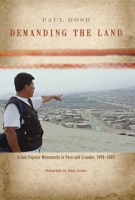




Demanding the Land
Urban Popular Movements in Peru and Ecuador, 1990–2005
Paul Dosh, and Photographs by James Lerager
Demanding the Land
Urban Popular Movements in Peru and Ecuador, 1990–2005
Paul Dosh, and Photographs by James Lerager
“Dosh is the latest in a long line of scholars who have taken an in-depth look at Lima’s squatter settlements and their internal organizations. What makes Dosh’s book exceptional is his comparative perspective (Quito as well as Lima) and the extraordinary detail that he has captured in his observations and interviews. Add to this his consistent efforts to tie his empirical inquiries to a variety of concerns in political science, and you have a truly significant piece of work.”
- Media
- Description
- Reviews
- Bio
- Table of Contents
- Sample Chapters
- Subjects
“Dosh is the latest in a long line of scholars who have taken an in-depth look at Lima’s squatter settlements and their internal organizations. What makes Dosh’s book exceptional is his comparative perspective (Quito as well as Lima) and the extraordinary detail that he has captured in his observations and interviews. Add to this his consistent efforts to tie his empirical inquiries to a variety of concerns in political science, and you have a truly significant piece of work.”
“Paul Dosh's study is timely. Its results may imply that significant developments, with regard to both urban-based social movements themselves and the context in which they operate, are presently under way. The author has assembled an impressive array of empirical sources, and the fact that his study is comparative—focusing on Peru as well as Ecuador—will increase its relevance for Latin America as a whole.”
“Dosh is the latest in a long line of scholars who have taken an in-depth look at Lima’s squatter settlements and their internal organizations. What makes Dosh’s book exceptional is his comparative perspective (Quito as well as Lima) and the extraordinary detail that he has captured in his observations and interviews. Add to this his consistent efforts to tie his empirical inquiries to a variety of concerns in political science, and you have a truly significant piece of work.”
“Paul Dosh's study is timely. Its results may imply that significant developments, with regard to both urban-based social movements themselves and the context in which they operate, are presently under way. The author has assembled an impressive array of empirical sources, and the fact that his study is comparative—focusing on Peru as well as Ecuador—will increase its relevance for Latin America as a whole.”
“Demanding the Land is a motivating and important book.”
Paul Dosh is Associate Professor of Political Science at Macalester College and Director of Building Dignity, a nonprofit organization focused on grassroots development in Peru.
James Lerager holds a master’s degree in public policy from the University of California–Berkeley and is Director of the Documentary Photography and Research Project.
Contents
List of Figures
List of Tables
List of Photographs
List of Abbreviations
Acknowledgments
Introduction
1. The Strategy, Success, and Survival of Urban Popular Movements
2. Metropolitan Trends in Land Invasions: Policy, Democratization, Geography
3. The Old Guard: Pragmatism and Strategic Rigidity
4. The Next Generation: Strategic Flexibility and a Sense of Entitlement
5. The Innovators: Strategic Creativity and a Sense of Mission
6. Analyzing Organizational Strategy, Success, and Survival
7. Conclusions: Contention, Political Process, and Mixed Motives
Epilogue: From Scholarship to Activism
Appendix: Sources of Data and List of Interviews
References
Index
Introduction
Weak from hunger, from the stench of human and animal waste, and uncertain if tomorrow would bring a violent eviction by hired thugs, Jesús Valencia and Martha Huamán did not feel like cutting-edge innovators. It was 1996, and this destitute but determined Peruvian couple wondered if they had made a terrible mistake by casting their lot with a thousand other poor settlers who, days earlier, had seized a patch of barren desert—La Encantada (the Enchanted Place) the settlers now called it—and built an illegal shantytown in a single night.
Eight years earlier, Jesús Valencia had fled the poverty of Tablazo Norte, a farming village in the northern province of Piura, and migrated to the capital city of Lima. In Lima, he met Martha Huamán, a migrant from the mountain province of Cusco, and the young couple became involved in the urban popular movements of the district of Villa El Salvador. Ready to start a family, Jesús and Martha had joined the La Encantada land invasion, hoping to claim a tiny parcel of sand and build a home.
One week after La Encantada’s founding, however, Jesús and Martha listened at a neighborhood meeting to reports of violent crime, cardboard shacks destroyed by arson, livestock-related pests and illness, and city hall’s rejection of the fledgling community’s pleas for water. On the brink of failure, there was little to suggest that in just a little over a decade, La Encantada would develop into a successful and resilient community, and that Jesús and Martha would become leaders not only of their own neighborhood, but of a successful project to build water and sewer infrastructure for fifty-five thousand settlers in La Encantada and the surrounding land invasion neighborhoods.
The stories of poor settlers like Jesús Valencia and Martha Huamán and the struggles of ten land invasion neighborhoods, including La Encantada, anchor this book’s exploration of urban popular movements in Peru and Ecuador and my own explanations for the strategy, success, and survival of popular movement organizations. Let me begin by posing a sharp three-way contrast in the outcomes I seek to explain.
In 1990, as Peru absorbed the initial shock of party system collapse and Alberto Fujimori’s election as president, organized groups of poor people took advantage of the political turmoil to illegally seize vacant lands and found squatter communities. In Lima’s northern district of Los Olivos, one such group founded “Rosales” and sought to bring electricity and piped water into their fledgling community through disruptive and militant protest actions. Yet while neighboring informal settlements encountered steady success in acquiring services, Rosales discovered that its own commitment to neighborhood-level elections resulted in volatile leadership shifts that debilitated the neighborhood organization. Led by veteran, “Old Guard” land invaders who had seen radical and extralegal strategies work before, the group’s stubborn determination to make militancy work for their community undermined the service initiatives of less rigid leaders. The resultant failure of service demands left the neighborhood leadership structure divided and weak.
By contrast, in the southern Lima district of Villa El Salvador (see Skinner 1983; Riofrío 1986, 47–100; Burga and Delpech 1989), a younger, “Next Generation” group of settlers founded the community of Oasis in 1994 and succeeded in acquiring important services for their neighborhood. Oasis was democratically organized but decision-making power was more diffuse, and the neighborhood did not experience the volatile shifts that characterized Rosales. The Oasis settlers had grown up in invasion neighborhoods founded by their parents, but unlike those ideologically committed parents, the strategically flexible younger generation employed a combination of legal and extralegal strategies. This blend of disruptive militancy and clientelist partnerships yielded electricity, piped water, and land titles. Ironically, however, with the acquisition of land titles, settlers felt secure and stopped participating in the neighborhood organization. With this decline in participation, the organization sank into a moribund state despite crucial unmet needs, such as sewer drainage.
Finally, the Villa El Salvador invasion of La Encantada—the community of Jesús Valencia and Martha Huamán—was founded in 1996 by a third type of settlement organization, which I call the “Innovators.” This community managed both to acquire service infrastructure and land titles and to consolidate as an organization, meaning it continued to pursue community objectives. The Encantada settlers were similar to the Oasis group in that they had grown up in the invasion communities of their parents, had a democratic organization, and employed a flexible combination of legal and extralegal strategies. But unlike either Rosales or Oasis, the Encantada settlers employed an innovative mix of novel tactics. Further, when Encantada’s acquisition of land titles precipitated a similar decline in participation, the organization rejuvenated participation by reorienting the neighborhood toward an activist mission of helping neighboring settlements. In this way, the Encantada organization was also able to continue acquiring services for its own membership.
Why did the Next Generation settlers of Oasis and the Innovator settlers of Encantada successfully acquire neighborhood services, while the Old Guard settlers of Rosales failed to do so? And since the demand-making methods of each group likely contributed to their success or failure, why did the experienced veterans of Rosales stubbornly refuse to modify their organizational strategy, while Oasis and Encantada’s squatter neophytes flexibly employed a savvy combination of strategies? Third, why did the Rosales and Oasis organizations falter precisely when settlers still needed an organizational vehicle to press their demands, while the Encantada group survived, consolidated its gains, and established a permanent local leadership role?
In the Latin American context, where illegal seizures of land and the development of informal housing settlements have become commonplace, understanding what factors contribute to both organizational success in demand-making and long-term organizational survival constitutes a crucial substantive goal. More broadly, understanding the major phenomenon of Latin American land invasions contributes to a critical theoretical goal: explaining the success or failure of social movements in general, both in terms of their objectives and in terms of movement survival.
Using a diverse set of conceptual and analytic tools, I examine squatter settlement development through ten neighborhood-level case studies of invasion organizations in Lima, Peru, and Quito, Ecuador. Although the founding dates of the organizations range from the 1980s to the early 2000s, the analysis focuses principally on the 1990–2005 period. The study sets forth a typology that identifies three types of invasion organizations, and the ten cases include one organization of each type from each city, as well as additional contrast cases from Lima that permit the study to control for some local factors.
In order to explain the key outcome of organizational success or failure in acquiring neighborhood services, I also explore the related questions of how invasions select their demand-making strategies and why such organizations survive or collapse. Hence, my three-part argument aims to explain three related outcomes: organizational strategy, organizational success, and organizational survival. To explain these outcomes, I develop dynamic conceptualizations of invasion organizations’ identities and strategy repertoires in order to employ political process theory—not just at the point of initial mobilization, but also throughout the development of each invasion organization.
The Evolving Struggle for Land and Urban Services
Throughout the latter half of the twentieth century, tens of millions of Latin Americans participated in illegal land invasions (see, for example, Leeds and Leeds 1970; Cornelius 1975; Collier 1976; Gilbert and Ward 1978). Prior to the 1940s, self-help housing existed principally in isolated patches of a modest number of Latin American cities (Gilbert 1998, 79). Beginning in the late 1940s and early 1950s, however, the “explosion of the periphery” rapidly became a defining feature of urban Latin America. Describing the escalating growth of informal housing in cities such as Bogotá, Caracas, and Rio de Janeiro as “exponential,” Alan Gilbert (1998, 80) cites the dramatic growth in Lima’s number of settlements: 39 by 1955, 237 by 1970, and 782 by 1984. And this pattern was not limited to large cities like Santiago and Quito, but also manifested in medium-sized cities like Cochabamba, Concepción, and Maracaibo (Matos Mar 1968, 217–73).
Over the course of the 1970s and into the 1980s, informal settlement housing increasingly came to be viewed not as a problem, but as a solution to the region-wide migration to cities sparked by economic crisis (Driant 1991, 116). Though individual families often made quick decisions to join an imminent land invasion, the phenomenon was rarely spontaneous. To the contrary, such mobilizations typically required months of planning and preparation (Matos Mar 1966). Poor migrants leapt at the chance to claim land, even illegally, and state officials looked the other way or even actively helped settlers, since they had few other policy options for housing the thousands of rural migrants that poured into the cities (Collier 1976). As the trend grew, a second generation of settlers jumped on the bandwagon (Driant and Grey 1988), and the 1970s witnessed massive and now-legendary invasions such as Villa El Salvador in Lima (Riofrío 1978, 44–47; Burga and Delpech 1989) and Comité del Pueblo (Committee of the People) and Lucha de los Pobres (Struggle of the Poor) in Quito.
In addition to transforming the landscape of housing in urban Latin America, informal housing also changed the meaning and nature of local politics and grassroots participation (Riofrío 1991, 124–26). In cases like Peru, where the political crisis of 1968–75 was linked to a surge in land invasions, the politicization of informal settlements was obvious, as popular groups organized on behalf of national and local political leaders and then remained in a state of high mobilization (Tovar Samanez 1982b, 49; Ballón 1986, 17–25). More generally, however, a less visible but more enduring politicization occurred through the popular organizations spawned by the hundreds of new urban neighborhoods that had brought together marginalized families in coordinated acts of reclaiming both land and dignity (Matos Mar 1986).
Though these types of popular organizations were not new, their expanded scope and reach was breathtaking, including settler organizations (neighborhood, housing, owners, settlers), women’s organizations (mothers’ clubs, popular kitchens, child care groups, women’s issues committees), cultural organizations (cultural groups, popular libraries, media groups), health organizations, religious organizations (base Christian communities), neighborhood markets, street vendors, provincial groups, sports groups, educational organizations, merchants organizations, and social clubs (Tovar Samanez 1986, 146–47). The importance of this impact could be likened to the mid-twentieth-century process of labor incorporation (Collier and Collier 1991), which brought millions into the political arena, albeit in subordinate roles. Likewise, the 1980s surge in popular mobilization coincided with the rise of municipal- and neighborhood-level democratic elections, and though settlers remained on the margins, they increasingly felt entitled to a voice in politics (Tovar Samanez 1982a, 24–26).
By the 1980s, many observers anticipated that the pattern of settlement via illegal land invasions would wane as major cities became saturated with informal settlements, but the onset of neoliberalism, increases in economic vulnerability, and the expansion of informal labor sustained and reshaped land invasion patterns (Portes 1989; Eckstein 1990; Stokes 1991). Thus, invasions focused increasingly on land that was already in use, including private property (which created more conflict) or land that was precarious or barely habitable (Riofrío and Driant 1987, 126). During this period, the fundamental objectives of invasion organizations remained unchanged: reliable electricity, potable water, sewer drainage, and, often most important, legal title to illegally acquired land (Burgwal 1995; Dietz 1998b; Gilbert 1998). The context in which they demanded these services, however, changed in three ways.
First, the economic context changed as Peru, Ecuador, and other nations embraced neoliberalism (Stokes 2001, 69–70). Neoliberal reforms debilitated already-weak social safety nets, sharply reduced the power of organized labor, and privatized some urban service monopolies, which reshaped the strategies available to settlers seeking service infrastructure and delivery (Gilbert and Gugler 1992).
Second, the national political context changed, as neoliberalism blurred party lines and many leftist parties moved toward the market (Roberts 1995, 100; Roberts and Arce 1998, 219–20). Despite important exceptions, such as Brazil’s Partido dos Trabalhadores (Workers’ Party), party identification became less important as party systems either faded in importance or collapsed outright, making political parties less likely allies for settlers (Villalón 2007). Peru and Venezuela were the most dramatic cases of party system collapse and the rise of candidate-centered, personalist vehicles, but Ecuador and Bolivia also experienced major increases in political volatility (Corrales 2002, 252–77; Olivera 2004; Sawyer 2004, 15). For land invasion neighborhoods, these changes meant that clientelist partisan alliances became less reliable, leading some settlers to reevaluate their options (Burgwal 1993).
And third, the local political context changed, as Peru, Ecuador, and many other countries introduced democratic municipal elections in the 1980s (Dietz and Shidlo 1998). While struggles between democracy and authoritarianism continued to dominate Latin America, empowerment of municipal government took root and slowly grew, gradually transforming the local political context for invasion organizations (Myers and Dietz 2003). Although the budgetary power of local districts remained minimal, the introduction of democratically accountable local leaders provided settlers with fresh targets for their service demands.
Partly in response to these changes, new patterns of organization emerged at the neighborhood level. As decreased availability of convenient land led to seizures of distant and barely inhabitable terrain, new organizational types emerged from older patterns of settlement organization (see Holzner 2004). These newer organizational types represented a major shift in both ideology and strategy. In order to understand the causes and consequences of these shifts, this study examines these changes from the perspective of social movement theory.
Structure of the Study
Given these changes in the political environment of invasion organizations, chapter 1 begins with a discussion of social movement theory, with special attention paid to the role of opportunity structures. Grounded in this literature, chapter 1 lays out the conceptual and analytic foundations of the study. First, I conceptualize strategies in terms of their legality and autonomy. The resulting typology supports an analytic construct that I call the strategy life cycle. Second, I conceptualize external and internal factors that contribute to the success or failure of demands for services by invasion organizations. These variables are presented in the neighborhood service acquisition model, which posits a series of causal claims to account for organizational success. Third, to explain varying outcomes in organizational survival, I introduce the concept of organizational stages of development and an analytic tool called the security trap. Building on this theoretical framework, the remainder of the study is arranged to examine the study’s three-part argument at the metropolitan level (chapter 2), the neighborhood level (chapters 3–5), and the level of individual demands for services (chapter 6).
Chapter 2 compares land invasions in metropolitan Lima and Quito. In Lima, invasions have become routine and institutionalized, while in Quito they are considered aberrations. Controlling for population, Lima’s invasion rate between 1990 and 2005 was double to triple that of Quito. In Lima, we often see vibrant neighborhood-level democracy, but in Quito local bosses dominate. In Peru, pro-settler legislation enacted by the progressive government of General Juan Velasco Alvarado (1968–75) makes public lands ripe targets for invasion organizations. Yet their Ecuadorian counterparts more often attempt to seize private land, partly because Quito’s entrepreneurial city hall defends its own assets but leaves other landowners to fend for themselves.
Chapter 3 explores the argument in the context of four Old Guard land invasion organizations. Intra-city and cross-national comparison of three Old Guard case studies in Lima and one in Quito reveals variation in the success or failure or service demands, demonstrating that the Old Guard’s fate depends on other internal and external factors.
Despite these contrasting outcomes across cases, the Old Guard organizations displayed several common traits. First, their pragmatic focus on material objectives made them likely victims of the security trap who would then struggle to consolidate their organizations. Second, the stubborn refusal of the Old Guard to adapt their strategy choices to an evolving political context meant that despite some victories, Old Guard organizations generally could not acquire 100 percent of basic services. And third, the Old Guard tendency toward power-concentrating neighborhood regimes meant that these groups were less able to take advantage of local avenues of participation.
Chapter 4 expands the scope of the argument to include four Next Generation case studies. Intra-district comparison of three Next Generation case studies from Lima and cross-national comparison with one from Quito reveal wide variation in neighborhood regime type but a predictable pattern of strategy choices. Whereas Old Guard groups display rigid strategy preferences, the Next Generation follows the strategy life cycle. Consequently, Next Generation organizations are theoretically able to adapt to changing political contexts and select the most effective strategy. Empirically, however, the lack of experience of Next Generation leaders and their at-times reckless faith in the lessons of their parents sometimes make their efforts at demand-making less successful.
As with the Old Guard cases, several broad findings emerge. First, Next Generation cases tend to use violence only in self-defense, or not at all. Second, although these groups use tactics similar to their Old Guard parents (such as defending land with a picket line), they are usually led by novice invaders and often eject veteran leaders as suspected “land traffickers” who might exploit the settlers. And third, although all four cases follow the strategy life cycle, only one case actually completed the cycle.
Chapter 5 presents the final two neighborhood-level case studies: the Innovators. Like the Next Generation, the strategy choices of Innovators also follow the strategy life cycle, but unlike the Next Generation’s wide variation in neighborhood regime type, both Innovator case studies (one from Lima and one from Quito) are characterized by power-sharing methods of governance. Innovators sometimes appear to choose the “wrong” strategy, given existing political opportunities or lack thereof, but this is because Innovator objectives differ from those of conventional invasion organizations. Innovators exhibit mixed motives, meaning their material agenda is supplemented by a nonmaterial and often altruistic agenda, which sometimes leads to surprising choices that may not support their material demands.
Three traits unite the Innovator cases. First, their power-sharing leadership structures are similar and appear to be considered necessary by organization leaders to each group’s broader democratic mission. Second, although not uniform, the Innovators’ commitment to nonviolence is remarkable, particularly in the face of sometimes-brutal attacks. And third, their use of technology and general creativity generates extraordinarily original tactics.
Chapter 6 analyzes all three major outcomes through comparison of 132 cases of demand-making across the ten neighborhoods. In order to analyze cases of demand-making by disparate organizations whose founding dates range from 1983 to 2001, I categorize each instance of demand-making in light of the group’s organizational stage of development at the time of the demand. This classification scheme both helps standardize cases of demand-making and also generates additional insights into the strengths and weaknesses of the neighborhood service acquisition model, the study’s typologies, and new analytic tools such as the strategy life cycle and the security trap.
Chapter 7 returns to the theoretical framework of chapter 1 and summarizes the study’s implications in light of social movement theory. What determines movement success? External factors beyond the control of organizations do invite and curtail mobilization in a variety of ways, but this study shows that whatever the array of external variables, certain types of organizations, characterized by specific strategies, assets, and leadership structures, are better able than others to exploit those external factors. In short, organizations do in fact exert control over key aspects of their own process of acquiring resources.
And what shapes trajectories of movement survival? Selective incentives do play a key role in motivating high levels of participation; at later points in a movement’s development, however, the interplay of mixed motives and collective action proves decisive, suggesting that mixed motives may be critical for the survival of any movement organization in the wake of diminishing selective incentives.
Although this analysis focuses on neighborhood-level cases in two Latin American cities, its empirical and theoretic findings raise important issues for social movements in nonurban contexts and in other world regions. Through a macro-longitudinal conceptualization of the evolution of invasion organizations, the study demonstrates that a historical dimension similar to Tarrow’s “cycles of contention” (1998, 141–60) may be required to fully understand changes in opportunities for mobilization. More important, the main causal model for movement success relies critically on the study’s micro-longitudinal framework for predicting organizational strategy selection. This indicates that the success or failure of social movements in general can only be understood through both an evolutionary conceptualization of invasion organizations and a dynamic deployment of political process theory.
Also of Interest

Mailing List
Subscribe to our mailing list and be notified about new titles, journals and catalogs.