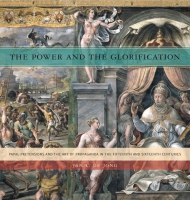




The Power and the Glorification
Papal Pretensions and the Art of Propaganda in the Fifteenth and Sixteenth Centuries
Jan L. de Jong
The Power and the Glorification
Papal Pretensions and the Art of Propaganda in the Fifteenth and Sixteenth Centuries
Jan L. de Jong
“This book sheds a powerful light on the great historical frescoes of High Renaissance Rome. Jan de Jong dwells on the historical situation of the popes, the meanings of history in Renaissance Europe, and the responses of contemporary viewers to these paintings. He teaches us how to see these grand and fascinating works as they were meant to be seen—and, at the same time, suggests some of the reasons why they did not have their full intended effects.”
- Description
- Reviews
- Bio
- Table of Contents
- Sample Chapters
- Subjects
“This book sheds a powerful light on the great historical frescoes of High Renaissance Rome. Jan de Jong dwells on the historical situation of the popes, the meanings of history in Renaissance Europe, and the responses of contemporary viewers to these paintings. He teaches us how to see these grand and fascinating works as they were meant to be seen—and, at the same time, suggests some of the reasons why they did not have their full intended effects.”
“Jan de Jong presents us with the first systematic study of the genre of political propaganda, invented in the sixteenth century. The author shows how the papacy, under pressure from religious and secular rivals, honed and fashioned the message of its narratives to present an image broadcasting its empyrean status. The pope’s authority was underscored by showing the emperor and kings kissing his foot. His right to rule the Papal States was justified by depicting Constantine making a gift to Pope Sylvester of the lands of his western empire. The role of the pope as adjudicator and peacemaker was authenticated by representing Paul III brokering the peace between Charles V and Francis I—even if that fragile treaty lasted only a handful of years. The political propaganda pioneered in the projects studied here provided a model followed by the courts of Europe up to and beyond Napoleon’s. De Jong gives us a fresh and vivid account, some of it based on material hardly studied before.”
“By the middle of the fifteenth century, the popes had firmly re-established themselves in Rome, after long years of exile, schism and instability. Their subsequent renovation of the once-great city recast Rome as the embodiment of a renewed Apostolic Church, built upon centuries of tradition, continuity and divine sanction. And yet, as Jan L. de Jong argues in this insightful and beautifully illustrated book, the unprecedented expansion of papal patronage in the fifteenth and sixteenth centuries took place at a time when the popes’ authority was being seriously questioned—by conciliarism, foreign invasions, the rise of nation states and ultimately the Reformation.”
“This engaging publication by de Jong offers a broad look at the way certain images were used as papal propaganda during the 15th and 16th centuries in Italy. This was a time when the church was presented with extreme challenges both from within and from secular forces. The book offers five case studies of artistic responses in a rough chronological sequence: the decoration in the Castel Sant’Angelo, the Conservators’ Palace on the Capitoline Hill, the Hall of Constantine in the Vatican, the Farnese Palace in Caprarola, and the Vatican’s Sala Regia. The unifying theme among all these cycles is the use of visual propaganda to exalt the status and significance of the papacy and promote its claims of supreme authority within the church. . . . Since many of these decorative cycles are relatively understudied, the book provides a welcome contribution to their study. It is well illustrated, with solid notes and index and useful scholarly appendixes.”
Jan L. de Jong is Associate Professor of Art History at the University of Groningen.
Contents
List of Illustrations
Acknowledgments
Introduction
1 The Pope, the Papacy, and the Church
2 The Pope and the King: Alexander VI and Charles VIII of France
3 The Pope and the City: Leo X and the Conservators of Rome
4 The Pope and the Emperor: Leo X, Clement VII, and Constantine the Great
5 The Pope and His Family: Paul III and the Farnese
6 The Pope and Secular Power, Muslims and Heretics: Pius IV, Pius V, and Gregory XIII
Epilogue: The Pope and the Past
Notes
Bibliography
Index
Introduction
Blessed art thou, Simon Bar-Jona: because flesh and blood hath not revealed to thee [that I am Christ, the son of the living God], but my Father who is in heaven. And I say to thee: That thou art Peter; and upon this rock I will build my church, and the gates of hell shall not prevail against it. And I will give to thee the keys of the kingdom of heaven. And whatsoever thou shalt bind upon earth, it shall be bound also in heaven: and whatsoever thou shalt loose upon earth, it shall be loosed also in heaven.
With these words, recorded in the Gospel of Matthew, Christ confers upon Peter supreme power to the fullest measure to govern the church. Peter will be Christ’s vicegerent on earth, and whatever he may bind or loosen will be divinely authorized. His position as the supreme head of the church is not transitory but perpetual, and as Christ personally establishes this constitution of the church, it must endure in this specific, divinely instituted way. “Thus,” according to The Catholic Encyclopedia, “an analysis of Christ’s words shows us that the perpetuity of the office of supreme head is to be reckoned among the truths revealed in Scripture. His promise to Peter conveyed not merely a personal prerogative, but established a permanent office in the Church.”
Other passages from the Bible can also be construed in support of Peter’s primacy among the apostles and within the church. One instance is the episode in the Gospel of John where Christ, after his resurrection, charges Peter to “feed my lambs.” Another case in point is related in the Acts of the Apostles, where Peter, after the ascension of Christ, acts as the leader of the apostolic band. Yet the words from Matthew are a key passage, for they convey that Peter’s authority, both legislative and juridical, is plenary (“whatsoever thou shalt bind upon earth, it shall be bound also in heaven: and whatsoever thou shalt loose upon earth, it shall be loosed also in heaven”) and that, moreover, it is not subordinated to any earthly superior.
Are these words of Christ unequivocal, and were their implications immediately clear? Did the apostles directly realize that Peter and his successors would be at the head of a universal organization, endowed with plenitude of power (plenitudo potestatis), superior to emperors, kings, and anyone else on earth, and not to be judged by any earthly person since their authority was divinely instituted? It is, of course, hard to speculate on Christ’s prescience, but one may wonder if the apostles, Peter included, fully understood the (possible) implications of these words. Yet The Catholic Encyclopedia states that “from the very earliest times” Peter’s supreme headship “has been freely acknowledged by the universal Church.” Nevertheless, it took more than a thousand years before this supreme headship was indeed generally recognized and respected. Not until the year 1200 was the pope, as Peter’s successor, indeed the undisputed head of the Latin Church, and his plenitude of power not checked by any bodies or institutions, not even synods or councils. The popes exercised their authority in all spheres, legal, juridical, and financial, and in controlling ecclesiastical appointments. As head of the spiritual “empire,” they were superior to all secular rulers. The latter were, as members of the church, executive organs who had to follow the supreme guiding authority of the former. Again, one can point to biblical texts to support this notion, for according to the theory of the two swords (based on Luke 22:38), Peter and his successors wielded the spiritual sword and handed the material sword over to secular princes to use in line with Peter’s will. In fact, Charlemagne and the following emperors of the West owed their position and title to the successors of Peter, and accordingly received their crowns from the pope.
This position of supreme authority was reached after centuries of increasing theological study and debate, and circumstances that forced the church, in order to survive, to develop into an international organization on a scale far beyond the original level of scattered communities led by local bishops. But even though the pope’s supreme authority was well founded in theological arguments and historical precedents, it was hard to maintain in practice. France, England, Spain, and to some extent the German Empire were developing into sovereign states and were ever less inclined to tolerate the interference of the church in their own affairs. This led to a crisis in the fourteenth century, when, due to political conflicts with France, the Apostolic See was forced to move from Rome to Avignon, in France. Attempts to move the see back to Rome resulted in a schism and two popes: one in Rome, the other in Avignon. The Council of Pisa in 1409, called upon to solve this embarrassing problem, ended in even more confusion. A new pope was elected, but the two others refused to step down, and so the church was now saddled with a supreme headship of three simultaneous successors of Peter, who all refused to acknowledge each other. In 1417, the Council of Constance finally succeeded in putting an end to this disgraceful situation and restored the church to its original state, with one supreme head residing in Rome.
Although the church survived this crisis, the papacy lost much of its respect and authority. Within the organization of the church, a serious discussion broke out over the question of whether the supreme authority was vested in one person—the pope as the successor of Peter—or in the body of the church, represented by a general council. Meanwhile the secular rulers of Europe increasingly reduced the influence of Rome on the affairs of their own states and local church matters. The authority of the papacy received a further, more serious blow in 1517, when the German monk Martin Luther released a series of writings in which he criticized the church and disputed on theological grounds the status of Peter’s successor as its supreme head. At about the same time, a treatise was printed that had been written some sixty years earlier. In it, the Italian scholar Lorenzo Valla argued, with superior knowledge of Latin and history, that the “historical” document with which the Roman emperor Constantine the Great had transferred his authority over western Europe to the pope was in fact a forgery.
Under these circumstances, the authority of the papacy was far from self-evident. It had seriously dwindled in numerous respects: morally, through the crisis the popes had brought upon the church and through their inability to solve it; politically, through the increasing strength and self-consciousness of the sovereign states in Europe; theologically and historically, through the writings of men like Luther and Valla. The lifestyle of the higher clergy and the church’s never-ending need for money further contributed to a general sense of frustration. In order to regain respect and authority, the successive popes had to come to terms with the changing religious and political situation in Europe, reform the church, and reconsider the position of the papacy itself. Yet their efforts to adapt the church and the papacy to the new circumstances were halfhearted and ineffective. They stubbornly stuck to the traditional claim of divinely instituted plenitudo potestatis, and expected the world to acknowledge and respect it.
<one line space>
This rearguard action of the papacy against the new developments in the late fifteenth and sixteenth centuries is the subject of this book. The successive popes deployed all possible means of propaganda to convey their eroded claim of supreme authority and stress its biblical and historical foundations. One very important way to communicate this message was through pictures. In the Vatican palace and other places, large propagandistic cycles were painted with the intention of demonstrating the papal pretensions through historical examples. I will study five of these cycles in detail, focusing on the kinds of propaganda and strategies used to uphold an image of the papacy that no longer corresponded to reality. These cycles do not form a complete selection; rather, I have singled them out as telling demonstrations of the ways in which the popes handled contemporary and older history, how they selected examples from it and presented them in a way that explained and substantiated the papal claims and pretensions.
For each of the five cycles, I first look at the paintings through the eyes of contemporary visitors, approaching them in the state they were in when they were originally presented to the public. I discuss specifically art-historical issues only when they are relevant to the subject of this book. Questions about authorship and attribution, conception and elaboration, dating, and so on may be fundamental topics for modern art historians, but they were not nearly as important to the original observers, who were primarily expected to be convinced by the propagandistic message of the paintings. These observers consisted in the first place of ambassadors, delegates, deputies, diplomats, and other persons of comparable rank who came to visit the pope or his advisers and were therefore allowed access to the Vatican and other papal buildings. They must have had enough education to be familiar with the major events of European history and to read Latin, so that they were able to understand the paintings in combination with their explanatory inscriptions (if there were any). I presume that they did not bring their history books in order to verify on the spot the historical content and accuracy of the paintings. Nor do I suppose that they consulted these books afterwards. They were essentially reliant on the information offered by the paintings and the explanatory inscriptions, which they must have accepted at face value, even if they sensed a propagandistic undertone.
I then analyze the paintings more comprehensively and explain the strategies by which the papal view on history was conveyed. Some historical and contextual knowledge is essential for understanding the paintings’ underlying assumptions about the status and significance of the papacy and the biblical, theological, and historical arguments that these assumptions are based on. In the first chapter I will briefly provide this information, together with a historical outline of the papacy in the fifteenth and sixteenth centuries and a short discussion of some of the most important instances of papal propaganda, as these were the forerunners of the paintings that will be discussed extensively in the following chapters. Throughout the book, however, I have tried to observe some restraint in discussing contemporary sources, comparable paintings, and other relevant material. The paintings, in my view, should speak for themselves, as they were originally meant to, and not dissolve into their historical context. I have conceived these following chapters as largely separate episodes, each dealing with one specific series of paintings.
In the epilogue, I will go over the main points of the propagandistic strategies that were employed and suggest that the reason examples from the past no longer had the desired impact was not only the dwindling respect for the papacy, but a changing concept of history. New concepts and different strategies were necessary. The papacy’s propaganda, like the papacy itself, needed fresh impulses and a novel approach. What this new approach was, however, and how well it succeeded are questions that fall outside the scope of this book.
Also of Interest

Mailing List
Subscribe to our mailing list and be notified about new titles, journals and catalogs.