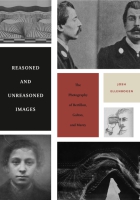




Reasoned and Unreasoned Images
The Photography of Bertillon, Galton, and Marey
Josh Ellenbogen
“Reasoned and Unreasoned Images is a fascinating discussion of photography in the second half of the nineteenth century. Josh Ellenbogen raises interesting questions concerning the nature of evidence that are still being discussed in current work on the philosophy of science and, in particular, the philosophy of experiment. In short, this is a first-rate piece of scholarship, with the additional bonus that it is a good read.”
- Description
- Reviews
- Bio
- Table of Contents
- Sample Chapters
- Subjects
“Reasoned and Unreasoned Images is a fascinating discussion of photography in the second half of the nineteenth century. Josh Ellenbogen raises interesting questions concerning the nature of evidence that are still being discussed in current work on the philosophy of science and, in particular, the philosophy of experiment. In short, this is a first-rate piece of scholarship, with the additional bonus that it is a good read.”
“Josh Ellenbogen offers a truly unique treatment of the nature of scientific uses of photography at the turn of the nineteenth century, one that will certainly be debated but whose value will lie in the specificity of its analysis and the originality of its argument. This will be an influential book, dealing with many contemporary issues in our understanding of photographic evidence and revealing their historical background. It has already influenced my own thinking.”
“Josh Ellenbogen’s Reasoned and Unreasoned Images provides a significant theoretical discussion of photography’s aim to capture the visible and nonvisible and, more widely, of its complex relation to human perception, cognition, and memory. . . .
[T]he journey the reader undertakes is guided by thought-provoking questions through a series of chapters that progressively build upon the previous one to form a layered work of interwoven arguments that cannot easily be pulled apart.”
“As an intellectual history of a period scientific use of photography, Reasoned and Unreasoned Images is a rich and thorough account. There is much to be learned from its careful unpacking of the intellectual correspondences of Bertillon, Galton, and Marey and the development of a scientific understanding of photography and vision that resulted.”
“[This] book is an instructive and useful read and serves the purpose of bringing together the philosophy of experiment and period photographic theory, with fascinating results.”
Josh Ellenbogen is Director of Graduate Studies and Assistant Professor of the History of Art at the University of Pittsburgh.
Contents
List of Illustrations
Acknowledgments
Introduction
Part 1: Criminality, Identity, and the “Unreasoned Image”
1 “To Fix the Human Personality”: Archived Bodies and Ideal Lenses
2 Mnemonic Economies or Galleries of Paintings
3 Educated Eyes and Moments of Repose
Part 2: Portraits of the Invisible
4 The Monstrous, the Meaningless, and Margins of Error
5 “The Basis of a Very High Order of Artistic Work”
6 Images and Antecedents
Part 3: Camera and Mind
7 Making Sense
8 Creatures of Reason
Conclusion
Notes
Bibliography
Index
Introduction
In the last decades of the nineteenth century, photography underwent one of the most momentous transformations in its history, a renegotiation of the camera’s status in regard to the visible world. From approximately 1880 onward, in a diverse array of institutional and investigative contexts, different inquirers developed uses for the medium in which the bedrock standard for what constituted a good or useful photograph—the ability to match what we see—no longer operated as it had. Unusually high stakes were at play in this development. From what it meant to use photography in scientific imaging, to how photographs more generally attained authority and validity as tools of knowledge, to the status of photographs relative to older, hand-drawn pictures, to what photographs should accomplish in regard to regimes of interpretation and intervention, foundational questions surrounding photography grew deeply problematic. Indeed, the photographic practices that contributed to this development, which number among the highest-profile uses of the medium in both the human and natural sciences of the late nineteenth century, do more than disrupt fin de siècle understandings of photography. The practices, which unfolded in such distinct domains as physiology, criminology, physics, and anthropology, also run against the grain of how art historians and other scholars today often discuss photography and can therefore discharge weighty conceptual duties. They allow us not only to establish new theoretical resources by which to treat photography’s scientific employment, but also to develop interpretative vantage points from which to consider uses of photographs more broadly, in everything from artistic to documentary pursuits.
The work of the German physicist Ernst Mach helps establish the crucial status of the years around 1880 in the transformation of photography’s relation to what we see, and the theoretical import of this development. Prior to this period, isolated forms of photography had of course existed, principally microscopic and telescopic applications, that problematized the medium’s relation to vision. Although these methods do not merge seamlessly with Mach’s on a conceptual level, they also did not make up part of a more general and comprehensive transformation of photography’s status in scientific work. While Mach illuminates just one of the ways this transformation took place, even here, we could as easily look to the late nineteenth-century projects of the Frenchmen Albert Londe and Jules Janssen, or the Englishmen William de Wiveleslie Abney and A. M. Worthington, or the German Ottomar Anschütz, or the American Eadweard Muybridge.
Consider figure 1. The product of a photographic technique Mach put forth in 1887, it registers the path that a bullet in flight follows, the patterns adopted by the shock waves it creates, and the turbulence the projectile leaves behind it. Meant to abet the study of supersonic aerodynamics, this technique takes its force in the present context by its capacity to visualize otherwise non-visible occurrences. It provides a picture of events that, in the absence of the picture, reside in a domain beyond human perception. To create images of this kind, Mach used specialized procedures related to Schlieren photography, developing a technique he called Shadowgraphy that allowed him to visualize the distortions that light rays undergo as they pass through shock waves. Most important, visualizations of this sort could only ensue via Mach directing at the bullet, at just the moment it passed in front of the camera, an intense flash of light from a spark. In this way, Mach could attain the extraordinarily brief photographic exposure, less than a millionth of a second, required to create an image of such occurrences.
How can one characterize the photograph that issues from such measures? It makes no sense to suggest that it looks like the event it registers, as Mach’s project proceeded from the idea that there is no event the photograph can look like. Although an event or displacement does indeed occur, the event Mach wishes to study has no ocular existence. We have no perception of the event that can serve as an antecedent to the image, or to which we can insist the image must conform. While photography, in the nineteenth century and today, is generally thought to attain its power by the faithful depiction of things we can see, what we see of the natural world supplies no counterpart to which these images can be faithful. Put another way, the extravisual data that the photograph discloses in figure 1 have no existence, as data, apart from the registration situation that investigators contrive. The data only exist as the result of particular imaging technologies, such as the extraordinary arrangements by which Mach made a photograph yield an exposure at a millionth of a second. Such a state of affairs does not mean these data are fictitious or untrustworthy, but it does mean one can only view them as the artifacts of a registration situation that investigators established in order to have data. In such an investigative context, one can go so far as to say that the identity of photography shifts, in that it ceases to function as a reproductive technology. Photography does not reproduce data in such images, but instead it produces them.
One of the central figures in the present study, the physiologist Etienne-Jules Marey, makes apparent, in an even more systematic and illuminating way than his contemporary Mach, the interpretative significance of this situation. Like Mach, Marey took photographic exposures of such short duration that they belonged to realms “where the eye ceases to see,” producing data that were autonomous from human observation. In figure 2, for instance, Marey creates an image he means to report on imperceptible events in human dynamism, the fleeting, unseen postures through which a leaping body moves and the way it uses energy. To make such an image, Marey not only used high-speed films that had just then come into use, but had recourse to other procedures, ones so striking they initially seem bizarre. Dressing his models in black suits with white lines affixed to them—his “homme squelette” (skeleton man) suits (fig. 3)—Marey told his subjects to perform various acts in front of a black screen, in a darkened room, before a camera equipped with an intricate set of rotating shutters. As only the white lines on the suits reflected light, Marey could render the motions he studied in the form of these undulating, luminous lines. While such a practice raises a number of questions, we can initially note the parallels between Mach and Marey. As also characterizes Mach’s work, the steps Marey took to register events centered on the active production of visual forms for occurrences that would not otherwise possess them. Marey’s work interposes a code, by such devices as the homme squelette suit, between the observer and the event he or she studies, creating a visual trace that registers events in a scientifically useful form. Minus this interposition, this willful presentation of events in a language of glowing lines and sinuous curves, Marey would have had nothing to examine.
Treating matters this way charges Marey’s project with considerable analytic force. On the one hand, it causes his endeavor to run against the grain of certain standard accounts of what it means for a photograph to operate as a useful and legitimate agent of knowledge. One such position would have it that photographic technology aspires to an “unmediated” condition relative to objects, and that uses of photography secure legitimacy for themselves to the extent that they persuade audiences they attain this status. In the successful photograph, by this account, the picture-making techniques and methods that bring the image into being should have no overt presence, so that the image seems to stand in a relation to its object variously qualified as “natural” or “transparent.” Since scholars treat the denial of human agency as central to the rhetoric of photographic authority, the image needs to appear empty of devices and conventions for the findings it presents to acquire scientific force. In Marey’s case, however, we have an image-making practice that answers to different imperatives. As Marey himself readily accepted, if his images had had an unmediated status vis-à-vis events, the events could not have registered usefully. The data that the images contain derive from the steps Marey took in establishing his registration situations, steps Marey explicitly dubs “artifices.” Marey does not aim at unmediated imaging, or imaging that can persuade audiences of its unmediated character, but for a species of mediation that will function reliably, one that will usefully report on the events it shows as it generates visual forms for them.
As this last point indicates, however, Marey leads us to a yet more important matter, one that allows his work not only to problematize how we often think about photography’s authority and utility, but also to establish new interpretative vantage points on the question. We can say that photography acquires a productive dimension in Marey’s work, registering as data events and displacements that inquirers could not otherwise study. Yet, given that the events he registers do not supply originals for his images to resemble, how do we account for the specific forms Marey bestowed on events? If Marey coded the events he studied in a conventional language of white lines on black backgrounds, what makes for a valuable or useful code to impose on these entities, and what tasks should it discharge? Had Marey, when he used the homme squelette suit, put a different pattern of white lines on it, he would have created photographs of a radically different aspect. Why did he not opt for lines in different places, or horizontal ones, or zigzag ones? What animated the choice to put these particular lines in this particular pattern on the suit, a choice that had a constitutive effect on the final image? While we cannot say that the entire category of resemblance has no value at all to Marey’s project, the term’s typical meaning in discussions of photography—a match with what an observer saw or could see in beholding what the photograph shows—becomes deeply problematic. What standards and concerns, in the absence of a drive to match with an antecedent in human sense experience of events, governed the manner in which Marey registered events?
Establishing a position from which to consider such questions has a significance that surpasses Marey’s work. A large number of photographic practices in the late nineteenth century demand that we scrutinize a set of issues broadly related to those I have sketched in the foregoing. That these practices represent some of the most famous and important photographic endeavors in the fin de siècle, uses of the medium that won photography new power as a scientific tool, makes grasping their character all the more essential. While scholars have fruitfully addressed parts of these endeavors, no one has yet developed a general intellectual framework that satisfactorily integrates them, one that reveals the drives, demands, and strategies that structured their unfolding. Since establishing such a framework is the largest goal of this book, the selection of projects on which it focuses follows certain contours. The endeavors of Alphonse Bertillon and Francis Galton, along with that of their contemporary Marey, are prominent in this study because of the particular ways in which they help us rethink the nature of photography’s force and utility as a means of knowing the world—a question of vital importance for everything from twentieth-century social documentary to twenty-first-century virtual images. The projects of Bertillon, Galton, and Marey all contribute to this goal by how they make problematic, in different ways, the position of photography relative to vision. Each project opens its own specific window on this question, and therefore on a series of related issues, all of which possess unusual salience to theorizing photography. By considering the three together, therefore, we develop an interpretative unit that proves uniquely fertile, one that conceptually opens out, in multiple directions, issues of deep significance to the history of photography.
Certainly, we can say that the concrete, historical links between the three figures also justifies their treatment together. Although Bertillon was French and Galton was English, for example, the two knew each other personally and inhabited the same research milieu. Galton’s work regularly referenced Bertillon’s, frequently operated in evident competition with his French counterpart’s, and took place within the same conceptual framework as Bertillon’s endeavor. In Bertillon’s case, when he set forth the most crucial reflections he ever provided on the photographic medium, he assigned Galton’s project one of the two analytic positions that drove his account. The other analytic position that structured this discussion, one that set forth the basic parameters in which Bertillon’s practice occurred, he gave to none other than Marey. As for Marey, while numerous concrete points connect his endeavor to those of Galton and Bertillon, I shall merely note here that when Marey offered a programmatic statement on the nature of scientific method in the second edition of his seminal La Méthode graphique, Galton’s photographic project furnished him the material model by means of which he thought scientific inquiry. Galton, on his end, found Marey’s photographs so compelling that he actually tried to build devices that would allow observers, when looking through them, to detect the unseen data that Marey had visualized.
Nonetheless, while such links may ensure that treating these three figures together breaks no rules of historical protocol, they do nothing on their own to justify a book-length study. Ultimately, what requires us to give scrutiny to the shared research milieu of Bertillon, Galton, and Marey are the foundational questions their projects force about photography—what does it most basically mean, in the context of these late nineteenth-century practices but also today, to make adequate and useful photographic images? Treated together, their three projects direct us to a range of issues, from photography’s relation to mental imagery to its status in regard to scientific law, that have wide application to photography’s history but that nowhere else become so apparent. Further, the analytic power of Bertillon, Galton, and Marey derives from the specific resources we need to mobilize to grasp these issues. First, since we cannot understand their endeavors in isolation from the art theory of the time and the understandings of drawn and painted pictures such theory established, Bertillon, Galton, and Marey demand that we rethink frontiers of central importance to the history of image making: the frontier between artistic and scientific images, and the frontier between photographs and older kinds of pictures. Second, the projects of Bertillon, Galton, and Marey, celebrated forms of late nineteenth-century scientific imaging, enjoy a special intimacy with particular strands of late nineteenth-century philosophy of science and the theories of representation they deployed. As the present book argues, these philosophical accounts possess such importance that, not only do they illuminate a range of photographic practices from the fin de siècle, they also address ones from outside the period, directing us to an intellectual apparatus of the broadest value for studying images.
Galton, whose photographic work unfolded in anthropology and psychology from 1877 onward, remains one of the most compelling, and at the same time frightening, investigators who worked in Victorian Britain. Like Marey, he aimed to use photography to visualize extravisual objects, albeit ones of a different kind. In particular, Galton tried to make photographs of ideas, type concepts that embraced all the individuals of a class. Such images clearly have a difficult position relative to what we see. While the human eye can behold individual horses and individual criminals, the eye can never see, in its experience of the natural world, species types such as “the horse” or “the criminal,” two of the ideas Galton frequently sought to present. Such a practice raises questions that closely follow those that Marey’s project courts: What standards govern a picture that aims to depict an idea? What can Galton mean when he casually invokes a criterion of the “ideal looking” as a way to judge his pictures? The answers these questions receive, above all when we treat Bertillon, Galton, and Marey together, demonstrate the full value of the interpretative issues their endeavors raise.
We might briefly consider here the issue of scientific law as it pertains to Galton. Galton tried to make his photographs of ideas by gathering photographs of individuals he considered to be of the same type, and generating a composite from them. For example, Galton would produce the portrait of “the Jew” by printing on the same spot of a single photographic plate one hundred portraits of individual Jews. Although a number of initial observations leap to mind about such a project—particularly concerning its racism and anti-Semitism, which ultimately led Galton to close involvement with eugenics—we should note right away that it partly derived from how Galton imagined perception and photographic technology by means of one each other. For Galton, just as he believed it made sense to construe photography as a technique in which images “stamp” or “impress” themselves on a sensitized surface, he also believed he could treat the human mind in perception from such a vantage point. Just as a composite portrait of a given type issued from the successive impression of, say, fifty different “horse” images on the same spot of a photographic plate, Galton argued that composite portraits of an identical kind developed in the mind, products of those occasions when the human mind looks out at the world and sees individual horses. Indeed, Galton believed, in a late version of British empiricism, that all of humanity’s general notions of type issue from such a process, the impression together of individual instances of the same sort in the mind.
Galton’s full notion of type makes apparent the orientation of his work to the above-mentioned issue of law. According to Galton, “It is the essential notion of a race that there should be some ideal typical form from which the individuals may deviate in all directions, but about which they chiefly cluster.” That is, Galton holds that mathematical “laws of error,” to whose discovery he dedicated considerable energy, govern the distribution of physical form in population groups and account for the stability of types. If we take the binomial curve, for example (a graphic device of which Galton made a near fetish), while it tells us that the average cranial diameter in a type has a given value, it also tells us that the distribution of larger or smaller cranial diameters in the type follows a mathematical rule, growing less and less frequent as one moves away from the average (fig. 4). In Galton’s view, if individuals in a particular group really belong to a common type, then the distribution of all physical and mental traits, at least as measured on certain key indices, will fall into a lawful pattern, a graphic form that holds sway within a chaos of individualities. Galton’s love of the sovereignty such lawful patterns exert moved him to make, in his capacity as president of the Royal Anthropological Institute in 1886, one of the most extravagant claims ever advanced on behalf of such patterns and the graphic forms that expressed them. For Galton, the binomial curve was not merely a statistical summary to be studied, but an aesthetic and religious form to be revered:
I know of scarcely anything so apt to impress the imagination as the wonderful form of cosmic order expressed by the “law of error.” A savage, if he could understand it, would worship it as a god. It reigns with serenity in complete self-effacement amidst the wildest confusion. The huger the mob and the greater the anarchy the more perfect is its sway. Let a large sample of chaotic elements be taken and marshalled in order of their magnitudes, and then, however wildly irregular they appeared, an unsuspected and most beautiful form of regularity proves to have been present all along. Arrange the statures side by side in order of their magnitudes, and the tops of the marshalled row will form a beautiful flowing curve of invariable proportions; each man will find, as it were, a pre-ordained niche, just of the right height to fit him.
While Galton’s assertion about “savages” has its own import, these claims also engage a host of other dimensions to composite portraiture that have direct significance to the matters at hand. Above all, Galton characterized his composites as “pictorial statistics.” While I shall dedicate great attention to what such a statement actually meant for his work, a part of what Galton sought to communicate by it needs illumination now.
If figure 5 shows a composite of fifty individuals who belong to a common class, Galton believes it provides a perfect average of every facial feature presented by the fifty individuals. If it comes from a sufficiently large statistical sample, Galton holds that the composite gives a viewer the equivalent to a group of anthropometric tables, ones that measured the average values of a given type’s traits (distance between the eyes, width of nose, length of skull, etc.). Indeed, Galton believed such images visualize not only the average values of these features, but even the rates at which individuals of a given group deviate from average values. One way to understand the composite, then, is as a synthesis of data—a condensed, abbreviative representation of the kinds of information one might otherwise derive from a binomial curve, or better, a series of binomial curves that measured the particular features a given composite shows. If the binomial curve appears as the graphic expression of law, or the lawful patterns by which physical form distributes itself in population groups, then the composite portrait appears as its pictorial expression. In this capacity, the composite portrait becomes an idealized image of scientific law writ large, not only a mathematical but also an aesthetic device in which disorderly individualities find a “pre-ordained niche.” In the context of such a practice, the overriding imperative in deploying photography becomes the visualization of already-conceived patterns of law, patterns that, following usage of the time, I call “synthetic.”
A part of this point’s significance, if we seek to understand broader issues in photography’s late nineteenth-century deployment, derives from the fact that both Bertillon’s and Marey’s projects offer strong parallels to Galton’s along the specific axis of law. In Bertillon’s work, in the first place, we find a similar love of the same synthetic form that has such import to Galton. As Bertillon puts it, “From the moment there is variation from one subject to another, one may be assured . . . that the distribution of the individual cases will obey the binomial curve.” Bertillon put this insight to a different end than did Galton, however, and the terms of the divergence between the two on this matter constitute one of the primary distinctions between their endeavors. Bertillon, in his role at the Paris Prefecture of Police from the early 1880s onward, oversaw an archive of criminal records. The immediate purpose of such records centered on the identification of recidivists. In order to mete out the stiff sentences for repeat offenders that the legal code mandated, penal authorities had to establish whether a given malefactor had already appeared before them. That is, they had to attach malefactors to the criminal records they had on file. Such a practice faced the difficulty that, in the case of a repeat offender, one could assume the individual would lie about his or her name and prior convictions in an effort to escape added punishment. Given the rudimentary state of individuation technologies in Third Republic France, one cannot overstate the difficulties of attaching recalcitrant individuals to fixed identities. Simply having a photograph of the criminal attached to his or her file, an expedient to which the prefecture had recourse before Bertillon’s tenure, was an inadequate measure. How could one organize an archive of hundreds of thousands of portraits so that, if a particular criminal appeared whom the police suspected of giving a false name, one could pull forth a particular portrait?
In order to overcome this problem, Bertillon took advantage of the same lawful syntheses so important to Galton, ones that supplied preordained niches to the data that individual bodies yielded. In particular, Bertillon produced anthropometric measurements of a standard group of eleven body parts for all arrested individuals, attached these measurements to the photographs, and organized the photographs around the numerical measurements. Because the distribution of these bodily measurements followed established laws, Bertillon could ultimately arrange his archive of photographs in a mathematical order based on the binomial curve, an order that made the extraction of any particular photograph simple. When the police arrested an individual, trained functionaries would produce the agreed-on set of eleven measurements from his or her body, and look in the archive of previously convicted individuals for a corresponding set, to which the detained person’s photograph would be attached. Because Bertillon’s system organized the archive in terms of the binomial distribution, it made it possible to assign photographs a place in the niches that the synthetic device established (fig. 6). Although the points of contact and divergence between Bertillon and Galton consist in vastly more than a single opposition, we can note right away how both seek to orient the photograph to law. For both, the proper position of the photograph relative to the preestablished, synthetic form emerges as their standard for its utility. Galton looks to a form of photography that can ultimately visualize lawful patterns in a way that will parallel what one might otherwise accomplish by a graphic curve. For Galton, the composite photograph contains synthesis within itself. It has its form determined, in the same way as does a mathematical graph, by the law implicit within it. In Bertillon’s case, however, the photograph exists only to find its place in synthetic frames, in the niches that the binomial curve has already established. It itself does not visualize or hold any synthetic frame, but is meant only to be the kind of thing one can easily store or contain in the condensatory schemas around which Bertillon had ordered his system.
Aspects of the foregoing have already received attention in the scholarship. Nonetheless, a related point accounts for Bertillon’s place in this book. In particular, we need to consider what it meant in the context of Bertillon’s work to produce data that allowed the rational storage at which he aimed, whereby individual records found a place in the lawful schemas on which his system relied. While one might imagine in any number of ways the data that Bertillon’s system created, one feature matters most in the present context—the tortured position in which Bertillon took these data to stand relative to what we see. When we consider the identity files his system created for criminals—the anthropometric data they contained, the photographs they held, the forms of data that Bertillon trained the “educated eyes” of police agents to extract from the photographs—we consider data that, for Bertillon, had only the most attenuated connection to what he called the perception of “the uninitiated.” In Bertillon’s view, the precondition for the science of identity he sought to establish consisted in data that had no relation to how the bodies of criminals ordinarily appeared. Bertillon, for example, often treats his archival order as a species of memory, one that infallibly recalls if a given malefactor has already appeared before criminal authorities. For Bertillon, the only way that the form of memory at which he aimed could unfold with rigor was if the seeing of ordinary observers, and the “unreasoned image” he imagined such observers to take from seeing and store in their memories, had no connection with the identity records he created. At times, Bertillon goes so far as to claim that the data he recorded have no existence whatever in the absence of his project. Bertillon’s system does not aspire to refer to, or produce a match with, the object as it appeared apart from the system.
Briefly returning to the question of the “unmediated” illustrates the importance of this point. Unlike Marey’s endeavor, in which the events he studied did not possess a preexisting sensory form to which his images could be faithful, the bodies of detained criminals do indeed have such a form. While Marey’s work made the events it studied into objects for subjects, criminal bodies have objective existence in the absence of Bertillon’s endeavor, and so Bertillon could have created a system that sought to keep faith with such objects. Indeed, one would almost expect Bertillon to do so, and perhaps to undertake his project under the banner of values such as “the unmediated.” But Bertillon does not attempt anything of the kind. His project becomes central to the present discussion because he treats the sensory antecedence of his objects as a problem, and so he deploys photography within a system that, in the name of sound memory, seeks to produce alternative versions of objects, ones that do not exist apart from his system.
I have brought the discussion back to Marey’s work, as it also turns on the matter that drives Bertillon’s and Galton’s projects—photography’s status in regard to law and synthetic generalization. Treating this aspect of Marey makes up a focus of the present book’s third part, so I shall only note here that Marey’s project has an even more adventurous nature than either Bertillon’s or Galton’s concerning the question. When we consider the aims that governed Marey’s work, the standards of utility that led him to produce certain visual forms for the study of events, we find that Marey’s ambitions go beyond anything Bertillon or Galton imagined. By establishing his registration situations in particular ways, Marey sought to produce visualizations in which the pictured events appeared as though they had already been recipients of human mental work, as though the camera had performed the work of synthesis on them. From this vantage point, the fact that Marey’s images actually contain graphic, parabolic elements becomes more than a visual curiosity (fig. 2). While Bertillon situated images in graphs, and Galton made images that served as equivalents to graphs, Marey’s images contain graphic elements directly.
The great philosopher C. S. Peirce enjoyed a stint as Marey’s translator. He flew into a rage over this set of questions, calling Marey a “charlatan,” expressing wonder at the fact “this man is a membre de l’institute!,” and dubbing his work “a proof of the degeneracy of France.” Peirce made these claims because he believed that, in Marey’s work, he discerned a hope that “the camera [would] supply intelligence and genius,” visiting treatments on the world, in the act of registering the world, that before had required human investigators. In the way Peirce understood Marey’s aspirations, the camera would become a kind of prosthetic intelligence, acting as a substitute or stand-in for scientists as it simulated certain kinds of mental work. Above all, the mental work Marey meant his devices to make redundant enabled the discovery of general propositions regarding the world’s lawful function. When we consider what led Marey to set up his registration situations in particular ways, we find that, in the genre of image we behold in figure 2, he meant such visualizations to perform a part of the work that culminated in the discovery of synthetic claims about the world. In a fashion that cuts against the grain of how scholars often treat photography—whereby the “indexical” photograph stays confined to individualities, registering only the “this” before the lens that leaves its trace on the plate—Marey orients the camera to law. Albeit in different ways, Bertillon and Galton do as well, a fact that gives these projects a difficult position relative to most accounts of photography. Since Marey makes visualizations that he intends to disclose the world’s lawful function, the claim that his imagery stays limited to the singularity of material referents, the particular entities moving past the lens, loses meaning. Marey’s work divests itself of material referents.
Establishing how Marey could think such things about his photographs requires careful discussion. At this moment, however, another, larger issue becomes pressing: What intellectual vantage point allows us to approach such photographic practices? The endeavors of Bertillon, Galton, and Marey, in their own distinct ways, create images that take their value from how they contribute to scientific synthesis, whether in the social or the natural sciences. They either use photography to produce objects one can easily synthesize, or use photography itself to produce the synthesis. At the same time, none of their projects, owing to the difficult position that the photograph stands in them relative to sensory originals, sits comfortably with established ways of thinking about the validity or utility of photography. The practices either have no original in what we see to which they can be faithful, or, if they do have an original, use photography in a regime that strives to create discrepancies with it. Above all, in every case, the distinct synthetic projects of Bertillon, Galton, and Marey correlate, as I shall show, to the distinct ways their practices disrupt photography’s mooring in the visual world.
Given the real thorniness of such endeavors, as well as how recalcitrant they prove to many of the ways we think about photography, they represent an opportunity to develop alternate theoretical resources for considering the medium. On the one hand, to provide a new way to conceive these projects in fin de siècle scientific imaging, this book develops an intellectual apparatus rooted in fin de siècle philosophy of science. It looks principally to the celebrated work of Pierre Duhem here, one of the great historians and philosophers of science, as well as one of the best working physicists of the period. Duhem’s thought has such stature, in fact, that philosophers of science today still contend with it. At the same time, just as important, this book treats the photographic practices it surveys in light of discussions in nineteenth-century art theory and the understandings of older, handmade pictures that such theory provided. The projects of Bertillon, Galton, and Marey all operated on a common intellectual terrain, and established accounts in art theory did much to bring this terrain into existence. Since we can situate a range of photographic endeavors from the time in this common conceptual frame—aside from Bertillon, Galton, and Marey, William de Wiveleslie Abney’s famous photographic work falls within it—drawing the contours of the frame has a more general interpretive value. It lets us do nothing less than create a new chapter in photography’s history, integrating practices that otherwise seem separate.
In Duhem’s case, although he and the photographic practitioners at issue must certainly have known of one another, no claim of direct influence stands behind Duhem’s presence in this book. My primary reason for using Duhem, aside from the historicist appeal of considering Bertillon, Galton, and Marey by a theoretical model contemporary with their endeavors, consists in the deep conceptual overlap between them and Duhem. As I hope to show, Duhem’s value for considering scientific images extends well into the present, but the core questions his endeavor confronts possess striking similarities to those at work in Bertillon, Galton, and Marey. This resonance becomes pronounced in the case of his countrymen Bertillon and Marey, so Duhem supplies a primary interpretative resource for parts 1 and 3 of this book. Above all, Duhem’s thought concerns itself with the production of images that have only the most attenuated relations to sensory originals, images we cannot understand in relation to things we might see or touch. For Duhem, productive inquiry takes place only by the intervention of such images in science, images whose value specifically turns on their independence from counterparts in sense.
While numerous considerations play into Duhem’s emphasis on this sort of image, the needs of synthesis play a primary role. In Duhem’s account, for investigators to “condense” a mass of individual instances in a single proposition—an activity that Duhem sees as the essential feature of scientific law and theory—they cannot work with objects as they present themselves to the senses. They must work instead with certain images of objects, images that Duhem dubs “creatures of reason.” What gives the images their power, and accounts for their difficult status relative to anything we might see, is the fact that they have been articulated in a symbolic vocabulary that answers to the theoretical presuppositions that occasion the work of investigators. These creatures of reason for Duhem are particular forms of mental images, “drawings” that investigators elaborate in their minds during the course of their research. This fact gives us crucial insight into how we might take Marey’s claim that a photographic image can stand in for human mental operations, and it also relates itself to certain attitudes that regularly appear over the course of the present book. When Bertillon announces that his system primarily seeks to avoid the “unreasoned images” that untrained observers take from observation and store in their memories, for example, the importance of this point in a Duhemian context surpasses the fact that Bertillon refers to mental images. Bertillon’s position on this unreasoned mnemonic proceeding parallels Duhem more deeply, in that the two men share a common standard of “the reasoned.”
Indeed, the particular question of memory has special importance for Duhem in this context and so establishes his applicability to the projects under discussion. To Duhem, scientific law essentially amounts to a mnemonic device. The production of objects without originals in what we see, the primary imperative he sets forth, ensures the smooth function of memory. Aside from the role particular forms of mental imagery play in the creation of suitable memory objects, Duhem looks to the intervention of artificial systems of measurement, systems that exist to generate objects investigators can economically condense within lawful memory devices. Given the role and character that Bertillon imputes to regimes of measure in his own mnemonic work, Duhem’s approach to such matters becomes salient in treating Bertillon.
While Duhem establishes vital new ways of discussing photographs, the relations of photographs to particular sorts of drawn and painted images prove equally significant. Duhem actually bears on this point as well, although the most central resource emerges as nineteenth-century art theory. Galton and Marey make these matters clear. As already indicated, both Galton’s and Marey’s photographs lack counterparts in what we see of the natural world that, even in principle, could furnish a standard for what they should look like. Marey and Galton found such a standard in certain forms of nonphotographic images. While scholarship on photography has often insisted that the medium’s scientific value turns on the things that separate it from handmade images—its “automatic” character, its immunity to interference by investigators, and so forth—both Marey’s and Galton’s photographs, to count as valuable in their endeavors, had to maintain contact with images made by hand. For Marey, the visual similarity between many of his photographs and a species of drawing Marey and his assistants produced manually—a form of drawing that occupied a central place in his endeavor—made up the standard to which many of his photographs had to conform (fig. 7). From this vantage point, we can view Marey’s homme squelette photographs as a way to make, with the camera, a drawing. Why the hand-drawn images, which Marey called “épures géométriques” (geometric sketches), attained such power in his work requires in-depth discussion, but the answer ultimately turns, I argue, on their affinity with Duhemian creatures of reason, the mental images Duhem placed at the heart of productive inquiry.
In Galton’s case, the images to which he looked in appraising his photographs have an even broader profile in this study than do Marey’s épures. They enjoy this profile in light of their relation to bodies of art theory from the time, ones that illuminate a shared intellectual framework of exceptional importance to Bertillon, Galton, and Marey. Galton’s work required a standard of what he called the “ideal looking.” Galton could not locate this standard in any extra-pictorial, individual object he saw. While Galton had many ways to test the appearance of his photographs to see if they yielded valid images of classes, he drew especially heavily on established accounts of how painting and drawing encompassed a multiplicity of cases, and in this way referred to general ideas. To the extent Galton satisfied himself that his photographs, at least in key respects that this study elucidates, had visual kinship with such ideal products of high art, he satisfied himself that they reliably referred to concepts. The final test of Galton’s scientific imagery became its kinship with the products of high art. This situation not only sheds new light on the art/science frontier in Victorian Britain, but also gives us a novel way to think about ideality in other photographic images. Part 2 of this study, for example, considers notions of the “ideal” in self-consciously aesthetic photographs from the years just prior to Galton, celebrated oeuvres such as that of Julia Margaret Cameron. It strives to illuminate what the term “ideal” actually meant when commentators applied it to artistic photographs in the Victorian era. Since this term made up a central aesthetic category for much of Victorian art photography, it is essential to grasp this point.
While many factors contributed to why Galton gave artworks such a place in his scientific project, the genesis by which masterpieces came into existence, according to accounts in aesthetics from Quatremère de Quincey’s to Sir Joshua Reynolds’s, played a significant role. To such accounts, the forms that works of genius displayed issued from a process of combination and abstraction, in which artists blended together different individuals of the same class to arrive at their universal type. Since Galton’s technique bore a similarity to this method, and since commentators generally agreed that the method had produced convincing visualizations of types, Galton could only be pleased if the appearance of his photographs established their kinship with great works of the past.
At the same time, the interconnection of Galton’s photographic work to established accounts in art theory overflowed the single axis of type, and this state of affairs helps illuminate the intellectual terrain his project shared with Marey and Bertillon. Galton, quite literally, construed the human mind in perception on the model of photography, as a sensitized reception surface on which successive images of objects “stamped” or “impressed” themselves. This fact not only gave his work in composite photography its basic warrant, in that it bolstered the idea that he could reenact concept formation photographically; it also gave Galton a way to imagine what happens, most generally, when human beholders look out at the world. Quite apart from the fact it supplied Galton with a way to think about how we come to our ideas of classes, the schema by which he imagined seeing furnished him with a means by which to conceive a range of other matters—ones that, fully as much as the question of type, had represented foci of interest for art theory. Above all, Galton took this schema to explain how we develop our notions of individual likeness, and hence to throw light on successful portraiture, as well as to explain what it meant to view moving bodies, and hence to depict them in painting and drawing. While Galton’s understanding of these matters had its provenance in a range of writers on aesthetics, from Reynolds to Gotthold Ephraim Lessing to Edmond Duranty to Walter Bagehot, Galton also recast their arguments. Owing to the way he construed seeing, which was ultimately rooted in how he understood photography, Galton could take the questions of individual likeness, typicality in images, and the depiction of movement and give them a profoundly new form. To Galton, these disparate questions of representation would emerge as strictly analogous to one another, so that a fleeting, nearly instantaneous motion became like a deviant specimen in a type, which became like an idiosyncratic expression in a human physiognomy. Galton’s approach to these matters even led him to find parallels between them and mathematical, graphic forms, above all binomial curves.
As important as this way of thinking proved for Galton, its full value in the present context derives from the fact that, albeit in different ways and to varying degrees, Bertillon and Marey also made use of it. To them as well, along with a range of other photographic practitioners of the time, the schema for imagining seeing at work in Galton appeared useful. They, too, used it to transmute established accounts in art theory, doing so in a strikingly similar way to Galton’s, thereby bringing into being a common intellectual ground on which photographic projects of the fin de siècle met. From Galton’s work, to Bertillon’s, to Abney’s, we find a number of projects operating on this shared ground, giving the interpretative frame it supplies a broader analytic value to the history of photography. The commentators who thought about seeing in the same manner as did Galton acquired a way to understand their own endeavors in photography, as well as a way to consider some of the most central questions in representation of the time. Galton thus allows us to bring under a common heading a range of nineteenth-century photographic practices, constituting them as a chapter in the medium’s history that otherwise does not emerge.
Before I move on to the organization of this book, I want to identify one particular stress point that accompanies the discussion of Bertillon, Galton, and Marey. Since this point concerns the questions of seeing and the visible, it bears on conceptual questions at the heart of this study. From the foregoing, a certain threefold division presents itself as a way of situating Bertillon, Galton, and Marey relative to one another. In Galton’s case, while his investigation concerns itself with things we do not see, we cannot describe in the same way the individual photographs from which his composites come. As I have noted, Galton goes so far as to claim a one-to-one correspondence between an individual photograph and an individual instant of seeing as it “impresses” itself on the mind. Just as the mind develops concepts out of individual impressions, individual photographs, when treated by Galton’s technique, come to refer to purely ideal forms. Put another way, Galton strives to study non-visible entities by the proper treatment of visible ones, the individual photographs he takes to correspond to individual instants of seeing.
Bertillon’s program, from this vantage point, emerges as the inverse of Galton’s. Bertillon seeks a scientific classification of objects—the bodies of criminals—that have a straightforward existence in what we see. Nonetheless, Bertillon does so by generating, through the protocols of the system he created, data that do not refer to the object as it appeared prior to his system’s application. Bertillon flatly states that the data his system creates “do not exist” in the human eye’s normal experience. Therefore we can initially say that Bertillon treats visible entities via non-visible data that his system produces. Within this rough division, Marey’s project focuses on events and displacements, and the creation of data as a means by which to study them, all of which have a non-visible character. When looking at the world, we do not see the sinuous traces and lines that figure 2 provides, nor do we have access by eye to the events and displacements on which they report.
This way of treating the material, by which we divide it up along axes of visible and non-visible, has a certain value, and so I occasionally refer to it over the course of this study. At the same time, the schema helps us identify a tension in the photographic practices at issue. This tension principally concerns the status of the “non-visible” in Bertillon and the “non-visible” in Marey. Bertillon often speaks of the data in which his system traffics as imperceptible. Yet, as already mentioned, he means to “educate the eyes” of expert functionaries to discern many of these data in criminals and set them down. The data his system uses, such as certain of the views in which he photographed criminals, have only, in Bertillon’s estimate, the most slender presence in what we see of the world. While it is striking that he builds a science of identity around such views, we cannot call them imperceptible in the way we can Marey’s visualizations. Bertillon’s data may be things we do not ordinarily behold, but that is vastly different from data we cannot behold. Therefore, when I speak of Bertillon’s data as non-visible, it should be understood that I refer to them as being non-visible to the inexpert, or as visible only in specialized conditions of seeing.
Marey faces different, and far more troublesome, issues around the question of the non-visible. It may indeed be the case that certain of the data Marey’s work reveals exist as data only because of his work. It may also be the case that Marey often emphasizes this specifically productive dimension of his endeavor. Marey, for instance, asserts such a deep abyss between what his work reveals and what human senses can learn that he suggests his registration devices are “like new senses.” While the meaning of this simile requires careful scrutiny, it evidently treats the data these devices generate as beyond the ambit of human sense.
Yet Marey loses hold of this idea at times, discussing his devices in ways that go against the grain of treating what they show as non-visible. For a glaring example of this problem, we might consider the above matter of educating the eye as it applies to Marey. Given that Marey’s devices are “like new senses,” it would seem difficult to give ocular education any great relevance to his work, to suggest that the data of significance to Marey have even potential availability to any human eye, however well educated. Nonetheless, although the claim runs counter to the primary motivation that drives his use of photography, Marey himself explicitly speaks the language of the education of the eye when it suits him, suggesting we can actually learn to see the data that he at other times treats as imperceptible. At these times, Marey describes the data his system reveals in ways that make them closer to the data of Bertillon’s system, data that fall within the domain of an expert perception rather than a new domain of sense. I want to emphasize that Marey only occasionally falls into approaching matters this way. It contradicts the main insight that stands behind his turn to photography, runs counter to his repeated claims that he aims to visualize otherwise non-visible events, and additionally creates a series of grave logical problems for his endeavor. Marey generally adheres to the idea that his devices have an autonomous status relative to what we see, and partly for this reason, I too characterize his work in this way.
Of the many questions this situation raises, one of the most important concerns why Marey fell into this difficulty at all. Many factors contributed, but one set of issues most calls out for attention, one that has already come up in regard to Galton and art theory. When we consider statements that many late nineteenth-century commentators put forward on the nature of seeing, particularly commentators who had close involvement with the imaging techniques that the present study examines, we find they often construed seeing in a way that lends itself to this confusion. That is, they modeled seeing on the imaging techniques they used in their work, thus making it the case that, by definition, if certain data became available by the techniques, they must always have been available to the eye. Of the techniques that commentators most inclined to project backward onto seeing in this way, the rendition, by high-speed photography, of events in the world as serial images enjoyed a special status (fig. 8). By construing seeing itself in terms of such imagery, Marey also, if only intermittently, granted a presence in seeing to the data the imagery held, effacing the data’s artifactual status.
This effacement sheds light on broader historical issues. On the one hand, it addresses how scholars today frequently treat photographs, whereby their indexicality, the causal link between them and the world, has exhaustive importance in understanding the images and their visual form. As Marey’s photographs make clear, giving indexicality such a role can require imagining that the visual forms in the photographs precede the artifices that bring them into being, as though they possessed a form of anterior existence that only needed to mark the plate. On the other hand, this effacement also illuminates how observers in the nineteenth century responded to these radical images, which decoupled photography from vision and so undercut the standards to which photographs had historically answered. Faced with such photographs, observers often spoke of them in ways that reasserted contact between them and the eye, treated the images as though the data they disclosed still fell under the rubric of the visual.
The present study consists of three broad parts. Each part takes one photographer as its focus, doing so based on the photographer’s special salience to the primary interpretative duty that the part in question sets itself. Since Bertillon, Galton, and Marey engaged in such closely linked projects, of course, no single part of this book can concentrate solely on one of them, and so each part brings all three figures into relation around the particular questions it treats. Part 1 concentrates on photography’s orientation to synthesis, in both the scientific and aesthetic spheres. Since Bertillon’s work proves particularly instructive in regard to this question, and since it provides a perfect opportunity for developing the intellectual frameworks that structure this whole study, part 1 privileges Bertillon. Thus, while the first chapter of part 1, “‘To Fix the Human Personality’: Archived Bodies and Ideal Lenses,” draws the main contours of Bertillon’s project, chapters 2 and 3 develop resources for treating Bertillon that bear equally on Galton and Marey. “Mnemonic Economies or Galleries of Paintings,” in particular, introduces Duhem’s thought. While Duhem’s work illuminates a range of the questions on which this book focuses, from mental imagery to the status of hand-drawn pictures, his approach to the question of the synthetic has unusual force, and so Duhem must be treated here. Chapter 3, “Educated Eyes and Moments of Repose,” considers the account of seeing I have mentioned above, and the ways in which it transmuted older arguments in aesthetics, particularly regarding synthetic forms of representation. The habits of thought that this chapter details united the endeavors of Bertillon, Galton, and Marey, integrating their projects within a common frame.
While part 2 engages most of the questions I have identified in this introduction, it ultimately seeks to illuminate the visual standards that governed pictures of the non-visible. Because his photography of ideas insistently demands that we consider this question, Galton makes up the primary subject of part 2, although Bertillon and Marey play significant roles in it as well. The first chapter of part 2, “The Monstrous, the Meaningless, and Margins of Error,” more fully introduces Galton’s endeavor and the theory of mind that underwrote it. The following chapter, “‘The Basis of a Very High Order of Artistic Work,’” interrogates Galton’s visual standard of the “ideal looking,” doing so, above all, by examining how Galton understood composite portraiture’s relation to art objects. This discussion hinges on the relation of Galton’s work to accounts in art theory and, as much as it seeks to understand his work, it also seeks to shed light on the self-consciously aesthetic, “ideal” art photography of the time. Finally, the chapter “Images and Antecedents” aims to address the ways that Galton took composite portraiture to surpass the findings of statistical inquiry, presenting information of a kind that has a curious relation to numerical antecedents. This perspective on Galton sheds further light on the visual standards that governed his photographic work, and has equal relevance to Marey, with whom this chapter closes.
Part 3 concentrates on the position of photography relative to human intelligence and regimes of interpretation. Although we can understand neither Bertillon’s nor Galton’s endeavor in isolation from this question, Marey’s absolutely turns on it, so his project receives pride of place. Readers will already have an acquaintance with many aspects of Marey by this point, so, while part 3 in some ways represents the most conceptually vital part of this whole study, it requires only two chapters to articulate its arguments. “Making Sense” seeks primarily to understand what Marey means when he states that his devices are “like new senses,” the central contention of his endeavor. “Creatures of Reason” focuses on how Marey believed that the new senses he created could stand in for the minds of scientists, visiting on the world, in the very act of registering it, treatments that contributed to the discovery of scientific generalizations and synthetic propositions. That Marey finally makes registration into a kind of prosthetic intelligence constitutes only a more radical version of the drives that propel Bertillon and Galton. The drives at work in this grouping of endeavors have never before received adequate scrutiny. Yet they make available for study, in one concrete, historical milieu, questions of the most general importance to the history of photography, in both the nineteenth century and today. Above all, this study aims to illuminate those questions and to establish new intellectual resources by which to treat them.
Also of Interest

Mailing List
Subscribe to our mailing list and be notified about new titles, journals and catalogs.