


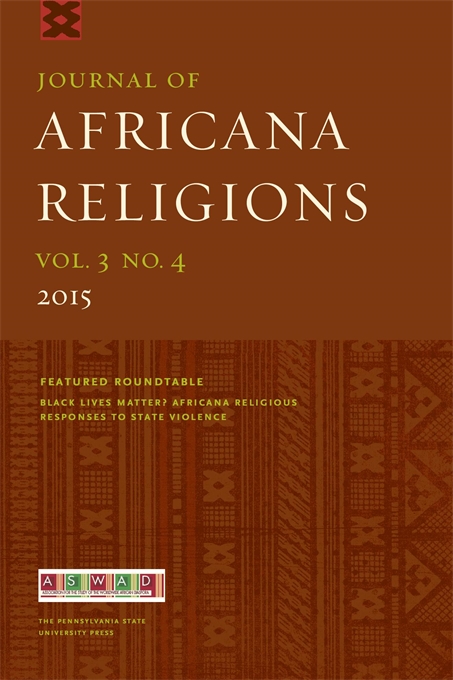
Journal of Africana Religions
Danielle N. Boaz, Editor
Sylvester A. Johnson, Editor
Ayodeji Ogunnaike, Editor
Journal of Africana Religions
Danielle N. Boaz, Editor
Sylvester A. Johnson, Editor
Ayodeji Ogunnaike, Editor
- Description
- Board
- Submissions
- Pricing
- Indexing
Access current issues through Scholarly Publishing Collective, Project MUSE, or back content on JSTOR.
The Journal of Africana Religions publishes critical scholarship on Africana religions, including the religious traditions of African and African Diasporic peoples as well as religious traditions influenced by the diverse cultural heritage of Africa. An interdisciplinary journal encompassing history, anthropology, Africana studies, gender studies, ethnic studies, religious studies, and other allied disciplines, the Journal of Africana Religions embraces a variety of humanistic and social scientific methodologies in understanding the social, political, and cultural meanings and functions of Africana religions.
The chronological scope of the journal is comprehensive and invites research into the history of Africana religions from ancient to contemporary periods. The journal’s geographical purview is global and comprises Africa, the Americas, Asia, the Atlantic islands (such as Cape Verde and São Tomé), the Caribbean, and Europe. The journal is particularly concerned with publishing research on the historical connections and ruptures involved in the spread of Africana religions from within and beyond Africa. Emphasizing the historical movement or spread of Africana religions and the dynamic transformations they have undergone underscores the nuanced, complex history of these religions and transcends the essentializing gestures that have hindered previous generations of scholarship. For this reason, we encourage authors to examine multiple dimensions of Africana religions, including the relationship between religion and empire, slavery, racism, modern industrial capitalism, and globalization.
The journal is co-sponsored by the African Association for the Study of the Religions and Association for the Study of the Worldwide African Diaspora.
The African Association for the Study of Religions (AASR) is an academic association that promotes the study of religions in Africa through international collaboration in research, publishing, and teaching. AASR was founded in 1992 in Harare, Zimbabwe at a Regional Conference of the International Association for the History of Religions (IAHR). The AASR has been an affiliate organization of the IAHR since 1995.
The Association for the Study of the Worldwide African Diaspora (ASWAD) is a not-for-profit, tax deductible organization of international scholars seeking to further our understanding of the African Diaspora, that is, the dispersal of people of African descent throughout the world. Through the examination of history, dance, anthropology, literature, women's studies, education, geology, political science, sociology, language, art, music, film, theater, biology, photography, etc., we seek to share the most recent research both within and across disciplinary and other conventional boundaries.
Editors
Danielle N. Boaz, University of North Carolina, Charlotte, US
Sylvester A. Johnson, Northwestern University, US
Ayodeji Ogunnaike, McGill University, CA
Managing Editor
Ahmad Greene-Hayes, Harvard University, US
Editor Emeritus
Edward E. Curtis IV, Indiana University, Indianapolis, US
Editorial Board
Abimbola Adelakun, University of Chicago Divinity School, US
Afe Adogame, Princeton Theological Seminary, US
David Amponsah, University of Pennsylvania, US
Aisha Mahina Beliso-De Jesús, Princeton University, US
Elias Bongmba, Rice University, US
Ras Michael Brown, George State University, US
Emily Suzanne Clark, Gonzaga University, US
Kyrah Malika Daniels, Emory University, US
Ambre Dromgoole, Cornell University, US
Carol B. Duncan, Wilfrid Laurier University, CA
Martha Frederiks, Utrecht University, NL
Margarita Simon Guillory, Boston University, US
Kelly E. Hayes, Indiana University, Indianapolis, US
Paul C. Johnson, University of Michigan, US
Adeline M. Masquelier, Tulane University, US
Elizabeth McAlister, Wesleyan University, US
Claudine Michel, University of California, Santa Barbara, US
Mary Nyangweso, East Carolina University, US
David O. Ogungbile, Obafemi Awolowo University, NG
Jacob Olupona, Harvard University, US
Damaris Parsitau, African Association for the Study of Religions
Elizabeth Pérez, University of California, Santa Barbara, US
Anthony Pinn, Rice University, US
Aldair Rodrigues, State University of Campinas, BR
Alphonso F. Saville IV, Union Presbyterian Seminary, US
Rüdiger Seesemann, University of Bayreuth, DE
Dianne M. Stewart, Emory University, US
Richard Brent Turner, University of Iowa, US
Adriaan van Klinken, University of Leeds, UK
Nicole von Germeten, Oregon State University, US
Judith Weisenfeld, Princeton University, US
Emma Wild-Wood, University of Edinburgh, UK
Jason R. Young, University of Michigan, US
Submission Policies
Thank you for your interest in publishing with the Journal of Africana Religions (JOAR). We encourage the submission of unsolicited manuscripts, comprehensive review essays, and creative or community-focused works.
How to Submit
Review the Guidelines: Please carefully read our formatting and category requirements below before preparing your manuscript. Submit Online: Visit the [JOAR Editorial Manager][http://www.editorialmanager.com/joar/] to create an author profile and upload your file. The online system will guide you through the submission process.
Submission Categories
Please ensure your manuscript fits into one of the following categories and meets its specific word count and abstract requirements.
1. Refereed Journal Articles
Description: Original, unsolicited research articles on topics relevant to Africana religions.Review Process: Peer-reviewed. In order to maintain an anonymous peer-review process, manuscript files should not include the author’s name, and citations to the author’s work should be redacted. Word Count: 8,000–10,000 words. Abstract: Approximately 150 words; 5 keywords required.
2. Comprehensive Review Essays
Description: Detailed, in-depth evaluation of recent literature or major themes in the field.Review Process: Peer-reviewed. In order to maintain an anonymous peer-review process, manuscript files should not include the author’s name, and citations to the author’s work should be redacted. Word Count: Approximately 5,000 words. Abstract: Approximately 150 words; 5 keywords required.
3. Short Review Essays & Round-Table Discussions
Description: Brief review essays analyzing two to five recent works, or proposals/comments for round-table discussions.Review Process: Evaluated by the editors (not peer-reviewed). Word Count: 1,500–3,000 words. Abstract: Maximum of 50 words; 5 keywords required. Important: Authors must contact the editors at journal@africanareligions.org to discuss their ideas before submitting a manuscript in this category.
4. Experimental Essays & Creative Works
Description: A dedicated space for works falling outside conventional academic boundaries. Some examples include essays describing experiences teaching or researching Africana religions, introductions to new theoretical frameworks, and experimental or creative writing. Review Process: Evaluated by the editorial team (not peer-reviewed). Word Count: Typically 1,500–8,000 words (depending on the nature of the piece). Abstract: Approximately 150 words; 5 keywords required.
5. Community Conversations
Description: Essays featuring the unique perspectives, insights, and contemporary experiences of religious leaders and devotees of Africana religions. Current Theme: For our inaugural section, we invite reflections on the broad theme: "What does your faith/tradition/religion mean to you?" Contributors might introduce their faith to an unfamiliar audience, debate categories like "tradition" vs. "religion," or contrast their lived interpretation with public perceptions. Review Process: Evaluated by the editorial team. Editors are happy to collaborate with contributors to edit submissions for clarity and format if desired.Word Count: Approximately 1,000–3,000 words. To Suggest Future Themes, email us at journal@africanareligions.org.
Style and Formatting Guidelines
All submissions (unless otherwise arranged with the editorial team) must strictly adhere to the following formatting standards:
-File Format: Microsoft Word document (.doc or .docx).
-Typography: Times New Roman, 12-point font, double-spaced, flush left alignment.
-Style Guide: Follow the current edition of the [Chicago Manual of Style][https://www.chicagomanualofstyle.org/home.html]
-Citations: Use endnotes only. Do not use in-text citations and do not include a bibliography.
-Total allotted word count includes endnotes.
Materials submitted to Journal of Africana Religions (JOAR) must not have been previously published nor submitted for publication elsewhere while under review by JOAR editors. All manuscripts accepted are subject to editorial modification. Questions may be sent to the editors at journal@africanareligions.org.
Illustrations
Once JOAR accepts a manuscript for publication, the author will be encouraged to provide the article with illustrations. It is the responsibility of the author to provide illustrations in a form that is suitable for publication, to obtain permissions, and to pay any permission, use, or processing fees involved with the illustrations. Each illustration must be submitted in an electronic format (e.g.,.tiff or .jpg). Images in the .jpg format must be of high quality and resolution: at least 600 dots per inch (dpi) for photos and at least 1000 dpi for line art.
Alt Text
Penn State University Press is committed to making its publications accessible to the widest audience possible. The inclusion of alternative text (or “alt text”) will allow those using assistive technology to access the images and other graphic elements (such as tables, charts, graphs, and maps) in the digital formats of articles. Authors are encouraged to submit alt text (and where necessary, extended descriptions) for all images and other graphic elements in their manuscripts.
General Guidelines for Composing Alt Text
Alt text should clearly and concisely describe the content and function of an image. Please limit the description to the most important elements of the image. In most cases a one- or two-sentence description, consisting of no more than 250 characters (not including spaces), should suffice. If more than 250 characters are needed to convey the content and function of an image, please provide an extended description in addition to the alt text.
Extended Description
For more complex images and graphic elements (such as graphs, charts, and maps), please provide an extended description with the necessary information. Any visible English text in an image must be transcribed in the extended description. Please note that images requiring an extended description must also have the shorter alt text.
Formatting and Submitting Alt Text
Alt text should be submitted along with captions. The alt text for a figure should be set on a new line after the caption and should be preceded by
-capitalize acronyms so assistive technology reads them as separate letters and not words (e.g., US versus us);
-avoid complex symbols, such as brackets, quotation marks, dashes, ellipses, and mathematical symbols, as assistive technology does not treat all of these symbols consistently;
-write in complete sentences but avoid overly complex sentence structures.For examples as well as additional information and resources, see [here][https://www.psupress.org/books/author_resources/accessibility_alttext.html]
Publishing Rights
All material appearing in the JOAR is copyrighted and all rights are reserved. Individuals may download and print materials appearing in JOAR for their own private educational use; otherwise, articles, essays, and all other materials in JOAR cannot be duplicated or reproduced by any means (electronic or print) without prior written authorization from the journal.
Institutional Online - $239.00
Institutional Print - $249.00
Institutional Online & Print - $363.00
Institutional Single Issue - $133.00
Individual Online - $64.00
Individual Print - $67.00
Individual Online & Print - $93.00
Individual Single Issue - $41.00
Outside US add Shipping & Handling - $14.00
ATLA
Web of Science Core Collection: Emerging Sources Citation Index
European Reference Index for the Humanities and Social Sciences (ERIH PLUS)
Scimago Journal & Country Rank
Scopus
Religious and Theological Abstracts
Mailing List
Subscribe to our mailing list and be notified about new titles, journals and catalogs.