



ab-Original
Journal of Indigenous Studies and First Nations and First Peoples' Cultures
Barry Judd, Editor
Adam Geczy, Editor
Katherine Ellinghaus, Editor
ab-Original
Journal of Indigenous Studies and First Nations and First Peoples' Cultures
Barry Judd, Editor
Adam Geczy, Editor
Katherine Ellinghaus, Editor
- Description
- Board
- Submissions
- Pricing
Access issues through Scholarly Publishing Collective.
ab-Original: Journal of Indigenous Studies and First Nations and First Peoples’ Cultures is a multidisciplinary journal committed to advancing rigorous, critical, and globally engaged scholarship. The journal positions itself as a space of intellectual provocation and ethical responsibility. It seeks scholarship that does not merely describe Indigenous experience but actively confronts questions of sovereignty, power, law, and knowledge production.
ab-Original is grounded in the imperative of truth-telling across Indigenous contexts worldwide and rejects the idea of Indigenous Studies as a purely descriptive or defensive field. It insists instead on Indigenous scholarship as leadership—intellectually demanding, ethically grounded, and, at times, uncomfortable.
ab-Original is a portal for new knowledge and contemporary debate—whose audience is not only that of academics and students, but professionals involved in shaping policies regarding Indigenous peoples.
The journal invites contributions that are analytically rigorous, ethically accountable, and grounded in Indigenous authority. It welcomes work that challenges institutional complacency and engages seriously with responsibility, relationships, and respect. ab-Original is dedicated to fearless scholarship—work that takes truth-telling not as performance but as obligation.
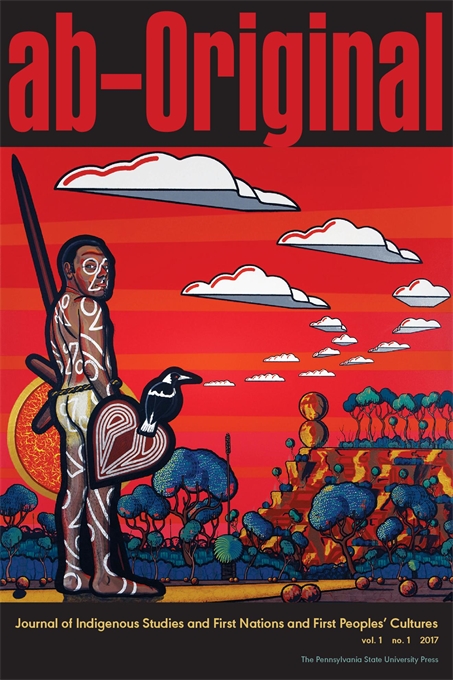
A note on the cover
The cover was created by the Sydney-based artist Blak Douglas and continues his longstanding association with the journal through the gift of this updated work. It is deliberately provocative. It does not seek to reassure; it seeks to unsettle.
“There’ve been some deplorable ‘circus’ acts as well as ‘elders’ projecting absolute delusional bosh. ‘Little Joe’ [in the image] is a 1930s cast iron money box based on the racist deep south attitudes of the era. The mechanism sees a coin placed in the hand and he ‘feeds’ himself. Upon the distant hillside is a stylized Hollywood sign, further indicating the sideshow attraction that has become what we know as a . . . ‘welcome to the country,’” said Douglas.
The image speaks directly to the journal’s commitment to truth-telling—not as a performative stance but as a demanding intellectual and ethical practice. This includes a willingness to ask difficult questions not only of institutions but of ourselves as Indigenous scholars and leaders operating within them.
In the context of Australian higher education, the cover confronts an uncomfortable and persistent dynamic: the narrowing of expectations placed upon Indigenous leadership. Too often, senior Aboriginal figures are positioned in ways that privilege representation over intellectual authority—valued as symbols of inclusion rather than as thinkers, critics, and producers of knowledge. The institutional appetite for reassurance can quietly displace the conditions necessary for genuine leadership.
The image draws on a longer colonial history in which Aboriginal figures such as Bennelong and Jaky Jaky were positioned within settler society in ways that were both visible and constrained, recognized yet circumscribed, present yet instrumentalized. These figures were called upon to mediate, translate, and signify, often within structures that limited their autonomy and reshaped their roles to meet colonial expectations.
The cover asks whether contemporary universities risk reproducing a version of this dynamic—where Indigenous leadership is permitted, even celebrated, so long as it remains legible, unthreatening, and institutionally useful. In this framing, presence becomes conditional, and authority is subtly managed.
This is not a comfortable critique, nor is it intended to be. The cover insists that Indigenous leadership in the academy must exceed symbolic function. It must be grounded in intellectual independence, critical capacity, and accountability to Indigenous knowledge systems, not merely to institutional expectations. Anything less risks reducing presence to performance—and inclusion to form without substance.
Editors
Barry Judd, University of Melbourne, AU
Adam Geczy, The University of Sydney, AU
Katherine Ellinghaus, La Trobe University, AU
Editorial Board
Len Collard, Emeritus, The University of Western Australia, AU
Philip Deloria, Harvard University, US
Malcolm King, University of Saskatchewan, CA
Gerald McMaster, Emeritus, University of Ontario, CA
Editorial Advisory Board
Bronwyn Bancroft, Artist, AU
Judith Nangala Crispin, Artist and Poet, AU
Bonnie Duran, Emerita, University of Washington, US
Fay Fletcher, University of Alberta, CA
Ashley Glassburn, University of Windsor, CA
Genevieve Hyacinthe, Massachusetts College of Art and Design, US
Michelle Johnson-Jennings, University of Washington, US
Niro Kandasamy, University of Sydney, AU
Hirofumi Kato, Hokkaido University, JP
Chiara Minestrelli, London College of Communication, UK
Dory Nason, The University of British Columbia, CA
Scott Manning Stevens, Syracuse University, US
All academic articles should be approximately 5,000-8,000 words. An abstract of up to 200 words must accompany each manuscript. All articles and comprehensive review essays will be peer-reviewed. Opinion pieces or short research reports, which are not peer reviewed, should be approximately 1,500 to 3,000 words in length. Book Reviews and Exhibition Reviews should be approximately 1,000 words.
Complete submission guidelines may be found here.
To submit an article, please visit http://www.editorialmanager.com/ab-original. The online system will guide you through the steps to upload your article to the editorial office.
Institutional Online - $198.00
Institutional Print - $220.00
Institutional Online & Print - $290.00
Institutional Single Issue - $113.00
Individual Online - $55.00
Individual Print - $58.00
Individual Online & Print - $81.00
Individual Single Issue - $37.00
Outside US add Shipping & Handling - $14.00
Mailing List
Subscribe to our mailing list and be notified about new titles, journals and catalogs.