


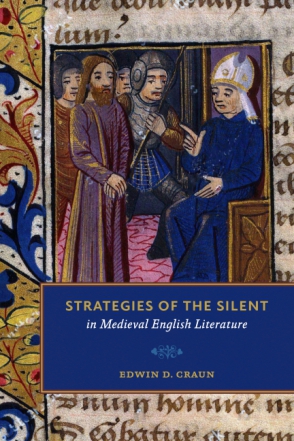
Strategies of the Silent in Medieval English Literature
Edwin D. Craun
“In this new and exciting study, Edwin Craun recovers the centrality of silence to late medieval discourse. Through insightful explorations of clerical authors, he shows that the choice of when to speak and when to remain silent was ethically fraught. Craun also shows that such vexed questions greatly influenced Middle English literary authors, shedding important new light on Hoccleve, Langland, and George Ashby, among others.”
- Description
- Reviews
- Bio
- Table of Contents
- Sample Chapters
- Subjects
Centering his study on readings of canonical texts, including the works of Thomas Hoccleve, the anonymous Mum and the Sothsegger, William Langland’s Piers Plowman, John Lydgate’s translation of Guillaume de Deguileville’s Pelerinage de vie humaine, The Testimony of William Thorpe, a selection of the York cycle of passion plays, and The Book of Margery Kempes, Craun recovers the widespread moral discourse on silence developed by late medieval secular and clerical writers, who compiled materials from Roman popular morality and Stoic texts as well as Jewish wisdom books and Christian texts. These texts model how silence could play a role in effective government, respond to violent and angry antagonists, or in some cases to entirely obviate a good outcome. Through this nuanced exploration of the ethics of communication in medieval moral, narrative, and dramatic literature, Craun shows us that public silences, then as now, have strategies and consequences, dimensions that medieval imaginative writers explore subtly yet analytically in order to provoke ethical reflection and pragmatic action.
Strategies of the Silent in Medieval English Literature offers original thematical and rhetorical insights into the written history of silence. It will appeal to scholars, graduate students, and advanced undergraduates interested in Middle English literature, history, and political thought.
“In this new and exciting study, Edwin Craun recovers the centrality of silence to late medieval discourse. Through insightful explorations of clerical authors, he shows that the choice of when to speak and when to remain silent was ethically fraught. Craun also shows that such vexed questions greatly influenced Middle English literary authors, shedding important new light on Hoccleve, Langland, and George Ashby, among others.”
“The book draws on Craun's deep knowledge of medieval theories about the use and abuse of language; it moves fluently from Latin to vernacular, alert throughout to how silence acquires its meaning from its contexts, which Craun shows us are nearly always both textually embedded and sharply instantiated in the world.”
Edwin D. Craun is Professor Emeritus of English at Washington and Lee University. He is the author of Ethics and Power in Medieval English Reformist Writing and Lies, Slander, and Obscenity in Medieval English Literature: Pastoral Rhetoric and the Deviant Speaker and editor of The Hands of the Tongue: Essays on Deviant Speech.
Acknowledgments
Editorial Practices, Translations, and Abbreviations
Introduction: Reading the Riddles of Public Silences
1. Why Public Silences Matter: Albertano da Brescia and Clerical Texts
2. The Art of Political Silence: The Prudent King of Hoccleve’s Regiment of Princes
3. Corrupt Political Silences: Mum and the Sothsegger
4. Patient Silences Under Interrogation: Jesus in the York Cycle and William Thorpe
5. The Limitations of Silence in Social Life: Thomas Hoccleve’s “My Complaint” and “Dialogue”
6. Wise Silences in the Life of Learning: Will and the Philosophers in Piers Plowman
Postscript: Literary Invention, Power Differentials, and Ethical Multiplicity
Notes
Bibliography
Index
Download a PDF sample chapter here: Introduction
Also of Interest
Mailing List
Subscribe to our mailing list and be notified about new titles, journals and catalogs.