


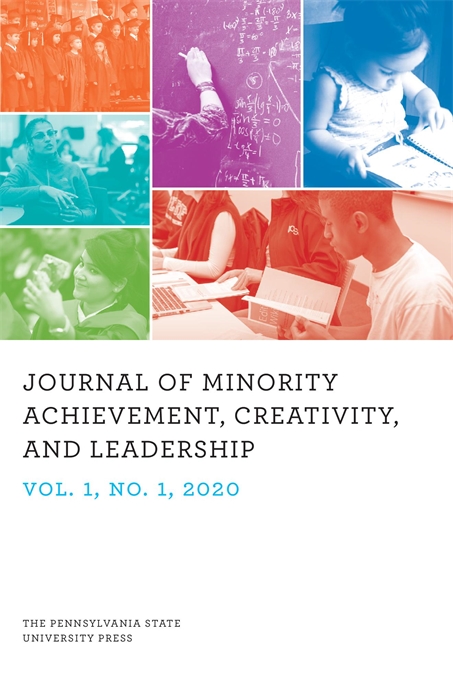
Journal of Minority Achievement, Creativity, and Leadership
Fred A. Bonner II, Editor
Journal of Minority Achievement, Creativity, and Leadership
Fred A. Bonner II, Editor
- Description
- Board
- Submissions
- Pricing
Access current issues through Scholarly Publishing Collective.
The Journal of Minority Achievement Creativity and Leadership underscores achievement, creativity, and leadership among gifted and high-achieving minority populations across the P-20 continuum. The journal aims to provide a range of information that foregrounds asset-based as opposed to deficit-oriented models for academics as well as practitioners in P-12 and higher education contexts.
Call for Papers: Please see Submissions
The Journal is affiliated with the ARCH-III Center at Prairie View A&M University. The mission of the Achievement, Research, Creativity, and High-Ability Center (ARCH-III) is to produce cutting-edge best-practices and scholarship that will speak to the contemporary issues impacting critical populations: administration, faculty, and students across the P-20 spectrum and beyond into workplace contexts.
Editor
Fred A. Bonner II, Prairie View A&M University, US
Managing Editor
Rishi Raj, University of Texas–Rio Grande Valley, US
Associate Editors
Liliana Bravo, Texas A&M University, US
Donna Druery, Texas A&M University, US
Jocelyn Gutierrez, University of North Dakota, US
Nicholas Hartlep, Berea College, US
Lakia M. Scott, Yale University, US
Terrell L. Strayhorn, Virginia Union University, US
Editorial Board
Mary Frances Agnello, Angello Enterprises
Mary V. Alfred, Texas A&M University
Judy Alston, Miami University
Donald Ambrose, Rider University
Dorinda Carter Andrews, Michigan State University
Rosa M. Banda, Texas A&M University Corpus Christi
Mitchell Chang, University of California, Los Angeles
Felecia Commodore, University of Illinois Urbana-Champaign
James Earl Davis, Temple University
Joy Lawson Davis, John Hopkins University
Edward Charles Fletcher Jr., The Ohio State University
Alonzo Flowers, University of Texas-San Antonio
Donna Y. Ford, The Ohio State University
Mark S. Giles, University of Illinois-Chicago
Ramon Goings, Loyola University, Maryland
Elsa Gonzalez, Texas A&M University
Mark Anthony Gooden, Teachers College, Columbia University
Tarek Grantham, University of Georgia, US
Kimberly A. Griffin, University of Maryland
Frank Harris III, San Diego State University
Kevin Lawrence Henry, University of Wisconsin-Madison
Mary Howard-Hamilton, Indiana State University
Sylvia Hurtado, University of California, Los Angeles
Jerlando F. L. Jackson, Michigan State University
Barbara J. Johnson, Georgia State University
Detra D. Johnson, University of Houston, US
Nicole M. Joseph, Vanderbilt University
Chance W. Lewis, University of North Carolina Charlotte
Luis A. Leyva, Vanderbilt University
Yvonna S. Lincoln, Texas A&M University
Dave A. Louis, University of Houston, US
aretha marbley, Texas Tech University, US
Ken McCluskey, University of Winnipeg
Michael Mobley, Merrimack College
Jerrel Moore, Prairie View A&M University
James L. Moore III, The Ohio State University
Maricela Oliva, South Texas College
Robert Palmer, Howard University
William H. Parker, Prairie View A&M University, US
C. Spencer Platt, University of South Carolina
Luis Ponjuan, Texas A&M University
Richard Reddick, University of Texas at Austin
Joseph Renzulli, University of Connecticut
Petra A. Robinson, Louisiana State University
Victor Saenz, University of Texas at Austin
Lawrence Scott, Texas A&M University, San Antonio
Stella Smith, Prairie View A&M University
Daniel Spikes, Lufkin Independent School District
Christine Stanley, Texas A&M University
Saundra Tomlinson-Clarke, Rutgers University
Franklin A. Tuitt, University of Connecticut
Caroline S. Turner, California State University, Sacramento
Cynthia Tyson, The Ohio State University
Chezare A. Warren, Vanderbilt University
Stephanie Waterman, University of Tornto
Gilman W. Whiting, Vanderbilt University
Henrietta Williams Pichon, Louisiana Tech University
J. Luke Wood, California State University-Sacramento
Taisir Yamin, International Centre for Innovation in Education
Sally J. Zepeda, University of Georgia
To submit a manuscript to Journal of Minority Achievement, Creativity, and Leadership, please visit Editorial Manager. The online system will guide you through the steps to upload your article to the editorial office. Refer to these submission guidelines before uploading your manuscript.
Subject areas and disciplines for submissions include:
*African American Studies/Black Studies
*Multicultural Education
*Equity/Diversity/Inclusion Studies
*Cultural and Ethnic Studies
*Counseling/Counselor Education
*Higher Education and Student Affairs
*Teacher Education
*Sociology
*Urban Education
*LBTQI Studies
*Giftedness and Creativity
*Leadership/Leadership Studies
*STEM Education
*Minority Studies
*Educational Psychology
*Educational Administration/Leadership
*Race and Gender Studies
*Qualitative Research Methods
*Educational Policy
**Education, Counseling, Psychology, Sociology, Anthropology, Research Method (AREAS)
CALL FOR PAPERS
1. "To Go Back and Retrieve: Fugitivity, Afrocentric Memory, and Black Futures of Education" - Forthcoming Special Issue with Guest Editors: Drs. Khalilah Ali-Brite, Takeshia Pierre, and Lakia Scott
Call Overview
At a moment marked by intensifying global repression, attacks on equity-based learning, and the attempted erasure of Black histories and ways of knowing, this special issue of JMACL calls scholars, educators, artists, and cultural workers to move Sankofa-style to go back and retrieve that which must not be forgotten, misnamed, or erased (Asante, 1998; Morrison, 1987).
Drawing from Afrocentric education, Black abolitionist thought, Critical Race Theory, fugitivity studies, and Afrofuturism, this collection foregrounds fugitivity as both a historical condition and an ongoing educational praxis. As Jarvis R. Givens (2021) demonstrates, Black educators have long practiced fugitive pedagogies teaching in excess of, alongside, and against schooling systems designed to discipline and contain Black life. These traditions of refusal, improvisation, memory work, and world-making remain central to Black educational survival and imagination. Afrocentric and African-centered scholars have long argued that Western schooling systematically distorts, fragments, or abandons African epistemologies and Black intellectual traditions (Woodson, 1933; Hilliard, 1998; Asante, 1991). At the same time, abolitionist educators remind us that liberation cannot be achieved through inclusion alone, but requires the dismantling and reimagining of educational systems rooted in racial capitalism and carcerality (Love, 2019; Davis, 2003; Gilmore, 2007).
This special issue invites work that critically retrieves Afrocentric educational thought, reckons with its contestedlegacies, and places it in generative dialogue with abolitionist, fugitive, CRT, and Afrofuturist frameworks to imagine Black educational futures otherwise.
Theoretical & Conceptual Orientation
This collection is grounded in, but not limited to, scholarship in:
*Afrocentric and African-centered education, including freedom schools and community-based pedagogies (Woodson, 1933; Asante, 1991; Hilliard, 1998)
*Fugitive pedagogy and maroonage, as educational logics of refusal, improvisation, and survival (Givens, 2021; Kelley, 2002)
*Abolitionist education, emphasizing the dismantling of carceral, punitive, and racialized schooling structures (Davis, 2003; Gilmore, 2007; Love, 2019)
*Critical Race Theory in education, particularly critiques of liberal reform and color-evasive policy (Bell, 1992; Ladson-Billings & Tate, 1995)
*Afrofuturism and Sankofa futurism, as speculative, temporal, and imaginative practices linking ancestral memory to liberated futures (Dery, 1994; Eshun, 2003; Nelson, 2002; Womack, 2013; Ali-Brite, forthcoming)
*Black psychology and precolonial epistemologies, including memory, healing, and fractured identities under colonial modernity (Fanon, 1967; Nobles, 2015)
Rather than treating these traditions as static or beyond critique, we welcome submissions that revisit earlierAfrocentric scholarship critically, interrogate its tensions, and explore how these ideas may be reimagined for contemporary educational struggles.
Guiding Questions
Contributors may consider questions such as:
*What educational lessons and practices emerge from Black fugitive life across slavery, segregation,colonialism, and contemporary regimes of surveillance and control (Givens, 2021; Hartman, 1997)?
*How might Afrocentric and abolitionist frameworks be reactivated, revised, or refused in today’s educational contexts (Love, 2019; Davis, 2003)?
*What does it mean to teach, learn, organize, and lead with a Sankofa orientation that retrieves ancestral knowledge without nostalgia (Asante, 1998; Morrison, 1987)?
*How have music, sound, performance, and visual culture functioned as liberatory educative texts in Black communities (Rose, 1994; Moten, 2003)?
*How do Afrofuturist and speculative traditions offer tools for imagining Black educational futures beyondreformist containment (Dery, 1994; Eshun, 2003; Womack, 2013)?
Suggested Topics
Topics for submission may include (but are not limited to):
*Afrocentric education, freedom schools, and abandoned or marginalized Black pedagogical traditions
*Fugitive pedagogy, maroonage, and educational refusal
*Black geographies, place-based resistance, and maroon educational spaces
*Sankofa pedagogies and Afrofuturist educational imaginaries
*Abolitionist education and critiques of reformist schooling
*Critical Race Theory and Black radical critiques of education
*Fugitive archives, memory work, and counter-histories
*Black psychology, precolonial epistemologies, and fractured identities
*Music, sound, performance, and visual culture as educative texts
*Diasporic and Afro-Indigenous educational formations
*Education as ritual, healing practice, and ancestral care
Types of Submissions
We welcome traditional and non-traditional scholarly contributions, including:
*Empirical research articles
*Conceptual and theoretical essays
*Critical analyses of music, lyrics, film, or visual art
*Arts-based and multimodal scholarship
*Narrative, poetic, or storytelling-based submissions with critical framing
Submission Guidelines & Timeline
Submission Format: Full manuscripts or substantial drafts (no abstract-only submissions)
Timeline
*Call Released: February 2026
*Manuscripts Due: June 2026
*Review & Feedback: July–August 2026
*Revisions Due: September 2026
*Publication: December 2026
Submission Inquiries
Questions about the call or to discuss a submission idea may be directed to: Dr. Khalilah Ali-Brite ; Dr. Takeshia Pierre ; Dr. Brooke Porter and Dr. Lakia Scott
References
Ali, K. (2024). “Looking back to look forward: Applying Akan and Yoruba science in
Sankofa Afrifuturist STEAM praxes and pedagogies.” In Eric Bridges, Sheila McKoy-Smith, and LaJuanSimpson-Wilkey (Eds.), Ifa: Using an ancient African paradigm in contemporary culture. Lexington Books.
Asante, M. K. (1991). The Afrocentric idea in education. Journal of Negro Education, 60(2), 170–180.
Asante, M. K. (1998). The Afrocentric idea (Rev. ed.). Temple University Press. Bell, D. (1992). Faces at the bottom of the well. Basic Books.
Davis, A. Y. (2003). Are prisons obsolete? Seven Stories Press.
Dery, M. (1994). Black to the future: Interviews with Samuel R. Delany, Greg Tate, and Tricia Rose. In Flame Wars (pp. 179–222). Duke University Press.
Eshun, K. (2003). Further considerations on Afrofuturism. CR: The New Centennial Review,
3(2), 287–302.
Fanon, F. (1967). Black skin, white masks. Grove Press.
Gilmore, R. W. (2007). Golden gulag. University of California Press.
Givens, J. R. (2021). Fugitive pedagogy: Carter G. Woodson and the art of Black teaching.
Harvard University Press.
Hartman, S. (1997). Scenes of subjection. Oxford University Press.
Hilliard, A. G. (1998). SBA: The reawakening of the African mind. Makare Publishing. Kelley, R. D. G. (2002). Freedom dreams. Beacon Press.
Ladson-Billings, G., & Tate, W. F. (1995). Toward a Critical Race Theory of education.
Teachers College Record, 97(1), 47–68.
Love, B. L. (2019). We want to do more than survive: Abolitionist teaching and the pursuit of educational freedom. Beacon Press.
Morrison, T. (1987). Beloved. Knopf.
Moten, F. (2003). In the break: The aesthetics of the Black radical tradition. University of Minnesota Press.
Nelson, A. (2002). Introduction: Future texts. Social Text, 20(2), 1–15. Nobles, W. (2015). Seeking the sakhu. Third World Press.
Rose, T. (1994). Black noise. Wesleyan University Press.
Womack, Y. (2013). Afrofuturism: The world of Black sci-fi and fantasy culture. Lawrence Hill Books.
Woodson, C. G. (1933). The mis-education of the Negro. Associated Publishers.
2. Avanzaremos!: Innovating Conditions for HSI Mission and Continuity
We are initiating a call for submissions for a special Hispanic-Serving Institution theme issue, Avanzaremos!: Innovating Conditions for HSI Mission and Continuity, in response to federal funding cuts of HSIs. The volume for the Journal of Minority Achievement, Creativity, and Leadership, is to be published through Penn State University Press.
The current U.S. policy environment for Hispanic-Serving Institutions (HSIs) has become contentious and counterintuitive as revoked funding has significant repercussions for the 5.6 million students enrolled at HSIs (HACU, n.d.). HSI leaders and practitioners who seek to promote best practices at these respective 615 institutions (HACU, n.d.) are in an impasse between policy, institutional mission, and the HSI designation.
As indicated in HEA Title III-A. and HEA Title V. legislation, this collective work aims to offer a platform for scholar-practitioners to highlight empirical-based strategies and practices within HSIs that continue to advance the intent of improving post-secondary education for Latinx/e populations.
We seek abstract submissions that encompass empirical studies and conceptual pieces revolving around key themes. All abstract submissions need to be between 350-400 words, addressing one or more of the following sections:
• Policy and Evaluation
o Assessment
o Implementation
• Institutional Leadership and Mission Alignment
o General Counsel
o Decision-Making
• STEM at HSIs
o Current Funding
o Maintaining Programs
• Visionary Campus Environments
o Institutional Identity
o Sharing Resources
• Student Success
o Ongoing Practice
o Innovative Practice
Your contribution and sharing of this call for abstracts within your network would be immensely valuable. This collaboration promises to offer diverse perspectives and innovative approaches, creating a robust collection that deeply investigates and promotes continuity for Hispanic-Serving Institutions.
The call for abstracts will be open from May 5 - July 31st via a google form, full manuscripts will be due October 15th (2026) to be submitted at Editorial Manager. All questions can be directed via email to .
Thank you for considering the importance of this topic and the potential impact of your contributions. We eagerly anticipate your involvement in this crucial initiative.
Editors:
Jocelyn A Gutierrez – University of North Dakota
Jessica Rivera – University of Texas – San Antonio
Vanessa Sanone - University of Texas – San Antonio
Katherine Arias – University of California – Irvine
Rosa Banda – Texas A&M University – Corpus Christi
Institutional Online - $171.00
Institutional Print - $178.00
Institutional Online & Print - $249.00
Institutional Single Issue - $96.00
Individual Online - $59.00
Individual Print - $62.00
Individual Online & Print - $85.00
Individual Single Issue - $39.00
Outside US add Shipping & Handling - $14.00
Mailing List
Subscribe to our mailing list and be notified about new titles, journals and catalogs.