



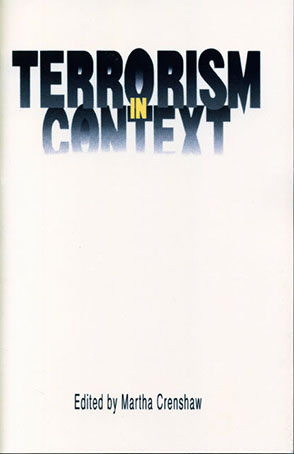
Terrorism in Context
Edited by Martha Crenshaw
“Martha Crenshaw, a scholar of repute on terrorism, has done a commendable job of compiling fourteen essays grouped under three broad categories of terrorism. . . . Those cases of terrorism which are peculiar in nature or have caused serious consequences to domestic political processes are included under each category. They spread across the world covering developed and developing States, include both democratic and authoritarian regimes, represent the past and the present, explain continuities and discontinuities in the development of violent political action in a variety of contexts, and situate terrorism in the paradigm of relationship between State and society and between Governments and oppositions.”
- Description
- Reviews
- Bio
- Table of Contents
- Sample Chapters
- Subjects
Acts of violence committed by terrorists have become a staple of news reports in modern times, from hijackings to bombings, kidnappings to assassinations. How are we to understand both the causes and the consequences of these disturbing events? The key, this volume of original essays shows, lies in linking terrorism to the different contexts—historical, political, social, and economic—in which it occurs.
The fourteen contributors to this volume—historians, political scientists, and sociologists—provide the expertise to explain the continuities and discontinuities in the development of this form of violent political action in a variety of contexts. They link terrorism to the pattern of relations between state and society and between government and oppositions. Their studies range from the early manifestations of terrorism in revolutionary Russia and the anarchist movements of Western Europe and the United States in the late nineteenth century up to the terrorism still ongoing in Latin America and the Middle East. A section on left-wing terrorism covers the activities of the Italian Red Brigades and German Red Army Faction in the 1960s and 1970s, the urban guerrilla warfare in Argentina in the 1970s, and the rise of Sendero Luminoso in Peru during the 1980s and 1990s. Another section deals with terrorism arising from conflicts in divided societies—by Basques in Spain, the IRA in Northern Ireland, and Sikhs in India. The last major section considers terrorism as it has been linked to the establishment of nation-states in Algeria, the Israeli-Palestinian conflict, and the effort of Iran to export its Islamic revolution throughout the Middle East.
The Introduction sets the stage for the individual case studies by outlining an approach to analyzing terrorism in different historical contexts, and the Conclusion by French sociologist Michel Wieviorka highlights some of the common themes that emerge from the case studies and addresses their implications for further research.
“Martha Crenshaw, a scholar of repute on terrorism, has done a commendable job of compiling fourteen essays grouped under three broad categories of terrorism. . . . Those cases of terrorism which are peculiar in nature or have caused serious consequences to domestic political processes are included under each category. They spread across the world covering developed and developing States, include both democratic and authoritarian regimes, represent the past and the present, explain continuities and discontinuities in the development of violent political action in a variety of contexts, and situate terrorism in the paradigm of relationship between State and society and between Governments and oppositions.”
Martha Crenshaw is Professor of Government at Wesleyan University, author of Revolutionary Terrorism: The FLN in Algeria, 1954–1962 (1978), and editor of Terrorism, Legitimacy, and Power (1983).
Contents
1. Thoughts on Relating Terrorism to Historical Contexts Martha Crenshaw
2. The Intellectual Origins of Modern Terrorism in Europe
Martin A. Miller
3. Russian Revolutionary Terrorism
Philip Pomper
4. Left-Wing Terrorism in Italy
Donatella della Porta
5. West German Left-Wing Terrorism
Peter H. Merkl
6. Political Violence in Argentina: Guerrillas, Terrorists, and Carapintadas
Richard Gillespie
7. The Revolutionary Terrorism of Peru's Shining Path
David Scott Palmer
8. The Culture of Paramilitarism in Ireland
Charles Townshend
9. Political Violence and Terrorism in India: The Crisis of Identity
Paul Wallace
10. Political Violence in a Democratic State: Basque Terrorism in Spain
Goldie Shabad and Francisco Jose Llera Ramo
11. The Effectiveness of Terrorism in the Algerian War
Martha Crenshaw
12. Terrorism in the Arab-Israeli Conflict: Targets and Audiences
Ian S. Lustick
13. Terrorism and Politics in Iran
Jerrold D. Green
14. Terrorism in the Context of Academic Research
Michel Wieviorka
"Thoughts on Relating Terrorism to Historical Contexts"
These comments, based on Terrorism in Context, Martha Crenshaw, (ed.) "Thoughts on Relating Terrorism to Historical Contexts," are featured in "Issues in Global Education."
What is Terrorism?
Terrorism is a conspiratorial style of violence calculated to alter the attitudes and behavior of multiple audiences. It targets the few in a way that claims the attention of the many. Thus a lack of proportion between resources deployed and effects created, between the material power of actors and the fear their actions generate, is typical. Among systematic and organized modes of civil or international violence, terrorism is distinguished by its high symbolic and expressive value. The discrepancy between the secrecy of planning and the visibility of results gives it even more shock value.
In general, who engages in terrorism?
Terrorism is not mass or collective violence but rather the direct activity of small groups. However authentically popular these groups may be, and even if supported by a large rorganization or political party, the number of active militants who engage interrorism is small. These few may be isolated from the broader society; on the other hand, they may act as an extremist offshoot of a larger social movement, profiting from the patronage of a significant segment of the population. Moreover, governments and their agents can practice terrorism, whether to suppress domestic dissent or to further international purposes, such as the export of revolution in the case of Iran. Such use is usually carefully concealed in order to avoid public attribution of responsibility.
Why do people or groups engage in terrorism?
There is nothing automatic about the choice of terrorism. Like any political decision, the decision to use terrorism is influenced by psychological considerations and internal bargaining, as well as by reasoned or strategic reactions to opportunities and constraints, perceived in light of the organization's goals. Both causes and consequences of terrorism can only be understood in terms of interactions among political actors, primarily governments and oppositions, at specific points in history.
What are the consequences of terrorism?
The impact of terrorism is often lost in a tide of sensational exaggerations. Furthermore, terrorism shapes interactions among political actors over long periods of time through a dynamic process in which violence alters the conditions under which it initially occurs. Many consequences are unintended, but it is rare that terrorism(or, more frequently, the government's reaction to terrorism) does not alter political institutions, values, and behavior as well as the functioning of society.
How does the media effect our view of terrorism?
In modern societies, political conceptions are communicated and even originated by the news media, an institution that serves not only as a channel for transmitting information about terrorism but also as a magnifying glass. It simplifies the problem of terrorism by focusing the attention of the public on the newsworthy aspects of the phenomenon, which tend to be its extraordinary or shocking characteristics, rather than on any banal or mundane qualities it may possess. Thus, terrorism is described as the dramatic, outrageous, and objectionable. At the same time, many oppositions that use terrorism are fully aware of the opportunities for publicity inherent in their environment and exploit their own newsworthiness with varying degrees of deftness.
Why is it sometimes difficult to determine what is terrorism?
Since "terrorism" is a political label, it is an organizing concept that both describes the phenomenonas it exists and offers a moral judgment. A label is a useful shorthand, combining descriptive, evocative, and symbolic elements but its meanings are inherently flexible and ambiguous. They may even be contradictory. Political language affects the perceptions of audiences and their expectations about how the problem thus evoked will be treated. That is, by defining and identifying a problem, labels may also indicate a preferred solutions. Politics involves competition to define terms, as actors attempt to impose their own interpretations of history. In contemporary politics, calling adversaries "terrorists" is a way of depicting them as fanatic and irrational so as to foreclose the possibility of compromise, draw attention to the real or imagined threat to security, and promote solidarity among the threatenes.
Are terrorists and their actions similar to traditional political or military actions?
An underground organization using terrorism probably defines terrorism as warfare in order to acquire political recognition and status, which in turn can confer legitimacy, which is exactly what governments resist. To be engaged in warfare is a justification for terrorism as well as a claim to powerful status. The smaller and the more extreme the group becomes, it seems, the more likely it is to call itself an "army" such as the Red Army Faction, the Japanese Red Army, or the Red Brigades); but one would not want to overlook the Irish Republican Army, which uses the term to remind us of its heritage. Most underground groups borrow the symbols and trappings of military discipline and procedure. Yet acts of terrorism do not typically resemble acts of warfare. "Hard" or well-defended targets of military or defensive value to the enemy are rarely the targets of terrorism; to the contrary, terrorists seem to prefer noncombatants.
[However] even the best scholarly intentions may not suffice to distinguish terrorism from protest, guerrilla warfare, urban guerrilla warfare, subversion, criminal violence, paramilitarism, communal violence, or banditry.
One reason for the power of terrorism as a political label, and hence for its controversy, is not only itsusefulness but its symbolic appeal. Terrorism has acquired a political value that can outlast short-term strategic failures. It persists despite negative outcomes. Terrorism projects images, communicates messages, and creates myths that transcend historical circumstances and motivate future generations. It may be true that audiences react with both admiration for its daring and revulsion at its cruelty. It is easy for terrorism to become the cutting edge of a movement and to define an ideology. Undeniably it possesses an aura of perversely tragic glamour.
What type individuals become terrorists and why?
Entrepreneurial types who create independent organizations (often splinters from larger social movements)as well as those who are recruited into long-standing organizations.[which]provide a convenient and accessible structure for participation, with specialized roles, hierarchies, and social support functions. Joining a radical organization may not be completely voluntary, since chance or coercion may intervene. Disappointments and frustrations with nonviolent action are frequently cited as motivations in both democratic and authoritarian environments. Psychic wounds inflicted on people at an impressionable age, [or] instances where demands for change were summarily rejected by governments and idealistic ambitions were crushed. Another influence may be solidarity with groups that move collectively to terrorism. This solidarity sometimes takes the form of membership in a rebellious counterculture (often springing from a student or university environment) or in the radicalized factions of a traditional or religious culture, as in Iran or India. The attractions of extremist violence for people with little to lose, free time, high energy levels, and a longing for excitement may be the factors that link the demographic characteristics of a society, or levels of unemployment, to terrorism.
What other factors act as a stimulus or facilitator to terrorism?
Ideologies that justify violence or beliefs that violence works. These ideologies owe much to the experience of national liberation movements in the postwar world, but in Europe the French Revolution had already established the principle that violence could be both morally right and politically efficacious. Today, awareness of the availability of terrorism as an options whether it be assassination of heads of state orhijackings or bombings is inescapable. The viability of terrorism enhances its contagiousness. We know, for example, that terrorism is made possible by the support of a circle of people that extends beyond those militants who actively participate. The existence of social support networks may need less explanation in divided societies where terrorism is inspired by the nationalism or communal solidarity of minorities or by their need to confirm an ethnic and religious identity.
How is terrorism distinguished from other forms of violence?
It is systematic, deliberate, and sustained over time; it is not spontaneous or purely expressive, as some other forms of civil violence (riots, for example) maybe. Engaging in terrorism usually requires a sustained commitment, which the individual must be able to justify in terms of society (or some part of society's) values and aspirations. Many individual terrorists need to feel virtuous or altruistic. Because terrorism is explicitly justified by those who use it in terms of widely held social values, it differs fundamentally from family or criminal violence. It makes an explicit claim to political relevance. Emotions may influence commitments, but they are controlled and channeled through collective decision-making processes that give motivations an ideological cast.
[Terrorists] may see themselves acting as representatives of groups within society, defending and preserving an identity, or preventing the assimilation of a religious or ethnic community into an alien society that would dilute its values and traditions. Users of terrorism may think of themselves as bringing abut a better society for all, thus acting in the interest of a collective good, not as a selfish contender for power in a narrow political arena.
How can the ideas or actions of terrorists be influenced?
[Because terrorists] seek to influence critical audiences, they respond to what they perceive the dispositions of these audiences to be. Terrorists may of course misperceive their circumstances and exaggerate the extent to which the "people" are prepared to offer sympathy or condone violence.
What are some signs of potential terrorism?
In divided societies, we can see that the existence of a long-standing conflict of interest, the persistence of real grievances based on long standing patterns of discrimination and inequality, the deep loyalty to community values and to the symbols and myths developed over centuries, and the government's contested legitimacy may produce an environment in which groups using terrorism, such as the IRA or the PLO, are genuinely representative of a popular base. If terrorism seems to be the only effective means of armed struggle, then resistance and terrorism become synonymous. The constituency for terrorism will almost certainly understand and possibly admire terrorism even if hostile to it as a method, in part because the users of terrorism can claim to be representative.
A further point to consider is the purposefulness of terrorism as a style of violence. We note that terrorism is intended to affect the attitudes of popular audiences by altering their dispositions toward the government and its challengers. It is also calculated to affect the government's decision making. Furthermore, the audiences for terrorism are multiple. They include sympathizers, in which case terrorism is meant to elicit excitement or enthusiasm, strengthen solidarity, or redeem the past; antagonists, whom terrorism is intended to shock, intimidate, or coerce, and "neutrals," especially foreign publics whose attention and interest are sought.
Terrorism is thus generated in anticipation of a public reaction and becomes part of an interactive process.
How might we expect various audiences & people—to react to terrorism?
Audiences react to two aspects of the issue: the case brought to their attention by terrorism and the particular method of terrorism, that is, the style of violence. Not everyone who supports a cause will approve of any method of achieving it, but sympathy for ideological objectives will make approval of the method more likely. However, people who disapprove of the cause will almost certainly reject the method. Audiences are more likely to approve discriminate tactics than indiscriminate tactics, but only if the victim can be blamed. Moral judgments about the responsibility for conditions and the appropriateness of violent responses influence popular reactions.
How do governments usually respond to terrorism?
Democracies usually combine repression and reform, depending on the nature of the threat. For example, Western European democracies confronting terrorism saw a growth in power of state security institutions. West German and Italian governments also upgraded intelligence-gathering and surveillance functions, bringing the government into a more intrusive role vis-a-vis society. In West Germany, Spain, Italy, and the United Kingdom, anti-terrorist legislation restricted civil liberties.
How can government control terrorism while maintining democratic freedoms?
Democracies struggle with terrorism from the Left and from the Right, as well as from nationalist or separatist interests. They must balance a perceived need to control the direct consequences of terrorism, by maintaining order and security, with the realization that any coercive response to terrorism reduces democractic freedoms.
How do you end terrorism?
Ending terrorism may require a change in the motivations of the individuals involved.How do conditions change so as to decrease incentives for terrorism? What might cause individuals to abandon the initial commitment that bound them to a terrorist role? When do people who use terrorism cease to believe in their own justifications? Under what circumstances can the individuals who have participated in terrorism be reintegrated into society? The causes and effects of terrorism are comprehensive only in terms of political conflicts in specific historical time periods. There are commonalities among instances of terrorism, but each case is unique. Terrorism remains unpredictable in part because its multiple contexts are dynamic. Governments and challengers respond differently to similar circumstances. Original conditions change as a result of terrorism. Even the meaning of the term changes as politics and society change.
© 1995 The Penn State University
Also of Interest
Mailing List
Subscribe to our mailing list and be notified about new titles, journals and catalogs.