


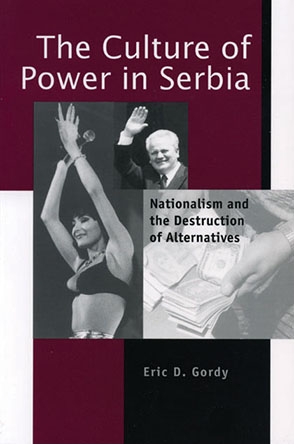
The Culture of Power in Serbia
Nationalism and the Destruction of Alternatives
Eric D. Gordy
“An original and important addition to the literature on post-Communist transformations. Gordy presents a detailed political sociology of the region which is grounded in a knowledge of the language and relevant sources. His work is timely and will reach a wide audience interested both in Serbia and in the political and cultural sociology of nationalism, authoritarianism, and aesthetic life.”
- Description
- Reviews
- Bio
- Subjects
Gordy finds the answer in everyday life. The Milošević regime has largely succeeded in making alternatives to its rule unavailable. By controlling key aspects of daily life, including politics, media, and popular music, it has undermined opposition by closing off alternative voices. The result is an atmosphere in which people feel they have lost control over their private life and cultural environment.
Nevertheless, Gordy finds reason to be optimistic about the long-term prospects for Serbia. The regime's forays into popular music have largely failed, and it has had only partial success in controlling the media, suggesting that the present strategy will not work forever. In Gordy's judgment, the Milošević regime has a limited future.
The Culture of Power in Serbia provides fresh perspective for readers interested in contemporary Eastern Europe, in the strategies and tactics of authoritarian regimes, in the sociology of everyday life, and in the political potential of culture.
“An original and important addition to the literature on post-Communist transformations. Gordy presents a detailed political sociology of the region which is grounded in a knowledge of the language and relevant sources. His work is timely and will reach a wide audience interested both in Serbia and in the political and cultural sociology of nationalism, authoritarianism, and aesthetic life.”
“This book presents a very original and informative approach to the study of the social base and social policy of Milošević’s regime, and goes a long way to explain why Milošević has been so resilient. I recommend it highly to those interested in the politics of transition from communism to ‘post-Communism,’ or in the ways authoritarian regimes maintain power. Students of Balkans will find this work indispensable.”
Eric Gordy is Assistant Professor of Sociology at Clark University. His articles have been published in the journals Problems of Post-Communism, Popular Music, and Pacific News Service.
Mailing List
Subscribe to our mailing list and be notified about new titles, journals and catalogs.