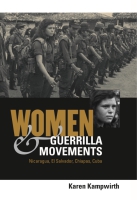




Women and Guerrilla Movements
Nicaragua, El Salvador, Chiapas, Cuba
Karen Kampwirth
“This is an intelligent and well-researched book—essential reading for helping academics and practitioners think through the complexities of women’s lives during and after revolutions. Kampwirth’s book will chart a new course for us to study women as individuals, not just as a group, with regard to political and social revolutions. A book that superbly captures the real lives of women revolutionaries—without over-romanticizing the revolutions or the roles of women.”
- Description
- Reviews
- Bio
- Table of Contents
- Sample Chapters
- Subjects
Karen Kampwirth writes here about the women who joined the revolutionary movements in Nicaragua, El Salvador, and the Mexican state of Chiapas, about how they became guerrillas, and how that experience changed their lives. In the last chapter she compares what happened in these countries with Cuba in the 1950s, where few women participated in the guerrilla struggle.
Drawing on more than two hundred interviews, Kampwirth examines the political, structural, ideological, and personal factors that allowed many women to escape from the constraints of their traditional roles and led some to participate in guerrilla activities. Her emphasis on the experiences of revolutionaries adds a new dimension to the study of revolution, which has focused mainly on explaining how states are overthrown.
“This is an intelligent and well-researched book—essential reading for helping academics and practitioners think through the complexities of women’s lives during and after revolutions. Kampwirth’s book will chart a new course for us to study women as individuals, not just as a group, with regard to political and social revolutions. A book that superbly captures the real lives of women revolutionaries—without over-romanticizing the revolutions or the roles of women.”
“Karen Kampwirth has here made a fundamental contribution to the literature on revolutions, weaving together structural political economy and personal stories in a provocative, soundly argued way. The stories are fascinating and gripping, the ideas striking and powerful, the writing highly engaging. The theoretical framework, based on a combination of structural and personal factors, is wise, inventive, and sound, and is tested with some very original and hard-to-get empirical data from four cases—Nicaragua, El Salvador, Cuba, and Chiapas. It will be widely seen as the essential work on the increasingly studied topic of women and revolution.”
“Why, then, yet another book on guerrilla movements? Karen Kamwirth shows us why in Women and Guerrilla Movements.
Kampwirth’s analysis thus, implicitly, leaves us with a frame to better understand how movements in the post-Cold War are likely to be different in form and content than earlier movements.”
“Overall, this is an important and engaging book.”
“Without a doubt, such a perspective raises new issues for research, while also focusing on old ones, and helps one gain a better view of gender politics within individual countries and societies.”
“Karen Kampwirth’s Women and Guerrilla Movements is an exceptional contribution to revolutionary studies. Through her analysis of female guerrillas in Nicaragua, El Salvador, Chiapas and Cuba, she demonstrates that by excluding gender from their analysis, the vast majority of scholars of revolutions have missed key dynamics.
In sum, Women and Guerrilla Movements is a coherent, engaging, well-researched, and thoughtful development in revolutionary studies.”
“Kampwirth provides an excellent synthesis of existing studies, documents, and theories. Her cross-national analysis highlights the similar structural and cultural patterns found across multiple movements, and she critically outlines the macro-level changes that made possible women’s increased political activism in recent decades. Kampwirth demonstrates unequivocally the necessity for incorporating gender into any explanation of revolutionary movements.
Kampwirth’s book provides an excellent foundation from which future studies will no doubt begin their discussion.”
“This book is most illuminating when it delves into the details of particular women’s lives.”
“An excellent addition to the literature, this volume will be of great interest to scholars interested in the long history of populism and will also make an accessible and thought-provoking addition to the reading lists of students of modern Latin American history and Latin American gender studies.”
Karen Kampwirth is Associate Professor of Political Science and Chair of the Latin American Studies Program at Knox College. She is coeditor of Radical Women in Latin America (Penn State, 2001).
Contents
Acknowledgments
Introduction
1. New Roles for Sandino’s Daughters
2. Feminine Challenges to Military Rule in El Salvador
3. Also a Women’s Rebellion: The Rise of the Zapatista Army
4. Rethinking Women and Guerrilla Movements: Back to Cuba
Appendix: Social Origins of the Central American Guerrillas
Bibliography
Index
Introduction
If the twentieth century was the age of revolution, then surely Latin America was the region of revolution. Over the course of that century, new revolutionary movements emerged every few years across the region, movements that promoted goals such as overturning dictatorships, confronting economic inequalities, and creating what Cuban revolutionary hero Che Guevara called the "new man."
But in fact, many of those new men were not men. Thousands of them, especially in the second half of the century, were women. This book is about the women who joined revolutionary movements in Nicaragua, El Salvador, and the Mexican state of Chiapas; how they came to become guerrilla activists; and how that experience changed their lives. I hope to show that our understanding of revolutionary movements is inevitably poorer if we try to understand those movements in gender-free terms; revolution in the real world has never been gender-free. Further, I will show how, in the cases of Nicaragua, El Salvador, and Chiapas, a series of political, structural, ideological, and personal factors allowed many women to escape the constraints of their traditional roles. Once those constraints were loosened, some of them chose, or were pushed into choosing, to participate in guerrilla movements and other sorts of revolutionary activism.
REVOLUTIONARY THEORY: WHERE ARE THE WOMEN? Strangely, theories of revolution have largely ignored the impact of gender relations on revolutionary organizations, despite the fact that women were active participants in late twentieth-century guerrilla movements in Latin America. Within the FSLN (Frente Sandinista de Liberación Nacional) of Nicaragua, many have estimated, 30 percent of the combatants, and many of the top guerrilla leaders, were women (Collinson 1990, 154; Flynn 1983, 416; Reif 1986, 158), though a study of the records of the Sandinista Social Security Institute found that only 6.6 percent of those who were killed in the war against Somoza were female (Vilas 1986, 108). In the southern Mexican state of Chiapas, women are well integrated into the ongoing movement of the EZLN (Ejército Zapatista de Liberación Nacional), constituting about one-third of the combatants (Marcos 1995; Olivera 1996, 49; Stephen 1994b, 2). Women’s participation in the FMLN (Frente Farabundo Martí para la Liberación Nacional) of El Salvador was also quite significant; and the data are more reliable than in either Nicaragua or Chiapas, because at the end of the war in 1992, the United Nations oversaw the demobilization of the FMLN, collecting basic data regarding the guerrillas.
Approximately 40 percent of the FMLN membership, 30 percent of the combatants, and 20 percent of the military leadership were women (Luciak 1995, 3; Mason 1992, 65; Montgomery 1995, 123; Mujeres por la Dignidad y la Vida 1993, 35; Vázquez, Ibáñez, and Murguialday 1996, 21). In discussing similar data, Timothy Wickham-Crowley notes a number of instances in which visitors to guerrilla camps did not see many female combatants. As he rightly observes, this discrepancy "should alert our critical facilities" (1992, 216). I too have reason to doubt the figure of 30 per- cent armed female participation, if for no other reason than that nearly the same percentage is claimed in all three cases. Nonetheless, years of qualitative research, along with data uncovered by Luciak (2001; 1995) from the demobilization processes in El Salvador and Guatemala, has led me to conclude, like Wickham-Crowley, that even if the percentage of female combatants was not exactly 30 percent, "a quantum leap occurred in women’s participation in Latin American revolutionary movements, roughly between 1965 and 1975" (Wickham-Crowley 1992, 216–17). Debates over numbers should not blind us to this leap. That women were such active participants is somewhat surprising, since in earlier guerrilla movements, such as that of Cuba, their numbers seem to have been considerably lower.
Why did women play such an active role in these three cases? Answering that question will require paying close attention to the roles that women play (or do not play) in revolutionary politics. To do so I will use a feminist approach, a method in which gender is a central category of analysis. Using a feminist approach can help theorists of revolution more easily reach their own goals of explaining the causes and implications of guerrilla struggle. Such a method can improve revolutionary theory by helping theorists to better address the central question of the literature: why do some groups succeed in overthrowing dictatorships while others fail? It simply is not enough to do what theorists of revolution have traditionally done: to look for the support or lack of support of social sectors, with a particular focus on class divisions. Even apparently simple questions regarding class—did the peasantry support the guerrillas?—are complicated, and illuminated, by a feminist approach.
Timothy Wickham-Crowley has taken steps toward incorporating gender as a factor in revolutionary theory by acknowledging change in the gender composition of recent guerrilla movements in Latin America. He notes that while in the 1960s, the percentage of women who led Latin American guerrilla groups ranged "from zero to 20 percent," by the 1970s and 1980s, women constituted between a quarter and a third of the combatants in Nicaragua and El Salvador (1992, 21). Unfortunately, after uncovering this interesting shift in gender roles, he fails to speculate on the causes of this change in the composition of guerrilla movements. Instead, his main explanation for the relative underrepresentation of women within guerrilla coalitions is that "men, on average, are more aggressive than women" and that some research suggests that this has "a biological basis" (1992, 23). But if this explanation were the most signifi- cant one, the expected outcome would have been no change in women’s participation in guerrilla movements since the 1960s. After all, the biology of Latin American women and men has not changed. It is worth asking why women are still underrepresented within guerrilla movements (or perhaps why men are overrepresented). But it is even more important to ask why their numbers are increasing, for the answer to that question will also offer clues to the question about their relative underrepresentation.
Despite the limits of his analysis of the role of women in guerrilla movements, Wickham-Crowley is unusual because he even acknowledges that the role has shifted. Why have most theorists of revolution paid so little attention to this shift? The problem is not that there has been any shortage of recent theoretical works on revolutionary change.6 Nor is there any shortage of research on the role that gender plays within revolutionary politics.
Yet with very few exceptions (Foran, Klouzal, and Rivera 1997; Moghadam 1997; Tétreault 1994), these findings on gender in revolutionary settings have not been integrated into theories of revolution, except at the level of footnotes. I suspect that in large part, this inattention to gender is a function of the fact that the vast majority of the work on revolution over the course of the past century has been devoted to some version of a single question. From a movement-centered perspective, this question is the following: Under what circumstances have revolutionary movements succeeded in overthrowing states? Alternatively, from a state-centered perspective, the question becomes, Under what circumstances have states fallen to guerrilla challenges? That question (which I will not address in this book) has informed multiple generations of revolutionary theory and has still not been fully answered to the satisfaction of most participants in the debate. Any question that can generate such lengthy and often heated debate is clearly a good question, but it is not the only question. Organizing the field of revolutionary studies around this single question has had some negative consequences. Too often, the study of revolution has been reduced to the study of war. This is not to say that the violence of guerrilla struggle may be ignored by revolutionary theorists (for otherwise revolution becomes synonymous with social movements), but overprivileging violence is costly. It has resulted in a body of revolutionary theory in which the overthrow of the old regime is usually the end point, and the period after its overthrow is often incorrectly called the "postrevolution." In contrast, Latin Americans reserve the term la revolución to name the period of political, economic, and social transformation that can only occur after the guerrillas succeed in seizing the state. So the guerrilla struggle and the revolution are distinct periods, separated by the moment in which the old regime is overthrown. At the same time, they are intellectually linked, for the guerrilla struggle makes little sense without the hope of a later period of revolutionary transformation. While many excellent case studies of particular revolutions have been published, few theoretically focused works have analyzed what happens during revolutions (Colburn 1994; Fagen, Deere, and Carragio 1986; Fagen 1969; and Selbin 1999 are notable exceptions). This book fits into the tradition of the single question in that it too focuses on the period of the guerrilla struggles (a manuscript in progress analyzes the effect of those struggles on gender relations and feminist organizing during the revolution and postrevolution in Nicaragua and during the periods following the guerrilla wars in El Salvador and Chiapas). But it diverts from that tradition by asking some new questions about guerrilla movements, questions that were not asked largely because of the predominance of the old question. Focusing most of our intellectual energy on a single question has meant that questions that do not fit very well into the parameters of the dominant question—including why women have participated in guerrilla movements, and what impact that participation has on them and their societies—have been typically addressed only as asides.
This book is an attempt to save a few of those questions from the footnotes. WHY SO MANY WOMEN IN THE GUERRILLA WARS? The reasons women have given for participating in the guerrilla struggle are similar to those given by men: to end the dictatorship, to end the exploitation of the poor and the indigenous, to create more just countries for their children. Over the course of my more than two hundred interviews with female activists, only one woman, a Nicaraguan, told me that a desire for gender justice played a role in her initial decision to tie her fate to the revolutionaries. The vast majority joined the revolutionary coalitions so as to live in freer countries and to have more options in life, as did their male counterparts. So I do not argue that women chose to become guerrillas for reasons that were fundamentally different from those that motivated men. Instead, in this book I focus on the circumstances of Latin American women’s lives, to understand how those circumstances changed in the final quarter of the twentieth century, making it possible for increasing numbers of women to join guerrilla organizations and other revolutionary groups. Recent upheavals in Nicaragua, El Salvador, and Chiapas were all made possible, in part, by previous shifts in gender relations. Politicaleconomic changes, including the growth of agroexports, had a notable impact on class structures from the middle of the twentieth century onward, an impact that often included increased inequality and insecurity for many of the rural poor.
Those changes, in turn, had a number of gen- dered effects, including changes in family structures and shifts in migration patterns. One indirect result of the expansion of export-oriented agriculture starting in the 1950s (especially in Nicaragua and El Salvador), was increased abandonment of wives.
As peasant men got pushed off their plots of land, they were forced to leave their communities in search of work. Many never returned. The wives they left behind were more economically desperate than they had been when their husbands were around, but they also had more personal autonomy. The sorts of solutions they found reflected both their desperation and their autonomy. Many women dealt with the crisis by migrating to the cities. Individual decisions to migrate had unexpected political consequences, because migration tends to facilitate social organizing for a series of reasons. First, the opportunity to compare tends to radicalize by giving migrants the opportunity to compare, to observe that social inequality is patterned and socially constructed rather than random and natural. The second reason that migration sometimes sets the stage for revolution relates to organizing: it is often easier to organize in densely populated and relatively anonymous urban areas than in sparsely populated rural areas. Moreover, migrants typically retain their ties to family and friends in the countryside, facilitating the formation of a guerrilla force with a base in both the city and the countryside. A third reason that migration facilitates revolutionary organizing is related to grievances. To the extent that social inequality is a factor motivating people to join guerrilla movements, what matters is how they perceive that inequality more than whether inequality is objectively rising or falling as measured by economic indicators. Migrants are more likely to be struck by the appearance of social inequality than are those who stay in the countryside, since inequality is typically more visible in the cities than in the countryside: the wealthiest members of society almost always live in the cities, not the rural areas, even when their wealth is based on ownership of farmland. Finally, movements to overthrow the state typically have some urban component because the relationship between the state and society is often more intense (in either a good or a bad way) in the city than in the countryside.
Arguably, the role of women in these new social organizations was facilitated by the two factors previously mentioned (changes in family structures and migration) combined with a third factor: changes in the Catholic Church starting in the late 1960s. A new movement within the church, liberation theology, promoted social organizing in general and women’s organizing in particular.
Initially, women formed organizations that were not particularly radical and certainly not feminist; early organizations included a variety of popular cooperatives, such as soup kitchens, child-care centers, clinics, literacy programs, and neighborhood-improvement associations. But for many women, their experience as political activists only started in the soup kitchens. It might have ended there, but did not, because of the knee-jerk authoritarianism of the dictatorships. Severe repression in response to very moderate oppositional activities caused many women to support or join the guerrillas as a means of self-defense (T. D. Mason 1992, 66, 79). The experience of organizing in an unarmed capacity both pushed and pulled women into guerrilla struggle; they were pushed by the government’s escalated violence, and they were pulled by their own growing political skills and consciousness. An important factor that is not directly addressed in T. David Mason’s otherwise excellent analysis is the fact that many women joined the armed insurgency at a very young age. Moreover, the factors that motivated young women were not identical to those that motivated slightly older women. The economically oriented organizing that tended to attract single mothers was not the only sort of organizational experience that preceded the decision to join the guerrillas. Large numbers of women who would become guerrillas began their activism within various student groups, at the university level and, more often, at the high school or even grade school level. Sonia explained her reasons for joining the FSLN guerrillas of Nicaragua at the age of seventeen. "I did not go off with the FSLN because of any great consciousness. No, I think I went off with the FSLN because of rebelliousness. . . . I always criticized the fact that [in my Catholic high school] people were treated differently depending on their social standing. . . . The FSLN was like the possibility of changing my life. And yes, I changed it definitively (interview, January 19, 1997). The motivations of the teenage girls who joined the guerrillas seem to have differed somewhat from those that drove female heads of families. While, according to Mason, the household heads were pushed into the guerrillas more than they were pulled, accounts such as that of Sonia suggest that the teenage girls were pulled more than they were pushed. Angry about the multiple inequalities that they had to confront on a daily basis, they tended to see participation in the guerrilla forces as an opportunity as much as an obligation. For students, both female and male, who saw multiple opportunities closed to them because of the dictatorship, the way to force those opportunities open was to get rid of the dictatorship. Joining the revolutionary coalition was also a way for many of them to create opportunities in an immediate sense, for the guerrillas allowed many of them to escape the tedium of their homes, to join another sort of family, to start life anew. In the most literal sense, becoming a guerrilla or a clandestine member of the revolutionary coalition meant taking on new identities through pseudonyms, which some would continue to use long after the wars were over. Finally, the guerrillas themselves had a strong incentive for trying to mobilize women as a result of changes in guerrilla strategies since the 1950s, when the largely masculine 26th of July Movement overthrew the dictatorship of Fulgencio Batista in Cuba. The increased numbers of women may be partially due to the shift from a foco strategy, which depends on a small band of guerrillas, to a mass mobilization strategy, which requires much larger numbers of supporters (Wickham-Crowley 1992, 215). Given the need of recent Latin American guerrillas for as many supporters as possible, they could hardly afford to reject the potential participation of 50 percent of the population just because those people were women. The result of this mix of social change—the growth of agroexports, changes in family structures, increased female migration, the transformation of the church and of guerrilla politics—combined with long-standing political authoritarianism, was the growth of guerrilla movements in which women were significant participants. But which women? Addressing this question requires filling in one of the gaps in the literature on revolutionary movements: the personal dimension.
Paying attention to structural factors (like changes in the distribution of land) or to ideological factors (like the rise of liberation theology) or to political factors (like state violence) is critical to explaining why there were so many women guerrillas in these three cases. But even when added together, those factors still leave the question partially unanswered. The trouble is that many, perhaps most, of the women who were touched by those structural, ideological, and political changes did not choose to become guerrillas or revolutionary activists of any sort. The personal dimension can explain why these macrosocial changes created activists out of certain women.
There were at least four personal factors that shaped the lives of the women who would join the guerrilla movements and related resistance groups. First, the roots of activism would often be set by accidents of birth. As the first arena in which power dynamics were played out, the family played a critical role in shaping children’s perception of political values such as fairness, justice, and responsibility. Some women were set on the path toward revolutionary activism by an early childhood experience of resistance to authority. Those experiences ranged from a mother’s activism in a union, or a father’s membership in an opposition political party, or an uncle’s visiting in the middle of the night and talking about the guerrillas when the children were thought to be asleep. That resistance to authority was sometimes as immediate as a girl’s battle with her parents for the right to attend school. All those experiences, which I call family traditions of resistance, planted seeds that would germinate many years later, when the structural, ideological, and political conditions were right.
Second, women who eventually joined politically radical organizations did not drop into those groups out of the blue. Rather, the movement to those groups was a slow transition over the course of years. Usually, these women first belonged to social networks, including their families, along with churches, schools, and less often labor unions.
Those networks were composed of groups that existed for nonpolitical reasons but that, under certain circumstances, could become politicized. The groups provided safe spaces for recruiting, as well as opportunities for girls to acquire basic organizing skills. One of those women, Katrina, would go on to become a midlevel guerrilla leader in the Fuerzas Populares de Liberación (FPL), one of the five parties that made up the FMLN of El Salvador. Katrina explained how membership in one preexisting network gradually led her to participate in ever more radical groups, a transition that took her from a church youth group to an armed movement in just two years. At the age of fourteen I began to work with the Christian communities. A year later, I heard talk of FECAS [Federación de Campesinos]. Within that organization there were people who I knew. Because of the affection I felt toward them, I began to identify with FECAS. At the age of sixteen I began to feel persecuted, seriously persecuted. I had two options: I could either renounce the organization and flee or I could become more involved. I thought that it was better to become more involved. And that is how I began to work in the popular militias. That was the first stage of the FPL. (Interview, July 4, 1996) While Katrina’s initial decision to work with the Catholic Church certainly did not make it inevitable that she would become a guerrilla, given the high levels of state violence in El Salvador, that decision did make her eventual recruitment by the guerrillas more likely. A girl who was excluded from the social networks of the schools and the church was less likely to be recruited for radical political activity than a girl who was integrated into the preexisting networks of her community.
In both Nicaragua and El Salvador, more of the women I interviewed had been channeled into the revolutionary coalition through a student group than through any other preexisting network. Even for women who had left school long before they became revolutionaries, having attended school for longer than the average girl seemed to have increased the likelihood of becoming a radical activist, since greater number of years in school meant greater literacy (which in turn meant easier access to oppositional newspapers and political pamphlets, and greater personal selfconfidence). Educational level is also an indicator of class background— the poorest of the poor are the least likely rebels.
The final factor, year of birth, may have been the single most important personal factor. A person’s age at the time of major societal turning points greatly shaped how these events were interpreted and how, or if, the person took action. For example, the emergence of liberation theology, which offered a framework for understanding historic injustice and gave meaning to the struggle against inequality and authoritarianism, may have had some impact on most people. But the people on whom it had a life-transforming influence were those who were directly involved in the movement. And few were as directly involved as students in Catholic schools. Although older people might participate in base communities, fortyyear- olds, as a rule, are not as impressionable as fourteen-year-olds. Fortyyear- olds are also less likely to be willing to invest great time and risk in organizing, because they have greater family and work responsibilities and because older people tend to be more cautious than younger people. Struggle against dictatorship could—and did—get activists killed. Young people tended to be more willing to assume such risks.
The chart on page 14 is a summary of the factors that, in combination, explain why so many females were mobilized into oppositional organizations during the civil wars in Nicaragua, El Salvador, and Chiapas. WHAT I DID In the discussion of my methodology, it is important that I explain what I did and, perhaps more important, what I did not do. Fundamentally, this is a study of activists. Although their activism took many different forms, and the meaning of that activism for the participants differed widely, there is a significant difference between women who participate in groups that aim toward social change and those who are too overwhelmed or (more rarely) too content with their lot to organize. In no sense should this book be read as the story of how the civil wars affected "women"; many women experienced the upheavals of the civil wars in different, and less empowering, ways. But though this study, like most studies of revolutionary movements, focuses on those who participated in such movements, it differs from the majority of studies in an important way. In general, the women I interviewed were not former guerrillas who had held the positions of most prestige such as commanders (as is typical in studies of guerrilla movements), nor were they the women who held positions of least prestige such as cooks or caretakers of safe houses.
Instead, those I interviewed FACTORS THAT LED TO MOBILIZATION OF WOMEN AS GUERRILLAS STRUCTURAL CHANGES Land concentration, increasing insecurity for rural poor (due to economic globalization and population growth) o male migration and often abandonment of families o rise in number of single-female-headed households o female migration (to cities or Lacandón jungle), which broke traditional ties, made organizing more possible IDEOLOGICAL AND ORGANIZATIONAL CHANGES Rise of liberation theology o growth of religious and secular self-help groups Change in guerrilla methods o from foco organizing to mass mobilization o from military strategy to political-military strategy POLITICAL FACTORS State response to those self-help groups was often repression o repression pushed many women into more-radical activities in self-defense Ineffectual state efforts to co-opt (especially in Chiapas) gave women new skills and new resentment PERSONAL FACTORS Family traditions of resistance Membership in preexisting social networks (student groups, church groups, labor unions) Year of birth COMBINATION OF ALL FACTORS o mobilization of women in guerrilla movements and other revolutionary organizations were mostly midprestige women. My category of midprestige women includes what other scholars have called members of the rank and file, or the base, since any woman who served in combat automatically enjoyed some prestige, given the glorification of violence that played a not so insignificant role in guerrilla culture.
In addition to the combatants, the midprestige members of the revolutionary coalition were women who either had some authority in carrying out traditional women’s work (such as the heads of nursing brigades) or did work that created opportunities for them to make decisions (such as student activism or human rights activism or political-education work). Such work was much more likely to be personally empowering than cooking tortillas. Moreover, their position in the middle meant that, on the one hand, they were not shielded from the brunt of machismo within guerrilla ranks, as were female commanders, but, on the other hand, they had the opportunity to develop political skills and consciousness that might not have been available to very low-ranking female participants. Because of this combination of grievances and organizing skills—both legacies of their guerrilla experiences—the vast majority of the women I interviewed continued to be active in social movements long after the guerrilla wars had concluded. The social-movement activists I spoke to lived and worked, with a few exceptions, in the capitals of their countries or state: in Managua, San Salvador, and San Cristóbal de las Casas.
Choosing to focus my interviews on specific cities rather than trying to get an overview of each country had a cost, but also a benefit. The cost was that my view of women’s activism was limited to that of groups that do at least some of their work in urban areas. Nonetheless, that limitation was mitigated in at least two ways: first, many of these groups also work in rural areas; and second, many of today’s urban activists trace their roots to small towns and rural areas. Indeed, as I argue, migration itself plays an important role in explaining the rise of revolutionary women’s organizing. The benefit of this focus on three cities was that it allowed me to gain a more comprehensive view of civil society in those sites than would have been possible had I attempted a more superficial overview of several countries. Over the course of ten years (1990–2000),
I conducted a total of 205 open-ended interviews with female political activists (76 in Nicaragua, 69 in El Salvador, 57 in Chiapas, and 3 in Cuba).22 These interviews ranged in length from fifteen minutes to three hours, with the average interview taking about an hour. In addition, I participated in workshops and conferences and followed the press. The method I used to find the women I interviewed is sometimes called "snowballing." I began by approaching an organization that worked on women’s issues (either on such issues exclusively or as a special project within a mixed-gender organization), described my project, and interviewed one or more activists in that organization. Then, at the end of the interviews, I asked for suggestions of other women or organizations I should include in the study, thus building a sample of major participants in the women’s movement, as identified by movement activists themselves. The majority of women I interviewed were activists in women’s organizations or women’s programs within mixed organizations; a few were former women’s movement activists; a number were congresswomen (all of whom were former guerrillas); and a few were officials in government women’s offices. In effect, I moved backward in time, from the present to the past. I started by identifying women who were involved with the women’s movements in Nicaragua, El Salvador, or Chiapas in the 1990s. A signifi- cant subset of my sample of activists in Nicaragua and El Salvador were former guerrillas. This was not the case for the women I interviewed in Chiapas, for I conducted the two Central American studies in the postwar period, whereas the study of Chiapas was carried out while the war was ongoing, at a time when the Mexican military made it difficult for foreigners to spend time in guerrilla territory. The women I interviewed in Chiapas worked with women in various organizations; many had years of experience in the indigenous communities that were the base of support of the EZLN, and some were born in those communities and continued to live there. Although, to my knowledge, none of them were part of the EZLN, they could accurately be called participants in what I have called the revolutionary coalition (see note 2 for an explanation of this concept) or in what Xochitl Leyva Solano (1998) has called "the new Zapatista Movement." In all three countries, many of those who were social-movement activists in the 1990s were former or (in Chiapas) current revolutionary coalition activists. So my sample of former and current revolutionaries is skewed in that it does not include those women who were mobilized in the decades of the 1960s, 1970s, and 1980s, but who had chosen to withdraw from political life by the 1990s, returning to lives as private citizens, workers, and, nearly always, mothers. Yet while many Central American revolutionaries did not stay politically active after the wars, those who did were drawn from a wide cross section of Nicaraguan and Salvadoran society: they were of both rural and urban origin, from peasant, working-class, middle-class, and (rarely) upperclass backgrounds. Many had been involved in student opposition groups; many more, especially in Nicaragua, would continue their education after the war against the old regime had ended. In the Appendix to this book, I review the literature on the social backgrounds of the participants in the Nicaraguan FSLN and the Salvadoran FMLN, challenging many of the common assumptions in that literature. Rereading the available data leads me to suggest that many earlier studies have underestimated the urban component of these movements; oversimplified the class backgrounds of the participants in those movements; and incorrectly assumed that women and men who participated in the guerrilla movements and revolutionary coalitions came from the same sort of backgrounds and had undergone the same sort of experiences prior to becoming revolutionaries. In fact, there is evidence to suggest that the thousands of women who chose to link their fate to guerrillas were more likely to have been of urban origin and to have attended high school or college than were their male counterparts.
AN OVERVIEW OF REVOLUTION IN THE REAL WORLD In this Introduction, I have outlined my arguments, setting them in the context of the literature on revolutionary movements, and have summa- rized in the chart my hypothesis regarding how and why, in the last quarter of the twentieth century, women were mobilized in significant numbers in Latin American guerrilla movements. The rest of this book builds upon these arguments.
In Chapter 1, I evaluate the FSLN (the guerrilla movement that overthrew the Somoza family dictatorship in Nicaragua in 1979) through the lens of gender relations. By following the personal stories of a number of the women I interviewed for this book, I illustrate how a series of political, structural, ideological, and personal factors—in combination—pushed some Nicaraguan women, and pulled others, into revolutionary politics in the 1960s and, especially, in the 1970s. The answer to the question of why the FSLN was the first guerrilla movement in Latin America that was truly a dual-gender coalition can be found in these combined factors.
In Chapter 2, I consider the role of women in the FMLN of El Salvador, both detailing the factors that led thousands of women to join the guerrilla coalition and analyzing gender relations within the guerrilla coalition. The factors that led to women’s massive participation in revolutionary politics in El Salvador were similar, in many ways, to those that led to women’s participation in Nicaragua, despite the significant differences in the histories of the two countries: the Nicaraguan guerrillas succeeded in overthrowing a dictatorship in 1979, while more than a decade of civil war in El Salvador would end in 1992 through a negotiated settlement between the guerrillas and the state they had tried to overthrow. This similarity in the two cases of guerrilla warfare from the perspective of gender relations, despite their great differences from the perspective of the state, points to the value of approaching the study of revolutionary movements from new perspectives. Whether or not movements are fundamentally similar or different and what lessons one movement may offer students of another movement are very much a function of the questions that scholars choose to ask. In Chapter 3, I shift from an analysis of guerrilla movements that emerged during the cold war era, and that were influenced by Marxist- Leninism, to a guerrilla movement of the post–cold war era, the EZLN of Chiapas, Mexico. In this chapter I analyze the EZLN’s roots in the indigenous communities of Chiapas, considering the influence of factors such as the church, migration, tourism, and party politics on women’s decisions to join the revolutionary coalition. The case of the EZLN is a particularly important one for the field of revolutionary studies, for it points to the future of revolution in the post–cold war era. It is a movement that largely rejects the vanguardism of Marxist-Leninist theory, at the same time as it integrates gender justice into the revolutionary agenda in a way that is much more explicit than was the case for its Central American predecessors.
Finally, in Chapter 4, I compare Nicaragua, El Salvador, and Chiapas with Cuba, a comparison that allows me to refine my arguments by introducing variation into my analysis. Cuba is a good test case since relatively few women participated as combatants in the guerrilla phase of the Cuban Revolution. By revisiting Cuba in the 1950s and viewing it through the framework of the theory explaining the role of women guerrillas that I have developed through the cases of Nicaragua, El Salvador, and Chiapas, I am able both to shed light on the reasons for the limited role of women in the guerrilla phase of the Cuban Revolution and to sharpen the theory I have developed throughout this book.
© 2002 Penn State University
Also of Interest
Mailing List
Subscribe to our mailing list and be notified about new titles, journals and catalogs.