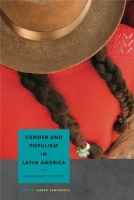




Gender and Populism in Latin America
Passionate Politics
Edited by Karen Kampwirth
“The case studies in this book offer a compelling and nuanced view of a multifaceted reality: populism is extremely difficult to grasp, both theoretically and empirically, and its complexity and ambiguity also apply to its gendered underpinnings. As the more general debate still unfolds as to whether Latin American populism is or has been a liberating or a controlling force toward the disfranchised masses, the same uncertainty prevails regarding its effects on women. Given the elusive nature of the topic itself, this book as a whole may raise more questions than it answers, but the editor and each of the individual contributors have done an outstanding job in giving the reader highly useful and intelligent insights into the role that gender plays in Latin American politics.”
- Description
- Reviews
- Bio
- Table of Contents
- Sample Chapters
- Subjects
Many have studied populist movements, for they offer fascinating insights into Latin American history and politics. But until now there have been no book-length studies of the relationship between gender and populism throughout the region. The essays in Gender and Populism in Latin America analyze the role of masculinity and femininity in the political careers of figures ranging from Evita Perón to Hugo Chávez, considering the relationships among populism, democracy, authoritarianism, and feminism in Argentina, Bolivia, Brazil, Ecuador, Mexico, Nicaragua, Peru, and Venezuela.
In addition to the editor, the contributors are Michael Conniff, Gioconda Espina, Sujatha Fernandes, Victoria González-Rivera, Karin Grammático, Jocelyn Olcott, Cathy A. Rakowski, Stéphanie Rousseau, Ximena Sosa-Buchholz, and Joel Wolfe. The Foreword is by Kurt Weyland.
“The case studies in this book offer a compelling and nuanced view of a multifaceted reality: populism is extremely difficult to grasp, both theoretically and empirically, and its complexity and ambiguity also apply to its gendered underpinnings. As the more general debate still unfolds as to whether Latin American populism is or has been a liberating or a controlling force toward the disfranchised masses, the same uncertainty prevails regarding its effects on women. Given the elusive nature of the topic itself, this book as a whole may raise more questions than it answers, but the editor and each of the individual contributors have done an outstanding job in giving the reader highly useful and intelligent insights into the role that gender plays in Latin American politics.”
“Karen Kampwirth has put together a fascinating and timely book that uses the lens of populism to compare patterns of women’s political mobilization and a gender perspective to explore the varieties of populism, both historical and contemporary. Insightful, provocative, and relevant.”
“This book offers a range of rich case studies on an array of populist leaders and experiences. More significantly, it illustrates how populism is gendered and how it promotes different, even contradictory, gendered practices. Drawing on examples from the early twentieth century to the present, and from Mexico to Argentina, it not only fills a gap in our understanding of populism but also sheds new light on the gendered politics and impact of major figures and events in modern Latin American history.”
“The vast literature on Latin American populism has long explored the relationships between populist leaders and diverse social groups defined largely by their class positions, but rarely has it analyzed the role of women in populist movements. Kampwirth's volume on gender and populism is a most welcome corrective to this oversight, and it sheds new light on the contradictory ways in which populist leaders—despite their macho tendencies—sometimes provide new legal rights, social benefits, or political opportunities for women. Readers of this volume will be introduced to a dimension of the populist experience that has for too long remained in the shadows.”
“Politics and society in Latin America cannot be understood without comprehending the power of populism. Combining fine-grained, historically rich analysis with powerful feminist scholarship, this superb volume explores the ways that populism and gender politics have been intertwined. Every essay is innovative, controversial, and highly persuasive.”
Karen Kampwirth is Professor of Political Science and Chair of the Latin American Studies Program at Knox College. Her two previous books with Penn State Press are Women and Guerrilla Movements: Nicaragua, El Salvador, Chiapas, Cuba (2003) and, co-edited with Victoria González, Radical Women in Latin America: Left and Right (2001).
Contents
Foreword
Kurt Weyland
Acknowledgments
Introduction
Karen Kampwirth
1 The Politics of Opportunity: Mexican Populism Under Lázaro Cárdenas and Luis Echeverría
Jocelyn Olcott
2 Changing Images of Male and Female in Ecuador: José María Velasco Ibarra and Abdalá Bucaram
Ximena Sosa-Buchholz
3 Gender, Clientelistic Populism, and Memory: Somocista and Neo-Somocista Women’s Narratives in Liberal Nicaragua
Victoria González-Rivera
4 From Working Mothers to Housewives: Gender and Brazilian Populism from Getúlio Vargas to Juscelino Kubitschek
Joel Wolfe
5 Women and Populism in Brazil
Michael Conniff
6 Populist Continuities in “Revolutionary” Peronism? A Comparative Analysis of the Gender Discourses of the First Peronism (1946–1955) and the Montoneros
Karin Grammático
7 Populism from Above, Populism from Below: Gender Politics Under Alberto Fujimori and Evo Morales
Stéphanie Rousseau
8 Populism and the Feminist Challenge in Nicaragua: The Return of Daniel Ortega
Karen Kampwirth
9 Waking Women Up? Hugo Chávez, Populism, and Venezuela’s “Popular” Women
Gioconda Espina and Cathy A. Rakowski
10 Gender, Popular Participation, and the State in Chávez’s Venezuela
Sujatha Fernandes
A Few Concluding Thoughts
Karen Kampwirth
Notes on Contributors
Index
Introduction
Karen Kampwirth
How can you—they would say to me—direct a feminist movement if you are fanatically in love with the cause of a man? Isn’t that a way of recognizing the total superiority of a man over a woman? Isn’t that contradictory?
No, it is not. I “felt” it. Now I know it.
The true, the logical, the reasonable point is that feminism comes out of the very nature of women. And what is natural for a woman is to give of herself, to give herself up for love, that in this giving up is found her glory, her salvation, her eternity. . . . I believe that Perón and his cause are sufficiently great and dignified as to receive all that the feminist movement offers to my Fatherland.
—Eva Perón (1951/2004, 34)
Every day the whole women’s movement takes on a form that is clearer, stronger, more committed and more beautiful, of course, for everything that a woman touches and sees becomes beautiful, that is true, it is even true for us, the ugly ones, they even see us as handsome. . . . An infinite kiss for all Venezuelan women! And my heart and soul, recognition, affection, and strength so that you continue carrying out the historic work of re-seeding, of reconstructing, the great woman who is Venezuela.
—Hugo Chávez (2004, 6, 12)
Populist politics has always been about passion. It has been passionate in the romantic sense, as is clear in the words of Evita Perón and Hugo Chávez. It has been passionate in the sense of strongly emotional, the politics of personal charisma rather than the politics of abstract policy. And it has been passionate in generating strong feelings of love for the people, and hatred for those who are defined as outsiders. As populist politics is the politics of personality, it has always been about gender, about particular models of masculinity and femininity.
The new wave of populist politics in Latin America has led to a flurry of analysis of the latest populists as well as a renewed interest in the populists of the classic period. But this work has rarely consciously analyzed populism from a gender perspective. Such analysis is long overdue.
My goal in introducing this book is not to offer a new definition of populism. Many insightful definitions of Latin American populism have already been written; that wheel does not need reinventing. A comprehensive definition was offered by Kenneth Roberts, who argues that populist movements are characterized by “five core properties”:
1. a personalistic and paternalistic, though not necessarily charismatic, pattern of political leadership
2. a heterogeneous, multiclass political coalition concentrated in subaltern sectors of society
3. a top-down process of political mobilization that either bypasses institutionalized forms of mediation or subordinates them to more direct linkages between the leader and the masses
4. an amorphous or eclectic ideology, characterized by a discourse that exalts subaltern sectors or is antielitist and/or antiestablishment
5. an economic project that uses widespread redistributive or clientelistic methods to create a material foundation for popular-sector support. (Roberts 1995, 88)
Although it does not explicitly refer to the highly gendered nature of populism, Roberts’s definition can certainly be read that way, considering its attention to personalistic and paternalistic leadership, and to the subaltern nature of populist coalitions. In this introduction, I consider what has already been written on the complicated role that gender plays in Latin American populism and present the five themes that inform the chapters in this book. The idea is to provide an overview of the populist experience in twentieth- and twenty-first-century Latin America, and a context in which to understand the chapters that follow.
First Theme: Gender and the Waves of Populism
In the literature on populism in Latin America, a distinction is generally made between two waves: classic populism (roughly from the 1930s to the 1960s) and neopopulism (roughly from the 1980s to the present). In the early twentieth century, political movements that became known as classic populist movements emerged in a number of Latin American countries, including those led by Arnulfo Arias in Panama, Lázaro Cárdenas in Mexico, José Figueres in Costa Rica, Jorge Gaitán in Colombia, Victor Raúl Haya de la Torre and Luis Sánchez Cerro in Peru, Juan and Eva Perón in Argentina, Anastasio Somoza García in Nicaragua, Getúlio Vargas in Brazil, and José María Velasco Ibarra in Ecuador. These movements responded to a series of socioeconomic changes.
Urbanization, driven by immigration from the countryside or from other countries, created new groups of unaffiliated people who were available for political mobilization. Organization was easier in the city, both because people lived and worked closer together and because poor urban dwellers did not tend to be under the political control of local economic elites, as was the case for poor people in the countryside. While earlier politicians had to generate followers through political parties and networks of local strongmen, the politicians of the populist era used newly available technologies like radio and television to create direct personal ties between leaders and their followers. At the same time, industrialization and the opening of new markets gave clever politicians the resources to provide those new groups with services (Conniff 1999, 7–10). “That these expanded government services also opened many jobs for the middle classes was a happy bonus to populist leaders. . . . Millions were made beholden to those who dispensed the benefits from the top down” (Wirth 1982, x–xi).
In many cases, the people who provided expanded governmental services were women. This was certainly true for services in areas that extended traditional female roles, such as education, health care, and the provision of food (Milanesio 2006; Navarro 2005; Plotkin 2003). And these new government jobs often went to women, who were not able to get private-sector employment because of discrimination and who were grateful to the populist leader for these opportunities (González 2001).
In addition to the new, expanded services that were provided to, and often by, women, the most direct way that many populists incorporated women into the body politic was through the vote. Many of the classic populists—Arnulfo Arias, José Figueres, Juan and Eva Perón, Anastasio Somoza García, Getúlio Vargas—gave women the right to vote (or at least took credit for it). Many others, like Lázaro Cárdenas and Jorge Gaitán, actively campaigned for women’s suffrage.
Lola Luna argues that these two ways in which the classic populists interacted with women—expanding their political rights and providing them with new social services—were intimately linked. Women’s suffrage and other forms of political participation were justified in terms of the social exclusion of maternalism, an ideology in which women are politicized around traditional female roles (Luna 2000, 200; see also French and James 1997, 15; Molyneux 2001, 170–71).
The classic populists were not gender radicals. As they extended political rights and opened new educational and employment opportunities to women, they took care to justify these rights in terms of an essentialist notion of women’s roles as mothers and even, at least in the case of Peronism, beauty queens (Crespo 2005; Lobato et al. 2005; Plotkin 2003, 70, 73–74, 79). Through their new public roles, women would make the public sphere more moral and more beautiful.
Though the populists were often successful in building strong political movements and incorporating previously excluded groups, many thought that the age of populism had reached its end by about the midpoint of the twentieth century. “Certainly, by the late 1950s, [populism] was losing the capacity to deliver more goods and services to more people. . . . Expanding the social benefits could only be sustained by rapid economic growth, which slowed. . . . Concurrently, swelling electorates rendered the Latin American state less able to insulate itself from populist pressures for redistribution. Control of the masses, always fundamental to the success of populist politics, was now in doubt” (Wirth 1982, xi).
With the triumph of the Cuban Revolution in 1959, Latin American politics entered a new, more radical phase. Although this new phase had many causes, one of them was that left-wing political activists believed that the populists had mobilized too little and provided too little social justice. Radical leftists responded with a series of guerrilla movements in most Latin American countries, although the only ones to seize power were the Sandinistas of Nicaragua. Right-wing activists, by contrast, feared that populists and leftists had mobilized the masses too successfully and had promised too much social justice. They responded with a series of brutal military dictatorships.
In the 1980s and 1990s most of the region returned to democracy, and most of the guerrilla movements were defeated or transformed into political parties. Populism also returned, but this time it was dramatically different from the populism of the classic era. The neopopulists, as they were called, no longer had the resources generated by inward-looking industrial growth, a strategy known as import-substitution industrialization (or ISI), that their classic counterparts had used to cobble together coalitions. Quite the opposite: Following the 1982 debt crisis, the dominant economic strategy of the late twentieth century—known as neoliberalism—required that politicians slash spending on basic social services and open markets to the outside world so as to be able to pay off their international debt. The antiunion politics of neoliberalism undermined one of the groups that had formed the base of many a classic populist coalition.
These did not seem to be promising times for populism. And yet populism is a form of politics that tends to respond to crises, and the crisis of neoliberalism provided an opportunity for politicians who presented themselves as personalistic, antielite, antiestablishment outsiders. The great irony is that these neopopulists—leaders such as Arnoldo Alemán of Nicaragua, Abdalá Bucaram of Ecuador, Fernando de Collor of Brazil, Alberto Fujimori of Peru, Carlos Menem of Argentina, and Carlos Salinas de Gortari of Mexico—responded to the crises generated by neoliberalism by promoting neoliberal policies, although they did target some services to the poorest of the poor (de la Torre 2000, 81–82; Knight 1998, 223; Roberts 2007, 4–5; Weyland 1999).
The gender politics of the neopopulists tended to be more complicated than those of the classic populists because the world had changed. Classic populists acted during the first wave of feminism, which emphasized expanding women’s access to education and legal rights (especially the vote). And so it was relatively easy for them to meet feminist demands by opening schools and changing laws.
In contrast, the neopopulists confronted the second wave of feminism, a movement that retained the commitment to legal and public rights but embraced a more complicated view of gender equality, addressing a range of “personal” political issues, among them domestic violence, sexuality, and reproductive rights. In this they shared much in common with second-wave feminists in the North. And yet the greater poverty and inequality in Latin America, compared to the United States and Europe, and the legacy of women’s (sometimes armed) mobilizing against the state gave a particular character to Latin American feminism. Neopopulists often found themselves confronting a highly organized and combative movement that was not as easily co-opted as the first wave had been (González and Kampwirth 2001, 11–21; Molyneux 2001).
Some neopopulists addressed the challenges of second-wave feminism by attacking feminist leaders. Arnoldo Alemán, for example, portrayed feminists within the nongovernmental organizations as elites who were not truly Nicaraguan, and blamed them for failing to eliminate Nicaragua’s poverty (Kampwirth 2003). Others, like Alberto Fujimori, sought to incorporate second-wave feminists through a variety of means, including electoral gender quotas, the appointment of women to cabinet positions, expanded access to contraception, and state services for victims of domestic violence. Although he addressed many of the second-wave feminists’ historic demands, Fujimori failed to incorporate Peruvian feminists into his coalition. The problem was that the feminist movement was strongly committed to national democracy and respect for movement autonomy, both areas in which the Fujimori government had problems, to say the least (Schmidt 2006; Rousseau 2006).
Another factor that shaped the gender policies of the classic and neopopulist periods was the change in the nature of the region’s political economy. Thanks to revenues generated through import-substitution industrialization, the classic populists had some resources to offer their followers, including women. Neopopulists, in an era of crushing debt and neoliberal policies, have found it harder to incorporate women into their coalitions through jobs and other material resources. While the politics of personality complemented the politics of patronage for the classic populists, in the neoliberal age personality politics increasingly is offered as a substitute for patronage politics. Of course, such a substitute may work only temporarily. Witness the neopopulist Abdalá Bucaram, who was thrown out of office a mere six months after his election. “Serial populism” (Roberts 2007, 12) has become the norm in many countries, as voters seek the salvation of new personalities, who almost inevitably disappoint, as they lack the resources to fulfill their promises.
From the perspective of the early twenty-first century, it is clear that the age of classic populism is over, but is the age of neopopulism also over? Certainly the latest populists differ in significant ways from those who governed in the 1980s and 1990s. The neopopulists have all implemented neoliberal policies (though some of them campaigned on anti-neoliberal platforms). In contrast, the latest wave of populists—including Hugo Chávez of Venezuela, Rafael Correa of Ecuador, Fernando Lugo of Paraguay, Evo Morales of Bolivia, and Daniel Ortega of Nicaragua—reject neoliberalism.
So what do we call them? One obvious term for the stage after neopopulism, neo-neopopulism, is aesthetically displeasing. All of these anti-neoliberal populists are considered part of the pink tide in Latin America, so perhaps that makes them pink populists? Or should we consider returning to the language of populism without adjectives when thinking about them? But that may just cause more confusion. Certainly, contemporary populists are not the same as their classic predecessors: They face different challenges and therefore must govern differently.
In our chapters on Hugo Chávez and Daniel Ortega, respectively, Sujatha Fernandes and I suggest that this brand of populism might be thought of as revolutionary populism, though we both use that term with caution. Arguably, revolution (a concept that is both collective and transformative) and populism (a concept that is individualistic—focused on one leader—and typically reformist) are inherently incompatible. Or, if they are not incompatible, at least they must exist in tension. Moreover, the term “revolutionary populism” does not travel well across the region. In fact, Ortega is the only member of the third wave who originally came to power through a revolution (as one of the leaders of the guerrilla movement that overthrew the dictatorship of Anastasio Somoza Debayle in 1979), and even Ortega has long since given up his guerrilla ways for electoral politics.
In his foreword, Kurt Weyland refers to this third wave of populism as radical populism. Hugo Chávez himself has referred to his style of politics as “radical populism,” as Gioconda Espina and Cathy Rakowski note in their contribution to this volume. Though Chávez did not explain why he called his movement “radical populism,” Espina and Rakowski argue that Chavismo needs to be understood as something distinct from both classic populism and neopopulism. While no term is perfect, “radical populism” is probably the best choice for labeling this third wave of Latin American populism. On the one hand, it seems that radical populists would like to return to the redistributive days of the classic era (though, with the exception of Chávez, they lack the resources to do so). On the other hand, they face far larger electorates, and more powerful international institutions, than the classic populists faced. So, both domestically and internationally, they must address louder demands, and those demands are often mutually exclusive.
Will the radical populists find the funds to buck the neoliberal trend, providing new services to the citizens of their countries, or at least to their own followers? To the extent that they can do so, they may succeed in incorporating more women, including poor women, and maybe even including feminists. Or will they yield to populist temptation, governing by skirting the rule of law and concentrating power in their own hands? They could thus empower certain women, at the same time that they exclude others and polarize their citizenries. What sort of models of masculinity help these politicians meet the challenges of governing in the twenty-first century? And what are the benefits and costs of those choices for themselves and their societies? The chapters in this volume on radical populism in Bolivia, Nicaragua, and Venezuela suggest some answers to these questions (see the essays by Espina and Rakowski, Fernandes, Kampwirth, and Rousseau).
Second Theme: Masculinity, Femininity, and Populist Leadership
The populist movement that has been most analyzed in terms of gender is Peronism, no doubt because it is the only national-level populist movement in which a woman played such a prominent role. Though she never held elected office—and did not even have the right to vote until shortly before her death at the age of thirty-three—Evita Perón was one of the most powerful women in Latin American history. Her husband, Juan Domingo Perón, built an extremely successful populist movement in Argentina in the 1940s and 1950s on the foundation of male-dominated union support. “He also recognized that women, still without the vote and making up a substantial section of the labor force, were an untapped political resource” (Fisher 2000, 323).
Marysa Navarro has argued that without Eva Juan Perón’s charismatic authority would have become routinized and less effective after he was elected president in 1946. By delegating responsibility for the Ministry of Labor to his wife (who eventually also oversaw the Partido Peronista Femenino and the Eva Perón Foundation), “he gave her the legitimacy she needed to be accepted by the descamisados, transferred to her part of his leadership, and in so doing prevented its ‘routinization’” (1982, 55). Evita turned out to be very effective in cutting through red tape and providing new services; for example, from the offices of the Eva Perón Foundation, “she subsidized vacations of descamisados, gave them funds for their union headquarters, and built luxurious hospitals, modern clinics, low cost housing projects, and elegant hotels for them” (57). As a result, she became a powerful leader in her own right, although, as Perón’s wife, she presented no threat to his leadership. Just in case, she always emphasized in her speeches that she was nothing and he everything.
Using a language that was extracted from the soap operas, she transformed politics into dramas dominated by relentless invocations of love . . . the love that united Perón, Evita, and the descamisados was the cause of the oligarchy’s hatred towards them. Her scenarios never changed and her characters were stereotyped by the same adjectives: Perón was always “glorious,” the people “marvelous,” the oligarchy egoista y vendepatria (selfish and corrupt), and she was a “humble” or “weak” woman, “burning her life for them” so that social justice could be achieved, cueste lo que cueste y caiga quien caiga (at whatever cost and regardless of the consequences). (Navarro 1982, 59)
Ordinary Argentines reacted strongly to Evita’s words and deeds. During her lifetime she was portrayed both as the “Lady of Hope,” a saintly figure akin to the Virgin Mary, and as the woman of the “Black Myth,” a woman who could do no good. Decades after her death, a third myth emerged, that of Evita the revolutionary. Without much evidence, the Montonero guerrillas of the 1970s proclaimed, “Si Evita viviera, sería montonera” (If Evita were alive, she would be a Montonera, i.e., an armed revolutionary), and insisted that they were the truest heirs to the Peronist tradition (Taylor 1979).
Evita is a critical figure. In fact, the joint leadership of Juan and Eva Perón is often considered the paradigmatic example of populism in the region. But Evita is not the only populist leader who may usefully be analyzed in gendered terms or the only populist to passionately declare love for the people. Her husband explained, “I want to tell the Argentine people that I do not wish to govern based on any other bond . . . than the union that is born from our hearts. I do not wish to rule over men, but over their hearts, because mine beats together with that of each descamisado, whom I understand and love above all things” (quoted in Plotkin 2003, 64). Luis Sánchez Cerro also spoke of his strong feelings for the people: “I love the masses with gratitude and conviction” (quoted in Stein 1980, 107). Abdalá Bucaram “always spoke about love: he loved el pueblo, he loved the poor, he loved Ecuador. The only ones he did not love were the oligarchy, who were excluded from the ‘real’ Ecuador, personified by Abdalá Bucaram” (de la Torre 2000, 95).
By projecting a variety of masculine images, the populists seem to suggest that larger-than-life figures like themselves are uniquely suited to attacking elites, to uniting the true people against outsiders, to embodying the nation. These masculine images have included populists as ladies’ men, often surrounded with scantily dressed dancers (Abdalá Bucaram, Hugo Chávez, Alberto Fujimori, Carlos Menem, Daniel Ortega). That model of masculinity sometimes shades into the populist as vulgar man. For example, at a rally celebrating the anniversary of the end of the Pérez Jiménez dictatorship, Hugo Chávez commented on U.S. Secretary of State Condoleezza Rice’s criticisms of his government.
First, a few days ago, she said she was very bothered by Chávez, the tyrant Chávez, the strongman who is a threat to the people of the world and of America. Later, the next day, she brought it up again; it seems that she dreams about me. . . . Look, even though as the secretary of state of that imperialist government, Dr. Alí Rodríguez would be the one to meet with her, I am willing to invite her to a meeting to see, what is the thing you have for me? Let’s see if we can arrange something. [Applause.] Do you want me to invite her? I will do whatever you tell me. A little while ago somebody suggested, “Look, why don’t you ask her to marry you?” [Audience: Nooooo!] That lady has very bad luck. You said no. (Chávez 2005)
Periodically throughout the speech, Chávez returned to the theme: “That’s why I say that I can’t marry Condolencia; because I have a lot of work to do, she’ll have to look elsewhere, to try to forget about me a little. [Pointing to others on the stage] Alí Rodríguez, he could do it, Cristóbal Jiménez is right there, he’s available, Juan Barreto is single; let someone else make this sacrifice for the fatherland” (11).
Abdalá Bucaram was also known for his vulgarity, as when he praised Ecuador-born Lorena Bobbitt, famous for cutting off the penis of her American husband, John Wayne Bobbitt. Bucaram invited Lorena Bobbitt, who had been acquitted of her crime on the grounds that she acted in self-defense, to the Congress, where he declared her a national hero for having “cut off neocolonial relations” (quoted in Lind 2005, 113). As with Chávez’s comments about Condoleezza Rice, vulgar jokes became a way of symbolically defending Latin American countries against the much more powerful United States.
Other models of masculinity that populists have drawn upon include the athlete (Abdalá Bucaram, Fernando de Collor), the military man (Lázaro Cárdenas, Hugo Chávez, Daniel Ortega, Juan Perón), and, perhaps most commonly in a region that is predominantly Catholic, the priest, or even as Jesus Christ himself. In one speech, Luis Sánchez Cerro told the crowds, “there is no effort, no sacrifice of which I am not capable. . . . Every morning when I awaken, I renew my vows, before the altar of the fatherland, to carry on my duties as ruler with the purity of the priesthood” (quoted in Stein 1980, 107).
The APRA movement, founded by Sánchez Cerro’s competitor, Victor Raúl Haya de la Torre, drew on similar traditions. “The repression of the original student-worker front induced the likening of the movement to a persecuted sect with an evolution akin to that of early Christianity” (Stein 1980, 176–77). “Numerous party tracts [were] filled with comparisons of Christ’s suffering with that of Haya de la Torre” (265n42). Like many of the populists, Victor Raul Haya de la Torre suffered long periods in prison or in exile, only to rise from the political dead. “With his exile in 1923 the legend of the eternally persecuted Haya was born. . . . Terms like apostle, mission, crusade, and faith proliferated in public references to Haya during his exile and later set the tone for much of Apra’s 1931 campaign rhetoric” (145–46).
Loyalty Day celebrated the founding myth of Peronism, Juan Domingo Perón’s release from imprisonment on Martin García Island on October 17, 1945, in response to pressure from his supporters, many of whom had gathered in Buenos Aires’s Plaza de Mayo. Over time, the Peronist government framed this event in increasingly religious terms. “Peronism needed ‘apostles’ to ‘preach’ its doctrine. . . . [The Peronist newspaper] Democracia characterized the Seventeenth of October as a ‘lay Mass’ and kept repeating that ‘God is a Peronist’” (Plotkin 2003, 79).
In another variation on the theme of the leader suffering for his people, one newspaper wrote of José María Velasco Ibarra’s political death and later return: “President elected by the popular Ecuadorian vote drowned in the blood of the martyrs of 12 January 1940, and resurrected in the blood of the martyrs of 29 May 1944” (quoted in de la Torre 2000, 53). By late in the twentieth century, Protestantism had become a major religious movement in Ecuador and many other Latin American countries, and so Abdalá Bucaram “used religious elements of popular culture, especially of the Protestant sects, to present himself as a new Christ, the new messiah who would redeem the people from their suffering” (109).
Redemption and images of the populist as savior were not always restricted to religious populists. For Lázaro Cárdenas, carrying out the agenda of the Mexican Revolution required wresting political power from the hands of the Catholic Church and turning Mexico into a secular republic. Yet many saw him in almost religious terms. “In this myth, Cárdenas is styled as something of a latter-day Jesus, a redeemer who traveled from village to village performing wonders. . . . Most spectacularly, while Cárdenas multiplied no loaves or fishes, he divided large estates into peasant plots. In response campesinos crowded around to pay homage to him and his government” (Becker 1994, 248).
But of the various masculine models that the populists have drawn upon, the most frequently invoked is that of the father. According to Michael Conniff, “virtually all populists assumed roles as paternal figures to their followers” (1999, 199). Similarly, Steve Stein notes that these movements “derived their real cement from the presence of a strong leader with whom people could identify above all in emotional terms. . . . He was perceived as a generous father figure who could capably direct the political affairs of his less sophisticated children” (1980, 11).
Haya de la Torre was known for patting and hugging his supporters, and his “predilection for physical expression became an integral part of his paternalistic style” (Stein 1980, 181). Juan Perón’s calm, “fatherly” tone has been contrasted with his wife’s “passion and fury” (Navarro 1982, 58). Getúlio Vargas called himself the “father of the poor,” though some have noted that he was really more grandfatherly (Conniff 1999, 49; Wolfe 1994, 81). Lázaro Cárdenas was called “‘Tata Lázaro,’ or Father Lázaro” by indigenous people in the Mexican state of Michoacán (Basurto 1999, 76). And the supporters of Jorge Gaitán were known to chant, “‘Guste o no le guste, cuadre o no le cuadre, Gaitán sera su padre’ (like it or not, agree or not, Gaitán shall be your father)” (quoted in de la Torre 2000, 20).
Third Theme: Gender, Populism, and Democracy
Populists have had an uneasy relationship with democracy, and the father metaphor is at the root of some of those difficulties. In some ways, the politician as father is a compelling metaphor. Stereotypically, to be a father is to be wise, brave, strong, responsible, protective. These are certainly characteristics most people seek in a leader. And yet fatherhood entails other characteristics as well.
Most disturbingly for democratic politics, the father metaphor turns citizens into children. It turns the politician into someone who understands the interests of the citizens—even when they do not—and who may punish wayward children who fail to recognize his wisdom. Of course, fathers are fathers for life and cannot be voted out of office. Many of the populists seem to have seen their own jobs as lifetime commitments: rewriting constitutions, shutting down other branches of government or packing the courts, seeking military backing so as to continue their good works. For a father’s work is never done.
Yet in speaking to the previously excluded, who often include women, especially poor women, populism may be profoundly democratic. After all, if they fail to incorporate all sectors of society, democratic procedures result in a very thin democracy. At the same time, however, incorporation of the excluded can happen in the absence of democratic procedures. Populists have sometimes used the democratic process to concentrate power in their own hands. Indeed, in some cases, populism has developed in the context of authoritarianism.
Opponents of particular populist leaders often blame the populist movements themselves for the weakness of democracy in their countries. This is sometimes the case: “popular activation occurs through movements that acritically identify with charismatic leaders, who are often authoritarian. Moreover, the Manichaean populist discourse that divides society into two antagonistic fields does not permit the recognition of the opposition” (de la Torre 2000, 26–27). Yet one could just as reasonably argue that populism is a symptom of the weakness of democracy in Latin America, not its cause. “The poor whose rights are specified in constitutions and laws, do not have the power to exercise those laws,” writes de la Torre. “They have to rely on protectors who can help them to take advantage of their rights and who can defend them from the arbitrariness of the police and the powerful. Politicians who have become such guardians have organized clientelist networks that have allowed their followers limited access to goods and services, not as rights but as concessions to interest groups” (xi–xii).
These clientelistic political traditions are a response to inequality, and Latin America is the most unequal region in the world. In a reciprocal fashion, populist movements, which emerge in response to limited citizenship rights, also contribute to the weakness of democracy. For all these reasons it is likely that Latin America will remain the region that is most characterized by populist politics (Conniff 1982, 22–23; Drake 1982, 224–26, 241; Roberts 2007, 9–11; Wolfe 1994, 87).
Fourth Theme: Populism and Feminism
Populists have not always enjoyed good relations with organized feminists, sometimes not even when they have promoted feminist issues. Lola Luna (2000) notes that while Colombian feminists supported Jorge Gaitán because he promoted women’s suffrage, Argentine feminists disliked Juan Perón because he stole the issue they had worked on for decades—women’s right to vote—and took credit for it (or, more precisely, Evita took credit for it). Clearly, the way in which each politician supported the feminist demand for women’s suffrage mattered as much as suffrage itself.
As I noted above, relations between populist leaders and organized feminists have only become more difficult over time. In some cases, as in the movements led by Arnoldo Alemán, Daniel Ortega, and Alberto Fujimori, feminists were almost entirely opposed to populist figures. In Hugo Chávez’s Venezuela, organized feminists are about evenly divided between strongly pro-Chávez and strongly anti-Chávez activists (Gioconda Espina, personal communication, January 2005; see also Rakowski and Espina 2006, 320–25).
In some ways, the frequency with which populists have clashed with feminists is surprising. Populism is potentially a deeply feminist movement, in that women are typically the most excluded of the excluded. But populism is a style of politics that tends to scapegoat elites or constructed elites. All too often feminists are portrayed as overly educated intellectuals who fail to fit into the mainstream of real women, in short, as elites. And even if they are not scapegoated, feminists may have reason to worry about the cult of (male) personality that has been inherent in populist movements since Evita. Whether they find populist movements to be full of opportunity or full of threat depends to a large extent on the nature of the feminists’ demands. Within Latin America, as elsewhere, there are many versions of feminism, and some are more compatible with populism than others.
Fifth Theme: Women as Populist Followers
An important but understudied theme in the literature on populism is the nature of populist followership. This issue has been neglected in part because it is easier to focus on a single leader than to study followers who may number in the millions. And evaluating the relationship between followers and leader is tricky. “The main challenge in the study of populism lies in explaining the appeal of leaders for their followers, without reducing the latter’s behavior to either manipulation or irrational and anomic action or to a utilitarian rationalism, which supposedly explains everything” (de la Torre 2000, 1).
Keeping our eyes open to what de la Torre calls “the complexities of populist seductions” (ix) complicates our job as students of populism, though it also makes it more interesting. Many, perhaps all, of the Latin American populists reached out to women directly. Certainly they did this because they wanted women’s votes, and sometimes that strategy worked very well. Juan Perón was reelected in 1951 with “a much higher percentage of votes from women than from men” (Horowitz 1999, 36). The same was true of Getúlio Vargas: “Vargas enjoyed a substantial lead in preferences among women” (Conniff 1999, 49). Similarly, opinion polls in 2000 showed that Alberto Fujimori enjoyed much more support from women than from men (Schmidt 2006, 164). But there are no systematic studies comparing the gender breakdown of votes for populist leaders. So it is not clear that women were generally more supportive of populist politicians than men were, or whether men were sometimes more supportive. In a survey leading up to the referendum to recall Hugo Chávez, men were somewhat more likely to oppose the recall than were women; the majority of women supported Chávez, just not proportionally as strongly as men did (Hellinger 2005, 21).
In addition to seeking votes, populists had other reasons to reach out to women. They often sought to mobilize female followers because, owing to their position in the gendered division of labor, they could do certain things that men could not. Mariano Ben Plotkin notes that the Peronist “government not only tried to gain the support of women as voters but also as potential ‘missionaries’ who would spread the Peronist word in the privacy of their homes. . . . Women and children would serve as a link between the Peronist state and the family” (2003, xii, also 178). Missionaries are outsiders, in this case outsiders to the world of politics. Their outsider status makes them uniquely qualified to spread the good news of a transformed world. And long after Juan and Eva Perón were dead, their female followers continued to embrace the role of missionary.
In his analysis of contemporary grassroots Peronism, Javier Auyero follows Peronist brokers who oversee soup kitchens, monthly food distribution, free haircuts, and a long list of other benefits that help explain why the Peronist party is still the most powerful political party in Argentina. But their relationship with Peronism is not limited to distributing goods. Auyero argues that with their bleached blond hair, their familiar manner with the recipients of their largesse, even their Evita wristwatches, they “perform Evita” (2000, 140). This performance is not just for outside consumption. Just as important, they perform Evita for themselves, for in asking themselves What would Evita do? and then acting on that answer, they make sense of their lives. Auyero summarizes the stories these followers of Evita tell.
Their work is more to them than just a job; it is a vocation, a mission fueled by a compassion for the poor that was recognized early in life. Their birth coincided with Peronism, and their political careers are closely tied to that of the mayor [a Peronist]. They have a special relationship with the poor—in terms of mutual obligations, in terms of the love they feel for them—that keeps at bay bureaucratic indifference. Their work is motivated by a “passion for the people.” They are willing to sacrifice all and work themselves to exhaustion on behalf of the poor. . . . Their work is not a job but something that comes naturally to them, because they are self-sacrificing and hardworking, they are the mothers of the poor. (127)
The language with which these women discuss their work echoes the discourse of contemporary party leaders as well as Evita’s words from decades earlier.
But this does not necessarily mean that they are manipulated. Joel Wolfe notes that the relationship between leader and follower is a complicated one. “Scholars often assume that workers . . . entered into a ‘populist coalition’ with Vargas. But, when these workers considered Vargas and other politicians, they did so skeptically. . . . Urban workers and rural proletarians have not necessarily been coopted by populism” (1994, 82). Many workers wrote Vargas directly to try to negotiate solutions to their personal problems, problems they often framed in gender terms.
One man noted that an industrial accident kept him from heavy work, and he asked Vargas for permission to sell popcorn on the street, explaining, “I am a man and I am ashamed of not working” (quoted in Wolfe 1994, 98). Another man complained that he felt “humiliated” by the way he was treated at General Motors do Brasil (95). One woman complained to Vargas that her boss made “improper proposals [that were] inconceivable for a poor girl, who is in fact honorable and moral” (96). When she refused his propositions, he cut her pay, a fact that she documented in her letter to Vargas. At least some of these direct appeals to Vargas got results: Vargas ordered an investigation of the allegation of sexual harassment, though the woman eventually lost the case. In response to other complaints, “Vargas eliminated the discount in the minimum wage paid to women” (96).
Women provided Lázaro Cárdenas with unique political resources as well, despite the fact that Mexican women did not yet have the right to vote when Cárdenas was in office. “[The Cardenistas’] plan was to reconstruct the countryside through a combination of land redistribution and cultural transformation. . . . In addition, the revolutionaries planned to recast peasant culture, the peasants’ way of seeing the world. . . . Rural teachers and agricultural agents who identified with Cardenismo would sport varying faces of liberalism” (Becker 1994, 257). This was an ambitious plan, to say the least.
Land reform is always difficult, as few big landowners willingly accept it. But the greater threat came from the Catholic Church, which organized armed resistance to the government (known as the Cristero Rebellion), told parishioners that beneficiaries of land reform would go to hell, and threatened to excommunicate those who sent their children to the Cardenista schools (Becker 1994, 257). Mobilizing women behind Cárdenas’s plan was critical, as women were seen as closer to the church than men. So the Cardenistas “established women’s leagues, in which women learned that Cárdenas championed their husbands’ (and by implication, their families’) rights to governmental land. In the leagues revolutionaries also discussed the evils of alcoholism” (258). But by far the most remarkable incident in which women were mobilized to support Cárdenas took place at a church in Michoacán.
Entering the church at night, male followers of Cárdenas stole the icons, including that of the Virgin. The next morning they burned the icons in the central square and “appropriated the church. They hired a band and issued invitations to their wives, daughters, and girlfriends. When the women entered the church it would have looked very different. The priest was gone. The image of the Virgin was missing. The band was playing popular contemporary music. And suddenly the women, too, were not quite the same. Their Catholic training, their lessons in humility began to recede, and the women, suddenly transformed, began to dance before the altar” (Becker 1994, 259–60). Needless to say, the burning of the Virgin and the women’s dance in the church shook the town. For in doing so they attacked the old hierarchies of daily life, and indeed their opponents responded with the most traditional gender slur—accusing the dancers of being prostitutes.
If populist followers are not always people out of place, the undermining of hierarchy and tradition is certainly a recurring theme. Poor Mexican women’s dancing at the altar echoed the Argentine working class’s seizing of the Plaza of Mayo to demand the return of their beloved Perón. Supposedly dressed improperly for a downtown gathering, some even waded in fountains. Many of the female workers who wrote Brazil’s Vargas also clearly felt out of place, for they had to defend their new roles as factory workers, roles that they insisted should not diminish their status as honorable women. In some sense populist followers are always out of place, as they are the previously excluded, people who for reasons of class or gender or ethnicity were not legitimate participants in national politics until the populist came along.
Hugo Chávez speaks to his followers in just these terms, asserting that those who used to be out of place—the poor and dark-skinned—are the true Venezuelans, and dismissing the old elites as the escúalidos, the squalid ones. Though these distinctions are oversimplifications, they speak to underlying truths about exclusion and inclusion, as the old elites did tend to be more middle-class and light-skinned than the average Venezuelan. It is equally true that under his administration thousands of previously excluded women, especially poor women, have become politically active.
Yet mobilizing is sometimes akin to joining a movie star’s fan club. Hugo Chávez encourages such movie star adoration, proclaiming in the epigraph to this introduction, “An infinite kiss for all Venezuelan women!” His followers often comment on how handsome he is and frequently adorn their workplaces and homes with his images, especially romantic images, such as the photo of Chávez holding a red rose. This does not mean that his female followers are simply manipulated, or that they are unconcerned with the material benefits to be had by supporting his movement. But it does mean that we cannot fully understand populism without paying attention to the emotional, and even passionate, nature of the relationship between leader and follower.
Also of Interest
Mailing List
Subscribe to our mailing list and be notified about new titles, journals and catalogs.