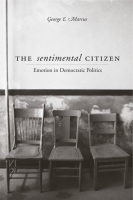




The Sentimental Citizen
Emotion in Democratic Politics
George E. Marcus
“George Marcus deserves thanks and praise for reminding us that emotional communication and arousal are the lifeblood of politics. Leaders who ignore the primacy of voters’ feelings are doomed to failure. Voters and political scientists who imagine that politics is a question of purely ‘rational choice’ are bound to be astonished by what actually happens. To gain a better understanding of how our emotions shape contemporary politics, this volume is must reading.”
- Media
- Description
- Reviews
- Bio
- Subjects
Winner of a 2003 Choice Award for an Outstanding Academic Title Winner of a 2003 AAUP Book, Jacket and Journal Show for Jacket Design.
Drawing on recent research in neuroscience, Marcus shows how emotion functions generally and what role it plays in politics. In contrast to the traditional view of emotion as a form of agitation associated with belief, neuroscience reveals it to be generated by brain systems that operate largely outside of awareness. Two of these systems, "disposition" and "surveillance," are especially important in enabling emotions to produce habits, which often serve a positive function in democratic societies. But anxiety, also a preconscious emotion, is crucial to democratic politics as well because it can inhibit or disable habits and thus clear a space for the conscious use of reason and deliberation. If we acknowledge how emotion facilitates reason and is "cooperatively entangled" with it, Marcus concludes, then we should recognize sentimental citizens as the only citizens really capable of exercising political judgment and of putting their decisions into action.
“George Marcus deserves thanks and praise for reminding us that emotional communication and arousal are the lifeblood of politics. Leaders who ignore the primacy of voters’ feelings are doomed to failure. Voters and political scientists who imagine that politics is a question of purely ‘rational choice’ are bound to be astonished by what actually happens. To gain a better understanding of how our emotions shape contemporary politics, this volume is must reading.”
“Why use a neuro-scientific account to explain something as contextual and multifaceted as political judgment? As Marcus persuasively argues, doing so allows us to examine the domain of perceptual existence that isn't fully conscious, yet is present in a way that meaningfully influences our thinking and our actions. His analysis of what this means for democratic politics is careful and intriguing. This nuanced account of how preconscious emotions play a role in creating and sustaining the conditions for reason should be read by all political scientists skeptical of citizen judgment.”
“This book is a must-read for all involved in the study of human political behavior.”
“This last point may serve to illuminate one of the greatest strengths of this book, namely, that The Sentimental Citizen offers us a powerful-indeed nearly irresistible-metaphor for who and what we are.
Indeed Marcus’s book can be seen as engaging in some elegant rhetorical maneuvers: it is not only a straightforward statement of a neuroscientific thesis: its action upon the reader illustrates the author’s own proposition. That is, the reader becomes, like the mind described in the book, a helpless witness to the emotional systems that surround him or her.”
George E. Marcus is Professor of Political Science at Williams College.
Also of Interest

Mailing List
Subscribe to our mailing list and be notified about new titles, journals and catalogs.