


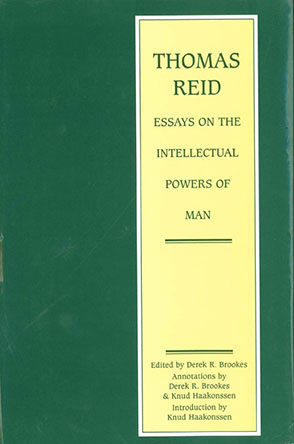
Thomas Reid: Essays on the Intellectual Power of Man
A Critical Edition
Edited by Derek Brookes, and Introduction by Knud Haakonssen
Thomas Reid: Essays on the Intellectual Power of Man
A Critical Edition
Edited by Derek Brookes, and Introduction by Knud Haakonssen
“Derek R. Brookes’ new annotated edition of Reid’s Essays on the Intellectual Powers of Man is, therefore, both timely and welcome.”
- Description
- Reviews
- Bio
- Table of Contents
- Sample Chapters
- Subjects
Reid's Common Sense philosophy responds to these problems by suggesting that skeptics such as Hume unavoidably affirm what they purport to deny—namely, the existence of a stable external world, of other minds, of the continuity of their own minds, and of their own and other people's ability to ascribe and accept responsibility for actions. We can understand all of these things by proper empirical observation and philosophical analysis of the activity of the mind. Reid's major positive contribution to philosophy is a detailed account of the various innate powers of the mind. This is the only properly established text. It is accompanied by Reid's manuscript lectures on the nature and immortality of the soul as well as helpful editorial annotations and an introduction, making it useful to a wide variety of readers.
“Derek R. Brookes’ new annotated edition of Reid’s Essays on the Intellectual Powers of Man is, therefore, both timely and welcome.”
“Regarding this new edition, not enough can be said briefly in its favor.”
“At once it should be said how pleasurable it is to read Reid’s words in this new typography. . . . It is anyway fitting that the work of a philosopher whose relevance to present-day debate is increasingly recognized by dignified but uncluttered modern layout. But more specifically the line numbers on every page of this new text give Reid scholars something very useful that they have never had before. . . . At all events the publication of these manuscripts opens up new areas of debate, and further unpublished material—some of it germane to EIPM—is promised as a supplement to the new critical edition of the Essays on the Active Powers. The Edinburgh edition is building into a magnificent series, and Thomas Reid’s present and future readers have every reason to be grateful to its editors.”
Derek R. Brookes is the editor of Thomas Reid's Inquiry into the Human Mind on the Principles of Common Sense (Penn State, 1997). He has a Ph.D. in Philosophy from the Australian National University.
Knud Haakonssen is Professor of Intellectual History and Director of the Sussex Centre for Intellectual History, University of Sussex, and the General Editor of the Edinburgh Edition of Thomas Reid.
Contents
Preface vi
Introduction ix
Note on the Text xiii
1. CRITICAL TEXT 1
Essays on the Intellectual Powers of Man
Dedication
Contents
Preface
Essay I Preliminary
Essay II Of the Powers we have by means of our
External Senses
Essay III Of Memory
Essay IV Of Conception
Essay V Of Abstraction
Essay VI Of Judgment
Essay VII Of Reasoning
Essay VIII Of Taste
2. "Three Lectures on the Nature and Duration of the Soul''
Register of Editions
Index
Thomas Reid: Essays on the Intellectual Powers of Man: A Critical Edition
Edited by Derek Brookes and Knud Haakonssen
Introduction
The Genesis of the Essays on the Intellectual Powers of Man
More than twenty years separate An Inquiry into the Human Mind on the Principles of Common Sense and the Essays on the Intellectual Powers of Man, but Thomas Reid had already foreshadowed the latter in his early work. Although he had analysed only the five senses and the associated principles of the human mind, he would, he said: leave the further prosecution of this inquiry to future deliberation. The powers of memory, of imagination, of taste, of reasoning, of moral perception, the will, the passions, the affections, and all the active powers of the soul, present a vast and boundless field of philosophical disquisition, which the author of this inquiry is far from thinking himself able to survey with accuracy.
Perhaps it was this typically modest assessment of his own powers which led Reid to abandon what appears to have been a plan of making the Inquiry a work in two books in which the second book should begin with a chapter on memory coming `next to the external Senses'. However this may be, it is clear that a great deal of the ideas which eventually were to be presented in the Intellectual Powers have solid roots already in his work at Aberdeen in the 1750s and early 1760s and, in some cases, earlier. As time wore on, he did come to think himself able to present a survey of sufficient accuracy and this proved to be one covering, to varying degrees, the topics he had listed earlier.
In the years which intervened between the two works, Reid was Professor of Moral Philosophy at the University of Glasgow, and it was his lectures there which, together with his contributions to the Glasgow Literary Society, provided him with the opportunity to plough the `vast and boundless field of philosophical disquisition' in the detail which he demanded. The result was that when he retired from active teaching in 1780, he could, as he points out in the Dedication to the present work, draw `the substance of these Essays' from his lectures. Reid gave two courses at Glasgow; one was the `public class', a general course in moral philosophy understood in the wide sense as distinguished from natural philosophy; the other, `private class' was a more specialised course in the philosophy of mind. The former course was divided into three sections, pneuma- tology, ethics and politics, of which the first was by far the most comprehensive. In the other course, Reid developed the implications of his theory of the mind, lecturing on `the culture of the mind', the relationship between mind and body, and on the fine arts, rhetoric and logic.
In Reid's voluminous manuscript Nachlass there is particularly much material pertaining to the lectures on pneumatology and on the culture of the mind–lectures which overlap in some measure. In addition the manuscript of the Intellectual Powers, except for the Preface and Essay I, chapter 1, has been preserved. From this material we can see that Reid was not exaggerating in the claim quoted above. The work is overwhelmingly derived from the lectures and especially from the course on pneumatology, including material which was used also in the lectures on the culture of the mind. In addition Reid used some of the papers which he had presented to the Glasgow Literary Society.
Unfortunately the manuscripts do not tell us much about the steps by which Reid developed his thinking for very few of them are dated. However, it is clear that the fundamental ideas were in place from early on in Reid's career in Glasgow, and that Reid's long years of teaching mainly were devoted to working out the full implications of these ideas. As Paul Wood has pointed out, Reid revised his lectures in 1768–9 but apart from matters of style and presentation, this was limited to refinements of the argument, in some degree an ongoing process as can be seen from the manuscripts. It should also be remarked that during the 1770s Reid began another philosophical enterprise, namely a major critical examination of materialism, determinism and associationism. This was occasioned by Joseph Priestley's onslaught in his Examination of Dr. Reid's Inquiry into the Human Mind on the Principles of Common Sense, Dr. Beattie's Essay on the Nature and Immutability of Truth, and Dr. Oswald's Appeal to Common Sense in Behalf of Religion (London, 1774) and by Priestley's introduction to an edition of David Hartley's Theory of the Human Mind (London, 1775) which Reid reviewed. While some of Reid's material on these issues made it into the Essays, and while the dispute with Priestley brought out some the most detailed explanations of Reid's method for his philosophy in general, the bulk of this work remained unpublished at his death. It was in fact a separate project whose extent and quality can only now be appreciated thanks to the recent reconstruction of it in Thomas Reid on the Animate Creation.
Reid stopped teaching when he was seventy, apparently because he was losing his hearing and because he wanted to write up a full and systematic account of his philosophy. It seems that he set about the latter with expedition. In a letter to his close friend, Lord Kames, in 1781 he responded to an inquiry of Kames's about his `magnum opus' and some time during the following couple of years Reid began to forward instalments of the work to Edinburgh where his two main protégeés, James Gregory and Dugald Stewart, read and commented extensively upon it. Reid thanked both of them, as well as the recently deceased Kames, in his characteristically generous Dedication to the Intellectual Powers. By June 1783 the writing instalments had reached 638 manuscript pages and we find Reid estimating that `what you [Gregory] have got before may be one-half or more of all I intend.' However, as we have seen, already at the time of the Inquiry, Reid intended a good deal more than what is in the Intellectual Powers, namely what he called the active powers. His plan was for one large work encompassing both intellectual and active powers, and only in the spring of 1784 is there evidence that he had decided to divide it into two volumes when he wrote to Gregory:
I send you now the remainder of what I propose to print with respect to the Intellectual Powers of the Mind. It may, perhaps, be a year before what relates to the Active Powers be ready, and, therefore, I think the former might be published by itself, as it is very uncertain whether I shall live to publish the latter.
In the same letter he states his choice of title for the first volume and settles for its division into eight essays. However, as late as December 1784, when Gregory and Stewart already were reading proofs of the Intellectual Powers, Reid was still fussing that the work might be too much for one volume and too little for two but that he might finish his work on the active powers so quickly that, `there may be two sizeable books in the whole'. As it turned out, the publisher John Bell brought out the Intellectual Powers in Edinburgh in the summer of 1785 while Reid continued his work on the rest of his scheme which appeared in 1788 as Essays on the Active Powers of Man. Reid received a fee of £;300 for the Intellectual Powers as well as a respectful, if limited, critical appreciation of the work. There seems to have been only three contemporary reviews, in the English Review, the Monthly Review, and the Critical Review.
Apart from a Dublin reprint in 1790, all further editions were posthumous and in the first half of the nineteenth century the two volumes of essays were commonly published together as Reid would have wished it, but under an imposed title, Essays on the Powers of the Human Mind. This was only a minor instance of the many liberties taken with the integrity of works to whose every detail Reid had devoted so much care both in the clarity of argument and the elegance of formulation. In fact, the combined Essays became part of a newly invented tradition of `the Scottish philosophy' as `the Common Sense' philosophy of Reid and Stewart, with James Beattie and James Oswald in minor supporting roles. While the role of this tradition in nineteenth-century thought, not only in Britain but also, and not least, in France and in America, is of the first importance, it is not conducive to an understanding of Reid's work on his own terms. The traditional lack of historical sensibility in the discussion of Reid is not without irony. Reid himself was formidably learned in the history of philosophy, as is seen in all his works but not least in the Intellectual Powers where he provides an extensive and detailed discussion of what he calls the theory of ideas. At some stage his correspondent James Gregory even suggested to him that he should present `the History of the Ideal System' as a separate work. Reid expressed interest in the idea on the grounds that in the future it might be as well for readers not to have to contend with the polemical discussions surrounding the formulation of his mental philosophy, much like we now—in the late eighteenth century—could do without the polemical efforts of the great reformers of natural philosophy, such as Boyle.
However, the genuine philosophy of the human mind, is in so low a state, and has so many enemies, that, I apprehend those who would make any improvement in it must, for some time at least, build with one hand, and hold a weapon with the other. In other words, the historical context of philosophical theories is only of relevance as a weapon in the war of ideas. When the war has been won, the victor is the pure philosophical distillate of timeless truth. The pleasure of the irony is that one has to understand Reid in his historical context to see why he should have come to this ahistorical conclusion.
Mailing List
Subscribe to our mailing list and be notified about new titles, journals and catalogs.