


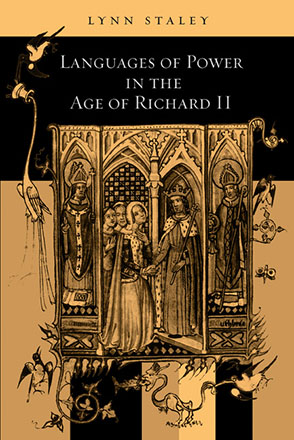
Languages of Power in the Age of Richard II
Lynn Staley
“In recent years so much has been written about the works of Chaucer and his contemporaries that it is hard for anyone to say anything that is new. But Staley has managed it. In this richly textured and wide-ranging work she tells us much about writers’ attempts to articulate the concept of princely power.”
- Description
- Reviews
- Bio
- Table of Contents
- Sample Chapters
- Subjects
n Languages of Power in the Age of Richard II Staley does not so much “read” literature through history as offer a way of “reading” history through its refractions in literature. In essence, the text both isolates and traces what is an actual search for a language of power during the reign of Richard II and scrutinizes the ways in which Chaucer and other courtly writers participated in these attempts to articulate the concept of princely power. As one who took it upon himself to comment on the various means by which history is made, Chaucer emerges from Staley’s narrative as a poet without peer.
“In recent years so much has been written about the works of Chaucer and his contemporaries that it is hard for anyone to say anything that is new. But Staley has managed it. In this richly textured and wide-ranging work she tells us much about writers’ attempts to articulate the concept of princely power.”
“In Languages of Power in the Age of Richard II, Lynn Staley investigates various Middle English ‘attempts to articulate the concept of princely power’ during the twenty-three years of the reign of Richard II. . . . Staley’s arguments are expansive and complex, [offering] fascinating insights. . . . I want to single out for attention Staley’s exploration of French texts: late medieval Anglo-French literary exchanges have tended to play second fiddle to Anglo-Italian contacts in recent years. Languages of Power reminds us once again of medieval England’s ‘French connection,’ but in an expansive (and non-courtly) sense that adds to earlier scholarship on Chaucer and his French sources. . . . I therefore recommend the book enthusiastically.”
“Lynn Staley’s new book is informed by an impressive command of Middle English culture and is chock-a-block with new insights. Few scholars could offer such a rich confrontation of literature and history for this important and distinctive period.”
“Staley has produced a remarkable book. . . . [T]he extraordinary richness and depth of learning in the book as a whole is . . . an achievement impossible to ignore for the possibilities it raises, and the challenges it presents for future directions of Gower scholarship, among many others.”
“This bold book adds a welcome voice to the rich, complicated, and contested discourse on the politics and culture of later medieval England. If it at times falls prey to the common historicist fallacy of mistaking interpretation for evidence, its stimulating readings of the poets should be taken seriously by literary scholars and historians alike.”
“Lynn Staley has given us a magisterial book about the political and cultural milieu of Richard II’s England, and in doing so she has greatly enriched our understanding of how fraught the environment was in which Chaucer and his contemporaries lived and wrote.”
Lynn Staley is Harrington and Shirley Drake Professor in the Humanities at Colgate University. She has published three previous books with Penn State Press: The Powers of the Holy: Religion, Politics, and Gender in Late Medieval English Literature (with David Aers, 1996), Margery Kempe's Dissenting Fictions (1994), and The Shepheardes Calendar: An Introduction (1990). She also is the editor and translator of the Norton Critical Edition of The Book of Margery Kempe (2001).
Contents
Preface and Acknowledgments
1. The Hawk on the Wrist and the Fool in the Chimney Corner
2. Inheritances and Translations
3. Princely Powers
4. French Georgics and English Ripostes
Epilogue
Bibliography
Index
1 The Hawk on the Wrist and the Fool in the Chimney Corner
At the end of December 1375, in Bruges, during the final period of negotiations for a truce to the Hundred Years War, the English contingent rode into the city with several lords, twenty-two knights, and about three hundred horse. The duke of Lancaster rode at their head with a hawk on his wrist. Some ten years later, a group of Trojan knights rode out to meet a group of Greek knights. A prince of Troy rode with them to watch a Trojan citizen, Criseyde, being taken off to the Greek camp. He rode “in wise of curteysie, / With hauk on honde.” In Geoffrey Chaucer’s hands, this scene belongs to a new English sense of necessity, far removed from the duke who rode into Bruges wearing feudal insouciance on his wrist as a sign that England, though bargaining at a disadvantage, still waved the banner of courtliness. The language in which power is cast is always of interest, but during the reign of Richard II, that language was particularly subject to negotiation and fluctuation. Not only did actual power (in the sense of military power and economic might) fluctuate and thus become the object of negotiation, but the prestige of the English crown and the terms used to define that crown were also in flux. For Richard and for those around him, there was a moment when kingship appeared to lack a defining rhetoric.
This chapter seeks to explore the search for a means by which power might be figured and addressed, focused through the writer’s appreciation of the impulses, lapses, and violence that underlay a language as ornate and refined as that of late medieval public rhetoric. Geoffrey Chaucer, Thomas Usk, John Clanvowe, and John Gower were each deeply involved in the affairs of the 1380s. Of these, only Sir John Clanvowe might be accurately described as a courtier, though all served the powers associated with Richard’s court. Moreover, these writers were conversant with one another’s work and seem to have shared an audience made up of lesser gentry, civil servants, knights, and esquires—literate, articulate, engaged men who frequented Westminster and who therefore understood the codes through which those issues could be examined. Chaucer’s work from this period (the Legend of Good Women as well as Troilus and Criseyde and the tale of Palamon and Arcite), Usk’s Testament of Love, Clanvowe’s Boke of Cupide, and Gower’s Confessio Amantis all share a vocabulary of ritualized love, a persistent interest in language and its relationship to truth, a conceited use of imagery, and an appeal to a figure of power for remedy or adjudication. Though each of these works takes as its ostensible subject the frustrations that attend lovers and their suits, none of these works can simply be described as “about” the self in love, or even as “about” interiority. Each text employs the language of courtesy or of erotic petition in order to explore the much more dangerous subject of power—individual, communal, and regal. These texts seem to participate in a highly coded and private conversation among men who style themselves as bumbling lovers and, simultaneously, in public forms of address that are meant to be overheard, if not completely understood, by the mighty. Rather than appearing to radiate from Richard II, these English works speak about him and his court in ways that suggest a search for a mode of address that can also be applied as a finely honed analytic tool.
In a conversation as multidirectional as it was multivocal, Chaucer, Clanvowe, Usk, and Gower capture the constrictions, the deficiencies, and finally the impossibilities of employing the rhetoric of courtly speech as a semiotics of power. Not only do they appear to speak among themselves and to share a common set of terms and stances, but they also, in their several ways, seek the terms of a more precise and perhaps assertive language with which to address either the prince or those in power. In book 7 of the Confessio Amantis, Gower gives an account of the fool unobserved in the chimney corner, one whose very marginality allows him to advise his prince. He thus provides a cameo portrait as conventional and as revered for poets as that of hawks on wrists for young noblemen. But both Gower and Chaucer indicate what Clanvowe does not and Usk cannot: that the mode of address must change because the audience has changed. The courtly rhetoric of love, with its language of petition and desire, positions the prince (or the lady) at the exact center of a web made up of favors and needs. It idealizes or magnifies the source of favor. Desire has a voice but is checked by an elaborate system of social ritual or control. The language of courtly desire was not static; medieval poets constantly scrutinized and tested its limits, examining the ethics and practices of specific social institutions. In England, however, after the events surrounding the Merciless Parliament—which went far beyond the simple checking of regal power that was attempted in the Good Parliament of 1376 and the Wonderful Parliament of 1386—the previous terms of discourse were no longer thinkable.
This chapter inquires into the ways in which Chaucer, Gower, Clanvowe, and Usk interrogate (or perhaps deconstruct) their own linguistic practices and possibly those of the court itself. Neither the fictions of courtesy nor the rhetoric of desire could describe the complexities of the world after June 1388, when, at the end of a parliament that violated Richard’s very terms of kingship, he renewed his coronation oath at a mass of reconciliation in Westminster Abbey. My argument is grounded in the hypothesis that literary texts might be used as guides to history—that authors such as these four, who were deeply involved in the events of their own day, do more than simply respond to those events. By their language and metaphors, their chosen subject matter and focus, they suggest active engagement with the very terms of political discourse as it may have been practiced at court, and they indicate both the direction of literary development and the scope of contemporary political disenchantment.
<one line space>
By the time Chaucer wrote Troilus and Criseyde and the Knight’s Tale, England’s political and social situation had substantially changed from that of the early days of Edward III. I have drawn a half-fanciful relationship in the opening sentences of this chapter. The duke of Lancaster who entered the final stages of negotiations at Bruges—to which the English had been brought, in part, by his own bungled expedition in France during 1373–74—has no literal connection to Troilus riding with his own group of knights to watch Criseyde being exchanged for the man who will eventually betray a Troy whose ideals have been cut to serve its needs. The duke’s gesture at once reflected the postures of countless well-dressed young men in the margins of manuscript pages and the actual tastes and habits of his class. (The Bruges conference itself was punctuated by a good deal of hunting and feasting, so much so that the French complained of the excesses of their own ambassador, Louis d’Anjou, the brother of Charles V.) The duke of Lancaster’s entrance was upstaged a few days later by the more splendid arrival of the French dukes, who were preceded by four hundred valets on horseback, carts of luggage, falconers, a leopard, squires, knights, mace bearers, minstrels, and special sword-bearing knights. The English were outmaneuvered in more ways than this, for the conference did nothing to restore to England its lost French holdings, nor did it repair England’s prestige or its sense of national security. Moreover, it earned John of Gaunt his first real taste of popular criticism.
Chaucer, as we know, was not in Bruges, nor did he participate in John of Gaunt’s expensive and futile long march south from Calais, then west to Bordeaux. During the first years of the 1370s, Chaucer is listed as an esquire of the king’s chamber; while serving the king, he was sent to Genoa and Florence as a member of an economic commission from December 1372 to May 1373. This was his first Italian journey. A few years later, in 1378, he was sent again. On this second visit, he encountered the works of Boccaccio, which provided him with the inspiration for the Knight’s Tale, Troilus and Criseyde, and the Franklin’s Tale. In August 1373, he went to Dartmouth, again on the business of trade between Italy and England. In 1374 Chaucer was appointed as a controller in the port of London, for which he was given the use, rent-free, of a residence at Aldgate. In addition to the annuity he received from Edward III, he was granted an annuity in 1374 by John of Gaunt. At this time, John of Gaunt (whose ambitions in both France and Spain were frustrated by his lack of military success and whose popularity in England was waning) sought to reinvigorate an English regal prestige that had been severely compromised by Edward III’s decline into senility. What followed in England altered the terms of political discourse: the Good Parliament’s attempt to chasten royal expenditures, reactions to the Good Parliament, John of Gaunt’s possible deployment of John Wyclif to shore up the powers of the English crown, papal schism, Wyclif’s growing sense of prophetic vocation, the deaths of the Black Prince and of Edward III, and, finally, the English Rising of 1381.
Also of Interest
Mailing List
Subscribe to our mailing list and be notified about new titles, journals and catalogs.