


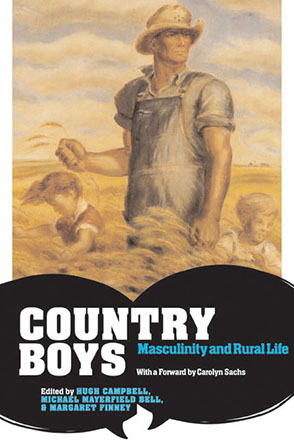
Country Boys
Masculinity and Rural Life
Edited by Hugh Campbell, Michael Mayerfeld Bell, and Margaret Finney
Country Boys
Masculinity and Rural Life
Edited by Hugh Campbell, Michael Mayerfeld Bell, and Margaret Finney
“Country Boys demonstrates how images and realities of the lives of rural men—from cowboys, farmers, and lumberjacks to militiamen, agrarian patriarchs, and the lads down at the local pub—play central roles in the social construction of masculinities of all sorts, as well as in the gendered construction of rural life. Avoiding both idealization and denigration of rural masculinities, these essays indicate and excavate, literally and figuratively, underexplored locations to yield important and enlightening sociological insights. The essays in this volume make a very significant contribution to our understandings of the economies, sexualities, politics, and health of rural life on a global scale.”
- Description
- Reviews
- Bio
- Table of Contents
- Sample Chapters
- Subjects
The essays in this volume offer much-needed insight into the myths and stereotypes as well as the reality of the lives of rural men. Interdisciplinary in scope, the contributions investigate what it means to be a farming man, a logging man, or a boy growing up in a country town and how this impacts both men and women in city and country. Chapters cover not only the United States but also Europe, the United Kingdom, Australia, and New Zealand, giving the book an unusually broad scope.
“Country Boys demonstrates how images and realities of the lives of rural men—from cowboys, farmers, and lumberjacks to militiamen, agrarian patriarchs, and the lads down at the local pub—play central roles in the social construction of masculinities of all sorts, as well as in the gendered construction of rural life. Avoiding both idealization and denigration of rural masculinities, these essays indicate and excavate, literally and figuratively, underexplored locations to yield important and enlightening sociological insights. The essays in this volume make a very significant contribution to our understandings of the economies, sexualities, politics, and health of rural life on a global scale.”
“This edited volume represents a solid contribution to two areas of study in sociology. . . . The editors present a cogent introduction to the field, and the last two chapters are thought-provoking explorations of the changes surrounding rural masculinities.”
“The collection is refreshingly progressive and, at times, unapologetically optimistic, being run through with the leitmotiv of the very real possibility of change.”
Hugh Campbell is Associate Professor of Social Anthropology and Director of the Centre for the Study of Agriculture, Food, and Environment at the University of Otago, New Zealand.Michael Mayerfeld Bell is Associate Professor of Rural Sociology at the University of Wisconsin, Madison. His most recent book is Farming for Us All: Practical Agriculture and the Cultivation of Sustainability (Penn State, 2004).Margaret Finney recently completed her Ph.D. thesis on gender and literature and is currently working at the Centre for the Study of Agriculture, Food, and Environment at the University of Otago, New Zealand.
Contents
Foreword—Carolyn Sachs
1. Country Boys: Masculinity and Rural Life
Hugh Campbell, Michael Mayerfeld Bell, and Margaret Finney
Part I: Practices
2. Cultivating Dialogue: Sustainable Agriculture and Masculinities
Gregory Peter, Michael Mayerfeld Bell, Susan Jarnagin, and Donna Bauer
3. Three Visions of Masculine Success on American Farms
Peggy F. Barlett
4. Masculinities in Rural Small Business Ownership: Between Community and Capitalism
Sharon Bird
5. Real Men, Real Locals, and Real Workers: Realizing Masculinity in Small-Town New Zealand
Hugh Campbell
6. Rooted and Routed Masculinities Among the Rural Youth of North Cork and Upper Swaledale
Caitríona Ní Laoire and Shaun Fielding
7. “White Men Are This Nation”: Right-Wing Militias and the Restoration of Rural American Masculinity
Michael Kimmel and Abby L. Ferber
8. Rural Men’s Health: Situating Risk in the Negotiation of Masculinity
Will H. Courtenay
Part II: Representations
9. Cowboy Love
David Bell
10. Embodiment and Rural Masculinity
Jo Little
11. Beer Advertising, Rurality, and Masculinity
Robin Law
12. Changing Masculinity in a Changing Rural Industry: Representations in the Forestry Press
Berit Brandth and Marit S. Haugen
13. Warrior Heroes and Little Green Men: Soldiers, Military Training, and the Construction of Rural Masculinities
Rachel Woodward
Part III: Changes
14. Country/City Men
Robert W. Connell
15. Gendered Places and Place-Based Gender Identities: Reflections and Refractions
Linda Lobao
About the Contributors
A Note on the Photographs
References
Index
Part 1: Practices
Masculinity is not something that is just “there,” a Mount Everest in the social landscape of rural life. Masculinity is something that is done: something we practice—something we do and something we do over and over again, trying to get it right, as we best understand that rightness. As we practice masculinity, however, we inevitably shape it to the specific local contexts in which we find ourselves. Masculinity is indeed there in the landscape of rural life, but because we practice and shape it, it is far from an unchanging monolith.
This first section of the book traces the local embeddedness of the variable practices of rural masculinity. Here we have chosen and arranged the chapters to provide examples of how particular versions of masculinity vary within different rural spaces, and the ways in which these rural masculinities emerge and change. We also present these chapters as ways of engaging rural masculinity with three long-standing concerns of rural sociology: farming, small towns and communities, and broad rural processes.
Some of these chapters deal directly with the first of these concerns: industries that are peculiar to rural space. In particular, the agriculture industry strongly conditions—and is conditioned by—different versions of masculinity. For example, Greg Peter et al. examine Iowa as an example of how the transition to sustainable agriculture in the United States is intimately bound up with the conflicts and power relations between versions of farming masculinity. Here, the masculinity associated with intensive, industrial farming contrasts with that seeking a more open engagement with other points of view and ways of farming. This latter style tends to be characteristic of farmers experimenting with sustainable agriculture. Extending this example, Peggy Barlett demonstrates that these conflicts between industrial and sustainable agriculture—and their close association to different styles of masculinity—are also manifest in other farming states across the United States. She then elaborates on an agrarian version of farming masculinity that presents a provocative contrast to industrial and sustainable versions of farming masculinity.
The second area of interest to rural sociology is the way in which gender operates in rural small towns and communities. Three chapters in the book focus specifically on gender relations in small communities and identify particular styles of masculinity that—in the same way that certain masculinities are privileged in farming—become powerful in these communities. These chapters identify particular sites in rural society—businesses, sporting activities, and pubs and bars—as important places in which masculinities develop and are reinforced. Sharon Bird examines business owners in a small, rural American town to trace how a particular paternalistic version of masculinity emerges within these businesses, becomes embedded, and then becomes powerful in establishing the entire gender order of such small towns. In a similar study, Hugh Campbell shows that small-town businesses and local pubs become closely related sites in which hegemonic masculinity is created. In his study of small-town New Zealand, pubs and workplaces become key sites where an equally powerful masculinity embeds its dominance in community life. In response, many young women choose to leave town and never return—thus undermining a key potential area of resistance to men’s power. Similar themes also emerge in Catríona Ní Laoire and Shaun Fielding’s study of two villages in England and Ireland. Again, a dominant form of masculinity becomes “rooted” in these communities—a masculinity that, despite cultural differences, has a strong resemblance to that described by both Bird and Campbell. Ní Laoire and Fielding also show how this rooted masculinity is challenged, undermined, and even partly formed by “routed” masculinities—masculinities that tend to draw young men away from these villages and promote rural out-migration.
The final area of interest to rural sociology is the way in which broader rural processes influence gender in general, and masculinity in particular. Working in this area, Michael Kimmel and Abby Ferber describe the emergence of a whole social movement of militias and separatists in the rural United States, and show how one commonality between these militias is the way they construct a particular definition of masculinity. This form of masculinity is a masculinity wounded but still proud; a masculinity patriotic and resistant to the incursions of “liberal, feminized” America; a masculinity prepared to resort to violence to defend itself. Finally in this section, Will Courtenay explores how broad social processes encourage rural men to engage in masculine practices that undermine their physical health. As Courtenay shows, rural men are more likely to suffer from a range of adverse health outcomes in their lives that can be causally related to the kinds of work rural men undertake, the social structure of rural life, and the particular risky behaviors that have been accepted as normal and natural for rural men to engage in.
Collectively, these chapters show that the different ways of “being a country boy” have an important bearing both on power in rural society and on how rural people establish their sense of self and other. They also show that the “mountain” of masculinity is a human creation, and as such—and however much we may imagine it otherwise—inevitably subject to constant change and variation in the face of the geology of the social.
Part 2: Representations
If we accept conventional ideas about masculinity, we accept that real men don’t eat quiche. They eat red meat, preferably meat they caught and killed themselves. Real men don’t wear sandals. They wear boots, and they’re not afraid of getting dirty or acquiring a few bumps and bruises, as they ride broncos and work the land. Real men don’t ask for directions. Like the tracker or scout, they are always self-sufficient in choosing a path through the wilderness of life. These common images of a stereotypical masculinity may tell us little about any actual man, but they point to a sociologically significant feature of the imagined real man: in many important and resonant instances, he is a rural man.
In order to examine the interconnections between the rural and the masculine that create the power and persistence of such images, it is helpful to contrast the masculine in the rural and the rural in the masculine—or what we could more efficiently call the masculine rural and the rural masculine. To study the masculine rural is to explore, as the chapters in the first section of this book do, how masculine practice takes place in specifically rural sites. To study the rural masculine, however, is to explore how rural images, ideas, and representations influence all masculinities—both rural and urban. In this next section of the book, the authors focus on this second task.
But we need to introduce a note of analytic caution here. While the distinction between the masculine rural and the rural masculine is useful in conceptualizing the study of rural masculinities, it is, like most dualisms, something that we must quickly move past when we encounter the messy realities of our gendered lives. After all, as soon as we recognize that symbolic rurality influences all masculinities, some examples of the rural in the masculine turn out to be exactly the same as examples of the masculine in the rural. When Kevin Costner portrays a particular kind of rural masculinity in films like Open Country, for example, the viewers of that film are both urban and rural. Thus the practices of masculinity among rural people are no less informed by the rural tone of much masculine imagery than the practices of masculinity among urban people: both are open to the ideological power of rural concepts, ideas, and representations. Thus the masculine practices of the farmer on the tractor (whether that farmer is male or female) are imagined as much as they are enacted. Both Costner’s audience and the tractor-driving farmer simultaneously demonstrate the masculine rural and the rural masculine.
Recognizing this point does not invalidate the dualism of the rural masculine and the masculine rural. Rather, it highlights the kinds of explanatory and theoretical readjustment we have to make to move beyond simply associating the way we “do” gender with the way we behave in particular social sites. While both gender and the rural unarguably have concrete dimensions linked to space and place, they also both have symbolic qualities that float free of particular social settings and can be consumed and reproduced in a variety of ways and at a variety of sites.
If this sounds like a recipe for analytical chaos and confusion, let us assure you that the following chapters demonstrate the exact opposite!
The first chapter, by David Bell, provides an intense and vibrant portrayal of the ways in which gay masculinity and rurality can be co-constructed. Bell not only spans the wide emotional distance between the charms of urban faerie movement rituals and the brutality of Matt Shepard’s murder, he also does what all good analysts should: opens up social sites that were previously invisible or ignored by the average reader. As he shows, behind the heterosexual hegemonies of rural representation operate multiple and varied worlds of gay and rural masculinities. After reading this chapter, you won’t be surprised to visit the International Gay Rodeo Association website and discover that—as of 2005—it had twenty-four regional chapters across the United States and Canada.
The following chapter, by Jo Little, provides the perfect complement, exploring the comfortable, unthreatening side of heterosexual hegemony in rural regions. Little explores the “work” of making heterosexuality and the ways in which rural people construct family life. Through three vignettes of country initiatives aimed at creating “unscary” heterosexuality in the countryside, she examines the need to civilize rural men into domestic, heterosexual, and stable family lives, and how far such projects can go in achieving this aim.
Unarguably, one of the key sites at which masculinities are represented and reproduced is the media, and two of our chapters directly target the ways in which the media reinforces some versions of rural masculinity while rendering others invisible. Robin Law analyzes the “Southern Man” beer advertising campaign in New Zealand. In this study she outlines a clear method for examining the specific “slants” of media activity and carries through an analysis of the multiple processes that eventually end up privileging one particular version of masculinity. Berit Brandth and Marit Haugen employ the same approach in their chapter on Norwegian forestry. They examine transitions over time within representations of forestry men in a Norwegian industry magazine to show that while the content of forestry’s hegemonic version of masculinity subtly shifts, the underlying power of the men does not.
So this section introduces the reader to urban faeries, heterosexual vigilantes, naked elderly women in rural England, a love train coming to rescue lonely bachelors (perhaps all aspiring Southern Men) in rural New Zealand, and the triumph of the organizational man in the Norwegian forestry industry (a subtle balance of wielding a chainsaw and fighting battles in the boardroom). One compelling set of images remains: Rachel Woodward’s examination of the discourse of the “warrior hero” in British army training. This military “he-man” conquers nature, survives ordeals in the wilderness, and rises from his swamp de passage in order to protect and save idyllic rural England. Then he gets posted to patrol a city in Iraq.
All these representations of the rural and the masculine exhibit the power of gender and the power of how we define the rural. Each author foregrounds the politics of sexuality, gender, and place in his or her analysis, and thus makes the case that studying rural masculinities is far from irrelevant to our day-to-day lives. On the contrary, rural masculinities are integral to how we all are shaped by, understand, and respond to the gendered world around us.
Part 3: Changes
The rural is the unchanging, the seat of tradition and routine—or so we have long imagined. In this view, progress and innovation are the features of urban life. Cities are where the young and innovative go, happily leaving behind the old, the social detritus of unchallenged custom and habit, the boredom of convention and settled lives, and the constraints of community solidified by isolation. Against the restless pulse of the city, however, we maintain a mental picture of a “home” we can return to—an “old country” that is always there, where neighbors still know each other, where families meet for picnics, where nature and Gemeinschaft remain to comfort the overwrought and heal those battered, bent, and dented by urban artifice. As an old Appalachian song, the Blue Ridge Mountain Blues, puts it,
When I was young and in my prime
I left my home in Caroline
Now all I do is sit and pine
For all those folks I left behind
Like the idealized and immutable rurality of this vision, the masculine is often similarly conceived as rock-solid and unchanging. What is the toughness and self-reliance of the real man but a kind of gendered obdurateness in the face of the trials of life and what they fling at the self? In this conception, masculinity is not compliant, nor does it vacillate; it makes no errors and therefore never has to correct the self; it takes no input from others because it needs none—it is already done, complete, finished and everlasting; rock not water, nature not nurture.
Given the persistence and power of these conceptions, it may seem culturally paradoxical to consider not just the rural in the context of change, but rural masculinities—apparently a double immutability. But rural masculinities are plural, not singular, and in that plurality we find both the means and the evidence of rural masculine change. In these final chapters of the book, two experienced observers of the rural and the masculine consider the methods and the indications of this change, and ponder the possibilities and constraints for future directions in rural masculinities.
Robert Connell gives us a largely historical vision of this apparent double obdurateness, showing how intellectuals from ancient Rome to modern Australia have found much more than singular and unchanging masculinity in the rural. Connell opens by reminding us of the Roman poet Virgil, whose writing is steeped in the conservatism we so strongly associate with the male farmer and his countryside, before moving to sketch out a history of rural radicalism. From the late nineteenth-century Australian magazine The Bulletin, with its sense of the rural as a site of a cleansing masculinity capable of exposing the corruptions of capital, to the commune movements of the sixties, to contemporary counterculturalists, Connell shows us how intellectuals have long envisioned the rural as a place to start anew, to experiment with alternative gender relations, and to resist the depredations of mammon.
In our final chapter, Linda Lobao points her overview of the book toward a focus on change in rural masculine (and masculine rural) practices of a different sort: the agenda of social science research. She begins by bringing together the threads of a theme prominent throughout the volume—the symbolic and physical contingencies of space and place that are so central to rural masculinities. Lobao uses this spatial perspective to review how the contributors to the book demonstrate the social significance of rural masculinities, how the rural and the masculine intersect, and how these significant intersections also provide openings for change. But she also points out that there is much more to be done, not only for the development of social science but also for social science’s broader moral agenda to give capacity to society’s potentials—in this case in terms of the gendered boundaries of both rural and urban power.
Rurality is not unchanging, and masculinity is not a fact of nature. Indeed, while we live in the world and interact with it, nothing can be final and unchanging. Nothing, therefore, is a fact of nature, if by a “natural fact” we mean something final and unchanging. It is a sign of rural masculinities’ continuing hegemonic hold that we so often still see them as singular and complete—and our developing ability to engage rural masculinities in their own reconstitution is perhaps equally a sign that this hold is now slipping. Increasingly, we are gaining the ability to consciously examine rural masculinities specifically as what they have always been: multiple and emergent in a relational world. Perhaps more important, we are also now able to study what they could become: sources of empowerment with others, instead of sources of power over others.
© 2006 The Penn State University
Also of Interest

Mailing List
Subscribe to our mailing list and be notified about new titles, journals and catalogs.