


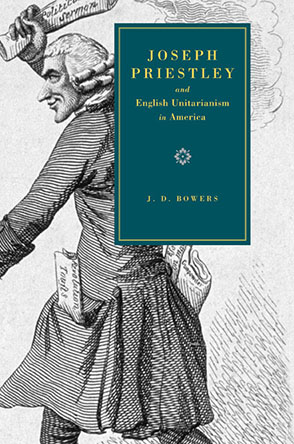
Joseph Priestley and English Unitarianism in America
J. D. Bowers
“This beautifully and persuasively written account of the contributions of Joseph Priestley and English Unitarianism to the development of liberal religious thought in nineteenth-century America offers a valuable contribution to the growing historiography on the transatlantic exchange of ideas in the early republic and on the role of religious thought in influencing political discourse on such topics as toleration and cultural identity. Professor Bowers renders complex issues of religious belief and denominational difference understandable while stressing their importance in a broader context of social, political, and intellectual history.”
- Description
- Reviews
- Bio
- Table of Contents
- Sample Chapters
- Subjects
In contrast to studies that simply trace the history of the denomination as it flows out of New England and is controlled by Bostonians, Bowers shows that Priestley's legacy grew in importance throughout the nineteenth century and held sway throughout many of the frontier regions of the nation. By discussing the complexity of interdenominational rivalry, lack of central control, and a continuous transatlantic exchange among religious liberals, he shows that English Unitarianism continued to serve as an essential and noteworthy foundation for subsequent developments within the American denomination as it endured the challenges of Protestant orthodoxy, unregulated liberalism, Transcendentalism, and the never-ending quest to define liberal religion in America.
This is an insightful account of an often neglected set of tenets and developments in the denomination's history. It uniquely traces the course of continued English influence as it established a new point of reference for understanding the dynamic origins of denominational development, Unitarian thought, and liberal religion.
“This beautifully and persuasively written account of the contributions of Joseph Priestley and English Unitarianism to the development of liberal religious thought in nineteenth-century America offers a valuable contribution to the growing historiography on the transatlantic exchange of ideas in the early republic and on the role of religious thought in influencing political discourse on such topics as toleration and cultural identity. Professor Bowers renders complex issues of religious belief and denominational difference understandable while stressing their importance in a broader context of social, political, and intellectual history.”
“A resolute and positive reaffirmation of Joseph Priestley’s place in the heritage of American Unitarianism. J. D. Bowers reminds us of both the complexity and importance of theology in early American history.”
“In Joseph Priestley and English Unitarianism in America, J.D. Bowers turns the historical lens and brings into focus two significant American locations where Joseph Priestley’s earliest efforts to establish liberal religious congregations took root in the early national period—Philadelphia, the nation’s capital and Northumberland, the frontier outpost that was Priestley’s home from 1794–1804.
“Readers seeking evidence of English Unitarianism’s contribution to the history and development of Unitarianism in the religious landscape of America’s Atlantic world will be rewarded with this volume, which is well-steeped in pertinent pamphlets, tracts, letters, and sermons that inform the author’s position on English Unitarianism’s critically influential role in the development of Unitarianism in America.”
“A welcome contribution to the long-neglected historiography of American Unitarianism.”
“This book is an example of Unitarian historiography at its best, wherein interesting detail is intertwined with a most stimulating argument.”
“An indispensable study of the origins of American Unitarianism and of Pennsylvania religious history.”
“An indispensable study of the origins of American Unitarianism and of Pennsylvania religious history.”
J. D. Bowers is Assistant Professor of History at Northern Illinois University. He has worked extensively with the Joseph Priestley House and Museum, serving as a consultant and writing a guide for docents.
Contents
Illustrations
Acknowledgments
Abbreviations
Introduction
1. English Socinianism: Antecedent to American Unitarianism
2. The Socinian Migration and the Founding of American Unitarianism
3. Joseph Priestley and Unitarianism in Philadelphia
4. Unitarianism in Northumberland and the American Religious Frontier
5. Socinianism, Arianism, and the Quest for Unitarian Identity
6. “Respecting the Good Cause in Our Neighborhood”
7. Conclusion: The Death and Resurrection of English Unitarianism?
Bibliography
Index
Introduction
“In my opinion, those who are usually called Socinians (who consider Christ as being a mere man) are the only body of Christians who are properly entitled to the appellation of Unitarians,” declared Joseph Priestley, the English Unitarian minister, in his 1786 treatise An History of Early Opinions concerning Jesus Christ. He simultaneously rejected all other theological expositions of belief in the unity of God, specifically noting that those who believed in the preexistence of Christ, the belief that Jesus was coeternal with God, and yet not God, “can have no claim to the appellation of an Unitarian,” and thereby set into motion a theological dispute over Unitarian religious identity and religious practice that would linger for more than a century and involve Unitarians on both sides of the Atlantic.
The doctrine of one God, for which English Unitarians were named, centered on the belief that there was no coexistent Christ, only the human prophet Jesus (which sometimes led people to call them Humanists or Humanitarians), and that the Holy Spirit was equally unscriptural. Though Priestley and others called the theological system and loose confederation of believers Socinian, the term was not completely accurate. The English Unitarians of the eighteenth century, who considered Priestley to be their leading theologian, were not in complete agreement with Faustus Socinus, the sixteenth-century divine who had been responsible for codifying the doctrines of what became the Minor Reformed Church of Poland in his work Bibliotheca Fratrum Polonorum. While the English accepted Socinus’s rejection of Christ’s divinity and promotion of the use of reason in scriptural analysis, they were not as open to some of his other rationalistic justifications of faith.
Nonetheless, English Unitarians took the name on the grounds that it identified them with the single most important aspect of unitarian thought and cast them into the religious landscape of England as reformers. The principles of rationalism and historical progress held by the Unitarians taught that as time passed old errors were corrected and previously unknowable truths were revealed. The most important of these old errors and new truths concerned what Priestley had come to identify as the historical corruptions of true Christianity—acceptance of Jesus as Christ, the notion of Jesus’ coeternal existence with God, his preexistence in the world, and the Holy Spirit—all formed in centuries when believers were prone to misinterpret both oral and written testimony. Contrary to what such positions might indicate and how their opponents categorized them, Unitarians also professed an acceptance of Christian evidences, historical and spiritual, compatible with prevailing Protestant beliefs, as well as being in agreement with them that God embodied human attributes. Most Unitarians also accepted the Arminian view of the doctrines of free will, resistible grace, and universal atonement. It was on such matters as universal atonement, the accepted notions of grace, and the existence of a corporeal soul (a later variant of Unitarianism would even question the soul’s very existence) remaining with the body until the time of the resurrection that the Unitarians were in disagreement with the Calvinists. Most Protestants, however, would have found the Unitarian belief that salvation was universal and their acceptance of the final resurrection as a literal event to be a familiar, if not fully acceptable belief.
Guided by this set of religious principles, Priestley, along with Theophilus Lindsey, initiated the transformation of Unitarianism in England, later formalized by Robert Apsland and Jeremy Belsham, into an acknowledged and avowed denomination. But his religious principles, coupled with his challenges to the established political and social views brought him into conflict with those who controlled England’s religious and political establishments. He was forced to flee, opting in 1794 to come to the United States, bringing with him his religious principles and his desire to spread the Unitarian beliefs. For a decade Priestley served as the inspiration and leading force in the spread of Unitarianism in America and the formation of numerous societies that followed his teachings on congregational formation, the education of youth, lay preaching, and espousing one’s faith in the presence of opposition from (and to) both the Protestant majority and a competing liberal faction. Fortunate to have been preceded by the dissemination of his writings and itinerant English Unitarians, Priestley’s arrival was the capstone in a process of transatlantic exchange that resulted in the formal emergence of Unitarianism in 1796 as yet another newcomer in the American religious landscape.
The collection of societies, some of which openly adopted the name “Unitarian,” was quickly identified by its Socinian theology and the English influence. Priestley’s efforts were the inspiration for at least a dozen congregations, mostly led and populated by English émigrés who were already present and waiting for viable leadership or who had come to escape oppression. Congregations of Unitarians, who directly attributed their existence to Priestley, were established in Maine, Massachusetts, New York, Vermont, Pennsylvania, Virginia, and Kentucky. Priestley’s American sermons were well attended, attracting many non-Unitarians, as well as published and distributed throughout the country. Ministers of other congregations shared their pulpits with him and engaged him in theological discussions intended to reveal their mutual understandings. Unitarian beliefs were categorized as “a denial of the catholic doctrine of the Trinity, and an adherence to the literal sense of those passages of scripture which assert the unity of God and the humanity of Christ, who they think cannot lawfully be considered an object of religious worship,” wrote James Mease. Widely known, but not universally accepted, these beliefs and the congregations who professed them became the accepted foundation of American Unitarianism.
But they did not occupy the liberal ground alone, and they were not the only group who professed the unitarian concept as part of their theology. As Mease further noted, Unitarians, “although agreed concerning the character of Christ as a man sent and approved of God, they are not unanimous as to his miraculous conception,” and therein lie the seeds of the theological contest that would ensue as English Unitarianism confronted an already-extant American liberalism with unitarian leanings. While there were many differences between the two beliefs, the major feature was that Priestley and many other English Unitarians believed that Jesus was never more than a man, had never ascended into heaven, and was a simple, yet special prophet of God. This was in contrast to the liberals, who professed that Jesus was of divine birth, had been taken into heaven and returned to earth with God’s blessing, and was both human and divine.
Reaching back to the time of the Great Awakening, if not earlier, New England liberals (as they both called themselves and were labeled by their opponents) had increasingly come to accept the notion of a single God with a distinct, yet still divine Jesus—rejecting the fullness of the trinitarian conception of God the Father, Son, and Holy Ghost—and promoting human reason as a necessary instrument in biblical interpretation. However, while they believed that Christ was preexistent, combining their Arminian views with an Arian conception of Jesus, they were unwilling, and in most cases theologically incapable, of espousing the unitarian idea as their central, defining belief and thus remained ensconced within the Congregationalist tradition prominent throughout New England. Despite holding beliefs that coincided with Socinianism, the liberals adamantly denied any association with the English Unitarians, believing them to be both extremist and polemical. The Socinians felt that the two groups shared a natural connection, one that should have resulted not only in a common agenda but also a common religion. The Arians shied away from interaction with Socinians and were content to side-step the early fracas they had created with their open advocacy of Unitarianism. While Priestley and his followers put themselves into the public realm, the New England Arians were content to remain within the confines of congregationalism—liberal impulses were one thing, open declaration of beliefs others would consider heretical was another.
Thus, while the English Unitarians were not simply free to grow unchecked and their development in America was challenged by established Protestant denominations and a lack of fellowship with the liberals, the various congregations were nonetheless able to achieve relative stability and develop institutional norms. Their views regarding religious rationality and theological dissent were the only ones openly denoted as Unitarian and offered the only presence with which the opponents of religious liberalism could contend. The forces of Christian apologists saw no reason, however, to confine themselves to splitting theological hairs when it came to repudiating the arguments and proclaiming the destructiveness of their opponents, freely conjoining the New England liberals with the professed Unitarians. As events would unravel, especially following the dispute in 1805 over religious authority at Harvard, known as the Unitarian controversy, the English Unitarians also attempted to call the liberals into their camp on the basis that they themselves had often passed through Arianism on their way to more Biblically consistent, logical Socinian belief. They were also quick to point out the growth in the number of Unitarian ministers and congregations throughout the nation, adding to their argument favoring association, not to mention that the liberals represented a potentially expansive base for the growth of a nationwide Unitarian denomination.
As the pressure on the New England liberals increased they began calling themselves “Liberal Christians” and sought to distinguish themselves from their Congregationalist brethren. In 1819, when they were finally ready to take further steps, the decades-old presence of Priestley’s Unitarianism forced them to contend with its competing ideas and beliefs. In short, if the New England Arians were to claim the Unitarian name, as William Ellery Channing proposed in his sermon “Unitarian Christianity,” they would only be able to do so by circumventing or eliminating preexisting Unitarian traditions.
The liberals’ quest to establish a “distinct sect” created quite a stir in the religious community. Their formal separation from the Congregationalists, predicated on the basis of their overwhelming numbers and legal decree, began to erode the English Unitarian identity and influence. Theirs was a new unitarian theology and identity, and they quickly relegated Socinianism to the periphery of American religion and fervently denounced all associations between themselves and the Unitarianism of old. In 1825, under the leadership of Channing they formed a ministerial association, known as the American Unitarian Association (AUA), and from that moment on, Channing and New England Unitarians of his ilk spent their entire ministerial and religious lives denouncing Priestley and his variant Unitarian theology. The “corporate development” of Unitarianism required the rejection of the original Unitarians and their beliefs if it was to succeed. Though there was an occasional charitable comment that separated “Priestley the man” from “Priestley’s beliefs” or that parsed the English theological system until the individual elements were found acceptable, conflict was the order of the day. The AUA sought exclusive claim to the name “Unitarian” and acceptance within the wider religious community on its own terms. Given the circumstances of the day and a continued desire to remain a part of the Christian community, it was left with little choice. Socinian belief included universal salvation and toleration, a literal view of the apocalypse, religious experimentalism, and humanistic visions of the soul. These ideas, derived from scientific and religious rationalism, were considered too extreme and were associated with the fringes of the standing order, a position that those who were coming out of Congregationalism fought to avoid. Likewise, Socinian theology served as a focal point of attack for other, competing religious groups who pointed to inconsistencies within the denomination’s beliefs and the absurdity of rationalism.
But there were those who, as Unitarianism confronted the changing religious realities of the American nineteenth-century, recognized that liberal religion was stronger when it was more inclusive. There were certain tenets of Priestley’s theological system that were widely accepted and understood as representing the universal foundations of religious reform, rationalism, and liberalism. Priestley’s advocacy of free inquiry was quite acceptable, since the very idea of unfettered discourse and investigation was what had attracted many liberals to the unitarian position in the first place. As Transcendentalism emerged among young Unitarians in the 1830s, and when Theodore Parker further transformed the faith in the 1840s, many Unitarians began to recognize that Priestley’s theological system represented a potentially strong ally against the new, even more extreme radicalism. While Priestley’s ideas on the humanity of Jesus were rapidly becoming the acceptable stance with respect to the Trinity, Parker’s movement away from a Christian and Bible-based faith were not. If Unitarians hoped to remain within the Christian community, as many did, and if they hoped to recapture the identity of their faith, Priestley’s now seemingly benign rationalism was viewed as an acceptable, historical, and effective weapon against the new extremes of rationalism. By the late nineteenth century it was clear, Joseph Priestley and the English Unitarians were accepted back into the Unitarian continuum.
In fact, Priestley and English Unitarianism had never disappeared; they had only faded into the background for a time. They had been sustained by the emotional, financial, and intellectual support of the Unitarians in England. Small groups of American intellectuals, liberal thinkers, and elites, most of whom were English immigrants themselves, continued to profess Priestley’s beliefs and teachings, and the flow of English Unitarian ministers, while never plentiful, was constant and produced some of America’s most notable Unitarian clergymen of the period.
When viewed in light of its context and existence in the Atlantic world, a history of Unitarianism reveals new connections and a deeper internal conflict among like-minded believers, not to mention the growing rift between Americans and Britons. The English involvement in American Unitarianism was significant and lasting, even if that involvement was as a result of ceaseless efforts to reject it. Although the Priestleyan version of Unitarianism never rivaled its successor in numbers of adherents or the extent to which it was tolerated by outsiders, its influence and initial successes in America were important. Priestley’s presence gave others the courage to openly profess their unitarian leanings and eventually proclaim themselves denominational Unitarians. Just as Priestley was able to capitalize on earlier efforts to spread Unitarianism in America, the New England wing was able to capitalize on Priestley’s efforts, even if they denied this link. Further testimony to Priestley’s success was the fact that his Unitarianism buckled only under the pressure of the New England liberals’ onslaught, not the pressures of the trinitarians. It was Channing’s supporters, those who felt it necessary to shove Priestley’s followers aside precisely because the latter represented a threat, who ended up erasing the English presence. Had Priestley and his followers failed, their legacy would have been easier to discredit.
It is doubtful if Channing and the later Unitarians could have succeeded without the earlier efforts of the Socinians to spread their religion. In fact, the New England Unitarians might not have even emerged as a separate entity had it not been for Priestley and his followers. It was the English Unitarians who pulled the New England liberals further from their orthodox heritage and engaged them in a debate over the substance and meaning of unitarian beliefs. This created a gulf between the Unitarians and the trinitarians that was later exploited and led to one of the most profound shifts in religious definition within any denomination in early national America. In the early years, Priestley and his followers attracted the wrath of trinitarian opposition, deflecting it away from the New England liberals, and thus shielded the unitarians hiding within Congregationalism. The English Unitarians also established the social and political message of the religion through their efforts to create congregations, publish theological writings, and involve themselves in the nation’s social issues, thus precluding the need for the New England Unitarians to stake out this ground once they formed themselves into the new denomination.
Throughout the Enlightenment America transformed many foreign ideas into distinctly American concepts. Though New England unitarians denied the influence of the English denomination’s ideas on the development of their faith, the Unitarianism of Lindsey and Priestley was discernible in America almost immediately. “America was more than a passive party, receiving and reflecting what had emanated from others. . . . In ways that are not altogether clear, the American people as a whole absorbed and adopted from Britain . . . some leading features of Enlightenment thinking.” The tradition of cross-cultural adoption and later adaptation has been a constant force throughout history, and we should not think of Americans as any different. Paul Conklin notes that “in no sense was doctrinal Unitarianism . . . a product of American reformers. And, to an extent rarely recognized by most Americans, neither doctrine [the humanity of Jesus and universal salvation] would be distinctive to those American Christians who adopted the labels ‘Unitarian’ or ‘Universalist.’” The ideas thought to be uniquely American were the product of a complex transatlantic process of intellectual and religious exchange. This exchange can be seen in the personal letters of interested parties on both sides of the ocean, in the libraries and bookshops of America, and through the connections that America retained with Europe in literary, scientific, and political concerns.
In an 1824 essay, F.W.P. Greenwood, the editor and chief correspondent of the Unitarian Miscellany, challenged William Ellery Channing’s characterizations of Joseph Priestley in his ordination sermon at the installation of Ezra Stiles Gannett as Channing’s associate pastor:
<ext>
We hold it our duty to remark, that we were not pleased with the manner in which the writer speaks of DR. PRIESTLEY. It is true that the merits of Unitarian Christianity are not indivisibly linked with the character of any one of its advocates; but it seems to us, that if there is one man to whom, more than to any other, Unitarians can look with confidence, and point with pride, as the honest, zealous, pious, unwearied, distinguished champion of their principles, Dr. Priestley is that man. If the orthodox see fit to revile him, and speak of him as an instance of the injurious tendency and influence of Unitarianism, we can only say, that we wish we had many more like him, to the objects of their calumny and misrepresentation, and of our pride. . . .
Dr. Priestley’s character was full of the beauty of Christianity; and, unless our ideas of him are altogether erroneous, he was so far from being “constitutionally deficient in moral enthusiasm and deep feeling,” that he rather seemed to overflow with those qualities, which had been poured into his constitution in double measure.
Greenwood’s sentiments echoed throughout the rest of the century, so that by its end, Joseph Priestley was once again recognized and celebrated as one of America’s leading Unitarian protagonists.
Scholars today have continued to overlook Priestley, leaning toward a confined consideration that explores only his immediate impact or contrasts his efforts with later developments of denominational formation. In the classic study Our Unitarian Heritage, Earl Morse Wilbur notes that Unitarianism was a uniquely American faith, a position that has been carried across the breadth of scholarship and reiterated with increasing fervor so that by the late 1980s, even after the New England centric approach to American religion was called into question, it was succinctly reaffirmed by Conrad E. Wright, when he labeled Unitarianism “indigenous to New England.” David Robinson’s somewhat tempered contention that “the story of the development of the denomination remains largely a New England affair,” includes an acknowledgment that English Unitarianism was “not without its impact,” though what that was remains unexplored save for its relationship to Jefferson’s views. Robert Schofield has labeled Priestley’s years in America as his religious “anticlimax” and contends that his presence left no lasting impact on Unitarianism. More recently Conrad Wright has written that “one suspects that there were many instances of Arians who . . . were actually as humanitarian in the Christology as Priestley had ever been,” but even still cautions that one must be “wary of exaggerating [Lindsey and Priestley’s] contribution to it.” Likewise, Priestley’s influence on the theological and denominational development of American Unitarianism remains virtually ignored. Even a visit to the Joseph Priestley House and Museum today, located in Northumberland, Pennsylvania, is likely to leave the visitor with a less-than-whole understanding of Priestley’s religion and the role he played in the course of the nation’s religious history.
This book seeks to restore Joseph Priestley and English Unitarianism to their proper and influential place in the history of the American denomination and to investigate the theoretical dimensions of early American religious denominations, using Unitarianism as a case study, through a combined focus on the theological, social, and political elements that shaped the formation of the nation’s religious identities and groupings. Denominations have multiple manifestations, never just one, and the threshold for considering a group a viable denomination needs to be reconsidered. While Priestley and his followers clearly lacked the formal, institutionalized structures of a denomination, they lacked little else. For all intents and purposes, as this work will show, they were regarded, though not necessarily welcomed, as one of the multitude of religious denominations in the United States well before 1825. This bopok does not contend that English Unitarianism was more important than the variant that emerged out of New England, but it does seek to call into question the traditional, monolithic New England-centered study of American Unitarianism. The historical narrative of American Unitarianism is viewed by many as one that is settled and unchanging. Unitarianism, alone among the assortment of American religious denominations, has been viewed as the proprietary religion of New England. Most religious histories place the central focus on the denomination’s transformation from New England Congregationalists into Unitarians, facilitated by a specific series of events that took place in and around Boston largely independent of any outside influence. This approach ignores several key developments and numerous important moments in the history of Unitarianism, when the matter of theology—its focus, language, and definition—was shaped by a multitude of influences, as John Allen MacCaulay has recently pointed out in his study on Unitarianism in the American Antebellum South. Simply put, “traditional” Unitarianism does not exist save in the minds of those who choose to ignore all other elements; the traditions which have emerged—in theology, fellowship, doctrine, and identity—are products of change and time, what one scholar has called “traditioning.” There is movement in all religious dispensations and early American Unitarianism was no exception. The history must reflect this movement and its myriad origins.
It is incorrect to argue that over the course of its two centuries of existence in the United States, Unitarianism simply grew out of an isolated and unchanging tradition. If one surveys the continuing history of Unitarianism (today known as Unitarian Universalism), one cannot help but see multiple threads of influence spanning its entire existence. Ideas about the reasonableness of Christianity, a leading tenet among Unitarians, were espoused by John Locke—whose writings were replete with references to religion and his nascent Socinian religious beliefs. Locke’s ideas were echoed, notably but not solely, by Charles Chauncy, one of the most influential religious figures in early New England and a significant figure in the development of New England’s liberal tradition, the same tradition that later emerged as Unitarianism. The ideas and theology of English Unitarianism were equally influential. Unitarian itinerants in the 1780s, open adoption of the English Unitarian liturgy in the 1790s, and Joseph Priestley’s decade-long personal efforts, supported by a host of others and carried on by supporters both in America and in England for years afterward, all attest to this fact. Finally, it is the later events in the development of Unitarianism, those developments between the 1830s and the 1890s, which clearly lay bare Unitarianism’s ever-changing and unstable status, and gave rise to a full recognition of the totality of theological influences.
Some have argued that denominational history is no longer relevant, that it is too frequently grounded in hagiographic tendencies and that it lacks relevance to the wider scope of historical and religious study, not to mention the prevailing emphasis on analytical themes and categories. Denominational studies, note two scholars, are often dismissed because they are rooted in “the obvious” and result in historical accounts that “pale by contrast to the great issues” and thus evoke only “ambivalence . . . not worth the intellectual attention” invested. Other scholars—including Henry Warner Bowden, William Hutchinson, Charles Long, and Nancy Ammerman—contest such views, noting that studies which investigate the multifaceted layers of denominational investment in American society can help shed light on the nation’s longstanding theological traditions, social and religious organization, and cultural identity. This study adopts a very similar view, going beyond traditional denominational history to document American Unitarianism’s central role in the nation’s broader theological discussions, its transatlantic context that stretched well past the conclusion of British rule in America, and the political-social issues that transcended religion and yet were such a part of the religious and intellectual milieu of the period.
This book seeks to pick up where Greenwood left off in 1824 and show cause for the inclusion of Priestley and his English theology as a significant part of the early story of American Unitarianism. By presenting the history of Unitarianism in America through the developments among the Socinian faction, something never before done in the historiography, it adds to the existing histories. With an emphasis on Socinianism and Priestley, much of the work will focus on Pennsylvania and other selected sites where both were physically present or prominent, with particular emphasis on the Northumberland congregation and its two most notable ministers, Priestley and a later successor, James Kay. Because this is a work that seeks to resurrect the on-going conversation within American Unitarianism over the theology of Priestley, I have chosen, for the most part, to allow the individual and group actors to speak for themselves, more so than has been the trend in recent historiography, yet far less so than in the histories of old, which were full of complete transcriptions.
Despite assertions to the contrary, there were various significant theological ideas and religious groups that influenced early American Unitarianism and presented challenges to its development. This early period of conflict predated the internal Congregationalist dispute that many claim resulted in the declaration of Unitarianism. The competing entities and ideas continued to influence the denomination’s direction even after the period of conflict had ended. These elements left a legacy that is discernible in the Unitarian religion today, even though it is greatly altered. The absence of the early contests from the histories of the religion in America has led to an oversimplification of Unitarianism’s past. The outcome of this oversimplification is a narrative that routinely presents the religion as a single entity at a time when the plurality of its views was a defining component of Unitarianism’s strength in America, a strength provided from England. As Greenwood concluded, “In short, Dr. Priestley was as good as he was great. In our opinion, he is not a man to be disclaimed. . . . We regard his memory with a fond reverence; and every time we think of his remote and quiet grave by the banks of the Susquehanna, we feel tempted to make a pilgrimage there, and offer our thanksgivings to Heaven for the instructions and the life of such a man.”
Also of Interest
Mailing List
Subscribe to our mailing list and be notified about new titles, journals and catalogs.