


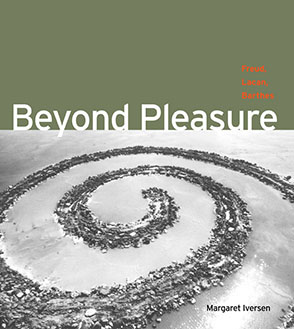
Beyond Pleasure
Freud, Lacan, Barthes
Margaret Iversen
“This new book by Margaret Iversen is truly exceptional. Ranging across modern and contemporary art with remarkable adeptness, each of its chapters has a luster and perfection that reflects her profound knowledge of philosophical aesthetics and psychoanalysis. It is guaranteed to reinvigorate debate about art and psychoanalysis.”
- Media
- Description
- Reviews
- Bio
- Table of Contents
- Sample Chapters
- Subjects
Winner of a 2008 AAUP Book Jacket and Journal Show for Scholarly Illustrated
“This new book by Margaret Iversen is truly exceptional. Ranging across modern and contemporary art with remarkable adeptness, each of its chapters has a luster and perfection that reflects her profound knowledge of philosophical aesthetics and psychoanalysis. It is guaranteed to reinvigorate debate about art and psychoanalysis.”
“It is very well written, making difficult Lacanian and other psychoanalytic concepts lucidly accessible and illuminating. It is extremely well informed with respect to the history of Lacanian psychoanalysis and its relations with Surrealism and art and film criticism. I am struck by the clarity of Iversen’s expression when she translates theoretical jargon into plain English.”
Margaret Iversen is Professor of Art History and Theory at the University of Essex.
Contents
List of Illustrations
Acknowledgments
1. Introduction: From Mirror to Anamorphosis
2. Uncanny: The Blind Field in Edward Hoppe
3. Paranoia: Dalí Meets Lacan
4. Encounter: Breton Meets Lacan
5. Death Drive: Robert Smithson’s Spiral Jetty
6. Mourning: The Vietnam Veterans Memorial
7. The Real: What Is a Photograph?
8. Conclusion: After Camera Lucida
Notes
Bibliography
Index
1
Introduction
From Mirror to Anamorphosis
It is natural to assume that the interest we take in art has to do with beauty and pleasure, and an august tradition of philosophical aesthetics backs up that assumption. The most influential contribution to philosophical aesthetics, Immanuel Kant’s Critique of Judgment (1790), argued that we call something “beautiful” when our faculties, both cognitive and sensory, entertain the form of an object in a pleasurable, harmonious free play. Of course, Kant acknowledged that some aesthetic encounters are mixed with pain. Huge mountains or violent storms are more likely to defeat our mental faculties as we struggle to come to terms with them. But this initial humiliation is followed, on Kant’s account, by an uplifting realization that we are not restricted to earthbound ideas derived from these faculties: we also have the capacity to entertain ideas of reason—totality, infinity, and morality. Although we call the objects that inspire these ideas sublime, the term really refers to the capacity of our minds to think these high abstract ideals. As Kant put it, while the beautiful “carries with it directly a feeling of life’s being furthered,” the sublime “is produced by the feeling of a momentary inhibition of the vital forces followed immediately by an outpouring of them that is all the stronger.” The sublime is thus balanced on the threshold between an acknowledgment of human limitation and an assertion of moral freedom or, as Kant poetically declared, between “the starry heavens above me and the moral law within me.” On reflection, we would also want to acknowledge that certain works of art (for example, depictions of Christ’s Passion or Titian’s Flaying of Marsyas) are more likely to inspire the tragic emotions of pity and fear, as described by Aristotle, rather than unalloyed pleasure. Indeed, there is a wealth of literature on these two aesthetic responses beyond pleasure, the feeling of sublime and tragic emotions. This book sets out to excavate a lesser-known tradition of writing on art that descends from Sigmund Freud’s essay Beyond the Pleasure Principle (1920).
In its reformulation of aesthetics, psychoanalytic art theory has tended to privilege pleasure and, like its philosophical counterpart, it has also found it necessary to develop a theory of aesthetic experience beyond pleasure. Although Freud tended to be dismissive of the tradition of philosophical aesthetics, he followed it to the extent that he thought that artistic creation and our experience of art are bound up with an indirect satisfaction of what he called the pleasure principle. His understanding of “pleasure,” however, is quite different from Kant’s notion of the mind’s free play. Before turning to a discussion of Beyond the Pleasure Principle and its bearing on our understanding of the experience of art, we will have to pause briefly to consider the psychoanalytic conception of pleasure and Freud’s theory of art as involving the sublimation of more visceral forms of pleasure.
It turns out that defining pleasure psychoanalytically is far from straightforward. Freud proposed that the mental apparatus is regulated by an economic system aimed at reducing high levels of tension that are felt as unpleasurable. Pleasure, then, is nothing more than the elimination of unpleasure, or the sensation of discharge. Yet the complete reduction of tension would lead to a state comparable to death. Freud did not shrink from that conclusion; he postulated a principle of inertia, later called the Nirvana principle, stating that the psychical apparatus avoids excitation and aims to reduce tension to zero. He then had to propose a principle countering that tendency, called the principle of constancy; it regulates levels of tension and maintains them at an optimum low level by avoiding external excitations and discharging internal ones. Both principles are, rather contradictorily, associated with pleasure, although they tend toward what are qualitatively very different states—one comparable to death and the other to the furthering of the feeling of life that Kant associated with beauty.
In Freud’s early work, the pleasure principle is set in opposition to the reality principle. This model posits psychic functioning as a struggle between the urgent need to satisfy instinctual drives (and to discharge tension by the shortest possible route) and the realization that, given external constraints, moderation, postponement, and detour may offer a more prudent approach. These two principles come into conflict, causing frustration, repression, and sometimes psychical dysfunction. But in so far as self-preservation or self-love (primary narcissism) is a fundamental instinct, this opposition between instinct and the prudential reality principle becomes difficult to sustain. Jean Laplanche has attempted to resolve this problem by arguing that we should understand the reality principle as linked to the emergence of the ego, which binds energy and regulates the free circulation of unconscious desire. On this account, the reality principle merges with the pleasure principle, as both aim to avoid excessive pleasure. Laplanche’s reading assigns the pleasure principle to a secondary, homeostatic process, while the primary, fundamental drive to ecstatic enjoyment (jouissance) and “Nirvana” would be properly regarded as an instinct beyond pleasure. There is also the complication, discovered by psychoanalysis, that what might be felt by the individual as pain—a psychosomatic cough, say—may in fact be a disguised satisfaction of a wish. Conscious distress may be a “symbolic” way of deriving unconscious satisfaction and pleasure. Freud speculated that our experience of tragic drama is of a similar kind: we derive pleasurable unconscious satisfaction when our hero murders his father and marries his mother, while at the level of consciousness, we recoil in horror and feel pity and fear.
Freud’s attempt to elaborate a general account of art’s relation to the instincts is the theory of sublimation—a term he introduced. Seeking the ultimate motivation behind artistic or intellectual activities that appeared to have no obvious yield of pleasure, he proposed that they represent a transformation of sexual instinct. A portion of sexual energy or libido is diverted, transformed, and channeled into other, culturally valued forms of activity, such as scientific research or art. The aim is displaced in a process facilitated by the fact that human sexuality has no natural object or aim. The artist or researcher manages to evade neurosis and associated symptoms brought on by repression because he or she has a talent for sublimation. The activity, however, is often marked by repression. Freud’s famous essay on Leonardo da Vinci presents a sort of “case study” of just this psychic mechanism at work. Leonardo’s intense curiosity and obsessive research, together with an apparent lack of sexual activity, point in the direction of sublimation. Freud’s admittedly speculative suggestion is that the overly close relationship between the baby Leonardo and his abandoned mother led him to identify with the mother and to love, in an idealized way, boys like his former self. His ambivalent relationship with his mother can be detected, Freud thinks, in the seductive smile on the faces of the women in his Virgin and Child with Saint Anne and his portrait of the Mona Lisa. Freud held to the theory of sublimation throughout his career, from the Three Essays on the Theory of Sexuality (1905) to Civilization and Its Discontents (1930), where sublimation is regarded as one of several paths to relative happiness—along with intoxication, religious delusion, and madness.
There is something dispiriting about this theoretical reduction of art to a diverted form of mainly sexual energy. Particularly disagreeable is the close link Freud makes between the suppression of perversion and sublimated cultural activities. One would almost prefer an expression of the desublimated drive itself as being more honest and courageously transgressive. Proponents of the abject and informe in art clearly take this view. One particularly good example of this trend is the case against critic Clement Greenberg advanced by Rosalind Krauss in The Optical Unconscious. Greenberg is accused of sublimating Jackson Pollock’s “art of violence, of ‘howl’” by lifting the drip paintings off their low, horizontal axis on the floor (where Pollock made them) and rendering them vertical, sheerly optical, and transcendent instead. The exhibition curated for the Pompidou Center by Krauss and Yve-Alain Bois, titled Formless, was an attempt to formulate something like a desublimating aesthetic.
The difficulties we have already encountered in Freud’s account of pleasure are not resolved in his highly speculative Beyond the Pleasure Principle. If anything, they are exacerbated. Yet the essay may offer a welcome alternative to the notion of sublimation. While Freud was writing the first draft, he was also writing “The ‘Uncanny,’” which is in large part a reading of E. T. A. Hoffmann’s tale “The Sand-man,” along with an account of its peculiar effects upon the reader, involving dread or fear. The “Uncanny” essay has a complex history. Although it was published in the autumn of 1919, Freud wrote about it in a letter to Sandor Ferenczi in May of that year, saying that he “has dug an old paper out of a drawer and is rewriting it.” And in the footnotes to “The ‘Uncanny,’” Freud describes Beyond the Pleasure Principle as already completed, although it was not published until the following year. In any case, we gather that the papers are closely linked. Perhaps the full significance of the uncanny was recognized by Freud only at the time of writing Beyond the Pleasure Principle, and that is what prompted him to retrieve the essay from the drawer. “The ‘Uncanny’” mentions some of the material that was to appear in the first parts of Beyond the Pleasure Principle—such as “repetition compulsion,” a force powerful enough to override the pleasure principle—but it does not mention the death drive. It seems likely, then, that in the interval of a year between the publication of the two essays, Freud reformulated his metapsychology.
The first parts of Beyond the Pleasure Principle concern instances when the pleasure principle is temporarily put out of action. This happens in cases of trauma, when, for example, people have a recurrent nightmare about some painful event in their lives. In fact, Freud’s observation of shell-shocked soldiers during World War I led him to reconsider his theory of instinctual life. The soldiers’ dreadful nightmares could not satisfactorily be understood in terms of a “disguised fulfillment of a repressed wish.” Trauma is an influx of unbound energy capable of puncturing the organism’s psychic “protective shield.” A traumatic event causes the psyche to shut down its normal, homeostatic function in order to attend to the urgent task of binding. The job of binding is done compulsively, repetitiously, painfully. The recurrent nightmare, then, is supposed to be rehearsing the traumatic event in order to deal with the unbound energy attached to it. The nightmares are attempting to master an overload of stimuli. But if repetition compulsion is supposed to be therapeutic, then why is it relentlessly repetitious? This quandary is perhaps resolved by proposing that the unbound energy of trauma is unbindable, because the moment when one could have defended against the trauma was missed. As Cathy Caruth observes, Freud stressed that the determining factor in trauma is fright, or lack of preparedness: “The shock of the mind’s relation to the threat of death is thus not the experience of the threat, but precisely the missing of this experience, the fact that, not being experienced in time, it has not yet been fully known.” Could repetition compulsion be a vain effort to develop anxiety, and thus preparedness, retrospectively? In any case, repetition would seem to figure as the hallmark of whatever cannot be assimilated or subdued.
The repetition of distressing experiences, which may be aimed at mastering the material, brings no pleasure, but this function cannot be said to be in conflict with the pleasure principle. Yet there seems to be another sort of repetition compulsion summed up by Freud as the fateful, perpetual “recurrence of the same thing.” The later sections of the essay develop this thought and introduce a radically new dualism at the level of the drives. Eros, or the life instinct, is said to be aimed at binding energy and maintaining vital unities. But Freud, who always adhered to a conflictual model of the psyche, thought that there must be another, contrary instinct that seeks to dissolve those unities and bring them back to their primeval, inorganic state. The death instinct (Todestrieb) is now seen to lie behind this tendency to reduce tension to zero: it is bent on returning the living organism to the inorganic matter whence it came. It is also associated with self-destructiveness and aggression, thus providing another explanation for repetition compulsion. While one can readily understand artistic creativity in terms of binding and the creation of vital unities, it is perhaps harder to see any aesthetic application for this new disintegrative death drive. Yet while he worked on the essay, Freud was clearly struck by the relevance of Hoffmann’s tale of a young man’s infatuation with a life-sized automaton and his compulsive, “mechanistic,” self-destructive behavior.
Together, Beyond the Pleasure Principle and “The ‘Uncanny’” inaugurated a tradition of writing on art first picked up by the Surrealists. André Breton’s surrealist understanding of trauma contributed to his conception of the “encounter” and the object found as if by chance, described in Mad Love (1937) and elsewhere. Those ideas were, in turn, elaborated by Jacques Lacan in The Four Fundamental Concepts of Psycho-Analysis (1973), where he introduced the concept of the “missed encounter.” In effect, Lacan gave a surrealist and, hence, aesthetic twist to his reading of Beyond the Pleasure Principle. Roland Barthes’s Camera Lucida (1980) carries forward that tradition. As I argue in Chapter 7, Barthes’s traumatic theory of photography is deeply indebted to his reading of The Four Fundamental Concepts. (We shall see that the photographic “punctum” is, in fact, a species of missed encounter.) Camera Lucida was crucial to this book’s formulation because, following Barthes, I took a path back to Lacan’s Four Fundamental Concepts, and from there was led to the Surrealists and Lacan’s encounter with them in the 1930s, and thence finally to Freud in the 1920s. I also branched off into a few alternative developments of Freud’s notion of the death drive in, for example, Georges Bataille’s Eroticism, Anton Ehrenzweig’s Hidden Order of Art, and Robert Smithson’s use of both. This book traces, then, some of the contours of a tradition of twentieth-century art that touches on the traumatic core of human “being.”
Though this intellectual tradition spans the twentieth century, my initial interest in aesthetics beyond pleasure was prompted by a reaction to a specific dominant conception of the image widely promulgated in the 1970s and 1980s. The acceleration of technologies of photographic and digital reproduction and the consequent de-realization of the world revived the use of the ancient term “simulacrum” to describe a likeness that does not refer back to an original and so cannot be called a copy. By invoking Lacan’s conception of the traumatic real, I have sought to provide an alternative to theories of the simulacral nature of representation and art in postmodern society. In this effort, I also follow Barthes. His book on photography sought, in part, to resist what he saw as the ever-diminishing value of a simulacral image-world. In my concluding chapter, I make a case for extending Barthes’s insight into photography to other art practices. I have not been alone in exploring this body of material. Books that have been particularly important for me include Slavoj <Z>i<z>ek’s interpretations of Hitchcock’s films (viewed awry) and his subsequent writings; Rosalind Krauss’s revision of modernism in The Optical Unconscious; Hal Foster’s reading of Surrealism through Freud’s “The ‘Uncanny’” and Beyond the Pleasure Principle in Compulsive Beauty and his writing on contemporary art collected in The Return of the Real; Parveen Adams’s Lacanian readings of art and film in The Emptiness of the Image; and Briony Fer’s exploration of the anxieties latent in modern and contemporary art in her On Abstract Art and The Infinite Line. What follows is a preliminary outline of the shift that has occurred in psychoanalytic aesthetics—a shift brought about by the reception of Lacan, Barthes, and these authors.
After Camera Lucida, art theory informed by psychoanalysis underwent a sea change. A model of the spectator’s relation to the work of art based on the figure of the mirror was replaced by a model that invokes the anamorphic image, the stain, and the blind spot. While the mirror model—which Lacan introduced in his celebrated article on the “mirror stage” of infantile development—emphasized the spectator’s identification with a coherent form, the anamorphic moment of art criticism turns its attention to what is necessarily expelled in that exercise. As we shall see, the formation of an illusory unified ego has a certain unconscious cost. Lacan’s conception of the mirror phase of infantile development is by now very familiar. It only exists as a verbal description, but is no less visually striking for that. The infant of about six to eighteen months, recognizing its mirror image, presents, for Lacan, a “startling spectacle”: “Unable as yet to walk, or even to stand up, and held tightly as he is by some support, human or artificial, he nevertheless overcomes, in a flutter of jubilant activity, the obstructions of his support and, fixing his attitude in a slightly leaning-forward position, in order to hold it in his gaze, brings back an instantaneous aspect of the image.”
Lacan draws a number of important inferences from this observation. The jubilant response indicates that the child perceives the image as an Ideal-I, that is, as better coordinated and more coherent. The image is illusory, or deceptive, because it does not reflect back the child’s real helplessness and dependence owing to the prematurity of human birth. In other words, its beautiful totality belies real bodily fragmentation. The child’s identification with the image means that his or her emergent ego will be an alienated one, an object outside. This primary identification acts as a template for a whole series of future identifications that will further shape and maintain the deluded ego. The “mirror” need not be literal: it is also a metaphor for any such identification—with an older sibling, for instance. Finally, the value the infant sets on the image involves a sacrifice of its own being, a sort of suicide in the manner of Narcissus. The mirror, in Lacan’s account of this developmental stage, does not reflect back an already constituted self. Rather, it creates a reasonable facsimile or simulacrum of a self. As Mikkel Borch-Jacobsen so succinctly stated, “the double comes first.”
In order to sustain this ideal image of the self, the child has to expel all those impulses and objects that cannot be assimilated into the beautiful, coherent picture. These expelled bits, which are further alienated by the introduction of language and “symbolic castration,” are what Lacan later calls the “real.” The formation of the ego thus alienates the subject’s real body and drives. As death is one of the realities marginalized by the defensive ego, Lacan later figured its underside as an anamorphic skull. He introduced this figure in The Four Fundamental Concepts, where he used the perspectivally distorted death’s head floating in the foreground of Hans Holbein’s famous painting, The Ambassadors (1533), to figure the blind spot in conscious perception. Several references to anamorphosis appear in The Four Fundamental Concepts, where it is used to describe what the geometral (conscious) model of vision necessarily elides. The real, in the scopic field, is formed when vision is split between conscious sight and what is expelled. The eye would then be master of all it surveyed, were it not for the gaze, a spot or void left behind by this splitting. This spot is said to “look back at me”: it is an intimate part of myself, projected outside.
Why did Lacan invoke death in the context of art? We can offer a preliminary answer to this question while attending to the crucial transition, from mirror to anamorphosis, that took place in art theory. During the 1970s and early 1980s, much art theory was dominated by a fertile strand of film theory, which amalgamated Lacan’s notion of a particular stage of infantile development—when the infant’s mirror image constitutes for it a rudimentary ego—with a critique of ideology. The French political theorist Louis Althusser originally made the connection between this Lacanian “imaginary” register and ideology. Althusser understood the mirror as a metaphor for ideological formations. Film theorists who followed his lead argued that the filmic image and the narrative of classical Hollywood movies were complicit in the formation of subjects who, captivated by the image, would identify themselves with idealized film characters and reproduce their social roles. The cinematic apparatus was thought to play a most important role in this process. The spectator, identifying with the point of view of the camera, would experience himself as at the center and in control of the represented world—yet all the while, he would be firmly locked into the camera’s trajectory. For these film theorists, the image projected on the screen acts as a mirror in which the subject (mis)recognizes the representation as a reflection of his or her real relation to the world. In effect, it rehearses the mirror stage of infantile development by reinforcing the general illusion of self-mastery, thus making the subject vulnerable to ideological indoctrination.
This argument about the role of visual imagery in the formation of subjects who mistakenly regard themselves as free and autonomous beings posed a serious problem for the psychoanalytic critic of visual art, for it was not just advertising imagery and Hollywood cinema that were criticized in these terms, but also the dominant system of representation in the West since the Renaissance—the apparatus of perspective. Any alternative, and less iconoclastic, psychoanalytic approach to visual art had to understand the force of this critique and confront it head-on. As we shall see, the resolution of the problem was found in a return to and closer reading of Lacan’s writings. While the Althusserian theory postulated a seamless “interpellation” of the subject in ideological formations, its psychoanalytic model, Lacan’s mirror stage, is a conflicted domain fraught with anxiety and paranoia. For Lacan, the major problem of modern culture (and the source of resistance to the psychoanalytic treatment of mental illness) is that we are held spellbound by our egos. As he argues in his article “Some Reflections on the Ego,” people are locked into “the stability of the paranoiac delusion system,” and when that system is threatened, aggression is understandably unleashed. Although the mirror stage has a positive and necessary role in the maturation of the individual, the ideal body image can easily become rigid and defensive, especially as it retroactively conjures up a fantasy of one’s original condition as a “body in bits and pieces.” Lacan spells out the consequences: “Here we see the ego, in its essential resistance to the elusive process of Becoming, to the variations of Desire. This illusion of unity, in which a human being is always looking forward to self-mastery, entails a constant sliding back again into the chaos from which he started; it hangs over the abyss of a dizzy Ascent in which one can perhaps see the very essence of Anxiety.”
If the illusion of coherence offered by the ego gives stability to the sense of self and world, then its fictionality and externality also make it extremely susceptible to subversion. The projected object world of this anxious subject has the same idealized rigidity. Just as the ideal ego reflected in the mirror or in the pages of glossy magazines is more sharply focused, composed, and unified, so, too, the view of space and the disposition of objects in it conform to an ideal order superimposed on what would presumably be a more fluid perceptual field of experience. As Lacan notes, “We are led to see our objects as identifiable egos, having unity, permanence, and substantiality.” Yet the simulacral nature of these objects, from which ambiguity and fragmentation have been expelled, means that they are as fragile as glass. Our satisfaction in imaginary coherence, then, has a permanent undertow of anxiety. This thought can be clarified by setting it in relation to our experience of a few paintings.
It seems fair to say that certain works of art are organized in such a way as to give the spectator a sense of satisfaction in an illusion of visual mastery and control, providing a pleasurable confirmation of his personal integrity and the stability of his world. This, I think, helps explain one’s profound satisfaction in viewing, for example, a Piero della Francesca fresco or painting in which figures, objects, and architecture are transformed into a harmonious arrangement of geometric solids. It has also been argued that systematic perspective construction, especially one in which the viewpoint is aligned with the spectator’s point of view, gives the spectator satisfaction in a representation that has what Lacan later called a “belongs to me” aspect. This effect, it has been suggested, is equivalent to the alignment of the cinema viewer’s eye with the camera’s look. Yet if we take into account the ambivalence of the mirror stage, we might also be able to explain the real sense of disorientation and estrangement a viewer may experience when confronted by the paintings of an extreme perspectivist like Uccello. They recall Lacan’s description of the peculiar stagnation of the flow of experience when stability turns to stasis. He describes this stasis as “the assumption of the armor of an alienating identity, which will mark with its rigid structure the subject’s entire mental development.” In Chapter 3, on Dalí and Lacan, we shall discuss at length this proximity (within the imaginary domain) of satisfaction in an apparently stable world and a worrying de-realization of it.
Film and art theory’s importation of Lacan’s concept of the imaginary founding of the subject of ideology had an unfortunate consequence: it gave visual imagery in general a bad name. A too-literal understanding of Lacan’s imaginary register was partly to blame. The imaginary is a function of narcissistic identification in general, which can take place in art, film, literature, or any other medium. Nevertheless, in order to prevent imaginary identification, artists overlaid the image with text or dispensed with images entirely. They aimed to interrupt the spectator’s imaginary enthrallment and so release him or her for more critical reflection. The transparency of the image could be countered by the introduction of a certain textual opacity. For example, artists influenced by feminism used strategies of defamiliarization to examine the part that images of women play in the formation of feminine subjects or in the psychic economy of patriarchy. Laura Mulvey’s famous feminist-psychoanalytic critique of the patterns of identification and objectification in classical Hollywood cinema, “Visual Pleasure and Narrative Cinema,” is contemporary with both Mary Kelly’s monumental inquiry into maternal femininity, Post-Partum Document, and the early “film stills” of Cindy Sherman displaying femininity as an imaginary construction—a flimsy tissue of costume, makeup, pose, and mise-en-scène.
In the fields of art history and theory, critics adopted semiotic strategies to break up the image and facilitate a “reading” of works of art. This undoubtedly had to do with art historians’ and critics’ reception of Lacan through the filter of film theory. The impasse of iconophobic art and criticism was based on a tendentious understanding of Lacan’s mirror-stage article, one that took account of the satisfactions of the imaginary domain—the child’s jubilation in its mirror image—but not its threat. Because, for Lacan, the ego is an object “outside,” it is capable of reversing its friendly aspect and confronting the subject as a rival. The mirror, as we have seen, is very far from being a straightforward confirmation of the ego. In the 1950s, Lacan was already playing on the figure of the mirror: “In becoming fascinated by a mirror, and preferably by a mirror as it has always been since the beginning of humanity until a relatively recent period, more obscure than clear, mirror of burnished metal, the subject may succeed in revealing to himself many of the elements of his imaginary fixations.”
How is the mirror of burnished metal different from a modern one? Lacan must be indicating a number of things here, including the way in which the metal mirror returns a blurred and evanescent reflection, “more obscure than clear,” that may resolve into unexpected, anamorphic projections of the self. These suggestions seem to me to leave the door open for an analogy between Lacan’s mirror of burnished metal and the work of art, which may be an occasion for projection and reflection. (This line of argument is pursued in detail in Chapter 3 on Dalí and paranoia-criticism, which draws attention to the contact between Lacan and Dalí in the 1930s. If the mirror is imagined as burnished metal, it already creates anamorphosis-like effects. The subsequent chapters dispense with the mirror model altogether, though, in favor of what I have described as the anamorphic model of psychoanalytic art criticism.)
The image as a linchpin in processes of ego-formation and ideological interpellation seems to me, even now, to make sense of much commercial cinema and advertising. But there have always been those who, however persuaded by the theory, were reluctant to approach the objects of their study—art or film—from such a relentlessly negative and iconoclastic standpoint. They hesitated, for example, to sacrifice practically the whole of art history on the altar of such an austere cultural politics. Even Mulvey’s pioneering essay attempted to rescue Hitchcock from censure: she pointed out the way he lures the masculine spectator of Marnie and Vertigo into identification with what turn out to be perverse heroes. Objections to the particular interpretation of Lacan that underpinned the film theory were also voiced. As early as 1975, Jacqueline Rose tried to resituate the concept of the imaginary in its psychoanalytic context, calling into question “the use of the concept to delineate or explain some assumed position of plenitude on the part of the spectator in the cinema.” Somewhat later, Joan Copjec argued persuasively that film theory’s appropriation of Lacan tended to disregard his stress on the instability of the imaginary register, which is fraught with rivalry and aggression. Both Rose and Copjec refer to Lacan’s later formulation of “the gaze” in order to make their case, but I would argue that the conflicted and latently paranoid character of imaginary identification is already present in the mirror stage essay and even earlier. Lacan’s doctoral dissertation, it should be remembered, concerned a paranoid young woman who indirectly punished herself by stabbing an actress who was her ego ideal.
The demise of the mirror model of psychoanalytic art theory was no doubt partly precipitated by these critiques and by an unease about treating art as what Althusser termed an “ideological state apparatus.” It was certainly aided by the publication, translation, and dissemination of Lacan’s Four Fundamental Concepts of Psycho-Analysis. By the mid-1980s, the figure of the mirror had given way to the anamorphic image. In particular, the figure of the anamorphic death’s head floating in the foreground of Holbein’s Ambassadors, as analyzed by Lacan, seemed to offer an alternative paradigm for art theory (fig. 1). This new paradigm was considerably more favorable to a positive reception of the image in visual art. In the earlier scheme, the image was held responsible for enhancing the ego and propping up its ideological supports; according to the later paradigm, the work of art could both point to that alienating image and suggest what lay behind it. If, for instance, the two rather self-satisfied ambassadors might at first seem to offer themselves as objects of identification fit to enhance my fictional sense of psychic integrity and visual mastery, then that satisfaction would be troubled by the unintelligible stain in the foreground and totally undermined when the perspectivally skewed skull came into view (fig. 2). It is unwise to take Lacan’s reading of Holbein’s painting too literally, however. Rather, the distended skull in the foreground should be understood as figuring for Lacan something about the nature of art in general. The suggestion is that art, the beautiful illusion, contains within itself a seed of its own dissolution. The inclusion of an anamorphic stain points to the fact that “what we seek in the illusion is something in which the illusion as such in some way transcends itself, destroys itself, by demonstrating that it is only there as a signifier.” Just at the moment when painting mastered perspective construction and attained a perfect illusion, one encounters, according to Lacan, “a sensitive spot, a lesion, a locus of pain, a point of reversal of the whole history” with the development of anamorphosis.
To put it plainly, art’s beauty or appeal to the imaginary is empty and may be one step away from horror. Indeed, for Lacan, one of the functions of the imaginary is to veil horror (or what he calls the “real”). Lacan uses the term to designate one of the dimensions of psychic life, but the real is harder to define than the imaginary or symbolic dimensions. In fact, it is defined only negatively—that which is foreclosed, cast out in the traumatic formation of the subject through its insertion in the imaginary and symbolic orders. As such, it can also be understood as the catalyst of a trauma that is blanked by the subject and erupts in traumatic returns. It is the missed encounter with the real, such as what Freud calls the “primal scene,” that later precipitates a trauma. Lacan illustrated the relation of the imaginary to the real with another exemplary anamorphic image. It is invoked most pertinently in the midst of a discussion of Sophocles’ tragedy Antigone in Seminar VII (1959–60), The Ethics of Psychoanalysis. The object is an upright cylinder of polished metal that mirrors anamorphically distorted shapeless blobs of color spread out at its base. From this shapeless mass, there rises up in the cylinder a beautiful image of the Crucifixion of Christ after Rubens. Lacan writes, “A marvelous illusion in the form of a beautiful image of the passion appears beyond the mirror, whereas something decomposing and disgusting spreads out around it.” The device seems designed to demonstrate the proximity of beauty and death. Similarly, our fascination with the figure of the beautiful Antigone, Lacan argues, has to do with her implacable death drive—her determination to bury her brother’s decomposing body despite prohibition and the inevitable consequences. Lacan reinterprets Aristotle’s conception of catharsis in tragedy to mean that we are purged of everything belonging to the order of the imaginary. Antigone’s intransigence is beyond ordinary forms of intelligibility or visibility. She is anamorphic. The beautiful, on this view, cuts through the knot keeping the subject enslaved by his or her ego. It enables us to recognize and to live with our subjective void. There is a perverse sort of pleasure mixed with pain in this recognition, which Lacan called jouissance. In this seminar, Lacan redefines sublimation as a way of approaching the real, circling around it rather than avoiding it. As he says, “a work of art always involves encircling the Thing”—the unattainable sublimated object of desire.
As this example illustrates, the anamorphic paradigm of psychoanalytic art theory constitutes the basis of an aesthetic theory beyond pleasure, one that ultimately involves an encounter with the pain of irretrievable loss and the inevitability of death. The smooth running of the pleasure principle is disrupted by something internal to the system itself, and we are forced to take account of that reality. The chapters that make up this book are all guided by this thought. I have organized the material under a number of key concepts. Each concept is elaborated in the context of a “case study,” that is, a particular work of art or body of work. This makes it sound as though the theory is “applied” to these works of art, but as we shall see, the situation is not so simple. Is Breton’s Mad Love theory or art? The same might be asked of other key texts here—Dalí’s Tragic Myth of Millet’s Angelus, or Robert Smithson’s “Spiral Jetty” essay, or indeed, Barthes’s Camera Lucida. And what about Lacan’s intricate prose? Part of my project is to demonstrate the permeability of boundaries between psychoanalytic theory, art theory, and art practice.
Freud himself enabled this permeability with his profound interest in literature and the arts of antiquity, not to mention his several excursions into art theory. His essay on the uncanny is a reading of a short story, yet the concepts he deployed there (such as doubling, making strange, repetition compulsion, and the blurring of the boundary between the animate and the inanimate) are equally available for the interpretation of works of visual art. Chapter 2 puts “The ‘Uncanny’” to work in an analysis of the paintings of Edward Hopper. My reading of his paintings concerns the dissolution of boundaries—that is, uncertainty about whether something is animate or inanimate, fantasy or reality—that accompanies the uncanny surfacing of the death drive in life. I particularly focus on what I call the “blind field” of Hopper’s paintings: the space implied by the composition, but not shown, which incites an anxious reverie in the spectator.
Lacan was actively engaged in the radical artistic movements of his time. At the time he was writing about paranoia and the mirror stage, he was in close contact with the Surrealists and especially interested in the work of Dalí. Chapter 3 is an account of the intellectual exchanges that took place between the two during the 1930s. It offers a detailed reading of Dalí’s paranoiac-critical tour de force, The Tragic Myth of Millet’s Angelus. The book is a demonstration of how an image can act as “a mirror of burnished metal,” eliciting the projection of paranoid fantasies that are then subjected to analysis. The insights discovered in this way provide the basis for a highly original interpretation of the work of art. Dalí also links the Lacanian mirror image with the idea of the simulacrum: his fantastical works of art were painted so as to produce powerful reality-effects, casting doubt on what ordinarily passes for reality.
Surrealism’s great contribution to aesthetics beyond pleasure is also acknowledged in Chapter 4. It concerns “the encounter” as it was introduced by André Breton in Mad Love and adopted by Lacan in The Four Fundamental Concepts. The chapter serves to broach some Lacanian concepts in a way that links them immediately to art practice and criticism. My argument shows that Lacan used the surrealist concept of the trouvaille—the object found as if by chance—in his formulation of the objet petit a, the object-cause of desire. The subject’s glancing encounter with this object prompts an indirect awareness of the real beyond symbolization. Because, as I will show, Lacan learned so much from Dalí, Breton, and Surrealism generally, psychoanalytic theory cannot simply be “applied” to art. Rather, Lacanian theory itself is thoroughly imbued with a surrealist aesthetic.
The last three chapters turn to more recent theoretical and artistic contributions relevant to my theme. In Chapter 5, I argue that Robert Smithson’s work continues to have a powerful resonance for contemporary artists and critics because he anticipated many of the present generation’s concerns. Anton Ehrenzweig’s Hidden Order of Art and Georges Bataille’s Eroticism form the background for a reading of Spiral Jetty as a stage for a ritual performance that gives temporary sway to the death drive. Chapter 6, on Maya Lin’s Vietnam Veterans Memorial in Washington, sets the work in relation to Freud’s article “Mourning and Melancholia.” The design of the memorial, I argue, instead of disavowing loss in the manner of the fetish, encourages remembering and a kind of “anti-mourning” because the reflections in the wall appear as shadowy revenants. It is also obviously informed by the tradition of monumental earthworks and is thus related to Spiral Jetty and its aesthetic concerns.
The Lacanian register of the traumatic real is foregrounded in my reading of Barthes’s Camera Lucida. In Chapter 7, I argue that the book is deeply influenced by his reading of Lacan’s Four Fundamental Concepts. The idea of the photograph’s wounding punctum derives, at least in part, from Lacan’s account of the missed encounter with the real. The book is a meditation on the essential nature of photography as a “that-has-been.” For Barthes, the photograph indexically certifies the past existence of the object, tying it to loss and mourning. Barthes’s text was of crucial importance for the shift in art theory I have described and is, in my view, a masterpiece of aesthetics beyond the pleasure principle. My concluding chapter, “After Camera Lucida,” attempts to assess the book’s impact on the theory and practice of photography as well as on other contemporary art practices. I argue that the theoretical shift from mirror to anamorphosis in art theory was manifested in art practice as a shift from a critical recycling of the photographic image as superficial simulacrum to a practice that values its indexical character. It is obvious why photography-based media should be held responsible for the proliferation of de-realizing simulacra, but Barthes’s text ensured that photography has also come to be seen as the privileged site of the return of the real.
Also of Interest

Mailing List
Subscribe to our mailing list and be notified about new titles, journals and catalogs.