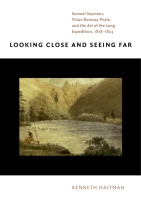




Looking Close and Seeing Far
Samuel Seymour, Titian Ramsay Peale, and the Art of the Long Expedition, 1818–1823
Kenneth Haltman
Looking Close and Seeing Far
Samuel Seymour, Titian Ramsay Peale, and the Art of the Long Expedition, 1818–1823
Kenneth Haltman
“It is difficult to imagine a more learned account of this material. Looking Close and Seeing Far is a signal contribution to studies of American Romanticism—a lucid, exemplary account of the richness of an art of not-knowledge, of an art about failings and strivings to know a place (the American West) as much as that place itself.”
- Description
- Reviews
- Bio
- Table of Contents
- Sample Chapters
- Subjects
This book unites the core body of extant paintings and drawings, providing a detailed account of the expedition through close visual readings that reveal Seymour’s and Peale’s complex and unique responses to the contradictory goals of their assignment. Such work is argued to have greatly influenced future artistic expression in the genres of landscape, ethnographic portraiture, and scientific illustration.
Though the subject matter is linked largely to the history of “the West,” both the art and the expedition itself were eastern in origin, influence, and institutional affiliation. As the leading cultural center of the time, Philadelphia gave focus to the American interest in understanding the world through both scientific and artistic forms of representation. Such a duality, Haltman argues, informed the work of Seymour and Peale, who struggled in their art to reconcile the conflict between their scientific obligations to the mission and their private imaginative and artistic ambitions.
“It is difficult to imagine a more learned account of this material. Looking Close and Seeing Far is a signal contribution to studies of American Romanticism—a lucid, exemplary account of the richness of an art of not-knowledge, of an art about failings and strivings to know a place (the American West) as much as that place itself.”
“University of Oklahoma art historian Kenneth Haltman has collected the surviving images and skillfully weaves a tale of science and art, of eastern sensibilities and western wonders, in this exhaustively researched volume.”
“Looking Close and Seeing Far deepens and complicates our understanding of the art of the western surveys and the relationship between art and science in the early national period. My major concern about this eloquent and beautifully produced book is that because it addresses lesser-known artists, working in less-valued media, in a little-studied period, it will not be as widely read as it deserves to be.”
“Haltman (Univ. of Oklahoma) offers a meticulously researched, carefully written, handsomely illustrated, and perceptively argued study that examines in particular the unique contributions of Samuel Seymour and Titian Ramsay Peale in providing both a visual record and artistic impression of the topography, geology, flora, fauna, and Native peoples encountered.
Haltman carefully examines their paintings and drawings to understand the cultural, artistic, and intellectual context in which they were created and the artistic conventions and symbolism that they followed or abandoned. The detailed notes, comprehensive bibliography, and attractive, appropriate plates further add to the value of this work.”
Kenneth Haltman is the H. Russell Pitman Professor of Art History at the University of Oklahoma. He is co-editor of American Artifacts: Essays in Material Culture (2000), translator and editor of major works by French phenomenologist Gaston Bachelard, and, most recently, a contributor to Nexus of Exchange: Philadelphia and the Visual Culture of Natural History, 1740 to 1840, edited by Amy R. W. Meyers (forthcoming).
Contents
List of Illustrations
Preface
Acknowledgments
Introduction: Figures in a Western Landscape
Samuel Seymour: Science and Imagination
Managing Distance
The Poetics of Geologic Reverie
The Dream of Ethnological Connection
Titian Ramsay Peale: Science and Selfhood
Managing Nature
The Art of Predatory Looking
Natural History as Family History
Conclusion: Looking Close and Seeing Far
Notes
Bibliography
Index
Introduction: Figures in a Western Landscape
The object of the Expedition, is to acquire as thorough and accurate knowledge as may be practicable, of a portion of our country, which is daily becoming more interesting, but which is as yet imperfectly known.
—John C. Calhoun, letter of instructions to Stephen Harriman Long, March 8, 1819
To argue that the hierarchy of genres experienced dramatic realignment in the early decades of the nineteenth century is in a way to state the obvious. The long-accepted view among historians of American art has been that in this period portraiture and history painting yielded in prestige, neatly and seamlessly, to landscape and genre painting. While this characterization seems in general outline true enough, and coincides with both a generational shift in governance in the art establishment, to the extent that one existed, and the rise of a new middle-class interest in works of art produced not by commission but for the market, it simply fails to account for either the range or sophistication of a body of less easily categorized images produced outside or at the margins of conventional usage—works neither portraits nor history paintings nor landscapes nor genre paintings strictly defined. Though art historians generally agree that the expansion of mainstream repertoire beyond portraiture in the early national period opened new avenues for artistic ambition, less attention has been paid the nature of the changes this new opening of possibility occasioned, involving not merely an addition of new genres to those previously in vogue but a reconfiguration of the genre system itself.
Failure to consider the “in their day newness” and “capacity to startle” of such images, of course, risks neglect or repression of their contribution to the visual culture of the period at the peril of our own historical understanding. The art produced by Samuel Seymour and Titian Peale in response to their participation in the Long Expedition offers an opportunity to recover the contemporaneity of this neglected watershed moment in the late 1810s, when a variety of new modes of representation were emerging and exerting a disproportionate influence on artistic innovation and production from, as it were, the margins of the established canon. From that perspective what might at first seem most unconventional about these images—their hybrid status, at once fine art and scientific illustration, rubbing up against, even transgressing, the boundaries of genre; the indefinition of the terms of their production; the uncertainty of their public patrons in the War Department regarding what precisely they should represent and how; indeed, the very multiplicity of audiences for which they were intended—could instead be considered representative of an ongoing process of genre redefinition. Seymour’s Kaskaia, Shienne Chief, Arrappaho (fig. 1), for instance, represents three men seated side by side, their forms contiguous, even overlapping, compressed into a shallow picture space. In the absence of delineated habitat beyond a scribbled clump of grass in the right foreground, they seem isolated from any larger context, recognizable principally in terms of their relation to the viewer and to one another. Seymour has taken pains to differentiate the three by picturing them gazing off in various directions, through a subtle rotation in their orientations in space, and of course by tribal affiliation as indicated in cursive beneath each figure, suggesting that they may be situationally unrelated, even unaware of one another’s presence. Yet their formal interconnectedness, the similarity in style and color of the clothing they wear, the captioned anonymity they share, creates an impression of orderly arrangement, even intimacy, so that a sense of group emerges in the face of psychological dissociation. What links these individuals together (thus the subject of the composition) is their Indianness itself, a naturalized fiction of transtribal racial identity.
The viewer’s inclination to make sense of Seymour’s watercolor as an unusual triple portrait is immediately troubled by the peculiarly generic quality and fragmentation of the likenesses themselves, the more remarkable given the circumstances under which they were created. We know from written accounts that Seymour chose his subjects from among “several distinguished men,” including four chiefs and a number of their followers, composing a war party returning from a successful raid into Spanish territory. Shienne Chief, represented at the center of Seymour’s image, struck Thomas Say as particularly deserving of attention because “endowed with a spirit of unconquerable ferocity.” The other chiefs present seemed, in contrast, “to possess only the dignity of office, without the power of command.”
While in certain details—Shienne Chief’s “highly-ridged aquiline nose,” “corrugated forehead,” and “mouth with corners drawn downward”—Say’s portrait and Seymour’s agree, the differences both in aspect and in treatment seem far more striking. The image represents all three men wrapped in drab undecorated blankets, neither hands nor legs and among them only one arm visible, thus limbless, shrouded, and ungrounded, devoid of attributes of power, indeed labeled like specimens. While Seymour’s execution of these sketches over a period of hours or days, as seems probable, may help to explain their radical abbreviations, it in no way diminishes the thematic impact of this effect. Here placelessness reads as a visual metaphor for decontextualization. Shienne Chief’s dignity and power have been reduced to mere centrality. The very features that communicated controlled emotional intensity to Say here suggest acquiescence rather than fierce independence, frailty as opposed to strength. The man’s distraught expression, his single visible arm, the “bandaging” in which the stump of his other arm has been swathed, read as so many bodily metaphors for disempowerment.
More than anything, perhaps, the portrait’s attitude of loss and resignation seems indebted to a period interest in the study of expression, with attributes recognizably borrowed from Seymour’s own earlier engraving Sadness, after Charles Le Brun (fig. 2). Produced two decades earlier for the Philadelphia edition of the Encyclopaedia Britannica, the image is distinguished similarly by raised eyebrows, downwardly turned nostrils and lips, and a careless lean toward one shoulder. My point is less that Seymour was governed by any one specific model in this inflection of physiognomic fact than that the mode of representation he here improvises, an art of ethnographic portraiture this image and perhaps others today lost played some role in defining, relies on such reference to elevate his visual effect from that of mere reportage, recognizing higher truths in local instances. Seymour in essence drains all three of his figures—Kaskaia, Shienne Chief, and Arrappaho—of some degree of ethnographic specificity the better to fill their forms, so many emptied vessels, with Ideas, contents not ordinarily associated with such images.
For if, in one sense, Seymour, through this decontextualization, dehistoricizes, representing Indians out of time as well as out of place, in another sense his image serves to chronicle their history, here figured as a woeful circumstance, by offering the viewer opportunity to empathize with them in their response to a condition of apparently inevitable loss prefigured here as civilized containment. The choice to combine three portraits in one, while suggestive of a certain density of ethnographic moment, runs counter to the prevailing conventions of historical portraiture in which the selfhood of a dignitary was most often suggested by his solitude in picture space. Seymour’s collapsing of multiple identities—and here, by extension, tribal profiles—into a single frame offers an apt spatial metaphor for the ethnographic practice he also illustrates.
A number of contemporary portraits perhaps beholden to Seymour’s example evidence a similar use of structural metaphor to similarly elegiac effect. John Neagle’s depiction in Philadelphia later that same year of two members of a visiting delegation of Plains Indians, Big Kansas, or Caussetongua, and Sharitarische, Chief of the Grand Pawnees (fig. 3), similar represents a pair of narratively dissociated figures, members of and literally representing different tribes, who float limbless in shared picture space and gaze beyond the picture plane somewhat unfocusedly in different directions. Despite an impressive degree of ethnographic detail featuring delicate feather headdresses, a bear-claw necklace, and a peace medal, the overall effect is one of moody introspection combining Kaskaia’s stoic nobility with Shienne Chief’s sadness and isolation. The gray blankets Caussetongua and Sharitarische wear enwrap them, binding their arms, again suggesting less prestige than powerless passivity, thus lending irony to the promise of bigness and grandeur in their honorifics. Even their adornments read ambiguously, their ear piercings as feminine, the chains around their necks betokening captivity. While it seems certain that for the Indians on whom peace medals were bestowed, those, like the one Sharitarische wears, would have betokened symbolic power instead, here, in an image intended for an Eastern audience of white Americans, the medal seems to signify not just political allegiance but acquiescence to a greater power. An ungroundedness similar to that of Kaskaia, Shienne Chief, Arrappaho, here in commemoration of a visit to the seat of government, reads as an even more telling metaphor for a literal territorial disconnection.
If these effects seem more the result of circumstance than of intent, due for instance to the preparatory nature of the painting, suggested also by its broad, loose brushstrokes, Charles Bird King’s more monumental and fully completed multiportrait Young Omahaw, War Eagle, Little Missouri, and Pawnees (fig. 4), painted in Washington just a few weeks later, suggests otherwise. Here again the representatives of tribes gathered by invitation for ceremonial purpose appear together in an orderly arrangement, sharing a picture space defined abstractly by race in such a way as to evacuate each subject of both personal autonomy and cultural identity. It appears that King took certain license even with historical fact, for the five heads represented belong to only two or possibly three actual sitters, arranged and modified to create a group effect. More unabashedly celebratory and ennobling in its surface rhetoric than the works by Neagle and Seymour to which I am comparing it, more sensually colored and convincingly illusionistic, King’s oil nonetheless subordinates nobility to framed containment. The Monroe peace medal suggests this, its double-edged symbolism familiar from Neagle, enhanced by its alignment with the painted blade of a dramatically aggressive war club pointed ominously and ironically at the throat of the Indian, War Eagle presumably, who wields it.
This relationship between the viewer and assembled Indians seen staring off in multiple directions received a considerably more intimate thematic formulation in Seymour’s expedition watercolor, in viewing which we both occasion and bear witness to the dislocation that results, apparently, as a matter of reformulated convention, when Native American subjects come into ethnographic view. While at least nominally in keeping with his instructions to represent Indians “engaged in celebrating their festivals, or sitting in council” or in “any other way that may be deemed appropriate,” Seymour here profits from the opportunity in order to reflect upon and to make visible the will to power underlying ethnographic understanding. The visual metaphors of fragmentation, indeed of amputation or castration, he employs to this end, like his invocation of Sadness to suggest sorrow, graphically acknowledge the violence of the taxonomic process he records. Seymour in this way offers a glimpse of human character doubly emblematic. His subjects, while standing in synecdochically for all the members of their tribes, embody a melancholy he invites the viewer to share in response to the vicissitudes of history, the passing of a way of life. Such emotional depth and dramatic intensity we might more readily associate with history painting than group portraiture—effects difficult to reconcile with structural and compositional elements that appear to define Kaskaia, Shienne Chief, Arrappaho as an unusual, thematically overdetermined specimen portrait as well.
Sand Hill Crane (fig. 5), a watercolor by Seymour’s expedition colleague Titian Peale, seems even more explicitly a specimen portrait, as we can see from its Linnaean subtitle, Ardea Canadensis. Peale based the image on several field studies recorded in April 1820 and merged them into a single composite image combining three related views. These read together in a narrative depiction of the species, represented by a single bird, beginning with a static profile portrait near to the picture plane, followed just beyond by a transitional image more clearly implying movement, whereby the bird stoops to eat, and culminating in an explosion of energies upward as it takes off in flight on an axis dramatically perpendicular to its line of former motion. Continuity of identity is established through a contiguity of form, reinforced by the singular in the work’s title. This piecing together of elements from a number of dated sketches, all of which survive, enables Peale to represent not just the ornithological specimens he studied but the environment in which they lived—a double fiction in that many individual birds, shot for the purpose, have been combined into one, and the one bird has been made to stand in for all birds in the species. The environment in which it can be seen to live, a wetlands along the Platte River, subtly colored in washes of blue, green, and gold, similarly has been composed from field studies combined into a landscape aesthetically as well as ecologically arranged.
This practice deviated remarkably from established convention. Earlier nineteenth-century natural history illustration, best exemplified perhaps by the engravings in Georges Cuvier’s four-volume Le règne animal of 1817, the most recent among a number of such works in the expedition library, relied instead on careful symmetry and orderly arrangement to represent less the world of nature than the system of rational thought by means of which the order of that world might be conceived. The very first plate (fig. 6) represents five somewhat exotic mammals: a galago (or African lemur), a vison (or American mink), an American otter, a red wolf, and a koala, symmetrically arranged on four tiers, each specimen accompanied by two numbers. The first, a whole integer between 1 and 5, refers to a legend below the plate, which refers in turn to the pages of Cuvier’s text. The second, a fraction denoting scale, gestures outside that text toward an unseen world of presumably observed ecological reality. For example, since the galago on the page measures a bare four centimeters in height, the “real” galago to which this representation refers must measure forty. This reality is reinforced, albeit minimally, by the shadow each animal casts on the generic ground below its feet.
The overall effect is less naturalistic than abstract. Vertical symmetry has been carefully established through orderly arrangement within a stable column composed of three longer specimens (the red wolf, otter, and mink), one to a tier, topped by a fourth tier shared by two more compact animals (the galago and koala), and with an alternance in orientation left and right in the lower tiers and chiastic outward facing above. The size order thus maintained, smaller figures resting on somewhat larger figures, has little, if anything, to do with the actual size of the animals depicted. The galago would in reality be much larger than the koala beside it or the mink below it, as is made clear to the mind, though not the eye, by the scale fractions adjoining each figure. The arbitrary nature of this symmetry is underscored by the koala’s appearance on the first tier, where it fits only in formal terms, adhering neither to the sequence in which discussion of these specimens occurs in the text nor to any geographic relation between them, for the galago is indigenous to Africa, the koala to Australia. Only in formal terms can the composition be said to signify coherently. The positioning of the koala (no. 5) to the immediate left of the galago (no. 1) has the additional effect of introducing a sequential closure to the composition, which reads as a self-contained illustration not so much of the world as of a text about the world.
Peale’s watercolor, by contrast, situates its depiction of a sequence of characteristic sandhill-crane activities in an actual landscape, a conceptual and technical innovation involving a shift from a view of nature as composed of simple elements arranged in clearly defined hierarchies to a more complex vision of ecological interdependency. Peale, in fact, stretches the bounds of the genre even further, imbuing his image with properly narrative action, occurring in time, not just space, so that his landscape specimen portrait reads also as a sort of ornithological genre painting telling a story from the everyday life of a bird. Arguably, however, his ambition is higher still; for Peale resolves tension between the positivist documentary content of the field studies on which this finished work relies and the generalizing, idealizing, abstract “portrait of a species” toward which it gestures, by honoring both modes of understanding equally and, in fact, by suggesting the nature of that resolution in the structure of the image itself, which reads from left to right, then back on the diagonal, inward and upward, as a staged release from ideal category into a realm of empirical facticity, from static profile portrait to the vision of a bird in flight.
The circularity of the soft interior oval of delineated space in which this combined narrative and theory of knowing unfolds suggests that scientific understanding involves focus on both the particular and the general, on facts and on ideas, on fieldwork and on more abstract theorizing, with these complementary modes of representation themselves, as it were, both taking flight from and eventually realighting as the other. This elegant compositional solution is in keeping with the practice that it illustrates, one in which field study leads to the recognition of ideal types, knowledge of which in turn informs a viewer’s subsequent perception of actual specimens.
Peale’s Sand Hill Crane thus at once documents a campaign of ornithological fieldwork while neatly synthesizing and theorizing its own contribution to scientific understanding. His choice to float his image with its indefinite borders centered within picture space, a style known as vignette, serves as an apt spatial metaphor for a style of interpretive, not merely mimetic, vision at the conceptual intersection of science and art. If the rectilinearity of Peale’s field studies, conforming to that of the sketchbooks in which he worked, suggests their own transcriptive rigor and adherence to fact, the cloudlike interiority of the vignette form that he favored in his finished watercolors suggests self-conscious fiction calculated to communicate ideas—less a dissolution of the secure structures of Enlightenment confidence in reason than an inflection of those structures toward a greater atmospheric subjectivity.
Whereas Seymour, in Kaskaia, Shienne Chief, Arrappaho, a different sort of triple portrait, suggests through dark metaphors of closure and containment skepticism about the scientific enterprise he represents, Peale expresses through metaphors of continuity, flight, and release a more uplifting view. Both artists, however, introduce into their work a heretofore unrecognized thematic content and methodological self-consciousness.
In Engineer Cantonment (fig. 7), Peale represents the expedition’s winter camp, a few miles south of Council Bluffs. We stand along the west bank of the Missouri River, facing across a sheltered inlet the pair of tidy log cabins, one almost completely hidden behind the other, that Long had had his men construct late that summer and early fall among the trees a short distance from the landing. A steamboat, the appropriately named Western Engineer, figures prominently in the left midground. Seen in profile, the vessel flies from its stern an American flag so large it reaches almost to the surface of the water. A thin cloud of black smoke pours from a cylindrical stack amidships, matched in color by smaller puffs of smoke emerging from a figurehead at the tip of the bow. To our right, four smaller masted vessels have been pulled ashore, now possibly iced in. The bluffs are bare of trees; those dotting the slopes are without leaves. An inscription at lower left bears out the impression of season we get from the image: February, the dead of winter. From the cold whitish blue of the sky, we know the hour to be shortly after dawn. There is no one about.
In Peale’s watercolor, in fact, the only signs of life are those aboard the steamboat itself, and his palette confirms this. The red pennant floating from the top of the mast, the only element in the composition to break the bleak horizon line, seems to gather the rose light suffusing the early morning sky, redirecting the viewer’s gaze downward toward the stars and stripes in which its color—along with the dominant blue of the far hillsides—is repeated. Given these subtly patriotic colors and the quiet allegory of a fresh beginning, of a voyage under way, Peale’s landscape (which is also a history painting, though writ small, and a ship’s portrait) ties its theme of optimistic nationalism to the engine firing invisibly away below deck. The steamboat, in the absence of passengers and crew, would seem to represent the expedition metonymically. The touches of red in the two flags, like the telltale plumes of smoke, are visual reminders of its heart of fire, of the mode of mechanized expeditionary progress that it symbolizes.
Long’s design itself was visionary beyond simple engineering. Through a program of public iconography, he contrived to turn the Western Engineer into a magisterial expression of War Department ambitions and his own, a set of visual conceit borrowed by Peale for other purposes.
On the actual steamboat, for instance, the circular covers concealing its innovative, stern-mounted port and starboard wheels bore the names respectively of James Monroe, then president, and John. C. Calhoun, who were, as Peale himself noted in his journal, “the two propelling powers of the expedition.” In Engineer Cantonment this lettering, though visible, has been reduced to the monogram insignia “U S” in an unpunctuated visual pun ensuring legibility while inviting viewers to take the ship’s symbolic surrogacy personally and collectively.
The steamboat’s calculated symbolism for period observers resided first and foremost in its figurehead, described in one newspaper account as “a huge serpent, black and scaly, rising out of the water from under the boat, his head as high as the deck, dart[ing] forward, his mouth open, vomiting smoke, and apparently carrying the boat on his back.” Early steamboats tended to resemble the seafaring vessels on which they were modeled, and so bowsprits and figureheads themselves were not uncommon. Long’s achievement lay in first selecting a motif appropriate to his design, then in integrating form and function. The idea of a serpent—Say thought it a boa, others a dragon—may have been suggested by the discharge of smoke and fire inevitable in early engines lacking an internal flue. With an eye to drama, Long redirected some of that exhaust through a pipe passing through the carved serpent’s mouth; and though most of the smoke the boat “vomited” actually escaped through the principal smokestack positioned behind the mast (as is apparent in Peale’s image), this detail tended not to be acknowledged.
These “captivating peculiarities in the structure of the boat,” as they were later described in Edwin James’s Account of an Expedition from Pittsburgh to the Rocky Mountains (hereafter the Account), were possibly inspired by the sighting of a “great sea serpent” off the Atlantic coast in August 1817, a minor cause célèbre of the period restimulated by a flurry of new reports the following summer. Whatever its source, the figurehead served many ends: providing the ship a stylishly totemic battle dress to frighten superstitious natives, lightheartedly invoking the scientific fait divers du jour, offering a humorous rejoinder to anti-industrialist critics of progress for whom the steam engine appeared a fire-breathing dragon despoiling the countryside, and not least making a fanciful Old Testament allusion to the serpent of knowledge, here bearing upon its back a boatload of scientists and artists spurred by intellectual, not merely territorial, desire to ingest and so reconstitute the world.
Peale borrows from this symbolism while carefully modulating it. He reduces the sensationalism of the serpent and its association with the ship’s arsenal (which he himself made much of in his diary, noting that a brass fourpounder mounted in the bow surveyed the river from directly above the serpent’s head) to insist instead on the boat’s integration into the environment through which it passed. Indeed here, as in watercolors he completed from more true-to-fact preliminary sketches, Peale seems less concerned with offering a virtual transcription of perceived experience than with propounding a symbolic or idealized vision based on facts selectively and artfully manipulated. We know, for instance, from the London edition of the Account, that in February 1820, when this image was completed or at least dated, the Western Engineer itself would not have appeared as it does here, since its mast had been unshipped for the winter (another of its innovative features), not to be remounted until late the following spring. Peale takes similar liberties with the landscape setting, which appears far bleaker in the field sketch from which he was working. The result, an image of dynamic scientific nationalism, warm despite the winter cold, represents the expeditionary enterprise in a quieter, though no less heroic, light.
The image betrays another more telling omission. The symbolic program of the Western Engineer culminated literally in an “elegant flag” flown from high up the ship’s mast, just below the fluttering red pennant we see, described in newspaper accounts as having been painted on silk by Peale himself to represent “a white man and an Indian shaking hands.” This motif was directly inspired by and so recalled the design on the reverse side of the scores of peace medals distributed by Lewis and Clark a generation earlier in some of the same regions through which the expedition hoped to travel. That allusion to expeditionary history would have had the practical function of recognizably linking Long’s command to a visible symbol of prior diplomacy, a gesture principally aimed at Indians they might encounter, which perhaps explains its absence here, in an image intended not for Western tribes susceptible of recognizing the motif from medals held for fifteen years as tokens of prestige but for Eastern whites for whom it might have been unintelligible without extrapictorial explanation.
Peale’s watercolor offers an appropriate rejoinder to another, more popular contemporary image associated with the travels of Lewis and Clark, the frontispiece to the only illustrated account of their “Voyages and Travels”—a volume naturally held in the expedition library but also listed in that of the Philadelphia Museum, where it appears in Peale’s own earlier inventory of the collection. The contrast between his romantic image of the Western Engineer and A Canoe Striking on a Tree (fig. 8) could hardly, in fact, be greater. That earlier depiction represents two men, by implication, although not according to the narrative, Lewis and Clark themselves, throwing up their hands in helpless disbelief as their canoe founders, having run into the branches of a dead tree jutting out from shore. While one of the two lifts his paddle to the heavens, the other gestures imploringly in the direction of their horses, whose heads alone appear above the surface of the water, echoing somewhat comically the men’s own.
The decidedly antiheroic tone of this inaugural image is only reinforced by recognition of its own pictorial allusion to that moment in Pilgrim’s Progress when Christian and Pliable sink down into the Slough of Despond, depicted in a popular late-eighteenth-century British print from which the Canoe composition has clearly been cribbed (fig. 9). Bunyan’s hapless pilgrims lament their plight in terms that reinforce its moral dimensions: “Ah, neighbor Christian, where are you now? Truly, said Christian, I do not know.” The frontispiece succeeds as a result in lending its depiction of a simple mishap both metaphysical and wryly political meaning, framing the memoir it illustrates as a perilous quest narrative and thus with some irreverence the Lewis and Clark expedition itself as an unlikely quest.
Peale, on the other hand, represents expeditionary science in 1820 as a confident assertion of civilized control and linear advance. The plume of dissipating smoke that emerges makes visible the metaphorics governing the expedition’s own function as an engine of translation designed to transform figuratively, through its library, through the performance of its scientific crew, the world of nature into image and idea, just as the fire in the steamboat’s boiler works to convert wood and water into the more literal power of steam. This, too, like Seymour’s Kaskaia, Shienne Chief, Arrappaho and his own Sand Hill Crane, presents, beyond transcription, a thoughtful response to artistic precedent as well as to history.
A chronological overview of the travels of the expedition would begin on board the Western Engineer, which, according to a local paper, having first “embraced the watery element in the most graceful manner under a national salute” near Pittsburgh on April 26, 1819, shortly thereafter began its voyage down the Ohio toward that river’s confluence with the Mississippi. Along the way both artists began to exercise their craft in a preliminary fashion. Peale, we know from both his journals and his sketchbooks, busied himself working out a system for recording and keeping track of specimens of interest to both William Baldwin, the expedition’s botanist that first season, and Say, for the moment principally its zoologist, his drawing somewhat random as a consequence. Seymour kept no journal that we know of (though one was required of him and may someday resurface); however, we know from the Account that he made visits ashore on certain occasions. According to Baldwin, even before departing Pittsburgh, Seymour had sketched “a number of romantic views,” while Peale recorded “fishes and amphibia” for Say.
In late June, after two weeks in St. Louis, they reembarked, now heading north and west up the Missouri, making all-too-frequent stops for wood and repairs. A general frustration with this tedium and the desirability of lightening the boat led Long early in August to detach his scientists and artists on an overland reconnaissance, instructing them if possible to make contact with the Kansa through whose territory they would be passing and to rejoin the vessel further upriver. It was in and around the Kansa villages that Peale would execute his earliest dated field sketches.
This contingent suffered one serious mishap, a hostile encounter with a much larger party of Pawnee, in addition to severe exposure to the elements, a taste of things to come; but by early September the full expedition had regrouped without losses on the west bank of the Missouri just a few miles south of Council Bluffs in the vicinity of the Missouri Fur Company trading post Fort Lisa. They christened the site Engineer Cantonment, the winter view of which was later recorded by Peale. Permanent accommodations were constructed and a shaded council site arranged along the river, where, in early October, Benjamin O’Fallon, the new Indian agent who had traveled with them from St. Charles, would meet with local tribal delegations, encounters recorded by Seymour. In the foreground of one of these images, Oto Council, Seymour offered the only known group portrait of the core members of the expedition, decked out in full-dress uniform (fig. 10).
By September, however, Long himself had returned east, taking Augustus Jessup, his geologist, along with him, leaving the remaining members of the party to their various assignments in making sense of the region. During the winter months, Peale and Say—Baldwin, in poor health, had resigned in July and died shortly thereafter—busied themselves most productively. In a letter to his brother hastily written the night before Long’s departure, Say boasted of their circumstances: “We have here very comfortable winter quarters, snug log houses, amply large, with capacious fire places & plenty of fuel around us. We shall not want for provisions.” He undertook with Peale’s assistance a comprehensive program of scientific investigation, ethnological—he would later recall the prevailingly “friendly intercourse with the neighbouring Indians”—zoological, ornithological, and entomological. Peale collected and recorded a wide range of specimens in his sketchbooks, while Seymour took advantage of the quiet to complete watercolors directly over pencil drawings in his.
Reality on the ground when Long returned in May, however, must have felt quite different from the easy confidence and heroic optimism suggested either by Seymour’s Oto Council, sketched and perhaps painted in October, or Peale’s Engineer Cantonment, dated that February. Long’s dream venture, which at its grandest was to have lasted three or more years and involved the examination by steamboat of “all the immense Western waters,” had been reduced by fiscal and political circumstances to a single overland excursion to the Rocky Mountains. While the larger military venture to which it had originally been attached, an effort to extend the influence of the United States among tribes along the upper Missouri and to discourage British competition in an increasingly lucrative fur trade, was canceled entirely, Long’s scientific reconnaissance was allowed to go forward, though greatly reduced in both budget and scope.
He returned with Edwin James, chosen to replace Jessup and Baldwin, and John R. Bell, an instructor at West Point, to replace Biddle, keeper of the expedition journal, who had requested a transfer. After somewhat hurried preparations, they “set out for the Mountains under the most discouraging circumstances” on the sixth of June, as Say would laconically describe the moment in a letter to a colleague. Ill equipped (with only six extra horses and just a month’s supply of food), lacking even enough boxes to store scientific samples, reduced to fewer than two dozen men, including a small military escort, hunters, guides, and interpreters, the expedition faced prospects that seemed perilous at best.
“During our Western tour we had to encounter & surmount many difficulties & privations,” Say later wrote, going on to provide an equally succinct synopsis:
Our paucity of number, induced our neighbouring indians to endeavour to dissuade us from what they considered a rash enterprise; they assured us that the country was covered with hostile indians, who would not fail to massacre every individual of our small party. . . . We however reached the mountains, by way of the River Platte, in safety & found them capped with snow in July. Some of the party ascended to the summit of the highest peak mentioned by Pike. We then passed along the base of the Mount[ain]s in a southern direction until we met the Arkinsaw River, & proceded down that stream to the vicinity of Pike’s ‘First fork’ where our party was divided & Major Long, our commander, with eleven others of our number proceeded in the direction of Red River, & the remaining ten of us, continued our journey down the Arkinsaw. We met several parties of the little known natives who wander in that remote region, of whom some received us with hospitality, & the conduct of others tended to excite our vigilance. But, contrary to our expectations, we had the good fortune to avoid hostilities with any of them. When within two hundred miles of Fort Smith, three of our men deserted from us, carrying with them our best horses, & all my manuscripts, consisting of five books. We soon after arrived at Fort Smith & were in a few days joined by Major Long & party, who had descended [the] Canadian River.
This itinerary can be followed nicely on the western section of the map Long himself produced for the Account (fig. 11), with the “several routes of the Exploring Expedition” indicated in dotted lines interrupted by small crosses showing the sites of encampments, with dates. As is the case with so much of the private record left by expedition participants, Say’s private narrative reveals what the public record often carefully obscures: the considerable dysfunction and anxiety that underlay noteworthy achievements attributable to all involved, from scientists to artists to topographic engineers doubling as diplomatic envoys and cartographers. Material privation, threats and warnings, doubts, the fragmentation of forces on the ground, a pervasive sense of having been betrayed by circumstances and mismanagement combined, all this made literal and narrative at last in the theft by deserters of a portion of their intellectual accomplishment—these were the conditions in the context of which the ascent “to the summit of the highest peak mentioned by Pike” and “good fortune to avoid hostilities” also described by Say are to be measured.
This prevailing circumstance of dogged achievement in the face of an adversity at once historical and existential seems well captured in the much more distant group portrait of the expedition Seymour embedded in his View of the Insulated Table Lands, known only in an engraving by Cephas Grier Childs (fig. 12). This image, the final plate in the illustrated atlas published as the third volume to the Philadelphia edition of the Account, represents that moment described by Say on the morning of July 24, 1820, just east of the Rocky Mountains, when Long divided his command, heading off with eleven men “in the direction of Red River,” while those remaining continued down the Arkansas. Seymour, assigned along with Say to the latter group, depicts the larger contingent moving off in single file. The line of men with their twenty horses and mules discernible in silhouette against a lighter swath of midground correspond, more or less, to the numbers Say reports. As the title of the image makes no reference to this division of forces, however, this advance, much like the steamboat in Peale’s Engineer Cantonment, serves both metonymically and metaphorically to represent the expedition as a whole, making its way determinedly through an unfamiliar world.
As Seymour’s title indicates, the landscape through which the expedition marches is geologically specific, defined by a range of insulated tablelands at the foot of the mountains. In his own report to the secretary of war, Long follows James in describing these formations as “insulated tracts . . . scattered throughout the section [that] give to the country a very striking and wonderful appearance. They rise from six to eight hundred feet above the common level, and are surrounded, in many instances, by rugged slopes, and perpendicular precipices, rendering their summits almost inaccessible. These tracts,” he goes on to note, “are denominated tabular, not from any flatness of surface, by which they are characterized, but from their appearance at a distant view, and from the horizontal disposition of the stratifications imbedded in them.”
In Seymour’s image narrative content and scientific content—a line of men moving through a geologic landscape—coincide. View of the Insulated Table Lands takes as its subject, that is to say, a formation of secondary sandstone as perceived by members of an expedition who have come to study it, upon whose observations and artistry the image itself relies. Seymour has chosen for his prospect the very “distant view” described by James and Long, a vantage that at once preserves the “striking appearance” of the series of formations while diminishing the daunting scale of their six- to eight-hundred-foot “rugged slopes” and “perpendicular precipices” thought likely to render their summits “almost inaccessible.” Both his subject and theme concern the drama of difficult yet still possible access.
The line of men and mounts thus represents the expedition not just in the documentary sense but in the figurative sense of passage through the landscape as a voyage of discovery. Seymour’s compositional design invites the viewer to participate vicariously in the expedition’s process of investigation, to pull up in one’s imagination behind the last rider in line. This implied continuity with the viewer’s own experience is reinforced by the backward glance of the second-to-last rider, seemingly in recognition of our witnessing presence, as by Seymour’s use of the term “view” in his title, a picturesque reminder of the particularity of the view that we enjoy; for while the tabular formation nearest us in the left midground can be clearly seen from the vantage we are given, the insulated tablelands themselves recede from view in a line only resolvable by moving slightly further into picture space.
In this regard typical of Seymour’s landscapes, the image frames the topographic detail visible in the distance with thematically charged foreground elements serving here to figure the work of expeditionary science allegorically as a heroic passage through the desert. In point of fact, the terrain the expedition traversed late that July was literally desertic as well; the list of engravings that serves the Account atlas as a combination table of contents and index refers the reader with an interest in Seymour’s image not to the narrative moment when the company divides but to a geologic description of the larger region identified as the “great American Desert,” later modified in the London edition to read “Great Desert at the Base of the Rocky Mountains.” Seymour’s understated allusive image gives pictorial expression to a language of secularized, quasi-biblical reference shared by other members of the expedition, for instance by Say in his description of the “many difficulties & privations we had to encounter & surmount.” James, most publicly in the Account but also in private letters to his brother John, refers similarly to the expedition’s “struggles” and “travails” that summer. In an affectionate letter to Peale written months after their safe return, he invokes their “last summer’s pilgrimage in the wilderness,” a phrase with a tone of pride and resolve suggested also by Seymour’s tidy line of march. The course the expedition plots across this landscape, reinforced by parallel recession in the rock formations it has come to study, imbues this passage through the desert with a quiet sense of order and decorum.
At the same time, as he does in Kaskaia, Shienne Chief, Arrappaho, Seymour takes advantage of the documentary ambition of his work, its status as a scientific illustration, to introduce a note of skepticism with regard to the scientific method itself. In View of the Insulated Table Lands, recording the profile of geologic formations James in particular has come to study, Seymour makes visible through parallel lines of recession the distance ineluctably separating the scientists from their putative objects of scrutiny, a structure of nonpenetration with resonance at once psychological and epistemological.
As chance would have it, a watercolor by Peale with a similar subject, painted in an expedition sketchbook back in Philadelphia at about the time Seymour was working up the original painting from which View of the Insulated Table Lands was engraved, survives as well, perhaps also intended for inclusion in the Account. Peale’s Near the Encampment of the 25th July 1820 (fig. 13) evidences the same respect for topographic accuracy shown by Seymour, although distances have been collapsed, allowing both a closer look at the striation in the rock face and a glimpse of the river that has just been crossed—as James specifies, “nearly at right angles.” Quite logically the artists were assigned to different parties, though the number of figures seen in neither image corresponds exactly to historical reality. Each serves principally to represent instead a noble, if anonymous, collective movement through the western landscape by a line of white explorers, a paradigm as much symbolic as historical of military/scientific progress and determination. Furthermore, Peale has incorporated into his rendition of the scene three fancifully symbolic Indians, imagined in the costume of classical Rome, who, from a low bluff above the river bank, observe the expedition’s lonely but still resolute progress, here across, rather than out into, the desert. The most prominent standing Indian points theatrically for his companions’ benefit, and so ours, in the direction Long and his men have taken, confirming by means of this gesture the linearity of their advance, which also parallels the line of cliffs. Warm earth tones throughout the foreground but concentrated in two curiously geometric fires burning just beyond the picture plane divide the realm we share as viewers with these wholly imagined Indian figures from the cooler distance beyond through which Long’s men advance.
By introducing into what originated in his sketchbooks as a color-coded drawing of a site of geologic interest to James not just imagined surrogate observers but a portrait of the expedition borrowed from his colleague Seymour, Peale transforms the landscape he records into a new mode of history-painting vernacular despite its classical allusions. In making use of stylized Indians to frame his version of a narrative presenting science as a stoic, civilized advance in uncharted wilderness, he at once raises and sentimentalizes the issue of Native American priority in that landscape while yet representing the line of advance itself as isolated and contingent, certainly at risk. This allegorical suggestion resonates with what we see in Seymour’s Insulated Table Lands, though more artfully self-conscious in its execution, and not just in the undisguised fiction of the Indian repoussoir but in the twin columns of smoke from their fires that open a V-shaped window serving to frame our view both of the expedition and the world through which it passes.
Peale’s Pawnee Loup Breastwork on the River Platte (fig. 14), representing an improvised circular fort composed of stumps and logs come upon by the full expedition a month earlier, employs imagined smoke from imagined Indian fires to similar effect, as a reminder of the rhetorical nature and artful contrivance of the image itself. This “fortification” (as Peale described the structure in notes scribbled directly on the field sketch from which this work derives) stood in the vicinity of a straggly line of cottonwoods, the likely source of its materials, perhaps a hundred yards from the river, just visible on the near horizon. In the foreground, as many as a dozen bison skulls arranged in an open semicircle stare fixedly in our direction, oriented toward a carefully hewn stick planted in the ground in front of us. James specifies, in fact, in both his personal journal and in the Account, that this semicircle opened toward the viewer in another sense as well, facing east.
Two Indians appear within the fort, one seated cross-legged, while the other, standing upright, a pointed staff or spear over his shoulder, gestures dramatically toward the smoke of a fire burning at its center. Two others engage in animated conversation in the right foreground. One, pipe in hand, exhales a large cloud of white smoke, while his companion gestures emphatically to our right and off the sheet.
From all evidence, however, even that of the fort itself, no actual Indians were encountered here at all. This fiction would appear inspired by an account of the fort given by Bijeau, one of the expedition’s guides and interpreters, recorded in pencil in the upper right corner of Peale’s image and subsequently painted over with wash. According to Bijeau, the structure was a Pawnee Skeeree breastwork abandoned that spring, months before the expedition came upon it.
James, in his diary, dedicates two pages to the fort, noting that its improvised structure of “broken and half-decayed logs of wood” buttressed by the bones of bison was large enough to hold thirty men. He repeats this assessment nearly verbatim in the Account, adding that the walls of the fort measured at some points five feet in height. It was, however, the possible significance of the display of bison skulls that compelled the closest scrutiny, occasioning much reflection. James counts sixteen skulls and notes that all point in the same direction, not just to the east but downriver. He describes with almost mathematical precision the focal position of a seventeenth skull, “[n]ear the centre of the circle which this row would describe, if continued,” and the red lines with which it has been marked. The description offered by Bell differs in numerous particulars—he sees sixteen skulls in total, fifteen around and one in the center—and outdoes that of James in its detail. He reports, for instance, the focal skull to have been painted with thirty stripes and a small half circle (but in black, not red) and goes on to note the discovery of “three small sticks each about 6 feet long” and “peeled of the bark” planted in the ground around the fort, to each of which three leather thongs were fastened “at the distance of 6 inches apart commencing from the small ends of the sticks.”
Such seemingly recondite, though obviously intentional, symbolism posed a challenge to scientific, here ethnographic, interpretation, and Bijeau’s reading, adopted by Peale in his watercolor, was recorded with obvious satisfaction by both James and Bell as well. The circle of skulls in combination with the markings on the central skull (whether in red or in black) were signs that the camp had of late been occupied by a war party returning from a southern raid and that thirty-six men had been involved. The three or four sticks found planted in the ground (the reports again differ in their count) “with a few hairs tied in two parcels at the end of each” announce that three (or four) scalps had been taken—that the raid had been a success. In the Account, echoing Bijeau, this manner of communicating information by design is termed “great medicine,” and James’s recommunication to the reader of Bijeaus interpretation seeks, perhaps unwittingly, to share in that “great medicine,” concluding with the following pronouncement: “A record of facts which may be important and interesting to others, is thus left for the benefit of all who may follow.”
Yet despite this collective effort at interpretive understanding and apparent interest in the facts, Peale’s image departs from the highly detailed observations of his colleagues in striking ways. No central skull appears, whatever the color of its markings, and the stick planted prominently in the center foreground, certainly shorter than six feet, bears only a single leather-thong bundle, not two. The watercolor’s most conspicuous departures, of course, are its depiction of Indians, the fire in the fort by which two of them gather, and, for that matter, a herd of equally invented bison grazing off to the left.
The logic in this restructuring and reimagining seems first of all aesthetic. The axis of visual engagement Peale has chosen brings the circle of skulls into alignment with the circular fort whose configuration it neatly echoes, a connection signaled and indeed made literal at the picture plane by the upright stick connecting the two passages. Thus organized, the ritual arrangement in the foreground helps to explain the fort, while the Indians who occupy the fort, along with their brethren, lend narrative plausibility in turn to the display of skulls. Peale’s aesthetic license thus serves the end of communicating information—an intent, moreover, broadly consonant with that of the Pawnee. Facts are not wholly abandoned. It seems likely that the fort itself, the nominal subject of the image, has been drawn to scale, no matter if the bison skulls have been reduced in number. As for the Indians, their presence, however stylized, corresponds at least to a plausible reconstruction of a past reality. Given the casual nature of their interactions, we might consider Peale’s watercolor something of an ethnographic genre scene depicting a moment in the everyday life of the Pawnee while documenting expeditionary history at the same time. The fictional aspect of his image, based on, though not constrained by, observation, seems to be acknowledged by the gestures of the Indians themselves, pointing toward plumes of rising smoke—a reminder also of the indefinite nature of scientific observation itself, as witness the discrepancies in the scientists’ own firsthand accounts.
As should by now be clear, both artists took scientific practices and objects as a pretext for artistic statement. That the science they found means to document in this way was of the highest seriousness lent and continues to lend their work considerable gravity, since the intellectual stakes were high. Both artists and scientists were involved in what they saw, and we with historical hindsight can see, as a revolutionary redefinition of ways of perceiving the world. Say and James between them were responsible for making sense of an unexplored region’s zoology, ornithology, botany, entomology, geology, and, in its emerging protoscientific form, ethnology; both were ambitious men, aware that their findings would reshape these fields of study, just as the science they practiced was itself emerging into national prominence and enjoying a new professional status. It was in fact under the simultaneous pressure of responsibility to science in the throes of new discovery and awareness of the equally new possibilities that art itself enjoyed, given its own emergence into national prominence and professional self-consciousness, that Seymour and Peale innovated with such freedom.
Their success had something, of course, to do with the unfamiliar nature and, where the established hierarchies of pictorial representation were concerned, uncertain status of their principle subjects. The lack of sophistication of Long and Calhoun in such matters—the premium they placed on a generalized, undefined aesthetic quality in art and on technical accomplishment—allowed both artists greater leeway still to introduce more properly, self-consciously thematic content into expedition images.
Such is the case, for instance, with Seymour’s lovely View of James Peak in the Rain (fig. 15) in its offer of a distant view of the mountains picturesquely framed by trees just as a summer storm arrives, casting an atmospheric veil over the scene. The accuracy with which the profile of James Peak itself, perfectly centered on the horizon, has been rendered is suggested both by its title status and the dotted contour lines that Seymour has left visible surrounding the white field of its snow-covered upper reaches. The lone sentry holding a sort of military line between the world we occupy and that far distance, however, introduces quiet drama into what might otherwise have been, or seemed, a merely topographic rendering. The gaze moves back and forth between this man making his way slowly out of view to our left and the far distant peak toward which his rifle points, triangulated in the image by an empty space in the right foreground, where we are invited to imagine stepping into picture space ourselves to follow his movement out of sight. In conventional terms the sentry functions in the image as a surrogate for us, yet curiously he would seem to have his eyes not on the mountain peak in question but on something out of our view.
We might conclude, in fact, that Seymour’s image is concerned with sight, not merely with the view of one particular peak, given its attention to the blurring effect the coming rain is having on that view and to the imminent disappearance of a sentry who is himself, after all, on watch, not to mention the seemingly self-evident use of the term “view” in the work’s title. The image would seem to have been inspired by one of the signal events in the expedition’s history, the climbing of this mountain peak a week before by Edwin James in the company of three others, a symbolic achievement in itself but one that had allowed an invaluable description from above of the region’s topography and the study and collection of a number of botanical specimens unknown to science. Because they were the first men known to have made the climb, Long renamed the mountain, previously known as Pike’s Peak, in James’s honor. Yet Seymour, in calling attention to these acts of discovery, seems insistently to call attention to his own translation of that place and those events into a visionary moment. This he signals not just through a reliance on picturesque compositional elements or through his handling of the rain to imbue the scene with an atmosphere of romance and mystery but through placement of his signature directly beneath the figure of the sentry whose presence, added only as a finishing touch, aligns his own creative act directly with this uncertain view within the view, as if contesting the claim of science to it.
Seymour consistently took pains to preserve a certain accuracy of description in his work yet always with a creative agenda, in narrative paintings like this one, for instance, positioning human figures in the landscape, some observed, others wholly invented, that serve in that other sense intended by the title of this introduction to introduce thematic or interpretive ideas. We see this even in a nonnarrative image not set in a landscape, like Kaskaia, Shienne Chief, Arrappaho, a work attentive to detail and responsive to history yet principally determined by aesthetic and conceptual concerns. Even Peale, for whom strict specificity was key (at least insofar as his field sketches were concerned, which featured measurements and detailed observations of particular specimens he collected for that purpose), designed the watercolors he completed from preparatory studies as artistic statements, abstracting field data into carefully, often beautifully aestheticized conceptual fictions.
This visual record, in its range and extent unique in the period, evidences pressure from conflicting modes of perception characteristic of both the expedition and its moment in history, the imperative to look close, appropriate to late-Enlightenment empiricism, in seeming tension with the proto-Romantic predilection to see far. Perhaps needless to say, these terms, adopted as the title to this book, refer as well to my own critical approach to the works of art I treat with close attention to images enabling consideration of their broader implications. Though neither Seymour nor Peale evidences much concern with the politics of empire per se, both men, in devising pictorial means to made sense of the work of discovery, made visible the processes of intellectual appropriation while reflecting self-consciously on the nature of the artistic conventions they deployed in so doing.
Also of Interest
Mailing List
Subscribe to our mailing list and be notified about new titles, journals and catalogs.