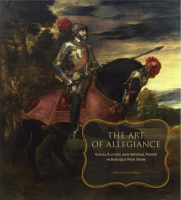




The Art of Allegiance
Visual Culture and Imperial Power in Baroque New Spain
Michael Schreffler
“The book is nicely illustrated; several of the visuals—some well known, others, lesser known—are delightfully incorporated into the study.”
- Description
- Reviews
- Bio
- Table of Contents
- Sample Chapters
- Subjects
The Art of Allegiance opens with a discussion of the royal palace in Mexico City, now destroyed but known through a number of images, and then moves on to consider its interior decoration, particularly the Hall of Royal Accord and the numerous portraits of royalty and government officials displayed in the palace. Subsequent chapters examine images in which the conquest of Mexico is depicted, maps showing New Spain’s relationship to Spain and the larger world, and the restructuring of space in and through imperial rule. Although the book focuses on material from the reign of Charles II (1665–1700), it sheds light on the wider development of cultural politics in the Spanish colonial world.
“The book is nicely illustrated; several of the visuals—some well known, others, lesser known—are delightfully incorporated into the study.”
“[This] handsome volume contains full source notes, an ample bibliography, and a wealth of illustrations. . . . Schreffler’s careful scholarship and well-written and persuasive text make the book a necessity for scholars and libraries dealing with colonial Spanish America.”
Michael Schreffler is Associate Professor of Art History at Virginia Commonwealth University. He is co-editor of Fritz Scholder: Thirty Years of Sculpture (1994).
Contents
List of Illustrations
Acknowledgments
Introduction
1. The Royal Palace and the Loyal City
2. The Architecture of Succession
3. The King’s Two Bodies Reconsidered
4. Allegiance, History, and Commodity
5. Shaping the Universal Monarchy
Conclusion: Empire and Enclosure
Appendix: Description of the Royal Palace in Mexico City from Isidro de Sariñana y Cuenca’s Llanto del Occidente, 1666.
Notes
Bibliography
Index
Introduction
At noon on Friday 15 May 1699, a letter from Charles II, the King of Spain, arrived in Mexico City, the capital of the Viceroyalty of New Spain. Penned several months earlier in Madrid, the geographic locus of Spanish imperial power, the letter had been sent first to Seville or Cádiz, the monarchy’s chief peninsular ports to the Americas in the later seventeenth century. From there, it had begun its 5,400-mile (8,700-km) journey aboard a ship that would dock several months later at Veracruz, New Spain’s principal Atlantic port (Fig. 1). When the letter finally arrived in Mexico City, its surprising contents were read aloud and were paraphrased in the journal of Antonio de Robles, one of the city’s residents. “The King,” Robles wrote, “desired very much to know how the rumor had spread that he was dead.”
This trivial but nonetheless remarkable episode in Spanish imperial history demonstrates the formidable challenge the crown faced in asserting its presence and authority in New Spain, where none of the Spanish Habsburg Kings would ever set foot. This problem, which has been described by historians as that of the “absent” or “distant” King, has been examined from a number of different perspectives, and the scholarly literature on the subject has revealed an intricate complex of ideas and acts that facilitated the crown’s governance of its territorial possessions in the Americas and elsewhere in the early modern Hispanic world. One of the ways in which the problem has been addressed is through the analysis of the institution and office of the Viceroy, the King’s appointed representative or “alter ego” in his distant kingdoms. That institution had a long history in the governance of medieval Iberia and was instituted in the Americas in 1535 by Charles V, the great-great-grandfather of Charles II. In total, thirty different men served as Viceroys to New Spain under the Spanish Habsburgs’ rule; all of them were from families of high social standing in peninsular Spain, most of them held titles of nobility, and several were high-ranking members of the clergy. Studies of the institution in New Spain have revealed its important role in governance in the early modern Spanish empire by examining the administrative and ceremonial duties with which the King’s appointees in the Viceroyalty were charged, and by exploring the complex political philosophy and logic upon which the institution was based. As Alejandro Cañeque has shown in his analysis of the institution, seventeenth-century writers conceived of the Viceroy as the King’s “living image.”
The problem of governance by a “distant King” has also been examined through the study of political rituals and their accompanying imagery and apparatus in New Spain. Such rituals included, for example, the Viceroy’s inaugural entrance into Mexico City, a series of processions, performances, and spectacles that took place over the course of several weeks; and the jura del rey, the ceremony in which the New Spanish public swore an oath of loyalty to the absent King. A large body of scholarship has shown that these and other rituals asserted the presence of kingly power in sixteenth- and seventeenth-century New Spain in performative and often theatrical ways. As Linda Curcio-Nagy has noted in her recent study, political rituals such as the Viceroy’s inaugural entry into Mexico City employed “music, dance, and public display, rather than the blasts of muskets . . . in a Spanish effort to maintain control of a newly acquired empire.”
This book builds upon those studies of administrators, institutions, and rituals in the Viceroyalty, but it approaches the problem from a different perspective, focusing on the ways in which visual representation—in the form of painted imagery—intervened in the exercise of imperial power in Baroque New Spain. The Art of Allegiance examines a corpus of visual images produced in and around Mexico City that, in a variety of ways, represents the concepts of kingly presence and authority as well as those of obedience, loyalty, and allegiance to the crown. The images include portraits of Kings and Viceroys as well as painted depictions of palaces, cities, and continents. It is important to note that these are not the only forms of visual representation that addressed the concept of the crown’s power in New Spain, for religious imagery, too, intervened forcefully in the production of a discourse on the monarchy’s presence and authority. But in this book, my focus is on what has been called secular painting, a field of artistic production that flourished in the Viceroyalty in the later seventeenth century, and one that has received less scholarly attention than has the religious art that constituted the lion’s share of painters’ output in New Spain. My approach to these secular-themed objects and images is what I would characterize as a visual-cultural one; that is, it fuses formal and iconological analysis with the study of representation’s agency in the production of a broader visual and spatial order. That order, I suggest, was unified in its deployment of a fixed vocabulary of forms and symbols, and it ultimately gave shape and structure to an ideology of imperial power and rule as well as a mode of ideal, imperial subjectivity. Just as the Spanish humanist Antonio de Nebrija wrote in his Grammar of 1492 that “language always accompanies empire,” so, too, I argue, does what might be called an official aesthetic.
Many of the objects and images I examine in this book are known to scholars and students of Latin American art and literature, but my interpretations of them challenge those in the existing scholarship. In doing so, they reveal previously unexplored aspects of representation’s agency in the exercise of Spanish imperial power in the Americas. Previous studies have viewed the emergence in seventeenth-century New Spain of nonreligious imagery as evidence for a rising spirit of “Creole patriotism” in the Viceroyalty. In the context of New Spain, the term “Creole” (criollo) is used to describe the American-born descendants of peninsular Spaniards and to distinguish them from their European-born parents and ancestors. The New Spanish elite was composed of peninsular Spaniards as well as Creoles, but the latter were deprived of certain forms of symbolic capital to which the former had access. Creoles, for example, were not ordinarily appointed to serve as Viceroys in the sixteenth and seventeenth centuries, nor were they given seats as oidores [judges] of the Audiencia, the royal court of appeals in the Viceroyalty. Historians have viewed social inequities such as these as factors that contributed to the consolidation of a Creole identity in the Viceroyalty, which distinguished itself from its peninsular counterpart, and which ultimately brought about the rejection of peninsular rule in New Spain and the formation in the nineteenth century of the autonomous nation of Mexico. I suggest, however, that the adoption of this master narrative for the analysis of the visual culture of seventeenth-century New Spain runs the risk of masking the complex and multivocal economy of the forms of representation that were produced and circulated there. Considered within the strictures of that narrative and, thus, within the social and discursive space of the nation of Mexico, these forms of representation inevitably come to be seen as early, visual manifestations of nationalistic sentiments. In contrast to that mode of analysis, this book situates those objects and images within the social and discursive space of the Spanish Habsburgs’ early modern, transatlantic empire.
In that way, this corpus of visual images comes to be seen in relation to royal portraits, battle pieces, and other genres of representation in early modern peninsular Spanish visual culture, imagery that traditionally has been interpreted as a form of royal propaganda. At the same time, however, the production and circulation of these works in New Spain (rather than in peninsular Spain) make them inherently different from their counterparts in Madrid, for they come into being in a world where royal authority and its presence are contested in a way that they are not in the Old World. As such, the works that make up the corpus I call the “art of allegiance” demonstrate the phenomenon that in another, related context has been called the “ambivalence” of colonial discourse. In other words, my analysis traces the contours of a visual discourse about imperial power and personhood in New Spain, but at the same time, it reveals the artifacts of a pervasive counterdiscourse that fractured the symmetry and coherence of the crown’s philosophy of kingly power and ideal, loyal subjectivity. The coexistence of these competing discourses in the visual culture of Baroque New Spain, I suggest, derives in large part from the fact that the objects and images I examine here date primarily to the reign of Charles II (r. 1665–1700), the last of the Spanish Habsburg Kings. Historians consistently describe the reign of Charles II as a period in which the empire was “crumbling,” “in decline,” and “decaying”; similarly, Charles’s reign itself has been described as “bleak” and “a failure.” At first glance, the emergence of a corpus of imagery that so vigorously glorified the crown at a time when the “Universal Monarchy” of the Spanish Habsburgs had reached its nadir seems paradoxical. But considered in relation to the larger field of cultural production in the later seventeenth-century Hispanic world, these New Spanish works and their laudatory rhetoric resonate with the phenomenon in peninsular painting that Jonathan Brown has called a “Grand Finale”—a flourishing of the visual arts in an environment of economic and political decline. It is my hope that this analysis will dislodge its objects of inquiry from the narratives of Creole patriotism and nationalism into which they have been incorporated, and, in turn, that this study will provide a fuller, more complex, and more heterogeneous picture of visual representation and its agency in the exercise of Spanish imperial power in the early modern Atlantic world.
Each of this book’s chapters focuses on a constellation of objects, images, and accompanying texts, produced in and around seventeenth-century Mexico City, \which address themes of imperial presence and loyal subjectivity in New Spain. The first three chapters take a progressively microscopic view, centering on the ways in which political power was represented in the capital city through the Royal Palace, the King’s architectural image that was itself the subject of numerous visual representations, and an ensemble of portraits of Kings and Viceroys that adorned the building’s chambers. Chapter 1, “The Royal Palace and the Loyal City,” examines a group of seventeenth-century representations of the now-destroyed Royal Palace, its façade, and its position in seventeenth-century Mexico City. This chapter concentrates most specifically on images of the palace in its civic setting, painted on the leaves of pictorial biombos, the painted folding screens inspired by works imported to the Viceroyalty from Asia, which became conventional formats for visual representation and interior decoration in the seventeenth-century Hispanic world. My analysis of those images introduces the Conquest of Mexico as a narrative that is fundamental to this discourse on imperial power and personhood, and it drives the chapter’s main argument that visual representations of the Royal Palace effected a mode of ideal imperial personhood through the conceit of “seeing through the King’s eyes”—a model of imperial intersubjectivity figured through these images in terms of vision.
Chapter 2, “The Architecture of Succession,” moves inside the walls of the palace whose facade is examined in Chapter 1. This chapter centers on a description of the building’s interior by a prominent Mexico City theologian, Isidro de Sariñana y Cuenca. Published in 1666 in the capital of the Viceroyalty to commemorate the death of King Philip IV and the accession to the throne of his then-four-year-old son, Charles II, the description provides the rudiments for a reconstruction of the palace interior and the pictorial program of one of its most important governmental chambers, the Hall of Royal Accord. That room, the theologian writes, contained portraits of the new King and all of the Viceroys appointed to New Spain in the sixteenth and seventeenth centuries as well as a copy of Titian’s renowned equestrian portrait of Charles V at Mühlberg, sent—the author claims—“by His Caesarian Majesty when he had the good news of the conquest of these kingdoms.” In addition to reconstructing the architecture and decoration of the palace, however, the chapter also analyzes the economy of Sariñana’s description itself. Published at the liminal moment when the death of the King brought about the succession to the throne of a child, the text, I argue, presents portraiture and architectural ornament as visual and spatial demonstrations of the presence of royal authority in New Spain at a time when the principles of kingly succession and government by representation were themselves in question.
Chapter 3, “The King’s Two Bodies Reconsidered,” takes a closer look at the portraits that hung in the palace’s Hall of Royal Accord, centering on the visual rhetoric of royal and viceroyal portraiture in late seventeenth-century New Spain. My analysis suggests that while certain formal and compositional elements of those portraits promoted an orthodox vision of the ideology upon which the crown’s governance in the Viceroyalty was based, others posed subtle challenges to it, raising questions about what, precisely, it meant for a Viceroy to “represent” the King in seventeenth-century New Spain. The chapter ultimately argues that although early modern Spanish imperialism depended heavily upon visual imagery to establish authority and encourage allegiance to the crown, much of that imagery was conceived as functioning through medieval principles of visual representation and the philosophy of the King’s “two bodies”—principles that, I suggest, were under attack in the seventeenth-century Hispanic world.
The book’s final chapters draw away from the Royal Palace and take a broader view of this visual discourse on imperial power and subjectivity in late seventeenth-century New Spain. They examine the ways in which visual imagery functioned to position the Viceroyalty of New Spain and the King’s subjects there in relation to a different set of spatial and ideological structures—those of imperial historiography, cartography, and economics. Chapter 4, “Allegiance, History, and Commodity,” centers on images of the Conquest of Mexico painted in the 1690s on suites of lacquered wooden panels adorned with mother-of-pearl mosaic—panels often referenced in the scholarship as enconchados. Reading those painted images in relation to the biombo examined in Chapter 1 and against the seventeenth-century chronicles of the Conquest by Bernal Díaz del Castillo and Antonio de Solís, I argue that their repeated representation of the rituals of gift exchange and the expression of allegiance constitutes a visual intervention into the established Conquest historiography, casting it in distinctly economic terms, and presenting a model of imperial power and ideal, loyal subjectivity that is firmly rooted in the linked superstructures of official historiography and early modern capitalism.
Chapter 5, “Shaping the Universal Monarchy,” centers on a group of cartographic and allegorical representations of the world produced in seventeenth-century New Spain. This chapter focuses most intently on an image attributed to the prolific New Spanish artist Juan Correa and painted on a ten-paneled folding screen. That biombo depicts a scene from the Conquest of Mexico on one side and, on the other, the continents of America, Europe, Asia, and Africa as human couples accompanied by their children and youthful attendants. Considering the screen’s composition and imagery in relation to those of early modern maps of the world and contemporary allegorical depictions of global space, I argue that, by the later 1600s, the centrality of the trans-Atlantic trade route between Spain and the Americas (the carrera de Indias) to everyday life in the Viceroyalty of New Spain had brought about a way of imagining geopolitical and social space in terms of imperial exploration and trade. In addition to demonstrating a distinctly spatial element of a discourse about imperial power in seventeenth-century New Spain, this phenomenon also reveals a spatial facet of ideal, loyal personhood in which certain members of seventeenth-century New Spanish society conceived of their own positions in the world in relation to a spatial structure produced through economic activity in the empire of the Spanish Habsburgs.
The Conclusion, “Empire and Enclosure,” considers the objects and images that make up what I have called the “art of allegiance” in light of the material and phenomenological conditions in which they were displayed and viewed. I ultimately suggest that the formats that bear this imagery of imperial power and personhood are, in many ways, formally and structurally coherent, and that like the imagery they bear, these objects can be seen as artifacts of anxiety over the scope of the crown’s shrinking, seventeenth-century empire-under siege.
Also of Interest
Mailing List
Subscribe to our mailing list and be notified about new titles, journals and catalogs.