


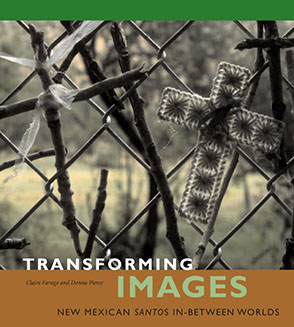
Transforming Images
New Mexican Santos in-between Worlds
Claire Farago and Donna Pierce
“This manuscript is quite unlike anything yet published on New Mexican colonial-period material. Long overdue, it not only brings together a wealth of new material, but it also addresses the region with an academic sophistication and respect that has been lacking, problematizing religious artworks with a strong theoretical underpinning and an interdisciplinary approach. Overall, the anthology chides and corrects conventional Eurocentric scholarship that devotes most attention to categorizing and identifying iconographic and stylistic patterns and continues to be inattentive to the reception, function, and bicultural production of artifacts. Particularly noteworthy is the effort to underscore the strong indigenous influence in colonial arts through both authorship and artistic/cultural influences during the campaign to evangelize and Hispanize the Amerindian population. By and large, the artworks are situated in a well researched social, political, historical context with the primary focus on how Santos are made, or seen, to operate.”
- Media
- Description
- Reviews
- Bio
- Table of Contents
- Sample Chapters
- Subjects
Winner of the 2009 Kayden Book Award from the University of Colorado Boulder.
The essays collected here explore the Catholic instruments of religious devotion produced in New Mexico from around 1760 until the radical transformation of the tradition in the twentieth century. The writers in this volume make three key arguments. First, they make a case for bringing new theoretical perspectives and research strategies to bear on the New Mexican materials and other colonial contexts. Second, they demonstrate that the New Mexican materials provide an excellent case study for rethinking many of the most fundamental questions in art-historical and anthropological study. Third, the authors collectively argue that the New Mexican images had, and still have, importance to diverse audiences and makers.
The distinctiveness of New Mexican santos consists not only in their subjects (which conformed to Catholic Reformation tastes) but also in elements that may appear to have been “merely decorative”: graphically striking and frequently elaborate abstract design motifs and landscape references. Despite their anonymity, the images are, as a group, readily distinguished from local products anywhere else in the Spanish colonial world. This distinctiveness suggests that we should inquire not so much about the individual identities of their makers as about the collective identity of the society and place that produced and used them.
“This manuscript is quite unlike anything yet published on New Mexican colonial-period material. Long overdue, it not only brings together a wealth of new material, but it also addresses the region with an academic sophistication and respect that has been lacking, problematizing religious artworks with a strong theoretical underpinning and an interdisciplinary approach. Overall, the anthology chides and corrects conventional Eurocentric scholarship that devotes most attention to categorizing and identifying iconographic and stylistic patterns and continues to be inattentive to the reception, function, and bicultural production of artifacts. Particularly noteworthy is the effort to underscore the strong indigenous influence in colonial arts through both authorship and artistic/cultural influences during the campaign to evangelize and Hispanize the Amerindian population. By and large, the artworks are situated in a well researched social, political, historical context with the primary focus on how Santos are made, or seen, to operate.”
“This heady book will serve as a basis for scholarly inquiry on the subject of New Mexican santos and santeros for years to come, and is a solid contribution to the field.”
“Together with the other contributors, these authors investigate anthropological, historical, demographic, and ethical questions bearing on this art. They have produced a book to be reckoned with by all serious students of the subject.”
“Overall, the volume and its authors display an impressive breadth and thoroughness of research. The book itself contains a remarkable quality of images, many of which are color. Furthermore, anyone searching for more details on santos will be delighted to find the exhaustive endnotes and twenty-four page consolidated bibliography.
With this intellectually rigorous volume in hand, readers will gain a sound understanding of the complexities and challenges accompanying the study of these devotional objects. Moreover, they will acquire a broad, detailed introduction to important issues in contemporary art-historical scholarship: theoretical, methodological, and ethical. Transforming Images will no doubt be a catalyst for a new and exciting era of Santos scholarship.”
“Transforming Images is an oversize volume that combines the aesthetic values of a coffee table book with deeply theoretical and well-researched academic articles. Especially notable are the 91 color and 114 black and white images that beautifully supplement and illustrate the textual arguments. It is in the specifics of simultaneous, multiple, and unresolved meanings that this text is most provocative and it is in this way it serves as a model for other works.”
“This heady book will serve as a basis for scholarly inquiry on the subject of New Mexican santos and santeros for years to come, and is a solid contribution to the field.”
“Transforming Images is an oversize volume that combines the aesthetic values of a coffee table book with deeply theoretical and well-researched academic articles. Especially notable are the 91 color and 114 black and white images that beautifully supplement and illustrate the textual arguments. It is in the specifics of simultaneous, multiple, and unresolved meanings that this text is most provocative and it is in this way it serves as a model for other works.”
“Together with the other contributors, [Claire Farago and Donna Pierce] investigate anthropological, historical, demographic, and ethical questions bearing on [New Mexican santos]. They have produced a book to be reckoned with by all serious students of the subject.”
Claire Farago is Professor in the Department of Art and Art History at the University of Colorado at Boulder. She is the author of Leonardo Da Vinci' ‚"Paragone": A Critical Interpretation with a New Edition of the Text in the Codex Urbinas (1992).
Donna Pierce is Curator of Spanish Colonial Art at the Denver Art Museum and the Museum of Spanish Colonial Art in Santa Fe. She is co-author of Cambrios: The Spirit of Transformation in Spanish Colonial Art (1992) and Spanish New Mexico: The Spanish Colonial Arts Society Collection (1996).
Contents
Acknowledgments
Illustrations
Introduction
1. Problems for Interpretation
Mediating Ethnicity and Culture
The Semiotics of Images
Reception of Sources in New Mexico
Interleaf A: Political Allusions
2. Reconstructing Ethnicity
Formative Era, 1693–1700
Dynamic Ethnicity in Eighteenth Century
Interleaf B: Research and Human Genome
Hybrid Households
3. Christian Icons, Theory and History
The Early Santeros
Interleaf C: The Life of an Artist
Hide Painting: Archival Evidence
Hide Paintings, Sources
Transforming Images
Interleaf D: Sound, Image, Identity
4. Inventing Modern Identities
Competing Religious Discourses
Tradition Reconfigured
Problems of Attribution
Santos in Contemporary Life
Interleaf E: Catholicism and Pueblos
5. Epilogue
Re(f)using Art
Notes
Consolidated Bibliography
Contributors
Photo Credits
Index
Introduction:
Locating New Mexican Santos in-between Worlds
Claire Farago
The very materiality of objects with which we deal presents historians of art with an interpretive paradox absent in other historical inquiries, for works of art are both lost and found, both present and past, at the same time.
—Michael Ann Holly, “Mourning and Method”
The concept of “style” has been one of the cornerstones not only of the modern discipline of art history but also of related practices of social and cultural history and theory such as archaeology, anthropology, and ethnography. In this volume, the writers argue the inadequacy of the belief that styles are specific or essential to a person, people, place, or period, making powerfully clear the ideological and critical investments that the idea of style has had and still has in maintaining social, political, cultural, and religious identities. While the subject matter of this book is specific to religious practices in New Mexico between the eighteenth and twentieth centuries, the implications of these investigations are far reaching both historically and historiographically, and both methodologically and theoretically.
A “historical” artifact of human manufacture—that is, a work of art in the most generic sense of the word—is one of those peculiar objects of historical inquiry that, in seeming defiance of time itself, are still with us today. In the above epigraph, Michael Ann Holly articulates the conundrum at the core of the art-historical enterprise: the very materiality of objects presents an interpretive paradox absent in other historical enterprises, “for works of art are both lost and found, both present and past, at the same time.” Assumptions about their permanent or semipermanent quality are intrinsic to this conventional understanding of works of art. Similarly, we understand works of art as objects whose significance transcends the historical circumstances of their making. Precisely—paradoxically—it is the materiality of the object that is at once affected and unaffected by time.
This study deals with Catholic instruments of religious devotion produced in New Mexico from c. 1760 until the radical transformation of local artistic tradition in the twentieth century. We argue that local artistic practice is indebted to many cultural traditions, and it addresses the pressing question raised by this reevaluation: why has the New Mexican tradition been understood exclusively in terms of its “Spanish” roots? Taken together, the writers in this volume make three key arguments. First, they make a case for bringing new theoretical perspectives and research strategies to bear on the New Mexican material and other colonial contexts. Second, and just as important, the essays in this volume demonstrate that the New Mexican materials provide an excellent case study for rethinking many of the most fundamental questions in art-historical and anthropological study, including questions about ethnicity and style, cultural appropriation, the ethics of scholarship, and the meanings that both practitioners and nonpractitioners assign to religious images. Third, the authors collectively argue that the New Mexican images had, and still have, importance to diverse audiences and makers. In making this argument, our collaborative study addresses a methodological problem of longstanding and widespread concern in the humanities: namely, how to account for relationships between “ethnicity” and culture, that is, between collective social identity and artistic production. One of the most demanding theoretical challenges posed by the study of cultural exchange is the self-reflexive one of paying attention to the history of the forms of thought that have been applied to the historical artifact, as well as to the history of the artifact itself. The present study, in keeping with an important trend in colonial studies worldwide, adopts a relativistic approach to the problem of reconstructing cultural continuity. In accepting partial recovery of dispossessed cultural traditions as a valid form of interpretation, we argue that the distinctive style of New Mexican Christian images is due to, among other things, important continuities with the precontact artistic traditions of the Pueblo Indians and other indigenous societies.
The painstaking process of partial recovery involves identifying the continued presence and transformation of artistic conventions. The present study implicates historians in the same continuum of cultural events it studies. As scholars supported by powerful institutions, we are not innocent bystanders to the history of cultural interaction in the colonial world. Yet previous generations of scholars were also sensitive to the problem of projecting their cultural values onto alien historical material. The difference between our current position and theirs is more tenuous than some contemporary cultural theorists might like to admit.
Interpretative aims may not have changed, but epistemological underpinnings have. One of our deepest-rooted forms of art-historical thought is the assumption that an artwork has a radical unity that reconciles (harmonizes, synthesizes) any surface contradictions. This radical unity purportedly stems from the conscious or unconscious intention of the author, and in turn accounts for the work’s power to communicate to audiences. The conditions of production and use of art in colonial societies call into fundamental question the connections among artistic intention, unified meaning, and communicative power. There appears to be no way to resolve the meaning of the colonial images into a single, stable reading, any more than there appears to be a resolution to the complex agencies involved in their production and use. The kinds of semiotic equivocation and polysemy discussed in the present study revise longstanding anthropological notions of the “syncretism” of colonial culture.
Exactly when and by whom portraits of saints and other holy figures began to be made in New Mexico are open questions. The first European exploration of the region was led by Vasquez de Coronado, who found subsistence-level villages instead of the seven cities of gold he was seeking in 1539. The first settlers arrived nearly fifty years later, in 1598––another group of adventurers, led by Juan de Oñate. By 1630, Franciscan missionaries filed the first report on the conversion process, but the regular clergy fought with landowners over rights to Indian labor to such an extent that, in 1680, the pueblos united to stage a well-organized revolt, ordering the destruction of all Christian images and forcing the settlers to retreat to El Paso. In 1692, Don Diego da Vargas recaptured Santa Fe, and abuses of the Indians continued, leading to a smaller revolt and further destruction of images in 1696, two years after the arrival of the first colonists who were prepared to survive by farming and providing for their own needs. The earliest-named artist whose works survive is Bernardo Miera y Pacheco, born in Burgos, Spain, who was working in Santa Fe by around 1760. But about most of the individuals who produced polychrome wood sculptures and paintings on wood panel before the end of the nineteenth century, we know next to nothing. Of the perhaps 10,000 objects that are known to survive, only about twenty are signed or dated. Typically, all that remains in the museum records is the name of the immediate donor or the dealer. Perhaps continued combing of the archives will yield new information about artists and early owners, which can be matched with existing works of art. It is, however, unlikely that information of this nature will ever be found for the majority of surviving objects.
These circumstances, while limiting in one sense, are liberating in another. For they mean that the most significant documents about New Mexican Christian art are the images themselves. It will be argued here that New Mexican Christian images of saints and other holy figures are not syntheses of separate cultural traditions. Rather, in the santos overlapping and even mutually exclusive meanings, like the positive and negative valences of the color “black,” coexist—these images oscillate depending on the viewer’s frame of reference. Nothing about these images resembles the model of the artist-embodied-in-his-work that is the backbone of art-historical interpretation. But how do we account for conflicting and overlapping meanings attached to one visual motif by different cultural traditions without grounding the analysis in the artist’s inward state? Studying the New Mexican material has led us to consider cultural identity in a very basic way: how people manipulate whatever material culture is available in their environment to negotiate their relationship with the world. Artifacts and images function in concrete, lived situations. Their meanings are “performed” in the sense that the same object carries different connotations in different contexts, and sometimes carries different connotations in the same context for different people. Miscommunication, as much as real communication, allows different worldviews to coexist in the same place. The maker of the object, the patron if there is one, the distributor if there is one, its users, its later owners, and so on all have agency of some kind in the “aesthetic field,” to give a name—Bourdieu’s—to all the social actions linked to the objects we use to construct meaningful relationships with the world.
The prospect of disentangling these agencies is daunting: it’s not surprising that most of the disentangling to date has taken place at the abstract level of theory. The distinctiveness of New Mexican santos, as these religious images are known in the scholarship today, consists not in their overt subjects (which conformed to Catholic Reformation tastes), but in elements that may appear to have been “merely decorative”: graphically striking and frequently elaborate abstract design motifs and landscape references. Despite their anonymity, the images are, as a group, readily distinguished from local products anywhere else in the Spanish colonial world. This distinctiveness suggests that we should inquire not so much about the individual identities of their makers as about the collective identity of the society that produced and used them.
Yet everything we know about that society suggests strongly that it did not have a single, homogeneous identity. The distinctiveness of New Mexican Christian art, then, raises questions central to postcolonial studies about the contributions of indigenous people and their descendants to colonial culture, and the social construction of meaning among segmented audiences. The process of trying to account for cultural identity in a colonial society—particularly in sensitive areas such as religion and in circumstances where lack of direct evidence may tempt us to reason backward from contemporary practice—raises issues of power and interpretative privilege. Readers, perhaps even more than writers of historical texts, take for granted that chronology is a neutral ordering device, as “natural” as it seems in “Nature.” But every historical study is necessarily a selective representation and therefore an artifice. By definition, an interpretation tries to make sense of the world. In this context, temporal succession cannot have the epistemological status of a “law of nature.” As the historian Hayden White famously argued in his 1978 essay “The Fictions of Factual Representation,” factual (re)presentation is grounded in the implicit claim that a chain of causes and effects was mere temporal succession and not narration.
Chronology is a powerful and seductive rhetorical apparatus. And cultural exchange has not been symmetrical. In a recent critique of postcolonial writing subtitled “Toward a History of the Vanishing Present,” Gayatri Chakravorti Spivak discusses the hegemonic effects of “historical” accounts of time. She formulates “the reader’s perspective” as a conundrum, describing the (im)possible position of a native informant whose identity has not been shaped by what Spivak calls the Kantian/Hegelian/Marxian heritage:
The possibility of the native informant is, as I have already indicated, inscribed as evidence in the production of the scientific or disciplinary European knowledge of the culture of others: from field-work through ethnography into anthropology. That apparently benign subordination of “timing” (the lived) into “Time” (the graph of the Law) cannot of course be re-traced to a restorable origin, if origin there is to be found. But the resistant reader and teacher can at least (and persistently) attempt to undo that continuing subordination by the figuration of the name—“the native informant”—into a reader’s perspective. Are we still condemned to circle around “Idea, Logos, and Form” or can the (ex)orbitant at least be invoked?
Spivak’s critique is directed partly against the anti-Eurocentrism of other postcolonial critics of European thought. No one will deny that, from first contact in 1539, Europeans attempted forcibly to impose their cultural beliefs in the American Southwest. The challenge before us is going beyond the old, tiresome, worn-out, and wearisome opposition between Eurocentrism and anti-Eurocentrism. As multiple authors of a unified study, we faced the organizational problem that, notwithstanding critiques of history writing, without chronological structure, our data would tend to appear chaotic and, beyond this, we would not have dealt with “chronology” as the fictive construct that it is, masking ideology under the false sign of “natural” time. The study that follows articulates a response to political realities—defined broadly to include, for example, professional expectations still emanating from some quarters to treat chronology as the neutral ordering device sine qua non of historical studies—as part of the critical enterprise. In compiling the manuscript, we have decided to maintain a chronological presentation, while breaking up the narrative sequence with short “interleaf essays” and extended captions between and in the chapters. That is, we have made some use of ”hypertext” strategies, without, we hope, mixing the ingredients to the point of confounding our readers.
As a preliminary point of departure, we do not wish to claim in this study that the significance specific icons held for one segment of their original audience was necessarily beyond the reach of other segments, but people undoubtedly attached varying importance to content derived from different cultural traditions and contexts. In the messy contingency of past-lived situations, moreover, a lot of the evidence does not survive, and what does survive is capable of multiple interpretations for this reason as well. In his 1940 study of Pueblo mission architecture, George Kubler formulated his classic view of a distinctive “Spanish colonial” culture in terms of its survival rate: “from the first formulation of the style to the recent decades of architectural activity, New Mexico has maintained the status of a provincial area, isolated from the currents of change which were effective in Metropolitan centers of the Spanish world. The phenomenon of regional survivals of an older artistic tradition, altered only by progressive simplification and reduction, characterizes the arts of New Mexico.”
Kubler’s statement that the regional variant (“survival”) of a preexisting artistic tradition is altered only by “simplification and reduction” is based on the limited evidence he took into consideration. The present study in its entirety addresses the problem of “artistic tradition” in a heterogeneous society where distinct but fragmented, previously unrelated social groups are in sustained, intensive contact. The iconography and formal structure of the New Mexican santos demand to be investigated at a level of generality that encompasses native and imported pictorial traditions without bias. Without such a comparative analysis, can we accept as anything more than a Eurocentric assertion the statement that colonial art forms are versions of old European traditions, “simplified” and “reduced” by isolation?
Isolation is a relative phenomenon anyway. Certainly, New Mexico was politically and geographically removed from ecclesiastic centers of the Catholic Church in Rome and the West Indies. But New Mexico was not isolated economically or culturally. The research published in this volume by Donna Pierce, Kelly Donahue-Wallace, and Cordelia Thomas Snow documents New Mexico’s links to a global network of commerce. The presence of imported goods from Mexico, Europe, and Asia—even though the quantities were limited—means that New Mexican artists had an extensive range of visual sources at their disposal. Furthermore, to varying degrees of refinement, basically the same material culture was available to everyone, regardless of lifestyle, social status, or economic circumstances. As is explored at greater length in the following chapters, the traditional view that locally made Catholic devotional art emerged in New Mexico in isolation from a cultural center ignores a significant, enduring Native American presence. It also underestimates the complex and heterogeneous conditions in which religious art circulated globally during the Spanish colonial period (1598–1821) and afterward. And it imposes an ethnocentric framework biased toward “culture” defined in European terms. New Mexico was a cultural center in its own right before, during, and after Spanish colonialism.
Also of Interest
Mailing List
Subscribe to our mailing list and be notified about new titles, journals and catalogs.