


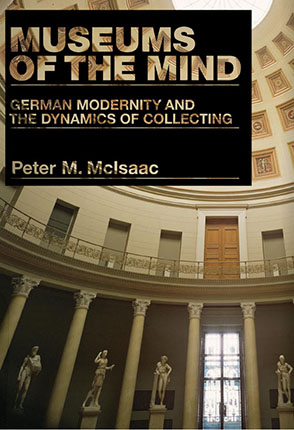
Museums of the Mind
German Modernity and the Dynamics of Collecting
Peter M. McIsaac
“It is the principal merit of this study to have highlighted the connections that bind the process of internalisation of memory in German literature with the tangible nature of museums as both objective and imaginative structures.”
- Description
- Reviews
- Bio
- Table of Contents
- Sample Chapters
- Subjects
McIsaac rethinks how fundamental cultural “truths” define what it means to belong to acculturated communities, showing that the activation of meaning in museums depends foremost on what people bring, in their minds, to those real and imagined environments, resulting in what McIsaac calls museums of the mind. This notion elucidates the vital shifts wrought by museum culture over the past two centuries and illuminates how museums, literature, and digital media shape thought and behavior today.
“It is the principal merit of this study to have highlighted the connections that bind the process of internalisation of memory in German literature with the tangible nature of museums as both objective and imaginative structures.”
Peter M. McIsaac is Assistant Professor of German at York University, Toronto. He is the author of numerous articles on German literature and culture and museum studies.
Contents
Illustrations
Acknowledgments
Part 1: Historical and Theoretical Coordinates of Museal and Literary Discourses
1. The Museum Function, Inventoried Consciousness, and German-Speaking Literature
2. Inventoried Consciousness Today: Durs Grünbein and W. G. Sebald
Part 2: The Rise of the Public Museum and Bildung
3. Ottilie Under Glass: Collecting as Disciplinary Regime in Goethe’s Wahlverwandtschaften
4. The Museum of Bildung: Collecting in Stifter’s Nachsommer
Part 3: Acculturation, Commodification, and the Nation
5. Archaeology, Exhibition, and Tourism: Raabe’s “Keltische Knochen”
6. Flâneur Optical, Collector Tactile: Rilke’s Neue Gedichte as Imaginary Museum Landscape
Part 4: Narrative Interventions in the Museal Abuse of Culture
7. “Quiet Violence”: The Army Museum in Ingeborg Bachmann’s Malina
8. (Re)collecting the Twentieth Century: Siegfried Lenz’s Heimatmuseum
Conclusion
Notes
Works Cited
Index
1
The Museum Function, Inventoried Consciousness, and German-Speaking Literature
Sights seen in the mind’s eye can never be destroyed.
—Strabo (64 B.C.E.–C.E. 21)
Someone reads aloud, you close your eyes, and you “see” exactly as much as if you were strolling through a museum.
—Durs Grünbein in conversation with Heinz-Norbert Jocks
Imagine Berlin’s Pergamon museum, a neoclassical building housing a series of ancient architectural wonders. Approach and ascend, in your mind’s eye, the Pergamon Altar, a full-size Hellenistic temple moved from Asia Minor and painstakingly reconstructed for display in Berlin (Fig. 1). Turn the corner into the space created by the Market Gate of Miletus (Fig. 2), pass through the Ishtar Gate (Fig. 3) and Procession Street of Babylon, and stand before the façade of the Umayyad palace from Mshatta, Jordan (Fig. 4). Built on such a scale that it dwarfs these and many other ancient monuments, the Pergamon museum is supposed to radiate greatness. This greatness is manifested in the brute fact of possession, to be sure, insofar as the museum was built at the height of Germany’s imperialistic ambitions. But the Pergamon also manifests the commitment of German culture to the contemplative aesthetic cultivation of the self (Bildung). Indeed, there could be no higher testimony to the values of Bildung than a museum like the Pergamon, an institution meant to inspire individual nobility in proportion to the sense of its treasures’ historical permanence and rarified aesthetic magnificence.
Peter Weiss’s novel Die Aesthetik des Widerstands [The Aesthetics of Resistance] transforms this bastion of Bildung into a site of political contestation, using the mind’s eye. In the opening scene, a small group of young, anti-fascist resistance fighters stands precisely before the Pergamon Altar. The young men seek a figure to whom they liken themselves in their struggle against overwhelming odds––Herakles, the only mortal to rise up against the triumph of godly force as depicted in the Pergamon’s battle friezes. Their visit makes the Pergamon into a space where the struggle to resist oppression pits not only mind against history and power, but also mind against matter. For in the museum display, all that remains of Herakles is his lion skin and the briefest of labels, a kind of material and curatorial erasure that can be confronted only in the beholder’s mind. Weiss’s narrative makes the reader into just such a beholder, a person who can challenge the myths constructed by the museum display in order to find Herakles in the mind’s eye. Writing such as Weiss’s that intervenes in the museal construction of the world is the topic of this book, a study of museum culture and German literature.
The premises of this book, to which Weiss’s text speaks, are twofold. This study ventures, first, that the forces that lead curators, artists, and politicians in a given culture to produce museums lead authors to produce certain kinds of literary writing. And second, the values and priorities that make a museum possible and desirable are also articulated in literary form. These are not simple premises, and they require some justification in relation to what, in the following pages, I call the “museum function.” But as becomes clear, good reasons exist for wanting to understand the relationship between collecting, exhibiting, and cognition. The relationship is of utmost importance in contemporary museum culture and German literary writing, where a mode of cognition I call inventoried consciousness has become predominant in shaping how people organize, classify, and interpret real and imagined environments. But it also true that this mode of cognition is not new or even, precisely speaking, a creation of modernity. Modern museal and literary institutions, rather, inflect this mode of cognition. Coming some 175 years after the invention of the first public museums, modern German literature, and the program of Bildung, the cultural and political coordinates of Weiss’s text appear at a fairly late juncture in the evolving relationship of modern collecting and writing. Yet the Ästhetik des Widerstands addresses both Bildung and museal conventions with a logic that is vital for understanding the trajectories of German literature, the museum, and what it means to be acculturated.
It is not hard to see that Weiss’s novel uses literary techniques to intervene in the museal presentation of the world. In the book’s opening pages, the reader encounters a fascinating literary rendering of the museal display. The book begins:
All around us the bodies rose from the stone, pressed together into groups, swallowed into each other or burst into fragments, with a torso, a propped-up arm, a cracked hip, an encrusted chunk indicating their form, always in the gesture of battle, evading, surging back, attacking, covering themselves, startled straight or bent, wiped out here and there, yet still with a free-standing foot jutting out, a back turned, the contour of a calf, yoked into a single common movement.
This long and demanding sentence represents nothing less than the literary casting of a sculpture. Replicating the reconstructed frieze from the remaining bits and body parts, the grammatical fragments (“with a torso,” “a propped-up arm”) are fused together into a single sentence whose progressive adjectives (“evading,” “surging back”) impart ongoing motion, following both the action of the pitched battle and the movement of the eye across the statue. As it mimics the cognitive and sensual work of taking in the sculpted block, the sentence culminates in the phrase “yoked into a single movement” that joins the various present and absent parts (“wiped out here and there”) into a unified sweep. In this way, content and grammar combine to form a meaningful unit with a sense of completion and aesthetic fulfillment.
In the next eight pages, Weiss presents a narrative consciousness ekphrastically infused with the protagonists’ movements, perceptions, and cognitive acts:
We were standing in front of the sculpted torsos of the weeping Ge’s sons, giants who had sacrilegiously risen up against the gods, though it seemed other battles that once passed over Pergamon’s Empire were hidden behind these representations. . . . Historical events appeared disguised as myth, events that were incredibly palpable, frightening, awesome but nonetheless not penetrable on a human scale, events we could only accept as the expression of a superhuman power wanting innumerable bondsmen and slaves and an elite few who could determine fates with a flick of the wrist. Passing by in holiday processions, the common people hardly dared to gaze up at their own history in effigy, the temple where the artists arriving for the occasion, the philosophers and the poets, together with the priests, had already been gathering in their expert knowledge, and what for the ignorant lay in a magical darkness was, for the knowledgeable, something to be soberly appreciated. The initiated, the specialists, spoke of art; they praised the harmony of movement, the interlocking gestures, while the others, who were unfamiliar with the concept of Bildung, stared furtively into the gashed throats, felt the blow of the animal’s paw in their own flesh. (9)
Stepping into the ekphrastic flow, Weiss’s figures envision the historical conditions of production and ownership that the artists, elites, and museum staff have, at various points, all left unrepresented (see, instance, Fig. 5). Elided information fills the mind’s eye, telling here of the forgotten souls who performed the artistic labor and those who, without the knowledge and experience of privilege, were and are excluded from this magnificent space and its traditions. The subtle but telling reference to Bildung signals that the frieze’s epic mythmaking is to be understood not only in the past. Via the museum setting, the frieze also contributes to the modern myth of Bildung.
Moreover, the less educated or less traveled reader has, via the text, a chance to have his or her ignorance dispelled. The grammar and images of Weiss’s opening lines manifest those same aesthetic qualities—harmony of movement and interlocking gestures—that constitute the specialists’ art. By exposing the savagery and oppression that museal displays often render invisible, Weiss’s opening disrupts the construction of mythic narratives. It ruptures what Walter Benjamin, in his critique of Wilhelmine state museums such as the Pergamon, called Kulturgeschichte (cultural history). In this cultural mode, past culture is presented only as a string of glorious high points, shorn of the barbarity Benjamin thought had to accompany each human triumph. Weiss’s narrative dynamically recasts the place of the aesthetic and material reality in our consciousness and in the world. Indeed, through Weiss’s literary imagination, the museum’s complex mode of articulating beauty and knowledge is brushed against the grain, transformed, and re-staged, generating a kind of museal counterdiscourse.
Such a counterdiscourse works because it, like the museum, refers to and shapes a particular mode of cognition. This mode of cognition expresses a paradigmatic way of organizing, acting, and making sense of the world, which I call inventoried consciousness. With this term I want to designate the mental activity involved not only in the making of lists, but also more differentiated orderings such as illustrated catalogs, three-dimensional displays, and topographies of memory. Such a term also resonates with notions such as Hans Haacke’s, when he calls modern museums “managers of consciousness.” Yet in elaborating what inventoried consciousness is and how it is that literary writing and museum culture are related to it, it quickly becomes clear that no one novel, by Weiss or anyone else, can on its own adequately account for this phenomenon. This is partially a historical question, insofar as inventoried consciousness has clearly existed for far longer than modern novels and museums and in fact continues to evolve to this day. One might think of ancient stories like Noah’s Ark, in which the ability to account for and assemble “the world” according to its core categories (individual animal species, male and female) is the key to envisioning its redemption, or narratives like Beowulf, in which the loss of a world is made complete by relating the mental catalog of exalted items that once were but no longer remain. And people have seemed always to collect things and show them off in some fashion, sometimes, as with early modern Wunderkammern (Fig. 6), in ways radically other to our own organizational habits.
Gaining access to inventoried consciousness is complicated by the disciplinary and institutional configurations that shape our own thought and practice. Since the late eighteenth century inventoried consciousness has been transformed following what Michel Foucault described in The Order of Things as the shift to the modern episteme, a shift that would eventually give rise to the differentiated arts and sciences disciplines and their attendant institutions such as laboratories, libraries, archives, and museums. Before 1800, the term “museum” tended to be understood as a “cognitive field of ideas, words, and artifacts”—potentially a place, but very often a text—whose “semiotic inventorying operations made the world readable.” In Renaissance collections, as Paula Findlen argues, the “museum” was in fact thought to reside most enduringly in the mind of the collector. This idea figures in my study in relation to what I call the “notional museum,” a term that recovers this Renaissance concept without losing sight of the epistemic shifts that have accompanied the rise of modern museum culture.
With regard to those epistemic shifts, it is worth pointing out that over the course of the nineteenth century, museums came to function as material repositories of disciplinary-specific objects, addressed by but no longer contiguous with discursive and textual registers. As Wolfgang Ernst puts it, “[T]wo forms of processing the past took shape in the eighteenth century: the architectural and institutional container of the (art-) historical museum was created, serving as a grid for memory; and the implementation of historical imagination, based on the literary medium of narrative, led to an ‘in/formation’ of the imaginary.” As a result of the perceived antagonism between material objects and imaginary narratives, inventoried consciousness tends from this point forward to be inflected by the epistemological constraints of each disciplinary context, particularly in light of history, art history, and literature undergoing further discursive and disciplinary differentiation. Literary writing, in traditional conceptions the art form least bound to materiality, might be collected in books and libraries, perhaps also in manuscripts and archives, but almost never in museums. Museums, in their classifying and ordering function now primarily linked to physical storage, retain a more narrowly circumscribed, but still deeply palpable relationship to forms of inventoried consciousness. At first glance, intense literary and museal exchanges might not be expected across these cultural and disciplinary divides. A genealogy of inventoried consciousness in the age of the public museum cannot, however, be constructed anywhere but in the exchanges between literature and museum culture.
The fact that literary and museal divides were always to some extent arbitrary, shifting, and permeable makes inventoried consciousness appropriate for study in the interstices of museum culture and the literary imagination. Yet what necessitates this study is that inventoried consciousness stands at the nexus of crucial, unresolved issues confronting contemporary scholarship, literature, and culture. The museum has become a dominant cultural paradigm shaping ever more areas of thought, particularly as they are affected by the exchanges between traditional and “new” media and culture. For a host of reasons, museums have in the past thirty years been dynamically expanding their purposes and audiences. This period has seen the rate and variety of new museums and museum types rapidly increase, some of which, as in Bilbao (Guggenheim), Milwaukee (Milwaukee Art Museum), New York (MoMA), Berlin (Jewish Museum), and Los Angeles (Getty), have been carried out in spectacular architectural idioms. Offerings in traditional museum fields such as the fine arts have become both wider and more differentiated, while areas previously outside museums’ purview, for instance, rock music or commodities from chocolate to Coca Cola, have entered the museum. No longer fittingly described as dusty vaults for elite edification (if they ever actually were), museums almost across the board have redefined their rationales for addressing the public, with some institutions becoming expansive cultural centers, others staging ever more extravagant blockbusters (in the minds of some a form of “dumbing down”), and still others opting for self-critical modes of interaction with visitors. By all accounts, visitors are responding with unprecedented attendance and interest.
How easy is it, then, to envision today’s world without museums? This thought experiment is a challenging one, particularly for anyone invested in prevailing notions of history, popular science, tourism, heritage, and/or art. In a variety of accounts, the appeal of museums and their ongoing cultural relevance have been explained in terms of their singular ability to supply organized material presence and uniqueness (“aura”) in an age of simulation. This is not to suggest that museums stand in some simple opposition to the onslaught of television and digital reproduction. But if a host of computerized presentation methods and cinematographic design techniques are finding their way into museum layouts at the same time as virtual museums are promoting the off-site exploration of holdings, it can be noted that museums’ spatial and material constraints also shape and interrogate the meaning of virtuality. This is no doubt one reason that computer companies such as Oracle, Microsoft, and Siemens-Nixdorf, among others, have turned to high-concept art and technology museums to aid in the discovery of software and hardware more capable of mediating through virtual means how people think and act in so-called material environments. But even without knowing how these efforts impact it, today’s world is clearly experiencing the expansion of “musealization” into aspects of everyday life previously not subject to relentless recording, categorizing, storing, and displaying. As old ways of organizing and interpreting knowledge and experience are disrupted, the spatial environments of museums represent important venues for exploring and negotiating new modes of inventoried consciousness.
In my approach, I describe inventoried consciousness in the museums and literary texts of a particular period in terms of what I call the “museum function.” I define the museum function as the way objects are valorized, acquired and discarded, organized, displayed, and hidden in a particular society and historical period. If the museum function refers to processes, then inventoried consciousness is the related discursive register that organizes and shapes the perception and comprehension of people and the world. Because it refers to processes, the museum function extends beyond institutional walls in important and subtle ways. This means that the prevailing social impulses and exigencies that give rise to museums can also be detected in the behavior and activities of noninstitutional agents such as private collectors and in a variety of discourses circulating at the time.
The museum function does not explain literary texts as the mere product of their time of production, as if the text’s ultimate “truth” could be elucidated through its straightforward alignment with a historical narrative. The museum function operates rather as a specific, consciously deployed hermeneutic, used to foreground the act of interpretation performed in the present while gaining access to prevailing cultural dynamics of a particular past. One of the things I show is the way that collections and exhibitions depend on narratives, such as those describing the formation of a collection, the stories people tell about it, and the values placed on the collection’s objects. Studying literary texts alongside museum practices enables me, moreover, to expand understandings of how museums are situated dialectically within the processes of the creation and preservation, storage, reproduction, and circulation of objects. In turn, I demonstrate how literary narratives collect, arrange, and display objects, characters, and other stories as they establish “obvious truths” by telling object-oriented stories.
The museum function enables an approach with a dialectical notion of history, which helps in three ways. First, collecting and exhibiting still exert a tremendous cultural force in our day, inevitably shaping the questions asked of the past. Without an awareness of potential historical difference, the events of the past turn into a mere anticipation of the present state of things. Second, inventoried consciousness was in existence, and in different configurations with respect to processes of collecting and display, long before the age of the public museum. If a society without modern museums can still possess a museum function—and the museum function has been formulated so as to permit its application to pre-Enlightenment practices of collecting—then it is far easier to understand what happened to those practices and thought patterns when the public museum was invented. And third, a nuanced historicizing of collecting and exhibiting draws attention to the larger cultural context in a particular time, requiring the examination of all the fields and discourses that contributed to the museum’s development, successes, and failures. The same is true of literary texts. Rather than see the establishment of a particular museum and a particular literary text as isolated phenomena, the museum function prompts us to look for a confluence of cultural discourses capable of producing a particular museum and a particular literary text. I claim in particular that this function finds poignant and revealing expression in narrative projects. Delineating this function in narratives yields insights not only into how people collect and exhibit, but also into how the experiences of these processes profoundly affect their perceptions, values, and behavior. Through collecting and museum going, visitors not only interact with objects; they also establish relationships with other people, certainly with collectors and exhibitors, but also with other visitors. The museum historically has been deemed capable of exerting a civilizing and enlightening effect on public behavior, or of helping to transform a citizenry into individuated members of a regional, superregional, or even national community, through what Carol Duncan has called “civilizing rituals.” In the German-speaking world, these civilizing and enlightening rituals have, in many ways, been related to the important and evolving concept of Bildung.
From the standpoint of collecting and literature, however, always speaking strictly in terms of Bildung does not provide the greatest insight into what these rituals of acculturation mean over time, and, as a corollary, how they relate people to one another by telling stories with objects. This is another way of saying that the quasi-private notion of Bildung needs to be superseded by a master category—the museum function—that accounts for both the public and the private. The museum function is attuned to models of culture such as that of Walter Benjamin, in which “the present moment (which a priori cannot understand itself) relates to the entirety of the past (which has never ceased speaking) through mutual translation.” Such a “translational” view of culture, as James Rolleston has shown, regards the past in terms of a “simultaneous functioning of dissonant language systems” that produce a great variety of texts: “buildings, administrative organizations, utopian fantasies, advertisements, social chatter.” Sharing the same social processes, all language systems, from discarded objects and advertisements on the sidewalk to rarified poetry, can reveal aspects of social change, but only when the process of closure in the present can be forestalled and the assumptions of the present inquiry allegorized. In this model, quotation represents one strategy available for accomplishing this allegorizing task, though, as Benjamin writes in the Passagenwerk (Arcades Project), collecting represents another. While it does not privilege political discourse over any other, the museum function—because it is tied to the processes of collecting—remains capable of recovering repressed political moments, of reconstituting “events that can be read as the text of a single story.”
The necessity of language for understanding social processes, as, for instance, manifested in Benjamin’s thinking, resonates with the notion that the study of literature is necessary for a full comprehension of the processes of collecting and exhibiting. This point is reflected, moreover, not merely in that artistic and literary practice of late has frequently entered into intermedial relationships, challenging a whole array of notions such as permanence, memory, and stable cultural tradition upheld by traditional conceptions of the monument and the museum. Nor is it, strictly speaking, because “[poetry] was at home in the virtual, long before the introduction of the computer and any neuro-Romanticism,” as the poet and essayist Durs Grünbein insists. Or perhaps Grünbein’s point needs to be put differently. For it is not only that literary discourses have failed to become obsolete per se with the advent of computer technology, but also that for the time period of this study, literary discourses represent a crucial, if not the most crucial, site where the boundaries of imaginative constructions and metaphorical regimes are interrogated and revised.
Insisting on the need to study literary discourses does not exclude consideration of nonlinguistic and/or multimedial discourses. Indispensable for thinking about the ways the museum operates on prevailing imaginative constructions is Mieke Bal’s theorization of the museum in terms of what she calls a “multi-medialization” of discourse. In this conception, various linguistic and nonlinguistic elements (images, architecture) are seen to contribute to the museum’s ability to make its core gesture of exposure signify, though what is true of literary discourse is also true of multimedial discourse. As Bal argues, “[D]iscourse implies a set of semiotic and epistemological habits that prescribes ways of communicating and thinking that others who participate in the discourse can also use. . . . It also includes unexamined assumptions about meaning and about the world.” These qualities of discourse enable Bal to elucidate a “grammar of display” regulating the production of symbolic meaning in the museum.
Now, Bal can then show not only why the museum’s core gesture of exposure inevitably leads to the production of narrative (a fascinating proposition in the context of literary museum narratives), but also that the multimedialized grammar of display acts on the imagination in much the same way as literary discourse. In both, according to Bal, narratives are structured by “myth models,” Gananath Obeyesekere’s term for “the powerful, paradigmatic myths that serve as models for the construction of similar myths. . . . The term also refers to underlying combinations of ideas deployed in a variety of narrative forms. . . . Discourses are repositories for myth models that become ‘naturalized’—taken for granted as obvious truths. Narrativization is a highly efficient way of inserting myth models into the stories of everyday life.” When Bal then drives home the point that “the realist novel flourished in the same age as the development of the great museums” because both narrativize in a profoundly similar fashion, she gives her own project traction on terms that compel us to attend to the main mode of narrativization from the age of Goethe to the present: literary writing. Literature must be studied with multimedialized discourse in order to understand the role of inventoried consciousness in converting myth models into “obvious truths.”
The concerns of a growing number of contemporary writers require probing the relationship of inventoried consciousness to literature. Since the 1970s, writers and literature scholars have become increasingly fascinated by the relationship of memory and culture to records, spaces, and artifacts. Titles such as Heimatmuseum (1977; literally Local History Museum, translated as The Heritage), Die Archive des Schweigens (1980–91; Archives of Silence), and Das Echolot (1990; The Echo Sounder) indicate an expanding paradigm that has tended to be analyzed under the scholarly rubrics of cultural memory and the archive. Though recent approaches to archival processes have foregrounded some of the concerns that interest us here, for the most part, these approaches cannot provide the theoretical precision necessary to account for the way inventoried consciousness has been shaped by the rise of the public museum.
Three points can be made here. For one thing, the notion of the archive is problematically overdetermined in contemporary scholarship, with the “archive” serving as a repository for any theory using the name. For another, the “archive” too often subsumes any and all forms, real or imagined, of knowledge production based on accumulation and classification. Too few “archival” approaches seem capable of, or interested in, making necessary distinctions between libraries, archives, and museums and their respective historical processes. Museums are archival institutions, to be sure, and the impact that libraries and archives have on how people make sense of the world is worth understanding. That impact cannot, however, become the main focus of this study. In insisting on the particularity of the museum, this study recognizes the specificity of museum culture in ways that require my full attention. Many critical issues—among them the layout and ordering of exhibition spaces, the identity and practices of collectors, the behavior of exhibition visitors, the circulation of collected objects, and the relationship of material objects to medial reproductions—pertain only to museum culture. Moreover, and just as important, these and several other issues are central to the concerns of contemporary writers, not to mention their historical predecessors, when their work is read with these questions in mind. To establish the link between contemporary writing and museum processes, this book’s first chapter focuses on two prominent German writers, W. G. Sebald and Durs Grünbein, in whose work scholars have tended to label any process of accumulation and classification as “archival.” Refining this view, this chapter establishes that these writers’ approaches and thought manifest specifically museal processes that bear on the contours of their writing and reveal the contemporary shape of inventoried consciousness.
Within my argument, the chapter on Sebald and Grünbein provides the present-day coordinates for the genealogy that follows in the remainder of this book. I have chosen this structure to generate, using prominent contemporary texts, a number of questions that inform the investigations of earlier literary texts. Part of this project involves showing that the cultural processes that now demand attention have in some sense been “with us” in the German literary canon for at least the last two centuries, even if they have never before received careful and sustained scholarly attention. Scholars in English-language literature have recently undertaken comparable efforts in their fields. Since the year 2000, Eric Gidal’s Poetic Exhibitions, Barbara Black’s On Exhibit: Victorians and Their Museums, and Catherine Paul’s Poetry in the Museums of Modernism have demonstrated that literary writing has much to tell us about the ways museal institutions shaped English-language thought and culture in the respective Romantic, Victorian, and modernist periods. Of these studies, Gidal’s emphasis on literature as “documented accounts of the [museal] institution as imaginative acts and encounters” is perhaps closest to my own in how it motivates the conjoined study of literature and museum culture, though many of the underlying ideas running through Black’s and Paul’s studies resonate with the premises of my study. What distinguishes my work from these allied approaches are three related points: the German-speaking traditions I work on, the time frame of my study (1800 to the present), and the theoretical framework (the museum function) I develop to gain access to inventoried consciousness in the age of the public museum.
With respect to the first point, I contend that the larger project of understanding the intersections of museum culture and the literary imagination remains deficient if it fails to account for the perspectives of German-language writers and thinkers. Many German-speaking writers and thinkers were avid collectors and/or drawn to museum-related work in one manner or another (so many as to provide one useful criterion for selecting texts). One of the most significant was Johann Wolfgang von Goethe, during whose lifetime the concept of the public museum suddenly began to exert its hold on European bodies and minds. The cultural shockwaves created by the looting carried out during the Napoleonic conquest of Europe—much of which ended up in the Louvre—were acutely felt by Goethe, a collector also attuned to the German neoclassical and Romantic thought that would allow the museum idea to take hold swiftly in the German-speaking universe. By portraying this rapidly changing world in penetrating fashion in the remarkable novel Die Wahlverwandtschaften (Elective Affinities) and in several essays including “Der Sammler und die Seinigen” (The Collector and His Circle), Goethe subtly revealed the relationship of collecting and exhibiting to emerging aspects of modernity such as Bildung. The perspicacity with which Goethe treated these issues and his status as a paragon of modern German culture caused his writing to be read and reread by many subsequent generations, permitting these ideas to radiate into German culture again and again under varying circumstances.
Perhaps the readers most sensitive to these issues in Goethe’s writing were other writers likewise attached to collecting projects, such as Adalbert Stifter and Walter Benjamin. While each took away very different lessons from Goethe, both developed Goethean ideas in highly significant ways with respect to collecting and exhibiting. Stifter’s writing was appreciated by the likes of Rainer Maria Rilke, Thomas Mann, and Friedrich Nietzsche, though Nietzsche never made clear whether his professed admiration for Der Nachsommer (Indian Summer) enabled his important critique of the historicism and museum culture of late nineteenth-century Germany. When it comes to collecting and exhibiting, however, even more significant than Stifter, Nietzsche, and even Goethe is Walter Benjamin. Few thinkers in any language can rival the nuance Benjamin brings to bear on these questions, though even scholars of museum studies familiar with his work have yet to take full stock of the cultural traditions that Benjamin consolidates, inflects, and transmits in his essays.
In focusing on Benjamin’s writing, I am not arguing that a single line of influence can be traced between Goethe and Benjamin. I seek, rather, to underscore Benjamin’s importance for transmitting collecting-related concerns to post–World War II German-speaking intellectuals. Hannah Arendt’s observation––that “collecting was Benjamin’s central passion,” which, after his youth, “soon extended into something far more characteristic, not so much of the person as of his work”––serves as a reminder that Benjamin’s writings are especially likely to sensitize his readers to the ways that processes of collecting shape inventoried consciousness. The Benjaminian resonance in Peter Weiss’s writing is one that I noted previously. Similarly, W. G. Sebald, Siegfried Lenz, Ingeborg Bachmann, and Durs Grünbein all explore Benjaminian conceptions of history, collecting, media and reproducibility, and/or “imaginary topographies” of memory. And from a theoretical perspective, Benjaminian thought offers productive conceptions for understanding the writing considered in this study, even by earlier writers whom Benjamin either did not analyze, or at least did not from the angle of collecting and exhibiting.
Certain perspectives offered by Michel Foucault also lend themselves for thinking about collecting, exhibiting, and discourse. Though Foucault himself wrote relatively little about museums, his notions of order, power/knowledge, and discipline offer sophisticated means for generating critical accounts of how display environments produce knowledge and regulate the conditions for social relationships. Foucault’s notion of the episteme makes it possible to think of the discursive spaces of public museums and exhibitions in terms of a grid, anterior to words, perceptions, and gestures, which governs the basic conditions and categories according to which people can perceive and make sense of the world. The world becomes comprehensible according to a set of primary organizing principles that determine which artifacts can and cannot appear in relation to other artifacts. How objects are collected and arranged, then, grounds the knowledge and narratives that a discourse based on the display of objects can generate. By the same token, different arrangements of objects would permit different ways of knowing and relating a subject position to the world and other people.
A focus on the semiotic encodings of exhibitions can be justified on this basis, a focus that sheds light on the crucial interplay between the ordering of visible elements and gaps in generating meaning. Such a semiotic approach makes it clear that museal displays—for instance, the use of frames and spacing to set off objects as aesthetically autonomous wholes—determine certain disciplinary conventions in fields such as art history and anthropology, without those operations necessarily being acknowledged. The power of exhibitions derives not only from the ability of exhibitions to make certain things and relationships visible and thus seemingly self-evident, but also in their ability to render alternative narratives and ways of knowing invisible, and thus more or less unthinkable. It also follows from this semiotic conception that certain levels of education and training are necessary to make sense of display environments, thereby suggesting ways competing social groups might use display techniques to differentiate and legitimate themselves. In other words, discursive regimes of exhibitions are capable of defining the constituencies they address and possibly also exclude, both with respect to agents in control of the collections (curators, state institutions, scientific bodies, private collectors, and so on) and to the relationships among these constituencies. Something like this was depicted in Die Ästhetik des Widerstands, where Weiss’s working-class protagonists resist their exclusion from the museum space by decoding and contesting the curatorial gaps particularly likely to frustrate the approach of those uninitiated in art history to the display.
More than symbolic inclusion and exclusion is at stake in public exhibition spaces. This can be seen in Tony Bennett’s subtle grasp of Foucauldian discipline in what he calls the exhibitionary complex, a term that serves to capture the work done by the differentiated set of display-oriented institutions, from permanent museum displays to temporary exhibitions and fairs. Bennett’s account is instructive because he recognizes that telling stories in museum spaces involves ideologies and the interaction of bodies with architecture and other bodies. Visitors would learn ways of thinking about the world by moving through exhibition spaces, to be sure, but they would also discern how to regulate their behavior by being subjected to a series of real and imagined looks. Thus on one level, the mechanisms of discipline offer a profitable way of understanding how display environments represent an uninterrupted exercise of power in the Foucauldian sense, potentially reforming or at least altering visitors’ sense of embodiment and behavior. At the same time, display space is organized differently from that of institutions of confinement. In contrast to schools, hospitals, and prisons, the exhibitionary complex offered environments promoting the sense among visitors that they were not only to be seen, but they were also, at least in principle, to look from the vantage point of some real or imagined eye of power. That is, “as micro-worlds rendered constantly visible to themselves, expositions realized some of the ideals of panopticism in transforming the crowd into a constantly surveyed, self-watching, self-regulating, and as the historical record suggests, consistently orderly public—a society watching over itself.” Though it is possible to think of ways in which this equalizing potential would fail to materialize fully—particularly for women, minorities, and the lower classes—the point remains that museal architectures organize the properties of discourse in unique ways, transforming them into embodied modes of belonging and behaving in modern, “cultured” society.
The implications these notions have for the important questions of personal and collective memory as well as identity formation emerge by turning to Benjamin’s linkage of the private collector to the problems generated by modernity. The collector is a privileged figure in Benjamin’s thought, for, in modernity, he is uniquely capable of communicating experience, in an age when true experience (Erfahrung) has generally become inaccessible. This is not the place to rehearse Benjamin’s intricate unraveling of the paradox of experience in modernity; suffice it to say that the labyrinthine path by which experiences can pass into memory is negotiable for him in only a few forms of cultural practice that can produce open-ended or dialectical images, two of which are writing and collecting. When inflected by the collector’s instinct and knowledge, collections and narratives offer interlocking strategies by which, in the words of Ackbar Abbas, the “experience of possession can become the possession of experience.”
Collecting, as understood by Benjamin, offers the opportunity for individuals to enter into a peculiarly intimate relationship with objects, so that the collector seems to live in them. The nature of this investment goes far beyond some simple identification. If, as Benjamin notes, the collector imposes order as a means of holding a dangerous flood of personal memories at bay, the collection represents a highly complex and fascinating means of constructing consciousness, with inventories listing what is known not in some positivistic fashion, but in the form of a habituated, perhaps even ritual, forgetting. Moreover, the collector’s personal investment in his objects obligates him to treat his objects in a way that ensures they are handled appropriately—not (just) utilized, bought, or sold—in the present as well as in future societies. The collector has this capability because of his knowledge of the object’s total history, or “fate” (Schicksal), which Benjamin describes thus: “[E]verything remembered and thought, everything known, becomes the pedestal, the frame, the base, the lock of his property. The period, the region, the craftsmanship, former owners—for the true collector the whole background of an item adds up to a magic encyclopedia whose quintessence is the fate of the object.” Indeed, that history or “fate” of an object might include all kinds of information on the object, including reproductions, lengthy descriptions, interpretations, any thought connected to the object. This combination of confrontation with material reality and awareness of the past’s fullness permits the collector to become, in the words of Michael P. Steinberg, “an allegory of the allegorist.” Moreover, by acquiring the object, it and its interlocking narratives pass into the collector’s life, renewing and enriching it. This strategy of renewal, embedded as it is in a process of narrative being added to narrative, works against cultural history’s fetishization of art objects, presenting images whose ambiguity keeps them unfolding and open to interpretation.
Benjamin’s valorization of the figure of Eduard Fuchs reveals important political and historical implications of this strategy of renewal. Fuchs was a turn-of-the-century private collector whose collecting and publishing techniques were directed at reading the museums and society of his day against the grain. For Fuchs as for Benjamin, as noted above, official state museums such as the Pergamon rankled for their propensity to show culture “in its festive Sunday dress, and only very rarely in its ragged work clothes.” Expanding how one might think about state collections and museums as politicized instruments of power, Fuchs advanced a mode of collecting and reading existing collections that represented one way of challenging the omissions and elisions made by state museums. This critique translated into tactics by which Fuchs rescued, and then put back into cultural circulation, officially neglected and endangered art objects such as Tang sculpture, erotic art, and political caricature. With respect to caricature, Fuchs took advantage of his thorough knowledge of the history of such images, creating book publications whose text and reproductions sought to keep these once mass-produced images in circulation.
The kind of encounter promoted by this strategy, of reproductions bringing the original into new contexts, is a form of renewal that likewise represents a crucial way of shattering tradition and renewing the object in the modern world as it is described in Benjamin’s seminal essay “The Work of Art in Its Age of Mechanical Reproducibility.” There, Benjamin argues that collecting has from the outset been embedded in a process of circulation that transfers objects from an original context into new orders dictated by the collector, following a system of values that has implications for how one might think about collecting, writing, and the body. This value-based conception is an integral part of Benjamin’s theorization of auratic art, which is thoroughly couched in terms of collecting and exhibiting. In explaining aura in terms of its value, Benjamin insists that the only true value a work of art can have, its use value (Gebrauchswert), arises from its use as a religious or cult object. When the dynamics of secularization and collecting bring artifacts into circulation, a new value Benjamin terms the exhibition value (Ausstellungswert) dialectically supplements, but does not replace, its original use value. “With the emancipation of the various art practices from ritual,” Benjamin writes, “go opportunities for the exhibition of their products.” While Benjamin observes that the concept of authenticity displaces that of originality, he makes clear that originality always precedes authenticity and remains in some form, even when authenticity predominates. It should not be surprising, then, to find a ritual function in secular environments such as museums, even in an age when aura was supposed to have been shattered. Indeed, as Hal Foster observes, the successful dissolution of aura through photography and digital media might well tend to increase demand for auratic objects, for, “as new aura is difficult to produce, established aura skyrockets in value.” This value can also be understood as respective increases in both the objects’ exhibition value and their exchange value (price). Though both values are dialectically tied to use value in Marxian fashion, these terms must remain differentiated for Benjamin. Indeed, as he took pains to point out to Adorno, many modes of acquisition and possession are available to collectors (arguably also to institutions) that do not involve direct monetary exchange (for instance, donation) and/or that are driven by considerations other than financial benefit (for instance, prestige). It is precisely because the collector resists universal commodification by reworking what possession means that his practices are of interest to Benjamin.
“Possession and having are allied with the tactile [taktisch],” Benjamin writes with respect to the collector, meaning that they can be key terms by which the collector’s body and identity figure in what it means to collect, preserve, and write in modernity. The increase in exhibition value does not take place at the expense of cult value of the object. It instead alters the human beings’ sensory perception (Sinneswahrnehmung) of them. As Benjamin puts it, “[T]he manner in which human sense perception is organized, the medium in which it is accomplished, is determined not only by nature but by historical circumstances as well.” Benjamin’s conception opens up the possibility that human beings might learn to perceive and respond to their environment in a new way, should a quantitative increase in display and exhibition at some point become qualitative. This insistence on the body can be understood in part as a rejection of German idealist aesthetics, based on illusory notions of autonomous art coupled with a mode of disembodied, contemplative reception. In contrast, the collector’s relationship to his objects is at once tactical and tactile (taktisch), guided as it is by passion and an instinct that works like a “divining rod,” turning “him into a finder of new sources” that need to be renewed, which he accomplishes by taking possession.
Of all the possibilities for taking possession available to the collector—finding or purchasing an object, receiving a gift or inheritance, “neglecting” to return a borrowed object—for Benjamin the most praiseworthy was to reproduce the object in one’s own hand. The greatest example of this Benjamin sees in Jean Paul’s story of poor little Wutz, the impoverished schoolmaster who acquires a collection of great books by writing them himself on the basis of titles he sees in advertising catalogs. This example represents for Benjamin nothing less than the ability of collecting and writing, indeed, of writing as collecting, to work as media in touch with experience. When Benjamin explains on this basis that from the standpoint of the collector, “writers are actually people who write books not because of poverty but rather because they are dissatisfied with the books they could buy but do not like,” he is stressing the value, seen by the collector, of allowing objects and narratives to enter into human lives, from which they can emerge enriched with additional traces of thought and action. Over time, such a cultural practice accumulates traces the way rings grow on a tree, enabling the enriched object to “grow” with the people who possess it. Resonant with what Benjamin calls “memory” in the “Storyteller” essay, this practice enables the fragile possibility of cultural transmission, of passing “a happening from generation to generation.” This practice figures at the beginning of our opening example, the Aesthetics of Resistance, which leaves traces of the protagonists’ thought embedded in an ekphrastic rendering of the Pergamon frieze.
The texts in this study similarly develop narrative modes––albeit to a variety of ends––that can be read from the perspective of Benjamin’s collector. That is, all contain traces of how lives and thought changed when objects in certain arrangements or organized environments entered them. In Goethe’s Wahlverwandtschaften (1809), a collector’s images and ancient funerary objects “organize [the characters’] imagination toward that time,” inspiring cultural practices and a built environment resulting in a modern type of grave mound (as Benjamin himself noted in his “Wahlverwandtschaften” essay). In Stifter’s Nachsommer (1857), learning to collect scientific specimens puts that novel’s hero on the royal road to the aesthetic and societal heights of Bildung, with the collections he creates reflecting his current state of mind. Or one might speak of Raabe’s “Celtic Bones” (1861), in which the display of unearthed bones and artifacts sparks desires for the wealth, academic prestige, or both in those who would possess or control them. And whereas Rilke’s Neue Gedichte (1907) represents an imaginary museum resulting from a complex mental process that situates objects, people, thoughts, and stories within a notional museal space, Lenz’s Heimatmuseum (1977) presents a textual museum, layering story upon story of the lives touched by objects destroyed to prevent their abuse by unapologetic fascists. In a different and even more intricate way, the “imaginary topography” constructed in Bachmann’s novel Malina (1971) depicts the creation of authorial consciousness as a function of the legacies of historical violence, in Viennese museums and their related organizing paradigms. Sebald’s method of composing text around images rescued from junk shops and old photo albums and Grünbein’s approach to exhibition spaces as a means of exploring the contours of the poetic mind represent two contemporary efforts that reveal, through the confrontation with collecting, the valences and ambivalences of human thought and memory in the digital age.
Other criteria, in addition to being readable from the standpoint of Benjamin’s collector, justify this selection of texts. Each of the literary projects examined here openly thematizes or comments on its relationship to museums and/or collecting and exhibiting. Though a text with an “unannounced” relationship to museums and/or collecting might still have something to tell us about inventoried consciousness in the age of the public museum, part of what I wish to establish is that these instances are not isolated cases. When text after text presents evidence that museum culture figures as part of its design, the inadequacy of prevailing approaches to these texts becomes apparent, particularly in light of the fact that more texts can be analyzed from the standpoint of the museum function than I can accomplish here (worth mentioning is Benjamin’s point that from the collector’s standpoint, the collection’s incompleteness is what makes it a patchwork and thus a form of allegory).
In any case, some sort of explanation is necessary to account for instances when, as in Goethe’s Wahlverwandtschaften, characters comment soberly on the need to develop norms of behavior for the newly devised practice of encountering real art in museums and art collections, or when, as in Ingeborg Bachmann’s Malina, the novel’s murderous namesake is from the very first page described as having gone underground at a real existing institution whose catalog the novel quotes at length. The possibility that this kind of evidence can be accounted for without considering processes related to collecting and exhibiting is even less when these writers, and sometimes their informed readers, confirm that reading for the museum function is not only possible, but in fact necessary. It is, for instance, significant that a figure such as the architect in the Wahlverwandtschaften was read as a like-minded collector by the Boisserée brothers, Romantic collectors whose assembly of religious art helped inspire the completion of the Cologne cathedral and eventually formed the core of Munich’s Alte Pinakothek—a fact from the historical record that justifies a focus on this particular novel. It is also significant that the writers in this study are themselves collectors (Goethe or Sebald), verifiably involved in museum- or object-based activities (Stifter, Raabe, Rilke, Grünbein), or, demonstrable interpreters of Benjamin’s projects (Bachmann, Lenz, Grünbein, Sebald). Benjamin’s own writing suggests why this third set of criteria should gain in importance. As he writes in “Ich packe meine Bibliothek aus,” “Even though public collections may be less objectionable socially and more useful academically than private collections, the objects get their due only in the latter. I do know that time is running out for the type [the private collector] I am discussing here and have been representing before you a bit ex officio. But, as Hegel put it, only when it is dark does the owl of Minerva begin its flight. Only in extinction is the collector comprehended.” If Benjamin’s insight proves right, fewer personal collectors as he understands them surfaced over the course of the twentieth century, at the same time as comprehension of the collector and his processes grows.
A separate point regarding the array of texts in this study is that certain features of the development of German-speaking museums must figure in deciding the sequence of texts within the trajectory of my argument. In selecting texts, I drew on some twenty years of museum-studies scholarship, which offers not only a critical vocabulary for studying museums in a variety of cultural contexts but also a number of issues that have particular importance in the German-speaking realm. One of these factors, as I have already suggested, has to do with the ways that the meaning of being acculturated (often, but not completely the same as being gebildet) has been constructed and changed over time. Though it makes sense on one level to regard museums as champions of Bildung, this concept is valorized and naturalized as a function of many other discourses and practices, not the least of which are forms of identity as refracted by notions of history, nationhood, class, and gender. Not only can these issues be interrogated by appropriately selected texts, but the study of their museum functions can also disaggregate and sharpen the views of them and how they develop alongside one another. This is particularly the case with gender constructs, which most of the texts in this study show to be related to questions of inventoried consciousness in ways the study of nonliterary museum culture tends to be less able to do. But it is the same with other cultural configurations, whose relationship to acculturation, on the one hand, and to processes of accumulation and classification, on the other, is worth thinking about in disaggregated ways. Even though Bildung has generally lost the cachet it once had, what it means to be acculturated and have access to related exhibitionary environments continues to have deep significance when it comes to practices such as tourism.
Even though each of the texts discussed here proves to be a rich vehicle in its own right for exploring its respective museum function, I make particular headway into the question of inventoried consciousness in the age of the public museum by organizing the chapters of the text into pairs around certain critical issues. In the first pairing of texts, in Chapter 2, I analyze the projects of Sebald and Grünbein as a means of probing two significant contemporary modes in which classified material culture interacts with modern media in shaping memory and consciousness. In Part 2, consisting of analyses of Goethe’s Wahlverwandtschaften (Chapter 3) and Stifter’s Nachsommer (Chapter 4), I study collecting and exhibiting as the first public museums were being founded in German-speaking Europe. Examining the competing forces and discourses that made German-speaking museums possible, in these two chapters, I account for the establishment and naturalization of German-speaking museum culture, precisely for the ways in which collecting served various registers of Bildung. In both chapters, references to the material and historical record are used to corroborate the view of inventoried consciousness generated by my readings of the respective museum functions. In Part 3, I examine the expansion of museum culture from the 1860s to the early twentieth century in Raabe’s “Keltische Knochen” (Chapter 5) and Rilke’s Neue Gedichte (Chapter 6). These two chapters trace the growing number and differentiation of museal offerings, on the one hand, and the emerging inflection of acculturation by cultural tourism, on the other, showing how the German-speaking literary imagination navigates national and foreign cultures through an orientation on exhibitionary institutions ranging from spectacles such as the Viennese Prater and the Parisian morgue to archaeology, history, and a host of fine-art museums. Even more than in the first two chapters, the respective material records from the Hallstatt archaeological digs and Rilke’s residency in Rodin’s studio-museums play a significant role in illuminating these museum functions.
Shifting to the post-1945 era, in the final part of this book I take up two institutions that played a peculiar and understudied role in the Nazi mobilization of the German home front during World War II: Heimat museums and army museums. In Chapter 7, I again turn to the material record of a museum, this time the Heeresgeschichtliche Museum im Arsenal (the Austrian Military History Museum in the Arsenal), the first purpose-built museum in Austria with a long and peculiar past. Unpacking that past helps us understand Bachmann’s Malina to be a subtle but unmistakable literary intervention into the oppressive discourses constructed by this museum, discourses that, as this text states on its first page, had since the Second World War largely operated out of sight but not out of mind. Examining a different kind of narrative intervention into museal discourses, in Chapter 8 I analyze Lenz’s Heimatmuseum, a novel named for a local history museum that is burned down in order to prevent its postwar takeover by unrepentant fascists. A text that revealingly anticipates the practices of later German Holocaust antimonuments—built environments often designed to disappear and be actively recalled through the mediation of photographs and texts—this textual museum comes into being when its curator, Zygmunt Rogalla, unpacks objects in his memory for an interlocutor. Their dialogue produces a series of textual “guided tours,” representing objects’ multivalent meanings in a serially unfolding form, beckoning readers to detect museal processes at work and actively to interpret the text in ways valorized by Benjamin. In some sense, this project has then returned, richer than when it began, to its opening coordinates: intellectually, with a project of writing as collecting very much in the spirit of Walter Benjamin, and chronologically, to the problems of the contemporary era. One of the outcomes of the journey is the concept of the “notional museum,” which, I show, pertains to thinking shaped by museums, certain literary texts, or both, in a fashion that once appealed to Renaissance thinkers on the museum.
Before turning to the next chapter, I should say a word about my use of sources and translations in this book. I have analyzed source texts in the original German, but because it is often necessary for me to quote large blocks of source material, offering original and translation in parallel would have led to an unwieldy presentation. I have chosen to work with published English translations unless otherwise indicated. I hope that German readers of this discipline-crossing study do not mind too much. Citations of German source materials are still provided, so that those wishing to look at the original language may readily locate quoted passages. In so doing, I present the page numbers of the German source first, followed by those of the English translation. Where key words or concepts are untranslatable or have no single English equivalent, I supply the original word in parentheses and sometimes elaborate further in a note. I follow the German titles of works, indicating in parentheses titles of standard translations. Where no translation has been published of either a title or passage, I offer my own rendering.
Also of Interest
Mailing List
Subscribe to our mailing list and be notified about new titles, journals and catalogs.