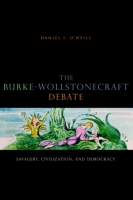




The Burke-Wollstonecraft Debate
Savagery, Civilization, and Democracy
Daniel I. O’Neill
“Who would have thought there was much new and fascinating to say about Burke and Wollstonecraft? But O’Neill’s argument, rooted in their response to the French Revolution and their relationship to Scottish Enlightenment ideas, is wonderfully fresh and illuminating, shedding new light on many a shadowy part of Burke’s conservatism and Wollstonecraft’s feminism.”
- Description
- Reviews
- Bio
- Table of Contents
- Sample Chapters
- Subjects
According to Daniel O’Neill, Burke is misconstrued if viewed as mainly providing a warning about the dangers of attempting to turn utopian visions into political reality, while Wollstonecraft is far more than just a proponent of extending the public sphere rights of man to include women. Rather, at the heart of their differences lies a dispute over democracy as a force tending toward savagery (Burke) or toward civilization (Wollstonecraft). Their debate over the meaning of the French Revolution is the place where these differences are elucidated, but the real key to understanding what this debate is about is its relation to the intellectual tradition of the Scottish Enlightenment, whose language of politics provided the discursive framework within and against which Burke and Wollstonecraft developed their own unique ideas about what was involved in the civilizing process.
“Who would have thought there was much new and fascinating to say about Burke and Wollstonecraft? But O’Neill’s argument, rooted in their response to the French Revolution and their relationship to Scottish Enlightenment ideas, is wonderfully fresh and illuminating, shedding new light on many a shadowy part of Burke’s conservatism and Wollstonecraft’s feminism.”
“This is an excellent contribution to the literatures on Mary Wollstonecraft and Edmund Burke and to the growing discussions of the significance of the Scottish Enlightenment.”
“It is fascinating to learn of Mary Wollstonecraft’s perception that Scottish stadial theory would end in the reign of sensibility, and the reign of sensibility in the ‘Angel in the House.’ From the Sublime and the Beautiful to Sense and Sensibility, via the Theory of Moral Sentiments! Daniel O’Neill has opened a new path.”
“This book should be read. O’Neill has given great and creditable effort to bringing these figures into fresh focus. If the overall effect is not so persuasive as he may wish, the questions about Burke and Wollstonecraft raised by this study, and its suggestion of a boundary beyond which the Scot’s influence does not extend, remain valuable.”
“This excellent book is a wonderful success, one that deserves a broad audience among historians of eighteenth-century political thought and contemporary political theorists alike.”
Daniel I. O'Neill is Assistant Professor of Political Science at the University of Florida.
Contents
Acknowledgments
Introduction
1. The Scottish Enlightenment, the Moral Sense, and the Civilizing Process
2. Burke and the Scottish Enlightenment
3. Wollstonecraft and the Scottish Enlightenment
4. “The Most Important of All Revolutions”
5. Vindicating a Revolution in Morals and Manners
6. Burke on Democracy as the Death of Western Civilization
7. Wollstonecraft on Democracy as the Birth of Western Civilization
Conclusion
Bibliography
Index
Introduction
For more than two centuries, conservatism and feminism have been driving ideological forces in Western political thought. What concerns initially animated these two powerful modern theoretical perspectives? That is the fundamental question at the heart of this book. It is one that has proved very easy to ask and profoundly difficult to answer. This is not because I am the first to ask the question, of course; there has been no lack of discussion of these ideologies. Indeed, early on in the project I found that shelf upon shelf of anthologies, general histories, and textbooks were filled with ready responses to this basic query, all of them founded upon certain certainties. I soon realized, however, that any convincing approach to the problem would require a beginner’s mind, one emptied of prefabricated answers and willing to return afresh to the earliest texts of modern feminism and conservatism.
Accordingly, this book focuses on the debate between Edmund Burke (1729–97) and Mary Wollstonecraft (1759–97) over the French Revolution. One leading scholar has rightly concluded that, from a contemporary perspective, Burke’s writings and speeches constitute “the bible, and he the prophet” and “enduring philosopher of conservatism.” Similarly, the author of a landmark study on Wollstonecraft notes simply that “she has become western feminism’s leading heroine.” Nevertheless, while we have an extensive literature on the so-called Burke-Paine controversy, this is the first book-length account of the clash between Burke and Wollstonecraft, the leading figures in the genealogy of modern conservatism and feminism.
I am well aware that the attempt to answer my overarching question by framing the encounter between Burke and Wollstonecraft as one featuring canonical exemplars of “conservatism” and “feminism” is itself to invite censure on certain fronts. For one thing, both of these terms are, at the very least, linguistically anachronistic. In addition, by party affiliation Burke was of course a Whig, not a Tory, and Wollstonecraft wrote at a time when no social movement existed to which she could affix her ideas. I am also deeply cognizant of the small library of scholarship, past and present, that rejects the label “conservative” as applied to Burke in favor of some other preferred nomenclature on more substantive grounds. So, too, there is a large body of literature on Wollstonecraft that, even when it identifies her as a feminist, subsumes her arguments under the rubric of some more conventional mode of interpretation, usually (though not exclusively) liberalism.
Having acknowledged these historicist caveats, I want to explain why I am not overly troubled by them. Burke and Wollstonecraft may have become conservative and feminist icons only in the twentieth century, but that they have become such, indeed that this is the overwhelmingly predominant way of referring to them, is beyond dispute. Furthermore, as Conal Condren has argued, there are quite good reasons why thinkers like Burke and Wollstonecraft become canonical figures and their texts assume “classic” status, and why they subsequently march under occasionally anachronistic banners. Burke and Wollstonecraft wrote works spurred by a great political controversy, the French Revolution, and their writings were effectively deployed by contemporaries as resources in that political controversy. This deployment in turn led their authors to be recognized as authorities whose names and works were capable of being similarly used by successive generations of interpreters engaged in the political struggles of their own present. Finally, the rich ambiguity of such texts not only continues to make them fertile ground for exploitation in political debate, it also ensures that no particular interpretation of a given canonical authority can definitively close the hermeneutic circle, or foreclose future interpreters deploying the works for very different ends. For these reasons, it is no wonder that Burke became a utilitarian liberal in the nineteenth century, a natural law conservative in the midtwentieth, and in the early twenty-first century seems well on his way, in some academic circles, to becoming an anti-imperial defender of cultural pluralism and difference. Similarly, it is not surprising that Wollstonecraft was long considered (and often still is) a “liberal feminist”—a term of ideological derision to those influenced by Marx or poststructuralism and of adulation to liberals themselves. In still other incarnations she has been read as a republican feminist, for both celebratory and damning purposes. Such are the predictable vicissitudes of political and ideological battles. My point is simply that, whether loved or hated, Burke is today predominantly understood as a conservative, and Wollstonecraft as a feminist of some sort, and their canonical names and classic texts are marshaled accordingly, within the framework of a given interpreter’s own political interests, just as surely as they were initially forged as weapons in an epic political struggle more than two centuries ago.
In making this last claim, I follow scholars like Condren, Sheldon Wolin, Richard Ashcraft, and numerous others in the assumption that political theory emerges most poignantly and powerfully from great political controversy and conflict. If this is so, it is little wonder that the debate between Burke and Wollstonecraft gave rise to what we now understand as conservatism and feminism. After all, their disagreement focused on the meaning of the French Revolution, the conflict that scholars regard as foundational for the emergence of political modernity itself. As one historian of political thought has recently put it:
The French Revolution has been regarded by subsequent generations as the emergence of the modern political world. It comprised a paradigm shift that irrevocably changed the way in which we think about, speak of and therefore conduct our politics. . . . Conceptions of political legitimacy, human agency, historical process and even time itself were fundamentally restructured by this cataclysmic event. . . . [But] . . . the Revolution did not exert this influence through establishing any agreed truths about politics: on the contrary, it generated—and continues to generate—heated opposition and disagreement.
As the effective touchstone of modernity, the French Revolution has always been highly controversial and evocative of the deepest political passions, from joyous affirmation to unbounded fear and hatred. That this was true from the beginning can be seen by considering the immediate and enormous ripple effect it had on its neighbor, Great Britain. The “Revolution controversy,” which provided the historical context for Burke and Wollstonecraft’s debate, was the occasion for what Alfred Cobban referred to as “perhaps the last real discussion of the fundamentals of politics” in Britain. This discussion included such basic issues as the role of popular sovereignty, the legitimacy of monarchy, the desirability of private property, the theoretical basis and practical status of individual rights, and the relationship between religion and politics.
The British pamphlet war that took up the fundamental questions raised by the French Revolution lasted no more than a decade. It began shortly after the French adopted the Declaration of the Rights of Man and the Citizen in August 1789. A few months later, in November, Richard Price, the well-known Dissenting preacher, political reformer, and friend to Wollstonecraft, gave his famous speech to the Revolution Society in London, entitled A Discourse on the Love of our Country. In that speech Price attempted to defend the French Revolution chiefly by comparing its principles to those of Britain’s Glorious Revolution of 1688. Burke’s Reflections on the Revolution in France, in part a response to Price, appeared in 1790. Burke’s famous essay was the match that ignited the tinderbox, sparking a furious flurry of rejoinders from such thinkers as Paine, Joseph Priestley, James Mackinstosh, and Catharine Macaulay. The first published reply to the Reflections, however, was Wollstonecraft’s A Vindication of the Rights of Men, in a Letter to the Right Honorable Edmund Burke (1790), which was available less than a month after Burke’s essay appeared.
Burke never formally responded to any of his critics; instead, he replied through numerous public texts and private letters designed to expand, clarify, and refine his position. These included A Letter to a Member of the National Assembly (1791), An Appeal from the New to the Old Whigs (1791), Letters on a Regicide Peace (1795–97), and Letter to a Noble Lord (1796), wherein his sworn enemies, including both Wollstonecraft and Paine, were specifically named. Burke also found support for his arguments in such journals as The Antijacobin. More important, his position gained a powerful ally in the British state, which became increasingly alarmed at the scope and depth of radical reforming zeal as the 1790s progressed, especially after Great Britain and France went to war in 1793. In 1794 twelve radicals, including John Horne Tooke, John Thelwall, and Thomas Hardy, a founding member and secretary of the London Corresponding Society, were arrested for high treason. In 1795 the Treasonable and Seditious Practices and Unlawful Assemblies Acts were passed, criminalizing certain public meetings and political discussions. In 1799 the LCS and other associations deemed dangerously radical were proscribed, and habeas corpus was suspended.
These actions effectively put an end to the “Revolution controversy” and made Burke its posthumous de facto winner. Before the dissent was stifled, however, the radicals produced an extraordinary array of texts. These ranged from high-minded philosophical treatises like Political Justice (1793), written by Wollstonecraft’s future husband, William Godwin, to popular weeklies edited by Thomas Spence and Daniel Isaac Eaton, which took fiercely anti-Burkean positions. These works advocated a dizzying variety of political and economic reforms.
Like Burke, Wollstonecraft also expanded and sharpened her theoretical arguments as the French Revolution unfolded during the 1790s, until she died in 1797, the same year as Burke. Moreover, there is a fundamental continuity of themes between Wollstonecraft’s direct reply to Burke in the first Vindication and the argument of A Vindication of the Rights of Woman (1792), considered one of the cornerstones of modern feminism. Thus, while the second Vindication was not written directly in response to Burke, insofar as it represents a deepening and broadening of the arguments first articulated in her earlier text, and addressed as it was to the French revolutionary, Talleyrand, in an endeavor to hold the French to what she understood as their theoretical principles, it can be read profitably as the second installment of her debate with Burke. Finally, it also makes good theoretical sense to read Wollstonecraft’s little known An Historical and Moral View of the Origin and Progress of the French Revolution; and the Effect It Has Produced in Europe (1794), as a contribution to the Revolution controversy and as a theoretical counterpoint to Burke’s views about the genesis and trajectory of the Revolution. The text was written about the events of 1789 but from the perspective of one on the ground in Paris during the Terror of 1793. As such, it takes up precisely the same figures and events as the Reflections, yet it interprets them in light of subsequent history and thus attempts to explain the violent course of the Revolution in a way that mirrors Burke’s later writings. As a counternarrative of the same events Burke interprets, aimed instead at defending the principles of the Revolution, which formed in part the foundation for the changes she advocated in the two Vindications, Wollstonecraft’s French Revolution can be read as part of an ongoing dialogue, the final installment in a three-part reply to Burke. This is true irrespective of any narrowly construed understanding of Wollstonecraft’s authorial intentions (or, for that matter, Burke’s).
Against this backdrop, I began the present project with a deceptively simple set of questions, or perhaps even the same question asked in slightly different ways. First, what was the basis for Burke and Wollstonecraft’s fundamental disagreement over the French Revolution? Second (or put differently), why had Burke so vehemently opposed the Revolution, even long before the Terror, and why had Wollstonecraft so steadfastly supported it, even during the Terror? Third (or yet again), what did the Revolution seem to signify in Burke and Wollstonecraft’s theoretical imaginations, such that the man conventionally regarded as the founding father of modern conservatism would dedicate his life to stopping its spread, whereas the woman seen as the most important early feminist would literally risk hers to defend it?
Little did I know that the attempt to answer these questions, which entailed the inevitable three-sided conversation between reader, primary text, and secondary literature, would lead into a vast interpretive wilderness from which I would emerge only after humbling lessons of dispossession. It was as if Burke and Wollstonecraft were conducting an argument about the French Revolution in a language in which they were both fluent but whose idioms remained foreign to my ears. Repeated attempts to unlock the meaning of their texts by recourse to the conventional theoretical skeleton keys on offer (e.g., Burke as a natural law theorist, Wollstonecraft as a liberal feminist) left me feeling frustrated.
Foremost, then, this book is an attempt to translate the language of political argumentation that I think most fundamentally structures the conflict between Burke and Wollstonecraft over the meaning of the French Revolution, with the goal of opening up the meaning of their debate for us. Nevertheless, the pages that follow make no claim to show the political philosophy of Burke confronting the political philosophy of Wollstonecraft. I readily accept that there are multiple ways of reading these two thinkers, and multiple contexts for framing their works. Similarly, it is not my intention to provide a synoptic overview of everything that Burke and Wollstonecraft ever wrote, or to synthesize the various strands of their work under the flag of coherentism. This book has very little to say, for example, on the question of Burke’s writings on India, and engages Burke on Ireland and America only insofar as these writings directly intersect, in my view, with his interpretation of events in France. So, too, I do not provide an analysis of Wollstonecraft’s early novels and pedagogical works, or the later travelogue of her experiences in Scandinavia and her unfinished novel, Maria.
While what follows does not seek to establish itself as the only legitimate way of reading Burke and Wollstonecraft, then, or even of reading Burke and Wollstonecraft against each other, neither is it an arbitrary interpretation. As J. G. A. Pocock has argued, the political languages that become matters of theoretical interest to later interpreters are not confections; rather, they must be established empirically, that is to say, with evidence. In one sense, this means that historians of political thought act like archaeologists, uncovering and recovering various linguistic contexts in which previous political arguments were conducted. As interpreters of such conversations, however, they must also be attuned to the complex interaction between discursive contexts and individual uses of language. The goal is not simply to be a linguistic archaeologist, but rather to find ways of understanding how particular deployments of political language modified the contexts they were originally situated within, and how some of those modifications led to the creation of entirely new languages of politics. That is to say, we have to recognize how some “moves” within a discursive context may not have simply modified the old linguistic paradigm but revolutionized it in unanticipated ways.
Following such methodological advice, this book argues that the Burke-Wollstonecraft debate is best understood as an extended argument articulated within the unique linguistic parameters established by the thinkers of the Scottish Enlightenment. Of course, like “conservatism” or “feminism,” “Scottish Enlightenment” is an ex post facto term of art that serves as shorthand for a complex intellectual movement; it was a term first coined in 1900, not one used during the eighteenth century. However, while Adam Smith, David Hume, Adam Ferguson, William Robertson, John Millar, Lord Kames, James Beattie, James Fordyce, Dr. John Gregory, and the rest only earned the moniker “Scottish Enlightenment” posthumously, there is no question that they saw themselves as a coherent group engaged in a common intellectual project, that of articulating a “Science of Man” based on a broadly unified, self-consciously shared set of theoretical presuppositions that culminated in a distinctive political language.
As this book demonstrates more thoroughly than has been done to date, Burke was a fellow traveler in this effort, and both the Scots and Burke recognized that they were taking part in a shared intellectual endeavor. At the same time, while it is clear that Wollstonecraft did not identify these thinkers as a coherent group, I show that she was very well acquainted with their arguments, had a profound understanding of their intellectual project and the language it was articulated in, and was deeply influenced by it. Thus, while we frequently have to guess at what Wollstonecraft discussed with Price, Priestley, or the other members of the radical Dissenting circles in which she moved, proof of the imprint of Scottish Enlightenment ideas on her thinking is marked by deep and abundant empirical tracks in her texts.
Specifically, my argument is that the clash between Burke and Wollstonecraft over the meaning of the French Revolution developed from a Scottish Enlightenment language of politics structured broadly around “moral sense” philosophy and the closely connected historical narrative of a “civilizing process” in which the Scots understood that moral sense to be embedded. The Scottish Enlightenment’s approach to the topics of moral philosophy and history produced a distinctive, clearly identifiable language that provided the discursive scaffolding for the Burke-Wollstonecraft debate.
Lest there be any misunderstanding, I am not saying that Edmund Burke and Mary Wollstonecraft were simply mouthpieces for Scottish Enlightenment ideas. Rather, I am arguing that both thinkers took certain Scottish Enlightenment arguments as their clay, and transformed that clay in very distinct and idiosyncratic ways in the course of developing their own theoretical constructs. Both writers freely adapted, melded, criticized, and fundamentally transformed certain broadly shared Scottish Enlightenment ideas and the language in which they were articulated, from their own theoretical perspectives and for their own particular political ends, which were those of repudiating or defending the French Revolution.
My central contention is that viewing Burke’s and Wollstonecraft’s texts about the French Revolution from the perspective of their appropriation, deployment, and transformation of a language of politics specific to the Scottish Enlightenment enables us to uncover the stakes of their debate. To put this suggestively, perhaps it is only by showing the depth of Burke’s and Wollstonecraft’s debt to the Scottish Enlightenment, and making clear how both thinkers fundamentally transformed that language of politics for their own purposes, that we can really understand what they ultimately disagreed about.
Thus my answer to the series of questions with which I began the project, which takes here the form of a promissory note that the rest of the book aims to make good: the debate between Burke and Wollstonecraft about the French Revolution rested on what was ultimately a profound disagreement about the relationship between democracy and civilization. For Burke, I argue, the French Revolution spelled the birth of a thoroughgoing democracy that encompassed both public and private spheres, a development that he interpreted literally as the end of Western civilization and its reversion to savagery. For Wollstonecraft, conversely, only such thoroughgoing democracy as she believed was promised by the French Revolution could mark the transition from savagery to civilization; for her, democratization was inseparable from, indeed analogous to, the civilizing process itself. If I am right, this means that modern conservatism and feminism emerged out of dialogic disagreement about deep democracy and whether it was synonymous with “savagery” or “civilization.” Modern conservatism was born in white-hot hostility to deep democracy, understood as the end of civilization, whereas modern feminism was not simply about the extension of the “rights of man” to women in the public sphere, but rather about the spread of democracy into all aspects of human existence, which was equivalent to the spread of civilization.
The thinkers of the Scottish Enlightenment originated and developed the idea that history was a story of stadial movement in which all societies naturally passed through four stages—hunting, herding, farming, and commerce—a developmental process that simultaneously tracked a cultural arc from “savagery,” through “barbarism,” to “civilization.” “Civilization” was not just a marker of material improvement for the Scots but also a normative judgment about the moral progress of society. Pocock has described the Scots’ perception of society as a developmental process culminating in polite modes of social interaction, or civilized manners, as perhaps “the greatest change wrought by Enlightenment in the field of social and historical thought.” “Manners” were the linguistic key to the Enlightenment historical narrative, in which eighteenth-century writers detailed the fate of the Latin provinces after the decline and fall of Rome, through the long, dark Christian millennium of “barbarism and religion,” into the light of modernity. The fundamental theme of this new Enlightenment historiography was precisely the emergence of a shared civilization of manners and commerce, from which sovereign European states grew.
Chapter 1 provides a basic sketch of the central approach, themes, and conclusions drawn by Scottish Enlightenment historiography. It also articulates the Scots’ equally important commitment to what can broadly be called “moral sense” philosophy and stresses its connection to the Scots’ historical narrative. The opening chapter is not meant to be a synoptic overview of every aspect of the Scottish Enlightenment, a tremendously complex intellectual movement that has been the subject of any number of scholarly monographs in intellectual and social history. Rather, it functions heuristically as a means of orienting the reader to the Scots’ central concerns with respect to two areas in particular, moral philosophy and history, and especially to the vocabulary in which those concerns were expressed. If we want to understand the debate between Burke and Wollstonecraft, I submit that we must first become broadly conversant with Scottish Enlightenment discourse on these two topics, which provided the linguistic ammunition for their clash.
The rest of the book examines the Burke-Wollstonecraft debate in an alternating, dialogic fashion. Chapters 2, 4, and 6 focus on Burke’s arguments, while Chapters 3, 5, and 7 take up Wollstonecraft’s. In the remainder of this Introduction, I want to give the reader an overview of my argument concerning each of these thinkers.
With respect to Burke, I stress his reliance on, and simultaneous transformation of, Scottish Enlightenment historiography for his understanding of the French Revolution. As Pocock has previously shown, Burke did not simply adopt the Scots’ historical narrative in its entirety as a means of interpreting the Revolution’s significance; rather, he modified their four-stages thesis in crucial ways. Rightly or wrongly, Burke interpreted his Scottish friends as arguing that the mode of economic production drove the progressive development of natural moral sentiments and their expression in increasingly refined social manners. Against this, Burke offered an idealist and institutional inversion of the four-stages account. In Burke’s view, modes of economic production were necessarily embedded in a rich soil of natural moral sentiment that was nurtured by two institutions, the nobility and the church.
At this point, however, my argument fundamentally diverges from Pocock’s, who stops short of developing a critical line of inquiry with respect to Burke. Specifically, why did Burke focus on the nobility and the church, and the worldview that they perpetuated, with its emphasis on the “spirit of nobility” and the “spirit of a gentleman”? And how exactly did Burke believe that these two institutions nurtured natural moral sentiments in such a way as to civilize the masses?
To answer these questions, one must grapple with the close connections between Burke’s historical analysis of the French Revolution and his moral theory, especially as the latter was set forth some thirty years earlier in A Philosophical Enquiry into the Origin of our Ideas of the Sublime and Beautiful (1757) and other writings from that period. These are texts that Pocock wholly neglects in his often brilliant reading of Burke. Nevertheless, the need to discuss the relationship between Burke’s aesthetics and the broader epistemological presuppositions of his moral theory for his interpretation of the French Revolution has become increasingly apparent. But scholars who have discussed Burke’s early writings on aesthetics and moral philosophy have not placed them in the context of his reinterpretation of the Scottish Enlightenment historical thesis.
Just as striking, little attention has been given to the arguments of Burke’s Abridgment of the English History (1758) and Account of the European Settlements in America (1757), or the ways in which these two texts resonate with both his overarching moral theory and narrative of history and thus with his later understanding of the French Revolution. Yet, if we want to understand Burke’s interpretation of that event, I think we must focus our attention in a new way on the intersection of Burke’s moral and aesthetic categories and his unique revision of Scottish Enlightenment historiography. These interpretive modalities meet most profoundly in Burke’s assessment of the nobility and church’s importance and the consequences of their respective demise, including the steps subsequently taken by the revolutionaries to democratize the moral and political landscape.
In this light, Chapter 2 seeks to recover the roots of Burke’s moral philosophy and theory of history and demonstrate their connection to the Scottish Enlightenment. By looking at the broader historical context, as well as considering Burke’s private correspondence and book reviews for the Annual Register, I begin by showing that he was a friend to, or acquaintance of, several of the leading Scots and demonstrate his explicit commitment to their broadly shared moral philosophy, historiography of a civilizing process, and overarching goal of establishing a “Science of Man.” I focus particularly on Burke’s epistemological presuppositions in A Philosophical Enquiry into the Origin of our Ideas of the Sublime and Beautiful and his other early writings, and their relation to Adam Smith’s Theory of Moral Sentiments, James Beattie’s philosophy of “common sense,” and the links between Burke, William Robertson, and Adam Ferguson.
In Chapter 2, I also show that as early as the English History and Account of the European Settlements in America, Burke was already developing a unique and dynamic understanding of historical change, the central focus of which was the noneconomic bases for the cultivation and transformation of innate “morals” into civilized “manners” over the course of European history. In Burke’s narrative of history, too, one moves from savagery, through barbarism, to civilization. Unlike the Scots’ story, however, Christianity and feudal chivalry, and their institutional guarantors the church and nobility, play the central roles in the civilizing process. The remaining two chapters on Burke describe how he believed the nobility and church transformed natural moral sentiments into historically developed manners in a way that culminated in European civilization, and why, in turn, he believed that civilization came completely undone with the French Revolution and devolved into morally, politically, and socially repugnant “savagery.”
Chapter 4 offers an interpretation of Burke’s most famous work, the Reflections on the Revolution in France, in light of the previous contextual rereading of his moral theory and understanding of history. I argue that the Reflections represents an extraordinary weaving together of the moral philosophy, social theory, and historical arguments of the Scottish Enlightenment with the themes Burke had articulated in the Enquiry, History, and Account. In the Reflections, Burke argued that the church and nobility were the institutional purveyors of fear, on the one hand, and voluntary acquiescence in inequality and servitude, on the other. Together, by acting as the institutional embodiments of the principles of the “sublime” and “beautiful,” respectively, Burke believed that these two institutions provided for the polishing of natural moral sentiments into appropriately deferential political and social manners, and created the requisite level of “habitual social discipline” necessary for “a people” to emerge, a beneficent “natural aristocracy” to govern, and civilization to flourish. By destroying these two institutions, the French revolutionaries obliterated the balanced alchemy of fear and love, sublimity and beauty, that had underwritten European civilization, and unleashed in their stead a world of fearless, untamed savagery.
In Chapter 6, I focus on the substantive nature of the “savagery” that Burke saw ensuing in the wake of the old European regime’s collapse. In particular, I chart Burke’s apocalyptic post-Reflections vision of democracy as a social, sexual, and cultural revolution aimed at leveling natural distinctions. Like the Scottish Enlightenment thinkers, Burke was convinced of the validity of a “moral sense” traceable to human nature and vital to the continuing progress of civilization. He therefore dreaded the threat to civilization posed by a total revolution that perverted and destroyed this precognitive affective sense and the various hierarchical relations derived from it. I show that Burke, in his later writings, decried what he saw as the revolutionaries’ systematic attempt to break down natural authority relations within the family and to promote adultery and sexual promiscuity, a skyrocketing divorce rate, the legal equality of nontraditional families and their offspring, and an explosive growth in popular entertainment of all sorts, especially via the print medium. At the same time, I demonstrate how Burke drew explicit connections between this egalitarian revolution in morals and manners, the advent of political democracy, and the collapse of “civilization” into “savagery.”
Burke consistently maintained that the French revolutionaries were introducing a new system of democratic manners precisely to accommodate and support their new scheme of democratic politics. Thus the collapse of civilization was signified for Burke by a politically engaged hoi polloi, ranging from tavern keepers and clerks to liberated women. His was a vision in which the masses had torn themselves free from their fealty to the natural aristocracy and lost all habitual social discipline, a nightmare vision of political equality echoed and reinforced by willful social, sexual, and cultural leveling in the private sphere. For Burke, it was thus thoroughgoing democracy that was synonymous with savagery and signaled the literal end of Western civilization.
Mary Wollstonecraft’s argument precisely inverted Burke’s. Wollstonecraft simultaneously engaged in her own attempt to transform Scottish Enlightenment moral philosophy and historiography, but in an effort to defend the French Revolution as the first step toward thoroughgoing democracy and thus true civilization. While Wollstonecraft’s links to the Scots have been partially developed, especially in an important piece by Jane Rendall, no scholar has established this relationship systematically. Moreover, Wollstonecraft’s entire body of work on the French Revolution has yet to be read as an extended reply to Burke formulated in the reworked idiom of the Scottish Enlightenment language of politics. My goal is to establish Wollstonecraft’s links to both Scottish historiography and moral philosophy, and, more important, to examine the theoretical relevance of Wollstonecraft’s revolutionary transformation of Scottish Enlightenment arguments.
In Chapter 3, I argue that Wollstonecraft engaged in a sustained critique of Scottish Enlightenment moral theory, particularly of the central theoretical role the Scots allocated to women in their effort to define and defend the emerging eighteenth-century “culture of sensibility.” In this chapter I look at the Scots’ view of women, as articulated by writers like James Fordyce, John Gregory, and other popular moralists, as well as by Adam Smith and David Hume, all of whom Wollstonecraft criticized extensively. I contend that Wollstonecraft’s critique hinged on denying the Scots’ assumption of the naturalness of the moral sentiments and the social manners derived from them, together with her denial of the historical role the Scots saw women as playing based on their natural aptitude for “common sense,” or sensibility. The chapter also shows that it was Wollstonecraft’s extensive work for Joseph Johnson’s Analytical Review, from 1788 to 1792, that led her fundamentally to reevaluate her initial understanding of the discourse of common sense or sensibility, as well as the broad historical narrative within which the Scots had embedded it.
In Chapter 5, I consider both of Wollstonecraft’s Vindications. I argue that in her direct reply to Burke’s Reflections, her Vindication of the Rights of Men (1790), Wollstonecraft attempted to deconstruct Burkean moral theory, the historical arguments used to justify it, and the defense of church and nobility adduced to buttress it, by using the discursive tools that she had derived from the Scottish Enlightenment and reinterpreted. Wollstonecraft linked Burke’s Reflections to the moral theory of his earlier Philosophical Enquiry, which she rightly understood as built upon the moral intuitionism of “sympathy,” “common sense,” and “sensibility.” Her critique of Burke’s Enquiry was therefore also a basic reevaluation of Scottish moral philosophy, one that stressed the socially constructed nature of both morals and manners. In this way Wollstonecraft contested Burke’s reification of the old European regime. She argued to the contrary that the ancien régime’s system of manners was an artificial and pernicious code of social mores developed in an oppressive, hierarchical institutional context fatal to the development of reason and thus to moral and civic virtue. Wollstonecraft took issue with Burke’s conviction that social, political, sexual, and other inequalities were part of the natural order of things, and argued that all such hierarchies had to be wholly razed and reconstructed on the basis of democratic equality.
In A Vindication of the Rights of Woman (1792), Wollstonecraft turned her attention specifically to how the old European system of manners had affected women, and urged a “revolution in female manners” as part of what she saw as the democratic emancipatory potential of the French Revolution. Wollstonecraft used the tools of critical reason and eighteenth-century associational psychology to analyze the social construction of womanhood under the hierarchical institutions governing Europe. The plight of women appeared to her a particularly onerous example of an immoral system of manners, an aristocracy of sex in which men dominated the church, the nobility, the family, and educational institutions. She argued that all of these institutions acted together to produce and reproduce the artificial hierarchies and gross inequalities that oppressed women but were nevertheless defended as the products of moral “nature” and civilized manners by Burke and others. Far from arguing simply for an extension of standard liberal rights to women, Wollstonecraft’s “revolution in female manners” necessitated the thorough democratization of political, economic, social, and gender relations. Virtue in both the public and private spheres for women and men alike, and thus real civilization, could be achieved in no other way.
Even in the wake of the Terror, Wollstonecraft sought to defend the French Revolution as a positive step forward in the civilizing process. I take up her argument to that effect through a reading of An Historical and Moral View of the Origin and Progress of the French Revolution; and the Effect It Has Produced in Europe (1794), the focus of Chapter 7. Armed with a firm belief in the social construction of character and a political commitment to democratic equality, Wollstonecraft rewrote the Scottish Enlightenment’s entire history of manners in a way that denied their theoretical and historical connection to supposedly natural moral sentiments. She fundamentally refashioned the Scots’ arguments by denying the central claim of the four-stages historical thesis, that the “polished” state of European manners that had accompanied the advent of commercial society marked an advance over earlier stages of the civilizing process. In this way Wollstonecraft fully transformed the Scottish Enlightenment language of politics into a democratic defense of the French Revolution and a rejoinder to Burke.
Wollstonecraft’s argument was complex. While she denied the Scottish and Burkean naturalization of the political, social, and economic status quo, Wollstonecraft agreed with the Scots that beneficial intellectual and technological progress had occurred with the advent of commercial society. Wollstonecraft went much further, however, and argued that the development of rational egalitarian principles, combined with the technological means of their transmission, could be used to radically transform the Old Regime in Europe.
Like Burke, Wollstonecraft was not surprised that the French Revolution produced the Terror, and she expected that the radical democratic transformation it foretold would not proceed peacefully. Rather than blame “nature,” however, Wollstonecraft explained the Revolution’s violent turn as the outcome of the radical inequality that prevailed in France and throughout Europe and was fatal to moral and civic virtue. Wollstonecraft believed that equality was the necessary prerequisite for developing the distinctively human capacity for reason sufficiently to control the passions and develop virtuous character. Consequently, she explained the French Revolution’s violence, while refusing to justify it, as the predictable consequence of underdeveloped character in the context of the ancien régime’s many artificial social hierarchies. But she remained steadfast in her belief that intellectual and technological progress could eventually reshape both the public and private spheres on the basis of equality, the tragic violence of the Terror notwithstanding.
In my reading, then, Wollstonecraft’s writings on the French Revolution were themselves truly revolutionary, insofar as they transformed elements of an already existing language of politics for her own, fundamentally different, theoretical purposes. By placing her writings in the context of their relationship to Scottish Enlightenment moral philosophy and history, we can see precisely how Mary Wollstonecraft made one of the most consistent arguments for the radical extension of democratic equality in the history of Western political thought.
Thus I argue that if modern feminism began with Mary Wollstonecraft, it began in an attempt to link the progress of civilization with the march of democracy. Moreover, Wollstonecraft made this revolutionary claim to counter the argument of the father of modern conservatism, Edmund Burke, that democracy and savagery were synonymous.
Also of Interest
Mailing List
Subscribe to our mailing list and be notified about new titles, journals and catalogs.