



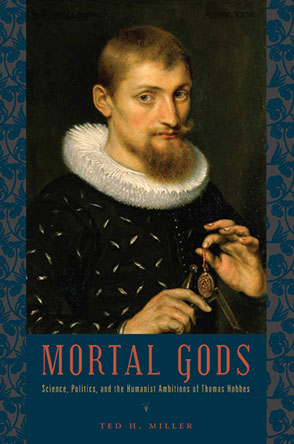
Mortal Gods
Science, Politics, and the Humanist Ambitions of Thomas Hobbes
Ted H. Miller
“Ted Miller's Mortal Gods is a great book, historically rich and theoretically innovative. His argument that Hobbes's humanist mathematical science is aggressively creative rather than descriptive or prescriptive institutes a debate where there has tended to be the consensus of a dominant interpretation. In prose that is fresh and lively, this is a provocative and rewarding read.”
- Media
- Description
- Reviews
- Bio
- Table of Contents
- Sample Chapters
- Subjects
Scott Horton of Harper's Magazine sat down with Ted H. Miller to discuss Mortal Gods. You can read that interview here.
“Ted Miller's Mortal Gods is a great book, historically rich and theoretically innovative. His argument that Hobbes's humanist mathematical science is aggressively creative rather than descriptive or prescriptive institutes a debate where there has tended to be the consensus of a dominant interpretation. In prose that is fresh and lively, this is a provocative and rewarding read.”
“Ted Miller makes a persuasive, nuanced, and surprising case for leaving behind the view that Hobbes’s development as a thinker proceeded in two or three distinct phases. Miller shows Hobbes’s thought to be dynamically unified. . . . Hobbes’s signal innovation was to have recognized the persuasive rhetorical power of mathematical reasoning among influential elites and seized upon it as a means for reforming philosophical inquiry. The combination accounts, in Miller’s view, for the striking originality of Hobbes’s political philosophy. Miller’s deeply learned and richly detailed account offers an engaging portrait of Hobbes’s intellectual and cultural milieu—from the mathematical debates of his day, to the grand court masques of the Stuart era, to the plastic arts of theater and architecture. Along the way, Miller offers solid correctives to Quentin Skinner’s influential readings of Hobbes; engages the style, purposes, and effects of Hobbes’s work more broadly; and offers potent reflections on the relations of humanism, modernity, and politics.”
“This rigorously argued and thought-provoking book challenges various received views of Hobbes by means of a few deceptively simple, mutually reinforcing interpretive moves.”
“For a latter-day audience, theology and mathematics are the thorniest branches of Hobbes’s philosophy. Not only does Mortal Gods illuminate both but, more importantly, Miller establishes the connection between them and, by doing so, brings out the grandiosity of Hobbes’s linkage of God and monarch.”
“Miller exemplifies a new kind of historicism. . . . Mustering resources of erudition toward nonantiquarian ends, he helps to liberate Hobbes scholarship from methodological constraints that have grown increasingly confining.”
Ted H. Miller is Associate Professor of Political Science at the University of Alabama.
Contents
Acknowledgments
1 Introduction
2 The Humanist Face of Hobbes’s Mathematics, Part 1
3 Constraints That Enable the Imitation of God
4 King of the Children of Pride: The Imitation of God in Context
5 Architectonic Ambitions: Mathematics and the Demotion of Physics
6 Eloquence and the Audience Thesis
7 All Other Doctrines Exploded: Hobbes, History, and the Struggle over Teaching
8 The Humanist Face of Hobbes’s Mathematics, Part 2: Leviathan and the Making of a Masque-Text
9 Conclusion
Appendix: Who Is a Geometer?
Notes
Bibliography
Index
1
Introduction
Alexis de Tocqueville is not, perhaps, the first name readers of an interpretation of Thomas Hobbes would expect to see. For some, it will correctly stand as a marker of the eclecticism of North American political theory. Nevertheless, every interpretation must have an origin, and this one is no exception. It emerges from within the broad, relatively fragmented and freewheeling constellation of curiosities of political theory as it is primarily practiced in departments of political science in the United States and Canada. These departments are staffed by a community of practitioners long interested in Hobbes, but often resistant to those readings which celebrate him as pioneer of social science, or hold up his work as an early model of analytic philosophy.1 This reading is, in part, an extension of that tradition of resistance.
De Tocqueville declared history’s trajectory to be the inevitable growth and progress of equality. Equality was an “irresistible revolution advancing century by century.”2 There is a straightforward way to connect Hobbes to this master narrative. By making men equals in the state of nature, Hobbes rejected the premises that sustained the hierarchical ways of understanding the natural, social, and political orders rooted within the doctrines of the schools, churches, and courts. As such, he is a part of the history of equality’s progress.3
As de Tocqueville insisted, though, that progress was (and still is) haphazard. One can imagine, says de Tocqueville, an “extreme point” where liberty and equality would “meet and blend.”4 All having an equal right to participate in government, and all being equal, no one would be able to exercise tyrannical power. Along the way, however, the two principles are realized neither at the extreme nor simultaneously, but distinctly and unevenly. Here again, a connection to Hobbes can be made. Hobbes moved from the equality of his state of nature to the gaping inequality embodied in the absolute sovereign’s relation to his or her subjects. In accord with the ideology of absolutism, Hobbes declares that the sovereign must outshine all the other subjects like the sun outshines the stars.5 The thirst for equality, de Tocqueville thought, could bring about tyranny. It could be of the absolutist variety, or the tyranny of the majority, which he feared most. Both the absolute sovereign and the sovereign majority might be compared to gods; they are likened to entities that dwarf all others with their power (and make them more equal to each other in their common subjection).6 When Hobbes speaks of his sovereign as a “Mortal God,”7 it is useful to think of what he hoped to assemble, but also, with de Tocqueville, what he was taking apart. His work was also an assault on the intermediary institutions between the sovereign and the people such as the established church,8 the nobility, and the courts. In so far as his philosophy insisted upon a unified form of sovereignty that need not take the form of an assembly, it was also an assault on Parliament.
For my immediate purposes, however, these initial points of connection to de Tocqueville can give way to another, perhaps less straightforward link. It concerns not merely de Tocqueville, but also the sometimes tangled relationship between some committed Tocqueville scholars and the audiences that make use of de Tocqueville for their own purposes. Alan S. Kahan, author of Aristocratic Liberalism: The Social and Political Thought of Jacob Burckhardt, John Stuart Mill, and Alexis de Tocqueville, wrote of de Tocqueville (and his two other subjects) that “the interpreters of aristocratic liberals are all too often ready to ignore the issues and circumstances . . . [these thinkers] thought crucial. Instead of asking the three what their questions were, we ask them our own questions, and as a result get an answer that is distorted and misunderstood.”9 Hobbes scholars have undertaken their own reclamation efforts. Hobbes, they have declared, must be spared our purposes and given back to his own. Among Hobbes scholars, these sentiments will bring to mind the “contextualist” approach of the Cambridge School historians. I will discuss the relationship between contextualist readings, and the status of “his own” below.
In light of the goals of this interpretation, de Tocqueville’s would-be rescuers offer a more poignant dynamic. They, of course, resist certain presentist readings by insisting that we understand de Tocqueville as a man of the nineteenth century (if not a man whose life was primarily determined years before by the French Revolution). They also, and more interestingly, caution against reading de Tocqueville as if his intended audience was in fact (or at least necessarily) the society of relative equals within the United States. They urge us to consider that his foremost audience may have been the frightened aristocrats of his native France. In short, they raise the possibility that Democracy in America was not aimed toward the sensibilities of our time and the political events that consume us. Democracy in America is not “ours,” they suggest, because it was not written to appeal to today’s egalitarians, much less those whom it describes. The book critically defends democratic ways to an inegalitarian aristocratic culture still trying to find its footing in early nineteenth-century France.10
For whom did Thomas Hobbes write? My purpose is not to duplicate the reservations urged upon readers by the Tocqueville scholars. Hobbes is not warning one class that another is coming to replace it. The differences between our society and Hobbes’s are in many ways unlike the differences between our society and de Tocqueville’s. In both cases, however, our democratic sensibility is offended by the suggestion that the texts of these two men are not immediately ours.11 Nevertheless, the example of de Tocqueville should prompt useful questions about how to approach Hobbes. Why should we be more attentive to where Hobbes’s audiences stood within the hierarchical cosmos of seventeenth-century Britain? In short, because doing so gives us a better appreciation of Hobbes’s politics. We should therefore ask: what did it mean to address oneself, or to offer a philosophical doctrine, to a sovereign one would make absolute? We can gain new and important insights into Hobbes’s politics if we try to discern how he negotiated (in the full sense) these distinctly seventeenth-century contexts and their attending practices. More specifically, I will read Hobbes in light of the practices of humanists education, patronage, and what I call the high culture of practical mathematics that were a part of seventeenth-century Britain’s most imaginative plastic arts.
Against the trajectory of this—or any contextual—approach one might raise a hermeneutic objection. Any reader, in fact every reader whether they acknowledge it or not, will reveal that the text they interpret is always for them because it cannot be otherwise.12 My interpretation always makes a book mine, and your interpretation makes it yours. In a broader historical frame, we, today, make the books we interpret ours. This argument seems to me undeniable, but if we must always make an author ours, the example of de Tocqueville suggests that one of the more fruitful ways to make an author ours is to make him untimely: “acting counter to our time and thereby acting on our time.”13 That is, the interpreted author who will necessarily be made ours can be ours in the way we make them not theirs. In this case “not theirs” does not mean denying authors their contexts, or more aptly what we think of as their contexts. It means working from those contexts to pull him or her away from some of our contemporaries. In fact, this reading works toward a doubly untimely Hobbes. I make arguments for taking Hobbes away from his scientific admirers,14 and for bringing him, I hope, too close for comfort to those who typically think of themselves as having achieved maximal distance from him.
We should therefore consider that Hobbes’s works were written for a different society, and likewise for someone other than ourselves. We may hold to this effort even while acknowledging that this “other” and the historically distinct society are never independent of ourselves because we (and not the dead) are the ones who declare and articulate these differences. Hobbes can and should be useful to us, but it does not mean that we need assume that his purposes are our purposes. This interpretation has been developed with this thought in mind, and with particular focus on Hobbes’s claim to offer his readers a science.
Returning to de Tocqueville, I would like to suggest an inversion of the audience question as it applies to Hobbes. Both raise the question of unequal audiences. De Tocqueville was trying to convince one audience of how the world need not be so horrid once it is forced to give up some of its powers. Hobbes was trying, in part, to convince another audience of how, with his help, it might claim a tighter grip upon power. Hobbes was not defending democracy to aristocrats; rather, he was defending a democratic moment of authorization of (and to) an absolutist sovereign. In other words, Hobbes had set himself the task of convincing a would-be absolute sovereign, a ruler who might have imagined his or her rule legitimated by other means, such as divine right, to accept power from the bottom up.15 In this respect Hobbes can be seen as the beginning of a de Tocquevillian nightmare: a man who joins the mandate of a dedifferentiated society in the state of nature to a central sovereign power who will rule without challenge.
As such, the greatest and first burden—and the central orientation—of Hobbes’s work is the sovereign his doctrine would create. Leviathan, in particular, is a mirror for a prince, if an unconventional one. It is a grand, scientifically constructed mirror. It offers a gift to the sovereign-in-potential, who—if he likes his gift—will find his likeness in it. That gift is to become the soul of a mortal god. This sovereign does not exercise its power merely over his or her subjects, but over all matter within its reach. Hobbes was a court philosopher who offered a would-be sovereign (and patron) a form of control that we in the twentieth and twenty-first centuries have not yet fully imagined, And it is this sovereign that is the as yet unimagined “other” that we need to consider not only in Leviathan but also in all of Hobbes’s major works.
In this book I try to reason through what I believe to be the most surprising implications of this concept of sovereignty and to show how it extends to domains of Hobbes’s thought not yet considered in the Hobbes literature.16 The most contentious claims will violate some contemporary scientific pieties, but I also hope to disturb some of the pieties among modernity’s critics that have also been a long-standing part of political theory. Sovereignty, in Hobbes’s thought, was more than merely political in the conventional sense. Others have noted how “the political” in Hobbes’s thought expands to exert its control over other domains of civil society, such as science, commerce, law, and religion, such that these domains lose whatever autonomous internal logic we might imagine they had. Such encroachments do indeed occur, and have been described by Carl Schmitt.17 Nevertheless, Schmitt and others (including Leo Strauss)—while mindful of Hobbes’s “mortal god” claim—did not fully appreciate just how thoroughly Hobbes proposed to make man the imitator of God through his science.18 God’s sovereignty over nature, as creator, was an implicit model for the activity of Hobbes’s science. His concept of philosophical inquiry, I will argue, was not so much a science of discovery as we often imagine it today, but a science of creation.
Although my purpose is not to make extensive comparisons of Hobbes and Francis Bacon, the broad outlines of this interpretation can be sketched in light of some fundamental differences and similarities. Hobbes embraced Copernicus and mathematics. Francis Bacon embraced neither. Because of this Hobbes is thought to have not been strongly influenced by him, in spite of his early employment as Bacon’s amanuensis. The differences between Hobbes and Bacon are substantial, but where they were alike is in their understanding of the purpose of knowledge. Each thought the end of knowledge was power, and more specifically state-power.19 Both men also advocated a new and total beginning to philosophy itself.20 Both men embraced conceptions of the practice of science to which the power and resources of the state were integral. Bacon imagined an army of investigators, each meticulously doing a small part in a collective effort to make nature yield up its secrets to the political elite. Hobbes, by choosing mathematics—and geometry in particular—imagined the state as a grand manipulator of all matter. Science was what taught this manipulator of matter to build the effects it desired and to maintain its own body politic in a state of peace and prosperity. God was a grand geometer. So might be the mortal god. Those who reverence both Hobbes and a notion of science as a systematic means of discovering, verifying, or even merely investigating and disconfirming inaccurate accounts of a reality independent of ourselves will be disinclined to agree with this reading of Hobbes.
I hope that this reading will also trouble and provoke in a friendly way those who have faulted Hobbes for having trod the path of modernity condemned by Heidegger and many others. That is, those who condemn him for having taken this independent reality for granted, for having duplicated the presuppositions that give us the Cartesian subject.21 If my Hobbes troubles them, it might be a kind of guilt by association. For against those who hope to master the world through grasping its inherent and inalterable principles, many critics have argued that the world is contingent, conditioned, and always already constituted by our gaze and our discourse. Nowadays these arguments seem a bit moldy, and those of us who are in sympathy with their self-appointed task of thwarting hidden sources of domination in modernity must, nevertheless, ask whether or not something has been overlooked in this struggle, since so many robust sources of domination exist and continue to reproduce themselves.
In the conclusion I will approach this question more systematically. In spite of many efforts to convince others that the wish for sovereignty is an impossible and dangerous dream, we have not fully understood what it has meant to aspire to sovereignty. A different understanding of Hobbes can help us address this problem. In his time and in his own way Hobbes was more aware of the fluxious character of world than most of his contemporaries. We are too facile if we declare ourselves his mental, political, or ethical superiors because we know that no amount of scientific inquiry will ever exhaustively describe the world that we ourselves are always constituting. Showing the scientific world its reflection in Procrustes is often apt, but the shock value would have been lost on Hobbes. Those who chop into pieces in this philosophy are not looked upon so harshly, provided they know how to construct what they will out of the basic elements.22 In spite of his materialism, his seemingly reductionist assumptions about human nature, Hobbes cannot be chastened by the figure of Procrustes. This is not merely because his conceptions of human activities often reveal themselves as more sophisticated than the stereotypical visions of homo economicus, his predecessors, or his new replacements. It is because Hobbes’s will to dominate nature pursues a more direct path toward its end than a cautionary tale about the unintended, or even devious, consequences of reductionism anticipates.
After positing, rather than defending, his assertions about the material universe, Hobbes never, conceptually, denied the world its contingency, its sheer protean possibility. On the contrary (as I shall argue) there were times when he insisted upon it in the face of rival conceptions of philosophy—especially natural philosophy—that claimed knowledge of creation, of its secret powers or its mechanisms. Hobbes’s goal was not to offer a superior account of nature (that which God is said to have created) but to teach the foremost member of his audience, the sovereign, to be like a creator god in mustering the causes necessary to produce desired effects—peace instead of the reigning chaos, as well as the things that make for “commodious living.” De Tocqueville offered his (aristocratic) foremost audience laments and reassurances in the world of increasing equality. Hobbes in his grand translation of all into matter in motion promised the foremost member of his audience the chance to be a god. The mediating institutions de Tocqueville (later) hoped to preserve (and some he did not) were the very ones that Hobbes threatened. These institutions, the universities, churches, and other elements of existing political and social authority fought back.
Hobbes’s language of “mortal gods” has been available to us for some time.23 Discerning the grand scope of his ambition, however, requires more than an apprehension of the social and historical dynamics that de Tocqueville brings to our attention. We must also dispense with a modern presupposition that has informed most Hobbes scholarship. Hobbes was said to have “discovered” geometry in a library in France in midlife.24 We have assumed that when Hobbes moved toward geometry, he was moving away from his earlier humanist training. Hobbes is thus said to have had two phases, an early, prescientific humanist phase, and a second, (New) scientific phase that began when he discovered geometry. Others maintain that Hobbes, upon further reflection, decided that philosophy alone was unable to accomplish its task in the real world, and so, especially with Leviathan, he reconciled with humanism, and with its most important political tool, rhetoric.25 That would constitute a third phase.
My contention against such readings is that Hobbes had a single phase, that is to say, no such distinct scientific and humanist phases, in his thinking. Like most humanists, he had disagreements with other humanists—especially those who used their eloquence for popular oratory—but what we have assumed regarding the relationship between mathematics on the one hand and humanism on the other is anachronism. The Renaissance humanists, who were especially good at pointing to the likeness between human excellence and divinity, were always a part of Hobbes’s intellectual repertoire.26 It is correct to say that unlike prior humanists, who located man on a great chain of being—somewhere above the beasts but beneath God—Hobbes’s thoroughgoing materialist metaphysic radically leveled this hierarchy. This is because he no longer counted upon “Nature” or God to enforce its hierarchy and orders upon the world, including the political realm. Hobbes can be folded into the narrative of the modern world’s disenchantment and secularization. On the other hand, Hobbes came from a world in which order and the promise of peace took the form of a divinely ordered hierarchy. If Hobbes lost faith in an animate nature that would restore itself and its order, he nevertheless proposed to those who might find themselves at the top that he had the means of creating a substitute, a grand artifice,27 which might even be superior to what nature was once said to have created. In a world of divinely sanctioned hierarchies, Hobbes’s philosophy was one of “do it yourself.” (Strauss is therefore correct in linking him with Machiavelli, but incorrect when he asserts that Hobbes’s science somehow masks the decision to “do it himself.”) When nature (and God’s) false promise of order failed, Hobbes proposed a philosophy that would establish human sovereignty over chaos.
To argue, as some have, that the world is never without remainder, always more contingent and chaotic than modern science’s categories have allowed is not incorrect, but here it misses the mark. Hobbes’s example illustrates that it is possible both to acknowledge, even trumpet, the world’s chaotic and contingent nature, and to wish to impose order upon it, regardless of the futility of searching out a natural order. We have grown accustomed to modern forms of domination that extend their reign over us through a claim of knowledge over what is declared the natural order. Having become accustomed to this, we tend to forget (especially when discussing science) that the will to dominate also operates independently of the will to know. Hobbes can help remind us of this sorry fact where we are most inclined to forget it.
The argument proceeds as follows. Chapter 2 begins to chip away at the dichotomy between humanism and mathematics. Chapter 3 describes how the imitation of God is integral to Hobbes’s conception of philosophy. Chapter 4 discusses the will to imitate God in the broader context of Renaissance humanism and speaks to the question of Hobbes’s conception of human being. Chapter 5 enters into a discussion of what it meant for Hobbes to reinvent science, and how Hobbes’s approach should be understood as his attempt to win an intellectual war on behalf of mathematics (and his own vision of geometry) against natural philosophy. For Hobbes it was a contest for dominance, not a plea to allow mathematics to join in the task natural philosophy had already set for itself. Chapters 6 and 7 address the questions of rhetoric and Hobbes’s notion of how his state would actually come into being. Chapter 8 returns to the topic of humanism and mathematics and courtly persuasion. There I argue that Leviathan may be read as equivalent of a grand court-masque, a stage genre cultivated in the Stuart era. The conclusion, Chapter 9, discusses implications for our understanding of sovereignty and the relationship between politics and reason.
Also of Interest

Mailing List
Subscribe to our mailing list and be notified about new titles, journals and catalogs.