


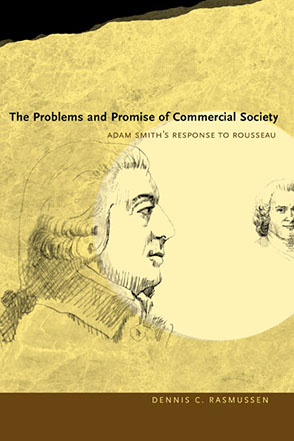
The Problems and Promise of Commercial Society
Adam Smith's Response to Rousseau
Dennis C. Rasmussen
The Problems and Promise of Commercial Society
Adam Smith's Response to Rousseau
Dennis C. Rasmussen
“Dennis Rasmussen has written a fine book on Adam Smith’s defense of commercial society as a response to Rousseau. As Rasmussen demonstrates, Smith not only took Rousseau’s critique of commercial society seriously but also evinced a surprising degree of sympathy with it. By reviving Smith’s dialogue with Rousseau, Rasmussen examines an important episode in the history of political thought and engages a debate over the benefits and drawbacks of commercial society that continues today.”
- Media
- Description
- Reviews
- Bio
- Table of Contents
- Sample Chapters
- Subjects
2008 Honorable Mention for the Delba Winthrop Fund for Excellence in Political Science Award
In this first book-length comparative study of these leading eighteenth-century thinkers, Dennis Rasmussen highlights Smith’s sympathy with Rousseau’s concerns and analyzes in depth the ways in which Smith crafted his arguments to defend commercial society against these charges. These arguments, Rasmussen emphasizes, were pragmatic in nature, not ideological: it was Smith’s view that, all things considered, commercial society offered more benefits than the alternatives.
Just because of this pragmatic orientation, Smith’s approach can be useful to us in assessing the pros and cons of commercial society today and thus contributes to a debate that is too much dominated by both dogmatic critics and doctrinaire champions of our modern commercial society.
“Dennis Rasmussen has written a fine book on Adam Smith’s defense of commercial society as a response to Rousseau. As Rasmussen demonstrates, Smith not only took Rousseau’s critique of commercial society seriously but also evinced a surprising degree of sympathy with it. By reviving Smith’s dialogue with Rousseau, Rasmussen examines an important episode in the history of political thought and engages a debate over the benefits and drawbacks of commercial society that continues today.”
“We have hitherto lacked a systematic and sophisticated book-length analysis of the relation between Smith and Rousseau. . . . Dennis Rasmussen’s beautifully written book will be important reading for anyone concerned with these two figures, and more broadly the Enlightenment and its critics.”
“Rasmussen has produced a concise, carefully organized, and insightful work that illuminates the thought of Rousseau and Adam Smith.”
“In this lucidly written study, Dennis Rasmussen argues that a comprehensive consideration of Adam Smith must engage with the question of Jean-Jacques Rousseau’s influence. And while others have already suggested this influence, Rasmussen offers what will likely be the definitive account of Smith’s grappling with Rousseau for years to come. He presents systematic and compelling evidence to defend the hypothesis that Smith was deeply affected by Rousseau’s deconstruction of commercial society.”
Dennis C. Rasmussen is Assistant Professor of Political Science at the University of Houston.
Contents
Acknowledgments
Abbreviations
Introduction
1. Rousseau’s Unhappy Vision of Commercial Society
2. Smith’s Sympathy with Rousseau’s Critique
3. The European Peasant and the Prudent Man
4. Progress and Happiness
Conclusion
References
Index
Introduction
Liberal democracy and market capitalism would seem to be the great success stories of our age—indeed, of any age. While troubling levels of deprivation and oppression still blot large regions of the globe, people living in today’s liberal capitalist societies enjoy unprecedented levels of prosperity as well as a greater degree of civil, political, and economic freedom than has been attained by any other society in history. Those who belong to these societies live longer and healthier lives, achieve higher levels of education, and enjoy more leisure time than almost anyone would have thought possible even a relatively short time ago. And in large part because of the spread of liberal capitalism, the number of armed conflicts worldwide and the numbers of people who die as a result of those conflicts have been—against almost all expectations—in steady decline. Moreover, these advances have contributed to a historically unrivaled degree of global consensus on the broadest political and economic questions: throughout the West and much of the non-Western world, there are virtually no serious alternatives to liberal democracy or to market capitalism of one stripe or another. In practice, of course, many Western nations and most nations outside the West fall short of fully embodying the ideals of liberal democracy and market capitalism. Yet in the wake of the discrediting of fascism after World War II and of communism after the events of 1989 to 1991, there seems to be little serious competition regarding the ideals themselves; indeed, these ideals are so dominant that one prominent scholar has famously asserted that we live at the end of history.
Yet triumphalist statements of this sort are bound to ring hollow for many readers. All but the most ardent supporters of today’s liberal capitalist societies judge them to be at best a mixed blessing, and a great many people on both sides of the political spectrum offer considerably harsher assessments. Numerous antiglobalizationists, environmentalists, socialists, post-structuralists, and multiculturalists, as well as communitarians, nationalists, virtue ethicists, cultural declinists, and religious fundamentalists of all denominations—taken together, perhaps most of today’s Western intellectuals—commonly blame liberal capitalism for exploiting the developing world, creating gross inequalities, harming the environment, promoting atomistic individualism, spreading conformity, and/or making people materialistic, selfish, immoral, and shallow. Of course, few of these thinkers or groups have an alternative vision for the world that is both truly different and truly realistic, but it is precisely the lack of alternative visions that makes these criticisms so important and pressing. The debate over the virtues and vices of liberal capitalism is, then, one of the broadest debates of our time; it shapes not only how we understand our world but also how we seek to improve it and how we approach the problems of the developing world. A uniquely valuable approach to shedding light on this debate, I believe, is to return to the thought of one of commercial society’s first and greatest defenders, Adam Smith, and one of its first and greatest critics, Jean-Jacques Rousseau.
Before turning to Smith and Rousseau, however, a word on terminology is in order. Throughout this book I will be using the term “commercial society” rather than the currently more familiar “liberalism” or “capitalism.” These latter two were not widely used until the nineteenth century and so are anachronistic when applied to the eighteenth-century world of Smith and Rousseau; they are also laden with unfortunate associations in a way that “commercial society” is not. Early in The Wealth of Nations, Smith offers explains what he means by this term:
When the division of labor has been once thoroughly established, it is but a small part of a man’s wants which the produce of his own labour can supply. He supplies the far greater part of them by exchanging that surplus part of the produce of his own labour, which is over and above his own consumption, for such parts of the produce of other’s men’s labour as he has occasion for. Every man thus lives by exchanging, or becomes in some measure a merchant, and the society itself grows to be what is properly a commercial society. (WN I.iv.1, 37)
Building on Smith’s description here, we can say that a commercial society is one in which we find an extensive division of labor and hence a high degree of interdependence, the protection of property rights and the rule of law, and a good deal of social, economic, geographic, and occupational mobility. Smith contrasted this kind of society with less developed societies ranging from hunter-gatherer peoples to feudal European states, and today we can also contrast it with societies that have relatively developed but authoritarian or planned economies, such as the fascist and communist nations of the twentieth century. This is not to say that these other forms of society have no commerce—some form of exchange is likely inherent in all human societies—but rather that commerce in these societies is constrained by tradition or command, resulting in less mobility, less interdependence, and often a less extensive division of labor than is found in commercial societies in the sense that we will be using the term. No sharp line divides commercial societies from other forms of society, but the nations that today conform most closely to the loose definition just offered are the member states of the European Union, the United States, Canada, Australia, New Zealand, and Japan, with many others around the world now developing quickly in this direction. This type of society began to develop in the seventeenth and eighteenth centuries, first in Britain and the Netherlands and soon afterwards in other parts of Western Europe and North America.
Smith and Rousseau were two of the most thoughtful and most renowned observers of the emerging commercial societies of the eighteenth century, and their attitudes toward these societies differed dramatically. Rousseau (1712–78) was almost certainly the most famous critic of the European world of his time. Born in the Calvinist republic of Geneva, he left his native city at the age of fifteen and, after a series of youthful escapades in Savoy (famously recounted in his Confessions), arrived in Paris in 1742. He lived in and around this city for most of the next twenty years during the heady days of the Enlightenment, a time when intellectuals from all over the Western world were gathering in the Parisian literary salons and the philosophes were beginning to mount their fierce attack on the throne and altar of the ancien régime. Rousseau attacked the attackers, taking on the “enlightened” principles and ideals of the philosophes in his first major work, the Discourse on the Sciences and Arts, which took the European world by storm when it was published in 1751 and made Rousseau a philosophical celebrity to an extent almost unimaginable today. (Diderot’s report on its reception gushed, “It is succeeding beyond the skies; there is no precedent for such a success” [Confessions VIII, 304].) After an even more blistering attack on their principles and ideals in the Discourse on Inequality (1755), Rousseau began to clash with a number of his erstwhile friends and colleagues, and he eventually became an exceptionally bitter adversary of many of the philosophes (most famously Voltaire). He ran afoul of the censors as a result of the heterodox religious ideas in Emile and The Social Contract (both published in 1762) and was forced to flee France, first to Neuchâtel and later, with the help of David Hume, to England. After nearly seventeen months in London and the English countryside, Rousseau’s paranoia led to a much-publicized break with Hume. He returned to France, where he spent most of the rest of his life in relative seclusion with his longtime mistress and eventual wife, Thérèse Levasseur. He died suddenly in 1778 while working on his autobiographical The Reveries of a Solitary Walker.
In sharp contrast to the famed “citizen of Geneva,” Adam Smith (1723–90) was celebrated as perhaps the greatest proponent of Europe’s emerging commercial order. He, too, lived in an “enlightened” society; Scotland had long been largely dismissed in European literary circles as a relative backwater, but by the late eighteenth century the thinkers of Edinburgh, Glasgow, and Aberdeen were every bit the equals of their French counterparts. Indeed, no less an authority on the matter than Voltaire acknowledged that “it is to Scotland that we look for our idea of civilization.” Smith was (and still is) generally regarded as one of the two leading figures of the Scottish Enlightenment, along with Hume, his closest and lifelong friend. Smith was born in the small port town of Kirkcaldy, and unlike Rousseau he received a first-rate formal education. He studied at the University of Glasgow under the eminent moral philosopher Francis Hutcheson, and then went on to spend six years at Oxford, where he found his teachers rather uninspiring and spent much of his time in self-instruction. After delivering a series of public lectures in Edinburgh, he obtained a position teaching logic at the University of Glasgow in 1751. A year later he was appointed Chair of Moral Philosophy (taking over Hutcheson’s old position). Smith’s first book, The Theory of Moral Sentiments (1759), was enthusiastically received throughout Europe. In 1763, as a result of his newfound prominence, he was offered a generous salary and lifelong pension to leave Glasgow and become the tutor of the young Duke of Buccleuch. The pair spent two-and-a-half years traveling on the Continent, where Smith met a number of prominent philosophes and économistes in Paris and Geneva. Upon their return to Britain in 1766, Smith, a lifelong bachelor, went to Kirkcaldy to stay with his elderly mother. He had been working intermittently on the material that was to become The Wealth of Nations at least since the early 1760s, and he began to delve into it in earnest there. He moved to London in 1773 and added to his already considerable reputation when The Wealth of Nations (1776) was finally published and became a resounding success. Soon afterward he was appointed Commissioner of Customs for Scotland, a job that he held during the last decade of his life, in Edinburgh.
Rousseau’s critique of commercial society was one of the earliest philosophic critiques of this kind of society, and even today it remains among the most comprehensive such critiques ever offered. Indeed, we will see that most of the serious arguments made today against commercial society were anticipated to some degree by Rousseau. Thus, in many ways Rousseau presents the greatest challenge to commercial society; anyone who hopes to make a persuasive defense of this kind of society will have to take all of the many different aspects of Rousseau’s critique into account. And Smith, we will see, attempted to do precisely that. Smith’s writings contain not only one of the earliest philosophic defenses of commercial society but also—I would venture to say—the first defense that takes Rousseau’s critique into account and that attempts to respond to its concerns. Many of today’s proponents of commercial society tend to ignore or dismiss critics of this kind of society; by contrast, Smith took the most serious critic of his day extremely seriously and was himself deeply concerned about many of the problems that Rousseau identified.
While Smith and Rousseau never corresponded and probably never met each other, they did have a number of mutual acquaintances among Europe’s “republic of letters,” including Hume and several of the philosophes; so Smith was unquestionably well aware of Rousseau’s immense intellectual influence. Smith never explicitly mentions Rousseau in either of his major works, but he does directly discuss him in a number of shorter writings and letters. In fact, one of Smith’s earliest published writings, a letter to the editors of the Edinburgh Review (1756), includes a substantial review of Rousseau’s Discourse on Inequality. In this review, Smith translates three lengthy passages from the Discourse that point to some of Rousseau’s most profound critiques of commercial society. As we will see, Smith continued to grapple with Rousseau’s arguments later in life, and The Theory of Moral Sentiments and The Wealth of Nations contain his answers to the tremendous challenges that Rousseau posed for him. I do not mean to claim that Smith’s books were written primarily as a response to Rousseau or that Rousseau was the thinker who had the greatest impact on Smith—that title undoubtedly belongs to Hume, with Hutcheson and the Stoics as probable runners-up—but I will be arguing that Rousseau’s critique of commercial society presented Smith with a challenge that shaped the development of his thought in a decisive way.
A deeper more thoughtful Smith emerges when he is seen in the light of the challenge posed by Rousseau. Other scholars have recognized, of course, that Smith was not the crude champion of laissez-faire capitalism and unbridled acquisitiveness that he is sometimes taken to be—Walter Bagehot noted more than a century ago that “free-trade has become in the “popular mind” almost as much [Smith’s] subject as the war of Troy was Homer’s”—but this view of Smith has long been seen as a caricature among Smith scholars, even if it remains the dominant one in the popular mind. Especially in the outpouring of work on Smith since the bicentenary of The Wealth of Nations in 1976, many scholars have painted a much more subtle picture of Smith’s outlook, one that recognizes that his analysis of commercial society is anything but crude or naive. We will see in Chapter 2, however, that even these more subtle accounts of Smith generally do not appreciate the full range and extent of his sympathy for the arguments against commercial society. Comparing Smith with Rousseau helps bring out these aspects of his thought, revealing the depth and complexity of his position as a social critic rather than as an apologist for commercial society.
Far from being an unabashed champion of commercial society, Smith actually shared a number of Rousseau’s severe misgivings about the type of society that was emerging in their time. For instance, both he and Rousseau acknowledged that commercial society necessarily produces great inequalities; that an extensive division of labor can exact an immense cost in human dignity by rendering people feeble and ignorant; that an emphasis on wealth and material goods can encourage moral corruption; and that the desire for wealth often leads people to submit to endless toil and anxiety in the pursuit of frivolous material goods. This is not to say that Smith is as harsh a critic of commercial society as Rousseau, or that he does not ultimately defend it. In fact, I think it is even too strong to say that Smith is “ambivalent” about commercial society, as many recent scholars have contended. Smith does unreservedly advocate commercial society, but he also accepts—indeed, insists—that many problems are associated with it. Why he advocates commercial society despite these problems is, I believe, the central puzzle of his thought.
For many decades, Smith scholars concentrated on a different puzzle in Smith’s thought, a puzzle that became known as the “Adam Smith Problem.” This problem was formulated in the nineteenth century by a number of German scholars, who argued that Smith’s emphasis on sympathy in The Theory of Moral Sentiments was irreconcilable with the emphasis on self-interest in The Wealth of Nations. This apparent contradiction was the central focus of Smith scholarship for many decades. Contemporary scholars, though, have generally rejected this problem (at least in its original formulation), and for good reason: it is based on the mistaken view that “sympathy” for Smith means benevolence and that “self-interest” means selfishness. There are certainly differences in emphasis between Smith’s two major works—as might be expected, since they deal with different subjects (moral philosophy and political economy)—but in the end I concur with the majority of recent scholars, who believe there is no fundamental contradiction between the two. Yet there are numerous tensions in Smith’s writings—witness here his agreement with many aspects of Rousseau’s critique of commercial society even though he defends this kind of society. Smith’s defense of commercial society and his acknowledgment of the ills associated with it are not simply split between The Wealth of Nations and The Theory of Moral Sentiments: some of his deepest criticisms, such as his harsh denunciation of the debilitating effects of the division of labor, are found in the former work, and important parts of his defense are found in the latter work. The tensions in his thought are, rather, found in both of his works. These tensions are real, but as we will see, they are not impossible to resolve.
All of that said, the question on which I am focusing—Why does Smith defend commercial society despite his full awareness of its possible drawbacks?—does not immediately present itself as basic to Smith’s thought. The main polemical thrust of his writings, after all, is the need to reform the commercial society of his day rather than to justify or defend that society. As its full title suggests, An Inquiry into the Nature and Causes of the Wealth of Nations was written above all to promote and facilitate “the wealth of nations” or economic growth, and Smith argues that the most effective way to attain this end would be to eliminate the mercantilist policies of the eighteenth century and replace them with free enterprise or “the obvious and simple system of natural liberty” (WN IV.ix.51, 687). Adopting “the wealth of nations” as one’s end only makes sense, however, if wealth and growth are ultimately desirable or beneficial. Smith probably did not feel the need to give the justification of these things a prominent place in his writings, since most of his readers would likely have assumed that they were desirable; but it is also clear—given his awareness of and sympathy with Rousseau’s critique—that he knew that the goodness of wealth and of commercial society itself could not be simply taken for granted, regardless of what most people thought.
Thus, throughout his works Smith offers a number of counterarguments and countermeasures for each element of Rousseau’s critique of commercial society. We will examine Smith’s responses to Rousseau’s critique in detail in Chapters 3 and 4, but let us note at the outset the key line of reasoning running through each of these responses: his argument that commercial society’s faults, though real and important, are not as numerous or as great as those of other forms of society. Smith provides a kind of cost–benefit analysis and concludes that, despite its very real problems, commercial society’s overall balance sheet remains preferable to those of other societies, for it constitutes a definite improvement over the poverty, insecurity, and dependence that dominated almost all precommercial ages. In other words, commercial society is unequivocally preferable, for Smith, even if it is preferable only on balance. This defense of commercial society was in some ways in the background of Smith writings, but it is necessary to foreground it if we are to understand the foundations of his thought. And it is through a comparison with Rousseau, I believe, that this underlying basis of Smith’s defense of commercial society becomes clearest and that the puzzle in his thought is brought out most starkly.
A study of Smith and Rousseau is also useful because their ideas have been so enduring. Few have had as profound (or profoundly different) effects on subsequent thought and history as these two thinkers. Smith is often hailed as the founder of economics and of capitalism itself, while Rousseau is frequently credited (or saddled) with inspiring the French Revolution, Romanticism, Idealism, nationalism, and even socialism and totalitarianism. It is perhaps impossible to overstate the impact these two thinkers have had (although many scholars have tried). Extravagant statements on this theme are too many to count, so a few representative samples will have to suffice: “After Smith . . . displayed the first true tableau of modern society, all the Western world became the world of Adam Smith: his vision became the prescription for the spectacles of generations” (Robert Heilbroner). “Alfred North Whitehead stated that the history of Western philosophy can be characterized as consisting of a series of footnotes to Plato. It can be said with even greater accuracy that the history of economics over the past two hundred years can be adequately characterized as a series of footnotes to Adam Smith” (Nathan Rosenberg). “The world has not seen more than once or twice in all the course of history . . . a literature which has exercised such prodigious influence over the minds of men, over every cast and shade of intellect, as that which emanated from Rousseau between 1749 and 1762” (Henry Sumner Maine). “There is hardly a respect in which [Rousseau] does not appear to have had his finger on the pulse of modernity, or in which his thought and its seismic impact did not serve to quicken that pulse” (Clifford Orwin and Nathan Tarcov). These may all be overstatements to one degree or another, but the prevalence of such assertions testifies to just how great the impact of Smith and Rousseau has been. Their ideas and arguments have helped form the framework within which present debates about commercial society take place.
As a result of their great intellectual and historical impact, as well as their sheer prescience and depth of insight, the questions Smith and Rousseau addressed remain our own as well, and to an astonishing degree. Given that the origins of many aspects of today’s society can be traced back to their era, Emma Rothschild rightly argues that “some of the disputes of the late eighteenth century are important, in the twenty-first century, because they are also our own disputes. They are not disputes which are repeated over time, or which can illuminate our times. They are our disputes.” The world has, of course, changed enormously since Smith and Rousseau’s time: in the eighteenth century, commercial society was based mainly on agriculture and small industry and was found only in one small corner of the world; that same society is now based largely on services, information, and technology and has spread throughout much of the planet. But because the defining features of today’s commercial societies—the extensive division of labor, the high degree of interdependence, the prevalence of mobility of all kinds—began to arise around this time, Smith and Rousseau’s assessments of commercial society’s moral, intellectual, social, and political impacts remain profoundly relevant. Indeed, the fact that commercial societies in the fullest sense were first emerging in their time makes their thought in some ways more valuable for us today, because this means they were observing commercial society as something essentially new and groundbreaking and so were in a better position than we are to see what is truly different about it, to see what is at stake in the arguments about it. A study of their writings can remind us of the alternatives to, and presuppositions of, ideas we now take for granted; thus they can help us gain a critical distance from our own situation without requiring that we abandon our own questions and concerns.
For all of these reasons, then, a return to the thought of Smith and Rousseau is timely in an era when commercial society seems to have triumphed—in reality in most of the West and at least in principle in many other parts of the world—but when the questions and problems surrounding this kind of society loom as large as ever. Hence, this book not only provides a much-needed comparison of the thought of Smith and Rousseau and uses this comparison to highlight and resolve the fundamental puzzle of Smith’s thought, but also seeks to use their deliberations to clarify and enrich the contemporary debate over the problems and promise of commercial society.
Chapter 1 of this book examines Rousseau’s three broad arguments against commercial society. The first, which I call the “division of laborers” critique, holds that it is not only labor that is divided in commercial society but also the laborers themselves: people living in this kind of society can have little social or personal unity, according to Rousseau, because of the prevalence of great inequalities and because of the weakness and ignorance produced by reliance on commodities and technology. In the second argument, the “empire of opinion” critique, Rousseau’s contends that in commercial society people are invariably dependent on the opinions of others and that this necessarily produces a great deal of ostentation, deception, and immorality. In his third and final argument against commercial society, the “pursuit of unhappiness” critique, Rousseau posits that the acquisitiveness encouraged by commerce expands people’s desires almost beyond measure, thereby ensuring that they spend their entire lives striving and toiling to attain a happiness that will always elude them. These three broad critiques encompass the most significant arguments against commercial society on both sides of the political spectrum, making Rousseau’s critique of commercial society one of the most comprehensive ever offered.
The rest of the book examines Smith’s response to Rousseau’s critique. Chapter 2 argues that Smith in fact showed a surprising degree of sympathy with each element of Rousseau’s critique of commercial society. It begins by exploring the historical and intellectual relationship between these two thinkers and then examining Smith’s review of Rousseau’s Discourse on Inequality. Almost half this review is devoted to translations of three lengthy passages from the Discourse that (surely not coincidentally, given Smith’s intellectual concerns) point to Rousseau’s three main critiques of commercial society as discussed in Chapter 1. In the remainder of the chapter I show that Smith was deeply engaged with the problems articulated by Rousseau and that he struggled with them in his later writings: he, too, acknowledged that the division of labor produces great inequalities and can exact an immense cost in human dignity by rendering people feeble and ignorant; that people’s great concern about the opinions of others can lead to problems such as ostentation and moral corruption; and that people tend to submit themselves to nearly endless toil and anxiety in the pursuit of “trinkets and baubles,” which in the end provide at best only fleeting satisfaction. The fact that Smith agrees with so many aspects of Rousseau’s critique of commercial society helps highlight the fundamental puzzle of his thought: Why did he defend commercial society despite his full awareness of the problems associated with it? Several possible answers to this question are offered in Chapters 3 and 4.
Chapter 3 outlines Smith’s response to the “division of laborers” and “empire of opinion” critiques. Smith acknowledges that the division of labor can produce harmful side effects, yet he defends it on the grounds that it generates astronomical increases in productivity, thereby opening up the possibility of raising the living standards of the poor. The inequalities produced by the division of labor are more than justified, for Smith, not only because everyone is materially better off in commercial society than they are in precommercial societies, but also because the worst effect of inequality—personal dependence—is significantly diminished by the interdependence of the market. Furthermore, he argues that the deleterious effects of the division of labor on laborers can be ameliorated through a comprehensive system of state-supported education. As for the “empire of opinion” critique, Smith concedes that people tend to be greatly concerned with the opinions of others; unlike Rousseau, however, he contends that this is actually a good thing, for this concern can act as the very basis of moral conduct. He maintains that the fact that people see themselves through others’ eyes gives rise to social standards of propriety and leads people to (more or less) follow those standards. Smith further argues that commercial society encourages virtues such as reliability, decency, cooperativeness, and strict adherence to society’s norms of justice by ensuring that these virtues are the surest path to success: the frequency of interaction in the market imposes restraints on people and obliges them to adapt their behavior to meet the expectations of others. In short, Smith argues that the overall economic and moral balance sheets favor commercial over precommercial societies, even if the former remain far from perfect.
Chapter 4 turns to Rousseau’s third and in some ways decisive critique of commercial society, the “pursuit of unhappiness” critique, and shows that Smith finds an answer to this critique in the positive political effects of commerce. Smith argues that the most important benefit of commercial society is that it helps provide people with a greater degree of liberty and security than they enjoy in other societies; extensive commerce does not guarantee an ideal political order, but according to Smith it does tend to lead to advances such as a decrease in personal dependence, the development of the rule of law, and more effective administration of justice. And since, on Smith’s account, dependence and insecurity are the chief obstacles to happiness, commercial society’s alleviation of these ills—ills that have dominated most of human history—helps promote people’s happiness in comparison to earlier societies. People in commercial society may not enjoy complete happiness, especially since they tend to toil constantly for meaningless luxuries, but neither do they face the degree of dependence and fear that characterized nearly all previous societies. Smith’s view of commercial society, then, is far from a triumphal one: there is simply a different mixture of benefits and drawbacks in commercial society, and on the whole it seems to him to offer the preferable mixture, for it provides the best chance for the most people to lead a decent life.
This book’s conclusion offers some reflections on the overall character of Smith’s outlook and on what his thought can teach us today. Smith’s approach, I maintain, is pragmatic rather than principled or foundationalist; his defense of commercial society rests on a kind of cost–benefit analysis rather than abstractions or ideologies. He is largely correct to suggest that commercial society is on the whole preferable to the historical alternatives; at the same time, however, his sober insistence that there are important drawbacks to commercial society helps call our attention to the need to address its very real problems. An examination of Smith’s thought, then, offers a salutary reminder to those contemporary critics of commercial society who mischaracterize him (and through him, commercial society) as indifferent to economic inequalities and to issues of character and morality; but it also serves as a wake-up call for those contemporary defenders of commercial society who mischaracterize him as arguing that we ought to be indifferent to these things. A return to Smith’s balanced, pragmatic approach seems worthwhile in an age that abounds with both dogmatic critics and doctrinaire champions of commercial society. Before exploring this approach more fully, however, we will turn, in Chapter 1, to a detailed examination of Rousseau’s critique of commercial society.
Also of Interest

Mailing List
Subscribe to our mailing list and be notified about new titles, journals and catalogs.