


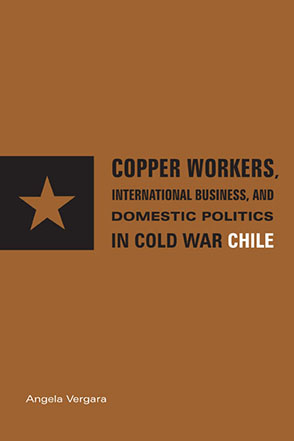
Copper Workers, International Business, and Domestic Politics in Cold War Chile
Angela Vergara
“Vergara provides an easy-to-read and exhaustively researched account of the negotiations among labor unions, U.S. capital, and the state in Chile’s strategic copper sector during the critical Cold War era. She demonstrates how outlawing of the Communist Party and mounting political conflict over the power of foreign capital shaped labor relations and the copper industry. An important contribution to our understanding of nationalism, state policies, and transnational capital.”
- Description
- Reviews
- Bio
- Table of Contents
- Sample Chapters
- Subjects
The labor movement, Vergara argues, was a progressive force instrumental in the introduction of national reforms and the radicalization of politics. In Chile its role is critical to understanding the expansion of the welfare state in the 1950s, the introduction of social reforms in the 1960s, and the Chilean road to socialism in the early 1970s. The book reveals the historical origin of the implementation of neoliberal policies, the erosion of labor rights, and the emergence of the so-called Chilean economic model championed by the “Chicago boys.” Many of the changes undertaken in the 1970s and 1980s, the book shows, had their impetus in the crisis of the import-substitution effort of the late 1950s.
“Vergara provides an easy-to-read and exhaustively researched account of the negotiations among labor unions, U.S. capital, and the state in Chile’s strategic copper sector during the critical Cold War era. She demonstrates how outlawing of the Communist Party and mounting political conflict over the power of foreign capital shaped labor relations and the copper industry. An important contribution to our understanding of nationalism, state policies, and transnational capital.”
“A solidly researched and well-written history of the least known of Chile’s large copper mines. . . . A major original contribution to our understanding of Cold War Chile that demonstrates the centrality of copper miners, their unions, and leaders to Chile’s social, economic, and political history.”
“Vergara effectively weaves together the plentiful supply of existing scholarship on the Anaconda workers and mixes it with new data of her own, especially concerning corporate efforts to modernize both mines and towns in the post-war era and developments during the period of socialization in the early 1970s.”
Angela Vergara is Assistant Professor of History at California State University, Los Angeles.
Contents
Illustrations and Tables
Acknowledgments
Introduction
1. From Montana to Potrerillos
2. The World of Labor
3. Copper, Labor, and Political Repression, 1945–1952
4. Making a New Deal: Copper Laws, Modernization, and Workers’ Rights, 1955–1958
5. Nationalism and Radicalization, 1958–1970
6. Experiencing Nationalization and Socialism, 1970–1973
Epilogue: Repression, Economic Transformations, and the Struggle for Democracy, 1973–1990s
Conclusion
Bibliography
Index
Introduction
On July 11, 1971, Chile nationalized its large-scale copper industry. President Salvador Allende celebrated this extraordinary event in the southern city of Rancagua, near the El Teniente mine, the largest underground copper mine in the world. In a speech he gave for the occasion, he restated the importance of copper for the country and the responsibility of copper workers in sustaining the national economy and the revolutionary process under way in the country. Until his tragic death in September 1973, he would constantly remark that copper was the “wage of Chile” (el sueldo de Chile) and that the nationalization of copper would lead the country toward its economic independence. “Fellow miners,” he declared in Rancagua, “strong workers of the red metal: once again I have to remind you that copper is the wage of Chile like the land is its bread. With their revolutionary consciousness, peasants are going to supply the bread of Chile. The future of our homeland, the wage of Chile, is in your hands. To work more, to produce more, to defend the revolution from the political point of view of the Popular Unity [coalition] and to defend the revolution with the production that will support the government of the people.”
As Allende clearly understood, copper was twentieth-century Chile’s most important commodity. In the 1960s, the material supplied nearly 80 percent of Chile’s foreign exchange and more than 20 percent of the state’s income. However, until 1971, Chilean copper was controlled by U.S. corporations and its marketing shaped by international forces beyond the control of the country. Many Chileans believed that their dependence on the international market and foreign capital was increasing the nation’s economic instability and causing its endemic inflation. In 1958, in his influential book En vez de la miseria, Chilean economist Jorge Ahumada argued: “The Chilean economy tends to be very unstable because exports fluctuate greatly. Exports are unstable because they are made up of 60 percent of copper, a product for which demand changes violently and frequently.” The central role of copper in the national economy and the perception that there was a pervasive relationship between foreign ownership and economic instability made the production, taxation, and ownership of copper mines a highly political and contested issue in modern Chile.
In 1971, President Allende also recognized the critical economic and political influence of copper workers and made efforts to incorporate them into the nationalization process. As a senator and presidential candidate, he had visited the copper camps and was familiar with the activism and radicalism of copper workers. He met with copper workers in February 1971 during a meeting of the Copper Workers Confederation to discuss the implications and directions of the nationalization and the peaceful revolution that he had proclaimed on taking office. Accordingly, the slogan of the nationalization effort specifically recognized the importance of workers in making nationalization of copper a reality: “With the effort of its workers, the capacity of its technicians, and the support of all the people, the nationalization means that Chile comes of age” [se pone pantalones largos].
Allende, however, underestimated or decided to ignore the copper workers’ complex reality and demands, and he faced challenging labor conflicts in the mines. A strike in the El Teniente mine, from April to June 1973, shortly preceding the military coup that ousted Allende, on September 11, 1973, considerably weakened the government and aggravated Chile’s internal political and economic crisis. By expecting copper workers to give up their demands for economic improvement, Allende ignored the role that high wages played in the copper industry. From within the leading sector of the national economy, copper workers organized one of the most powerful and successful union movements in the country. Through local and national strikes, their unions improved conditions for members and gained a voice in the debate about copper and nationalization. The workers earned some of the best salaries in the country. But behind good material conditions and political influence lay the harsh reality of mining copper in the Chilean Andes. Production of the element was a dangerous, difficult, and backbreaking job. The large-scale copper industry employed more than twelve thousand people, who lived and worked in isolated, high-altitude, foreign-owned camps. Workers were entitled to free housing and a wide range of social benefits, but most blue-collar miners’ homes lacked private bathrooms and there was no high school in the towns. Copper workers suffered chronic occupational diseases and had a short life expectancy; moreover, accidents were frequent in the mines and plants. The extreme contrast between the prosperity of copper companies and workers’ everyday lives and the gap between miners’ salaries in Chile and in the United States encouraged and legitimated Chilean miners’ demands for economic improvement.
In this book I explore the history of copper workers by looking at the living and working conditions of the workers and the sociopolitical aspects of copper production. The study focuses on one particular complex of mines and plants, Potrerillos and El Salvador, from the end of World War II to Chile’s transition to democracy in the early 1990s. Potrerillos and El Salvador are located in the province of Chañaral, in the southern part of the Atacama Desert, on the western slope of the Andes. At an altitude of seven thousand feet, Potrerillos and El Salvador have few water resources, almost no vegetation, and a high-desert climate. After its copper was depleted, Potrerillos was replaced in 1959 by the El Salvador mine, thirty miles away. From 1917 to 1971, the mines were owned by the Andes Copper Company, a subsidiary of the Anaconda Copper Company, then among the three largest copper corporations in the world. Since the nationalization of copper in 1971, the mines have been owned by the Corporación del Cobre (codelco), a state-owned copper corporation.
The history of Potrerillos and El Salvador was shaped by complex negotiations and conflicts between labor, foreign capital, and the national state. At the local level, workers, management, and state authorities defined the organization of production and of living and working arrangements. At the national political level, copper labor unions demanded from the state and legislators changes in labor and social legislation. At the same time, U.S. copper corporations, the national state, and the Copper Workers Confederation discussed the directions of copper policies and the rights and obligations of foreign investors. These interactions were ultimately shaped by the international copper market and changes in world demand and supply of copper. By taking into account how these actors interacted at different levels, I seek to overcome the traditional division in copper historiography, between the local, labor history of copper workers and management and the political and economic history of the relationship between the state and copper companies.
The cases of Potrerillos and El Salvador demonstrate how the characteristics of a foreign-owned-company town created enormous tensions between workers and management and, eventually, the state. As in many mining and company towns around the world, management was responsible for providing basic services, among them housing, food, transportation, health care, and entertainment. Andes Copper segregated Chilean workers from foreign supervisors and established two separate payroll systems (dollars for U.S. managers and supervisors and local currency for Chilean workers). It also regarded the camp as private property, restricting the access of visitors and independent shopkeepers. The intersections of living and working spaces, the strong presence of the company in workers’ daily lives, the company’s efforts to control and shape the working community, the gap between foreign managers and Chilean workers, and urban segregation became the basis of a radical and nationalistic labor culture in these camps.
Oriented to the export market, life in Potrerillos and El Salvador was shaped by global economic changes and international conflicts. The world market suffered from chronic instability, affected by constant changes in demand and supply, the U.S. government’s price ceilings during times of war, and competing commodities such as aluminum. Andes Copper reduced and increased production according to alterations in the international copper market, causing instability in jobs, social benefits, and state revenues. The company used the instability of copper prices to reject workers’ demands for economic improvement and to contest the efforts of the Chilean state to increase taxation. However, the contradictions of Chilean democracy and limitations of the domestic economy influenced workers’ lives and politics throughout the twentieth century. While inflation and stabilization programs threatened working people’s income and economic security, shifts in national politics limited workers’ political rights.
Copper workers adapted to and contested these forces, transforming their own realities, the companies’ production strategies, and the history of the nation. Workers strived not only to improve their material conditions, but also to redefine the structure of copper production and Chile’s social, economic, and political development. These two efforts—improvement of economic conditions and larger political and national claims—were entangled in such complex ways in workers’ everyday lives, discourse, and ideology that they cannot be separated.
In this book I trace the history of copper workers through three distinctive periods in Chilean and copper mining history: Chilean traditional democracy and foreign ownership of the copper industry (1945–70), Popular Unity and nationalization of copper (1970–73), and military dictatorship and state ownership of the copper industry (1973–90). In doing so, I explore the changes, transformations, and continuities in workers’ rights, identity, collective power, and material conditions throughout these five critical decades of the twentieth century. From a larger perspective, this local history of copper workers becomes a window into the modern transformation of Chile as it experimented with and lived through very different political, economic, and social models of development.
Between the end of World War II and 1970, copper camps were union towns, copper was the most important export commodity, and foreign companies produced 90 percent of the country’s copper. At the local level, the intersections of the workplace and the community increased the legitimacy of labor unions and expanded unions’ responsibilities in social and daily activities. In Potrerillos, for example, local unions financed summer camps for children in the area; sponsored Christmas parties; and maintained restaurants, barber shops, libraries, and radio stations. The strength of unionism was especially visible during strikes, when the entire community participated on the picket line and the few strikebreakers (called krumiros) were often left naked and covered with chicken feathers in the middle of town. The growing economic importance of copper in the Chilean economy consolidated the political influence and economic power of the copper workers’ unions. Yet their power was constrained by the unsolved contradictions of Chilean democracy, specifically in the cycles of inflation and stabilization policies and in the tensions between the expansion of democracy and the periodic repression of popular and labor movements.
Between 1970 and 1973, workers attempted to overcome their traditional dependency on management and Chile’s dependency on foreign copper companies. Following Salvador Allende’s presidential election victory in September 1970, workers joined the ambitious project of nationalizing the copper industry, democratizing local social and urban services, and redefining labor relations. It was an extremely difficult and conflict-laden process, conditioned by embedded labor practices, a national economic crisis, political polarization, and U.S. sanctions against Chilean copper and the Chilean economy. The Popular Unity coalition challenged the image of copper workers as radicals and revolutionaries, exposing the tensions that existed in the copper industry and the social, political, and regional divisions within the copper workers’ labor movement.
Following the military coup of 1973, this traditional industrial community began to disintegrate. Repression rapidly demobilized workers, facilitating the imposition of economic policies and laws that destroyed union influence and hard-won gains in the workplace. For the following seventeen years, an authoritarian state company replaced the socialist project of nationalization and reestablished many of the old labor practices. The traditional argument that workers’ benefits were a heavy load for an industry trying to be competitive in the international market was the basis for the attack on workers’ gains. In the 1980s, copper workers reorganized, but they were unable to overturn the dramatic transformation of their industry. Beginning in the 1990s, neoliberal-inspired economic policies and the effects of intensified globalization introduced new challenges, such as dismantling of mining towns, flexibilization of employment conditions, reorganization of working shifts (twelve-hour shifts), and the threat of privatization. Today (2006), the El Salvador mine is becoming too expensive to exploit and authorities have announced plans to the close it by 2010.
Copper Workers and Labor History
Despite the importance of copper and copper workers in Chilean history, their history remains incomplete. In the 1970s, Chilean scholars Jorge Barría, Manuel Barrera, and Francisco Zapata published the first serious studies on Chilean copper workers. Barría, a labor historian, carefully studied the institutional aspects of labor unions in the copper industry between 1956 and 1966, showing how copper labor unions successfully combined labor laws, direct action, political alliances, and trade solidarity to improve local conditions. Barrera and Zapata, by contrast, emphasized the unique characteristics and status of copper workers as an “isolated mass,” an occupational community, and underlined workers’ location in a strategic and export-oriented industry. They sought to explain the controversial political role and bargaining agenda of copper workers. Geographical isolation, harsh living and working conditions, and heavy dependence on the company created solidarity among workers, intensified labor conflicts and strikes, and inspired deep-rooted anti-imperialist ideas. While Barrera emphasized the notion of an economic enclave and isolation to understand the activism of copper workers, Zapata focused on the relationship between local conditions and a pragmatic union agenda that prioritized immediate demands over larger political claims.
In the late 1990s, U.S. scholars began looking at copper workers through the lens of community and working-class formation. Thomas Klubock focused on the construction of a working-class community in the copper mine of El Teniente during the first half of the twentieth century. By looking at labor migration; the experience of work; the role of women; the characteristics of the community; and corporate labor, welfare, and gender discourse, Klubock explained the emergence of a distinctive collective identity and a militant union movement. By shifting the analysis from the union hall to the community, Klubock shows the complexity of gender relations and the emergence of a local community as it negotiated and adapted to the demands of capital and the state. The work of anthropologist Janet Finn complements this study by showing the construction of a cohesive and vocal labor community in the open-pit Chuquicamata mine in connection with the unique characteristics of living conditions, the company’s welfare and gender policies, and patterns of labor recruitment. Finn also demonstrates the interrelationship between events in Chuquicamata and Anaconda’s most important mine in the United States, at Butte, Montana.
The scholarship of the 1970s effectively explained some of the unique aspects of living and working conditions in the copper industry and the ways in which these shaped the agenda of the unions. It tended, however, to provide a picture of the copper mines and copper workers as isolated from the rest of the country and the world. It also gave a very homogenous view of the Chilean side of the copper camps, disregarding the divisions within the community and the distinctive experiences of men and women and of blue-collar and white-collar workers. Thomas Klubock and Janet Finn filled many of these gaps, especially by acknowledging the role of women. Yet many questions remain unanswered. How did this community, formed in the first half of the twentieth century, evolve in the second half? How did changes in Chile’s political, social, and economic structure shape life and politics in the copper mines? How did changes in the postwar international copper market affect local conditions? How did copper workers in the post–World War II decades influence the history of their industry and Chile?
Influenced by recent research and debates on the Latin American export sector, labor, and globalization, this book integrates the local history of workers in Potrerillos and El Salvador into the larger history of the global copper market and copper consumption, U.S. imperialism, and the Chilean national state. This case study suggests a need to expand our analysis from the ways in which the international and national forces affected the lives of working people to how local communities shaped corporations’ strategies. Mining families and union members in Potrerillos and El Salvador transformed the decisions and production strategies of Andes Copper, forcing it to incorporate workers’ demands, throughout the second half of the twentieth century, a period usually disregarded by labor historians studying Chile. In addressing the events of this time, I shift the debate from the process of working-class formation to the identity, struggles, and politics of a mature proletarian labor force. I returns to the union hall to understand the ways in which workers collectively undertook the challenge of improving local conditions, shaping the national debate, and overcoming the impact of international forces.
The identity and history of copper workers were especially complex because these workers negotiated three unique experiences: participating in the export and foreign-owned sector of the economy, identifying collectively as Chilean blue-collar workers, and being male as well as mine workers. These three experiences became the basis of a collective identity that emphasized economic nationalism, an aggressive collective bargaining tradition, a pragmatic and independent political agenda, a demand for the incorporation of the “working class” in the national political and economic debate, and strong trade union solidarity.
Chilean copper miners worked in an export-oriented, foreign-owned company. As historian Charles Bergquist argues, workers in the Latin American export sector had a tremendous impact on the political and economic history of their countries. Their influence, he explains, was conditioned by the particular characteristics of each export industry, such as the nationality of the company (foreign or national capital), capital investment, use of technology, and the impact of the cycles of boom and bust. In the case of Chilean copper workers, the foreign ownership of the industry and a dual pay system (dollar and local currency) helped to consolidate a discourse in which the demand for labor rights intertwined with calls for economic nationalism and an anti-imperialist ideology, this nationalism reinforced by the development of a (politically and economically) dependent relationship between Chile and the United States. Their special status as export workers also led them to develop unique relationships with international labor organizations.
But copper workers’ identity and politics were also conditioned by their experiences as Chilean workers. Three important characteristics of modern Chilean democracy had an especially strong impact on copper workers: embedded inflation, institutionalization of labor relations, and the state’s ineffectual enforcement of labor rights. Inflation, a result of combined structural forces (for example, dependence on the export market, stagnation of national agriculture), government spending habits, monetary policy and emissions, and wage policies, was a constant threat to working people’s income. The institutionalization of labor relations, the high participation of the state in regulating labor conditions and mediating labor conflicts, and the relative independence of labor unions from the state and political parties shaped the ways in which labor unions approached collective bargaining and solved local conflicts. Yet the state’s commitment to guaranteeing workers’ rights was inconsistent, and through special legislation and force, the state attempted to control, repress, and co-opt the labor movement.
In the mines, Potrerillanos and Salvadoreños experienced the daily risks of mining copper at an altitude of twelve thousand feet. Large-scale mining is unique because it combines a heavily industrial mode of work, a system of life and work isolated from major urban centers, and a strong dependency on unpredictable natural forces. Copper miners worked in dusty underground tunnels, crushing plants, and hot smelters, constantly exposed to toxic fumes and the risk of accidents. The characteristics of the industry forced them to live in isolated company towns, under geographical and extreme weather conditions, and dependent on the company’s services. Geologists could only guess at the life expectancy of the mine and the quality of the ore, and miners speculated about when and how the future depletion of the mine would eventually destroy their way of life. Like many miners around the world, Chilean miners were proud of their work, physical strength, and manhood. They challenged the unpredictable character of nature and tested their own lungs by entering the mountain and digging its ore. Inside the mine, they joked, teased one another, and challenged traditional job hierarchies. They were superstitious and respectful of nature and resisted—until the late twentieth century—the entrance of women into the mine. Outside, a mining culture characterized by heavy drinking, promiscuity, gambling, and consumerism mixed with strong solidarity, union activities, and political commitments.
This book tells the story of Chilean miners in Potrerillos and El Salvador, their struggles at the local and national level as they made efforts to improve their living and working conditions and expand their rights. In Chapter 1, I describe the Anaconda Copper Company’s decision to invest in Chile, the construction of the Potrerillos mine, and the formation of a foreign community in the Chilean Andes. Arguing that the transnational dimension of capital shaped production and marketing decisions at the local level, I address the structure of capital and the relationship between Anaconda and its subsidiary Andes Copper. The focus of Chapter 2 is the working community in Potrerillos, specifically how the structure of that company town and unionization shaped the living, working, and political experiences of its copper workers.
The subsequent chapters are organized chronologically. Chapter 3 covers 1945–53, a time of crisis in the Potrerillos mine and of political repression directed against the Communist Party and the wider Left in the country. The instability of the international copper market, the crisis of Chilean copper, the depletion of Potrerillos, and state repression restricted workers’ resources and opportunities for economic improvement. Potrerillos workers experienced intense labor conflicts, economic hardship, and both political and labor repression. They adapted to these forces of change by distancing themselves from the Communist Party, establishing a relationship with the U.S. labor movement, and negotiating with state authorities.
In Chapter 4, I analyze the beginnings of a new era, in the relationship between workers, foreign capital, and the state. In 1955, the Chilean government offered copper companies tax breaks in exchange for increased production and investment. Taking advantage of this favorable investment climate, Andes Copper launched the El Salvador Project. It built a new mine to replace the depleted Potrerillos mine and a modern camp to house the labor force. The following year, in an attempt to reduce conflict in the copper mines and control the militant working class, President Carlos Ibáñez approved the Statute of Copper Workers of 1956.
The impact of economic nationalism, high labor costs, persistent labor tensions, and an unstable national economy on the company’s production scheme are the subject of Chapter 5. Responding to the challenges of the 1960s, Andes Copper increased investment, modernized its facilities, and introduced new technological advances. An important component of this wave of modernization was mechanization and automation. In an attempt to gain flexibility and reduce labor costs, the company hired large numbers of private contractors for construction and maintenance. Similarly, national pressures and labor costs provoked copper companies to reduce their foreign staff members. The social and labor consequences of management schemes led to intense confrontation with labor unions, eventually undermining the company’s position in the country.
Chapter 6 concentrates on the period of the Popular Unity coalition (1970–73). I analyzes the process of nationalization by looking at workers’ participation in the industry, labor relations, and living conditions. Although nationalization of the copper industry was a long-standing workers’ demand, and workers in Potrerillos were highly committed to its success, there were serious conflicts. I explore the tensions in the copper mines resulting from conflicts born of the legacies of the social and labor system constructed by foreign corporations; the problematic transition from a private to a state, socialist company; national problems such as economic crisis and the violent politicization and polarization of Chilean society; and international pressures. A description of developments in the copper mines since the military coup of 1973 is presented in the epilogue.
Copper workers have been influential in the modern history of Chile. They not only produced the “wage of Chile,” they also strove for the expansion of labor rights, the nationalization of copper, and the return of democracy. Their story is key to understanding the ways in which labor has shaped the history of Chile; they played a part not only as victims of models of economic growth, undemocratic political institutions, and imperialism, but also as active participants in contesting, negotiating, and making their own history and that of Chile.
Also of Interest

Mailing List
Subscribe to our mailing list and be notified about new titles, journals and catalogs.