


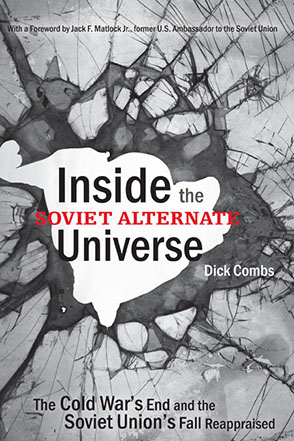
Inside the Soviet Alternate Universe
The Cold War's End and the Soviet Union's Fall Reappraised
Dick Combs, and Foreword by Jack F. Matlock Jr.
Inside the Soviet Alternate Universe
The Cold War's End and the Soviet Union's Fall Reappraised
Dick Combs, and Foreword by Jack F. Matlock Jr.
“Dick Combs was by training and experience a leading analyst of Soviet doctrine and behavior within the U.S. from the early 1960s until the late 1990s. His book combines scholarly exegesis with historical narrative. It will interest anyone seeking to make sense of the sudden collapse of the Soviet state. Its account of decision-making and advocacy within the Department of State and the National Security Council is equally compelling. In short, Mr. Combs has made a significant contribution to the international history of the twentieth century.”
- Description
- Reviews
- Bio
- Table of Contents
- Sample Chapters
- Subjects
Part I of the book sets the stage by affording the reader an “existential feel for the reality, including the psychological atmosphere, of Soviet communism” in everyday life as the author himself experienced it while serving as a young diplomat in the U.S. legation in Sofia, Bulgaria, in the late 1960s and later during eight years of diplomatic service at the U.S. embassy in Moscow. Part II then builds on this direct exposure to the Soviet mind-set to develop an analytical perspective on the causes for the Cold War’s end and the USSR’s disintegration as arising “essentially from Gorbachev’s attempt to reform the regime’s official conception of governance” once the Stalinist fixation on international class struggle had proven no longer viable as a basic rationale for policy-making. Part III, finally, deploys this perspective to explain the unfolding of events that led to the ending of the Cold War and the demise of the Soviet system, to reveal the relationship between the two, to point out the relevance of this explanation to current U.S. foreign policy, and to show how it can help us better understand what is happening in today’s Russia.
“Dick Combs was by training and experience a leading analyst of Soviet doctrine and behavior within the U.S. from the early 1960s until the late 1990s. His book combines scholarly exegesis with historical narrative. It will interest anyone seeking to make sense of the sudden collapse of the Soviet state. Its account of decision-making and advocacy within the Department of State and the National Security Council is equally compelling. In short, Mr. Combs has made a significant contribution to the international history of the twentieth century.”
“Synthesizing memoir, history, and policy analysis, Dick Combs’s book combines an instructive inside account of a high-ranking American diplomat’s years in the Soviet Union with a critical analysis of the evolution of Soviet thinking about world affairs. It also analyzes American thinking about the USSR and applies the lessons of all this to understand post-Soviet Russian politics and foreign policy, and American misperceptions thereof.”
“Dick Combs’s study is a welcome addition to the many memoirs and scholarly studies devoted to the end of the Cold War and the demise of the Soviet Union. Readers will be rewarded with a fresh view, penetrating insights, and—equally important—a very good read.”
“Throughout the post-Soviet period, the Nunn-Lugar program has been a primary vehicle through which the new Russian-American relationship has evolved. Dick Combs was one of the original conceptualizers of that program, born of his understanding of the deep-seated social and psychic strains unleashed by the Soviet collapse, but also a major facilitator of the policy’s application through his mastery of the Russian language and his appreciation of the sensibilities of the Russian people and their leaders.”
“I greatly benefited from Dick Combs’s deep understanding of Soviet culture and thinking during his service as my U.S. Senate foreign policy advisor. His depth of knowledge and balanced judgment are clearly reflected in this book, which offers fresh, persuasive analysis of the end of the Cold War and the fall of the Soviet Union. Policymakers, academics, and the public can draw important foreign policy lessons from Combs’s insightful account.”
“Overall, Inside the Soviet Alternate Universe is a sophisticated, well-reasoned argument about the demise of the USSR and the problems of dealing with different mindsets and cultures. As such, Combs’s book deserves study by historians, analysts, and politicians alike.”
Dick Combs spent many years as a Foreign Service officer, from 1966 to 1989, with three tours of duty at the U.S. embassy in Moscow during the height of the Cold War. He later served as a Congressional foreign policy adviser to Senator Sam Nunn and as research professor at the Monterey Institute of International Studies.
Contents
Foreword: Myths That Mislead
Jack F. Matlock Jr.
Author’s Preface
Part One. Reminiscence: Ten Years Inside the Empire
Introduction to Part One
1. Initial Encounters with the Other Side
2. Working Levels of the Soviet Regime
3. Stagnation and Disaffection
4. The Beginning of the End
Part Two. Reflection: A Neglected Psychological Perspective
Introduction to Part Two
5. Comprehending Another Political World
6. Formation of the Soviet Conception of Governance
7. The Conception’s Evolution Under Khrushchev and Brezhnev
8. Gorbachev and the Conception’s Terminal Phase
Part Three. Relevance: Psychological Milieu and Current Foreign Policy Issues
Introduction to Part Three
9. Reappraising the Cold War’s End and the Empire’s Fall I: Key Pieces of the Puzzle
10. Reappraising the Cold War’s End and the Empire’s Fall II: Fitting the Pieces Together
11. Empire and Democracy in Post-Soviet Russia
12. An Analytical Blind Spot and Its Consequences
Notes
Bibliography
Index
Introduction
It may seem unusual that a book that is mostly analytical opens with several chapters that are mostly descriptive. This is the case because of the importance I attach to providing a real-world setting, a specific historical context for the analysis and policy recommendations in the second and third parts of the book. Before setting forth a theoretical framework for analyzing the end of the Cold War and the fall of the Soviet empire, I want the reader to take part vicariously in the experiences and encounters I describe in this opening section and thus to develop some existential feel for the reality, and particularly for the psychological atmosphere, of Soviet communism as I came to know it. I want the reader to see that the analytical perspective I develop in Part 2 and use apply to current foreign issues in Part 3 is based upon the realities of the Soviet regime as I experienced them, above all from the mind-set, the concepts, and the categories with which the Soviet leadership construed the world.
Although I was trained in political science, the approach I use in Part 1 as well as in Part 2 resembles the methods characteristic of the school of cultural anthropology represented by Clifford Geertz. In his view, the proper study of other people’s culture involves discovering who they think they are, what they think they are doing, and to what end they think they are doing it. To accomplish this, Geertz contends, one must gain working familiarity with the frames of meaning within which other peoples live their lives. And the basic data in this effort “are really our own constructions of other people’s constructions of what they and their compatriots are up to.”
Understanding foreign frames of reference is also one of the main concerns—or should be—of career diplomats, who, while interested in the thinking of all peoples in a given country, are most interested in that country’s leadership group and its frame of meaning. As an American diplomat dealing primarily with the Soviet Union and Eastern Europe, I developed my construction of the Soviet leadership’s outlook from specific observations during my eight years in the Soviet Union and Bulgaria—from trying to understand who Soviet and Bulgarian leaders thought they were, what they thought they were doing, and to what end they thought they were doing it.
My selection of observations in Part 1 and my subsequent generalizations from them in Part 2 certainly do not have the methodological rigor of anthropological fieldwork. As will become obvious in the first four chapters, most of my observations regarding leadership outlook were of necessity indirect—in those days, American diplomats had little personal contact with senior Communist leaders and had to rely on inference, imagination, and a fair bit of guesswork in attempting to understand their thinking. Still, as Geertz has nicely put it: “Believing, with Max Weber, that man is an animal suspended in webs of significance he himself has spun, I take culture to be those webs, and the analysis of it to be therefore not an experimental science in search of law but an interpretative one in search of meaning.”
The reader of course may not agree with my view of the Soviet alternative universe and the analytical scheme I have derived from it—indeed, given the still-contentious nature of the substantive issues with which this book deals, it would be unrealistic to expect widespread consensus, particularly among Western specialists in Soviet affairs who have formed their own understanding of Soviet leadership motivations and reached their own conclusions about the end of the Cold War and the fall of the Soviet empire. At least my inductive approach, proceeding from descriptive particulars to more generalized analysis and then to policy recommendations, will provide explicit grounds for the specialist as well as the general reader to judge the validity of my findings.
More generally, I hope my episodic account of diplomatic life and times behind the Iron Curtain will convey a sense of the texture and flavor of those times and illustrate U.S. diplomacy at the working level during the last phase of the Cold War, from the mid-1960s to the late 1980s. To this end, I have included descriptions of the routine of living and working inside the Soviet empire, along with selective accounts of experiences that illuminated the nature of that empire. I hope this will benefit younger readers, for many of whom America’s costly and sometimes dangerous preoccupation with the Soviet threat over the four decades following World War II doubtless seems a distant, closed chapter in American history.
Part 1 is not intended as a personal memoir, although the episodes are arranged in rough chronological order for the sake of clarity and are of necessity personal in nature. The episodes are described as accurately as memory allows, with the exception of my using pseudonyms and changing or omitting nonessential facts in a few instances, out of respect for the privacy of the specific individuals concerned and also with due deference to a few still sensitive matters pertaining to U.S. national security.
A word of explanation may be in order regarding my background and experience, to demonstrate the nature of my specialization and also to provide something of a road map for the four chapters that follow. I was one of a core group of U.S. Foreign Service Officers who specialized in Soviet and Eastern European affairs during the last three decades of the Cold War. My interest in communism and the Soviet Union had a somewhat unusual genesis: it was stimulated by my father, who was engaged professionally in such matters as chief counsel and chief investigator for the California Senate’s Committee on Un-American Activities from the early 1940s to the 1960s. Despite his extensive firsthand experience with American communism, he could never satisfy my curiosity as to why intelligent Americans would opt to dedicate their lives to the Soviet-led communist movement.
I pursued this interest as an undergraduate and graduate student at the University of California at Berkeley, learning Russian at the Army Language School during a three-year stint in the military between my undergraduate and graduate studies. As a graduate student I specialized in Soviet affairs in Berkeley’s Department of Political Science, from which I received a doctorate in 1966. My dissertation dealt with the internal logic of Marxism-Leninism and the ways in which this doctrine appeared to shape Soviet policy-making. In working on the dissertation, I became convinced that despite what struck me as Marxism-Leninism’s overall falsity and pretentiousness, if one temporarily suspended disbelief and assumed its basic assumptions were valid, the doctrine had a seductive internal logic, was consistent over time, gave the true believer a sense of participating in a scientifically grounded just cause, and did in fact appear to play a major role in shaping Soviet policy.
I had many subsequent opportunities to test and refine these conclusions through direct exposure to the Soviet empire. I joined the foreign service in 1966 and was initially posted to the U.S. Legation in Sofia, Bulgaria, for two years. Next came a year of advanced Russian language training and Soviet area studies at the U.S. Army’s Russian Institute in Germany, after which I was assigned for two years (1969–71) to our Moscow embassy. Chapter 1 highlights my experiences in Bulgaria, at the Army Institute in Germany, and on an extensive, institute-sponsored tour of the Soviet Union. Chapter 2 describes the impressions I drew from these experiences as well as from my first assignment in the USSR.
My initial Moscow assignment was followed by a posting to the U.S. Mission to the United Nations, where I served as the mission’s specialist on the Soviet Union and Eastern Europe (1971–73). My next assignment was to the State Department’s Office of Soviet Union Affairs (1973–75) and led to my return to Moscow for a four-year tour of duty at the embassy (1975–79). My experiences in the Soviet Union during those years are sketched in Chapter 3. I then went back to the State Department to work as one of two assistants to Marshall Shulman, who was Secretary of State Cyrus Vance’s Special Assistant for Soviet Affairs. Next came a second posting to the Office of Soviet Union Affairs, where I served as principal deputy director during the initial years of Ronald Reagan’s presidency (1980–83). Following that, I served for two years (1983–85) as director of the Office of Eastern European and Yugoslav Affairs. And in 1985 I returned to the USSR for my third Moscow assignment, this time as the embassy’s deputy chief of mission. Chapter 4 highlights those two years.
My departure from Moscow in the summer of 1987 marked the end of my foreign service assignments inside the Soviet empire. But three subsequent positions outside of the Department of State brought me back to the USSR and its successor states many times from 1988 through the late 1990s. The first position was head of Soviet and Eastern European affairs at the Congressional Commission on Security and Cooperation in Europe, on loan from the State Department (1988–89). The second, immediately following my retirement from the foreign service in 1989, was foreign affairs advisor to Senator Sam Nunn (1989–95), in his capacity as Chairman and later ranking Democratic member of the Senate Armed Services Committee and also as a member of the Senate Select Committee on Intelligence. The third position was director of programs in the former Soviet Union and research professor at the Center for Nonproliferation Studies (1995–98), a component of the Monterey Institute of International Studies. Chapter 4 also touches upon those experiences.
Mailing List
Subscribe to our mailing list and be notified about new titles, journals and catalogs.