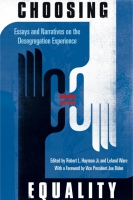




Choosing Equality
Essays and Narratives on the Desegregation Experience
Edited by Robert L. Hayman Jr., Leland Ware, and with a Foreword by Vice President Joe Biden
Choosing Equality
Essays and Narratives on the Desegregation Experience
Edited by Robert L. Hayman Jr., Leland Ware, and with a Foreword by Vice President Joe Biden
“This splendid collection combines reminiscences and essays tightly focused on Delaware’s experience with segregation and desegregation with more general essays on the meaning of Brown v. Board of Education to provide readers with a well-rounded understanding of the experience of desegregation in Delaware and, as important, around the nation.”
- Description
- Reviews
- Bio
- Table of Contents
- Sample Chapters
- Subjects
Choosing Equality includes contributions that give voice to these concerns, yet it provides a strong challenge to this revisionist interpretation. It does so in a unique way, by positioning the issues in the overall national context but focusing on them in the experience of one state, Delaware, that stands as a microcosm of the larger conflict. The State’s significance to Brown lies in its contributing two of the five cases that were consolidated in the Court’s review of the litigation. But Delaware’s own history registered the racial conflict at the heart of the American dilemma: a slave state that fought on the side of the North in the Civil War, it experienced black migration to its cities and the ghettoization that followed but also had black farmers working as sharecroppers next to whites in its southern section. Moreover, while it saw massive resistance to desegregation, it also was the site of one of the largest and most peaceful metropolitan desegregation efforts.
This volume offers not only academic analyses of Delaware’s experience of Brown, set in the broader framework of the debate over its significance at the national level, but also the personal voices of many of the leading participants, from judges and lawyers down to community activists and the students who lived through this important era of the civil rights movement and saw how it changed their future by giving them hope.
“This splendid collection combines reminiscences and essays tightly focused on Delaware’s experience with segregation and desegregation with more general essays on the meaning of Brown v. Board of Education to provide readers with a well-rounded understanding of the experience of desegregation in Delaware and, as important, around the nation.”
“This is an excellent collection of essays dealing with the impact of the Supreme Court’s historic 1954 opinion in Brown v. Board of Education. It is a must-read for anyone trying to understand the implications of the Brown decision for American society.”
“This collection of essays provides an interesting lens through which to examine Brown and its legacy, namely, the local situation in Delaware, particularly New Castle County and Wilmington. . . . Its unique local perspective offers an important lens for better understanding the national issues.”
“In clear words, thorough research, and powerful arguments, Hayman and Ware—through their own voices and those of contributors, some of whom were the titans for justice—retell the road to Brown v. Board of Education. They do so through a deep exploration of Delaware’s untold story. Choosing Equality thus lays bare a northern state’s part in a personal, legal conversation for human dignity. Brown’s integration principle did not end this conversation. It continues today in the founding of charter schools and in Parents Involved in Community Schools. A truly important book, Choosing Equality is a must-read.”
Robert L. Hayman Jr. is Professor of Law at Widener University. Among his publications is The Smart Culture: Society, Intelligence, and Law (1998).
Leland Ware is Louis L. Redding Professor for the Study of Law and Public Policy at the University of Delaware. He is the co-author of “Brown v. Board of Education”: Caste, Culture, and the Constitution (2003), which won the Langum Prize for Legal History in 2004, and Thurgood Marshall: Freedom's Defender (1999). He served as a trial attorney for the Civil Division of the Department of Justice from 1979 to 1984.
Contents
Foreword by the Hon. Joseph R. Biden Jr.
Acknowledgments
Introduction by Robert L. Hayman Jr. and Leland Ware
Part I. The Context: Race and Segregation
1. Robert L. Hayman Jr.: A History of Race in Delaware: 1639–1950
2. Interview of the Honorable Collins Jacques Seitz Conducted by the Honorable A. Leon Higginbotham Jr. and by David V. Stivison
3. Delaware Voices: Collins J. Seitz Jr.
4. Annette Woolard-Provine: Remembering Louis Redding
5. Juan Williams: Remembering Thurgood Marshall
6. Robert J. Cottrol: The Difference That Brown Made
7. Jack Greenberg: A Glass Half Full
Part II. The Experience: Education and Desegregation
8. Leland Ware: Educational Equity and Brown v. Board of Education:
Fifty Years of School Desegregation in Delaware
9. Orlando Camp and Ed Kee: Lost Opportunity: The Failure to Integrate Milford's Public Schools in 1954
10. Delaware Voices: Littleton Mitchell
11. An Interview with the Honorable Murray M. Schwartz
12. Roger L. Goldman: The Resegregation Decisions and the New Federalism
13. Delaware Voices: Jae Street
Part III. The Legacies: Desegregation and Resegregation
14. James T. Patterson: Legacies of Brown v. Board of Education
15. Robert J. Lipkin: Haunted by Brown
16. Paul Finkelman: Civil Rights in Historical Context: In Defense of Brown
17 Jack M. Balkin: Brown, Social Movements, and Social Change
18 Nancy Levit: Race and Sex Segregation in Schools Fifty Years after Brown
19 Patricia J. Williams: Pre-White and Post-Black: The Aesthetics of Oppression
20 Jeffrey A. Raffel: Charter Schools in the Context of Brown: Panacea
or Faustian Bargaining?
21 Michele Fuetsch and Leland Ware: Race, Class, and Resegregation:
Delaware Schools Fifty Years after Brown
22 Robert L. Hayman Jr. and Leland Ware: The Geography of Discrimination:
The Seattle and Louisville Cases and the Legacy
of Brown v. Board of Education
Bibliographic Essay by David K. King
Contributors
Index
Foreword by Vice President Joseph R. Biden Jr.
Our nation is far different today than it was fifty years ago, when the Supreme Court announced its decision in Brown v. Board of Education. Racial discrimination – then buttressed by our legal system – is no longer sanctioned by law. Segregated lunch counters and water fountains – commonplace then – are now relics of the past. Barriers like poll taxes and other shams – once tolerated – are no longer permitted to bar African Americans from voting.
America is indeed a far better and much richer country today because of the enlightenment delivered, in no small part, by the decision in Brown, by the brave attorneys who fought for it, and by the leaders and foot soldiers of the movement for civil rights. They awakened a nation to the cause of equality and justice for all, and because of their courage and foresight, America is stronger.
Yet, it is that sense of accomplishment that is today, perhaps, the greatest enemy to equality. Having survived the civil rights movement and then reaped the benefits that struggle produced, we are inclined to believe that our work is done, that racial disparities no longer exist. But that simply is not true.
Although we may no longer tolerate legal discrimination and segregation, we live, more than ever before, segregated lives in segregated neighborhoods. We worship in segregated churches, synagogues, and mosques. And a half-century after Brown, our children – still and yet again – attend largely segregated schools.
Now is no time to rest on the accomplishments of yesteryear. We must remain vigilant in our efforts and true to the vision of legends like Dr. Martin Luther King Jr. and Shirley Chisholm and Thurgood Marshall and Barbara Jordan, all of whom knew what we all now know – namely, that America can only be great when all its citizens are afforded an equal opportunity to grow and learn and themselves be great.
I was called to the U.S. Senate more than thirty years ago, inspired largely by this promise of equal opportunity and by the legions of brave Americans who risked life and limb to ensure that America kept that promise. When I began my service in 1972, we were living in tumultuous times. Only a few years before, this country had witnessed the assassination of its bravest sons. We had survived a war abroad, and our security at home – threatened by unfriendly foreign powers and a deeply divided public – was uncertain. I thought then, as I do now, that vigilance and strong, outspoken leadership could usher in the healing and transformation we so desperately needed.
Some of that leadership comes from extraordinary individuals. I knew some of them in Delaware. As a kid from Claymont, Delaware, I knew about the Seitz family. I knew that the Seitz family had contributed to the well‑being of my state in every single aspect of their lives, and for more than a single generation. I knew that Judge Seitz was a genuine hero. One of the proudest moments in Delaware history, and one of the proudest in Americanhistory, occurred, when led by Judge Seitz, we finally acknowledged that separate was not equal.
And I knew about Louis L. Redding. When I was a young lawyer, he scared the living heck out of me. He was an intimidating force, but I knew that force had been used to great good. And perhaps the highest compliment I received when I first ran for the Senate came one day when I was with Louis Redding. We were together on one of those little corner elevators, going up, and he looked at me and he said in that distinctive and distinguished voice, “I think you should run.” That was the totality of it – the beginning and the middle and the end of it. And I walked out of that elevator, thinking I was walking on a cloud, for Louis L. Redding thought I should run.
And I knew the incredible contributions so many Delawareans had made to our struggle for racial equality. Perhaps no one demonstrated more personal courage in that struggle than Littleton Mitchell. Lit Mitchell was an extraordinary crusader – he still is – and I was and remain inspired by his example. In the face of seemingly insurmountable obstacles, he led the charge to secure fair housing, equal access to public accommodations, and equal educational and employment opportunities in our state. And so when I had an opportunity to appoint someone to the national Brown vs. Board of Education Fiftieth Anniversary Commission, I wanted Lit. I suppose I could have appointed someone who was more decorous or a bit more diplomatic. I didn’t want that; we don’t need that. I wanted someone who would tell the truth; I wanted someone who would wear his heart on his sleeve. Lit will do that. And he will kick and scream, because it is time to kick and scream. There are times, after all, to be angry about what is happening. We need to be angry.
The fact of the matter is that, just a few years after we commemorated the fiftieth anniversary of Brown v. Board of Education, I feel a great deal of pride in my state. I am so proud of all that Delaware did to confront the wrong of segregation and to advance the cause of equality. But I also feel a great deal of frustration too, and even a little bit of shame.
Our state has a shameful history. That is not an easy thing to write. But it is the truth. Ours is a shameful past.
We fought on the side of the North in the Civil War. However, Delaware was one of the border states; we were a slave state. And we held on to slavery until the bitter end, long after the northern states had abolished it, long after it filled any economic need. We clung to slavery even when there were hardly any slaves in the state, even when most black Delawareans were already free. Even after the Emancipation Proclamation, even after the Civil War, we would not give up slavery. It took the Thirteenth Amendment to abolish slavery in Delaware, and Delaware, the First State, where most black citizens had already been free for a generation, refused to ratify that amendment. Delaware – a border state, a slave state that fought on the side of the North. That schizophrenia has persisted for a long time in this state, and there are vestiges of it still.
Delaware has, per capita, the tenth largest black population in America. And in many respects, when it comes to race, Delaware is America, both North and South. As in the North, we had large black migrations into our cities, primarily Wilmington, and with it the ghettoization of our black communities. But as in the South, in southern Delaware, many black farmers became sharecroppers, and they lived next to white folks, and they still do. And so in Delaware we have a curious mix of living patterns, and of customs, and of attitudes. Part North, part South. Part slave, part free. A segregated state, struggling for equality.
It is so much a part of us. Each one of us in our youth can mark those moments that animate our passion. For many of us, it was the civil rights movement. I don’t pretend to have understood it at the time. I don’t pretend to have fully known about inequality. But it was one of those things that hits you hard in the gut – and it makes you want to scream, and it makes you want to cry, and it makes you want to fight.
In 1954, I was attending an all‑white Catholic grade school in Claymont, Delaware. But I could sense the coming changes. Dr. King was in “the South,” trying to change things. I came to see what he was trying to change, and I came to see that “the South” was not a distant land. This was an awakening for white boys who didn’t know many black folks. It was really kind of an epiphany.
And I came to understand. It was America. And it was also Delaware. I have to admit, to my embarrassment, that when I was a kid I knew more about what was going on in Selma than I did about Milford, Delaware. But I learned.
And we learned. As a state and as a nation, we learned. And we’ve come a long way.
Brown v. Board of Education was a large part of that learning curve. Brown was the product of great individual acts of courage – by Louis Redding, and Thurgood Marshall, and Chancellor Seitz, and Chief Justice Warren. Yet, Brown also produced great acts of courage; Brown was emboldening. Brown helped reconstruct our public institutions, and it revived our public faith. It reminded us what we could be; it reminded us what we should be.
In America, our schools do more than teach; our courts do more than decide cases; our legislatures do more than make laws. In America, our public institutions reflect the distinctive virtues of American life: they offer hope for achievement, for transformation, for redemption.
Let me share with you a personal lesson that comes from a page in American political history that is until now unwritten. It has long resonated in my heart. It is a lesson of redemption.
When I first arrived in the Senate, I met with John Stennis of Mississippi. He was in his seventies at the time and was chair of the Armed Services committee. He had long been a segregationist, a senator from the Old South. And yet, he would become my friend.
We sat at the end of this gigantic, grand mahogany table he used as his desk. It was, I was told, the table on which the Southern Manifesto had been signed.
Senator Stennis patted the leather chair next to him when I walked in to pay my respects as a new young senator, which was the order of the day. He said, “Sit down, sit down; sit down here, son.” And he looked at me and he said, “Son, what made you run for the Senate?” Before I could think better of it, I told him the exact truth: “Civil rights, sir.” As soon as I did, I could feel the beads of perspiration on my head, and I got a very uneasy feeling. Yet, John Stennis looked at me and said, “Good, good, good.” And that was the end of the conversation.
Eighteen years later, after we shared a hospital suite for three months at Walter Reed Hospital, we became friends. I met with him then at that same table. This time he sat behind it, in a wheelchair. John Stennis was leaving the Senate, and I was likely to occupy his office.
I went in to see him, and he looked at me and said, “Sit down, Joe, sit down,” and he tapped that chair. And he said something that startled me. “Remember,” he asked, “the first time you came to see me, Joe?” I shook my head; I didn’t remember. He leaned forward, and he recited the story. And I laughed, and said to him, “I was a pretty smart young fellow, wasn’t I, Mr. Chairman?”
He said, “Joe, I wanted to tell you something then that I’m going to tell you now. You are going to take my office, aren’t you?” And I said, “Yes, sir, Mr. Chairman.” And he ran his hand back and forth across that mahogany table in a loving way, and he said, “You see this table, Joe?” I replied, “Yes, sir, Mr. Chairman.” He said, “This table was the flagship of the Confederacy from 1954 to 1968. We sat here, most of us from the Deep South, the old Confederacy, and we planned the demise of the civil rights movement.”
Then he looked at me. “And now it’s time,” he said, “it’s time that this table go from the possession of a man against civil rights to a man who is for civil rights.”
I was speechless. And he said, “One more thing, Joe.” He said, “The civil rights movement did more to free the white man than the black man.”
I looked at him. I didn’t know what he meant. And then he said, in that distinctive, old, Southern voice, “It freed my soul, it freed my soul.”
Strom Thurmond was another man who, in the end, made his choice and moved to the good side. When I arrived in the Senate, I disagreed deeply with Strom on the issue of civil rights and on many other issues, but I watched him change. Making that change took great courage, and it was in part a reflection of his individual bravery. But it reflected something else too.
The place in which I work is a majestic place. If you are there long enough, it has an impact on you. If you respect the institution and those in it with whom you serve, you come to understand how strongly people feel about things, and you learn to appreciate their perspectives and their passions, and to honor their deeply held views, even when their views are very different from your own, even when you know – as surely as you can ever know anything – that they are wrong. That respect is contagious – and it is transformative. You can find in it the possibility of redemption.
That, in my mind, is why Brown matters the most. Brown was the renewal of a promise; it was a demand for respect. It was a reminder of what our laws could do, of what our schools should do, of what our nation must be. It redeemed a generation and pointed the way to redemption for those that followed.
But that is a hard path. Our sins have been many, and their roots run deep. Real equality – our full redemption – remains elusive. It was a lot easier to get Rosa Parks a seat on the front of the bus than it has been to get Rosa Parks’s children a genuine opportunity to own the bus company. It gets more complicated. It gets more difficult. And in some respects, it gets more difficult every day.
The view of the Constitution that prevailed in Brown v. Board of Education is still the majority view – but maybe not for long. The view of the Constitution that upheld the Civil Rights Act of 1964 and the Voting Rights Act of 1965 is still the majority view – but it may be in peril.
I cannot help but worry that we are seeing today the gradual ascendancy of a new generation of legal thinkers – a new generation with some very old ideas. Read what the Federalist Society is writing. Listen to what Judge Bork said at his hearing: “The wave is coming.” Learn about the Chicago School of Law and Economics. And understand that these people mean what they write. They are serious about states’ rights; they are serious about economic liberty. They think that we have gone too far in promoting social equality. They want to honor “private choices” – of those who have the means to choose; they want to vindicate “merit” – for those who have been trained in “merit’s” ways. They are conservative in their nostalgia for some of the old ways, but they are downright radical in their willingness to change the law – and transform society – to fit their vision. They are bright people. They are honorable. And they are wrong.
And so at this time in our history, as we make our new destiny, it is very important that we commemorate our achievements. They define who we are. They remind us where we came from and help us understand how we got here. They help us see the choices and see what we still can become.
If we had had more families like the Seitzes, then we might be better off than we are today. And if we had more Louis Reddings, and more Lit Mitchells, then there would be less to fear in our future. But it is our job now. We must forge our own path to redemption.
As my grandfather would say, at the end of our good-byes, “Keep the faith.” And as my grandmother would say, as I walked out the door, “Spread it.”
© 2008 The Penn State University
Also of Interest

Mailing List
Subscribe to our mailing list and be notified about new titles, journals and catalogs.