


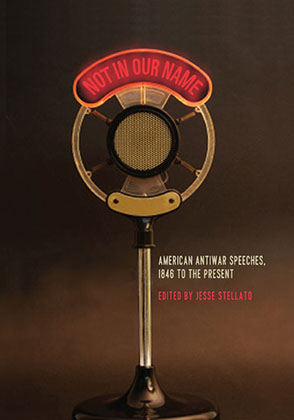
Not in Our Name
American Antiwar Speeches, 1846 to the Present
Edited by Jesse Stellato
“Jesse Stellato's splendid collection of antiwar speeches, Not in Our Name, presents material unique to the literature of protest and dissent, one of the glories of American letters and a tribute to the power of open democracy and the First Amendment. Stellato's analysis and commentary reveal rich veins of political rhetoric, some more familiar, some unjustly forgotten, while opening up the larger question of how language that is consciously crafted can shape national life and foreign policy. Here the decisions of government may conflict with the will of its citizens. Reading these speeches, we realize that the exercise of power and the power of the aesthetic, the practice of historical interpretation and the creativity of literature, often inhabit the same words.”
- Description
- Reviews
- Bio
- Table of Contents
- Sample Chapters
- Subjects
In Not in Our Name, Jesse Stellato presents the history of American antiwar speeches in a readable way that is neither pacifist nor partisan, featuring speakers with diverse backgrounds and political beliefs. By combining historical research with a review of classical Greek and Roman rhetorical theory, Not in Our Name also helps answer a fundamental question: “What makes a great antiwar speech?”
“Jesse Stellato's splendid collection of antiwar speeches, Not in Our Name, presents material unique to the literature of protest and dissent, one of the glories of American letters and a tribute to the power of open democracy and the First Amendment. Stellato's analysis and commentary reveal rich veins of political rhetoric, some more familiar, some unjustly forgotten, while opening up the larger question of how language that is consciously crafted can shape national life and foreign policy. Here the decisions of government may conflict with the will of its citizens. Reading these speeches, we realize that the exercise of power and the power of the aesthetic, the practice of historical interpretation and the creativity of literature, often inhabit the same words.”
“As a longtime antiwar activist and a rhetorical historian who studies U.S. empire, I welcome this project with a glad heart and open arms—finally, an anthology to help America remember its long and rich history of opposing war. Taken as a whole, I suspect that the book will become an instant classic. Its breadth is impressive.”
“This interesting, well-crafted book is a welcome addition to the literature on antiwar dissent. It will appeal to scholars and general readers who are interested in the American antiwar tradition, in rhetoric, and in the culture of dissent.”
Jesse Stellato is an author and lawyer residing in Miami, Florida. He is a graduate of Harvard College and Boston College Law School.
Contents
Acknowledgments
Editor’s Note
Introduction
1 Mexican-American War
Theodore Parker Delivers “A Sermon of War”
Charles Sumner Calls for the Withdrawal of American Troops from Mexico
Abraham Lincoln Inveighs Against President Polk
2 Civil War
Clement Vallandigham Argues That the War Cannot Be Won
Alexander Long Proposes Peace at Any Price
3 Spanish-American War and Philippine Insurrection
Moorfield Storey Warns of a Dangerous and Growing Militarism
Charles Eliot Norton Defines “True Patriotism”
Carl Schurz Discusses the Perils Faced by an Occupying Force
Charles Eliot Norton Accuses America of “Counterfeit Patriotism”
4 World War I
William Jennings Bryan Resigns as Secretary of State to Launch an Antiwar Crusade
George Norris Assails the Senate’s War Resolution
Robert La Follette Argues That the War Lacks Popular Support
Kate Richards O’Hare Discusses the War’s Degradation of Women
Eugene V. Debs Argues That the Working Class Will “Furnish the Corpses” of War
5 World War II
Norman Thomas Discusses War’s Effect on Civil Liberties
Richard Wright Justifies AfricanAmerican Opposition to World War II
Charles Lindbergh Asks, “Who Are the War Agitators?”
6 Korean War
Paul Robeson Declares That Blacks Will Never Fight the Soviet Union
W. E. B. Du Bois Runs for Congress on a Peace Platform
7 Vietnam War
Martin Luther King Jr. Urges Americans to Go “Beyond Vietnam”
Eugene J. McCarthy Celebrates the “Spirit of 1963”
Robert F. Kennedy Says of the War in Vietnam: “It Must Be Ended”
Shirley Chisholm Demands “People and Peace, Not Profits and War”
Fannie Lou Hamer Rallies Antiwar Students at Berkeley
John Kerry Testifies on Behalf of Vietnam Veterans Against the War
8 War on Terror
Barbara Lee Pleads with the House Not to “Become the Evil That We Deplore”
Barack Obama Criticizes a “Dumb War”
Noam Chomsky Asks, “Why Iraq?”
Robert Byrd Chastises the Senate for Standing “Passively Mute”
Epilogue: The Globalization of Dissent
Arundhati Roy Rails Against “Imperial Democracy”
Appendix A: Full-Text Sources
Appendix B: Rhetorical Devices in Antiwar Speeches
Notes
Biographical and Bibliographical Notes
Index
Credits
Introduction
I
Why anthologize American antiwar speeches? Above all, the speeches contained in this anthology are important historical artifacts. They contribute to a unique understanding of the rhetorical history of America’s wars and foreign policies. To be sure, much has been written on the rhetoric of war and on antiwar movements, but a survey of the literature reveals a startling imbalance between the attention given to prowar and antiwar speeches. Throughout the nineteenth and the twentieth centuries, few antiwar speeches were anthologized. Even fewer antiwar speech anthologies have been published, and these have been starkly partisan or limited to particular military involvements. Their lack of objectivity and scope doubtless contributed to a limited viewership, and they have long been out of print.
In contrast, speech anthologists have embraced “rallying-cry” speeches—the more incendiary, the better. Calls to arms by Patrick Henry (“Give me liberty or give me death”), Woodrow Wilson (“The world must be made safe for democracy”), Franklin D. Roosevelt (“December 7, 1941—a date that will live in infamy”)—to say nothing of the militaristic exhortations of international leaders such as Hitler, Mussolini, and Churchill—are firmly entrenched in contemporary speech anthologies. In Lend Me Your Ears, for example, William Safire includes a “War and Revolution Speeches” section that contains only one antiwar speech. The choices of other anthologists are often similarly skewed, at the risk of distorting America’s rhetorical history and obscuring the country’s vibrant culture of dissent.
Conversely, while anthologies and critical studies of American antiwar essays, novels, poetry, theater, art, motion pictures, music, pamphlets, oral histories, propaganda, and literature generally abound, speeches have received little attention. The only possible exception is material related to the Vietnam conflict, and even there speeches almost always play a peripheral role. This lack of attention to antiwar speeches may be the product of the assumption that speeches themselves are comparatively uninteresting or unimportant. It is the editor’s belief that the material in this volume proves quite the opposite. The speeches are interesting because they provide a glimpse into a liturgy between speaker and audience. Each speech is a type of ritual calculated, at times, to produce ecstasy or sorrow. The speaker becomes a priest leading his congregation to exorcise the demons of war. At the same time, the speeches are important because they are deliberate political acts with clearly defined, nontransitory, and historically significant effects. The ideas are profound, the words and phrases are stylized, the context is dramatic. These speeches, which lie squarely within our public sphere, thus fall within a genre of what I call literary politics—politics carried out through and reflected in literature.
In addition to attempting to redress the relative lack of attention given to speeches in American antiwar literature, this anthology helps illustrate the history of the extent to which Americans can—and cannot—oppose a wartime government and the majoritarian impulse that often accompanies and sustains it. Though it is well established that the First Amendment right to free speech contracts during wartime, the legal line between permissible and impermissible speech is not always bright. In addition, extralegal sanctions available to prowar majorities represent real limits on free speech. The outspoken individuals included in this volume were uniformly threatened with—and sometimes subjected to—social stigma, pecuniary loss, physical violence, imprisonment, or death.
Finally, in a larger sense, these antiwar speeches represent a culture of dissent. On the intellectual battleground, the speakers rarely limit their scope to the issue of war and peace. The speeches often implicate much broader arguments concerning the distributions of political, social, and economic power within society, and the capacity of human beings to defend cruelty, champion arrogance, and justify avarice. Read in this way, the speeches offer commentaries on human nature, and the speakers offer critiques, hopefully constructive, of our American democracy itself.
In this anthology, for example, Robert Kennedy begins his antiwar speech at Kansas State University by reminding students that the presidential campaign of 1968 would be one in which “we choose not simply who will lead us, but where we wish to be led.” One might engage Kennedy’s interpretive clue and read all of the speeches collected here as visions of America, that is, as attempts to answer such quintessentially American questions as Who should govern us? How should we be governed? Which values are fundamentally American? and What does it mean to be an American citizen? Thus, the subject of the speeches may be war, but their object is a more perfect union. As Paul Potter stated at a 1965 protest march in Washington, D.C.: “What is exciting about the participants in this march is that so many of us view ourselves consciously as participants . . . in a movement to build a more decent society.”
II
Classical rhetoric provides a useful framework for understanding how great antiwar speeches are made, and why those speeches endure throughout history. The study of classical rhetoric is divided, mainly for pedagogical reasons, into five parts: inventio (creation or discovery of arguments), dispositio (arrangement), elocutio (style), memoria (memory), and pronuntiatio (delivery). Some scholars consider these “canons of rhetoric” a paradigm for all communication theory. Since invention and style play a particularly important role in antiwar speeches, I consider them in detail here.
Inventio
First to the Greeks and then to the Romans, inventio encompassed both the invention of a new argument and the discovery of an old one. A speaker would “create or discover” arguments by applying three modes of persuasion to certain topoi, or topics.
The three modes of persuasion were analyzed by Aristotle in his Rhetoric, a book that Edward P. J. Corbett calls “the fountainhead of all later rhetorical theory.” The Rhetoric lays out an analytical framework with which to understand the modes, theorizing that the strength of a speaker’s logos (logic), ethos (credibility and relationship with the audience), and pathos (emotional appeal) collectively constitute the speaker’s persuasive effect.
As profound as it is ancient, the Rhetoric’s analytical framework has found champions (and critics) throughout its twenty-three-hundred-year history. As Lane Cooper remarks, “the Rhetoric not only of Cicero and Quintilian, but of the Middle Ages, of the Renaissance, and of modern times, is, in its best elements, essentially Aristotelian.” A direct application of Aristotelian rhetorical theory appeared during the 2000 presidential election, when Gary Orren, a professor at Harvard University, applied the three modes of persuasion to the candidates themselves. In “It’s All Greek to Me,” Orren explained that the Democratic nominee, Al Gore, was “the most logos-oriented presidential candidate in memory,” while the Republican nominee, George W. Bush, was “ethos incarnate,” a man whose “rise in American politics is a triumph of personality over policy.”
The topoi, or topics, were once a widely taught method—to use the Greek term, heuristic—for helping speakers or writers who had “nothing to say.” The topics are not hard to understand conceptually; they are nothing more than a collection of generally accepted arguments. It is not my purpose to survey them here, as Corbett discusses the “common topics” at length. However, there are two special topics that students of antiwar speeches will find useful when dissecting a speech. The first is called, appropriately enough, “War and Peace.” Aristotle’s treatment of this topic is brief and is worth quoting in full:
As to Peace and War, he [i.e., the speaker] must know the extent of the military strength of his country, both actual and potential, and also the nature of that actual and potential strength; and further, what wars his country has waged, and how it has waged them. He must know these facts not only about his own country, but also about neighbouring countries; and also about countries with which war is likely, in order that peace may be maintained with those stronger than his own, and that his own may have power to make war or not against those that are weaker. He should know, too, whether the military power of another country is like or unlike that of his own; for this is a matter that may affect their relative strength. With the same end in view he must, besides, have studied the wars of other countries as well as those of his own, and the way they ended; similar causes are likely to have similar results.
The second special topic is called “ceremonial topics,” because it is a collection of arguments unique to ceremonial discourse. As this anthology demonstrates, antiwar speeches are not solely deliberative. They contain ceremonial components as well. Ceremonial topics come in two types: those that praise someone’s virtues, and those that denounce someone’s vices. Almost without exception, antiwar speakers focus on the latter.
In the commentary that accompanies each speech in this anthology, I have highlighted what I take to be the most interesting, idiosyncratic, and imaginative ways in which each speaker assails an individual war. Implicit in this project is the notion that a norm does, in fact, exist. Despite the different historical contexts and changing modes of communication over 150 years, recurrent modes of logos, ethos, and pathos can readily be found in these speeches. The recurrent topic of vice is easily spotted as well. Indeed, with respect to these elements, the similarities between antiwar speeches in the last century and a half are striking. Whereas other forms of antiwar dissent, such as poetry, have changed radically over the years, antiwar speeches appear remarkably consistent. I will describe and illustrate their likenesses briefly here, and more fully in the individual commentaries that accompany each speech in this anthology.
Logos
The logic of antiwar speech is most broadly categorized as attacking either the causes or the consequences of war. With respect to the former, little is more common than indicting the war-maker’s alleged motives. Thus, the Mexican-American War was characterized by its detractors as a war to perpetuate slavery; the Civil War, to conquer and command the Confederacy; the Spanish-American War, to create an empire; the First World War, to protect capital investments in England; the Second World War, to acquiesce to Jewish interests; the Korean War and Vietnam War, for economic colonization; the war with Iraq, to control Middle Eastern oil production.
Subtlety is not a virtue in antiwar speeches, and most speakers appear to be indifferent, if not downright hostile, to the possibility that the motive they assign to the president’s administration is neither the sole nor the determining factor in the decision to go to war. The speaker’s strategy is twofold: first, the speaker implies that a blameworthy, though minor, intention can taint even the best justification for war. Secondly, as I have suggested above, the speaker assumes that the mere naming of the evils associated with a particular war may, as the first stage in a type of exorcism, have some salutary effect by itself.
A similarly ubiquitous antiwar argument concerns the consequences of war. At its core, the argument is simply a cost-benefit analysis in which the cost of war is always too high: the financial costs to the national treasury and to the individual taxpayer are too much, the human cost of human limbs or lives is too great, the psychological costs of fear and anxiety are too severe, the cost of losing international repute is too high, and, perhaps most common of all, the opportunity costs of war are too numerous. These propositions are commonly described and illustrated with statistics, anecdotes, or heartwrenching testimonials. When Robert Kennedy was campaigning for the presidency in 1968, for example, he often provided a vivid illustration of the opportunity costs of war: “When I see the numbers of all those boys killed in Vietnam, I wonder to myself: ‘How many would have grown up to be poets, how many would have helped to cure cancer?’”
Ethos
The aim of every persuasive speaker is to establish himself as a trusted authority with his audience. Such a figure demands attention, and his opinions require respect. Aristotle referred to the general relationship between a speaker and his audience as that speaker’s ethos. Ethical appeals are often of the “if you were there” variety. John Kerry’s testimony before the Senate Foreign Relations Committee provides exactly this type of appeal. Kerry (who was wearing his military decorations) opens his speech by telling his audience that he is a veteran who had experienced firsthand the wrongs of the war. “I am not here as John Kerry,” Kerry begins. “I am here as one member of the group of 1,000, which is a small representation of a very much larger group of veterans in this country, and were it possible for all of them to sit at this table they would be here and have the same kind of testimony.”
Moorfield Storey used a common variation of this theme during the buildup to the Spanish-American War. Unlike Kerry, Storey was a practicing lawyer who had never been in the military, much less set foot on a battlefield. He had to find another way to assert ethos, and thereby lend credibility to his arguments. His solution? During an address to the Naval War College in Newport, Rhode Island in 1897, Storey discusses the courage of his relatives: “I sympathize with you and understand your hopes,” Storey tells the war college, because “I could not spring from ancestors who for five successive generations died at sea, without some of a sailor’s instincts, some comprehension of his feelings.”
Barack Obama tried this same tactic, what I call hereditary ethos, in the run-up to the war in Iraq. Like Storey, Obama was a lawyer who had no military credentials whatsoever. Unlike Kerry, he could not speak while wearing a military uniform. Nevertheless, this did not stop Obama from tapping the wellspring of ethos to lend credibility to his antiwar cause. He thus invokes a warrior-relative, his soldier-grandfather: “My grandfather signed up for a war the day after Pearl Harbor was bombed, fought in Patton’s army. He saw the dead and dying across the fields of Europe; he heard the stories of fellow troops who first entered Auschwitz and Treblinka. He fought in the name of a larger freedom, part of that arsenal of democracy that triumphed over evil, and he did not fight in vain.” Why would Storey believe his dead relatives had anything to do with his opposition to the war? On what basis would Obama think that his grandfather’s experience in World War II was relevant to the emerging conflict with Iraq? Storey and Obama were using their ancestors for persuasive effect. They summoned them not to draw logical parallels between wars, or to illustrate the pathetic futility of war in general; rather, they used their relatives to lend credibility to their own lackluster or even nonexistent experience in matters of war and peace. They were making an ethical appeal to their audience.
Pathos
Cities scorched and razed, sons orphaned, mothers widowed, soldiers writhing in pain—antiwar speakers use this type of rending subject matter to represent the horrors of war. At best, the speakers’ descriptions are graphic, but not gratuitous; at worst, their sentiments are stale and less illustrative than conclusory. In “Beyond Vietnam,” Martin Luther King uses an emotional appeal to recount the effect of U.S. military involvement on the people of Vietnam:
They move sadly and apathetically as we herd them off the land of their fathers into concentration camps where minimal social needs are rarely met. They know they must move on or be destroyed by our bombs.
So they go, primarily women and children and the aged. They watch as we poison their water, as we kill a million acres of their crops. They must weep as the bulldozers roar through their areas preparing to destroy the precious trees. They wander into the hospitals with at least twenty casualties from American firepower for one Vietcong-inflicted injury. So far we may have killed a million of them, mostly children. They wander into the towns and see thousands of the children, homeless, without clothes, running in packs on the streets like animals. They see the children degraded by our soldiers as they beg for food. They see the children selling their sisters to our soldiers, soliciting for their mothers.
King’s description is a fairly typical example of an emotional appeal. Even though the language is at times maudlin (the women and children and the aged move “sadly,” as if they could move any other way under the circumstances) or tired (the children are “running in packs on the steet like animals”), the imagery works works because the picture he paints is so pitiful.
Creating a successful image, or one that is both horrible and memorable, requires less scientific exactitude than imaginative artistry. The paradigmatic example of such art is Theodore Parker’s 1846 “Sermon of War.” Parker forgoes historical factuality in the middle of his speech and begins to recount a fictionalized battle of his own making. Imagining that Boston and Cambridge are at war, Parker tells his audience the wrenching story of a mother who travels to a battlefield on the banks of the Charles River to find her fallen son:
Stealthily, by the pale moonlight, a mother of Boston treads the weary miles to reach that bloody spot; a widow she—seeking among the slain her only son. The arm of power drove him forth reluctant to the fight. A friendly soldier guides her way. Now she turns over this face, whose mouth is full of purple dust, bit out of the ground in his extremest agony—the last sacrament offered him by earth herself; now she raises that form, cold, stiff, stony, and ghastly as a dream of hell. But, lo! another comes—she too a woman—younger and fairer, yet not less bold, a maiden from the hostile town to seek her lover. They meet—two women among the corpses; two angels come to Golgotha, seeking to raise a man. There he lies before them; they look,—yes, ‘tis he you seek; the same dress, form, features too;—’tis he, the Son, the Lover. Maid and mother could tell that face in any light. The grass is wet with his blood. Yes, the ground is muddy with the life of men. The mother’s innocent robe is drabbled in the blood her bosom bore. Their kisses, groans and tears recall the wounded man. He knows the mother’s voice; that voice yet more beloved. His lips move only, for they cannot speak. He dies!
The switch from fact to fiction is not duplicitous—Parker tells his audience that the story is imaginative in order “to make the evils of war still clearer, to bring them home to your door.” The mother’s chance meeting with the “maiden from the hostile town,” and their simultaneous discovery of the dying son-lover, are tragic. Parker thus produces nothing short of drama.
Does it matter that such an account is completely fictional? In a word, no. The true object of the emotional appeal is the heart, not the head. In other words, though Parker’s account of war was perhaps less true than King’s, in a sense it was no less real.
Vice
One of the most fascinating, and unusual, aspects of the material in this volume is its incredibly hostile tone. Denigration, demonization, vilification—this is the stuff of which antiwar speeches are made.
In his first major speech as a congressman, Abraham Lincoln, of “with malice toward none” fame, criticizes President Polk for waging war on Mexico, calling him a “bewildered, confounded, and miserably-perplexed man.” In the draft of Lincoln’s speech, the future president was even more intemperate. Noting Polk’s vacillating justifications for war, Lincoln wrote, “His mind, tasked beyond its power, is running hither and thither, like an ant on a hot stove, finding no position on which it can settle down, and be at ease.”
Even the Reverend Martin Luther King Jr. could not resist taking part in the ad hominem slugfest. Speaking of Ronald Reagan in 1967, King jabbed, “When a Hollywood performer, lacking distinction even as an actor, can become a leading war hawk candidate for the presidency only the irrationalities induced by a war psychosis can explain such a melancholy turn of events.”
Of all the antiwar voices, though, Eugene V. Debs’s is the most unsettling. Debs argued that Wall Street’s financial opportunism sparked the United States’s entrance into World War I. In the process, he smeared the American “gentry” who, he claimed, traded their young daughters like the commodities in their portfolios:
To whom do the Wall Street junkers in our country—to whom do they marry their daughters? After they have wrung the countless hundreds of millions from your sweat, your agony, your life-blood, in a time of war as in a time of peace, they invest these billions and millions in the purchase of titles of broken-down aristocrats, and to buy counts of no-account (laughter). Are they satisfied to wed bad daughters to honest working men? (shouts from the crowd: “No.”) to real Democrats? Oh, no. They scour the markets of Europe for fellows who have titles and nothing else (laughter). And they swap their millions for titles; so that matrimony, with them, becomes entirely a matter of money (laughter), literally so.
Why do so many of the great antiwar speeches exhibit such viciousness? One can understand the endemic ad hominem attacks contained in this anthology in various ways—as entertainment for an audience hungry for blood, as irresponsible intemperance on the part of the speaker, as a manifestation of political impotence, or, to use William Hazlitt’s phrase, as calculated pandering to the “habitual prejudices of mankind.” I Of all these critiques, the most compelling appear to be those that take into account the ceremonial function of the address. That is, antiwar speakers are at least partly concerned with pleasing, rather than merely exhorting, their audience. Understood in this way, these speeches serve the same function as Fourth of July speeches, funeral orations, and nominating speeches at political conventions. But instead of paying tribute or lavishing praise, they offer blame and stern rebuke.
As previously stated, the classical rhetoricians developed a system of topics, or generally accepted arguments, that a speaker might use in crafting his speech. The ceremonial topics were generally accepted arguments used to praise virtues and vices. In books III and IV of his Nicomachean Ethics, Aristotle famously set forth the vices, which he defines as deformed or disproportionate virtues. Though presented outside the context of rhetoric, they serve as a perfect illustration of the ceremonial topics.
To illustrate how the these topics might be used in practice, consider the ways in which antiwar speakers often attack the president for his prosecution of a war. With respect to the virtue of courage, for example, one can find countless examples of antiwar speakers criticizing the president for acting with too much courage, that is, for acting rashly. With respect to the virtue of prudence, one can also find countless examples of antiwar speakers criticizing the president with acting with too little prudence, that is, for acting foolishly.
Of course, not all of these topics necessarily apply to the subject of a president and in the context of war. But many do. As one reads the speeches in this anthology, one might well remember these vices, and ask whether any given speech does not evidence a curious marriage between deliberative and ceremonial oratory.
Elocutio
Elocutio, or style, is a difficult concept to define. One of the most influential early definitions appears in the anonymous Rhetorica ad Herennium (ca. 80 BCE), where it is the “adaptation of suitable words and sentences to the matter devised.” Rhetoricians have struggled ever since provide a more precise definition, and, failing that, have settled on the use of one metaphor or another. Thus, style was defined as “clothing and ornament” by Cicero in the first century BCE.
One ancient—and still relevant—debate over rhetorical style is whether it is merely decorative (the “dress of thought,” as Cicero’s metaphor suggests), or instead forms an essential part of one’s argument or ideas (the “incarnation of thought”). These positions should be familiar to anyone who has heard the accusation that one speech or another is “mere rhetoric” or that a speaker “has style but lacks substance.” The assumption in both cases is that a speaker is decorating his argument with pleasing phrases and memorable lines in order to dupe an unsuspecting audience. This is the modern-day connotation of the term “rhetoric”—that it is polish upon scuffed-up reasoning.
For example, take the charges leveled against Barack Obama, a figure whom I claim later in this anthology to be a “rhetorical leader.” During his campaign for president, Obama was barraged by accusations that he had style but lacked substance. Thus, a reporter for the New York Times stated that “it remains unclear whether an Obama candidacy would present a slate of new ideas or just offer a fresh way of articulating familiar ideology.” Mario Cuomo, the ex-governor of New York, commented that Obama’s campaign for president exemplified “pure, glorious rhetoric about hope and aspiration. Just lacking specifics.” New York’s Daily News pointed out that “speechifying isn’t leading,” and the Independent in England asked baldly whether Obama had any “substance.” Again, these observations all assume that Obama’s style of speaking can somehow be disentangled from the substance of his thought.
Despite the fact that the meaning of style has sparked considerable debate, there is a fundamental agreement as to many of its key features. In the remainder of this section on style, and in appendix B, I describe and illustrate the levels of style as well as common tropes and figures or schemes.
Classical rhetoric distinguished three levels of style: the low or plain style, the middle style, and the high or grand style. Each style has certain properties and purposes, and each is properly used in different forums. The low or plain style uses conversational words and makes little use of tropes or figures or schemes (rhetorical devices that I define below). It suits educational and instructional purposes, for example. The middle style is more refined than the low or plain style and often employs tropes and figures. It might be used, for example, in a ceremonial address. The high or grand style often makes use of hyperbole, or exaggeration. To use Quintilian’s metaphor, if the middle style “flows gently like a clear stream overshadowed on both sides by banks of green wood,” the high or grand style is “a great torrent that rolls down rocks” and “carves out banks for itself.” Epic poems and Shakespearian tragedies make use of the high or grand style.
The styles used by antiwar speakers are diverse. The low or plain style appears in, for example, Noam Chomsky’s lecture at Harvard University in 2002. Chomsky explains that one interpretation of the war in Iraq is the government’s adherence to the “classic modern strategy of an endangered right-wing oligarchy, which is to divert mass discontent to nationalism.” Related to this strategy, Chomsky explains, is the United States’s attempt to dominate the world’s oil resources:
Well, that’s one interpretation. One interpretation well within the mainstream establishment is what I just said: there’s a long-term goal of regaining control over the second largest resources in the Middle East, and ensuring domination of one of the greatest material prizes in world history, and a stupendous source of strategic power. September 11 gave a pretext, as it gave a pretext around the world, for an intensification of violence and disciplining of the populations, and domestic considerations in that very important security problem probably accounts for the timing. So it has to be this winter, not next winter. That’ll be too late. By then we’ll have been consumed by the mushroom cloud, which will avoid everyone else but hit us. And of course it’s kind of like an accident that that will be right in the middle of the presidential campaign, just as it’s an accident that the people of the region are afraid—but mostly of us, and joining most of the world in that. Well, that’s one interpretation.
Chomsky is having a simple conversation with his audience. Though some rhetorical devices (e.g., irony) can be found in this excerpt, Chomsky is primarily speaking matter-of-factly. He uses conjunctions (“that’s” and “that’ll”) and colloquialisms (“it’s kind of like”) that would be inappropriate in a more formal essay or in a book. Further, Chomsky’s low or plain rhetoric is consistent with his academic forum: Chomsky was, after all, giving a lecture for educational purposes. For other examples of the low or plain style in the context of antiwar speeches, one might consider the Vietnam-era “teach-ins” held at universities across the United States.
The high or grand style is best exemplified in this volume by speakers such as Theodore Parker and Clement Vallandigham. Arguing in the U.S. House of Representatives for peace during one of the bloodiest moments of the Civil War, Vallandigham said that the Union’s war could not be won despite the massive resources at President Lincoln’s disposal:
[W]ith twenty millions of people, and every element of strength and force at command—power, patronage, influence, unanimity, enthusiasm, confidence, credit, money, men, an Army and a Navy the largest and the noblest ever set in the field or afloat upon the sea; with the support, almost servile, of every State, county, and municipality in the North and West; with a Congress swift to do the bidding of the Executive; without opposition anywhere at home, and with an arbitrary power with which neither the Czar of Russia nor the Emperor of Austria dare exercise; yet after nearly two years of more vigorous prosecution of war than ever recorded in history; after more skirmishes, combats and battles than Alexander, Caesar, or the first Napoleon ever fought in any five years of their military career, you have utterly, signally, disastrously—I will not say ignominiously—failed to subdue ten millions of “rebels,” whom you had taught the people of the North and West not only to hate but to despise. Rebels, did I say? Yes, your fathers were rebels, or your grandfathers. He who now before me on canvas looks down so sadly upon us, the false, degenerate, and imbecile guardians of the great Republic which he founded, was a rebel. And yet we, cradled ourselves in rebellion, and who have fostered and fraternized with every insurrection in the nineteenth century everywhere throughout the globe, would now, forsooth, make the word “rebel” a reproach. Rebels certainly they are; but all the persistent and stupendous efforts of the most gigantic warfare of modern times have, through your incompetency and folly, availed nothing to crush them out, cut off though they have been, by your blockade from all the world, and dependent only upon their own courage and resources. And yet they were to be utterly conquered and subdued in six weeks, or three months! Sir, my judgment was made up, and expressed from the first. I learned it from Chatham: “My lords, you cannot conquer America.” And you have not conquered the South. You never will.
Here, Vallandigham makes ample use of hyperbole (“with an arbitrary power with which neither the Czar of Russia, nor the Emperor of Austria dare exercise” and “after more battles than Alexander, Caesar, or the first Napoleon ever fought”). Vallandigham also summons the words of England’s Chatham (“You cannot conquer America”). This invocation is classic high style: Quintilian himself said that a defining mark of such a style could be the “the orator that will call the dead to life.”
Finally, different levels of styles can appear in one speech. As Wolfgang G. Müller points out, the high or grand style is well-suited for a speech’s peroration, or closing. A good example here is Barack Obama’s October 2, 2002, speech in Chicago’s Federal Plaza. Most of Obama’s speech could be described as either low or middle style. Some evidence of the low style appears with such plain phrases as “I’m opposed to dumb wars.” Some evidence of the middle style appears with Obama’s use of such rhetorical devices as alliteration, anaphora, and metaphor. But at the end of the speech, Obama elevates his language, bringing the full weight of his rhetorical power to bear on the audience: “The consequences of war are dire, the sacrifices immeasurable. We may have occasion in our lifetime to once again rise up in defense of our freedom, and pay the wages of war. But we ought not—we will not—travel down that hellish path blindly. Nor should we allow those who would march off and pay the ultimate sacrifice, who would prove the full measure of devotion with their blood, to make such an awful sacrifice in vain” (emphasis added). Obama is echoing Abraham Lincoln’s November 19, 1863, speech at Gettysburg: “It is rather for us to be here dedicated to the great task remaining before us—that from these honored dead we take increased devotion to that cause for which they gave the last full measure of devotion—that we here highly resolve that these dead shall not have died in vain” (emphasis added). The style is high or grand not only because Obama is trying to move the audience through hyperbole but, again, because he is, in a way, summoning Lincoln and thereby “calling the dead to life.”
In addition to distinguishing between the three levels of style, classical rhetoric was built on tropes and figures or schemes. Often referred to as rhetorical devices or figures of speech, these include such common devices as metaphor, alliteration, and rhetorical questions. They also include such uncommon devices such as chiasmus, metonymy, and antimetabole. A trope (from the Greek tropein, or “to turn”) “involves a deviation from the ordinary and principal signification of a word.” A figure or scheme (from the Greek schéma, “form” or “shape”) “involves a deviation from the ordinary pattern or arrangement of words.” As Corbett explains, “both types of figures involve a transference of some kind: a trope, a transference of meaning; a scheme, a transference of order.” See appendix B for definitions and discussions of the most important literary devices found in American antiwar speeches.
III
At first glance, one may fault the speeches below for their manifest failure to avert war. This critique is misguided for a number of reasons. First, it ignores the value of dissent in a democratic society. As John Stuart Mill wrote in On Liberty, the incessant questioning of the status quo keeps opinions from becoming tired or stale: “if it is not fully, frequently, and fearlessly discussed, it will be held as a dead dogma, not a living truth.” Thus, at the very least, antiwar advocates may, paradoxically, function to reinforce the policies they oppose. Dissent also tends to purge lies and uncover truths. Readers may be familiar with those facts put forward by advocates of a given war. They may be less familiar with the facts put forward by the war’s opponents. Listening or reading pro- and antiwar speeches together helps the listener or reader form a more nuanced understanding of each conflict.
Secondly, focusing on the purported “failure” of a particular speech to alter the course of an entire war can be unfairly shortsighted. Though antiwar speakers surely never had as great an impact on governmental decision making as they would have liked, they were often successful in galvanizing antiwar dissent and inspiring others to stand strong, hold fast, and keep the flame of peace alive. Fifty years after Eugene V. Debs uttered his “insubordinate” and “disloyal” antiwar speech in Canton, Ohio, for example, Ray Ginger claimed that Debs’s speech had become “a byword, a flaming document in the Socialist movement.” “Thousands of Socialists,” he wrote, “warmed themselves on bleak, cold days with the memory of Eugene Debs standing on the platform at Canton, speaking his mind.” Similarly, Clement Vallandigham, leader of the antiwar “Copperheads” during the Civil War, inspired pro-Lindbergh, noninterventionist students at the University of Southern California in the run-up to World War II some eighty years later to form a “Campus Copperheads” organization. Thus, these speeches, shorn of their virtuous or vicious viewpoints (depending on one’s point of view), can serve simply as examples of persuasive speech, as case studies of leadership through public speaking.
Thirdly, it is unclear how history might have looked without the appearance of one or all the antiwar speeches during a given war. To be sure, the United States would have continued its military involvement in, say, Vietnam whether or not any single antiwar speaker chose to speak out. But protest taken in the aggregate—John Kerry’s speech to the Senate Foreign Relations committee in 1971, plus the speeches of the other members of Vietnam Veterans Against the War, plus the 1968 antiwar campaigns of Robert F. Kennedy and Eugene McCarthy, plus all the innumerable others who spoke out against American foreign policy in the 1960s and 1970s—makes the “no effect” argument less convincing. Some go so far as to say that certain individuals were critical in manufacturing dissent during wartime. Forty years after Eugene McCarthy broke with the Democratic Party and began campaigning against President Lyndon Johnson on an antiwar platform, President Bill Clinton stated that McCarthy was instrumental in building opposition to the Vietnam War. “It all began with Gene McCarthy’s willingness to stand alone and turn the tide of history,” Clinton said.
Fourthly, the government’s reaction to many of the dissenters suggests that the speakers’ antiwar dissent was far from nominal and, indeed, may have posed a serious threat to an administration’s ability to stay in power. During the Civil War, for example, the Lincoln administration tried ex–United States Congressman Clement Vallandigham in a military tribunal for giving a “disloyal” speech to citizens of Ohio. Vallandigham was convicted, imprisoned by the military, and banished from the North for the duration of the war. During World War I, the federal government convicted Socialist leader Eugene V. Debs for giving an antiwar speech in which he “obstructed and attempted to obstruct the recruiting and enlistment service of the United States.” Justice Oliver Wendell Holmes, writing for a unanimous Supreme Court, affirmed the trial court’s ten-year prison sentence. Somewhat less dramatically, but still significantly, the Federal Bureau of Investigation (FBI) monitored the antiwar activities of many of the twentieth-century individuals in this anthology. This surveillance suggests that members of the executive branch believed that antiwar speakers were a potential threat to the war effort and perhaps even to the stability of the government itself.
Fifthly and finally, the speakers in this anthology can be appreciated in a biographical light outside the political arena. Even if these dissenters did not lessen the reach or intensity of war in any way, the historical consequences of their dissent make for compelling reading. Vallandigham and Debs are famous cases in point. Less well known, perhaps, is that of W. E. B. Du Bois, who ran for Congress on a peace platform in 1950, when he was eighty-two years old, and who soon after was indicted under the McCarran Act for failing to register with the government an antiwar organization he chaired. Virtually unknown is the case of Kate Richards O’Hare, an antiwar Socialist in World War I whom her trial judged called “the most dangerous character in the United States” before sentencing her to five years in prison.
Additionally, the biographies of antiwar leaders illustrate the fact that their antiwar dissent often took place within a much larger struggle to transform America into a place that, at least in each speaker’s view, would be a better place to live. In this way, antiwar leaders function not merely as “antiwar activists,” but also as reform-minded individuals whose ideas run far outside the ambit of war and peace. Fannie Lou Hamer, for example, was an outspoken critic of the Vietnam War, but also a staunch opponent of segregation and the racist voting policies of the South in the early 1960s. Forced into sharecropping by a jealous white neighbor, given a hysterectomy without her consent, arrested during the “Freedom Summer” of 1964 and beaten unconscious with a metal-studded blackjack in jail, Hamer is someone whose story few will read without admiring the strength and endurance she brought to bear in pursuit of a more free and more equal society.
In short, what remains of these speakers when the “effect on decision makers” dimension is stripped away is charisma reflected by and preserved in words. Such a perspective, as scholar James Darsey has explained, “reveals the falseness of the dilemma whereby we celebrate those rhetors who, in significant ways, failed to achieve their stated goals.” Darsey continues aptly, “It is because of their failure on behalf of noble principles that they continue to be celebrated and to rally those who must carry forward a principle against hopeless odds. They are less voices to us than ethical presences. It is in this continuing influence that they have achieved their greatest success.”
IV
The specific conflicts examined in this anthology are the Mexican-American War, the Civil War, the Spanish-American War, World Wars I and II, the conflicts in Korea and Vietnam, and the so-called War on Terror in Iraq and Afghanistan. Short introductions to each of the speeches examine how the speaker formulates his arguments, arranges his ideas, and stylizes his language. The introductions also consider the speech’s place in its cultural, political, and historical context.
Ultimately, I hope this anthology will be neither pacifist nor partisan, but will instead provide compelling reading for a diversity of readers, including those interested in history, politics, rhetoric, literature, American studies, and the culture of dissent.
Mailing List
Subscribe to our mailing list and be notified about new titles, journals and catalogs.