


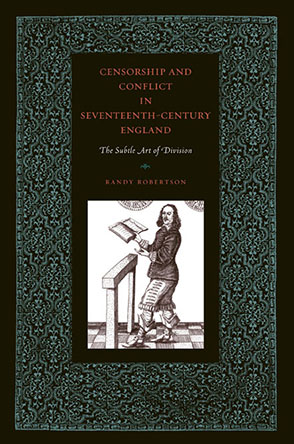
Censorship and Conflict in Seventeenth-Century England
The Subtle Art of Division
Randy Robertson
Censorship and Conflict in Seventeenth-Century England
The Subtle Art of Division
Randy Robertson
“Robertson’s work is a welcome contribution to a field already warmly contested, and the ‘British Index’ online will surely prove invaluable, enabling new questions to be asked as well as old ones answered.”
- Description
- Reviews
- Bio
- Table of Contents
- Sample Chapters
- Subjects
“Robertson’s work is a welcome contribution to a field already warmly contested, and the ‘British Index’ online will surely prove invaluable, enabling new questions to be asked as well as old ones answered.”
“This book is a welcome entry in an expanding scholarly conversation, and Robertson’s wide-angle view makes his contribution quite attractive.”
Randy Robertson is Assistant Professor of English and Creative Writing at Susquehanna University.
Contents
Acknowledgments
Abbreviations
Introduction
1 “Consider What May Come of It”: Prynne’s Play and Charles’s Stately Theater
2 Lovelace and the “Barbed Censurers”
3 Free Speech, Fallibility, and the Public Sphere: Milton Among the Skeptics
4 The Delicate Arts of Anonymity and Attribution
5 The Battle of the Books: Swift’s Leviathan and the End of Licensing
Conclusion: Dividing Lines—1689, 1695, and Afterward
Notes
Select Bibliography
Index
Introduction
In the 1600s, Britain witnessed a civil war, the judicial execution of a king, the restoration of his son, and an unremitting struggle among Crown, Parliament, and people for sovereignty and the right to define “liberty and property.” This contest entailed a battle, sometimes subtle, sometimes bloody, for the control of language and representation. The succeeding chapters offer a portrait of the “censorship contest” joined in seventeenth-century England, and, more particularly, of the art that emerged from this affray. The portrait spans several panels; the subjects include figures whose concerns and commitments were equally political and aesthetic: William Prynne, Richard Lovelace, John Milton, Andrew Marvell, John Dryden, and Jonathan Swift.
In this introduction I offer an overview of censorship’s workings in early modern England, along with a picture of the licensing system’s gaps and loopholes. I want to begin more broadly, however, to furnish a larger context for the work. In the first section, “1450 and All That,” I provide an aerial view of censorship’s history from the inception of printing to the early eighteenth century. I then narrow my focus to seventeenth-century England: I address the methods of censorship available to the Stuart governments, the policies and practices of the licensing machinery’s agents. Finally, I take up the author’s view of such constraints: I look at the artistic, rhetorical, and political strategies that writers used to evade or even to exploit the censorship regulations. Although I separate the two strands of this dialectic—government controls and writers’ resistance—for the purposes of introduction, it should be understood that they are very difficult to disentangle in the warp of history. Indeed, it is the textual knots created by censorship’s loom and the penman’s needle that figure centrally in the chapters that follow.
“1450 and All That”: A Brief History of Censorship
The invention of the printing press circa 1450 revolutionized what John Milton was to call “knowledge in the making.” Revolutions are complex affairs, however: “science” and the Bible could now be standardized, but the development of printing seems to have fostered political, religious, and scholarly conflict rather than consensus. It also complicated censorship. Before the advent of printing, the suppression of books was a relatively simple matter; with the invention of the printing press, censorship became byzantine. The anonymous author of The London Printers Lamentation expounded the reason for this in a succinct couplet: “In one dayes time a Printer will Print more, / Than one man Write could in a Year before.”
Clerical and lay controls of the printed word—mechanisms of both prepublication and postpublication censorship—existed as early as 1479, but many printers and booksellers ignored them. In England, Henry VIII assumed a monopoly on the privilege of printing, offering patents to favored printers and regulating the trade. To the king’s chagrin, however, controversial works seeped in from abroad. Henry therefore drew up a list of forbidden books in 1529, some fifteen years before the first continental index. Among the texts that Henry proscribed were “the chapters of Moses called Genesis.”
English monarchs and clergymen had a nearly continuous dialogue with the rest of Europe: in the 1520s Henry answered Luther’s works and banned them, receiving from the pope the title of “Defensor Fidei” for his efforts. His desire for Anne Boleyn wrought religious change—not in Henry, but in England. His reformation was a matter of convenience; but vernacular translations of the Bible were now permitted—until 1543, at least, when the fickle king, perhaps fearing a reincarnation of Wycliffe, reimposed a partial ban on religious expression.
England’s national church brought religion within the precincts of government: the lines between heresy and sedition became increasingly blurred. Queen Mary shepherded England back into the Catholic fold (and burned the black sheep who disobeyed her), but she retained control over the press. In 1557 Mary gave the Stationers’ Company its charter: in exchange for their assistance in checking the production of seditious books, she awarded the stationers a monopoly on the print trade. The symbiotic relationship between the company and the Crown continued under Elizabeth and the Stuarts.
Although Elizabeth renewed the stationers’ charter, she reversed the vectors of Marian policy. Instead of suppressing Protestant books, she suppressed Catholic ones, and indeed all works that challenged her position as “Supreme Governor of the Church,” the title conferred on her by the Acts of Supremacy and Uniformity (1559). The widely loathed High Commission, an ecclesiastical court formed by letters patent, was supposed to be Elizabeth’s enforcement arm, but the archbishop of Canterbury and the bishop of London came to govern the press as her reign wore on. While the press controls that the queen detailed in her 1559 injunctions seemed systematic, the execution of censorship proceeded on an ad hoc basis.
Over Puritan objections, James I enhanced the power of the High Commission and took a more personal interest in the press than had his royal predecessor. Though his administration too censored offensive works on a more or less ad hoc basis, James skillfully wielded the press as a propaganda tool and created bonfires out of books that crossed him or his international allies. Indeed, James censored works twice as frequently as had Elizabeth. Cyndia Clegg observes that over the course of her forty-five-year reign, the queen and her minions took “23 actions to suppress objectionable books, bring court cases against their authors, or order a search for illegal materials; during the 22 years of James I’s reign, there were 25 instances.”
James’s son Charles, together with Archbishop Laud, exercised a still more stringent control over printing, engaging in “70 acts of [postpublication] censorship” between 1625 and 1640. Moreover, the licensing regime of the 1630s was stricter than that of any other decade in the seventeenth century. Charles and Laud used the notorious Star Chamber to enforce their political and religious agenda and to control the dissemination of print. Their controversial Arminian program aroused considerable resistance, but for much of Charles’s personal rule, authors and stationers were forced to toe the line.
By the end of 1640, however, the press had become unmanageable. Political and religious debates spurred the demand for polemical pamphlets; the act dissolving the courts of Star Chamber and High Commission in 1641 gave another impetus to the press. In 1642, on the cusp of the English Civil War, the king’s printer Robert Barker struggled to reestablish the status quo ante bellum by drawing a parallel between print and coin: “Printing is as inherent a Prerogative to the Crowne as Coining of Money. ” The flip side of this is that for stationers and patent holders, print was coin in a certain sense. Barker’s analogy proved long-lived: when William Ball presented his Brief Treatise Concerning the Regulation of Printing to Parliament in 1651, sovereignty had changed hands more than once; yet Ball still likened the state’s control over printing to its control over coin:
For prevention (as much as may be) of . . . dangerous extravagancies, the most regular Christian Potencies (or Republicks) and Illustrious Potentates have thought fit to comprehend the liberty of Printing, (even as of Coyning) within the sphere of their severall Powers: Wherein (amongst others) the late Q. Elizabeth, and her successors have (not without mature deliberation, and sage presidents in this point) been most vigilant, well perceiving that the Eye of understanding might be subject to be deceived by erroneous principles in Print, as may the bodily Eye by counterfeit Coyne; In Regard whereof they propagated wholsome Orders, and Decrees for the Regulating of Printing, and Printers; which rightly considered, cannot be defaced, no not blemished by the notion of Tyranny.
The analogy between coin and print is striking: by insisting that it is the government’s job to distinguish the true from the counterfeit, Ball is suggesting that truth is a monopoly of the state.
After the chaos of the stationers’ trade during the Civil War, Charles II’s administration worked with Parliament to shore up the printing regulations. Shortly after he was restored, the king signed an act against “tumultuous petitioning”; a treason act that included clauses against treasonous speaking, writing, printing, and thinking; and a Licensing Act modeled on the 1637 Star Chamber decree. Moving beyond his predecessors, Charles created the office of the “Surveyor of the Imprimery,” to which he appointed the doggedly loyal Roger L’Estrange. In L’Estrange, the king found a tireless opponent of sedition and nonconformity.
Toward the end of the seventeenth century, England’s Licensing Act expired, but other forms of censorship filled the vacua that the licensers left—the laws of blasphemy, seditious libel, and obscene libel all restricted the flow of print. The truth of one’s assertions offered no defense against a libel charge, especially in cases of seditious libel. In 1704 Lord Chief Justice Holt maintained that “if people should not be called to account for possessing the people with an ill opinion of the government, no government can exist.” Respect for authority was all-important: if Noah was naked, one simply pretended not to see it.
To a certain extent, censorship was privatized in the eighteenth century. Societies for the reformation of manners cropped up; Jeremy Collier and George Ridpath fulminated against the theater. Moral censors thus replaced government censors, ushering in an “age of sensibility.” In The Tatler, Richard Steele observed, “In a Nation of Liberty, there is hardly a Person in the whole Mass of the People more absolutely necessary than a Censor.” The vicissitudes of censorship are many and complicated, but censorship itself never disappears. As one commentator put it recently, “Censorship never really goes away: it just changes form.”
“Broken Contracts”: Censorship in the Seventeenth Century
If censorship exists at all times and in all places, the seventeenth century was “censorship’s great moment,” at least in England. The government had a battery of legal instruments available in its campaign against seditious writers, printers, and booksellers. The topic of censorship in Stuart England is so vast and so complex that generalizations founder quickly, but a few remarks by way of background can be offered here. The first is that censorship in the period was more rigorous than is sometimes allowed. D. F. McKenzie, for instance, argues that it was practically nonexistent:
[T]he [London] trade’s total production for, say, the years 1641 to 1700 was 75,285 titles or editions of them, excluding serials. Allowing a loss rate for the period of something like 25 per cent, the total output of the trade would have been about 100,000 titles or editions of them over those years. For precisely that same period, I have recorded every book mentioned in the journals of the Lords and the Commons, the State Papers (Domestic), and the court books of the Stationers’ Company. There are some 800 items, of which 400 are entirely innocent and 400 in some degree suspect. Those 400 represent 0.4 per cent of the output of the trade. Of those 400 the number which led to a charge, let alone a conviction, let alone punishment, was only the tiniest fraction.
He concludes that “fear of the courts had virtually no impact on the economy of the book trade.” But despite the surface persuasiveness of the data he presents, there are several flaws in McKenzie’s analysis. To start with a relatively minor point, he posits a “loss rate” for books of 25 percent, but he assumes that the loss rate for state papers and stationers’ court records was zero—an unwarranted assumption, as such papers often existed in unique copies, making them particularly vulnerable to the drift of time and chance. The stationers’ original charter “perished” in the London fire of 1666; it is anyone’s guess how many other records were destroyed. McKenzie assumes further that the sources he consulted comprehend all cases of censorship during this time, yet not all of the books to which Parliament objected, for instance, are noted in the House journals, nor is every volume in a pursuivant’s quarry recorded in the state papers. Indeed, many journal entries and government documents refer to the seizure of “scandalous and seditious books and pamphlets” without specifying either number or title. And how many manuscripts did the licensers blot or alter rather than suppress?
McKenzie did more than perhaps any other scholar has done to trace the contours of the seventeenth-century book trade, but he underestimated the depth of censorship’s impact. A complete tally of works that came under official scrutiny from 1641 to 1700 would need to include not just those that appear in the stationers’ records, the House journals, and the State Papers, Domestic, but also those named in the Historical Manuscript Commission reports, the state trial transcripts, the King’s Bench judgment roll, the proceedings of the Old Bailey, the Middlesex County records, the sessions files in London, the state papers of Scotland and Ireland, and myriad other documents. Numerous works appear in the latter sources that do not appear in the former. For example, early in 1649 John Lilburne was charged with treason for his part in writing The Second Part of England’s New Chains Discovered. In his trial later that year, however, Lilburne was taxed with writing several other pamphlets that do not appear in the state papers, the House journals, or the stationers’ records: A Salva Libertate; A Preparative to an Hue and Cry after Sir Arthur Haslerig; and The Legal fundamental Liberties of the People of England, Revived, Asserted, and Vindicated.
On a related note, McKenzie seems not to have counted discrete editions of suppressed works. “Charles I”’s Eikon Basilike, which caused even greater concern than Lilburne’s pamphlets, appears only once in the House journals, but all thirty-eight editions printed in England in 1649 were undoubtedly banned. The wording of the Commons’ order implies as much: “Ordered, That the Serjeant at Arms be appointed to make Stay of, and seize at the Press, all those Books now printing or printed under the Name of the Book of the late King”; the news writers reported a vigorous search for the books and their printers. The “king’s book” was adapted, excerpted, and versified; Charles’s prayers, included in some versions of the Eikon, were also published as separately. Altogether, the various Eikons printed in England in 1649—full editions and derivative works—number around forty-eight. It seems unlikely that McKenzie included these forty-eight editions in his total of “suspect” works, which he calculated at four hundred, yet in computing the total number of books produced in the period (100,000), he counted different editions as distinct titles. It is worth noting as well that the government succeeded in checking publication of the Eikon Basilike: between 1650 and 1660 only four editions of the book were published in Britain, all by the devoted loyalist Richard Royston.
Also off McKenzie’s charts are important treatises like Filmer’s Patriarcha and Hobbes’s Behemoth, books that for decades left no trace in the official records but that were nevertheless blocked outright by the two monarchs for whom they were written—Charles I and Charles II, respectively. To be sure, they were published eventually (Behemoth illegally), but not without significant delays. Finally, McKenzie’s exclusion of serials and periodicals from his study artificially deflates the percentage of works suppressed, as the government’s efforts to curtail the publication of news were on the whole quite successful. Indeed, in his essay “Trading Places? England 1689—France 1789,” McKenzie arrives at a higher percentage of “suspect” works than he does in “Printing and Publishing, 1557–1700,” because in “Trading Places?” he looks at “all printed works” of the period, including serials and periodicals.
In the magisterial three-volume Chronology and Calendar of Documents Relating to the London Book Trade, 1641–1700, Maureen Bell notes that McKenzie relied on indexes of the House journals and the Calendar of State Papers, Domestic, when he started the project some years ago; but the indexes, as Bell observes, are imperfect, a problem she has redressed by sifting through the entirety of the Calendar of State Papers, the House journals, the Stationers’ Company court records, and the Historical Manuscript Commission reports for the years covered in her study. I have consulted the Bell-McKenzie volumes, Howell’s State Trials, the Proceedings of the Old Bailey, the Middlesex County session rolls, the Stationers’ Company Wardens’ Accounts, the Thurloe State Papers, the Register of the Scottish Privy Council, royal proclamations, and W. H. Hart’s Index expurgatorius anglicanus, as well as the writings of Roger L’Estrange, messenger of the press Robert Stephens, dissident bookseller Francis Smith, and sundry others for instances of censorship during the period 1641–1700. In most cases I have checked the Bell-McKenzie Chronology and Hart’s Index against the original documents, a task made easier by the House journals’ availability online. From the sometimes fragmentary evidence that appears in these sources, I have pieced together and catalogued the full titles of the vast majority of the works censored; the list, entitled The British Index, is being published online. By my count, the number of works intended for print publication that the government deemed “suspect” was at least 2,500 titles and editions of them, excluding serials and periodicals. The number of extant titles published in Britain and the North American colonies during the same period is approximately 90,607. If we assume a loss rate of documents relating to censorship of 25 percent, a conservative figure that matches McKenzie’s estimate of entire impressions lost, the total number of suspect titles comes to 3,067 (4/3 × 2,300) out of 120,809 (4/3 × 90,607), or 2.75 percent. McKenzie’s figure of .4 percent was, therefore, off by a factor of seven.
What is more, all books needed to be vetted by a licenser before they were printed. Authors and stationers did not always abide by this rule, yet scholars have likely underestimated the percentage of authorized works. From 1622, stationers were supposed to enter all of their “copies” in the guild’s register; such entries, certified by one of the company’s wardens, provided proof of ownership. The clerk, who had custody of the register, also recorded the licenser who approved each work, so in theory the register should provide a comprehensive list of authorized titles. Entrance, however, was erratic and declined steadily in the second half of the century. A stationer might obtain a censor’s license for a book, along with a warden’s company “license,” thus ratifying his ownership of the copy, but decline to have the title registered to avoid the four pence fee. Indeed, toward the end of the seventeenth century, booksellers rarely entered their works, as the growth of partial shares in copies rendered the system of registration impracticable. The Stationers’ Court of Assistants probably did not help matters when in 1687 it ordered the clerk to keep a “Waste Book” in which to record the purchase and sale of copies; although the court instructed him to transfer the transactions of which it approved into the register, he may not have bothered to enter many of the titles. In the early 1690s someone apparently tore several leaves out of the register-book so that he or she could more easily pirate another stationer’s literary property, further truncating the official record. Moreover, none of the books legally printed in Oxford, Cambridge, York, Edinburgh, or Dublin required registration; neither did those printed by royal patent. The stationers’ register is, therefore, a radically incomplete list of licensed publications.
Robert Clavell’s General Catalogue of Books Printed in England throws some light on how many books were licensed, as Roger L’Estrange, chief censor during the Restoration, authorized Clavell’s Catalogue; presumably he would have refused to allow it if it had advertised any illicit works, yet some unlicensed titles doubtless slipped through. One might inspect the books and pamphlets themselves for seals of approval, but such a course is from one vantage an idle exercise, as only a fraction of licensed works displayed their imprimaturs. It should be stressed, however, that quite a few works that were not entered in the stationers’ register bear valid licenses, underlining once again the register’s inadequacy as an index of precensorship. In 1676, for instance, at least 148 unregistered books display authentic licenses. To complicate matters further, it is theoretically possible for a work to have been duly authorized but to bear no imprimatur and to be unregistered, so, as N. H. Keeble remarks, “the actual amount of unlicensed printing . . . is impossible to compute.”
Some have urged, however, that the licensing system was not strictly enforced. In his posthumously published article “The Stationers and the Printing Acts at the End of the Seventeenth Century,” Michael Treadwell observes that “[d]uring the entire period that the [1662] Act was in force no charges seem to have been brought against any printed matter which was not considered seditious as well as unlicensed.” Occasionally, messengers of the press seized publications simply because they were unlicensed, but on the whole, Treadwell’s assessment that the government did not bother to suppress publications that were merely unlicensed seems just. Yet, as Treadwell notes, such a strategy made the censorship machinery more efficient, not less: if an inoffensive work lacked a license, why should messengers waste time and money pursuing the matter? To concede that royal administrations seldom pursued authors or publishers merely for failing to obtain an imprimatur is not to admit censorial laxity—it is simply to acknowledge the censors’ pragmatism in narrowing the scope of their targets to obnoxious material. As Treadwell puts it, “the government . . . used the easily proven offence of failure to obtain a licence as its preferred weapon against those publications to which it objected on quite other grounds.”
McKenzie is right that “commerce compromised censorship,” a dynamic to which I shall return in a moment, and it is certainly true that the licenser’s trawl was not always effective; but in July 1664 Roger L’Estrange remarked that he and his deputies had recently seized upward of thirty-one thousand pamphlets from dissenting booksellers, a figure that suggests the extent to which censorship could affect “the economy of the book trade.” As for the number of titles L’Estrange censored, in 1670 he claimed that he had “suppressed above 600 sorts of seditious pamphlets” since his appointment as surveyor. Even if the figure is grossly exaggerated—if L’Estrange’s vaunted total is, say, double the actual number—the suppression of three hundred different pamphlets in such a short span is still an impressive achievement. Indeed, three hundred titles represents three-quarters of McKenzie’s estimate for the entire period.
Perhaps most seriously, however, McKenzie fails to consider the psychological impact of censorship, the “chilling effect” that licensing and exemplary punishment undoubtedly had. One wants to know what part self-censorship played in the literature of the period. Some writers were willing to write, and some stationers to publish, unlicensable work, yet given the barbaric punishment meted out to the likes of William Prynne, John Twyn, and Stephen College on the public stage, surely many more were loath to do so. In 1639, for example, Sir Henry Wotton concluded a letter to his nephew by admitting, “my lodging is so near the Star Chamber that my pen shakes in my hand.”
Wotton was right to worry. Postmasters had a licensed curiosity—they could intercept and open letters at will—which permitted the government to eavesdrop on letter writers. Charles I’s Privy Council ruled that “in times of war or danger the Secretary of State, if he required it, was to be ‘made acquainted’ with the letters and despatches which the messenger[s] carried.” Secretary Coke opposed the merchants’ practice of using their own carriers; he predicted chaos “if every man may convey letters, under the covers of merchants, to whom and what place he pleaseth,” noting further “how unfit a time this is to give liberty to every man to write and send what he list.” By the proclamation of 1635, which founded the new letter office, “[t]he State messengers were alone to be permitted to carry letters, and all other foot messengers and posts on post routes—except certain common carriers carrying letters with goods—were to be rigidly suppressed.” In 1637 Secretaries Coke and Windebanke assumed control of the inland post. Such governmental control was crucial because of the stationers’ increasing dependence on the post to distribute books, pamphlets, and newspapers. Any packet suspected of containing subversive literature or seditious correspondence could be opened without ado.
Authors, printers, and publishers of seditious matter feared more than just “the courts,” as Parliament and king could consign offenders to prison “at their pleasure.” Indeed, writers and stationers feared not only “conviction” but indictment: bail could be denied, and, despite the petition of right, writs of habeas corpus were hard to come by. One could spend weeks, months, or years in prison before being charged with a crime. To be sure, when it came to sentencing, not everyone was pilloried, whipped, or mutilated—though plenty suffered corporal punishment—and only a handful of writers and stationers were executed, but conditions in an early modern jail were singularly unpleasant: not a few died in English prisons. In one especially pitiful case, Thomas Delaune, his wife, and their two children died in jail after Delaune was convicted of writing and publishing A Plea for the Non-conformists (1684). According to a reader’s note in the Union Theological Seminary copy of A Narrative of the Sufferings of Thomas Delaune, For Writing, Printing and Publishing a late Book, Called, A Plea for the Nonconformists (in Early English Books Online), Delaune and his family survived for less than fifteen months in prison.
To determine, then, whether “fear of the courts” had any effect on the book trade, rather than simply estimating how many books were produced and how many censored, we would need to reckon how many works would have been produced had it not been for government censorship. In his account of the matter, McKenzie begs this and other questions. For instance, what kinds of works would have been published in the absence of licensing laws (partisan newspapers, political cartoons, and so on)? What subjects would authors and their publishers have broached? Would writers have treated contentious topics, as seems likely, in a less circumspect style?
One way to gauge the efficacy of preventive censorship is to compare the number and kind of works published under a licensing regime with the number and kind of works published in an era free of prior censorship. Even a cursory review of the British book trade’s evolution and expansion after the Licensing Act’s expiry (1695) indicates the degree of censorship’s chilling effect when the act was in force. In the four-year period before the Licensing Act lapsed, 1691–94, the average yearly output of the British press was 1,536 titles, an unusually high number that owes much to the “Glorious Revolution” of 1688–89. The average for the years spanning 1695–1700, however, was still higher than that for 1691–94: 1,896 titles per year, excluding serials and periodicals. To provide another touchstone, the mean for the period between the Licensing Act’s enactment in 1662 and the law’s expiration in 1679 was a mere 992 titles per year. Once the Commons abandoned the act for good in 1695, neither the government nor the stationers had any legal mechanism with which to limit the number of printers and presses in Britain. Treadwell remarks on the consequent rise in the number of printing houses: “In 1695 there were about forty-five printing houses in London. Ten years later there were close to seventy.” Indeed, the number of printing presses in London grew by 400 percent in the eighteenth century. The growth of provincial printing was even more impressive, and the book trade began to flourish in Scotland and Ireland. Mark Knights observes that “[t]hose who distributed print, the hawkers, pedlars, and mercuries (many of whom were women) rose to record numbers. . . . Just over 2,500 hawkers and pedlars were licensed 1696–97 when an act required it; only about a fifth of these were based in London.” As for the kinds of works published, newspapers and magazines treating current affairs exploded in 1695, and though controversial religious books—deistic tracts and other works on “natural religion,” for instance—had grown more numerous after the Act of Toleration (1689), once the Licensing Act expired, their numbers rose still more sharply.
Furthermore, systems of licensing nursed a poetics of opacity and indirection. As L’Estrange observed, “they that write in fear of a Law, are forc’d to cover their Meaning under Ambiguities, and Hints.” In the fraught political atmosphere of 1651, Thomas Stanley—ardent royalist and intimate friend of Richard Lovelace—addressed the issue of stylistic indirection in his Excitations Vpon Anacreon. In one stretch of dialogue between Apollonius and Demetrius on Anacreon’s Ode 63, Stanley glances at midcentury censorship by using the trope of the grasshopper as a carefree Cavalier poet, perhaps alluding to Lovelace’s emblematic “Grasshopper” ode of 1649.
As Demetrius and Apollonius were sitting under a tree, the Grassehoppers incited by the heat of the day, chirpt round about them; to whom Demetrius, O happy and truly wise; You sing the song the Muses taught you subject to no censure. . . . Apollonius, though he knew well whereto these words tended, gently reprov’d him, as more cautious then the time requir’d; Why, saith he, desiring to praise the Grassehoppers, dost thou not do it freely and openly, but even here seemest to fear, as if there were an Act against it; Demetrius replyed, I did not this so much to shew their happinesse, as our own misery, They are allowed to sing, but we not to whisper our thoughts: Wisdome as a crime is laid to our charge.
Discussing even grasshoppers, Stanley implies, required a muted style and a hushed tone. The state understood the power of fabular imagery in the wrong hands; the censor knew that a poetic blade of grass might be a blade indeed.
Taking a different tack from McKenzie’s in her seminal book Censorship and Interpretation, Annabel Patterson argues that while censorship exerted a powerful influence over early modern literature, the surprising incidence of “noncensorship” implies that the state was generally tolerant of political criticism so long as that criticism was artfully rendered. Patterson’s thesis that censorship pervaded early modern consciousness is borne out by both numeric and archival evidence, at least from the Caroline period forward, and the connection that she draws between self-censorship and artistic indirection is well founded. Indeed, Patterson’s insight that authors deployed “functional ambiguity” in their writings is of lasting value.
Her contractual model, however, presents certain difficulties. Patterson contends that writers struck a “cultural bargain” with the government outlining the appropriate bounds of criticism; changing figures slightly, she maintains that subjects abided by a “social contract” with the state that defined the forms and limits of opposition. In many cases, however, the truth is more prosaic. Take, for instance, Thomas Middleton’s A Game at Chess, produced in London in 1624. Patterson interprets the long run of Middleton’s play, which was bitterly critical of the Spanish and tacitly critical of James’s recent pro-Spanish policy, as a sign of the Crown’s connivance: “James I ‘allowed’ Middleton’s Game at Chess . . . to play for almost two weeks to packed audiences, before acceding to the protests of the Spanish ambassador and closing the play down.” But the king was not in London when the play was performed—indeed the first he heard of it was from the Spanish ambassador Don Carlos, at which point he suppressed it. Far from “allowing” A Game at Chess, James had simply been unaware of its production.
Too often literary scholars bracket such material details as unworthy of their attention. Inefficiency in censorship’s operation explains far more cases of “puzzling noncensorship” in early modern England than does administrative tolerance. This is true even of such periods of apparent freedom as the Civil Wars: after the collapse of the Star Chamber and the High Commission in 1641, Parliament hauled authors, printers, and publishers of obnoxious material before their examination committees and consigned many to jail. Parliament restricted not only the producers but the consumers of literature, sequestering royalist libraries, for example, and making it illegal to own seditious texts. The Commons brooked criticism of the king’s advisors—they dissolved the prerogative courts to permit such criticism and printed the Grand Remonstrance to amplify it—but they did not brook strictures on Parliament. The 1640s witnessed more measures against “licentious” printing than any other period in English history. The limited success of many of these edicts owes more to a lack of resources than to a lack of resolve: Parliament, after all, had to prosecute a war.
The “social contract” model that Patterson espouses is particularly problematic, as the very idea of a social contract provoked controversy in early modern England. Contractual models of governance—whether Hooker’s, Lilburne’s, Hobbes’s, or Locke’s—were anathema to the Stuarts, and the notion of a “contract” permitted various constructions even in the heady 1640s. As power shifted hands from king to Parliament, Parliament to army, and army to Council of State, censorship changed complexion to match the new-modeled regime; but all who reached positions of power were highly sensitive to criticism and sought to stymie it.
Indeed, even indirect political commentary fell within the sweep of the censorship laws. Debora Shuger, endorsing Patterson’s position, has recently argued that “[f]rom the mid-sixteenth to the mid-seventeenth century English defamation law operated with the hermeneutic rule known as mitior sensus (literally, the milder sense). The rule stipulated that if a statement can be construed in both a defamatory and an innocent sense, the latter should be considered the true meaning, for, Coke explains, ‘where the words are general or ambiguous, the more favorable reading should take precedence.’” In practice, however, and even in theory, Stuart law was rarely consistent. If Coke suggested the rule of “charity” for many hermeneutical contexts, he also made clear that judges had a responsibility to see through the various “literary” forms of ambiguity. In his landmark opinion of 1606, De libellis famosis, he notes that “L. P.” (Lewis Pickering) was rightly tried in Star Chamber “for composing and publishing an infamous libel in verse, by which John Archbishop of Canterbury (who was a prelate of Singular piety, gravity, and learning now dead) by descriptions and circumlocutions, and not in express terms; and Richard Bishop of Canterbury who now is, were traduced and scandalized.” To take another example, in Histrio-mastix William Prynne attacked Charles and Laud indirectly but suffered nonetheless; the judges did not abide by the mitior sensus rule. While Prynne was scarcely a subtle critic of the Caroline regime, Shuger seems to me to reduce the complexity of both Prynne’s book and his trial by assuming, with the justices of Star Chamber, that mitior sensus did not apply because Prynne’s intentions in the tract were everywhere transparent. On the contrary, reading Histrio-mastix entails no small amount of hermeneutical work, and even his judges were sensitive to the book’s multiple layers of meaning.
The legal tendency to read through hints and innuendos became more pronounced after 1640. John March repeated Coke’s maxim on the mitior sensus in his textbook Actions for Slander, which was published in 1647 and again in 1674. Yet Richard Baxter was convicted of seditious libel and Algernon Sidney of treason by judges and jurors who read between the lines of their writings. Finally, although L’Estrange noted that allusive works that reflected on the government were less dangerous than controversial works written in a “Popular Stile,” as “popular” literature reached a wider audience, he is unequivocal about the culpability of even an artful writer: “they that write in the fear of a Law, are forc’d to cover their Meaning under Ambiguities and Hints, to the greater Hazzard of the Libeller, than of the Publique.” Many judges and censors, therefore, did not bind themselves to the kind of contract that Patterson and Shuger envision.
I want to suggest that the signal “cultural bargain” was struck not between writers and the state but between the state and the Stationers’ Company. As we have observed, the company received a monopoly on print in exchange for its assistance in carrying out the censorship decrees; together, the government and the company determined what people could read. It is unclear whether the Crown or the loosely knit guild of printers and booksellers was the prime mover in incorporating the stationers, but both parties stood to benefit from the contract they devised. Arber maintained that the stationers pushed for a charter to prevent copyright infringement and that “trade control” was the main reason for their incorporation, but the evidence he cites supports a different conclusion. He notes that in 1583 Christopher Barker and Francis Coldock, wardens, wrote to Edmund Grindal, bishop of London, on the “occasion of the Company”: “[T]he printers and Stacioners of [London] obteined a ch[art]re for Corporacon by reason of the disorders in the pryntinge did soe greatlie encrease to the ende we might restrayne manye evilles which would have happened in the saide profession.” Arber contends that “by ‘disorders’ the writers chiefly intended trade control and copyright arrangements, and not the religious or political power of books, [which] is clear from the next sentences” in the letter: “By vertue of which corporacon we haue verye good and charitable ordynaunces, also verie prouident to avoide the disordered behauior of prynters and suche troubles that mighte growe by printinge. Notwithstandinge all which yet is yt an enles toile to withstand the lewde attemptes of manie of our profession beinge even within our citie and at our elbowes and daielie looked vnto.” In fact, these “next sentences” militate against Arber’s thesis, as does the gist of the entire passage: “lewde,” for example, meant “vile, evil, wicked, base” (OED, def. 5); the term appears frequently in indictments for seditious libel. As the language of the letter implies, the two wardens were helping Grindal to draft a new Star Chamber decree by tracing the company’s origins. In the same letter, Barker and Coldock asked the bishop to prevent a printer from setting up at Cambridge, but they added that while “Yt maie be thought we speake this for oure pryvate profette . . . yt is not soe”; they stressed that a printing press far from London, and hence out of their jurisdiction and oversight, would be “daungerous bothe for matters of state and religion.” The stationers, of course, had their own designs in their dealings with the government, but they were careful to cast their petitions in the language of public interest.
What is more, the stationers’ charter reinforced the mercantilist economy that the Crown had been cultivating, offering the company a monopoly on the book trade in exchange for state regulation. As a consequence of the charter, the print trade was concentrated in London, which behooved both the state and the company. The 1586 Star Chamber decree expressly limited printing to London, “in the eye of gov’mt.” The stationers often petitioned the Crown or the Parliament for new measures to eliminate competition and to secure their rights, but the government was itself a shrewd customer, using economic principles to its own advantage. The language of the various printing measures evinces an acute sensitivity to the economic conditions that encouraged illicit printing. In the years leading up to the Star Chamber Decree of 1637, Dean of the Arches John Lambe surveyed the printing trade, articulating the government’s interest with that of the Stationers’ Company in his analyses. Both the 1637 Star Chamber Decree and the 1662 Licensing Act limit the number of master printers and presses; they also provide for the employment of apprentices and journeyman printers, who might otherwise have been forced to print illicit material for want of regular work. John Locke later made fun of the 1662 act’s minute regulation of “joiners, carpenters, and smiths”—tradesmen who could assemble a printing press—but such clauses demonstrate the government’s appreciation of the printing trade’s material aspect.
The Stationers’ Company enjoyed two monopolies that served the government’s interest. As William St. Clair has shown in his magnificent study The Reading Nation in the Romantic Period, the stationers’ monopoly on the book trade and its members’ perpetual copyrights in individual works acted as brakes on the press from the company’s incorporation in 1557 through most of the eighteenth century. Queen Mary and her successors surely appreciated that the guild’s dual monopoly restricted the flow of print. The stationers may have “procured [the] charter for the establishing of a corporation,” as Barker suggested in 1582, but they evidently did so by appealing to the Crown’s interest. The question of whether the state or the stationers drafted the company’s charter is, therefore, a red herring: the crucial point is that the bargain they struck was to their mutual advantage.
Both sides violated the contract on occasion. In April 1643 Henry Parker addressed a petition to Parliament on the stationers’ behalf: urging forward a printing bill then under consideration, Parker alludes to the cultural bargain between stationers and the government but hints that Parliament is not holding up its end of the deal. He observes that members of the company are uniquely situated to enforce printing regulations, but he adds that “if Stationers at this present do not so zealously prosecute [the laws] as is desired, it is to be understood, That it is partly for want of full authority, and partly for want of true encouragement.” The phrase “true encouragement” here plainly imports financial incentive, the securing of the stationers’ monopoly that had broken down in the turmoil of war. Although Parker is writing in wartime, the tacit contract to which he refers applies to the entire Stuart period.
Stationers too fell afoul of the bargain between the Crown and the company: indeed, in the Restoration, the censor Roger L’Estrange fingered stationers as the main obstacles to a well-regulated press. As Parker had noted, company members constituted a nexus of “Informers,” but they were in a position not only to inform the government of illegal activity but also to apprise one another of impending searches. As always, profit corrupted: illicit texts commanded handsome sums of money, tempting stationers to defy their own ordinances. In 1642, for instance, the House of Commons ordered that Sir Edward Dering’s collection of printed speeches, which favored episcopacy and broached parliamentary privilege, be publicly burned; as one Kent gentleman observed, Parliament’s order raised the price of Dering’s book: “The book I could have bought for 14 pence last night, but now [after the order to burn it] a crown cannot buy it.” When in 1668 Samuel Pepys wanted to purchase Hobbes’s Leviathan, now banned, he observed that it “is now mightily called for; and what was heretofore sold for 8s I now give 24s at the second hand, and is sold for 30s, it being a book the Bishops will not let be printed again.” Stationers even paid printers more money to produce unlicensed books than they did to produce licensed ones.
The wardens, who were supposed to help regulate the company, were often the worst culprits. In Charles II’s reign, even putative loyalists like Samuel Mearne and Richard Royston took advantage of their positions, winking at the seditious publications of their allies within the company, and seizing the illicit copies of their nemeses only to sell them themselves. On one occasion, Mearne’s agents carried off fifteen hundred copies of A Treatise of Baptism, published by the nonconformist bookseller Francis Smith. When Secretary Arlington subpoenaed these copies from Mearne, the warden claimed (falsely) that he had deposited the impression at the bishop of London’s. Though he finally gave the bulk of Smith’s copies to the bishop, Mearne appears to have withheld some copies for himself and his friends, using his seeming compliance as a screen, for his “favorites” Thomas Sawbridge and Randall Taylor had the work printed a short while later; presumably Mearne received a share of the profits for the copies and his connivance. Sawbridge and Taylor deviously used Smith’s “name and sign” in their imprints in case the authorities discovered this “seditious” impression abroad. Mearne and his colleagues had managed to pirate both the copies and the “copy” (the copyright) of A Treatise of Baptism and to lay the blame for this offensive publication with the dispossessed copyright owner.
Although L’Estrange encountered some difficulty in curbing these abuses, he was more successful than any who preceded or followed him (with the possible exception of John Thurloe, Cromwell’s secretary of state). Paul Seaward points out that “by the mid-1660s fewer works were coming from the presses than at any other time between 1649 and 1684,” a dip that he attributes to L’Estrange’s “energetic assault on unauthorized printing.” As surveyor of the press, L’Estrange exercised a rigorous surveillance over authors, publishers, printers, and printing houses. He sometimes relied on a network of spies in the Stationers’ Company; sometimes he went undercover himself to gather information about seditious printers. In his Considerations and Proposals In Order to the Regulation of the Press, L’Estrange even canvassed the details of printing house architecture: “let no Printing-House be permitted with a Back-dore to it.” A panoptician of paper, he conducted a survey of printing houses in 1668 similar to the one conducted by John Lambe before the 1637 Star Chamber Decree. He sought to regulate the public space of the coffeehouse and the private space of the study, and he tried to bring manuscripts under his purview.
L’Estrange took advantage of the “general warrants” granted by the secretaries of state, and he put pressure on the Stationers’ Company throughout his tenure in office; the king himself promoted stationers who dutifully exposed “disorderly printing” to coveted positions in the company. Among the most potent weapons in the government’s arsenal was the threat of quo warranto proceedings to revoke the company’s charter. In 1678 L’Estrange forced the guild to issue a series of orders, one of which made it a punishable offense to “neglect to inform of a secret press,” and another of which required the stationers to compile a “day-book of unlicensed books, their printers, etc.”—a book of the company’s sins—“which . . . shall be shown to Sir Roger L’Estrange, Esq., when he shall think fit.”
L’Estrange communicated often with the secretaries; Arlington and Williamson shared intelligence with him, and he with them. Centralization was critical to the entire process: the secretariat had a monopoly on the news, controlled the post, carried on an extensive correspondence with intelligence agents, and strove to coordinate the several arms responsible for enforcing censorship. With a team of deputies and delators, L’Estrange pried into every corner of the book trade.
Also of Interest
Mailing List
Subscribe to our mailing list and be notified about new titles, journals and catalogs.