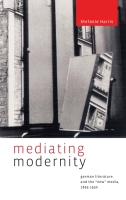




Mediating Modernity
German Literature and the “New” Media, 1895–1930
Stefanie Harris
“Well conceived and shrewdly executed, Mediating Modernity impressively traces the ever-shifting relations between modes of literary discourse such as the novel and the mediascape in which photography, film, gramophone, and other technologies transform the ways in which we think, write, and read. It should be of compelling interest to readers in German studies, comparative literature, media studies, cultural studies, and art history.”
- Description
- Reviews
- Bio
- Table of Contents
- Sample Chapters
- Subjects
Through an interdisciplinary examination that includes close studies of Rilke, Döblin, Dos Passos, Pinthus, Musil, and Hofmannsthal—and relies on the theoretical works of Foucault, Benjamin, and particularly Friedrich Kittler—Harris proposes that literary authors in the early twentieth century, while generally considered far removed from mass culture, engaged in an inevitable, if uneasy, relationship with widespread emergent technologies. These technologies, which radically reoriented temporal and spatial orders and thus the organization of modes of understanding the world, compelled literary authors to draw literature definitively out of the poetically ideal realm and into adaptive contact with other forms of media.
“Well conceived and shrewdly executed, Mediating Modernity impressively traces the ever-shifting relations between modes of literary discourse such as the novel and the mediascape in which photography, film, gramophone, and other technologies transform the ways in which we think, write, and read. It should be of compelling interest to readers in German studies, comparative literature, media studies, cultural studies, and art history.”
Stefanie Harris is Assistant Professor of German at Texas A&M University.
Contents
Acknowledgments
1. Introduction: Print in the Age of Edison
2. Exposures: Rilke, Photography, and the City
3. Kinetic Writing and Kino-Books
4. Crisis of the Novel: Döblin’s Media Aesthetic
5. From Wordminded to Eyeminded: John Dos Passos’s Image-Text
Notes
Bibliography
Index
Introduction
Print in the Age of Edison
“Edison” is the slogan of the times. . . . The torchbearers of culture hasten to new heights, while the people below greedily listen to the clattering of the movies and put a new waltz on the phonograph.
Franz Pfemfert, “Film as Educator” (1911)
In the first issue of the leading expressionist journal, Die Aktion, the journal’s founder Franz Pfemfert still maintained that the high arts could be designated as such because they were literally above the media fray. As the traditional arts of literature, theater, and painting soared to ever greater aesthetic heights, the masses below were abandoned to the corrupting influences of entertainment technologies. In a trajectory stemming from the romantic tradition, Pfemfert’s idealist poetics continued to insist on the distance between art and life, the artist and the masses, the aesthetic and the functional—that is, on transcendent claims to truth and beauty and their communicability. Pfemfert was, of course, not alone in his criticism of the new media emerging at the beginning of the twentieth century. Indeed, the rhetoric of this period often foreshadows the dystopian prophecies that accompany our current state of technological transition at the start of the twenty-first century: the loss of a privileged world of books and learning, the distracting and agitating effects of the proliferation of images, a lack of unified meaning and coherence. With his statement, however, Pfemfert indicates (albeit unwittingly) an even greater shift than that of the perceived split between so-called high and low culture. For he concludes his essay by referring to the traditional arts in terms of their lofty aims and signification and by criticizing film and the phonograph in terms of the material effects of their functioning—the clatter of the projector and the scratches and hisses of phonograph. In other words, he concludes his essay by drawing attention to their status as media, specifically as mass media, which he insists will never sate the greedy appetites of an overstimulated public. The loss of aura is already foretold in the allusion to mere surface effects and mechanistic functioning. With this move, however, the author already indicates that even the so-called high arts were always also the product of specific, which is to say limited, means of recording, transmission, and reception. For these flickering images on film and the raspy sounds of the phonograph are the recording of real physical effects that the symbolic mediation of print had never been able to encode, thus permitting a data stream to be perceived by a public consciousness that would be forever altered in its wake.
Questions concerning the relationship between contemporary technology and the arts are not uncommon today. The pages of newspapers, news magazines, books, scholarly journals, and the internet resonate with this at times ferocious debate. How does or will new media affect how we read books, present ideas, learn, and interact with each other? How do various media shape and influence how we experience the world, record that experience, and communicate it to others? These questions, however, were not formulated for the first time with the advent of television, the computer, and other digital media. The shock of new media is itself not new. Rather, one finds very similar questions being formulated around the beginning of the twentieth century by poets, novelists, and philosophers, during the nascent stages of mechanical technologies of reproduction that changed the manner in which we perceive and understand the natural world. The interrogation by these literary authors of what I will call the mediascape of the early twentieth century is twofold: the term “mediascape” both refers to the traditional and new media of the period for the recording and transmission of knowledge as a collective whole and suggests a relationship to the world as constituted or conditioned by those media through which we perceive, experience, and represent our world. In other words, it is through the various and differentiable media that our relations to oneself, to others, and to the world are shaped and created. What then is the position of the print medium—specifically, the novel and narrative discourse—in this emerging media environment? For it is important to recognize that literature, too, is not only a medium, delimiting a particular mode of selection, combination, transmission, and reception of data, but further, depends on evolving technologies of production—namely, the letter, paper, print, or other means by which it is composed. The alteration or introduction of new media by necessity changes the composition and perspective of other, already ubiquitous media, and further, introduces the possibility that traditional conceptions of literature may no longer be able to contain this increasingly hypermediated world. In the pages of many of these early twentieth-century writers, we read the beginning of a poetics of media that still informs our relation to the mediascape over a century later.
Writing Technologies
Etymologically, medium denotes a midpoint, a middle state or position, or something that is in-between. In physics, a medium is an intervening substance, such as air or water, through which a force acts or an effect is produced. In spiritualism the medium was a living person through which a supernatural agency was believed to manifest itself. Both uses of the term suggest a transparent, open channel to any and all information passing through it. However, a medium can also be the means or instrument used to accomplish something. We are using it in this sense when we refer an artist’s medium as oil, or watercolor, or egg tempera. The broad terms media or mass media as they are employed today are generally associated with communications technologies, such as radio, television, film, or the internet, and printed matter with a wide circulation and including blogs and electronic communications in addition to traditional (now “old”) print media. The term medium must thus be understood simultaneously in two senses: not only as a position or a place, but also a particular means or material by which positionings and placings are manifested through the specific manner in which information is stored, transmitted, and received. Marking a place, the idea of media is revealed as a stubbornly historic or contingent concept, inseparable from the material means of its functioning. In this way, any abstract theory of media is rendered impermanent and always already obsolete by multiple specific and physical occurrences.
As Marshall McLuhan stated in Understanding Media, the basic function of media may be “to store and to expedite information,” but by definition, the medium employed presupposes an act of selection of that information, and further, organizes the information thus stored and transmitted in a particular way. A medium thus implies technical differentiation, for through various media, information flows are separated into incompatible data channels with differently formatted data (one might think, for example, of visual images as opposed to sound recordings). We can read this perhaps as an updated version of McLuhan’s by now ubiquitous if poorly understood dictum, “The medium is the message,” for as McLuhan plainly stated, “It is the medium that shapes and controls the scale and form of human association and action.” A medium, then, does not merely imply the selection and formatting of information in a delimitated fashion, but by means of this selection and formatting, organizes how we perceive and understand that information, and as a result, establishes both one’s position in and relationship to time and space, altering sense ratios and patterns of perception. In other words, media produce real and varied physical effects in those interacting with them and this in a way that may even take priority over the content of the information being communicated. At the far end of this argument, one can conclude that the term medium does not merely delimit a particular technology of communication but serves as the historical a priori of the organization of perception itself. As a result, we find, historically, a very close relationship between technical standards for information storage and transmission, the change in perceptual modes, and formulations of a theory of media. New media that challenge traditional patterns of sensibility impact other media that were very much invested in those same experiential modes. The various means for the processing, storage, and transmission of data are determined by the technological possibilities of a particular period. Differing media do not merely transfer any and all information (the model of a transparent and open channel), rather the term medium refers to that system or network through which information is, or just as important, is not, available for selection. Media map out the grid of intelligibility, and with the appearance of new media, this grid is altered. With the increasing digitization of media, the notion of different and exclusive data streams may appear quaint to us now, but I will argue that it is precisely this technologically outmoded concept of media thresholds that explains why the literature of the early twentieth century is in a privileged position to register these effects, and serves as the site on which is registered the alteration or restructuration of this grid of intelligibility.
The meditations on technology and media by literary authors of the early twentieth century can function as a way of reflecting on these changes in the mediascape. For contrary to the frequent depiction of the modernist author in self-isolation, the expanding mediascape of the late nineteenth and early twentieth centuries did not go unnoticed or unrecorded. The works I examine span roughly the dates 1895 to 1930—from the year in which the first moving pictures were screened before public audiences in Berlin to the approximate end of the silent era—and include novels, short stories, screenplays, theoretical and philosophical essays, and cultural critiques of the period. At one level, the texts serve to document and register the technology of the turn of the century, and in this sense we might consider them as records of our own technological prehistory. One notes in their pages, for example, the many references to photographs, films, phonograph records, radio, typewriters, the telegraph, and the telephone. These texts do not reference these technologies merely to mark their historical appearance, however, nor are new technologies employed solely as symbolic shorthand for industrial, social, or economic modernization. Rather, they serve as a means of literary self-reflection on prose narrative within the multiple modes of inscription and reproduction that were beginning to saturate the perceptual field.
The period in question records for us the moment in which writing, which is based on the symbolic mediation of language, is positioned against media like photography, film, the radio, and phonography, which are techniques for recording and transmitting physical effects. This would be one way, for example, to formulate the problem of the referent that is such a hallmark of modernist literature, and certainly the question of reference emerges as a marked difference between prose writing with its linguistic code and other media that record the direct physical effects of light and sound waves. A central issue of the debate between literature and other media will be, paradoxically enough, the perceptual im-mediacy of these new forms. However, the question of reference, or the power of words to adequately represent, is certainly not a new one, and was posed long before the advent of moving images (and will be raised again, as we will see, as a challenge to the aesthetic viability of film). More important, what is introduced with the new media, and the modernization which they both announce and represent, is a radically new relationship to time and space, a relationship that is marked by an inability to keep time (in both senses of the word) or to order space in a unified fashion. It is through this apparent impasse and the literary strategies provoked by hyperstimulation, fragmentation, simultaneity, the lived experience of daily life, or any other of the many spatial and temporal “disorders” described during this period, that we can look to what literature can tell us about the role of the new media in the construction of a particularly modern subject and the relationship of that subject to the world, to others, and to the self.
Although literary historians have analyzed problems of perception, memory, and language in the literary texts of modernity, because they have restricted their focus to the texts alone, or at least as an alternative to and distinct from mass media, what has not yet been understood is how the literature of this period engages with the larger mediascape of which it is a part. In other words, one cannot reflect specifically on writing or on broader questions of the work of art without theorizing about media. Himself no stranger to multimedia events, Bertolt Brecht once reflected on the relationship between cinematic and literary discourse:
The old forms of communication do not remain unaffected by the development of new ones, nor do they survive alongside them. The filmgoer develops a different way of reading stories. But the man who writes the stories is a filmgoer too. The mechanization of literary production cannot be thrown into reverse. Once instruments are used, even the novelist who makes no use of them is led to wish that he could do what the instruments can: to include what they show (or could show) as part of that reality which constitutes his subject-matter; and above all, to assume the attitude of somebody using an instrument.
As a result, literature is affected not only by its own material means of production but also by the media with which it competes. The texts I examine in the following chapters present their authors as assuming the attitude of somebody using an instrument. For the writer, encountering other media, such as film, profoundly affects the act of literary production itself. These texts articulate their authors’ recognition that literature has been impacted by technologies that have introduced new temporal and spatial organizations, thus leading the author to question traditional values of poetic art and to experiment with a new type of writing that takes these technological effects into account. If the communication of experience traditionally presupposed a unified consciousness or a continuous, circumscribed, and autonomous subject in time and space, the interference of technology in the social dynamic and the noise and cacophony of varying information networks forces us to formulate a new theory of consciousness. The early twentieth century witnessed the transformation of the novel into a medium whose communicative structure was challenged by the advent of the unremitting immediacy of new media that reorganized the networks through which information was transmitted and presented. One way of understanding the experimental and fragmented nature of what is often called the “modern” novel is as a recording of a certain asynchrony between literature and the mediascape in which it is situated.
DN 1900: Sound-Image-Print
The idea of a perceptual and intelligible shift brought about in conjunction with developments in new media echoes the epistemic breaks that Michel Foucault outlines in The Order of Things (1966) when he describes the discontinuities in forms of discourse and the field of knowledge at particular historical moments. In his study, Foucault sought to “reveal a positive unconscious of knowledge: a level that eludes the consciousness of the scientist and yet is part of scientific discourse.” To employ, to analyze, or to write about discourse is already to imply rules for its use. The “order of discourse,” therefore, not only describes discursive practices, but more broadly the conceptual terrain in which knowledge is formed and produced. The episteme—those discursive rules and categories that constitute discourse and therefore knowledge—may remain unvoiced and unthought, but as the space or condition of possibility for all thinking, it is impossible to think outside the episteme. The entry “Foucault, Michel, 1926– ” in the 1984 edition of the Dictionnaire des philosophes describes the philosopher’s work as “an analysis of the conditions under which certain relations between subject and object are formed or modified, to the extent that these relations are constitutive of a possible knowledge.” And in The Order of Things, Foucault analyzes these conditions of possibility in the modern sciences of linguistics, biology, and political economy. In his review of Foucault’s text, George Canguilhem clarifies what is introduced with Foucault’s analysis: “The idea that language is a grid for experience is not new. But the idea that the grid itself calls for decoding still had to be formulated.”
Almost twenty years after the publication of The Order of Things, the German literary and media theorist Friedrich Kittler borrowed from Foucault’s methodological approach to write Discourse Networks, 1800/1900 (1985), in which he delineates regimes of knowledge through their respective and distinct epistemologies. Like Foucault, Kittler contrasts clearly delineated epochs in order to describe their distinguishing characteristics. Foucault had identified epistemic breaks occurring between the sixteenth and seventeenth centuries (the classical period) and the eighteenth and nineteenth centuries (the modern period). Kittler likewise marks two epistemological breaks. The first, which he argues occurred in 1800, corresponds to Foucault’s modern period. The second, which Foucault only alludes to in the final chapter of The Order of Things as possible and in the future, occurred, according to Kittler, at the start of the twentieth century. Kittler believes that Foucault overlooked this break because he focused his analysis on text for the most part, whereas Kittler argues that discourse networks or systems are not limited to the print medium—at least, not after 1900. In his lecture “Literatur und Literaturwissenschaft als Word Processing” (Literature and Literary Studies as Word Processing), Kittler remarks that while focusing his analysis on the rationality of systems of knowledge, Foucault largely ignored the rationality of technologies through which human knowledge is acquired, stored, and transmitted. What Kittler adds to the conversation, then, is that varying discourses of knowledge, science, and truth have not only been subject to radical shifts or discontinuities over the past two centuries, but that these shifts are in no small part occasioned by the particular technological means at one’s disposal for the production of knowledge in general. Kittler thus clarifies the condition under which, in Foucault’s words, “something can become an object of a possible knowledge,” in his statement: “Media determine our situation” [Medien bestimmen unsere Lage]. As we know, Foucault’s work includes analyses of systems of knowledge, not merely in terms of what is said, but more frequently, in terms of what is not said, or at least not said in the public arena, and in terms of the relationship between various discourse regimes and institutional policies: What is rational? Who is allowed to speak? What are the determining conditions under which a discourse can be employed? What is considered true? What we do not get in Foucault, or at most very rarely, however, is an analysis of the techniques of a system of discourse. For example, Foucault and Kittler will both stress the role of education in determining the conditions under which discourse can be employed and in determining who is a legitimate agent of this discourse. However, Kittler extends this notion further with his claim that educational processes, reading practices, theories of reading, and the practice of literary analysis itself are determined by specific technologies of the letter. Indeed the title of Kittler’s own lecture, “Literature and Literary Studies as Word Processing,” reveals the extent to which its author has completely abandoned the hermeneutic model as untenable: literature is just a particular means of data processing through the medium of print and the materiality of the letter.
Like the group that Franz Pfemfert identified, “Edison!” could also be the slogan of Kittler’s groundbreaking work on the impact of the emerging media environment on the discursive regimes of the early twentieth century. If in Pfemfert’s view, however, the emergence of new media widens the chasm between so-called high culture and low, Kittler’s deployment of the term often assumes a technological determinism against which the artist can offer no resistance. In December 1877, Edison presented to the public the prototype of what would become the phonograph (in Germany, this instrument went by the trademark name Gramophone); and in February 1892, Edison patented the kinetoscope, which when combined with the projection devices developed by the Lumière brothers in France and the Skladanowsky brothers in Germany, would become what we know today as cinema. With these two inventions, acoustic and optical effects could be recorded in time. Before Edison, in Kittler’s decidedly linear formulation, literature was the only medium for recording not only linguistic but also visual and audible data flows as temporal or serial data. When fully internalized through the practices of silent reading that rely on perfect alphabetization (Kittler’s term for what we might think of as a literacy of transparency), the mental sound movie of print allowed all readers to participate in a life-world that literature of the time described and that philosophy and poetry ratified. With the invention of sound and image recording, however, acoustic and optical effects could be recorded in so-called real time. The recording of other forms of data (namely, sounds and images) meant that the materiality of the text as itself an object of data processing could no longer be ignored. Thus literature could be seen as just another imperfect and limited medium and displaced from its position of absolute sovereignty (in an inversion of Pfemfert’s metaphor of cultural peaks and valleys). The “torchbearers” literally pre-date electric light and can only allude to a romantic-classical tradition that has long since ceased to exist.
Kittler’s Discourse Networks, 1800/1900 investigates the metamorphosis or systems shift denoted by the two dates of his title, when literature, which had once operated as an autonomous sphere for the totalization of human experience, began to compete with other media for the inscription of reality. Kittler took his German title—Aufschreibesysteme —from the early twentieth-century memoirs that Senate President Daniel Paul Schreber wrote to prove his sanity. These are the same memoirs that Freud analyzed as a case study of paranoia. Schreber’s exhaustive and redundant writings are the product of an Aufschreibesystem, or literally writing-down-system, under which he is commanded and compelled to write by distant forces. Kittler uses Schreber’s term as a critical concept to describe what is inscribed by a particular culture at a particular time, or as he states, to “designate the network of technologies and institutions that allow a given culture to select, store, and process relevant data.” In other words, Kittler alludes to Schreber to understand the rigid and normative systems of cultural production with a given network. With contemporary developments in more complex digital technologies operating through sophisticated coding to which the user has no access, Kittler will argue elsewhere that these networks are decidedly authoritarian. Critical to Kittler’s reappraisal of Foucault’s discourse analysis, as we see here, is the fact that the discourse network is not limited to language stored in the archive of print. The title of Kittler’s subsequent book, Gramophone Film Typewriter (1986), is one way of announcing the death of the hegemony of the book itself.
According to the first half of Discourse Networks, “1800,” poetry occupied a privileged status in the discourse network of the nineteenth century precisely because it was not considered a medium. As Kittler notes: “The other arts were defined by their respective media (stone, color, building material, sound); the medium of poetry, however—language or tone, language as tone, but certainly never language as letters—disappears beneath its content so that . . . the spirit can appear directly to the spirit.” Poetry alone does not constitute the entirety of the discourse network, however, but is part of a triad with philosophy and the state, for these authors are produced under the influence of the state apparatus in compulsory education, the homogenization of writing, and the new discipline of silent reading. Kittler argues in detail that the 1800s saw a shift in language learning in German schools from complete words and phrases to the phonetic unit that is voiced inwardly in the act of reading, thereby echoing the voice of the Mother from whom the romantic poets first gained access to language. Consequently, the poet’s pen on paper is conceived as a continuous translation of these inner soundings of the spirit, and literature appears to function as a transparent channel in which words tremble with sensuality and memory, and the reader hallucinates a prelinguistic meaning between the letters and the lines of the printed text.
Kittler reads the traces of these discursive effects through close analysis of a variety of texts, starting with the scene of writing in Goethe’s Faust. He finds a privileged example of the exalted position of literature in the elusive quest for the blue flower of Novalis’s literary double Heinrich von Ofterdingen. As Ofterdingen admits, “I long to catch sight of the blue flower. It is always on my mind and I can write and think of nothing else.” Poetry serves here as the means of obtaining this vision, through its ability to transform words into flowers and flowers into words, since poetic words “liquidate material media.” In other words, poetry established itself as a medium that denied its own functioning as a medium. This is why Novalis can write in one of the fragments of his Allgemeinen Brouillons, “If one reads correctly, then a real, visible world unfolds itself in us internally according to the words.” Here Novalis seems to provide a perfect interpretation of interpretation in general—readers do not see letters, but hallucinate a perfect signified. Poetry translates the other arts into a nonmaterial and universal medium that is called Imagination, that marvelous sense, as Novalis once wrote, that can replace all our senses.
In the nineteenth century, poetic writing was so general and absolute a medium that the term medium did not encompass it, but Kittler argues that the discourse network of the early twentieth-century was the product of the technical differentiation of written, optical, and acoustic data flows through the typewriter, film, and the phonograph, and the concurrent sciences of and experimentation on the body that led to their invention. These new media are important at many different levels, but primarily in their differing functions as media. In other words, they delineate distinct and separable channels of information and data processing. As a result the discourse network of 1900 is one of division and deviation. For with the introduction of new media, written, optical, and acoustic data flows are separated from each other and rendered autonomous. Indeed, this technical differentiation—the separation of data flows—becomes the very definition of a medium in this historical context. Against a background of noise, each individual medium can only channel a select and limited amount of information. The clattering of film reels and whistling and scratching of phonograph records give evidence to the wealth of information and noise that no symbolic writing could ever encode. In other words, they draw attention to the existence of alternate data flows that must be organized through different channels. Texts are only a specific form of data processing, and as long as no film or phonograph, no computer or word processor, existed to break the textual monopoly, the literary sciences could ignore the materiality of their object of study and assume sense and meaning, content and form. With this differentiation, the materiality of discourse, as opposed to the transparent meaning of the word, is made explicit, thus bringing the hermeneutic project to an end. Interpretation of the text is subordinated to the identification of its medium of transmission. In the absence of a universal reference, discourses make sense only with the support of other discourses. Signals received and amplified are employed to close a given network’s loop, and it is only an anthropocentric illusion that maintains that books present themselves to theoretical eyes whose freedom (from discourse) then allows them to discover meaning. Or as Nietzsche, the first “mechanized philosopher,” once wrote in a letter, “Our writing tools are also working on our thoughts.”
With the invention of the phonograph, technical sound recording renders explicit the materiality of language, and a methodological and distinct separation is drawn between the real physical effects of sound recording and the symbolic notation of phonetics and phonology. It is within this historical context, Kittler argues, that the possibility of a structural linguistics, in which words become symbols with only an arbitrary relation to the real, emerges. And it is not only the phonograph that contributes to this event—the typewriter will also play a major (indeed, determining) role, for the typewriter effects the dislocation of language from the individual body or subject engaged in the production of writing. As Mark Seltzer notes in his book, Bodies and Machines: “The typewriter, like the telegraph, replaces, or pressures, that fantasy of continuous transition with recalcitrantly visible and material systems of difference: with the standardized spacing of keys and letters; with the dislocation of where the hands work, where the letters strike and appear, where the eyes look, if they look at all.” We note that in his attempt to explain the nonreferential value of the linguistic sign, Saussure resorted to a comparison with writing—a comparison that is telling indeed because the point is more strongly made with typing than with writing longhand. “We shall use writing to draw some comparisons that will clarify the whole issue. . . . The value of letters is purely negative and differential. The same person can write t, for instance, in different ways: [the text reproduces here three different handwritten variations of the letter t]. The only requirement is that the sign for t not be confused in his script with the signs used for l, d, etc. Values in writing function only through reciprocal opposition within a fixed system that consists of a set number of letters.” The letter is void of significant content—its meaning is pure difference. In his analysis of the technologies of the early twentieth century, Kittler focuses much of his attention on the typewriter and its specific mode of production. Indeed, typewriters were not only finding increasing use because of their speed but also their enhanced legibility—both of which were requirements in the information boom of the early twentieth century. We find not only the increased use of typewriters, but a general interest as well in the simplification of typefaces, which were subjected to extensive experimentation in order to rate their varying degrees of legibility. The letters that the typewriter produces are not autonomous vessels bearing meaning, rather the letters are what they are only through the contrast of distinct black figures on white paper. The problem with Saussure’s example of the t written in longhand is that this t is only differentiable from every other letter produced by the same hand. In this case, each individual would constitute only his own system of differentiation. With the typewriter, however, the system of differentiation becomes collective, which was, in fact, Saussure’s point. In other words, with the typewriter, the separation between letters becomes visible. In order for letters to exist as signs, however, they must stand on a background that no mechanism can record or store, meaning that the medium of print must always simultaneously indicate its own threshold.
In Discourse Networks, 1800/1900, Kittler refrains from naming the periods designated by the two dates of his title, or what is most commonly referred to in German literary history as romanticism and modernism. Instead, he selects a mathematical formula to serve as an epigraph to each section:
1800: eix = cos x + i sin x Leonhard Euler
1900: y = (+a) + (-a) + (+a) + (-a) + . . . Bolzano
As David Welbery instructs Kittler’s presumably mathematically challenged readers, the first formula “can be interpreted as an algorithm of ‘growth,’ the movement of progressive augmentation that characterizes the discourse network of 1800. The second formalizes the pulse of differential alternation that permeates the modernist discourse network.” By refusing to give names to the periods in question, Kittler not only reveals his persistent fascination with engineers and mathematicians, but further hopes to deflect the reader’s traditional presuppositions associated with the terms “Romantic” and “Modern” (or any other name they have been given in the history of interpretive discourse). Nevertheless, the substitution of these words by formulas does present a question that Kittler does not pursue, namely what kind of medium is the language of mathematics? The deployment of mathematical formulas suggests that all elements of cultural production are subject to the same abstract, unyielding rules. In other words, in this historically mathematical view, the media landscape is rigid and fixed rather than constantly in play, and hybrid or fluid forms are either rejected from the outset or normalized. Bolzano’s formula becomes, within the context of Kittler’s argument, a blueprint that dictates not only how literature and newer media but also economics, politics, education, social policy, and so on, are perceived and comprehended. I will show, however, that a close examination not just of the media but of the early theories of media produced during this period suggests that the terrain is hardly this straightforward. The system does not alternate with such perfect symmetry.
The Blue Flower: From Poetry to Film
It is not surprising that Kittler situates not only literature but also the evolution of psychoanalysis (more specifically, the constitutive elements of a Freudian vis-à-vis a Lacanian perspective) within a technologically determined narrative, as if the effects of media were inscribed directly onto the unconscious. What is omitted from this narrative, however, is a sense of the interruption and disruption of a monolithic network. In other words, in this period, the explicit meditations by literary authors on image-based and sound-based technologies and their attempts to come to terms with a perceived disconnect between the inherited literary tradition and the world in which they lived reveal an important resistance to these new technologies that cannot be overlooked. One way this anxiety is verbalized is within various iterations of the question, how can one go on writing in the reconfigured mediascape? By engaging in a structural analysis of the larger mediascape—and by focusing on literature as an intrinsic element in that system—I have sought to highlight (rather than ignore) the fluidity that permeates the relationship between the actual media with which we record and transmit knowledge and the construction of the subject and the subject’s relation to the world as constituted by those media. In other words, in this period the relationship of the subject to these new media was one of constant renegotiation, and often not without recourse to media technologies that may, in this brave new world, have already seemed anachronistic.
When McLuhan stated that the contents of one medium are always other media, he was only echoing what Walter Benjamin had already made clear in what is perhaps the most widely cited essay in media, and particularly film, studies, “The Work of Art in the Age of Mechanical Reproduction”: “Traditional art forms in certain phases of their development strenuously work toward effects which later are effortlessly attained by the new ones.” The essay marks a pivotal moment in twentieth-century aesthetics because Benjamin shifts the then current question of whether or not film should be considered art to the question of how the technical reproducibility of film forces us to rethink our assumptions concerning the work of art in general. Benjamin does not merely marvel over the technological wonder of the moving image, but instead uses his meditation on this technology to reflect on among other things how our previous assumptions about art become shifted. For example, our criterion of authenticity is useless when it comes to a work of art designed for reproducibility, such as the photograph or a film. As the essay makes clear, a change has transpired in what constitutes the essence or nature of art (to say nothing of the notion of essence itself), for the technical reproduction of art is inseparable from the technologies that have created it. Norbert Bolz has thus correctly drawn our attention to the fact that Benjamin’s insight was to analyze film not as an art form but as a medium, with a specific and delimited mode of recording, transmission, and reception. We find in Benjamin’s writing a relationship between technical standards and changes in perception, between cultural production and a constantly evolving understanding of the concept of media itself. “During long periods of history,” Benjamin wrote, “the mode of human sense perception changes with humanity’s entire mode of existence. The manner in which human sense perception is organized, the medium in which it is accomplished, is determined not only by nature but by historical circumstances as well.” Media do not merely delimit a particular technology of communication but serve as the historical apriori of the organization of perception itself. One need only consider Benjamin’s pronouncement on the decline of the “aura” of the unique artwork as a result of its having been photographed and disseminated; the loss of “aura” is a direct function of the upsetting of traditional spatial and temporal relations, and that has everything to do with the manner in which the work stores and transmits information. In other words, it has everything to do with the placement of the work within a network.
We should not be surprised, then, to discover that after 1900, Novalis’s blue flower turns up in a new setting, namely in Benjamin’s description of the specificity of the cinematic medium:
In the film studio, the equipment has penetrated so deeply into reality that its pure aspect freed from the foreign substance of equipment is the result of a special technical procedure, namely, the shooting by the specially adjusted camera and the mounting of the shot together with similar ones. The equipment-free aspect of reality here has become the height of artifice, and the sight of immediate reality has become the blue flower in the land of technology.
Benjamin’s allusion to one of the preeminent symbols of German romanticism suggests that film has taken over a function that was once the domain of the romantic poet—the blue flower that was once hallucinated from the words of the written page is now transferred to countless film screens, which is to say that the image appears to be presented directly, although its relationship to “reality” must be heavily scrutinized. With this choice of phrase, Benjamin indicates the extent to which the functions of the universal medium of the previous century (poetry) have been separated into various domains. One does not have to “read correctly” as Novalis once wrote, in order to see the blue flower, although the media literacy of the public will have important sociopolitical consequences. Benjamin clearly argues that one’s reception of that blue flower is a direct function of the technical means by which film records, programs, and transmits information. New technologies of representation force us to rethink the notion of representation in general.
In her essay, “Benjamin, Cinema and Experience: ‘The Blue Flower in the Land of Technology,’” Miriam Hansen indicates that the “blue flower” would at first glance appear an odd choice of allusion to be used in conjunction with film, if for no other reason than its status as a preeminent poetic metaphor of the unattainable object, the incarnation of desire. Its “aura” would appear at odds with the very technologies of reproduction that Benjamin tells us have contributed to its decline. Hansen proposes that Benjamin’s allusion to the “blue flower” may have been part of a larger argument in which cinema “could be redeemed . . . as a medium of experience.” However, this reading suggests that what might be recouped with the screen image of the “blue flower” is the secure and stable position of the individual subject to the work, which is at odds with the “shock effect” of the cinematic medium as it is otherwise described in the essay. Rather than looking back to a previous discursive model, Benjamin’s reference to the “blue flower,” particularly when taken in conjunction with the position of the reference in one of the more explicitly technical portions of the essay, likely indicates the extent to which Benjamin dramatically underscores the perceptual shift of modern consciousness as a result of the intervention of technology, and as a result, one’s increasing inability to conceive of the blue flower except as an image on the screen. In other words, the flower (as poetry) no longer signifies the liquidation of all media, which is to say their perfect translatability or what Benjamin called “pure language” in “The Task of the Translator,” but reveals itself as firmly embedded within a particular media-specific network of storage, transmission, and reception.
Samuel Weber’s essays on Benjamin in the collection Mass Mediauras make clear the extent to which the recording of the technical apparatus is doubled by reception as a technical effect, for as he points out, the German verb aufnehmen is used by Benjamin to designate both the technical procedure of cinematic recording and its reception by the spectator. In English, aufnehmen translates literally as “to take up.” This doubling is clear in the quotation from “The Work of Art in the Age of Mechanical Reproduction”; the “equipment-free aspect of reality”—that is to say, what we see on the screen—is only perceptible from the position of the camera. In other words, with film, we see ourselves seeing; the film records our own processes of perception. However, just as the film is the product of certain media effects, so too our perception of the world around us is informed by other components of the mediascape. Even the reception of film in a state of distraction and the shock effect of disconnected and disorienting images only doubles the technical condition of cinematic production itself. Bolz seems to say as much in his own analysis of the essay when he writes: “The conclusive media-technical condition of the decline of the aura is the mass reproduction of images which, in their endless doubling of reality, absorb reality itself. In a fully aestheticized world, in which reality coincides with its own image, there can be no discriminating transcendence of art.” An aesthetics that moors the work of art to fractured space and time, to circumstance, to contingency, to the moment, is not easily or seamlessly incorporated into prevailing views of the duration and permanence of the artwork and its unique experience by an individual. The media technologies of the early twentieth century radically changed the manner in which art was conceived, produced, and experienced.
With the end of the media monopoly of print, what happens, to paraphrase Kittler, when the acoustic and optical realms stop not writing themselves? In other words, what happens to the writing of a printed text when the phonograph and cinematograph—and both names refer, not accidentally, to writing—are able to fix the hitherto unwritable data flow of time and the visual image? Another critical part of the question, however, is how do examinations of mechanical media lead to an examination of the literary arts themselves? It is in congruence with this larger mediascape and other narrative modes (and not merely a reaction against or a slavish imitation of them) that the early twentieth-century author begins to redefine poetry, the novel, the essay, and other forms of writing. The boundaries between media are not permeable—despite calls for cinematic writing and the like—but are defined by technological thresholds. And this incompatibility becomes, for many, grounded in a more general anxiety surrounding the split between word and image as vehicles for representation. The so-called image-text therefore becomes a highly unstable site for thinking through the question of art. Further, these distinct channels—print, image, sound—suggest differences in communicative media that are in excess of their mutual translatability. As such, the discourse on literature and the “new” media at the beginning of the century is an interrogation of the limits and boundaries of differentiated media.
Literature as Media
A reconfigured understanding of the modern novel and related literary modes emerges from a sustained examination of the interactions between literary history and the history of media technologies. The multiple inscriptions of print, image, and sound in the modern mediascape give rise to ways of thinking about, producing, and reading literature that take up the modes of recording and reproduction that were beginning to saturate the perceptual field in the late nineteenth and early twentieth centuries. Over the course of this book, I examine four texts that give evidence about the changing status of the literary text and the way in which authors understand their own medium. In selecting from a combination of greater and lesser known works, and from German and American examples, I further show how these reflections on the aesthetic and social shifts in the new mediascape do not themselves remain static but are constantly in flux. If modernism is commonly understood as a retreat from mass culture and modernization, I intend to show how this sweeping claim does not take into account the many detailed examinations of new media taken up by even the most stalwart members of this canon, and to argue that the period can not be properly understood without a consideration of the literary turn to concerns about media.
I begin with an examination of the work produced by Rainer Maria Rilke during his Paris period, revealing how the emerging media environment at the beginning of the century, and the corresponding technological training of the sensorium, is a frequent preoccupation of his letters and essays and is inscribed in the pages of his literary record. Tellingly, both in his novel Die Aufzeichnungen des Malte Laurids Brigge (The Notebooks of Malte Laurids Brigge, 1910) and in the poems and other writings of the period, Rilke makes explicit reference to photography, particularly in relation to his anxiety over the city and the act of writing, leading one to inquire into the ontological and epistemological stakes of the photograph such that poetic writing, or at least a certain notion of poetic writing, becomes problematized. Rilke employs the language of photography to examine questions of framing, perception, temporality, memory, and the relationship to death—questions that permeate not only his reflections on the mediascape at the beginning of the century, but those of all of the authors I discuss. Mindful of the possibilities of the new technologies, Rilke does not cede any ground to them but instead argues for the continued relevance and necessity of the work of art in the age of its technical reproducibility.
With the introduction of film, pictures of course became both mechanical and moving. Kurt Pinthus’s Kinobuch (1913), a collection of screenplays by a variety of young German expressionist authors, opens a discussion of non-novelistic considerations of film by literary authors. Strikingly, a number of these screenplays are built around a scene of writing or reading. I develop the argument that early film criticism in Germany and Austria—at least that practiced by members of the literary community, and including Hugo von Hofmannsthal, Robert Musil, and Thomas Mann—was a formulation of the changing terrain of the literary medium within a mediascape in which aesthetic reception was increasingly programmed by mechanical forms of recording and representation. In other words, I examine how the notion of writing itself was changed by how people were beginning to think about photography and film.
Almost every emerging technology from the end of the nineteenth and beginning of the twentieth centuries is accounted for in Alfred Döblin’s novel Berlin Alexanderplatz (1929). Unlike Rilke, for whom technological models of representation presented a crisis to his understanding of poetic language (as articulated through his literary double, Malte), Döblin explicitly employs alternative media to expand literary discourse. Berlin Alexanderplatz thus not only records other, nonliterary discourses, but further, adopts strategies, such as cinematic and phonographic techniques, from the media it concorporates. I posit that early twentieth-century literature is part of the assemblage of the differentiation of media that occurs with the invention of technologies such as film and the phonograph which record and transmit alternate information flows. I pay specific attention to Döblin’s earlier works—his short stories, screenplays, and particularly, essays that either directly or indirectly address the mediascape—in order to show the development of ideas that are later worked out and refined in Berlin Alexanderplatz.
Like Döblin’s Berlin Alexanderplatz, John Dos Passos’s Manhattan Transfer exploits alternative media to construct a text about a city that reveals the extent to which the city is defined by the competing networks of media found in it. In other words, Dos Passos’s works reflect on their own possibility and restrictedness within the grid of intelligibility constituted by the new media. In his later U.S.A. trilogy, these separable media flows are made explicit, delimiting the boundaries and gaps where the media are not seamless. By focusing particularly on the mode of writing Dos Passos termed the Camera Eye, a concept that brings literary representation together with photographic technology, we revisit the questions Rilke posed some twenty years earlier, but this time from the position of the photographer as successful poet, not that of the poet as failed photographer. Rilke struggled with the question of how the medium of photography problematizes the presuppositions of poetic writing, but Dos Passos used the Camera Eye, and by extension a theorization of photographic recording, to show how one can employ the epistemological considerations introduced by the fact of photography precisely in order to go on writing. By concluding with this American author, it is my intention to put the German response to the new media into a broader context, drawing out both the continuities and singularities in the shifted media aesthetic of the beginning of the century.
The crisis of representation brought about by the new media, or even more specific technological interventions into the literary domain, did not, of course, spell the end of the book—despite dire predictions to the contrary. Rather, at the limit of narrative representation, the books of the early twentieth century record their own changing status as a medium. By reading against the established notion of the literary creation of autonomous and poetically ideal realms, we can see how the history of literature intersects with the history of media, especially image- and sound-based recording. The texts I examine help show how their authors use the encounter with mechanical media to address the changing conditions of human experience and the problem of communicating that experience through their work. Of foremost concern, then, are not thematic considerations of media (for example, Franz Biberkopf’s trip to the cinema in Döblin’s novel), but rather stylistic experiments within prose and poetry, the reproduction of, say, cinematic effects within the literary text, and, especially, the explicit meditation on media in the letters and essays of these authors. In this way, both familiar and less familiar writers can be seen not only as deeply engaged with the question of the position of literature in the emerging mediascape but also as early media theorists. Contrary to Pfemfert’s early pronouncement in Die Aktion, “Edison!” is the slogan of the times precisely because the emerging technological environment and the corresponding technological training of the human sensorium are implicit and necessary characteristics of the very notion of modernity itself.
In closing the book, I consider how we might productively consider the relevance of the relationship of literature to “new media” around 1900 to our own current moment. For even a brief survey of postwar and postmodern literary works will show that authors of literary prose continue to interrogate, examine, and analyze both emerging digital media and what is now usually referred to as “traditional” media (photography, film, television, and audio recording). Are questions of medial specificity simply transposed to the digital age or have a different set of concerns emerged? I offer that in the postwar period, the shock and novelty of the “new” media abated so that questions concerning spatial and temporal experience, subjectivity, agency, and memory are taken up especially in relation to the role of media in the apparatus of power relations. For these later generations of writers, the literary experimentation of the authors of the modern mediascape will be less compelling than the writings of someone like Walter Benjamin and his prescient analyses of the sociopolitical repercussions of the new media.
Also of Interest
Mailing List
Subscribe to our mailing list and be notified about new titles, journals and catalogs.