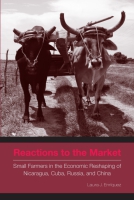




Reactions to the Market
Small Farmers in the Economic Reshaping of Nicaragua, Cuba, Russia, and China
Laura J. Enríquez
Reactions to the Market
Small Farmers in the Economic Reshaping of Nicaragua, Cuba, Russia, and China
Laura J. Enríquez
“Boldly adapting Karl Polanyi’s classic framework to contemporary cases, Enríquez develops a matrix of market reform strategies with starkly different implications for small rural producers. Combining theoretical rigor with careful fieldwork, this study draws on original survey research and fine-grained analysis of Cuba and Nicaragua, examined in comparison to Russia’s ‘shock therapy’ and China’s gradual transition. This excellent work offers valuable insights for students and practitioners of rural development and agrarian social relations.”
- Description
- Reviews
- Bio
- Table of Contents
- Sample Chapters
- Subjects
Through this comparison, we see the similarities between Nicaragua and Russia in their rapid retreat from socialism and their adoption of reforms that have placed small agriculture, especially that focused on food crops, at a distinct disadvantage relative to export-oriented production. By contrast, Cuba has been more like China in adopting aspects of market reform while emphasizing small-scale cooperative and private farming in an effort to achieve food self-sufficiency.
Drawing insights from Karl Polanyi’s study of the social and economic effects of the expansion of market relations in the nineteenth century, Enríquez highlights the role of the state in each of these countries in driving change in a certain direction: toward de-emphasis of small-scale farming and the eventual assumed demise of the peasantry in Nicaragua and Russia, which has led to countermovements of peasants struggling to survive, and toward the reconfirmation of the value of small farming in contributing to balanced economic development in Cuba and China.
“Boldly adapting Karl Polanyi’s classic framework to contemporary cases, Enríquez develops a matrix of market reform strategies with starkly different implications for small rural producers. Combining theoretical rigor with careful fieldwork, this study draws on original survey research and fine-grained analysis of Cuba and Nicaragua, examined in comparison to Russia’s ‘shock therapy’ and China’s gradual transition. This excellent work offers valuable insights for students and practitioners of rural development and agrarian social relations.”
“This remarkable and unique comparative study draws on Polanyi’s theory of the great transformation. The author discusses the fate of the peasantry in four countries that have experienced different paths of transition from a planned economic system to a more market-oriented system. The state plays a key role in this transition, generating different countermovements. The various ways in which small farmers shape state policy—and hence their future trajectory—are explored within this comparative framework, providing fresh insights into the processes of agrarian transformation. This extraordinary book will appeal to all those who are interested in rural issues and are concerned with the challenges facing small farmers in the era of neoliberal globalization.”
“This is an excellent study that I recommend highly highly to all interested in rural development issues in particular.”
Laura J. Enríquez is Professor of Sociology at the University of California, Berkeley.
Contents
List of Figures, Tables, and Maps
Acknowledgments
List of Abbreviations and Key Terms
Introduction
Part 1: Transitions from Socialism and Their Social Consequences
1. The Theoretical Backdrop
2.: Small Farmers in a Contrasting Light
Part 2: Nicaragua’s Rapid Retreat from Socialism
3. The Economic Strategy of the Post-1990 State
4. The Economic Strategy’s Varying Impact on Nicaragua’s Small Farmers
Part 3: The Reconfiguration of Cuban Socialism
5. Cuba’s Post-1990 Economic Strategy
6. The Reconfiguration’s Varying Impact on Cuba’s Small Farmers
Conclusion: Transitions Toward the Market and Their Theoretical Implications
Postscript
Appendixes
Bibliography
Index
Introduction
The year 1990 was a turning point in both Nicaragua and Cuba. That year witnessed the electoral loss of the Sandinista National Liberation Front (FSLN), which had sought to move Nicaragua in the direction of socialism following the overthrow of the Somoza regime in 1979. The election results forecast a major shift in the government’s reigning political economy, one characterized by a rapid retreat from socialism toward a “social economy of the market.” True to its electoral platform, the government that assumed power in 1990, which was headed by Violeta Barrios de Chamorro, quickly moved policy making toward a full embrace of capitalism. In Cuba, it was not a change of political regime that triggered the modification of that country’s socialist political economy. Rather, the economic crisis that was provoked by the disintegration of the Council of Mutual Economic Assistance (COMECON—the Soviet-led trade bloc) forced the reconfiguration of what had heretofore been Cuban socialism.
The contrasting political economic orientations adopted in the 1990s by these two formerly allied governments resulted in the pursuit of distinct economic strategies. As part of Nicaragua’s rapid retreat from socialism, a comprehensive program of economic stabilization and structural adjustment (SA) was put in place. In Cuba, the economic crisis led to the implementation of SA-like measures in several sectors of the economy. Yet policy in some other sectors of the economy, such as agriculture, was notably different from that typically associated with SA. Logically, their respective strategies had varying consequences for certain sectors of their populations. One of these sectors was that involved in agricultural production.
The Chamorro government in Nicaragua largely patterned its policies according to the model set forth by the proponents of orthodox SA programs. As a result, it followed the path taken by most other Latin American governments beginning in the 1980s. The assumption behind that model was that the principal cause of the economic troubles facing many countries in the Global South was the economic approach they had employed for the previous few decades. That approach, known as import substitution industrialization (ISI), had prioritized moving their economies away from complete reliance on the export of primary products to also producing their own industrial goods, even if that required some degree of protectionism in the early stages of the push to industrialize. The state had played a crucial role in this effort to diversify production.
Proponents of SA argued that the Global South’s nascent industrial sectors were being maintained artificially by the state, which was creating an unsustainable economic situation. By interfering with the market, these states were keeping afloat nonviable industries and causing disequilibria throughout their economies. The answer was, then, to restructure (or “adjust” the structure of) these economies so that they would once again experience growth, which was best done by emphasizing what they had produced historically—products for export.
Within Nicaragua’s SA program, export production was to be prioritized. Within agriculture, export products were to be the focus of attention. As a result, domestically oriented production—which was the specialty of small farmers, who made up close to 90 percent of the country’s agriculturalists in 2001 —found itself relegated to a distant second place in terms of the government’s resource allocations. This situation, combined with other aspects of SA, led to the increased marginalization of this sector of producers. Their marginalization translated into a growth in the numbers of rural dwellers living in poverty and to the concentration of land, the key indicator of wealth in the countryside.
Conversely, within the context of the reform that was designed to address Cuba’s economic crisis, agricultural producers—particularly those who emphasized food production—became a select group of beneficiaries of the government’s limited resources. This was, in good measure, a consequence of Cuba’s need to achieve greater self-sufficiency, especially in food, given the extreme shortages that resulted when its trade relations fell into disarray. Moreover, through various means, much of Cuban agriculture was downsized (i.e., the scale of units of production was reduced) and smaller-scale production gained new prominence in policy making toward this sector. Hence, the cooperative and small private farm sectors of agriculture—which were responsible for approximately 80 percent of the production of Cuba’s principal food products in 2005 —were given priority. Their relatively better-off economic situation compared with most of the rest of the Cuban population was the logical outcome.
Thus, in the 1990s, these two countries’ governments adopted very distinct approaches toward their respective rural sectors. Earlier on, their socialist-oriented governments had implemented far-reaching agrarian reform programs, involving land redistribution, the formation of state farms, and the provision of loans to small producers to redress the previously existing inequities in their agrarian sectors and to bring about more balanced development. However, with the shifts in overall orientation reflected in each government’s economic policies in the 1990s, the status of the small farm sector was once again in question.
The status of small farmers has relevance beyond the issue of the social and economic well-being of this one sector of the population, with ramifications throughout their societies and even extending into others. Since, in many countries in the Global South, they are central actors in food production, their labors can contribute in crucial ways to efforts to move a country toward greater food self-sufficiency and, therefore, greater independence. The significance of this only became clearer in recent years as food prices rose in the international market because of the growing emphasis on biofuels and climatological effects on production, among other factors. In addition, in many countries, small farmers continue to represent a sizable part of the labor force, which means that their economic viability as producers affects a notable percentage of the population. Unless other sectors of the economy can absorb their labor—which is not typically the case in the Global South—if they are pushed out of this activity, they come to find themselves among the multitudes of unemployed and underemployed urban slum dwellers and migrants in search of employment in the Global North. Thus, the implications of their ability, or lack of it, to subsist as farmers in the Global South are very broad in scope.
This book will examine the nature of the Nicaraguan and Cuban governments’ differing political economic transitions, the effect policy shifts have had on their small farmers, and the initiatives set forth by these same farmers to ensure their own ongoing production and survival. It will also analyze each government’s vision of development and the role of the small farmer within that vision.
Interestingly, Nicaragua’s and Cuba’s approaches to agricultural producers, and especially their small farmers, bear some important resemblances to those of Russia and China, respectively. In Russia, agricultural policy changes have been key in the full-scale retreat from socialism since 1990. Those changes have had, by and large, an extremely negative effect on the sector, leaving it to slide toward mere subsistence production. And those producers associated with the former state and collective farms, who generate more than half of the country’s food products on their small parcels of land, have born the brunt of this effect. They have seen their lives and livelihoods become more marginalized. In China, in contrast, major changes in the agricultural sector have been of a piece with the larger endeavor of reconfiguring socialism. In the initial phase of this latter country’s process of change (1978–85), the rejuvenation of agriculture was seen as central to China’s economic reactivation. The entire farming sector was reorganized into individual small-scale units that were responsible for producing all of the country’s food products. And, farmers were the beneficiaries of this wholesale policy shift, as their rising income demonstrated.
To locate the Nicaraguan and Cuban cases within a larger context of transition, they will be compared with Russia and China. I use the position of the small farmer as an index of these states’ different approaches to the expansion of market relations in their formerly socialist economies. I will show, this sector has been hard hit where a rapid retreat from socialism was embarked on—as in Nicaragua and Russia. At the same time, it has flourished, relatively speaking, where socialism was reconfigured—as in Cuba and China. Clearly, from the point of view of small farmers’, continuing some form of socialism was more advantageous than a complete embrace of capitalism.
This conclusion—the evidence for which will be presented in the following chapters—finds a strong echo in the theses set forth by Karl Polanyi (1944) in his study of the social and economic effects of an earlier worldwide expansion of market relations, that is, the original period of liberalism. That study argued that the unfettered expansion of market relations in England was highly destructive for rural small-holders, effectively eliminating their livelihoods and transforming them into the nascent industrial working class. The conditions they found themselves in once this transformation was finished were similarly troubling, to the extent that Polanyi (1944), following William Blake, referred to their new places of livelihood as “the Satanic mills.”
The insights gleaned from my comparative study will be set against the backdrop of Polanyi’s (1944) analysis of the spread of market relations. His study, however, speaks to a number of issues that a few other bodies of literature also raise. One of these has emerged over the past couple of decades and is focused on the nature and consequences of the changes experienced in China, Russia, and a number of other countries as they have moved away from what had been orthodox socialism. Several questions have been at the center of this debate, only one of which is particularly relevant here: what is the relationship between the expansion of markets and inequality? As capitalist relations spread into these formerly redistributive economies, has inequality increased or diminished?
In addressing these questions, I will also draw on the more general literature on the social impact of the expansion of market relations inherent in the recent neoliberal era. Although this literature is more inclusive than that describing the transition from socialism, it has insights to offer for the study of the latter.
This study looks at what has happened in the agricultural sector as this process moved forward. More specifically, it assesses the effects of the transition from orthodox socialism on small farmers. As such, it also engages with the long-running debate on the future of the peasantry or small-scale producers. In the late 1800s, F. Engels (1977) and V. I. Lenin (1957) posited, albeit in different ways, that the expansion of capitalism into agricultural production would lead to the disappearance of the peasantry. Yet some of their contemporaries, and others in more recent decades, have disputed this position. Instead, they have suggested that the peasantry—at times with the assistance of other actors, such as the state—will continue to maintain a foothold in agriculture, even as its access to productive resources is reduced.
By looking in-depth at the circumstances of small farmers in two countries that have moved away from orthodox socialism, but in distinct directions, my study is located at the crossroads of these various literatures. The comparison with Russia and China not only highlights the commonalities of these two pairs of cases but also lends weight to my arguments regarding the question arising at this theoretical intersection.
What follows below draws on findings generated by research I have conducted on these four countries. The case studies of Nicaragua and Cuba are based on interviews carried out with representatives of the key actors in each country’s agricultural sector—the respective agricultural ministries, farmers’ unions, nongovernmental organizations with projects in rural areas, and research institutes engaged in the study of related issues. These informants provided general characterizations of changes in agricultural policy and the implications these would have for the rural population, especially small farmers. These were complemented by the implementation of a survey of small farmers in four rural municipalities in each country. In Nicaragua, these producers were farming on an individual basis at the time of the interview, although some of them had previously been members of the Sandinista Agricultural Cooperatives (CAS) that had formed in the 1980s on agrarian reform land, while others continued to be members of Credit and Service Cooperatives (CCSs). In Cuba, the survey drew on farmers participating in CCSs, Agricultural Production Cooperatives (CPAs), Basic Units of Cooperative Production (UBPCs), and the parcelero sector (which included those who had received a tiny plot of land to farm as individuals during the 1990s). In addition, in Cuba, I interviewed one or more officials from each of the various CCSs, CPAs, and UBPCs whose members participated in the survey.
Once the fieldwork in Nicaragua and Cuba was finished, I engaged in a comparison of these two cases with those of Russia and China. Thus, I undertook a comprehensive review of the secondary literature on the changes that have occurred in each of these latter two countries in the wake of their own reform processes.
I will begin this examination of different approaches to market expansion by exploring, in Chapter 1, how the issues they raise are situated within the relevant theoretical literatures. This theoretical discussion will be followed, in Chapter 2, by a comparative analysis of Russia and China. Hence, as I embark on an examination of Nicaragua and Cuba in the subsequent four chapters, both theory and larger cross-country comparisons will serve as the background. Upon completing this exploration of the effect that post-1990 political economic changes have had on small farmers in Nicaragua and Cuba, in the Conclusion, I will analyze the similarities and differences they share with the cases of Russia and China, respectively. This will help to highlight the lessons to be derived from comparing these distinct approaches to the market.
Mailing List
Subscribe to our mailing list and be notified about new titles, journals and catalogs.