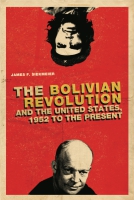




The Bolivian Revolution and the United States, 1952 to the Present
James F. Siekmeier
“James Siekmeier has produced a model of scholarship in this concise analysis of U.S. relations with Bolivia from the Revolution of 1952 to the present. With superb multi-archival research in Bolivia and the United States, Siekmeier demonstrates the multifaceted nature of the bilateral relationship. The United States deployed economic and military aid to contain the Bolivian Revolution, even as Bolivian officials skillfully channeled the aid for their own purposes. Siekmeier’s fascinating discussions of the joint campaign to capture Ernesto ‘Che’ Guevara in 1967 and Bolivia’s decision to expel the Peace Corps in 1971 further reveal the complex nature of U.S. interactions with Bolivia.”
- Description
- Reviews
- Bio
- Table of Contents
- Sample Chapters
- Subjects
“James Siekmeier has produced a model of scholarship in this concise analysis of U.S. relations with Bolivia from the Revolution of 1952 to the present. With superb multi-archival research in Bolivia and the United States, Siekmeier demonstrates the multifaceted nature of the bilateral relationship. The United States deployed economic and military aid to contain the Bolivian Revolution, even as Bolivian officials skillfully channeled the aid for their own purposes. Siekmeier’s fascinating discussions of the joint campaign to capture Ernesto ‘Che’ Guevara in 1967 and Bolivia’s decision to expel the Peace Corps in 1971 further reveal the complex nature of U.S. interactions with Bolivia.”
“This book is a welcome update to the history of Bolivian-U.S. relations. . . . [It] updates scholarship on Bolivian-U.S. relations in three ways. First, it takes advantage of more recent scholarship and declassified documents to examine foreign relations in the 1970s. Second, it does an excellent job of treating the cultural, social, and political transformation of Bolivia between 1952 and the present. Finally, this book gives perhaps the definitive word on the Bolivian Revolution and shows how that seminal event affected relations between the United States and Bolivia through the 1970s.”
“Siekmeier reveals how the Bolivian leadership shrewdly played on Washington’s desire to demonstrate that it could partner successfully with socially progressive governments and manipulated Washington’s anticommunist impulses by warning that the new government’s collapse could create opportunities for unpredictable far-left forces. Siekmeier’s narrative includes an interesting profile of the charming Bolivian diplomat Victor Andrade, who cunningly translated his nation’s politics into terms that Washington officials and pundits could comprehend.”
“The book is a valuable contribution to the historiography on the Bolivian Revolution, US–Bolivian relations, and US relations with Latin America, and should compel a rethinking of several long-held assumptions.”
James F. Siekmeier is Assistant Professor of History at West Virginia University.
Contents
Acknowledgments
Introduction
1 .The Early Years
2. The Bolivian Revolution and the United States
3. The Splintering of the Revolution
4. The Rebellion in the Countryside
5. Bolivia’s Line in the Sand
6. The Revolution’s Long Shadow
Conclusion: Another Round of Tension
Appendix: U.S. Economic Assistance to Bolivia
Bibliography
Index
Introduction
-Explaining a Unique Relationship
Evo Morales, Bolivia’s first indigenous president, called upon the leaders of South America to oppose the U.S.-sponsored Free Trade Area of the Americas (ALCA), blasting it as a “neocolonization project.” He concluded that “for the first time in Latin America the [U.S.] Empire could be defeated.” Morales’s rhetoric tapped into a deep well of resentment against the United States, but overstated the extent of its power. In its relationship with the so-called colossus of the North, Bolivia has managed to exert a degree of control. Bolivia’s ability to get what it wanted from the United States was particularly evident during the Bolivian revolution, arguably the nation’s most significant event in recent times.
Along with the revolutions in Mexico (1910), Cuba (1959), and Nicaragua (1979), the Bolivian revolution marked a distinctive turning point in Bolivian history and stands as one of the great twentieth-century social revolutions in Latin America. It deepened Bolivia’s democracy and made Bolivian society more inclusive. The early 1950s, however, also represented a turning point in U.S. history. After 1945, U.S. interests had multiplied worldwide, and it began to employ new policy techniques to pursue its interests. One of these techniques, economic assistance, had a large impact on the Bolivian revolution and on the trajectory of U.S.-Bolivian relations. Washington’s policy toward Bolivia proved to be a pioneering test case of U.S. attempts at nation-building in the developing world.
This book analyzes U.S.-Bolivian relations from 1952 to 1971. In doing so, it describes and analyzes the formation and implementation of U.S. policy, as well as Bolivia’s response to U.S. policy. This study breaks new ground in three ways. Unlike most other existing studies, it carries the saga of the revolution through the beginning of the 1970s and provides a more up-to-date analysis of the revolution’s political dynamics. It explores the political, social, and cultural transformation of Bolivia during the revolutionary years between 1952 and 1971 and explains how that transformation emanated from a process in which a relatively poor and nonindustrial nation moved in momentous revolutionary directions.
Because Bolivia represents the earliest example of attempted U.S. nation-building in the nonindustrialized world, studying U.S.-Bolivian relations is key to understanding Washington’s relationship with the Third World. This monograph will focus on two key aspects of U.S.-Bolivian relations: the attempts by U.S. leaders to influence Bolivian policy, often without adequate understanding of Bolivian society and culture, and Bolivia’s role as an active player in crafting a series of workable compromises over time with U.S. government officials, which has not been adequately addressed in the literature. Part of the story is how Bolivia reacted to U.S. initiatives. Some scholars, such as Eduardo Gamarra, discuss this side of Bolivia’s relationship with the United States. However, Bolivia also influenced U.S. policy on its own initiative, not reacting to specific U.S. policy decisions. A study of the course of the Bolivian revolution in the context of its relations with the United States shows how a nation can make a revolution work in the midst of a rapidly globalizing world.
Despite Bolivia’s success at moderating Washington’s intentions, U.S. influence forced a partial retreat from the revolution on the part of Bolivia’s powerful Left as early as 1960. Later, in 1964, a coup d’état or golpe de estado by the military removed the revolutionaries from power—a coup in which some observers have implicated the United States. In any case, by the late 1960s, the legacy of U.S. policy was a heightened dislike for the “colossus of the North.” In early 1970s, however, U.S.-Bolivian relations became cordial, and after a rocky period in the late 1970s and early 1980s, remained largely so for over thirty years. In 2006, Bolivian voters elected leftist Evo Morales as president. Morales called for rapid reform, including increasing taxes on the profits of foreign-owned oil and gas companies, and promoting non-cocaine uses of the coca leaf, one of Bolivia’s more common agricultural products. Washington officials disagreed with much of Morales’s program, which led to a deterioration of U.S.-Bolivian relations.
-A Most Important Revolution
Morales’s rise was not the first time in recent Bolivian history a candidate swept into power on a platform of rapid economic, social, and political change. A similar event occurred in 1952. Income inequalities and the unjust treatment of the indigenous majority led many to call for a total reorganization of the power relationships in the country. Indigenous persons, or Indians, had little access to land and few civil rights. The economy was dependent on the export of valuable minerals, in particular, tin; and three large (and all foreign-owned) mining companies controlled the market for minerals in the nation. These conditions were a compelling argument to many for revolution. With the 1952 revolution, Bolivia, despite its isolation and its status as an economic and cultural backwater, became an important part of the worldwide nationalist, democratic, and anticolonialist fervor that was sweeping the developing world in the late 1940s and 1950s.
The revolution was a “total social fact”: it touched all social, cultural, and economic aspects of Bolivian life and changed many of them irrevocably. It was a dramatic social upheaval that resulted in a major reorganization of society that, among other things, empowered the less privileged. The literacy requirements for the franchise were dropped. The franchise was extended to Indians; and although some anti-Indian discrimination has remained to this day, postrevolutionary indigenous members of Bolivian society now have a significant voice. The franchise was also extended to women. The important role that women had played in the revolution radically altered gender relations. Bolivia committed itself to education reform, national integration, and economic development, issues hardly discussed before the revolution. In their pursuit of national integration and economic development, the revolutionaries nationalized the holdings of the three large mining corporations and in 1953 passed a land reform to benefit poor, landless campesinos (farmers with small holdings).
Up through the 1970s, Bolivia’s economy remained largely dependent on the export of minerals. But this dependence did not prevent it from exerting a degree of influence over its relationship with the United States. The U.S. decision to use economic assistance as means of promoting its interests in Bolivia represents an early example of nation-building in the Third World and thus was an important test case for U.S. policy. Once the economic assistance began to flow, Bolivian leaders realized they could use this assistance to assert a degree of agency over their relationship with the United States. Bolivia leaders discovered that they could increase the flow of assistance either by claiming outright that more assistance would prevent the nation from falling to communism or by quietly reaching out to the East bloc.
-The Revolution and a New U.S.-Bolivian Relationship
U.S. economic involvement in Bolivia during the revolution proved to be a new departure for U.S.–Latin American relations. Instead of using force, Washington turned to economic leverage to influence the revolution, in part because of the logistical difficulty of deploying the U.S. military to Bolivia. This restraint is striking for two reasons. First, the use of force had featured prominently in U.S. efforts to channel, constrain, or attempt to overthrow twentieth-century Latin American social revolutions whose leaders called for rapid, thoroughgoing social change, such as in the Mexican, Cuban, and Nicaraguan upheavals. In fact, the Good Neighbor Policy of the 1930s and 1940s, in which the United States formally pledged not to intervene in Latin America militarily, proved to be but a brief pause in the use of U.S. force in the hemisphere. This pause ended when U.S.-backed paramilitary forces overthrew the constitutionally elected government of Guatemala in 1954. Second, the Bolivian revolution, while unusually complex and sharply divided along ideological lines, had a strong radical, even communist, dimension to it, which made it the sort of revolution the United States most opposed.
Why did the United States eschew the use of force? Some interpretations of U.S.-Bolivian relations argue that when the United States realized that it could control the Bolivian revolution through economic means, it knew that force would not be necessary. Some historians have also highlighted the role of Milton Eisenhower, the brother of President Eisenhower, who served as an important adviser to the president on Latin American affairs. According to this school of thought, Milton Eisenhower’s well-publicized tour of South America from May 21, 1953, to June 6, 1953, proved instrumental for the Bolivians. During his Bolivian stop he met the new revolutionary leaders, who apparently convinced him that the revolution was something the United States should support. Other interpretations emphasize the decision of the leadership of the Movimiento Nacionalista Revolucionario (Nationalist Revolutionary Movement, MNR) to take a pro-U.S. stance.
I argue that the policymakers avoided the use of force and opted for economic assistance because they thought that only through such assistance could they maintain a friendly regime in La Paz. Washington leaders feared that if the Bolivian revolutionary government fell, a government further to the left and even more hostile to U.S. interests would come to power. The MNR, which started out as a social movement in the 1940s, coalesced as a political party with a broad coalition, from leftists to conservatives, by the early 1950s. Soon after the triumph of the revolution in 1952, Washington leaders realized that the MNR’s victory was near total, and no other viable option remained to contest the revolutionaries. Although U.S. leaders disliked Bolivia’s nationalist economic policies—the nationalization of the three largest mining companies into a state-run mining company, the Corporación Minera de Bolivia (COMIBOL)—there was little Washington could do about it.
Realizing, however, Washington’s discomfort at the creation of COMIBOL, and desiring U.S. assistance, the MNR (at least its centrist, middle-class strain) worked to help solidify U.S. support for the regime. These efforts help to explain the large distributions of U.S. aid to the nation during the revolution—Bolivia received the highest amount of U.S. government foreign assistance during the 1950s (measured in per capita terms). U.S. policymakers quickly learned that the revolutionaries had a long list of economic needs, and the willingness of Bolivia’s middle-class leadership to accept assistance (on behalf of the entire nation) gave Washington policymakers leverage over Bolivia’s economic policy, which had a significant impact on Bolivian politics—U.S. aid gave the moderates the means to “deliver the goods” to their constituency, which strengthened their hold on the MNR and the country as a whole.
It is important that the MNR featured both centrist and left-wing groups. The centrist element (nearly all if its members were middle class) concentrated on national integration and economic diversification. The Left demanded co-gobierno—that labor should have a say in governance and in managing state-run industries and that labor leaders sit on the boards of state-run corporations—and were pressing hard for agrarian reform. The centrist leaders, however, proved adept at reminding U.S. officials that they shared the same assumptions regarding how Bolivia should develop economically—through private sector investment. The tacit message of the centrist leaders to Washington officials was that if they cut off assistance, the MNR might collapse. Given the atrophy of the cautious moderates and the severe reduction of the size of the military in the early revolutionary period, such a collapse would have very negative ramifications—from the perspective of Washington’s “cold warriors.” Centrist MNR leaders were fully cognizant that Washington feared that if the MNR collapsed, a radical regime hostile to the United States would take power in La Paz. To avoid that, Washington gave and gave generously.
One important middle-class MNR leader, Víctor Andrade Uzquiano, Bolivia’s ambassador to the United States at various times from 1944 to 1962, wanted U.S. aid and the policy changes that would come with it. One prominent scholar of U.S.–Latin American relations has characterized Andrade as a “raconteur.” Indeed, his personal charm proved an important asset in his efforts to secure aid for the Bolivian government. However, I argue here that he was far more than a charming diplomat. He systematically used his abilities as a public speaker and behind-the-scenes negotiator, as well as his extensive knowledge of U.S. culture, to impress upon Washington officials the benefits of bulwarking the centrist elements of the MNR.
By 1960, the middle-class leadership of the party had triumphed over the Left. Certainly U.S. power played a part, but one cannot discount Andrade’s behind-the-scenes efforts. Although his actions reinforced preexisting tendencies among Washington officialdom, he proved to be a trailblazer when it came to Bolivian leaders influencing U.S. policy.
By the end of the 1950s, then, U.S. officials had exerted a significant degree of control over Bolivia’s economic policy and helped to exacerbate already heightened political divisions in the nation. When Bolivia entered a period of rapid inflation, in 1956, the United States, in tandem with the International Monetary Fund (IMF), threatened to cut off economic aid unless the Bolivians rescinded some of their nationalist economic policies, which were designed to control foreign economic activity and promote diversified economic development. Washington’s policy in this regard marked a reversal: an earlier U.S.-sponsored mission, headed by Merwin Bohan in 1941–42, called for Bolivia to take measures to diversify its economy. The austerity plan of 1956–57 marked the first instance in which the IMF applied an austerity/stabilization program in the Third World. Washington leaders firmly believed that if they forced Bolivia to reduce the role of the state in the economy, foreign investment would flow in, thereby stimulating growth, and ultimately, benefiting all Bolivians. The MNR responded to this pressure by reducing its subsidies for government-run mining and oil and gas industries and shelving some, but not all, of its hydroelectric and economic diversification projects.
U.S. pressure by the end of the 1950s, therefore, had prodded Bolivia to open itself up economically. The costs of this opening fell most heavily on the nation’s working class and poor. The Left had feared increasing U.S. intervention in the nation since the beginning of the revolution. It sharply criticized Washington’s role in slowing down the implementation of the goals of the revolution and stepped up its denunciations of the MNR’s centrist wing. The centrists found themselves relying more and more on the Bolivian military to remain in power—a military that had become more powerful as U.S. military assistance (at the behest of the centrists) began to flow in 1958. The dependence of the centrists on the military only fueled the desire of the armed forces to rule the nation directly. The divisions between the left and centrist wings of the MNR paved the way for the military golpe de estado in 1964.
-After the MNR: Changes in U.S.-Bolivian Relations
The military golpe brought fourteen years of democracy in Bolivia to a close, but not before dramatic, even irreversible, changes had occurred. Although Bolivia still remained largely dependent on the export of tin, the revolution had empowered new groups, attempts at economic diversification had taken place, and national integration had proceeded apace. In addition, U.S.-Bolivian ties had changed. The coup in Bolivia capped a process by which the centrists had solidified their power in Bolivia—and the United States had become more assertive in promoting pro-U.S. regimes in the region. By the late 1950s, the United States feared that the rise of nationalism in Latin America would lead to increasing anti-Americanism. Consequently, Washington took measures to attempt to jump-start economic growth in the region, and to dispense more foreign assistance. While U.S. relations with the Paz Estensorro government were fairly close, by the mid-1960s Washington’s ties with military governments in Latin America were tighter than U.S. ties with civilian governments, because Washington saw military governments as firmer bulwarks against the spread of communism. By 1964, with the coming to power of the Bolivian military, then, U.S.-Bolivian relations became more cordial.
But despite closer ties with the United States after 1964, Bolivia made it clear that Washington could not control Bolivia, and relations between the two countries eventually soured. In this context, sharply increased U.S. assistance gave Bolivian leaders more influence over U.S. policy than Andrade had exerted. While the United States did not control the nation in the 1950s, close working relationships between the MNR’s middle-class leaders and Washington political leaders gave the United States at least the appearance of considerable control over Bolivian policy. After 1964, however, Washington leaders frequently agonized over their seemingly fruitless efforts to produce pro-U.S. stability in the South American nation. Bolivian officials understood Washington’s terror regarding a possible collapse of Bolivia, which borders all of the major nations of South America’s southern cone. Showing considerable political skill, Bolivian military leaders convinced Washington that economic and military aid was necessary to keep their nation from disintegrating. Such assistance flowed in record amounts in the 1960s as the Kennedy and Johnson administrations funneled military assistance to friendly Third World militaries in order to make them more effective counterinsurgency fighters. The military assistance to Bolivia—including funds for civic action programs and an internal security program directed at the Bolivian people—closely served Bolivian military interests.
By the 1969–71 period, Bolivia’s connections with the United States swiftly and dramatically changed. Rising anti-American sentiment in Bolivia provoked crises that sent relations between the two nations to their lowest point in a generation or more. A lack of U.S. understanding of Bolivia’s society and culture proved to be the crux of the problem.
Bolivia forced changes in U.S. policy in the late 1960s and early 1970s by nationalizing the holdings of a key U.S. company, Gulf Oil, and by expelling the U.S. Peace Corps. Expropriation was not a new problem in U.S.-Bolivian relations—Bolivia’s expropriation of Standard Oil in 1937 roiled relations with Washington. However, the expulsion of a relatively new player in the foreign policy arena, the Peace Corps, proved to be particularly interesting. This episode shows that U.S. officials did not understand Bolivian society and culture.
Bolivians tended to perceive the United States as generally insensitive toward Bolivian culture and saw the Peace Corps as a symbol of that insensitivity. Many Bolivians believed that the Peace Corps workers constituted an actual danger to Bolivian culture. For example, Peace Corps volunteers helped Bolivian government officials in (quietly) distributing various forms of birth control and instructed the recipients on how to use it. U.S. contraceptive policy combined in a volatile mix with rising anti-Yankee sentiment to produce the 1971 expulsion of the U.S. Peace Corps from the nation. Washington was unprepared for this assertive Bolivian reaction to U.S. policy. Popular protest in Bolivia was fueled by a fear that U.S. personnel were sterilizing Indian women (there was no solid evidence of this, however). This incident illustrates how rising anti-U.S. sentiment can affect the nexus between the United States and other nations—indeed, anti-Americanism was a staple of U.S. relations with Latin America in these years. The end of the Peace Corps experiment in Bolivia also reveals that nations with very different cultures often have a hard time spanning their cultural differences. U.S. officials had little idea of the value Bolivians attached to their children; for many Bolivians, offspring are their only form of wealth. In addition, children are the only conveyors of history and culture in indigenous cultures with strong oral traditions.
The right-wing dictatorship of Hugo Banzer-Suarez (1971–78) represents a turning point in recent Bolivian history. First, Banzer slammed the brakes on the political and social reforms that flowed from the revolution. (Economic diversification proceeded apace, in part because of investments in infrastructure made since 1952.) Second, after 1971, relations between the United States and Bolivia warmed noticeably. In part because of its continuing need for foreign investment funds to ensure its economic diversification, Bolivia, most notably in the 1980s and 1990s, increasingly accepted the U.S. argument that more foreign (most notably U.S.) investment was necessary for continued economic growth.
Studying the history of U.S.-Bolivian relations helps us understand a key aspect of U.S.–Latin American relations. All too often observers conclude that the United States dictates the terms of its relationships with the various countries of Latin America. However, it is important to understand that the Latin Americans also play an active role in the making of the inter-American relationship. Unquestionably, the United States used its considerable economic clout to force changes in Bolivia’s economic policy. Nonetheless, Bolivia did not unquestioningly accept U.S. policy actions. In some instances, Bolivia managed to get U.S. officials to produce policy according to Bolivia’s calculation of its interests. Because Bolivia has been a dependent nation for so long, the Bolivians have learned the ins and outs of being on the receiving end of a dependency relationship. They have used this knowledge to influence U.S. policy. In general, because the United States does not have a long history of dependency on a foreign power, Washington was not fully cognizant of how the dependent government in a patron-client relationship can subtly manipulate its more powerful benefactor. The U.S. lack of understanding in this regard, then, provided an opportunity for Bolivia to slant U.S.-Bolivian relations in a way favorable to Bolivia.
Also of Interest



Mailing List
Subscribe to our mailing list and be notified about new titles, journals and catalogs.