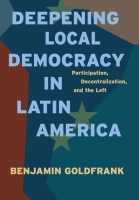




Deepening Local Democracy in Latin America
Participation, Decentralization, and the Left
Benjamin Goldfrank
Deepening Local Democracy in Latin America
Participation, Decentralization, and the Left
Benjamin Goldfrank
“Benjamin Goldfrank’s proposal to compare various leftist-sponsored experiments in collective participation in local decision-making represents a valuable contribution. . . . This book is an example of exceptional scholarship. It is well focused, explores the theoretical and practical implications of its findings and draws on extensive fieldwork and considerable secondary literature.”
- Description
- Reviews
- Bio
- Table of Contents
- Sample Chapters
- Subjects
“Benjamin Goldfrank’s proposal to compare various leftist-sponsored experiments in collective participation in local decision-making represents a valuable contribution. . . . This book is an example of exceptional scholarship. It is well focused, explores the theoretical and practical implications of its findings and draws on extensive fieldwork and considerable secondary literature.”
“This is a superb book, built on in-depth comparisons of local experiments with participatory processes in Venezuela, Uruguay, and Brazil, mainly in the 1990s. . . . Benjamin Goldfrank’s book should become a key reference on the deepening of local democracy in Latin America and beyond. . . .
“Beyond elaborating a compelling, well-substantiated, and substantively significant argument, this book helps to extend a literature that deserves continued attention. Goldfrank rightly recognizes the impressive works on participatory democracy in these cases individually, as well as comparative subnational work. . . .
“ . . . This book delivers on all counts. It will be referenced for its arguments, but it also deserves to be read as a book. It is a model for careful empirical work and theory building on questions of lasting and growing importance.”
“An incisive and thorough analysis of the strengths and weaknesses of experiences of participatory democracy in contemporary Latin America.”
“Before leftist parties began electing presidents in Latin America at the turn of the century, they were electing mayors and experimenting with participatory forms of democracy at the municipal level. In this outstanding book, Benjamin Goldfrank explores the most important of these participatory experiments in Brazil, Uruguay, and Venezuela. Drawing from intensive field research and original public opinion surveys, Goldfrank analyzes why some participatory programs are more effective than others, and he carefully explains how these different outcomes relate to the institutional features of decentralization policies and the nature of partisan opposition. For anyone who seeks to understand the opportunities for—and the constraints on—the ‘deepening’ of democracy in contemporary Latin America, this insightful book is essential reading.”
“This volume is a well-researched comparative study of the empowerment of local citizens in the 1990s in three South American cities: Caracas, Venezuela; Montevideo, Uruguay; and Porto Alegre, Brazil.”
“Goldfrank shows how participatory democracy's biggest challenges, including social inequality, bureaucratic inefficiency, and political rivalry, can be surmounted.”
“Goldfrank has constructed an excellent and timely empirically grounded study into the emergence in the late 1980s and early 1990s of Latin American participatory innovations which resulted from attempts to deepen democracy by decentralising the vote for city mayors to the electorate. . . .
. . . Deepening Local Democracy in Latin America provides an insight into the development of the left as a result of decentralisation and participation, by providing a detailed, comparative account of how they were opposed, badly designed or successfully supported by a range of government parties. Furthermore, the extent to which the quality of democracy varied across the three cases is explored through the degrees to which participatory innovations were decentralised, the degree of opposition they had, and whether they had an open, regulated or restrictive design. In its empirical approach and theoretical underwriting, the work succeeds in providing a convincing insight into the various issues facing citizen participation in Latin America. . . . As Goldfrank applies his understanding of participation in Latin America more recently in the conclusion, his work stands as an excellent statement on deepening democracy in Latin America, as well as the obstacles this process can encounter.”
“This is an impressive book and a major contribution to the debates about the direction of democracy and of the Left in Latin America.”
Benjamin Goldfrank is Assistant Professor at the Whitehead School of Diplomacy and International Relations at Seton Hall University.
Contents
List of Figures
List of Tables
Acknowledgments
List of Acronyms
Overview
1. Democracy, Participation, and Decentralization
2. A Tale of Three Cities
3. Caracas: Scarce Resources, Fierce Opposition, and Restrictive Design
4. Montevideo: From Rousing to Regulating Participation
5. Porto Alegre: Making Participatory Democracy Work
6. Stronger Citizens, Stronger State?
Conclusion: The Diffusion of Participatory Democracy and the Rise of the Left
Bibliography
Index
Overview
Ever since Latin America began a phase of democratic renewal toward the end of the twentieth century, pessimistic voices about the quality of the new democracies have dominated. Political leaders, citizens, and scholars alike lament the clientelism, corruption, and ineffective and unaccountable government that, among other ills, have plagued the region. At the same time that national democratic regimes are criticized as “shallow,” however, there is growing optimism about the potential of experiments in participatory government to deepen democracy at the local level. Such experiments became increasingly common in the 1990s, as voters in an ever-larger number of cities chose political parties on the Left that advocated giving citizens a more direct role in deciding public policy. By the year 2000, Left-leaning mayors had governed dozens of important cities, including the capitals of Brazil, Colombia, El Salvador, Mexico, Peru, Uruguay, and Venezuela. The new officeholders implemented a wide array of novel forms of citizen participation, which met with varying degrees of success. Many of them proved unsustainable, but a few endured and even went on to become models of how to deepen democracy for activists, scholars, and international development organizations.
This book examines the Left’s participatory innovations, asking why only some experiments succeeded in enhancing the quality of local democracy. I compare three initially similar participation programs that eventually yielded widely different results. Heading each experiment was a party that had won the mayor’s seat for the first time with the explicit promise of participatory reforms in order to deepen democracy: the Workers’ Party (Partido dos Trabalhadores, PT) in Porto Alegre, Brazil (1989–2004); the Broad Front (Frente Amplio, FA) in Montevideo, Uruguay (1990–present); and the Radical Cause (La Causa Radical, LCR) in Libertador, the largest municipality of the metropolitan area of Caracas, Venezuela (1993–95). The core of their reform efforts focused on creating new institutions to give citizens influence over government spending, whereas prior administrations made budget decisions behind closed doors.
How successful were the new institutions in actually attracting and sustaining a large number of citizen participants and in stimulating new civic associations? What were the effects of the participatory mechanisms on improving local government transparency and responsiveness? The answers to these questions varied in each case, as will be shown in more detail in the following chapters. In brief, Porto Alegre’s participatory budget process met each of these goals, becoming an international reference. In Montevideo, the participation program was less capable of sustaining a large number of participants or stimulating civic associations, but government transparency and responsiveness improved considerably, earning the program widespread public approval. Finally, the experiment in Caracas essentially failed. These outcomes lead to the central puzzle examined in this book: why do participatory experiments aid in deepening democracy in some cities but not in others?
The recent boom of studies on participatory local democracy in Latin America has yet to produce compelling cross-national comparative analyses to provide an answer. Much of the literature on participation programs is limited to individual success stories that ignore the politics of participation, that is, the motivations and strategies of the key actors advocating and resisting participatory institutions. And the new scholarly attention to the region’s contemporary wave of presidential victories for the Left has all but ignored that the tide shifted locally first. Before addressing the central puzzle, then, we should examine two prior questions: why parties on the Left rose to local power in so many major cities in the 1980s and 1990s and why they chose to emphasize participatory democracy.
Three roughly simultaneous trends abetted the Left’s local rise and participatory turn. While political decentralization provided Left parties with the opportunity to run for local office, urban economic crises gave citizens reason to consider voting for alternatives to the populist or centrist parties holding national power, and the Left’s own ideological transformation—with a new commitment to democracy—made it more appealing to the electorate. Until the late 1970s, when democratic transitions began in Latin America, many countries were politically centralized; they had either suspended or never held elections for all local government officials. Since that time, nearly every country in the region has implemented decentralization reforms (Campbell 2003, 3–4), including the introduction (or reintroduction) of direct elections for mayors in major cities. For example, Peru, Uruguay, and Brazil reintroduced elections for mayors of all cities in 1980, 1984, and 1985, respectively, while Colombia in 1988 and Venezuela in 1989 allowed voters to directly elect mayors (and governors, in Venezuela) for the first time in history. By 2000, Mexico, Chile, and Argentina had instituted unprecedented mayoral elections in their national capitals.
Region-wide moves towards democratic elections, in most cases both nationally and locally, overlapped with the combustible combination of rapid urbanization and impoverishment of the so-called lost decade of the 1980s and continuing economic stagnation of the next decade. The eruption of urban crises can be traced to the collapse of the import-substitution industrialization (ISI) model under the weight of the debt crisis and its replacement with a neoliberal export-oriented model. During the peak performance years of ISI, from roughly the late 1940s to the late 1960s, the major cities grew at tremendous rates (Portes and Roberts 2005, 44), making Latin America the world region with the most urbanized population by the end of the period. By the early 1990s, it led the world at a rate of 71 percent urban (Dillinger 1994, 5), with nearly a third of the population living in cities with over a million inhabitants (Angotti 1996, 13). With urban growth came increased poverty, even before the abandonment of ISI. As the rural poor moved to the cities, lured by subsidies for food and utilities and labor rights for unionized workers (Eckstein 2006, 10, 35), shantytowns mushroomed in the peripheral areas of major cities, and mansions in many formerly wealthy neighborhoods in city centers became overcrowded tenements.
Whatever problems the region’s cities faced in the ISI era paled in comparison to those of the neoliberal era inaugurated in the 1980s with the debt crisis and the worst recession since the Great Depression. During that decade, while some rural areas benefited, the major cities saw falling incomes, rising inflation, unemployment, and inequality, and the reduction or elimination of subsidies and welfare programs (Villa and Rodríguez 1996; Burki and Edwards 1996; Portes and Roberts 2005). The cutbacks of food and utilities subsidies were often accompanied by currency devaluations, making cost of living increases in urban areas even more acute (Eckstein 2006, 27). Throughout the region, urban poverty grew in the eighties and nineties (Burki and Edwards 1996, 18; Rodriguez and Winchester 1996, 78–79), and by 1986 55 percent of the poor already lived in urban areas (Reilly 1995, 5). In Brazil, over two-thirds of the poor live in urban areas, and nearly one-third of the poor and one-third of all Brazilians live in the nine metropolitan regions with over a million inhabitants (Valladares and Coelho 1995). Urban service provision, including water, sanitation, solid waste collection, education, health care, and transportation, also suffered (Dillinger 1994, 5; McCarney 1996, 7), leading scholars to speak of Latin America’s “urban crisis” during the 1980s (Castells, Belil, and Borja 1989, 32–36).
One response to the decline of urban living conditions was popular pressure, in both organized and unorganized forms: popular movement organizations for urban reform and more or less spontaneous riots against government austerity programs, perhaps most famously the “Caracazo” in Venezuela in 1989 (see, inter alia, Eckstein 1989; Escobar and Alvarez 1992; Walton 1989; López Maya 1999a). Voting Left parties and/or mayors into office has been another response, especially in cities with relatively high union membership, relatively large middle-class populations, and organized popular movements. The urban lower and middle classes were hit hardest by the urban crisis, and in several of the largest, most industrialized cities, they coalesced in support of new Left parties, at least temporarily. These constituencies have shared interests in defending a stronger role for the state, which had provided employment as well as subsidies and services, and in finding a more democratic interlocutor than had been available under the previous authoritarian and/or clientelist local governments.
For frustrated urban voters in the 1980s and 1990s, new or “renovated” parties on the Left offered a potential substitute as they renounced violence, embraced democracy, and proposed more collaborative state-society relations. During the preceding years of brutal military dictatorships and mostly failed guerrilla warfare, major portions of the Latin American Left underwent a significant ideological transformation. The chief element was the change from seeing democracy as bourgeois formalism or, at best, as an instrument to achieve power, to adopting democracy as a fundamental value and to deepening democracy as a permanent goal. Deepening democracy became the “master frame” for both social movements and political parties on the Left and suggested “both procedural and substantive connotations, ranging from popular participation in the policymaking process to redistributive socioeconomic reforms” (Roberts 1998, 3). Parallel to its valorization of democracy, the renovated Left abandoned the “fetishism of armed struggle” (Robinson 1992, 5) to focus on elections and nonviolent social movement organizing and protest. The Workers’ Party, the Broad Front, and the Radical Cause have all been seen as representative of this transformation of the Left. Indeed, several analysts have lumped the three parties together as embodiments of what they see as a positive trend: Angell (1996, 11–18) labels them the social democratic Left, Castañeda (1994, 136–55, 171–74) calls them the reformist Left, and Robinson (1992) sees them—as members of the São Paulo Forum —as part of a new Left.
Importantly, while this new Left retained its classic positions such as anti-imperialism, redistribution, social justice, and a strong, interventionist state, the conceptualization of the state changed. The notion of an all-knowing and powerful centralized state gave way to calls for a permeable, transparent, decentralized state that would cogovern with civil society. This reconceptualization of the state, based partly on a rejection of the Soviet model, was connected to the revalorization of democracy. The radical, socialist, or deep democracy that the new Left parties aspired to signified consolidating and moving beyond periodic elections and individual liberties to the creation of more regular mechanisms by which citizens could collectively and directly influence state policy and monitor state performance. Decentralization would be a stepping-stone on the path to opening the state to citizen control. Formulating the public interest within the new participatory mechanisms would leave the state “less subordinated to the private appropriation of its resources” and result in public policy oriented toward generating social equality (Dagnino, Olvera, and Panfichi 2006, 48).
These ideological changes involved reconceiving other past practices and positions of the Left that prevented it from appealing to a broader electorate. Several parties moved away from Leninist, top-down, vanguardist organizations and toward creating democratic processes for selecting candidates and deciding party policy. Many Left leaders also vowed respect for the autonomy of social movements, which militants had previously often viewed as party vehicles. The focus on the working class as the sole bearers of “the revolution” has also been redirected. While organized labor remains a, if not the, central constituency of the democratic Left, a variety of social movements advancing claims based on issues of gender and racial equality, and consumption, services, and the environment have also gained significance. Likewise, the new Left parties began speaking less of the working class and more of working classes in the plural. Given the small size of unionized labor in Latin America, organizing along strict class lines has always produced relatively small voting blocs for Left parties, especially where facing competition from populists. In order to build and consolidate long-term power, the renovated Left realized it had to move beyond the core of union activists to gain the support of middle- and lower-class voters so as to create a broad, multiclass majority. The Left’s proposed participatory mechanisms could contribute in this regard by helping to aggregate the diverse interests of the urban popular sector and to develop a common identity based on active citizenship. In other words, though party leaders never stated such aims publicly, some hoped that their participatory endeavors would help attract new adherents and win future elections.
It is perhaps not surprising, given the confluence of novel local elections, urban crises, and progressive ideological transformations, that the new democratic Left swept into office in many of Latin America’s major cities starting in the 1980s. More interesting are the innovative participatory institutions that Left parties subsequently implemented and their differing effects on the quality of local democracy. When the PT, the FA, and LCR won power in Porto Alegre, Montevideo, and Caracas, each promised to deepen democracy through new channels of citizen participation. Their reforms bore a striking resemblance. Specifically, there was a focus on holding public assemblies to encourage debate over community priorities for investments in public works projects and social programs, investments that represented between 10 and 20 percent of the budget in all three cities. Each administration included measures to decentralize administrative functions as well. To facilitate widespread citizen involvement, each city was divided into a roughly equal number of districts: sixteen in Porto Alegre, eighteen in Montevideo, and nineteen in Caracas. The new institutions eventually included both open public assemblies involving direct volunteer participation and also smaller district-level forums for which participants were selected through some established procedure as representatives.
In the first year, hundreds and sometimes thousands of citizens in each city showed up to identify and prioritize projects for inclusion in the budget. However, within a few years, participation rates in Porto Alegre’s participatory budget process had jumped, foretelling its future success, while the number of participants had stagnated in Montevideo and declined drastically in Caracas. Existing studies cannot explain why only Porto Alegre’s participation program achieved each of the Left’s goals of promoting an active citizenry, opening the local administration to public scrutiny, and responding effectively to a backlog of demands for government services, while initially similar programs fell short in Montevideo and especially Caracas.
The main argument I advance in this book is that two factors best explain these contrasting outcomes: the degree of national decentralization of authority and resources to municipal government and the level of institutionalization of local opposition parties. These factors strongly shaped the ability of the progressive incumbents to design meaningful participatory institutions that could attract sustained citizen involvement. Only in Porto Alegre and Montevideo did the city governments have this capacity, because only in Brazil and Uruguay had the central state devolved sufficient jurisdiction and resources to the local level. The differing levels of institutionalization of local opposition parties had two important consequences for the design of the new participation programs. One was that while in Montevideo and Caracas the so-called traditional parties that had dominated politics for decades and developed strong organizations and societal roots had the motivation and the resources to resist the FA’s and LCR’s participatory channels, in Porto Alegre the PT faced feeble opposition from divided, weakly institutionalized rival parties that had few resources to act against the participation program or to try to shape its design to their advantage. The other consequence was that community organizations in Caracas and Montevideo were linked to either the opposition or incumbent parties, and they did not push for power in the new participation programs. In Porto Alegre, however, community organizations did not have strong party loyalties. Although many such groups engaged in clientelist relations, most were relatively autonomous and even mercenary, cultivating and breaking ties with different parties and constantly pressing for material improvements and for greater leverage in municipal politics. Porto Alegre’s community organizations thus played a major role in shaping the ultimate design of the PT’s participation program.
Thus, while the participation programs originally looked quite similar and the PT, FA, and LCR shared the same goals, the eventual design of the new institutions as well as the effects on the quality of democracy differed dramatically. In Caracas, nationally centralized authority and strongly institutionalized local opposition parties led to a restrictive design, in which the range of issues debated was narrow, the participants lacked decision-making power, and the structure privileged district boards controlled by political parties over the arenas for volunteer participation. This restrictive design contributed to a vicious cycle, in which the citizens’ lack of influence over important issues and the continued dominance of party representatives discouraged participation as well as formation of new civic associations. In turn, the limited jurisdictional scope of the local government, paucity of municipal funds, and sabotage by the opposition impeded the government’s ability to respond capably to citizen demands, thereby diminishing the incentive to participate. Overall, democracy remained shallow in Caracas.
Montevideo’s pattern of significantly decentralized authority in the context of a strongly institutionalized opposition yielded a regulated design. I give it that label because, after beginning with a more informal structure without designated seats for political parties, the FA was essentially forced by the opposition to regulate participation. As in Caracas, seats on district boards were set aside for party members, some to represent the incumbents and others reserved for the opposition. While the range of issues was fairly broad, the role of citizens in decision making was limited. With this regulated design, participants saw little connection between their attendance at meetings and actual policy outcomes. Without a direct link between participation and the advances in service provision that were realized, residents had little incentive to become involved in the program, either individually or collectively. Uruguay’s high degree of national decentralization thus allowed for the FA’s partial success in Montevideo. Establishing effective local government represents a clear improvement over the past, even if incomplete.
Last, the weakly institutionalized parties in Porto Alegre, combined with Brazil’s high degree of decentralization, allowed the development of an open design, which let participants engage in genuine deliberation, debating and voting on the most important city services and the most needed public works projects in their neighborhoods. Their votes determine how the government allocates its investment resources and in which neighborhoods. Their votes thus represent the exercise of real political authority. The range of issues open to debate was also widest, and in contrast to Caracas and Montevideo, there was no formal arena for party representatives. The open design of Porto Alegre’s participatory budgeting produced a virtuous cycle of deepening democracy. Participants saw the extension of the services they had prioritized, participated again, and revitalized old civic associations or formed new ones. Further, the participants demanded greater transparency and more decision-making power, supported higher tax rates, obtained greater service provision, and intensified their involvement, thus continuing the cycle.
Not surprisingly, the comparative study of Caracas, Montevideo, and Porto Alegre suggests that designing meaningful local participatory institutions is facilitated where decentralization brings both resources and responsibilities to local government. But one of the key discoveries of this study is the potential for strongly institutionalized parties to undermine the democracy-enhancing benefits of decentralization. This study also may provide insight into the rise of the Left in the region, the spread of participatory experiments under the Left’s national governments, and the international diffusion of participatory budgeting under governments of varying ideological tendencies. Significantly, the participatory experiences in all three cities eventually affected the national politics of Brazil, Uruguay, and Venezuela, showing that even those institutions that do not entirely succeed can have important repercussions. The FA’s only moderately successful program in Montevideo helped the party not only to hold on to local power but ultimately to win the presidency under its first mayor, Tabaré Vázquez, and to spread participation programs throughout Uruguay. And LCR’s mostly failed program in Caracas would serve later as a reference for the Bolivarian Revolution of President Hugo Chávez, as its mayor, Aristóbulo Istúriz, played prominent roles in the Constituent Assembly and the Chávez administration. Under Chávez, Venezuela is now host to the most extensive and controversial experiment in participatory democracy in Latin America, if not the world. Of course, Porto Alegre, the PT, and participatory budgeting have garnered the most attention, even though the PT eventually lost the mayor’s office. Porto Alegre became host to the World Social Forum, the gathering of anti-neoliberal globalization and pro–participatory democracy activists on the Left. The PT’s first mayor, Olívio Dutra, went on to become governor of the state of Rio Grande do Sul (of which Porto Alegre is the capital), where he implemented participatory budgeting as well; he then served as minister of cities for President Luiz Inácio Lula da Silva. And participatory budgeting in some form or another has been adopted by hundreds of Brazilian cities and over two thousand cities in Latin America as a whole (Goldfrank 2007, 91), as well as in more than sixteen thousand cities worldwide (Sintomer, Herzberg, and Röcke 2008, 164). This book should help understand why.
In chapter 1 I outline the theoretical debates over whether participation and decentralization help or hurt democracy and presents hypotheses about the likelihood of success of participatory experiments. I suggest that while scholars of development tend to focus on the state bureaucracy, sociologists on civil society, and political scientists on the mayor and party in power, opposition parties have largely been ignored. Furthermore, scholars have shown little concern for providing a complete explanation that integrates political actors’ intentions, local and national sociopolitical conditions, and the design and development of new institutions. In chapter 2 I briefly describe the research design, rationale for selecting cases, and data-collection methods before demonstrating substantial similarities among the three cases with regard to the major explanatory elements emphasized by previous research: the ideology and constituency of the incumbent party, the extent of prior civil society organization, the quality of the municipal bureaucracy, and the city’s size and level of development. I also lay out the crucial differences across the cases in terms of national decentralization and local opposition institutionalization.
In chapters 3, 4, and 5 I analyze Caracas, Montevideo, and Porto Alegre individually. I take a dynamic perspective, explaining how the design of the participatory programs evolved as community organizations and opposition parties responded to the incumbents’ initial plans, and, in turn, how the resulting changes in the institutional design affected the level of participation. After examining why some experiments succeed in attracting and sustaining participants while others fail, I turn to the last link in the causal chain in chapter 6, comparing the effects of the experiments on broader citizen activism and on state transparency and responsiveness. Finally, in the conclusion, I analyze whether the argument for the three principal cases helps explain the success and failure of participatory budgeting as it spreads across Latin America and becomes a more mainstream policy tool, and I speculate about the future of participatory democracy in the region with the rise of the Left to national power in several countries.
Also of Interest
Mailing List
Subscribe to our mailing list and be notified about new titles, journals and catalogs.