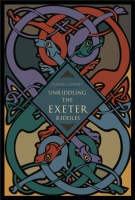




Unriddling the Exeter Riddles
Patrick J. Murphy
“[Unriddling the Exeter Riddles] is a stimulating and engaging study that is sure to be invaluable in the study of the enigmatic Exeter riddles. It provides both an excellent foundation for undergraduates (and non-specialists in the Old English) to study these murky texts, and an important (if rousing) contribution to scholarly analysis of them in situating them within the riddling tradition. Murphy’s unriddling of the Exeter riddles sheds some light on these dark texts by unraveling the intricate relationship between their form and meaning and will make a significant impact on how scholars and students alike understand their form and genre.”
- Description
- Reviews
- Bio
- Table of Contents
- Sample Chapters
- Subjects
“[Unriddling the Exeter Riddles] is a stimulating and engaging study that is sure to be invaluable in the study of the enigmatic Exeter riddles. It provides both an excellent foundation for undergraduates (and non-specialists in the Old English) to study these murky texts, and an important (if rousing) contribution to scholarly analysis of them in situating them within the riddling tradition. Murphy’s unriddling of the Exeter riddles sheds some light on these dark texts by unraveling the intricate relationship between their form and meaning and will make a significant impact on how scholars and students alike understand their form and genre.”
“[Murphy] successfully integrates folklore scholarship on contemporary riddles with literary and medievalist scholarship on early Medieval riddling to show that the Exeter riddles grew out of a vibrant tradition and were not created in isolation. Folklorists will find value in the way the book highlights the constant interplay between elite, popular, and vernacular culture. Most importantly, this book demonstrates why intertextual analysis of such texts is essential to understanding their surface answers and deeper cultural meaning.”
“Unriddling the Exeter Riddles is a dense and provocative read, saturated with ingenuity, offering new solutions for many riddles considered to have been properly ‘solved.’ . . . The book’s greatest contribution (and proof of its author’s profound knowledge of riddling in general) is its comparative strategy, which urges us to look to other riddles from different eras and cultures. Seeing how medieval folk riddles with similar subject matter have been transformed by these writeras into literate and nuanced statements is enlightening and much needed.”
“This is a dazzling book, sparkling with easy erudition and wit, and very well written. Patrick Murphy offers a fresh approach to a much-studied group of poems in Old English literature. Taking issue with the view that the riddles come from an entirely bookish tradition, Unriddling the Exeter Riddles demonstrates that these poems, though deeply imbued with monastic learning, also draw richly upon other traditions, most significantly those of popular oral culture. It will likely be seen as the most significant publication on the Old English riddles since Craig Williamson’s edition of 1977.”
“This is a wonderful new study of the Exeter Book riddles, packed full of insight. Its greatest strength lies in its innovative readings, which draw on an impressive knowledge of the range of analogues and insist that these riddles should be read both in the long folk tradition of oral riddling and through the literary tradition that was available in late Anglo-Saxon England. The whole study is presented in a lively style, illustrated by useful translations of the Old English that go some way to match the appeal of the subject matter.”
“Most studies of the Exeter Book riddles treat them singly in order to offer a particular solution, playing the riddler’s game in modern terms. In one of the few studies since Williamson’s watershed edition that addresses this group of riddles as a whole, Patrick J. Murphy brings a new theory to bear. Positioning his study in response to both popular and learned riddling, he argues that the coherence of many of the Old English riddles is shaped by extended implicit metaphors; he calls this shaping ‘focus.’ After providing a lively summary of previous practice in his introduction, and laying the groundwork there for his new theory, in chapter 1, he explains the theory in lucid detail, with much attention to oral forms of riddling. He uses the focus idea in chapter 2 to propose a new metonymic meaning for the ‘dark swarms’ of Riddle 57, and in chapter 3 he shows how his method enriches even those riddle solutions that scholars generally agree about. Chapter 4 argues that the underlying focus of Riddle 17 (about bees) is a well-known biblical story, and chapter 5 addresses the ‘sex riddles,’ making the point that focus is not necessarily fixed; a riddle may drift in and out of its focus. Chapter 6 demonstrates this by peeling the layers off Riddle 25, in which a fluidly gendered onion takes its ‘caustic revenge.’
“The author has clearly enjoyed following the dark tracks of these riddles (with far more complexity than suggested above), as will readers both new and old in the study of enigmatics and Old English poetry. The approach offered here, specific to the construction of the Exeter Book riddles, makes the task of unriddling them more engaging and intriguing than ever.”
Patrick J. Murphy is Assistant Professor of English at Miami University.
Contents
Acknowledgments
Introduction
1. Unriddling the Riddles
2. A Literal Reading of Riddle 57
3. Transformation and Textual Culture
4. Riddle 17 as Samson’s Lion
5. Innuendo and Oral Tradition
6. The Roots of Riddle 25
Afterword
Bibliography
Index
Introduction
This book is about the ninety-odd literary riddles, all but one composed in Old English, included in Exeter, Cathedral Library MS. 3501 (“the Exeter Book”), a neatly written poetic miscellany that has been dated by its most recent editor to circa AD 965–975.1 The dialect is predominantly West Saxon, and the manuscript may have been produced in a West Saxon center of learning such as Crediton, Glastonbury, or possibly Exeter itself.2 The book has resided in Exeter at least from the death in 1072 of Leofric, archbishop of Exeter, in whose list of donations to the cathedral library we find mentioned “an mycel Englisc boc be gehwilcum þingum on leoðwisan geworht” (one large English book on various subjects composed in verse).3 The Exeter riddles take up more than one section of this manuscript. Riddles 1–29, 30a, and 31–59 are found on folios 101r–115r, while Riddles 61–95 are found on 124v–130v, the final section of the book. In between these two groups of riddles are a number of miscellaneous texts, including the poems known as The Wife’s Lament, Judgment Day I, Resignation, The Descent into Hell, Alms-Giving, Pharaoh, The Lord’s Prayer I, and Homiletic Fragment II, The Husband’s Message, and The Ruin, as well as Riddles 30b and 60. Riddles 30a and 30b are variations of the same basic text, with a few notable differences in diction and morphology.4
As the titles of Riddle 30a and Riddle 30b suggest, the numbering of the Exeter riddles can be a bit confusing. In various editions and translations, several systems have been employed. Throughout this study I use the numbers of Krapp and Dobbie’s ASPR edition of the Exeter Book simply for clarity, since most recent criticism employs them.5 For the most part, however, I take my texts from Craig Williamson’s excellent 1977 edition of the riddles, which numbers the collection differently.6 Objections could be raised against any numbering system, not only because of damage to the Exeter Book and ambiguous textual divisions within the manuscript, but also because questions remain as to which of the Exeter texts are properly to be called “riddles.” Poems such as The Husband’s Message, The Wife’s Lament, and Wulf and Eadwacer have sometimes been interpreted as riddles, while the generic status of Riddle 60 has at times been called into question.7 Whatever the exact number of riddles, it was probably quite close to a hundred, and many have speculated that the compiler of the Exeter Book (or the compiler of its exemplar) would have been aiming at something near a so-called century of riddles, a hundred being the traditional number of enigmas in Latin collections.8
The medieval paradigm for a century of literary riddles was established by the collection of Symphosius, an author who may have written his Latin enigmas sometime between the late fourth and early sixth centuries AD. Although we know virtually nothing about Symphosius’s personal history, his riddles were a popular text in Anglo-Saxon England from at least the late seventh century on.9 Even more influential were the hundred riddles written by the English scholar Aldhelm (c. 639–709), whose Enigmata became a favorite text both in Anglo-Saxon England and on the Continent.10 Two of the Exeter riddles (numbers 35 and 40) are translations from Aldhelm, while others show his influence.11 A contemporary of Aldhelm, Tatwine (d. 734), composed a group of forty Latin enigmas, while another eighth-century author known as Eusebius seems to have sought to “complete” Tatwine’s collection by writing sixty more to form the century.12 Boniface (c. 675–754) composed twenty enigmas on Christian virtues and vices (ten on each).13 Other early medieval collections of Latin riddles are suspected to have their origin in Anglo-Saxon England, including the sixty-three “Bern Riddles” (also referred to as the Enigmata Tullii) and the “Lorsch Riddles,” a collection of twelve riddles preserved in a single surviving manuscript.14 Latin riddles also show up gathered together with catechism-type puzzlers and proverbs in collections such as the Flores, once attributed to Bede, and the Disputatio Pippini, a riddlic dialogue of questions and answers framed as a conversation between Alcuin (735–804) and Charlemagne’s son Pippin.15 Stray riddles are also found here and there in the manuscript record, including a text known as the Leiden Riddle (like Riddle 35, an Old English version of Aldhelm’s Lorica “mail shirt” enigma, but written in an early Northumbrian dialect) and at least one Old English prose riddle.16 Yet despite such a robust tradition of literary riddling in Anglo-Saxon England, the Exeter riddles are unique as an early medieval riddle collection in the vernacular.
In addition to this strong textual tradition, it is a safe guess that the Anglo-Saxons shared riddles by word of mouth. As Michael Lapidge notes, “We may be sure that popular, oral riddles were in circulation in Aldhelm’s England, as they are in circulation everywhere in the world.”17 Indeed, it has often been remarked that riddling is a profoundly ancient, widespread practice and that its conventional motifs are amazingly durable in oral transmission, with numerous identical riddling conceits found in collected materials spanning centuries and crossing multiple linguistic boundaries.18 In fact, the riddle’s ubiquity and concision have made it a favorite study of folklorists, who have devoted considerable energy to analyzing its structure and social contexts, as well as to gathering vast collections of folk riddles for comparative study.19 Collections such as Archer Taylor’s monumental English Riddles from Oral Tradition draw on both the fieldwork of folklorists as well as early riddle books with roots in oral tradition to demonstrate the richness of the riddling genre.20 Today, however, the conventional metaphors, common motifs, and patterns of traditional riddling are unknown to most English speakers, who are more likely to be familiar with the genre from the playful conundrums of children’s literature or, in many cases perhaps, from reading the widely admired Exeter riddles in translation.21
In fact, the popularity of these poems for modern anthologies of medieval poetry means that many readers today have at least an introductory understanding of the prominent features and formulas of Old English riddling. A few short, thematically related examples may nevertheless prove useful to introduce the collection, as well as some of the basic questions and concerns of this study. The very shortest text of the Exeter Book, Riddle 69, is a mere one-liner.22 It reads:
<ext>
Wundor wearð on wege—wæter wearð to bane!23
<translation>
[There was a wonder along the way—water became bone!]
<end ext>
What is the answer? No one can say with certainty, for the Exeter riddles, unlike most of their Latin counterparts, come to us without supplied solutions.24 This circumstance has shaped their reception, for scholars have been racking their wits to solve these texts for nearly two hundred years, rarely agreeing on anything. Let us agree in this case, however, that the answer to Riddle 69 must involve ice. We might then ask what this solution does. Among other things, the solution snaps the text into sudden focus and reveals the great wonder of a commonplace thing. This sense of the miraculous in the mundane is at the heart of Old English riddling. Many Exeter riddles begin with the formulaic observation that “Is þes middangeard missenlicum / wisum gewlitegad, wrættum gefrætwad” (This middle earth is beautified in a variety of ways, decked out with ornaments), a lavish preface for texts describing the features of a common rake, bell, well, or book. Often animated or lent a voice to speak its own story—in accordance with long-standing conventions of riddling—each of these uninspiring items is defined as a “wunderlicu wiht,” a wondrous creature, something rich and strange.
As if disappointed with such simple solutions, though, modern solvers of the Exeter riddles have sometimes offered dramatic answers to match the outlandish descriptions. Past guesses for Riddle 69, for instance, include literally petrified objects from a “Dripping Well” and “Christ walking on the sea.”25 Although somewhat less miraculous, the current favorite solution, “iceberg,” seems unnecessarily spectacular, given the genre’s penchant for defamiliarizing common objects. The form of ice in question is a small matter, but it seems strange that no one has yet suggested a simple icicle (OE gicel) as the answer.26 The Dictionary of Old English—making a rather bold excursus into riddle explication—tells us that the solution is “iceberg” and explains that the use of ban in Riddle 69 is “figurative, referring to ice as a hard material.”27 The solution “icicle,” though, extends that figurative sense to the elongated, rodlike forms of ice that would most readily activate the image of ossification: wæter wearð to bane ‘water became bone’.28 The same image applies to folk riddles in which ice is described in terms of bone: “I have a riddle! You have a riddle! / What is the meaning of the three rods? / What is the splinter that Brigid put in her cloak? / It is not a figure, it is not a bone, and it is not a stone.—An icicle.”29 Other icicle riddles from oral tradition describe similar formations: “a silver stick,” for example, or “a bayonet hang[ing] from the eaves.”30 Reading these traditional texts alongside Riddle 69 underlines riddling’s sharp sense of wonder for the ordinary slice of life.
More convincing as an iceberg, though, is the speaking creature of Riddle 33:
<L/L>
Wiht cwom æfter wege wrætlicu liþan;
cymlic from ceole cleopode to londe,
hlinsade hlude— hleahtor wæs gryrelic,
egesful on earde. Ecge wæron scearpe;
wæs hio hetegrim, hilde to sæne,
biter beadoweorca. Bordweallas grof
heardhiþende. Heterune bond!
Sægde searocræftig ymb hyre sylfre gesceaft:
“Is min modor mægða cynnes
þæs deorestan þæt is dohtor min
eacen uploden; swa þæt is ældum cuþ,
firum on folce, þæt seo on foldan sceal
on ealra londa gehwam lissum stondan.”31
<end L/L; prose translation here>
[A marvelous creature came moving along the way. The beautiful thing called to the land from its ship, loudly resounded—its laughter was horrid, terrifying on earth. Its edges were sharp; the cruel one was slow to battle, fierce in its fighting. The hard-plundering one delved into the shield wall. It bound up a terrible secret! Said the cunning one concerning her own creation: “My mother is of the most precious of the race of women: she is my daughter, grown up pregnant. Likewise, it is known to men, to people among the folk, that it is her custom to stand gracefully on earth.”]32
<end prose translation>
If only in terms of line count, Riddle 33 is more representative of the Exeter riddles than Riddle 69.33 It also combines the two most characteristic riddling frames in the collection: the third-person description of a “marvelous creature” and the first-person monologue of an object or animal that “feels and speaks likes a person.”34 Most Exeter riddles are either one or the other, but by interjecting her voice into the description, the creature of Riddle 33 expresses an explicit paradox, another hallmark of riddling: in this case, the contradiction of a mother as her own daughter. Such paradoxes have sometimes been labeled “block elements,” the idea being that impossibilities of this kind bind the riddle solver’s mind in a hopeless knot.35 In fact, though, set paradoxes and other conventional motifs are often the clearest clues we have to unriddling the Exeter riddles and would no doubt be readily recognizable by Anglo-Saxon readers of the collection. Simply put, in traditional riddling ice is the daughter of water and the mother of water as well. The idea is a standard conceit, well known both in English oral tradition and as a default example of aenigma in many medieval texts.36
The opening of the riddle, too, is a variation on conventional riddle formulas: “Wiht cwom æfter wege wrætlicu liþan” (A marvelous creature came moving along the way). Formulaic openings (e.g., ic eom wundorlicu wiht ‘I am a wonderful creature’) and closings (e.g., saga hwæt ic hatte ‘say what I am called’) seem to have been recognizable markers of vernacular riddling to an Anglo-Saxon audience. Note the similarities we see in a lone Old English prose riddle found in BL Cotton Vitellius E. xviii.37 Here we find language reminiscent of the Exeter riddles, including the opening assertion, “Nys þis fregen syllic þinc to rædenne” (Nor is this question a strange thing to unriddle), which echoes standard Exeter formulas such as ic seah sellic þing ‘I saw a strange thing’ and ræd hwæt ic mæne ‘unriddle what I mean’. A related observation is that the scribe of the Exeter Book seems at least once to have mistakenly divided one of the texts through a misapplication of a known riddling formula. On folio 107v, punctuation signaling the conclusion of Riddle 27 has been inserted after the formulaic half-line frige hwæt ic hatte ‘ask what I am called’, although the text continues with the qualifying clause “ðe on eorþan swa esnas binde / dole æfter dyntum be dæges leohte” (who on earth binds as slaves the foolish after fighting, in the light of day). As Patrick W. Conner observes, “The error suggests a scribe whose attention was not completely on his texts, but who also understood Old English riddles well enough to react to a riddling formula.”38
The Exeter riddles presuppose readers familiar with such riddling formulas and conceits, as well as with the conventions of Old English poetry more generally. Anita R. Riedinger has convincingly argued that Riddle 33’s obfuscating language is set against the expectations of heroic action so that, for instance, when the fearsome creature is said to be “hilde to sæne / biter beadoweorca” (slow to battle, fierce in its fighting), the paradoxical details clash with the convention of warriors described as nalas hild-lata ‘not at all a laggard in battle’.39 As Riedinger stresses, details like this are meant to be “misleadingly accurate” in their ironic relationship with the solution, and indeed ice, quite unlike a fierce warrior, is slow to battle in its powerful erosive action, whether “erratic icebergs” or a less titanic form of ice is imagined.40 In fact, a more general solution (is ‘ice’) would suffice, for the riddle reflects the creature’s existence both raging on water (as floes breaking up on a river or lake?) and in a more placid state: “seo on foldan sceal / on ealra londa gehwam lissum stondan” (it is her custom to stand gracefully on earth). In the Old English dialogue poem Solomon and Saturn II, a riddle on yldo ‘old age’ portrays the destructive actions of the abstraction:
<L/L>
Ac hwæt is ðæt wundor ðe geond ðas worold færeð,
styrnenga gæð, staðolas beateð,
aweceð wopdropan, winneð oft hider?
<end L/L; prose translation here>
[But what is that strange thing that travels throughout this world, sternly goes, beats the foundations, arouses tears, often forces its way here?]41
<end prose translation>
Solomon’s explication of this riddle elaborates further on the subtle violence of yldo as it bebriceð ‘shatters’ tree branches and abiteð ‘bites’ into iron.42 Saturn responds by inquiring into the erosive action of snow and ice:
<L/L>
Full oft <he> gecostað eac
wildeora worn, wætum he oferbricgeð,
gebriceð burga geat, baldlice fereð
reafað ***
<L/L; prose translation here>
[Very often it distresses many wild animals too, makes a bridge over water, breaches the gate of the citadel, boldly proceeds, robs ***]43
<end prose translation>
Such passages are reminiscent of the destructive ice of Riddle 33, another bold creature who is hilde to sæne ‘slow to battle’ in doing her damage. No berg is necessary for ice to work its will, and a less dramatic solution again better reflects the genre’s tendency to dramatize more commonplace, if no less powerful, forces in the world.
At any rate, Riddle 33 counts on the reader’s familiarity with both Old English poetry and the particular quirks of the genre in question. These riddles are not posed out of thin air but are often allusive variations on standard themes. In fact, one might see the traditional conceit of ice as the eternal mother of its own water as shaping Riddle 33 throughout. The paradox stresses the creature’s transformation from a solid to a liquid state and back again. Around this core conceit, the Old English riddle builds an extended image of ice in the dynamic, sluggishly violent, and above all loud process of thawing, cracking up (hleahtor wæs gryrelic ‘the laughter was terrible’) and fragmenting (ecge wæron scearp ‘the edges were sharp’). It is possible, too, that the riddle’s conclusion reflects the opposite process of freezing, as the daughter comes again to “stand” on the land. Echoing the shift from crystal daughter to mother water (and vice versa), ice in a state of transformation forms the riddle’s basic theme.
Lively variation on such themes is often the name of the game for the Exeter riddles, though modern solvers may find themselves in the dark when it comes to the traditional patterns of riddling behind these texts. A particularly murky example is Riddle 74, a text that has been solved and re-solved again and again in the critical literature:
<L/L>
Ic wæs fæmne geong, feaxhar cwene,
ond ænlic rinc on ane tid;
fleah mid fuglum ond on flode swom,
deaf under yþe dead mid fiscum,
ond on foldan stop— hæfde ferð cwicu.
<end L/L; prose translation here>
[I was a young woman, a gray-haired lady, and a beautiful warrior at one time; I flew with the birds and swam in the sea, dove under the wave, dead with the fishes, and stepped onto the earth—I had a living spirit.]
<end prose translation>
A strong spirit would be needed to inventory and evaluate all the ingenious guesses for Riddle 74. These five spare lines have yielded cuttlefish, shadows, quill pens, the sun, sirens, sea eagles, swans, barnacle geese, and, in Williamson’s edition, the figurehead of a ship. Each of these solutions makes elegant sense of many details in the riddle, and each at times strains to explain a clue or two.44 With so many good options, it seems impossible to choose among them. One of the most attractive answers, in fact, is once again “water in its various forms,” offered by Moritz Trautmann about a hundred years ago.45 The basic idea is that the young woman is a stream, the gray-haired lady an iceberg (!), and the beautiful warrior a blanket of snow. The last three lines make good sense in terms of a hydrologic cycle from rain, to flowing water, to frost, while the shifting character of the speaker in lines 1–2 may be attributed to grammatical gender: the young woman, for instance, may be a burne ‘stream’ (a feminine noun), while the masculine warrior may be snaw ‘snow’ (a masculine noun).
No doubt other possibilities could be named, whether we choose to include in this group a gray-haired ea ‘river’ (a feminine noun), the peerless figure of forst ‘frost’ (a masculine noun), or another princely is-gicel ‘icicle’ (another masculine noun). The embarrassment of possibilities illustrates both the potential and the problems of using grammatical gender as a clue to solving these Exeter riddles.46 It is nevertheless probably the best way to account for the opening lines of Riddle 74 and comes into play in what I consider the text’s best solution, one recently proposed by John D. Niles. That solution is a ship of some kind, but the exact wording of the solution is what counts most in making sense of the first two lines. Niles’s answer is to offer a doublet, āc ‘oak tree’ (a feminine noun) and bat ‘boat’ (a masculine noun). As Niles himself notes, this solution solves one problem but raises another. How can the speaker be an oak tree and a boat on ane tid ‘at one time’? Niles offers two alternative ways out of this difficulty. The first is to repunctuate the poem so that the phrase on ane tid applies not to the first statement in the riddle but the second: “At a single time I flew among birds and swam in the sea.” Niles’s other suggestion is that a single tid may be taken as a long stretch of time: “It is nothing magical, then, for a sapling to become a tree and a tree to be turned into a ship in a single tid.”47 Recently, however, Mark Griffith has contested both of these arguments on philological grounds, while at the same time acknowledging the attraction of Niles’s basic solution. What is needed, he claims, is “an Old English word meaning both ‘tree’ and ‘ship’ which is at once both feminine and masculine in gender.” That solution, Griffith tells us, is simply āc, a single word that can have either feminine or masculine gender and mean either “oak tree” or “ship of oak.”48
For both Niles and Griffith, the chief concern, understandably, is to account for the puzzling gender of the speaker’s opening statement, and indeed the solution āc as oak tree and ship of oak fits the bill brilliantly. But why should we accept it more than Trautmann’s water? Arguments could be launched (and have been) for any number of answers that satisfy the clues coherently. Rather than simply satisfying clues, then, the real trick is to situate this Old English poem within known traditions of riddling. Niles, in fact, begins to do just this by directing our attention to a riddle type found in Archer Taylor’s English Riddles from Oral Tradition: “Folk riddles of Taylor type 828 are usually put into the voice of an imagined speaker, who declares one or another variation on the theme ‘When I was alive, I fattened the living. Dead, I carried the living.’”49 As Niles provides only a couple of examples, it is worth tracing the tradition more fully to understand how this riddle type has played out over time.50 As is the case with many distinct riddling patterns, the riddle of the oak ship is quite old and widespread. The earliest known examples date from the early medieval period. Paul Sorrell, in fact, has drawn a clear connection between this motif and the Old English Rune Poem:
<L/L>
<comp: insert rune to the left of this line, as shown in memo>(āc) byþ on eorþan elda bearnum
flæsces fodor, fereþ gelome
ofer ganotes bæþ; garsecg fandaþ
hwæþer ac hæbbe æþele treowe.
<L/L; prose translation here>
[The oak on the earth is food for flesh for the children of men. It often travels over the gannet’s bath; the ocean tests whether the oak has a noble faith.]51
<end prose translation>
The food provided by the oak is acorn mast consumed by swine, whose flesh in turn is consumed by the children of men. This passage confirms the amazing durability of riddle motifs over time, for an early modern manuscript of popular riddles (the so-called Holme Riddles) includes the following:
<ext>
Q. Wn j lived j fed the liveing now j am dead j beare the live[in]g & with swift speed j walk our the liveing
A. a ship mad[e] of oake groweing feeds hogs with acorns now b[e]ars men & swims our fishes.52
<end ext>
In other words, the oak ship is dead mid fiscum ‘dead with the fishes’. Other early modern variations are solved specifically as a “ship built of oak,” or “An Oak now a ship.”53 The latter solution is provided in an illustrated book of riddles, which includes two variations on the theme in a row, along with the striking image of an oak tree positioned above the woodcut of a ship. Such analogues suggest that āc ‘oak’ or ‘ship of oak’ is indeed the likely solution to Riddle 74.
It could be objected that Riddle 74 includes no reference to the acorn mast, unlike all the examples cited above. It is in the nature of riddling traditions, however, that such motifs take on a protean range of forms, with a cluster of recognizable elements recombined in endless variation. Some versions of the ship riddle, for instance, focus primarily on the paradox of the dead bearing the living, as in the opening lines of this eighth-century riddle from the Bern collection:
<L/L>
Mortua maiorem uiuens quam porto laborem.
Dum iaceo, multos seruo; si stetero, paucos.
<end L/L; prose translation here>
[Dead, I bear a greater labour than when living. When I lie dead I preserve many; if I remain standing, few.]54
<end prose translation>
In riddle after riddle the quick and the dead play out in multiform fashion: “A dead man bears a living man to take the living (pl.) to make the living (pl.) live.—Boat, fisher, fish.”55 Other variations stress the tall mast and sail of the oak ship: “I spread my Wings to forreign Regions fly, / Over the Living [fish] pass, and yet have I / the Living in the Womb.”56 In this strand of ship riddling, the creature is often journeying forth on a liminal path, alive and yet dead, flying with the birds yet swimming with the fish: “I am dead but there is life in me, the living go under me, and the living hover above me, the living walk in me, and the living have regard for me.”57 Dead with the fishes, swimming in the water, flying with the birds, and formerly possessing a living spirit, the creature of Riddle 74 is a snug fit within this tradition. The Old English poem, then, is best read as an elegant variation on this venerable riddling theme, paired with an opening paradox of āc’s variable grammatical gender. Needless to say, we can never be certain, but without due attention to this sturdy but fluid tradition, Riddle 74’s answer would be anyone’s arbitrary guess.
Surprisingly, however, very little weight has been placed on such comparative evidence in the study of the Exeter riddles outside of the examination of Latin literary analogues, which have received considerable attention.58 Recently, for instance, a full-length study of the Old English riddles by Dieter Bitterli “argues for a vigorous, common tradition of Old English and Anglo-Latin enigmatography.”59 Bitterli’s book begins to answer Andy Orchard’s challenge that we study Old English riddling and Anglo-Latin enigmata as “connected parts of the same literary tradition.”60 The importance of such an approach is beyond question. Much less attention, however, has been paid to the relevance of oral traditional riddles or early modern vernacular analogues in the study of the collection, which, as Orchard stresses, is apparently quite eclectic.61 The notable exception is the work of Frederick Tupper Jr., whose 1910 edition of the riddles made frequent and useful reference to folk analogues in the introduction and notes. In the century since, however, very little work in this area has appeared, despite the availability of many new resources for comparative study. There are no doubt complicated reasons for this neglect, but Craig Williamson’s position may have played a role in discouraging such research. In the introduction to his influential edition of the Old English riddles, he writes, “As I have indicated elsewhere in the notes and commentary to several riddles, the relevance of late medieval, renaissance, or early modern English folklore to Old English riddles (which are, incidentally, literary creations) is doubtful at best.”62 As the small example of Riddle 74 shows, there is little reason for such doubt. The boundaries between medieval literary enigmas and riddles circulating in oral tradition were probably quite fluid, each often the mother and the daughter of the other.
One of the aims of the present study, then, is to take advantage of this missed opportunity and to read the Exeter riddles as artful and allusive responses to traditional forms of riddling, as well as to Latin enigmatography. The significance of this approach does not lie only in an appeal to conventional motifs and conceits, however. In fact, as the simple presence of “double-entendre” riddles in the collection suggests, the very modes of riddling in the Exeter Book are likely to be influenced by popular, as well as learned, enigmatic kinds. In particular, this study focuses on the importance in the collection of metaphorical riddling, a form favored in oral traditional riddling but much less prominent in Latin collections of enigmas. The simple idea is that an Old English riddle’s proposition (the “question” or description posed) may at times relate not only to an unnamed solution but also to what I call its “focus,” an underlying metaphor that lends coherence to the text’s strategy of obfuscation. Scholars have long recognized that the Exeter riddles must sometimes be read as metaphorical, but in practice this has mostly meant that a few scattered individual words and images are taken as figurative. There is thought to be, in other words, no underlying pattern in the riddle’s description, beyond what can be accounted for by the literal solution (or the needs of generating a pun, a paradox, or a fairly simple sense of animation or “heroic” personification). On the surface, this assumption makes good sense, especially because so many known literary riddles do in fact work this way. As Archer Taylor explains, “In order to accumulate details enough to permit the listener to guess the answer, the riddler often sacrifices the unity of his conception. The first assertion and its denial are almost certain to conflict with the next pair. Yet the author goes on and on, while his conception becomes more and more incoherent.”63 By contrast, I argue that the dark clues of Old English riddles often add up to something quite coherent, shaped as they are by extended implicit metaphors. Reading many of the riddles in this way, I contend, allows us to resolve some of the most puzzling problems in the collection as well as to revise our understanding of texts that have already received convincing solutions.
One final opening example may help clarify what I mean by referring to a riddle’s underlying metaphor as its focus. Riddle 85 reads:
<L/L>
Nis min sele swige, ne ic sylfa hlud
ymb * * *; unc dryhten scop
siþ ætsomne. Ic eom swiftre þonne he,
þragum strengra; he þreohtigra.
Hwilum ic me reste; he sceal rinnan forð.
Ic him in wunige a þenden ic lifge;
gif wit unc gedælað, me bið deað witod.
<end L/L; prose translation here>
[My hall is not silent, nor am I myself loud; about. . . . The Lord shaped a journey for us two together. I am swifter than he, at times stronger; he is more relentless. At times I rest; he must run on. I dwell in him always while I live; if we two are parted, death is appointed to me.]
<end prose translation>
The solution to this riddle is fairly certain, grounded as it is in the famous Symphosian conceit of a fish in a river as a silent guest in a noisy house:
<L/L>
Est domus in terris clara quae voce resultat.
Ipsa domus resonat, tacitus sed non sonat hospes.
Ambo tamen currunt hospes simul et domus una.
<end L/L; prose translation here>
[There is a home in the earth that resounds with a clear voice. The house itself makes sound, but the silent guest does not. Nevertheless, together the two run, the guest and house at once.]64
<end prose translation>
As Williamson notes, the parallels between these poems are largely limited to the first two lines of Riddle 85 and the motifs of a common journey and the silent guest in a resounding house.65 The Old English text, however, extends the riddling in a series of additional observations that can be explicated in terms of a fish speaker. The fish is swifter than the river, its strength can fight the current, but the river is more relentless in the long run. The fish at times rests, but the river is relentless. The fish dwells in the river always while he lives, but if the river and fish are separated, the fish will perish. While Symphosius’s enigma is preoccupied by simple paradoxes (how can a house speak? how can a dweller travel in his house?), the emphasis in Riddle 85 is on exploring the contrasting relationship of guest with hall. In fact, there is a familiar ring to this discussion, as Andy Orchard observes: “Without the existence of the enigmata by Alcuin and Symphosius, one might well conjecture that the Old English riddle is not about a river-fish at all, but rather another ‘soul and body’ riddle like others in the Exeter Book.”66
Orchard is right. While the solution must be a fish in the river, the riddle’s descriptive proposition is shaped by something more—the unspoken metaphor of the soul and body. This “focus” selects and filters out the details of the proposition, lending it an underlying coherence beyond the literal answer. It would be easy, in fact, to rescan the riddle in terms of its focus. The speaker is the silent soul, which dwells inside the hall of the body. The Lord shaped them both for a journey together. The soul is swifter and at times stronger than the body, but not always, since the demands of the flesh are unflagging. But if the body gives up the ghost, the soul experiences death. There is a clear coherence to this description of Riddle 85 not found in Symphosius and one that is compelling to consider beyond the riddle’s general employment of paradox, personification, and poetic elaboration.67 In Soul and Body II, a text only a few items away from the riddles in the Exeter Book, the soul upbraids his body:
<L/L>
Eardode ic þe in innan. No ic þe of meahte,
flæsce bifongen, ond me firenlustas
þine geþrungon.
<end L/L; prose translation here>
[I dwelled within you. Nor could I ever get out of you, encircled with flesh, and your wicked desires pressed in on me.]68
<end prose translation>
The language of this poem strongly echoes the second half of Riddle 85 both in diction and in the use of dual grammatical number. The speaker of Riddle 85 declares that “unc dryhten scop / siþ ætsomne” (The Lord shaped a journey for us two together), while the soul speaker of Soul and Body II demands, “Ac hwæt do wit unc, / þonne he unc hafað geedbyrded oþre siþe?” (And what are we two going to do for ourselves, when he has appointed for us two another journey?)69 The same language appears in Riddle 43, a text universally solved as “soul and body”:
<L/L>
Gif him arlice
esne þenað se þe agan sceal
on þam siðfate, hy gesunde æt ham
findað witode him wiste ond blisse
<end L/L; prose translation here>
[If the servant honorably serves him who must rule on that journey, they safely at home will find sustenance and bliss appointed for them.]70
<end prose translation>
The body and soul will be united on the day of judgment, while for the fish the situation is more permanent: “gif wit unc gedælað, me bið deað witod” (if we two are parted, death is appointed to me). For Riddle 85, then, the soul and body duo is not the riddle’s solution (as it seems to be in Riddle 43) but represents rather an unspoken metaphor governing the selection and form of the riddle’s proposition. It shapes the obfuscation.71 The product of this strategy is at once a lively “fish and river” riddle and a poem that plays artfully against the implied solver’s knowledge of the body-soul dynamic.
My chief argument in this book is not that all of the Exeter riddles engage in metaphorical riddling of this kind, but simply that it plays a much more significant role in the collection than has previously been noticed. The riddling strategies of the Exeter Book, after all, are not likely to be straightforward, unenigmatic, or even consistent across the anthology. The collection seems if nothing else eclectic, offering a mixed bag of riddling kinds. Some are loose translations of Aldhelmian enigmata—whether on the expansive paradox of the created world or on the unwoven fabric of a coat of mail. Many describe the cunning mechanisms of medieval technologies: well sweeps, weaving looms, and weapon racks have all been detected in the collection. Others focus on the marvelous qualities of birds and beasts, from bull-calves to barnacle geese, their curious customs, qualities, and calls. Still others describe the elegant transformation of raw materials into crafted books, swords, inkhorns, and ships. Quite a few are preoccupied by the wonders of the written word and silent speech, whether inscribed in metal or ingested by bookworms. Some require a meticulous counting of stars, letters, body parts, or even the offspring of biblical incest. Several rely on runic anagrams, substitution codes, or etymological puzzles. A handful or two deal in double entendre. Many, I argue, are at their core metaphorical.
In recent years there has been a resurgence of interest in the riddles, with new studies appearing to synthesize and extend our understanding of many of the riddling categories listed above. For instance, John D. Niles’s Old English Enigmatic Poems and the Play of the Texts, while not dedicated exclusively to the Exeter riddles, devotes several chapters to them, with particular attention to how runes, verbal wit, and the texture of medieval material culture play out in the collection. By contrast, Dieter Bitterli’s recent book, Say What I Am Called, explores the relationship between the Anglo-Latin tradition of enigmatography and the Exeter Book riddles, though his work is also very interested in runic codes, wordplay, and etymology. With some exceptions, the present study focuses on different aspects of riddling in the Exeter anthology, and so it is probably no accident that there is relatively little overlap in the examples I choose to discuss in detail. Any study of the Exeter riddles, of course, is indebted to the monumental efforts of past scholars, editors, and solvers such as Dietrich, Trautmann, Tupper, Wyatt, and Williamson. Innumerable others have added key contributions to the effort to unriddle these elegant poems. I hope that the following chapters are a useful contribution to this lively, ongoing conversation.
In chapter 1 (“Unriddling the Riddles”), I examine some of the common critical assumptions made in past interpretations of the Exeter riddles and propose a new approach to their study and solution. Rather than classifying or defining the riddles in terms of common features, formulas, or the imagined position of an implied solver, I stress the importance of the two sides of a riddle’s binary structure: a descriptive proposition and its named solution. While we should not assume that the relationship between these two elements is the same across the entire eclectic Exeter collection, there are traditional patterns of riddling we can usefully consider in their interpretation. The mystery of the Old English riddles is not best explained by a vague sense of obscurity, a literal accounting of straightforward clues, or an elaborate inside story. Convincing interpretations of these texts must involve rather a coherent account of their obfuscation. In particular, I contend that the propositions of many of the Exeter riddles are shaped not only by their hidden solutions but also by an unnamed metaphor in a way similar to the so-called obscene riddles of the Exeter Book—texts that are often explained as having “double solutions.” Such riddles, however, do not feature two solutions, but rather simply show evidence of metaphorical obfuscation similar to what is commonly found in folk riddling. The Exeter riddles are certainly not folk riddles, of course, but they are artfully crafted literary responses to a complex and varied mix of enigmatic forms that were probably available to Anglo-Saxon riddlers.
In chapter 2 (“A Literal Reading of Riddle 57”), I examine one of the most difficult texts in the Exeter collection as a test case for reading the Old English riddles in a more metaphorical mode. Riddle 57 is a short, spare text describing the birdlike sounds and movements of small, dark creatures. In a century and more of solving, these flocks have been variously identified by learned birders as swallows, swifts, starlings, house martins, jackdaws, crows, blackbirds, midges, gnats, and bees. With close attention to a wide range of analogues from oral and textual tradition, I argue that such readings are far too literal in their approach and that a better answer is bocstafas ‘letters’, a solution that resonates with the early medieval conception of littera as both written mark and the smallest indivisible unit of speech. In fact, I show that Riddle 57’s enigmatic flocks reflect the three key properties of letters—name, shape, and sound value—as commonly defined by grammarian authorities well known in the early Middle Ages. This small riddle, therefore, represents a bookish response to a popular mode of metaphorical riddling, a pattern that appears to be favored in the Exeter anthology.
Chapter 3 (“Transformation and Textual Culture”) takes up this theme, not by offering new solutions but by examining the underlying metaphors that shape the propositions of the Exeter riddles almost as much as their hidden answers. The three main readings in this chapter are designed to demonstrate the elegance with which the Exeter riddles transform the traditional forms of metaphorical riddling in the light of Anglo-Saxon textual culture. Perhaps more than any other text in the Exeter Book, Riddle 22 invites a metaphorical reading of its sixty enigmatic riders and fifteen bright horses crossing a deep sea in a mysterious wagon. This wagon, as scholars have long recognized, must be Ursa Major, or carles wæn ‘Charles’s Wain’ in the Anglo-Saxon tongue. What modern solvers have not figured out is how to understand the numbers problem posed in the poem’s opening lines, and so I offer here a new account of these celestial riders in the context of the particular forms of astronomical learning available to an Anglo-Saxon stargazer. By unriddling this puzzle, moreover, a clearer picture emerges of the bookish aspect of many of the Exeter riddles, even in those most clearly informed by popular forms of metaphorical riddling. Next I consider a second celestial enigma, Riddle 29, one of the most famous texts of the Exeter Book. Although this riddle is widely admired, modern readers may have overlooked an unspoken metaphorical focus shaping its dramatic depiction of the moon striving against the sun, and in particular its enigmatic ending. Once again, the metaphorical riddle is reshaped by the preoccupations of Christian literate culture, in this case the drama and imagery of a key moment of salvation history. In the final reading of the chapter, I shift from the heavens to the earthy speaker of Riddle 83, a text informed, I argue, by the unspoken pull of the biblical account of Tubalcain and the origins of ore. Here the traditional “transformation riddle” is itself transformed and extended into new territory, an emblematic text for the Exeter collection.
If chapter 3 concerns the literary transformation of metaphorical riddling, chapter 4 (“Riddle 17 as Samson’s Lion”) explores the possible reworking in the Exeter Book of the most famous moment of biblical riddling. I argue that Riddle 17, one of the most baffling poems in the collection, is best read as an Old English response to the solution of Samson’s riddle, “de comedente exivit cibus et de forte est egressa dulcedo” (out of the eater came forth food and, from the strong one, sweetness).72 That solution, of course, is a lion’s carcass colonized by bees, and my analysis of the poem demonstrates not only the aptness of this answer but also the ways in which patristic exegesis shapes Riddle 17’s response to its classic exemplar. What is more, this reading accounts for two marginal runic marks in the Exeter Book (an “L” and a “B”) that have long proved elusive: the simple rhyming answer leo ond beo ‘the lion and the bee’, I propose, makes instructive sense of both runes and riddle.
In chapter 5 (“Innuendo and Oral Tradition”), I turn to a set of Exeter poems that appear to revise not scriptural riddles but instead the venerable innuendo of oral tradition. Although long suspected of having roots in popular riddling, these “sex riddles” have not to date been studied in relation to the extensive body of folk riddling analogues available. A comparative study of these texts reveals, however, that the artfully allusive Exeter sex riddles are far from “obscene” and far from simple jokes in their sophisticated response to traditional images and conceits. Beyond the value of these analogues for comparing riddling motifs, however, they may also reveal questionable expectations modern readers of the Exeter Book bring to the interpretation of the double-entendre subgenre. In particular, we should question the current critical trend of naming for these texts explicit “double solutions.” The sex riddles, in fact, do not have two solutions any more than do other metaphorical riddles in the Exeter Book. What they have is a proposition shaped at once by a solution and by an unspoken (at times perhaps unspeakable) metaphor. In this crucial respect, the Exeter sex riddles can be said to stand at the center of the collection.
For a final instance of reading the Exeter riddles in context, chapter 6 (“The Roots of Riddle 25”) attempts to unravel one of the most deceptively simple texts in the Exeter anthology. In fact, I argue that Riddle 25 might itself be called an anthology of suggestive riddling, relying for its more subtle effects on the reader’s recognition of its component parts. Those layers are skillfully combined, yet to be functional they must remain visible to the knowing eye. Close attention to related strains of riddling raises the strong possibility that our very construal of Riddle 25’s grammar may be incomplete if read without attention to the traditional motifs informing the text. Indeed, this Old English onion riddle is a surprisingly complex aggregate of some of the oldest jokes in the book, and we can only guess how its readers may have relished the text’s comic deflation of sexual pride and the mischief of a played-out riddle serving a new master.
Ræd hwæt ic mæne, demands one of these sex riddles, “unriddle what I mean.” There is no easy response to this challenge, whether asked of a single text or of the collection at large. If nothing else, though, we might begin by saying that the Exeter Book provides a variety show of riddling modes, in which runic puzzles, Christian mysteries, and sex riddles all make an appearance. It has often been remarked that the collection offers an expansive and inclusive vision of the created world, from the mysterious visions of the celestial enigmas to the earthy bed of the Exeter sex riddles. In between, these poems catalogue an abundant reality, crawling with strange creatures and adorned with the artifice of daily life. If the arguments of this book are accepted, we might see this sense of abundance as extending beyond the list of solutions to the very metaphorical core of Old English riddling. That is, the Exeter riddles do not simply gather for us a miscellaneous selection of bookworms, glass beakers, and barnacle geese; they also reveal an abundance of metaphorical connections within the riddler’s reach. They not only list items in the world, they attempt to uncover unlooked-for patterns in its fabric. They draw intricate links between disparate things, as birds become letters, bright riders shift into suns and stars, and onions strip away layers of allusion and mordant metaphor. To characterize the enigmatic Exeter collection is no easy problem, with no single solution. But at least for the metaphorical riddles, one illuminating answer might be the medieval grammarian Donatus’s definition of riddling as revealing the occultum similitudinem rerum, ‘the hidden similarity of things’.73
Also of Interest

Mailing List
Subscribe to our mailing list and be notified about new titles, journals and catalogs.