


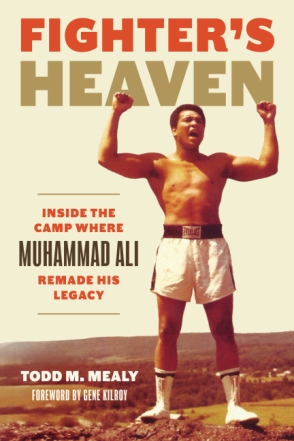
Fighter’s Heaven
Inside the Camp Where Muhammad Ali Remade His Legacy
Todd M. Mealy, Foreword by Gene Kilroy
Fighter’s Heaven
Inside the Camp Where Muhammad Ali Remade His Legacy
Todd M. Mealy, Foreword by Gene Kilroy
“I had thought I knew everything about Muhammad Ali’s life and times. How wrong I was. Todd Mealy’s depiction of the Deer Lake camp, aka ‘Fighter’s Heaven,’ paints a picture of Ali we haven’t seen before. It roots Ali in a time and place when he wasn’t in front of the cameras and had the space to be himself. This book is an utter triumph and a must-read for people who think they know the life and times of the champ. We actually did not know the rest of the story and the rest of the man until now. It makes us feel like we are seeing Ali as a three-dimensional human being for the first time, and, in my eyes, this only burnishes his reputation as ‘the greatest.’ Thank you, Todd Mealy.”
- Description
- Reviews
- Bio
- Table of Contents
- Sample Chapters
- Subjects
In 1972, Ali built a training camp in the mountains of Pennsylvania, a rustic compound he named Fighter’s Heaven. There he prepared for some of the most consequential bouts of his career, ultimately reclaiming the heavyweight title twice. Yet the camp was more than a training ground. It became a sanctuary—a place where children gathered, celebrities visited, activists strategized, and Ali explored business ventures and political commitments. Within its cabins and along its wooded trails, Ali did not just refine his boxing technique; he cultivated a generous and deeply human persona that captivated the world.
Fighter’s Heaven retraces Ali’s footsteps through this extraordinary place, revealing how a secluded mountain retreat became the staging ground for his comeback and the foundation of his enduring legacy. Drawing on personal letters, memoirs, and new interviews with those who knew Ali best, historian Todd M. Mealy offers an intimate, behind-the-scenes portrait of Ali during these pivotal years that shaped one of the most transcendent figures of the twentieth century.
“I had thought I knew everything about Muhammad Ali’s life and times. How wrong I was. Todd Mealy’s depiction of the Deer Lake camp, aka ‘Fighter’s Heaven,’ paints a picture of Ali we haven’t seen before. It roots Ali in a time and place when he wasn’t in front of the cameras and had the space to be himself. This book is an utter triumph and a must-read for people who think they know the life and times of the champ. We actually did not know the rest of the story and the rest of the man until now. It makes us feel like we are seeing Ali as a three-dimensional human being for the first time, and, in my eyes, this only burnishes his reputation as ‘the greatest.’ Thank you, Todd Mealy.”
“The most important and original book about Muhammad Ali’s life to appear in years. In Fighter’s Heaven, Todd M. Mealy takes readers on an eye-opening tour of Ali’s training camp, a place filled with larger-than-life characters engaged in activities that defy the imagination. At the center of it all is American’s greatest legend, Ali, who is brought vividly to life in this well-written and impeccably researched account. Even hardcore Ali fans will find troves of new information. Mealy has helped complete an important and overlooked chapter of Ali’s endlessly fascinating life.”
“Fighter’s Heaven wasn’t just a training camp; it was a sanctuary, a village, and a movement. Mealy reveals the mountain’s heartbeat and Ali’s humanity, proving he was the greatest not only in the ring, but in spirit.”
“In Fighter’s Heaven: Inside the Camp Where Muhammad Alli Remade His Legacy, Todd M. Mealy provides a compelling, deeply-reported, portrait of the most famous, and often mythologized, training compound in boxing history. Mealy preserves this history via a big, complex, and memorable exploration of the land, layout, and personal relationships that served as the backdrop to some of Ali’s most important fights. Mealy’s book is a must-read for Ali aficionados.”
Todd M. Mealy is a historian, educator, and author of thirteen books, including Shades of Brown: The Biography of Jane Elliot and the Blue Eyes, Brown Eyes Exercise. He is also the founder of the National Institute for Customizing Education and curriculum writer for the Dr. Martin Luther King Jr. Center for Nonviolent Social Change.
List of Illustrations
Foreword by Gene Kilroy
Author’s Note
Acknowledgments
Introduction
PART 1: THE MINK FARM
1. “I Don’t Need to Train to Beat Bums Like Him”
2. “I Need to Get Myself a Training Camp”
3. The Furrier
4. “The Mountain Air Is Good Here”
5. “He Has Fallen in Love with Trees”
PART 2: MUHAMMAD ALI’S TRAINING CAMP
6. Muhammad’s Mountain
7. Fisticana
8. The Ken Norton Roast
PART 3: FIGHTER’S HEAVEN
9. “I Ain’t Comin’ Out of These Mountains”
10. “Come Up on My Mountain”
11. “My Own Fountain of Youth”
12. The Ghetto Whopper
13. Rope- a- Dope
14. “I’m Not in the Best Shape”
15. The Ali Gang
16. Most Accessible Superstar in Sports
17. “The Spirit’s on the Mountain”
PART 4: FIGHTERS’ PARADISE
18. “A House Up Here for Everybody but God”
19. The Third Coming
20. Magic
PART 5: AFTER ALI
21. “I Retire Myself ”
22. Home of Champions
Coda
Appendix: Muhammad Ali’s Training at Deer Lake—
Fights and Duration, 1972–1981
Notes
Selected Bibliography
Index
FOREWORD
Gene Kilroy
My first encounter with Muhammad Ali was during the 1960 Olympics in Rome. At the time, I was stationed in Munich with the Twenty-Fourth Division, assigned the mundane task of signing pay vouchers and passes for servicemen competing in the games. It was through that job that I met a brash teenage fighter named Cassius Clay.
One of our earliest moments together has stayed with me all these years. Someone came up to him asking for money. Clay had only $8 in his pocket. He handed the man five. I looked at him like he was crazy. “Why would you do that?” I asked. He told me, “Gene, what I did was from my heart. So if he was lying, he’ll have to answer to God.”
That was Clay—later, Muhammad Ali. Always generous, always larger than life, and always living by the mantra that service to others is the rent one pays here on earth.
After Rome, my path took me into professional football with the Philadelphia Eagles, while Ali’s took him to the top of the boxing world. But destiny has a way of circling back. Years later, I found myself not only his business manager but also one of the five or six men he truly trusted. I became part of what people called Ali’s inner circle. He once told me, “Friendship is a misused word. A lot of people say they’re your friend, but they really aren’t.” I’m proud to say that I was Ali’s friend. Not a hanger-on. Not a business deal. A friend.
That friendship was built on a mountainside in Schuylkill County, Pennsylvania.
In 1972, I convinced Ali to build his training camp not far from my boyhood home in Mahanoy City. The land itself came through the Pollack family, led by Bernie Pollack, a mink rancher and boxing aficionado. There was a bidding war among local entrepreneurs to convince Ali to buy their land for the camp. While Bernie was determined, what sealed the deal was his son, David Pollack. Ali and I both saw David as an upstanding young man, and that mattered to us. David helped make everything hap-pen, and I couldn’t thank him enough. The love David had for his father was remarkable, and every son should respect his dad the way David did. It impressed me deeply, and it impressed Ali, too.
The boxing compound Ali created became known as Fighter’s Heaven. It was more than a training camp. Fighter’s Heaven was a home, a stage, and a headquarters for Ali’s service to the world. For eight years, until 1980, it was the center of his boxing life, where he prepared for bouts with Joe Frazier, George Foreman, Ken Norton, Earnie Shavers, and Larry Holmes.
I also helped him understand how tax write-offs could apply when he ran the camp as a boxing facility. That little lesson taught him something about taxes and finances, and, as you’ll read in this book, he picked up practical lessons about using the camp as a business long after his fights in the ring ended.
But the great thing about the camp wasn’t just the training. It was also the peace. The cabins. The mountain air. The neighborhood kids who wandered in to watch him train and left with autographs and stories for a lifetime. Celebrities, athletes, actors, singers. Some visited out of curiosity; others were drawn by Ali’s gravitational pull.
I was there for it all. I watched him run through the woods at dawn. I heard him recite poetry in front of the kitchen cabin. I saw him talk to one more child, sign one more autograph, pose for one more picture, tell one more joke, perform one more magic trick. I saw him tired, aching, but never turning anyone away. That was Ali.
To understand the man, you have to understand that place.
Most fans know Ali from the bright lights of Madison Square Gar-den, the Rumble in the Jungle, the Thrilla in Manila. They know his fast hands, quick tongue, bold predictions. They know the controversies—the draft, the exile, the comebacks.
Fewer know the Ali I saw at Fighter’s Heaven. The Ali who, once the crowds left, sat quietly in his cabin or in the mosque he’d built at the com-pound. The Ali who would beam while performing a magic trick for local kids. The Ali who prayed daily, cared deeply about people, and gave away money he couldn’t spare.That’s why this book you’re holding matters.
Over the years, many have written about my friend. Some captured his boxing brilliance. Some captured his politics. Some captured his celebrity. But very few have truly captured the soul of the man. Few know what Ali was like when the cameras weren’t rolling.
Todd M. Mealy does.
I’ve seen plenty of writers attempt to explain Ali. Most come close, but they miss something. They miss the quiet. They miss the way Ali’s eyes lit up when the children visited him in Deer Lake. They miss how much that camp meant to him, and how much it meant to all of us who were there.
Mealy hasn’t missed it. He has written a book that shows Ali through the lens of Fighter’s Heaven. It’s a pure, clear lens, one that most biog-raphers overlooked because they were chasing the big fights or the big headlines. But Ali wasn’t just made in Madison Square Garden or the Superdome or Kinshasa or Manila. He was made, too, in those rural cab-ins, in those runs up the mountain, in those evenings when the stars came out over Schuylkill County.
What Mealy has produced here is authentic scholarship. He’s treated the camp with the seriousness of a historian but the heart of someone who understands what it meant to all of us. He’s gone beyond the stories you’ve heard before. He’s pulled from archives, newspapers, and, yes, from voices like mine to re-create the world we lived in then.
For me, this book is a walk back into the camp itself—reading it, I can smell the woodsmoke, hear the jump ropes snapping against the floor, see Ali sitting outside his gym, holding court. It’s all here.
I don’t hand out praise lightly. I’ve read a lot of books on Ali, and more than a few have left me shaking my head. But this one deserves your time. It honors the champ, not by repeating what everyone already knows but by showing what only a few of us ever saw.
Before I finish, I want to tell you one more story about someone who’s played a big part in keeping Muhammad Ali’s memory alive.
In 1980, I was serving as executive assistant to the chairman of the Dunes Hotel in Las Vegas. One weekend, I was hosting Ali and Sugar Ray Robinson. We ducked into a coffee shop for breakfast and in walked John Madden. He wasn’t coaching anymore. He had retired in 1979 and was just beginning his broadcasting career with CBS, where his color commentary work would soon make him famous. Ali and Sugar Ray wanted to talk football, but Madden, who was obsessed with boxing and had idolized Sugar Ray, impressed them with how much he knew about boxing history. After breakfast, I snapped a picture of the three of them together.
The next day, a young man who looked like a teenager approached me. “Excuse me,” he said, “my name is Mike Madden. You met my dad yesterday.” I still remember thinking what a classy kid he was. Years later, in 2016, just days after Ali passed, Mike called me. He had bought Ali’s old training camp in Deer Lake. That meeting back in 1980, I truly believe, planted the seed for his buying the camp to preserve Ali’s legacy.
The camp was Ali’s own creation. It was the biggest thing to keep the name of Muhammad Ali alive. He believed in an old Chinese proverb: “You’re never dead as long as your name is remembered.” Mike Madden, by purchasing and restoring Fighter’s Heaven to how it looked in the 1970s, and Todd M. Mealy, by writing this book, have gone miles toward preserving Ali’s legacy. Just as the camp was all his, every effort to keep its memory alive helps keep Ali alive.
There was a moment in 1974 when Ali and I slipped away from train-ing to visit the burial site of Jim Thorpe. After looking at Thorpe’s grave, he turned to me and said, “When I die, I want to be buried at my training camp.” That wish never came true. But not long before his death, I joked that I might kidnap him, just like the old days back at Deer Lake. His eyes lit up and he said, “When? When?” I believe that’s what he was thinking. For eight years on that mountainside, I saw Ali up close as a champion and as a man. And I can tell you without hesitation that the book you are about to read is the closest anyone has ever come to capturing both sides of him.
So, on behalf of the champ I loved and the friend I was blessed to have, I give you this book. Read it carefully. Read it with your heart open. Because in these pages you’ll find not just Muhammad Ali but the training camp he built, the place that was all his. His Fighter’s Heaven.
Also of Interest
Mailing List
Subscribe to our mailing list and be notified about new titles, journals and catalogs.